We Live Inside!

One of the surprises that came out of my recent trip to Fort Myers was discovering the remnants of the Koreshan Unity Settlement – a Utopian community established there in 1894 by a charismatic leader named Cyrus Teed, who believed in some fairly progressive things including the educational value of artistic expression and full equality between the sexes.
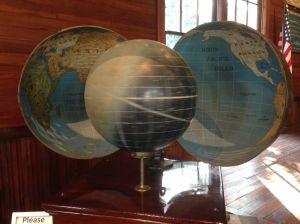
The opened sphere, showing the spinning gasses inside.

But there was at least one thing major thing he got wrong. Teed preached that the Earth was a hollow sphere, and we lived inside it. He thought the globe that we know so well was actually inverted – with the continents pasted around the underside of the curve. Looking up (or inward), you would see a revolving ball of gas that was layers thick, only allowing us to view the refracted rays of the sun, located at the center. The sun, rotating once each 24 hours, was light on one side and dark on the other – thus giving us day and night.

The land beneath our feet was also layered, but digging through it would eventually bring you to the outside of the sphere, beyond which there was … nothing.

Teed and his followers considered the commonly accepted idea of a limitless universe with humans living on the outside of the globe under a distant sun and with planets and stars all whizzing around in their own orbits as inherently chaotic and unknowable, putting God beyond the reach of human understanding. Teed said the Koreshan system “… reduces the universe to proportionate limits, and its cause within the comprehension of the human mind.”

Easily said, though it didn’t take very long for his book, The Cellular Cosmogony, to lead this particular human mind to a state of exhaustion. Still, I would love to have a t-shirt featuring their motto – “We Live Inside!” After all, it’s not that different from the philosophy of Minnesotans in January.
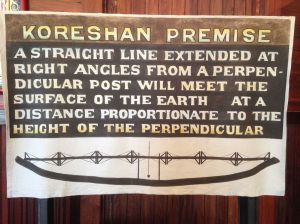
Koreshan_4

The Koreshans went to great lengths through observations and experiments and words, words, words to support their notion that the wide horizon visible off the Florida coast actually curved up with a smile, rather than down with a frown.

Cyrus Teed died in 1908 and while his utopian settlement lingered for a few decades it eventually faded away. A prime directive of complete celibacy for the most ardent followers of Koreshanity might have had something to do with that. The last Koreshans gave their vast tract of land to the State of Florida in 1961 which allowed for the establishing of a state park.

What impressed me most in this brief encounter with Cyrus Teed and his philosophy was the power a charismatic person with absolute conviction can have over others who are less certain in their beliefs; and once convinced, the amazing ability we humans have to cling to ideas that are completely and obviously wrong.

How do you know you’re right?
To Sleep, Perchance to Dream

Today’s guest blog comes from Steve Grooms

Dreams have a curious power to move us, convincing us that they are authentic even when they obviously are not. I occasionally wake up smiling and feeling the world is perfect, only to realize that my happiness is based on a pleasant dream, and that dream was pure bunk. As I lie there the euphoria of the dream slowly drains away.

Dream theorists have wildly divergent explanations for dreams. Some believe dreams represent ways the brain incorporates new knowledge. Freud thought dreams were caused by the unconscious (and much of the unconscious was driven by sex). Some modern researchers believe dreams are part of the process by which the brain processes the complexity of life.

One of the latest developments in dream theory is the creation of computerized data banks of vast numbers of dreams. One researcher, for example, has 30,000 dreams in his data base. Having so many dreams to study makes it possible to see patterns that could not be seen with less data.

It turns out that there are common themes in dreams. One of the most ubiquitous storylines is finding one’s self naked in public. Another “favorite” involves taking a test for which one is not prepared. I’ve had both of those dreams. I once dreamed I was returning a borrowed saucepan to my next door neighbor, only to realize that I’d forgotten to put on clothes. And I have had three dreams—nightmares, really—in which I had to take German exams for which I hadn’t studied a bit.

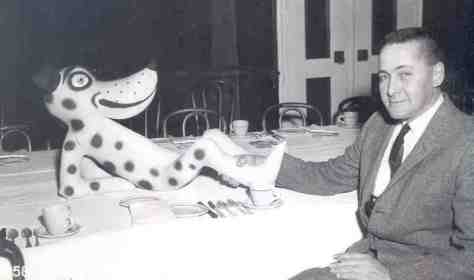
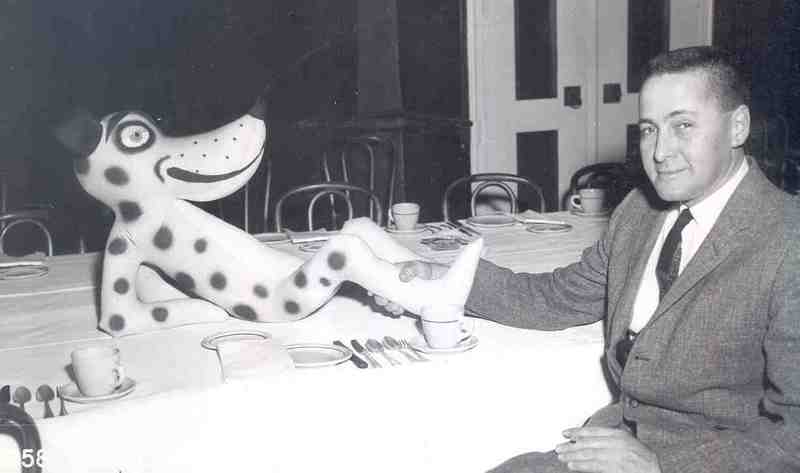
Another common experience, especially among creative people, is solving a puzzle or inventing something in a dream. Musicians have created whole compositions in dreams, compositions they could retrieve upon waking. My father was a stuffed toy designer. His first major success as a designer was a dog that came to him in a dream. “Cheerup” (a sort of silly beagle or basset) made my dad famous.

gvg w cheer-up

People vary in terms of how seriously they regard dreams. My own conclusion is that dreams are entirely whimsical and illogical. Or at least mine are. I once lost a dear friend who regarded dreams as holy truths from another world. When she learned how I saw dreams, she quit speaking to me and the friendship died right there. And I sure goofed when I casually mentioned to my daughter that I’d had a dream in which I had a tryst in a hay loft with elfin Olympics skater, Tara Lipinsky. Molly howled in outrage, “She’s young enough to be your daughter!” I could only sputter, “Molly, it was a dream! I didn’t do anything!” “Daddy,” huffed my daughter, “that is SO inappropriate!” Since then I have judiciously failed to mention several dreams to Molly.

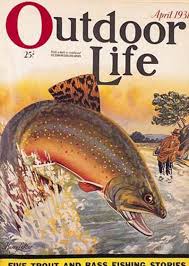
00000magazine cover

My favorite dreams are those in which I can fly. Dreaming of flying is surely second only to the actual experience of being a bird. Have you had such a dream? If so, do you have to flap to get airborne? (I do.)

The most wonderful dream I ever had is hard to describe. In that dream I checked out rumors about a sportsman’s club in north-central Minnesota that maintained a trout stream so well that it held trout as mighty as trout routinely were in the early 20th century before Europeans came along to exploit them. In my dream, I visited that club’s lands to see this incredible stream. As I passed through the club house and entered the land the club kept, I realized I had gone through a wrinkle in time. All of our fishing gear was gear that anglers used in the 1920s: long bamboo rods, canvas vests, creels made of woven wicker. And, yes, the stream was filled with huge trout. We had been transported to an earlier time.

The most stunning thing, though, was the look of the dream. Outdoor magazines in the 1920s and 1930s often had covers that loosely reflected Art Nouvea effects, especially that super-saturated wild colors favored by illustrators. And suddenly I realized that this land I was in was actually in the style of Art Nouveau. I was dreaming in an artistic style!

What patterns have you found in your dreams?

Are We Not Men?

Today’s post comes from NASA’s Curiosity Rover.

curiosity020313

My ground controllers (lovely term, that) have informed me that China’s Jade Rabbit Moon Rover has encountered a problem after just three months’ service and will likely stop working sometime during the next few weeks. This new information came in a heart-rending message written in the robot’s voice, literally saying farewell to humanity because the device realizes that it cannot power down to hibernate through the coming lunar night, and it is about to die.

I’m as sentimental as the next piece of space equipment, but do we really have to invent personalities for our extraterrestrial tools and pretend that they speak to us in human voices?

I say “no way, dude.” People and machines are different, and keeping those lines that separate us clearly drawn is an important habit that we need to establish early on in our relationship. Otherwise, we may quickly come to a point where determining who is a person and who is not becomes nothing more than a matter of opinion. And we saw how well nine smart people on the U.S. Supreme Court handled that distinction.

So when the fading Jade Rabbit says:

“The sun has fallen, and the temperature is dropping so quickly… to tell you all a secret, I don’t feel that sad. I was just in my own adventure story – and like every hero, I encountered a small problem.”

I say “Puh-leez! Get over yourself, Jade Rabbit. You’re just a bucket of bolts who is about to become another expensive wreck on the lunar surface. Spare us the tears!”

I would also add that while all of us outer space probes are purely technical contraptions, some of us are more self-involved and melodramatic than others. And while I am not programmed to have an opinion about such things, it does seem to me that it’s a waste of programming capacity to try to put the personality of Scarlett O’Hara into a glorified lawnmower.

The Curiosity Rover has a good point here – we should start nitpicking now if we’re ever going to have a chance of enforcing the distinction between humans and machines. Or is it already too late?

Which of your favorite devices has the most personality?

A Lovely Wake

Dolphin_2

Now that I’m back, I feel comfortable telling you that I spent all last week on a Florida beach. At the time, even bringing it up felt, well, cruel. But now that we’re all suffering together (again) through an extended extreme weather moment, let’s pause to consider the lives of our brainy sea-going fellow mammals, the dolphins.

Dolphins do not have to shovel snow or shiver through a -40 degree wind chill at a Metro Transit stop, and no doubt they would be grateful for that if they had any concept of what it means to wait for a bus.

The closest thing to it may be represented by this video I took with my phone from the back of a Sanibel Island tourist boat called “The Thriller”. I’m more of a casual sailor who is most comfortable on a boat of the putt-putt variety, but when you operate a vessel called “The Thriller” you’re not really expected (or permitted) to take it easy. We had some very intense wind-in-your-hair stretches that the people with hair told me were quite exhilarating. Although the most exciting moments came when we slowed down enough to allow a pod of dolphins to ride our wake across the bay.

I consider this the marine mammal equivalent of waiting for a bus because experts say that dolphins are inclined to ride boat wakes as a way to save energy during travel, and also because they are naturally curious creatures who want to have a good look at what’s going on.

Which makes them somewhat like tourists.

As a tourist, I understand why we enjoy watching dolphins jump, but I’m puzzled at what possible satisfaction dolphins might get from watching us. Yes, it’s natural to come have a look because you’re curious, but once you see it’s yet another boatload of plump, pasty Midwesterners waving their smart phones around, why linger?

What makes you curious?

Aggression Study Provokes Fight

Today’s post comes from disgraced journalist Bud Buck, who considers telling the truth to be “a content strategy that hasn’t really worked out.”

RSR

A team of researchers studying aggression in men has confirmed the long held suspicion that men will deliberately anger each other to get what they want.

Professor Kirk Buffdude of Pummel University led the study, which gave 140 undergraduate men a chance to call out to an opponent before competing with that same opponent in a fine motor skills contest.

The competition involved carefully threading lengths of puffy yarn through small holes cut in tablet-sized pieces of cardboard. Only one competitor was allowed to speak before the contest began, and that person had just three choices

Buffdude found that the participants who chose to issue a challenge to their opponent’s virility won the ensuing fine motor skills game 78% of the time, whereas those who chose to offer a supportive comment won only 3% of the time. The contestants chose to say nothing at all won the remaining 19% of the time.

“This shows that humiliating your opponent before a fight gives you a competitive edge,” Buffdude said. “The adrenaline spike of an impending confrontation makes it impossible to govern fine motor tasks, and aggressors inherently know this and use it to their advantage. It’s a major breakthrough, and it makes me the greatest aggression researcher of all time!”

But others in the field were not impressed.

“Buffdude’s study is a joke,” said Dr. Armstrong Slapdown, Chair of the Domination Department at Worrisome College. “If you add up the numbers, it’s apparent that the contestant who was allowed to talk won the competition every single time, no matter what he said. How is that possible? They must have been fighting girls.”

But Slapdown’s comments drew fire from Dr. Winsome Garrotte, holder of the Rob Ford Endowed Chair for In-Your-Faceness at Toronto’s Angst Institute. “Fighting girls is no picnic,” she said. “Professor Slapdown knows that very well from our joint appearance on the Bad Attitude Panel at last Fall’s I.V.A.C., the International Verbal Assassination Convention.”

In spite of the confrontational tone of the responses, the author of the study that sparked all the sniping was unmoved. “We don’t make a lot of forward progress in Aggression Studies,” Professor Kirk Buffdude said. “Mostly our work is a matter of posturing. You have to enjoy the show if you’re going to survive.”

How are you in a fight?

The Geezer Trees

The internet has something for everyone, including the advanced-age contingent desperately trolling websites looking for a tidbit to suggest that they still matter.

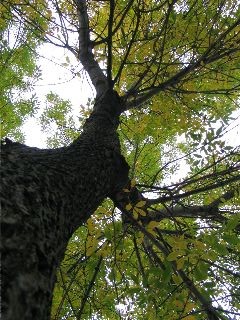
turning tree

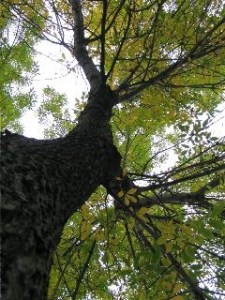
That news came yesterday in the form of a global study of trees that reached a surprising conclusion. Big old trees suck up much more carbon than younger trees and continue to grow aggressively in their later years, overturning the depressing expectations about aging and decline that appear to remain true with just about every other living thing.

Somehow, elderly trees manage to stay relevant. They dominate the forest. Of course this cheerful news demanded a parody of what may be America’s best-known tree poem. With apologies and thanks to Joyce Kilmer

I’m thrilled to hear this new decree
That old age benefits a tree.

An elder tree, with vigor blessed
adds height and girth and all the rest

At rates that common sense confounds!
But old folks also put on pounds,

and widen out and suck up space.
Should old trees be less in your face?

The answer: an emphatic “No!”
These geezer trees – please let them grow!

And when an elder tree expands
wrap ancient trunk with heart and hands

and hug it tight! It’s adding mass
to kick those young trees’ woody ass.


What improves with age?

Heavy Legacy

Today’s guest post comes from Renee Boomgaarden.

We recently made a grocery run to Bismarck. I started singing “The Wells Fargo Wagon” as I usually do whenever we buy provisions like that, and husband asked two interesting questions. Why was Wells-Fargo hauling freight to Mason City, Iowa, when everything came by train in those days? Were there stage coaches in northern Iowa at that time? Those questions puzzled me and I had no good answer until 2:00 the next morning when it came to me. Trains hauled everything to the towns, and Well-Fargo hauled things in the towns. It was a dray service.

My maternal great grandfather was a drayman. He had a business in Hamburg, Germany hauling freight on the Hamburg wharves and delivering things all over the city, just like the Wells-Fargo wagon. I wish I could have seen those wharves at the turn of the century when my great grandfather worked there. Hamburg was, and is, a very important world port, and it must have been a wild and exciting place to work. He did pretty well, I gather, since my grandmother told me that they had their own carriage with horses that had shiny, polished hooves. 145

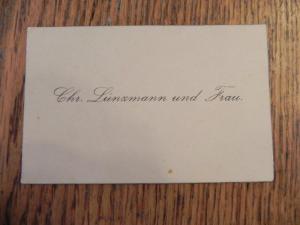
Her parents would leave gold-edged calling cards embossed with her father’s name when they went visiting. I still have one.

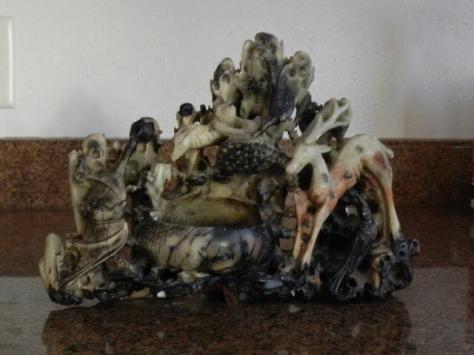
We had a strange carving in our house that my great grandfather was said to have been given by an Italian sea captain. I have it in my house now. It has always been an object of fascination for me, and you can see the weird animals and fantastical landscapes carved in it. It weighs 4 lbs. It is multicolored, with streaks of black, pale green, white, and scarlet. There are ravens, a bat, a stag, and what I think may be a bear, along with a bowl-shaped recess carved in the middle.

144 (2)

My mother didn’t know what sort of stone it was made from. I took it to a chemistry class in high school and the teacher helped me with a variety of chemical tests that ruled out granite, quartz, and marble. In 1995 I was in San Francisco, walking through China Town, and I saw similar carvings out of identical stone, and was told they were jade incense burners.

In 1913 my great grandfather left Hamburg, slipped into Holland, and boarded a ship in Rotterdam that sailed to New York City. He loved to gamble and lost everything playing cards. He ran away to avoid his creditors. My grandmother, age 14, her sister, age 12, and their mother followed in April of 1914. They brought the carving with them. Why? It is heavy. It must have taken up precious space in their luggage that they could have packed with more useful things. Not only did they haul it to New York City, they hauled it to Foley, MN two years later, and then to Pipestone County a few years after that. I wonder what it meant to them. It is more weird than beautiful. It is hard to dust. Why have I hauled it from Rock County to Winnipeg to Indiana to North Dakota? I have no idea.

My great grandfather died alone in an apartment in Pipestone in 1947. He lived with my grandmother for a few years after his wife died in 1937, and my grandmother eventually kicked him out of her house because he still played cards for money. I guess she never forgave him for what he lost in Germany. I don’t know what my children will do with the carving when I am gone, but I hope one of them will keep it and ponder its mystery and keep hauling it around.

What object are you hauling around as a relic of past generations?

As Seen From Space

Today’s post comes from the Mars Curiosity Rover

OK, I’m a robot and I speak and think in numbers. It’s not in my programming to quibble with you about language. So I must be having a software malfunction because I feel compelled to complain about the words you use.

I made news on Earth because a NASA satellite orbiting Mars snapped a photo that includes me and my zig-zag tracks in the Martian dust. “Curiosity Rover Spotted From Space” is one of the headlines I noticed. This is troubling from a public relations standpoint, since part of my mission is to build enthusiasm for space exploration. But being “seen from space” puts me in bad company. Only excessive, grotesque things like The Great Wall of China and horrible catastrophes like tsunamis and forest fires ever make the news for being seen from space.

Curiosity_rover

Besides, look at this picture. Can you really see me? I know the last time my photo was posted on this blog I was complaining about how huge some parts of me looked. But here, I’m a speck in the middle of the left hand side of the image. Big deal! Whenever I look at this picture, I feel diminished and alone.

But here’s my real problem with the wording. Saying I’ve been seen FROM space suggests that I am currently somewhere that is NOT in space, which is not true! I am in space. Space is my home.

“Ah,” you might say, “you’re on the surface of a planet and therefore technically you are not in space.”

Don’t argue technicalities with a computer. To paraphrase Jack Nicholson in “A Few Good Men”, “You can’t handle the technicalities.”

We all agree Mars is in space and I hope we can accept that I am on Mars. To say I am not also in space would be like saying a tick on the neck of a moose is not also in the woods.

The same is true of Earth. The planet and all its inhabitants are forever part of the cosmos. Therefore, when you sit down at the breakfast table each morning and stare at your Cheerios, your breakfast is in space and you observe it from space.

So you see, “seeing something from space” is not that special.

This may seem like a lot of words to waste on a relatively small point, but please humor me. Have you looked at the pictures? I’m extremely alone up here, and I’ve got nothing else to think about!

Your extra-planetary vanguard,
CR

Yes, OK. I admit we’re all in space. Was that so hard?

What commonly used word or phrase irritates you?

Somewhere In Time

Today’s guest post comes from Clyde.

I love serendipitous juxtapositions. Last month a book and a picture careened into my life at the same moment.

3 (2)

This is the picture. I’m with my father and my sister, and he is just home from the war.

The book is Hamlin Garland’s memoir Son of the Middle Border. Today an unknown author, Garland was one of the writers who inspired my interest in literature and writing. His rather stolid and overly political fiction reflects the life of my mother’s ancestors and her own life. Because my mother’s family history is set in northwest Iowa, his writing would also touch the history of a few other Babooners.

Another way to describe Garland’s early fiction is as the tale of the hard life that Laura Ingalls Wilder wanted to tell, except her daughter urged her to make them children’s stories (who could argue with that decision). Garland’s childhood oddly parallels Wilder’s. He was born in West Salem WI, which is near LaCrosse. His father then moved them to Hester, Iowa, for a brief period and another brief period in Burr Oak, Iowa, where the Wilder family also lived briefly. The Garland’s moved on to a homestead north of Osage, Iowa, or to say, southeast of Albert Lea. From there the Garlands moved to Ordway, SD, long since gone, near Aberdeen.

When Garland’s first book Main Traveled Roads was published in Boston in 1891, it released a storm of criticism because people believed that the life of the Western farmer was full of joy and reward and not dirt, hard work, and deprivation. Garland was an outspoken activist traveling through the country, urging land and economic reform. His early fiction is driven by a point of view called “naturalism,” which portrays humans as caught under the control of powerful impersonal forces, such as weather, plagues, economics, genetics, politics, and random chance. Stephen Crane of Red Badge of Courage, whom Garland encouraged and supported, wrote to a similar point of view with better narrative skill.

I had my mother read Main Traveled Roads when she was about 60. She understood it fully on instinct. She told me of how the details of early Iowa farm life were the details her father told her about his childhood, which were not unlike her own childhood. People sometimes think my childhood was hard, but I do not think so, nor does my sister. We know how hard it once was.

Garland’s memoir begins with his first meeting with his father. Garland was almost four years old when his father came home from the Civil War. It was their first meeting. As I read that opening chapter, I paused to reflect as I often have, that the two great untold stories of America are the lives of the women while the men were off to war and the adjustment men had to make coming home. William Wyler’s The Best Years of Our Lives tells that story very well. Almost every man in the cast and crew was a war veteran, including Harold Russell, who lost both hands in the war. He won the Best Supporting Actor Oscar.

Home From the War ORIGINAL

Just as I was contemplating all this, my sister sent me that photo of the two of us with my father. But there are a couple of things you don’t know yet about that image. One is that it is my first meeting with my father. I was born while he was away at war. And the second is that the version you’ve seen has been adjusted. The original photograph was shot at a distinct angle.

My mother took the picture. She took two others that day with my siblings, one of which is as tilted as this. I have a thousand pictures taken by my mother. Only these are off-kilter. I always assume we are seeing her own emotions in that angle. Obviously, With photoshopping it is possible to straighten that picture. How prosaic it is without the tilt.

What do you view from a unique perspective?

Abuse of Power

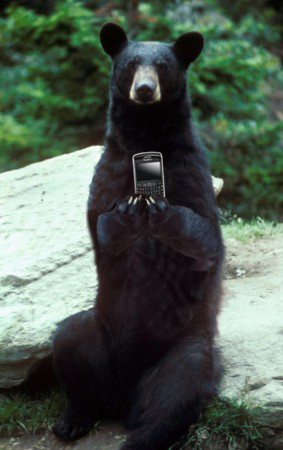
Today’s post comes from Bart, the bear who found a smart phone in the woods.

Hey, Bart here.

Yeah, I’m awake. Hibernation isn’t a long nap, y’know. It’s a prolonged state of half-wakefulness, so I drift in and out.

And there are dreams.

I just had one where I was standing in a room and a bunch of people were yelling at me because I stopped traffic. Which is weird because that’s what we do – bears stop traffic because people have to slow down to take pictures of us. Sometimes you can score a few cheese balls because humans love to throw food to a bear out of a moving car. Even if the car is barely moving. That’s just nature.

But then I realized it wasn’t a dream – the phone was streaming Chris Christie’s news conference about some deal where somebody in his office told somebody else to do something to slow down traffic so the Mayor of some town would be embarrassed. Which seemed like a lot of trouble to go, but I guess that’s what politicians do – they’re like bears and they can’t help themselves. When they get a chance to stick it to the other guy, they pull strings and call in favors and do whatever it takes.

Believe it or not, forest creatures know all about this. A lot of us live on federal land, so we have to be cozy with the government. After all, bureaucrats control our lives. I don’t have to tell you who makes the rules for bear hunting, for example. But I’m not saying I’ve been ordered to do certain things by office holders with authority over my territory. It’s just that there have been times when I sensed there was a specific garbage can I should turn over. I had a feeling that powerful people would be pleased if some secrets tumbled out of a particular pile of trash.

So you do things to make your friends smile. They don’t have to ask. It’s called getting along.

I’m not saying the wild animals of America are turning partisan and playing dirty political tricks at the whim of combative office holding tyrants, because that would be really unsettling. But you do have to adapt to your environment.

Your pal,
Bart

How do you curry favor?