“I scream . You scream. We all scream for ice cream.”
Proust may have had his madelines, but my sweetest taste memories melt together with ice cream in the bottom of a dish. How many spoonfuls before it’s all gone?
1) My Manhattan grandmother lived across from a playground where a formally dressed Good Humor man stood with his push cart. I still remember the combined taste of wooden spoon and chocolate ice cream from a cup.
2) My other grandmother would take us to Coney Island for dizzying rides and real frozen custard. I chose based on color-often picking pistachio because of its electric green hue.
3) Back in the city we’d go to Broadway matinees and afterwards a stop at Schrafft’s for Black and White parfaits with rich whipped cream complementing the hot fudge and the always vanilla ice cream.
4) Did anybody else go to Farrell’s? My clearest member of the overly enthusiastic, piano player, straw boater, parlor was the trough of ice cream you could get to share with your friends.
5) I babysat for a little boy who spent most of his childhood in a hospital. Every time I took him to Baskin Robbins he chose orange sherbet from all 31 flavors.
6) There was a place in the suburbs of DC where the whipped cream was pink, yellow, and green and all the sundaes were named after memorials. We never ordered the Washington Monument. The sundae was too tall for us.
7) College in Boston brought ice cream options previously unexplored. Saturday lunch in Harvard Square was often a hot fudge sundae at Bailey’s. The ice cream was on a pedestal with low sides and the hot fudge dripped onto the plate with the melting ice cream.
8) Even more amazing was Steve’s, the first shop to churn its own ice cream and allow you to mix in fruit, candy, etc to customize your flavor. The process was slow and even in the winter the lines stretched outside. Still, we came and gloried in making our own sensational flavors.
9) Minnesota introduced me to buckets of ice cream, the Schwann’s man, and malts at the State Fair.
10) I was runner-up in a Kemps contest to design a Minnesota ice cream flavor. They never made Gopher Tornado, but the ribbons of raspberry and pineapple together with the rich ice cream would have delighted me.
11) Kemp’s has a new contest. This time my entry is for Mini donut ice cream. If that isn’t memorable enough for you, make up your own flavor before June 12th.
How many spoonfuls of ice cream are in your memory?
My artistic friend Sue has no difficulty describing the earliest memory of her life. Sue remembers looking through the bars of her crib at flowers on the bedroom wall. The wallpaper flowers were “funny,” she recalls–lumpy things with ugly colors. Such deformed flowers could only be somebody’s idea of a joke, and Sue laughed out loud. She had seen real flowers, so elegantly formed and suffused with vivid color, while these ugly blobs were nothing like that. By working with old photos and family lore, Sue has dated that memory to a time she was two or three years old.
Some folks simply cannot retrieve early memories. A friend once told me he has no memory—no memory whatsoever—of anything before his last years of high school. I find that spooky. Most people remember events from when they were four or five. One of my friends insists she has a clear memory from when she was two. I’m skeptical, and yet I don’t rule it out. Scientists tell us that children have memories from their earliest years, but as they age children lose those first memories, replacing them with later ones.
When my daughter Molly was a toddler, her daycare mom, Julie, talked with her about a woman who lived nearby. Julie once took her daycare class to visit that neighbor, and she mentioned this when Molly was about three. “I know,” said tiny Molly. “Her dog is Samson.” Julie was gobsmacked. When Julie took Molly to the neighbor’s, Molly was an infant, so young she hadn’t begun talking, and yet she remembered Samson. Molly no longer has that memory.
My earliest memory was set in the upper half of an old duplex in Manchester, Iowa,where my mother, my sister and I lived during WW II. The duplex where Steve’s family lived during the war – the scene of the very first memoryI was two or three years old at the time, most likely three. My mother was using a metal key to wind the strange little cuckoo clock in our living room. The clock had a pendulum and a fat painted bluebird that wagged left and right.
“Where’s Daddy?”
“He’s at The War, Stevie. Daddy is a soldier and he is at The War.”
“Why doesn’t he come home?”
“He has to be a soldier now.”
“I miss my Daddy.”
“He’ll be home after The War.” ”But when?”
This is the exact spot along the Maquoqueta River where Steve caught his first fish.
That memory surely predates my recollection of catching my first fish. My father is part of this memory, so he must have been on leave or (more likely) this happened in 1945, shortly after he came home from Japan. Our family was enjoying a summer day in Tirrill Park in Manchester. The park is bordered on the west side by the Maquoqueta River. My father set me up with a fishing rod, baiting my hook with a worm. Against his repeated instructions, I walked up and down the bank rather than sticking to one spot. Then I caught a fish, a white crappie. Several years ago I returned to Tirrill Park while researching the book I was writing about my parents. With no effort I walked to the spot where I caught the crappie.
It is harder to describe the time my grandfather bought me a “drumstick” (one of those ice cream novelties). I was four at the time. I had eaten a drumstick before, but only one. Drumsticks, like most nice things in life, seemed to my child’s mind like magical and random events. When my grandfather bought that drumstick I suddenly realized that drumsticks were a normal part of the world; you could have one at almost any time if you had money. Life was more orderly and predictable than I had understood. Joy was repeatable, at least potentially.
My only clear memory of kindergarten took place on the first day of school. I was five. Toward the middle of the day Miss Carlson ordered the kids to take a nap. I rolled out my rug next to the rug on which Susie Stoever was trying to sleep. Perhaps I should mention that Susie was a blond cutie with a pug nose. I stretched out on my rug, my head near Susie’s face. Disgusted, Susie swapped ends so her feet were at my head. I switched so we were again head-to-head. We repeated that sequence several times before Miss Carlson dragged me off to the cloak room, that gloomy overgrown closet where we stored our coats and galoshes. And there I napped alone. On my first day of school I was busted for sexual harassment!
Some of my early memories have ideas or discoveries attached to them. When I was in first grade, a kid in my class named Andy Williams (same name, but not the singer) stood before the class to deliver a report. Up on the wall above Andy was a picture of our president: Harry S. Truman. Sitting in my seat (on the far right hand side of the class, three rows from the front) I suddenly realized that that was Andy up there talking, not me. “Hey, that’s Andy! That is not me! He is Andy and I am Steve. HE has to give a report and I do not!” It was my discovery of how each human being has a separate consciousness and a separate experience of life. I leaned back with a smile as Andy quavered his way through his report.
This last memory is my favorite, and it too is hitched to an epiphany. On a rainy spring night, I was in my crib in the little bedroom that my sister and I shared in the years right after the war. I was four or five. As cars moved north along Carroll Street, their headlights shone through our cottage’s picture window and made a spot on my bedroom walls. While the cars were distant that spot would move slowly, but as the cars passed us the light would suddenly whip around the bedroom walls with startling speed. Similarly, the tires of the passing cars hissed as they rolled along the rainy street. That hissing became louder as the cars got near us and then reached a crescendo of Doppler Effect just as the autos went by us and the light spot was zipping around. I clutched the bars of my crib and gloried in this show of light and sibilant sound. “This is beautiful!” I thought. And then I thought, “There is such a thing as beauty.”
Do you have any favorite memories from early in your life?
Most of the regulars here on the the Trail know that I have been a Social Worker for most of my career. I’ve worked in a number of settings, including one of Minnesota’s Chemical Dependency Treatment Centers. This center treated adolescents and young adults ages 14-25 years. In this population substances, both legal and illegal, were never the only dependency. There were young gamblers, porn addicts, Mountain Dew Junkies, cigarette smokers, and the most common dependency of all–male or female romances, gay or straight, depending on orientation. We would often talk to the kids about being “Male Dependent” or “Female Dependent.” These youngsters did not want to be alone and would embark on constant romances, dependencies, that rarely ended well.
The term Male Dependent took a funny twist in my own life after Dale departed from Radio Heartland two years ago. After this occurred I realized I had been “Dale Dependent” for 35 years. What a shock to have that empty space in the morning air waves where funny parodies, eclectic Americana music, and Dale (and previously Jim Ed) once presided over dedications, entertained and comforted me through the years. They developed the show that challenged my intellect and my emotions for so many years that I never developed any other taste for the morning routine. In my family alone Lou and I celebrated birthdays for each other, my son’s birthdays, and our wedding (May 29, 1993) with dedications that Dale and Jim Ed faithfully executed.
From May 18, 1990 to November of the same year I was treated for breast cancer with surgery and chemotherapy. The end of the treatment became terribly difficult as my body responded to the treatment as if it were systematic poisoning, which indeed it was. The veins in my hands where they inserted the IV’s collapsed. Lou asked for encouraging dedications of music that motivated me to endure the last few treatments that caused my body, especially my feet to swell and my hair to become straw-like and sparse. TLGMS became part of my treatment team, whether DC and JEP knew it or not.
It appears that the management of MPR never realized the depths to which a show like TLGMS bonded its listeners to both the on-air personalities and the format. A venue such as The Morning Show builds loyalty because it softens and deepens life’s struggles with humor and the balm of music. For those who listened and participated it was an experience of community. That MPR allowed this to develop over the years was a gift to Minnesota. But when Dale’s tenure there ended I was lost for a source of music and parody.
The Trail Baboon became my Late Great Morning Show Anonymous group to treat my Dale Dependency. Instead of “Rise and Shine Baboons!” maybe I should sign on as, “Hi. I’m Jacque and I’m Dale Dependent.” Then you can all respond with a hearty, “Hi, Jacque!” The development of the blog, though, has been a delight that has also come to challenge me intellectually and emotionally. Now I might even send MPR a thank you note for taking the action that caused this to develop. I’ve learned a lot about any number of trivial subjects (i.e. Haiku), as well as having written some posts. I’ve also made friends with TLGMS and reading in common. Baboon Book Club and the friendships growing there is a garden planted by TLGMS. I always knew those other listeners must love to read like I love to read.
Because of the beloved Trail Baboon, we all get to continue to enjoy Dale’s flights of fancy. However, I am still struggling to find a source of music that fits as well as TLGMS and the Keepers collections. I entertain an on-going fantasy that Dale will produce a weekly podcast with some music and parody, for which I would gladly pay. So this leads to the question for the day. Dale I hope you will answer it, too. I always wondered where you found the delightful music.
What is your source of finding new music to enjoy?
I love science and am constantly amazed at the things researchers are able to discover through careful, methodical experimentation. These human “lab rats” are the smartest people around, and they provide the best hope for our future together!
But I’m worried that we may be missing something fundamental in the latest results that suggest actual rats whose spinal cords have been severed (by scientists) can learn to walk again through the combined application of chemicals, electricity, physical therapy, technology and chocolate.
After the rodent’s spinal cords were cut (by scientists), the animals lost the use of their back legs. Different approaches were tried to get them moving again. The one that worked best used all of the above elements and resulted in a number of the rats experiencing a “nearly complete regrowth of severed spinal fibers.” Amazing. Some of the creatures were described as “sprinting up” a ramp to retrieve their reward.
There’s a video on the National Geographic website that shows all this happening.
The poor things are working so hard! But what inspired their comeback?
I didn’t see Burgess Meredith cheering them on from ringside, but I definitely heard a different kind of music to accompany the video of these striving rats. I know we’re not supposed to anthropomorphize them, but what if rat recovery from surgical paralysis is really aided, not by electricity, drugs and chocolate, but by white hot feelings of ratty vengeance that inspire them to perform unlikely feats, such as running up a very long flight of stairs?
Kinda like this?
What would you be doing in your inspirational “Rocky” training montage?
Congratulations to all the graduates at every level, college, high school, middle school and kindergarden. This is a necessary ceremonial marker to remember significant transitions and major accomplishments.
OK, maybe not for the kindergarden graduates. That one might be more for the parents.
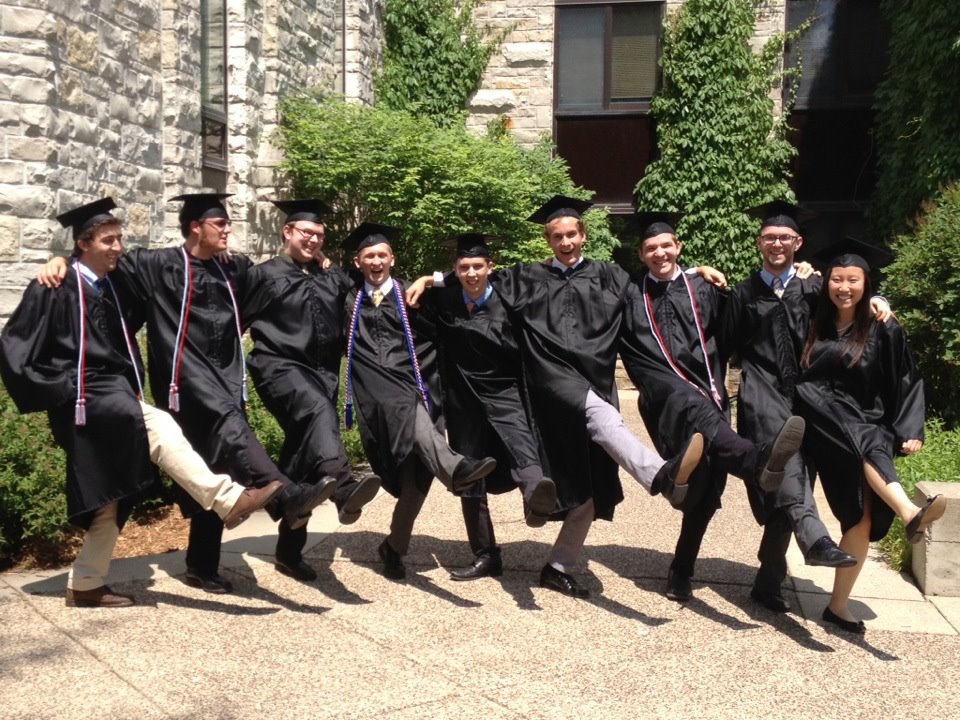
But for those who put on robes and hats at this time of year, it is important that we all acknowledge the achievement of completing a course of study. It was my great pleasure to attend a graduation last Sunday and to honor my son, Gus, and his friends as they moved into a new phase of their remarkable lives. Here they are, giddy with relief and tossing out a leg to take the next big step.
While I am filled with a father’s pride in my graduate and overwhelmed with admiration for excellence of his friends and the education they were offered, I did find parts of the final rituals a little comical.
Saturday night featured a ceremony where the graduates gathered in the chapel, heard speeches from classmates, sang a few songs, and then went out onto the campus grounds to find a lantern with their name affixed. Over 700 lights were aglow in the falling dusk. To hasten the search, the lanterns were arranged alphabetically. It was a beautiful scene with lovely symbolism, and weirdly appropriate that the final test after 16 years of schooling required a public demonstration that one had mastered those confounding ABC’s.
The next day was even better – I loved the sight of all the scholars marching in orderly lines to their rows of assigned seats – something I had just seen on an old videotape of a preschool holiday pageant. Major difference – as pre-schoolers, they were allowed to bang drums on the way.
And then came the ordeal – sitting under a merciless sun in 90 + degree heat for two hours wearing black robes and caps – something no truly educated person would choose to do. I wondered if the administration would unveil a late stunner of a surprise and award diplomas only to those who had the sense to skip the ceremony.
But no, this was a final, necessary hurdle, and will be remembered forever by the graduates for their sense of educational accomplishment and the light headed feeling of stubborn pounds most certainly lost through perspiration. On a molecular level, this graduation was a race between the need for the learned speakers to say every word they had carefully written, and the assured disintegration of the student’s bio-degradable robes. Moisture always wins in the end!
Congratulations Graduates! Now you know how to be patient and obedient, and if you hadn’t learned it before, now you know how important it is to hydrate!
What is your favorite memory from a graduation ceremony?
The great Doc Watson has passed away at the age of 89. He played the guitar and sang, but mostly he took possession of songs and fixed them with a translation that others could only admire and hope to imitate.
Doc Watson became blind around the time he was one year old, the result of an eye infection. But Doc Watson did not allow blindness to restrict him. I gathered some notes about Doc Watson for Trial Balloon in May of 2010. They still apply.
He was an expert in flatpicking and fingerpicking guitar techniques. His influence among players of traditional and popular music is impossible to measure. Among his many honors, Doc received the National Medal of Arts from President Clinton in 1997.
But far greater gifts came from Doc’s father, who hand built a banjo for his 11 year old son. Watson told Fresh Air’s Terry Gross that his dad …
“… showed me a few of the old time frailing or clawhamer style banjo tunes. And one day he brought it to me and put it in my hands and said “son I want you to learn to play this real well. Some of these days we’ll get you a better one. It might help get you through the world.”
General Dixon Watson’s dedication to helping his son ‘get through the world’ led to another important moment. When Doc was 14 his father assigned him to do some work with a crosscut saw – a risk many of today’s hyper-protective parents wouldn’t take with their sighted children. Doc told an interviewer for “Bluegrass Unlimited” …
“He made me know that just because I was blind, certainly didn’t mean I was helpless.”
And it helped develop a useful skill. Doc and his younger brother cut and sold scrap wood to a local tannery to make some money. Doc used his share to buy his first mail order guitar from Sears Roebuck.
Years later, a music store proprietor in Boone, North Carolina offered to help Doc get a better guitar, a Martin D-18, by cutting the payments to five dollars a month.
“At that time I was playing at the little fruit stand and a little bean market that they had at Boone and makin’ me a few shekels on Saturday. Havin’ a good time a pickin’. I paid for the guitar that summer. He got me that thing at his cost – and it cost ninety bucks. And I paid for it. Lord I was proud of that guitar. But in all truth, compared to my guitar now it was like frettin’ a fence. It was really hard to play.”
Doc Watson made the best of what he had to work with. If you didn’t already know the story you wouldn’t look at that early handmade banjo or the Sears mail order guitar and guess that a blind boy might pick them up and with time and talent, become a national treasure.
Watson also told Terry Gross in that interview that he considered leaving the road and the music business when his son Merle died in 1985, and would have if Merle hadn’t come to him in a dream and urged him to keep going. Good thing, or we’d have lost 27 years worth of music.
What talent or skill would you like to be able to practice all the way to the very end?
Today’s guest post comes from Jim in Clark’s Grove.
I see two kinds of volunteers in my world – plants and people.
Volunteer people give up their free time to do work they feel is important. Sometimes they’re thought of as being not as good or as serious as a paid worker. Plants are called volunteers if they show up someplace they aren’t expected. Often they’re yanked out and tossed away.
But what if we tried to change the way we view these volunteers?
Various plants are always popping up in my garden or yard without being invited. One that appears on its own in many places is Feverfew. It is usually found in places where I have applied some of my homemade compost, thanks to my old habit of putting Feverfew plants that went to seed in the bin. This year, before I did any tilling in my garden, I decided to transplant some of the young Feverfew plants into a flowerbed instead. By using these plants that came up on their own as bedding plants they have become an integral part of my gardening efforts. Now I’d miss them if they were gone, and I no longer think of them as just volunteers.
Doug is the first person I think of when I think of people who do volunteer work. In his last years my father lived with us and also in a nursing home. Doug was a volunteer in an organization that recruited people to make visits to shut ins, and he came by to see my dad almost weekly in both places. Dad began to look forward to Doug’s visits, in part because Doug understood how much some shut in people need to have company. And Doug approached this work like it was meaningful and not just an activity to fill his spare time. For my dad, it became something much more than a random visit – it was an essential service that improved his life.
Just as I have found ways to use Feverfew that make it more than a volunteer plant, people like Doug have found ways to be helpful that go beyond what is expected of a mere “volunteer.”
Today’s Memorial Day guest post comes from Barbara in Robbinsdale.
One or more Baboons have expressed interest in hearing more about our son Joel, who died in September 2007 from an alcohol related accident, at the age of 26. Telling stories about Joel is one of the most healing things I do, so here you are.
Well, I finally did it. I threw out the remaining lefse.
This wasn’t just any lefse, not even just any homemade lefse. My son and I made this in December 2006, his last Christmas in the physical. This is one of my favorite things about Joel – he loved family traditions, and making lefse is something his grandpa had taught him. He truly enjoyed getting together with Family, was the one that would take videos of the little kids at Christmas and Thanksgiving, and then make video gifts for their parents. He was the fun “uncle” who would be on the floor playing with the toddlers.
Christmas 2004
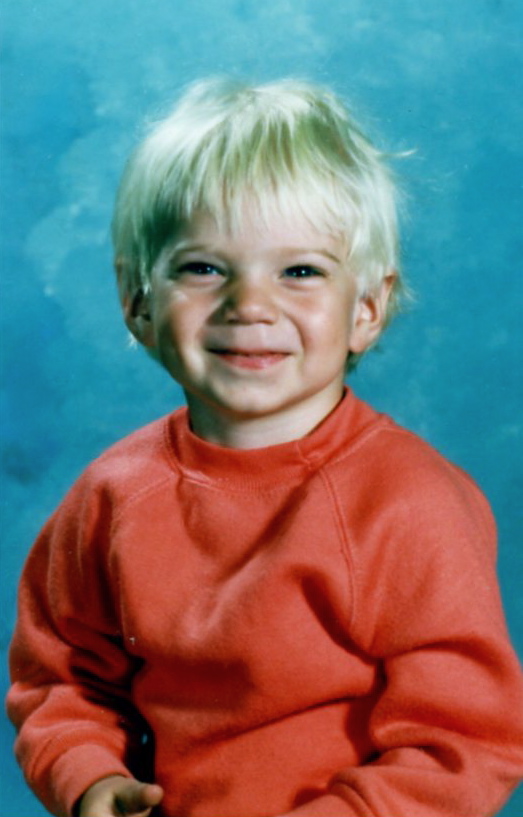
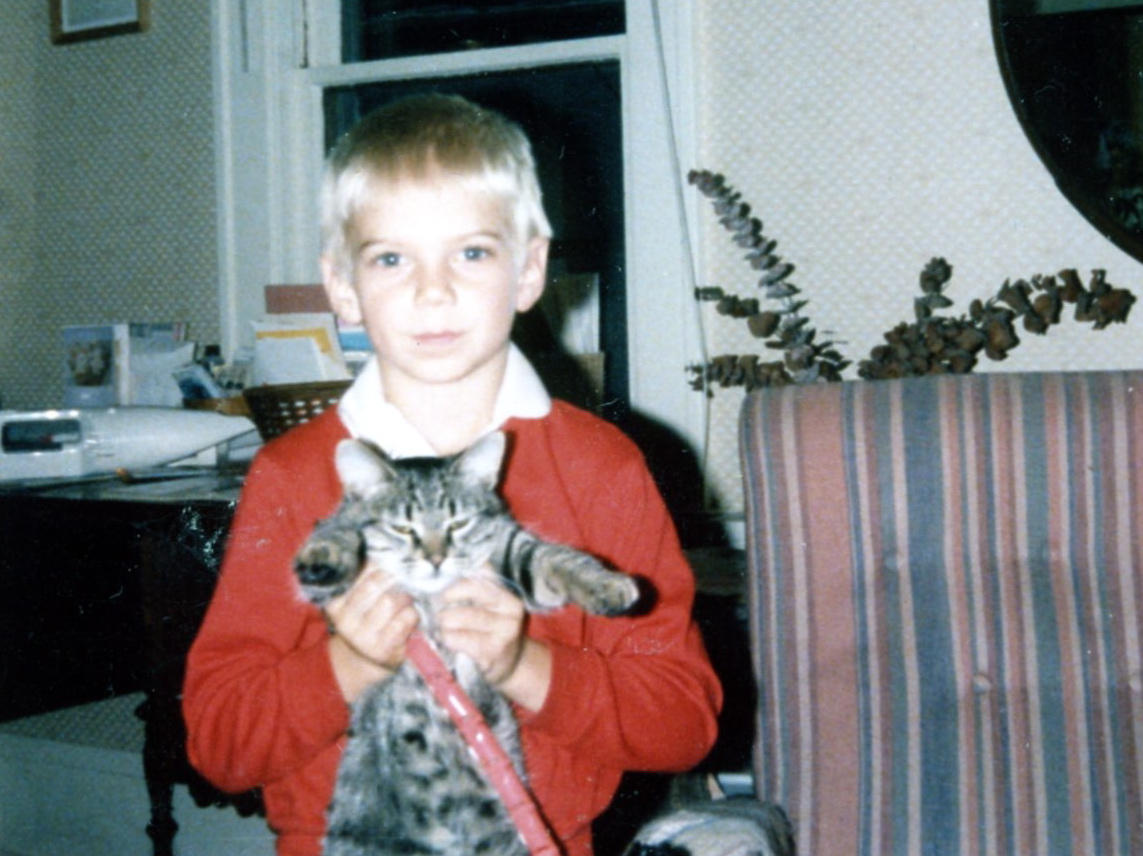
When Joel was little, his favorite color was orange; I dressed him in that so he’d be highly visible on the playground. He loved cats from day one – Sox was absolutely appalled when he turned 9 months old and started walking. By the time he was eight, he was more reliable.
Like many children of Babooners, Joel put up with our beloved Morning Show (TLGMS) while growing up, and thanked me for it later – and yes, he appreciated ALL kinds of music because of it, from Classical to Frank Sinatra, Johnny Cash, the Beatles.
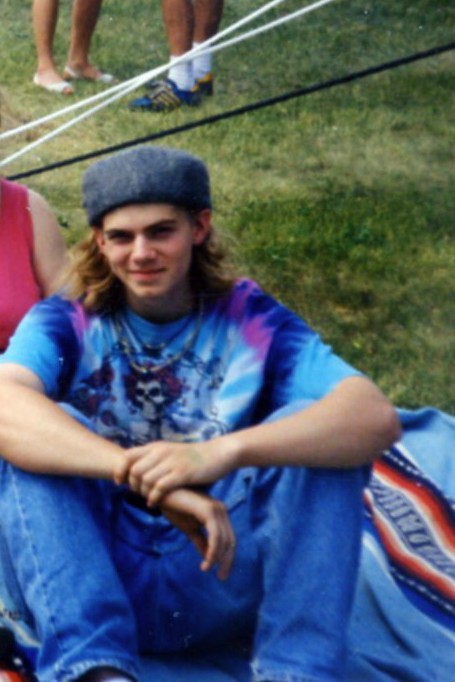
Music is what made it possible for us to connect when he got to be 14 – Jerry Garcia had just died, and suddenly “my music” from the 70s was in the mainstream again. In music we had something that could start us talking.
Joel was smart, good looking, funny, and he shared my sense of humor. He liked helping people, and was a good listener – ended up being the Confidant in his group of friends. He was organized (!), practical, and resourceful. He became the medic on the hunting trips – had little vials of anything they would need: aspirin, antihistamine… tucked into the “slots” on his ammo belt.
Blues Festival in Mankato, 1997
An Aquarius, as an astrologer friend would tell me, he did “march to the beat of a different drummer”. When (at age 20) he and a buddy set off to look for an apartment, they ended up buying a little house a mile from ours, and rented out a room to at least one other friend to help make payments. We saw him almost weekly for dinner, followed by watching any DVD he would bring (i.e., the entire seven seasons of The West Wing). Or sometimes we’d do a special project like making lefse.
Last of the Lefse
And now, like many things, I have to let the lefse go. It smells stale and I see some (former) insects in the box. So I arranged and photographed it, then put some out for the critters and composted the rest. I still have my dad’s griddle – I might make lefse again some day, but I probably won’t do it alone.
About ten months ago, I was asked to give the commencement speech at a local university and I said “yes,” not thinking that the time would come when I would actually have to do it. But now that time is here and I’ve done nothing to prepare. The speech is tomorrow and all I’ve got is a head full of nonsense and clichés.
When I think about the speech I’d like to give, it’s full of wisdom and fun and the students love it they’re glad they came and grateful they had the chance to sit in the 90 degree heat while wearing black robes under a full sun to listen to it.
But in reality I don’t relate to young people very well, and even if I did I don’t suppose there’s anything anyone could say that would make them grateful at this point. They’re tired, broke, in debt, and are being sent out into the economy to find work when job prospects are impossibly bleak. There’s a huge backlog of highly educated people just like them who have been sitting in their mother’s basements for the last decade, playing video games and picking up pocket change through intermittent babysitting and landscaping jobs.
I looked online and found lots of advice on giving commencement speeches – most of it in the form of pithy clips from talks given by celebrities and earnest instructions from well meaning haiku writers who will never, ever, be asked to do what I’m about to do.
I’m frightened. Right now, this is the text I’ve got.
“Congratulations, Graduates. You’ve already been though a lot, and that has prepared you as you head out into the world. Because whatever it was you went through, there’s a lot more of it out there, and some of it has your name written on the side.
So work hard, conduct yourself with integrity, and whatever you do, always, always know your audience. In particular, always try to be aware of the boundaries – those places where your audiences’s interest in what you have to say abruptly and permanently ends. And whatever you do, do not step across those lines.
Because, whoever you are, politician, priest, or professor, one thing remains true. Unless you are a magnificent singer or a brilliant genius, people are almost always grateful and appreciative when you finally sit down and shut up.
Thank you very much.”
Do you think I can get away with that?
Sincerely,
Fully Gown Man
I told Gown Man he should not, under any circumstances, give that speech. Condescension and self deprecation are never as enlightening or entertaining as you think they will be.
People expect an uplifting message at graduation. It should be about the graduates and not about you. And yes, it should be presented in as few words as possible. If you truly know your audience, you will give them what they want, but prioritize.
“Uplifting” is job number one.
“About them” is job number two.
And “few words” is job number three.
But that’s just one opinion. What do YOU think, Dr. Babooner?
Today’s guest post is by Dr. Larry Kyle of Genway.
I know what you’re thinking, but I did not enter a bid on the Blood of Reagan!
Oh, I was tempted! As the founder and produce manager of a grocery store that specializes in genetically engineered foods, I am well aware of the value of even the smallest drop of celebrity DNA. And to have a sample from the man who arguably represents the first and most blatant intersection between show business and political power … I’m still amazed that I was able to resist.
Think about the possibilities inherent in introducing Reagan DNA into our produce section alone – like Corn on the Teflon Cob – grill it all day, it’s impossible to burn! Or Supply Side Grapes! Each bunch comes with a poor person whose job it is to feed them to you! The more you eat, the better they live! Or should I say, “the better you’ll feel about they way they live”. I know it doesn’t make sense but people will accept it anyway – that’s the Reagan DNA at work!
So why didn’t I bid on the Vial of Reagan’s Blood when I had a chance?
It was a business choice, pure and simple. In my line of work, it’s bad for the profit margin to do anything that pushes up the market value of raw DNA. That’s because DNA is the material that gives my style of unsupervised and under regulated experimentation its great potential.
Sure, a whole line of Reagan-infused produce would prove irresistible to my staunch Republican customers, but once shoppers got used to the idea of foods branded with their own peculiar political persuasions, I’d have to produce Palin Pomegranates and Santorum Celery. And you thought the sweater vests were ghastly!
Of course Democrats would do the same. I don’t know about you, but I’m just not ready for Obama Okra.
I can only hope that Reagan’s Blood will be safely kept from commercial misuse by the Ronald Reagan Presidential Foundation. Although like the powerful One Ring in that Tolkien trilogy, Reagan’s Blood may have the power to corrupt whoever possesses it. Pay close attention – if the foundation begins to explore cloning … watch out!
It sounds like Dr. Kyle has mellowed with age – he’s actually saying “no” when in years past his answer to every harebrained idea was always “yes, yes, YES!”






 Trail Baboon