I loved this New York Times story about Hamid Chaudhry, the Pakistan-born operator of a Dairy Queen in Reading, Pennsylvania. He has made his shop a cornerstone of the community by getting involved and giving back. The reporter, Dan Barry, describes the proof he saw of a special relationship between an immigrant and his adopted home town, all of it posted on the walls –
The Cumru Elementary School thanks Hamid. The Mifflin Park Elementary School thanks Hamid. The Brecknock Elementary School thanks Hamid. The Governor Mifflin intermediate, middle and high schools thank Hamid. The Boy Scouts and the Girl Scouts, the soccer leagues and the baseball leagues, the Crime Alert program, the home for adults with mental retardation — they all thank Hamid.
And here comes the owner, Hamid Chaudhry, in the midst of another 80-hour workweek, fresh from curling another soft-serve. As he makes his way to a corner table, customers hunched over chicken-strip baskets and sundaes call out his name, and he calls back theirs.
“Hi, Tracey; I have that check for you.” “Bye, Mrs. Brady. All good for the homecoming?” “Bye, Mr. Rush. How was the Blizzard? Want another one?”
Great guy. Great story. Even better because it includes ice cream. It sounds like Chaudhry’s DQ has become the town square.
The biggest surprise in the story? It cost him $413,000 to buy the place. Yow! Even if I had that much, I don’t think I’d bet it all on people’s love of Dilly Bars, and I find Blizzards irresistible. I guess that’s the difference between me and a real entrepreneur.
The sort of business where so many people feel welcome and connected is a boon for any town – large or small. When I was growing up in Montrose, New York, our gathering place was the convenience store down on the State Highway – a centrally located establishment with a big sign that featured the cutout of a police officer blowing a whistle, and a huge halting hand outstretched, commanding you to “Stop N’ Shop”.
What did they have there? Everything. Who did I see when I went? Everyone!
Ever live in a town with an unofficial meeting place?
Now that the Iowa’s over promoted Straw Poll has ended, there are truckloads of national political horserace reporters available for temporary re-assignment. Perhaps that’s why President Obama met the hoard more than halfway, starting his Midwest tour at a point conveniently between Ames and the Minneapolis airport.
While the approval rating handicappers and political spinners tried to deduce the nation’s mood from the interaction between the chief executive and 500 or so Cannon Fallsters, ordinary people can be forgiven for their genuine excitement at seeing the President of the United States (POTUS), whether they support his policies or not.
Ben Rutter, a 19-year-old college student from Cannon Falls, told the Worthington Daily Globe that getting to shake the president’s hand is a “once-in-a-lifetime” experience.
“It’s pretty awesome to see him in your hometown,” he said. “Especially your small hometown.”
Everyone should be excited to see the president – any president. Ultimately, all men and women are surprisingly ordinary – even the famous ones. That’s what makes us all so lovable. But the title and all the responsibility that comes with being POTUS – now that’s something special.
I stood on a street corner in Minneapolis to get a glimpse of George W. Bush a few years ago, and I thought I saw a hand wave behind smoked glass as his motorcade sped by. Not much to go on – but I still remember it. I doubt that he remembers me. I can only guess that from behind your Secret Service escort, every collection of tired-looking middle aged bald guys begins to blur with the scenery.
But even Michele Bachmann couldn’t hide her excitement at greeting W. Remember this famous moment from her first few weeks in Washington in 2007?
Well of course you’d be delighted. There have only been 44 U.S. Presidents, so why not grab one as he goes by and see how long you can stay connected? Though maybe it wasn’t the man Michele found so invigorating. She might have been trying, even then, to hang on to the office.
You are a touring (campaigning!) President of the United States, and someone has just handed you their baby. What do you do?
A fascinating article about trains and autism in the New York Times got me thinking about the ways we each try to make sense of a nonsensical world.
The article profiles an autistic 5 year old named Ravi who has an amazing command of train and bus schedules. He, his older brother and mother visit the New York Transit Museum weekly because “People with autism have difficulty processing and making sense of the world, so they are drawn to predictable patterns, which, of course, trains run by”.
The article also quotes the museum’s assistant director, who said she had been besieged by field trip requests from schools that serve children with autism, so she established a program that indulged the young people’s need to dig deeply into the details of routes and timetables while also offering a chance to build social skills.
One parent said her child finds trains especially soothing, and he gets upset when they are not on schedule. Apparently one very effective bridge between loving trains and developing social skills is an old favorite – Thomas the Tank Engine. But a word of caution – if you’re comforted by vehicles that have to stay on their proscribed path, this mini-episode is bound to be unsettling.
Only on children’s TV is the idea of a locomotive crashing into a house made infinitely worse by the undeniable fact that a collapsing plaster wall can ruin your breakfast. Some calamities are too big to take in – you have to view them through a lens that minimized the damage. Perhaps this is how Tim Pawlenty feels today.
But it does make some sense that any person who has a hard time adapting to quick, unannounced change might find a bit of happiness in the carefully planned environment that’s on display in a transit museum.
Where do you like to go when things feel out of control?
I absolutely adore Science Fiction shows – always have. Since the original “Star Trek” series was televised when I was in grade school right up to current edgy shows like “Fringe” that are being aired now. Along the way I’ve enjoyed all Star Trek series and movies, Babylon 5, Dr. Who, Hitchhiker’s Guide to the Galaxy, Stargate series, Quantum Leap, Battlestar Galactica (the recent one – not the cheesy old one with Lorne Greene) and others.
The best way to explain my love of science fiction is the feeling of exhilaration I experience when well-done science fiction explores the range of possibilities available in our wide universe – the dreams of what could be. Time travel, parallel universes, technology advances, spiritual and physical evolution. I am fascinated and uplifted by the innovative genius of the writers and how they use beloved and familiar characters to flesh out the questions, curiosity, dark urges and brilliance that always bubbles beneath in our collective consciousness.
I’m guessing that doctoral theses have been written about the triumvirate of archetypal characters that embody Kirk, Bones and Spock. Personally, I’ve never fully understood or felt the need to pick apart and analyze art or literature to mine the metaphors and deeper meanings that may be there – fascinating and rich they may be. I prefer the simple-minded pleasure of watching my favorite characters that seem like old friends, wrestle with the challenges of the future and unheard of scenarios … yet they resonate with the same challenges you and I face on a daily basis in one form or another.
And the gadgets! I remember pretending an old metal Sucrets box was a communicator, trying to emulate Capt. Kirk’s ultra-smooth move of taking his out of back pocket and flipping it open. Now I try to do that with my cell phone. Not as easy as it looks. But the idea of transporters, tricorders, warp speed, translators, bloodless surgery, healing instruments, the TARDIS, parallel dimensions, etc., really gets my blood jumping. The moments I experience the hold-your-breath, expansive, spellbinding trance of great storytelling that transport me to a different level of thinking, a blinding new perspective or breathless possibilities that never occurred to me before. And yet – there’s an underlying familiarity of how it relates to present day problems, shows us our vulnerabilities and celebrates the glories of human existence in a way most other genres cannot.
Granted there are occasions of heavy-handed morality, clunky storylines, weak acting and – God forbid – cheesy special effects; but they all add to the charm of the genre, and are forgiven in a generally good quality Science Fiction show. It’s also a fact that some current technologies were based on science fiction gadgets. Even the making of science fiction shows and movies contributed to great advances in movie special effects that we now take for granted.
What gadget, technology or personal power from Science Fiction would you most like to see, do or have in your life?
I used to work for a superintendent whom everyone called “Ballpark” because he could not get out a sentence without a sports metaphor. He had a half-dozen uses for the term “ballpark.”
Similarly because of my constant use of science metaphors and science parallels to what we were reading, my students used to wonder if I was an English teacher or a science teacher. At this stage in my life two of my favorite science metaphors, which I had to carefully explain in class, are very useful descriptive terms.
The first is ENTROPY, which is a concept from Newton’s second law of thermodynamics. I bet all baboons know the concept. In pure science, it is much more complicated than as used in my metaphor or common usage. Entropy is the tendency for systems to proceed to disorder, chaos, or randomness. Complex structures will eventually break down to their constituent parts (such as my body). It was an effective way for students to understand “Lord of the Flies.”
Old age is certainly a battle against entropy. A friend of ours says that when she is a senile wreck in a nursing home that she wants someone to tie her knees together every morning before she is put in a wheelchair and rolled out into the common area. A pastor we know has been dealing with a mother and daughter who were both in long-term care, the mother for old age and dementia and the daughter for a degenerative disorder. When the daughter died, every few minutes the mother would find out her daughter had died and grieve freshly all over again, including several times at the funeral.
The other metaphor, PUNCTUATED EQUILIBRIUM, is from S. J. Gould. For a long time the unassailable rule of geology and evolution was that all change occurs at a constant and slow rate. Various scientists in different fields fought this rule for much of the last century and finally won. For instance a region of eastern Washington called the Scablands is now believed to have been created in a few days, not millennia, as if Lake Erie has suddenly decided to empty over Ohio in a three days. A similar but less dramatic event occurred along the Minnesota River valley.
Biological and geological change are now believed to have had long periods of stasis or very slow change and briefer periods of intense change. Of course, “briefer period” can also mean thousands of years or more as opposed to millions of years or more. Gould and a couple of other people developed the term “punctuated equilibrium” to describe this concept, which seems to me more widely applicable. (In its root meaning, “punctuate” means break in or interrupt, as in “puncture.”)
For instance, geo-politcal/social/economic/technological equilibrium was “punctuated” in so many astounding ways in the 1990’s it should have been overwhelming, but we all just kept motoring along. Humans are so very adaptive. I wonder if the punctuation will ever cease.
How much are entropy and punctuated equilibrium metaphors for your life and times?
At 6 a.m. I rode the Sakatah Trail to a bridge across a narrowing in Eagle Lake, a fun place to watch wildlife, such as beaver, egrets, herons, swans, eagles. This morning below the bridge was a swarm of a few hundred 3-6 inch catfish, most about 5 inches. They were feeding on water bugs, or perhaps their larva on the surface of the shallow water in a circle about 8 feet across.
After a bit I saw a pattern to their movements. Four to six catfish would make a group and swim abreast across the area of feeding. At the edge of the circle they would disband and swim back into the circle, soon joining another band. In the 20 minutes I watched I guess about 150 such groups formed, swam, and then disbanded at the edge. The few three-inch fish were never part of a group.
The question, of course, is, in the language of the evolutionists, what advantage is there to such behavior? The answer is obvious; improved feeding. A group can sweep up the larva and/or bugs more efficiently. When the larva/bugs try to swim out of their way, the ones at the edge catch them. I wonder two things: 1) is there more advantage to being in the middle or at the ends? 2) are some fish dominant, as in wolf packs, and always get the more advantageous position?
Can you tell I read a lot about nature and evolution. I believe Stephen Jay Gould is one of the great essayists, a match for Montaigne, Addison, Steele, Pepys, Emerson and the like. Thoreau I would still place above all of them. Perhaps it seems odd that as a former pastor I read about evolution. But I see no conflict; I believe reading about nature and evolution has a strong worshipful aspect. I admire the mind of the creator, in the design of both species and processes/systems. I have on occasion quoted Gould from the pulpit, but not his evolutionary thinking as such. Gould’s nature essays covered vast ground, including one of the finest and also one the stupidest essays ever on baseball. I did have one church member who knew who he was, and we enjoyed our inside joke.
The fish behavior I observed raises one of the most difficult questions for evolution, one that still perplexed Darwin at his death: how do cooperative behaviors develop? Survival of the fittest is a fully competitive model in which each individual is trying to protect its DNA and pass it on at the expense of other species and individuals.
How in a very competitive world do cooperative and even community behaviors develop? In some non-human species community roles have developed, such as foster parenting. How does one explain the vast community/cooperative behaviors of humans in evolutionary terms? A theory of an altruistic gene has developed to explain such behavior, which really only raises deeper questions. One man believes he has identified a gene for religion, thereby disproving the existence of God, which again only goes deeper because, of course, God could have made that gene.
It is a fascinating and complex issue. I do recognize both competitive and cooperative behaviors in myself and think to some extent they are instinctual. I have a visceral competitive response every now and then, damn it. I also think that in general men are more competitive and women more cooperative, but that may be learned in socialization. Lots can be said, but:
Where do you fall on the competition/cooperative continuum? Where would you like to fall?
I worked for 2 ½ years at Hormel Foods in Austin, mostly in quality control and toward the end on the production lines. This was one of the last jobs that I worked at before I retired. As a person who supports sustainable farming and use of locally produced foods you would think that I would not be willing to work for Hormel. I am not one of Hormel’s fans, but I do understand that they are an important part of our economy as a major employer and major supplier of food products.
While I could say some negative things about working at Hormel, for now I will concentrate on things that I liked, in particular the people who work there. Almost everyone I met at Hormel was a capable worker because poor workers were weeded out quickly. Some of the workers helped me learn how to do the jobs I was given. My most unusual trainer was a Latino man who spoke almost no English and taught me how to make hams using sign language. He pointed to his eyes to let me know I should watch him and then wagged his finger to indicate my technique was not right. After showing me my mistakes he demonstrated a better way to do the work.
One crew that helped me run an x-ray machine for quality control really impressed me. This crew worked in another part of the plant and was temporarily assigned to help with x-raying. They immediately found the most efficient way to load and unload the machine and while they were there I had none of the problems with the machine jamming that occurred earlier. I found out that they had learned to give packages a push at just the right time to avoid jamming.
Probably my most pleasant experience was meeting and working with some Filipino women. I meet one of these women because she was a coworker and several others because they worked near me. Soon I found out that they ate together in the lunch room and I was invited to eat with them. They were very friendly and sometimes shared some of their interesting Filipino food with me. . On another occasion a Latino man also shared some good home cooked food with me. I tried some of his very well flavored ears of sweet corn and samples of empanadas that had an excellent pumpkin filling.
Veteran workers had lots of stories to tell me and gave me some suggestions for staying out of trouble. One of their tricks was to stay out of sight if they were ahead on their work and wanted to take an “unofficial” break. One morning when I was early getting to work I found several night workers hiding in a dark room toward the end of their shift. On some production lines you had to be an extremely efficient worker due to the fast pace of the work. I was told that a representative of a company that made a machine used at the plant said it was breaking because it was not designed to work at the high speed set by Hormel.
But it wasn’t the machines that made my time at Hormel worthwhile, it was the people.
Describe your favorite (current or past) co-worker.
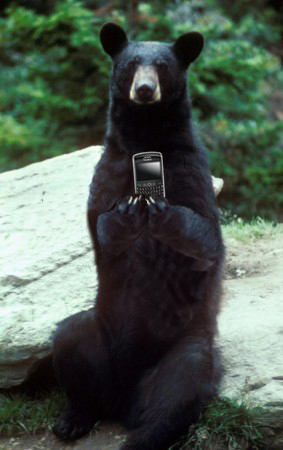
Here’s a message that came in early this morning from our text-crazy friend in the woods, Bart the Bear. I think he was up all night, picking at the keys, trying to make up for his lack of thumbs.
Bart - The Bear Who Found a Cell Phone
Hey. Bart here.
Some campers were up here yesterday and I got kind of excited because they were talking about getting blackberries out of their backpacks.
“I can’t live without my blackberry,” one said.
“Me neither,” said the other one. “I’ve got it in my hand, like, all the time.”
I’m thinking these are my type of guys. I can’t live without blackberries either.
But then the first one said “My wife yells at me and says I can’t play with my blackberry at the table.”
Honest, it didn’t sound like these guys even KNEW that blackberries are food. And lookin’ at ‘em and playin’ with ‘em? They’re pretty, I admit, but geez! And what use is just one? You confuse me. How did you humans get to be so … everywhere … if you don’t know the difference between what’s good to eat … and toys?
Anyway, I almost charged in there and ripped open the backpacks myself, but I figured it wasn’t worth it for just two bites. When I have blackberries, I eat bunches.
Then they got to talking about other stuff I don’t care about, but my ears perked up when one said “this drop is gonna put us in a bear market.”
A bear market is a really interesting idea to me. Is that a market where you buy bears, or a place where bears go to buy the stuff that they like? I’d like it to be the second type, of course.
The other guys says “Put us in a bear market?
We’re already IN a bear market.”
Then the first guy answers with “It’ll be a SUPER bear market. A bear-a-palooza market!”
I started drooling ‘cause that sounds awesome. I can think of all sorts of things I’d like to get at a bear market, especially if I don’t have to pay. And I don’t, usually. I just take the stuff that looks good to me – as much as I can carry – and I come back for more, later. Unless the ranger shows up.
That’s Bear Marketing 101.
Anyway, I know lots of other bears – polars, grizzlies, koalas, black bears, brown bears and wooly bears too. If there’s someplace you guys are hiding from us every body calls a bear market, especially a SUPER bear market, let me know. I thought I heard them mention where it is, but I can’t remember if it was by a wall or near a street. One of those. Anyway, send me a map. I’ll organize a buying trip and we’ll give ‘em a day of commerce at the bear market like they’ll never forget!
Many thanks to Steve for two guest blogs last week. We’re in a guest blog free-fire zone. No need to ask – just send one whenever you have an idea! connelly.dale@gmail.com
On this day in 1815, Napoleon Bonaparte set sail for the Island of St. Helena in the south Atlantic, his second exile. They had already tried to put him on ice at Elba, but he didn’t stay.
Don’t get the wrong idea. I really don’t know anything about Napoleon, except that led the French when they were successful at war, that he was short, he liked to tuck a hand into his vest, and he married Josephine.
Oh, and he has a lovely pastry named for him. Although this one wants to be called Alice. And why not? Alice is a friendly name, and being served a dessert named Alice is not an instant reminder that you are a zero when it comes to French History.
It is pitiful to be so clueless and I would blame the American education system except that I have been out of it a long time. Several of my beloved teachers are long dead and at any rate they can’t be held responsible for my ignorance anymore. I have had plenty of opportunities to complete my education, but decided to watch TV instead.
So no historical facts or meaningful observations come to mind when I think of Napoleon’s final exile, but I have been able to come up with two songs.
This one by Mary Black is very specifically about St. Helena.
And this one, named for the battle that sent Napoleon into his final exile.
If I had appeared on television in any of those outfits, I would want to go away for a while too. But the thought of total exile seems quaint today. Where is exile, exactly? And what is it? Can our compulsively interconnected world even imagine it?
And is there a place on the globe where they haven’t heard of Abba? Anywhere?
You are responsible for punishing a military mastermind so threatening he can’t be allowed to raise another army. Prison would be a dangerous place – too many impressionable minds waiting for a leader. And dropping him on a barren island somewhere? That’s just a reality show waiting to happen. His influence would grow!
Construct some sort of exile to keep him in check.
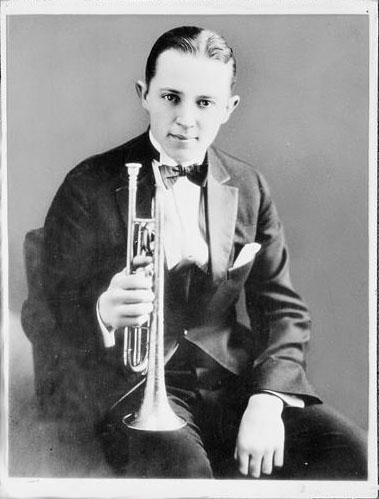
The first days of August in 1931 were so hot in New York City that people couldn’t sleep. The residents of a large apartment building in Queens had the additional problem that the man in room 1G was out of control, getting up at all hours to pound out bizarre melodies on his piano. On the evening of August 6, the musician went crazy, hallucinating that Mexicans with knives were lying under his bed. He suddenly pitched forward and fell dead. Bix Beiderbecke was only 28 years old.
The cause of death was listed as pneumonia, but that was probably a fiction to comfort Bix’s parents. Most scholars think he died of a seizure suffered during an attack of the “DTs.” Simply put, Bix had finally killed himself with Prohibition bootleg booze. Bix’s health also suffered because of the heavy work schedule of jazz artists. I could make the case that Bix was crushed to death by the conflict of high and low culture. Others have concluded that Bix died of humiliation. In the words of his friend Eddie Condon, “Bix died of everything.”
The body was shipped back to Davenport, Iowa, for a quiet burial. The family was ashamed of their alcoholic son. Even the jazz world failed to note the passing of the cornet player who was one of the giants of jazz’s formative years. Bix lay in obscurity for decades until later commentators rediscovered his work and created a new identity for him as jazz’s first “dead saint” and romantic cult figure.
Now, almost century after Bix’s tragically brief career, historians can’t agree about almost anything about his life. Battles are fought over his name, his sexual orientation, what made his music distinct, his musical legacy, why he died and many other issues. We know almost every movement he made in his short life, and yet Bix will forever be a mysterious figure wreathed in contradictions and conundrums.
What we know for sure is that Bix was a musical genius, born with perfect pitch and an almost mystical ability to think creatively during his solo improvisations. When he was a toddler he would stand below the piano, his arms stretched up to play keys he could not see. He acquired a cornet and taught himself to play it, and one consequence was that Bix learned strange fingering for producing some notes. His idiosyncratic fingering might account for the pure, sweet tone everyone tried in vain to imitate. A friend said the notes coming from Bix’s horn were as pretty as the “sound of a girl saying yes.”
While many early jazz players liked silly effects, such as barnyard noises, Bix was a purist who impressed audiences with the stunning creativity of his solos. In the early years of jazz, the cornet or the trumpet was the instrument that drove the group’s pace and presented the melody. The magic of Bix’s playing is his creative way of spraying pretty little notes in patterns that progress in a supremely logical and pleasing way. He proved that jazz tunes could be both hot and beautiful at the same time.
Bix came to the attention of the jazz world in 1924 when he was the boy wonder star in a band known as the Wolverines. He hit his peak in 1926 while playing in various groups. In 1927 he joined the most famous band of the era, the Paul Whiteman Orchestra. Already by 1927 Bix began seeing himself as a musical ghost, a pathetic creature stuck playing in a style that had become outdated.
What we have of Bix today is a pathetically small body of recordings made between 1924 and 1930 . . . just six years. In addition to his cornet work, Bix wrote and recorded some odd piano compositions. The surviving recordings are a tiny percentage of Bix’s musical output. It is hard for the modern ear to pick out Bix’s playing in the ensemble sound, and it is even more difficult to appreciate how radically superior his playing was when compared to other cornetists.
As someone who has studied Bix for twenty years, I can only urge others to take the effort to become familiar with this tormented, inebriated genius from the earliest years of jazz. The best way to meet Bix now is through a documentary film produced by Playboy entitled “Bix: Ain’t None of Them Play Like Him Yet.” The film, which is sometimes sold by Amazon.com, is in the Netflix system. Electronically remastered versions of his recordings continue to be issued almost every year.
His most famous recording is “Singing the Blues.” Bix’s horn comes in at the one-minute mark:
“I’m Coming Virginia” captures Bix’s reflective, poignant side. Again, Bix’s horn appears one minute into the recording:
Have you ever grieved the death of a celebrity you didn’t personally know?



 Trail Baboon