Earlier today I was waiting for a city bus at a bus stop in downtown Minneapolis after making a nice haul at the 25¢-a-book-sale. A few years ago, people would just wait for their buses in silence, but now there are a few people who, naturally, yack on their cell phones while they wait. I don’t try to listen to their conversations, because most of them are boring. I mean, how many times when I’m shopping at Target do I want to hear, “Yeah, I’m at Target right now, picking up paper towels” or at a bus stop, “I’m waiting for the #5 bus”? But today, I’m pretty sure I overheard the logistics of a crime-in-progress.
A ordinary-looking woman crossed the street to get to the bus stop. She had a suitcase and was talking on her cell phone. I heard the fairly normal cell phone line, “I just made the copies at the library and now I’m at the bus stop and I think I’ll make it there on time.” Yawn. Then I heard, “You’ll have to meet me at HCMC at 4:00 and I’ll pass off the suitcase and the money.” My ears pricked up. Whoa! What sort of shady deal was this?
Unfortunately, right at that moment, my bus pulled up and I got on. The woman must have been waiting for a different bus because she did not board the bus I was on. But I’m still wondering, “Why does she have to “pass off” both a suitcase and money at HCMC? Was she talking with a friend or was this some sort of undercover “business” dealing?
What suspicious activity do you think was being planned in that conversation I overheard?
Here’s a fresh note from our perennial sophomore, Bubby Spamden of Wendell Wilkie High School.
Hey Mr. C.,
I know people your age like to gripe about us high school kids because we’re “soft” and “lazy” and “ungrateful” and we’re addicted to our “gadgets.” I know I’m guilty on all counts. But my Life Skills teacher, Mr. Boozenporn, says you guys weren’t all that different when you were in high school. He says every generation is accused of being dumber and weaker and less excellent by the generations that came earlier. And while overall test scores may be down a bit, the pressure to be super as an individual keeps going up and up and up.
What do I mean?
There’s this girl – Brianna Amat. She managed to get on the football team at Pinckney High School in Michigan because she’s such a good kicker on the girl’s soccer team. Fair enough, I guess. But then she went and got voted to be the Homecoming Queen and got to go out on the football field at halftime and get a tiara put on her head while she was wearing her uniform! And then when the Pinckney Pirates were one point behind in the second half (because she missed a point-after in the first half), she kicked the field goal that beat their archrival, Grand Blanc!
So she managed to corner two of the most prized roles in high school in the very same night – homecoming queen and football hero. The only top roles she left on the table are The Kid Who Always Has Money and The Kid Whose Parents Are Never Home. That’s pretty amazing. It means she’s probably got, like, a record percentage of other students at the school with a crush on her. And it lifts up the bar for anybody else who wants to be really, really celebrated.
People say kids today are a lot more open to all kinds of people doing different things they aren’t “supposed” to do. That might be true, but I don’t think anybody else will ever be able to equal Brianna’s feat, even though I know for a fact that there are a couple of guys at Wendell Wilkie High who would very much like to be Homecoming Queen. No big deal, they just really feel comfortable in tiaras.
Anyway, I guess the point is that not everybody my age is good-for-nothing. Some are good-at-everything. And some, like Brianna Amat, are living out pretty incredible stories.
Your Pal,
Bubby
I told Bubby that forty years ago, as both homecoming queen and football hero, Brianna would have been required by unwritten high school law to date herself. So I’m glad to see things have changed. Compared to the old days, there are many more opportunities for high school kids to get that feeling of being celebrated today. Brianna gets our attention because she happened to corral two of the classic favorites.
What was the high school honor you most wanted to win?
The winners of the Nobel Prize in Physics are three American scientists who asked some important questions and wound up getting answers they didn’t expect.
Hubble's snapshot of the backyard, courtesy of NASA
As a result they gave us this confounding image of a universe that is expanding rapidly, with stars and galaxies rushing away from the center at ever-increasing speeds.
How’s that?
For folks (like me) who write news stories and summaries, Nobel week is a challenge and an education. In trying to explain how a prize was won, we’re called on to distill and decipher other people’s complicated multi-million-dollar research. Do you really think I can, with little knowledge or understanding of the field, step in and do a better job explaining a major technical principle in fewer words than the scientist who has spent his or her life struggling with the same information?
Some topics don’t like to be compressed.
But try I must. So why not take it all the way down to the minimum? Here’s a challenge – boil the expanding universe down to three lines, with five syllables in the first line, seven syllables in the second, and five in the third.
Go.
Galaxies racing
faster away from center
Mama will be pissed.
Dark Energy is
The unseen motivator
Behind the madness
The whole universe
Receding away from you
It’s not personal
The spaces between
the words in this haiku are
bigger. What’s up, huh?
Leave your own haiku, or just explain how the universe will end.
Today is my birthday, and I am determined to relax, no matter how much work it takes.
Fortunately I have great help from people like my good friend Jim of Clark’s Grove, who wrote today’s guest post. With a few forthright words about nematodes, Jim has helped me understand my true role in the universe and has placed my birthday in its proper context. To anyone who says “host” is not a decent job description, I say, ‘Pal, we’re all hosts.’
Here’s Jim’s post:
I suspect that many people know a lot about something which is not widely known by most other people. I am thinking about unusual information that might be gained through professional training, or from involvement in a hobby, or by somehow gaining access to unusual information. I happen to know quite a bit about nematodes, a group organisms that I think are a mystery to the general public. My knowledge of nematodes came mostly from my study of these organisms as a graduate student. I would like to share some of the information I have about these very significant and severely overlooked creatures with the hope that you will share information about something that you think has been largely ignored.
Nematodes, which are also known as round worms, are the most numerous multicellular animal on earth. There are some single celled organisms that outnumber nematodes, but nematodes have exceeded all other animals with more than one cell when counting the total number of individuals. If you removed all the soil and water from the earth and left the nematodes, the large populations of nematodes found everywhere would show you where the soil and water was previously located. Most nematodes are very small, only a millimeter or two in length, although you might have seen some of the larger parasitic ones that are several inches long in the stools of your pets. Some whales contain parasitic nematodes that are more than 20 feet long.
A Nematode with a Nematode Inside.
Nematodes parasitize just about everything including all kinds of animals and a wide range of plants. People suffer from many kinds of nematode parasites; including pin worms, hook worms, and the worms that cause trichinosis which you can get if you don’t do a good job of cooking pork. In fact, there are even some nematodes that are parasitic in other nematodes. If you look closely at the picture I provided you will see two nematodes because this is a picture of a nematode with a parasitic nematode in its body cavity. I came across this parasitized nematode during my study of free living nematodes found in soil. The drawing was done with ink on scratch board following instructions for making nematode drawings that came from a famous nematologist, Gerald Thorne. Thorne was very devoted to the study of nematodes which he was sure would be found in soil samples from the moon. He was certain of this because he knew they are found everywhere on earth.
I got started in nematology by doing a research project on plant parasitic nematodes, some of which can severely damage plants. However, most of my efforts in nematology were centered on the taxonomy of a group of free-living nematodes which led me to discover and describe a dozen new species of nematodes. Most people who work on the taxonomy of larger organisms would not expect to discover such a large number of new species. When it comes to nematodes, it is not hard to find numerous new species because most of the existing species have not been described.
I have attempted to dazzle you with some information about the wondrous group of organisms called nematodes. You probably weren’t aware of the huge number of these organisms hidden in soil and water everywhere and also found as parasites in or on many animals and plants. In fact, you might have harbored or still be harboring some of them, yourself. I think I was infested with pin worms when I was a kid. In those days many school children suffered from infestations of these very small worms. I wonder if you have information about something that is unusual or not well known to the general public.
Are you familiar with something that is being ignored?
During a recent conversation with my son, I inadvertently let it slip that I think his children, a pair of girls aged 14 and 12, are selfish little heathens who exhibit all the social decorum one would expect from a pair of hungry wolverines.
One example: They put their elbows on the table, lower their faces to a scant 2 inches above the plate and proceed to gnaw and inhale their food, always accompanied by a cascade of grotesque slurping and chewing noises reminiscent of a National Geographic special about the food chain on the African savannah.
In response to this observation, my son said “manners are dead”. “I’m raising these children to be ‘natural creatures'”, he said, “wild and free and unencumbered by the petty rules of society.”
And he pointed out that Emily Post herself considered good etiquette to be a style of behavior intended to help other people feel comfortable. If his children feel comfortable eating their pizza as if they have just buried their faces in the warm entrails of an exhausted antelope, what right do I have to judge them?
He suggested that it was bad manners for me to even bring this up, and especially uncouth for me to pretend that I just let the criticism “slip” when in fact I have been brooding over this for years.
Dr. Babooner, while there may be some truth to the assertion that I have been thinking about this for a long time, it was never my intention to attempt to correct the atrocious behavior of these young barbarians. They are irredeemable. I would sooner try to convince voracious Asian Carp to swim back downstream.
But if etiquette is all about helping others relax, why must I always be the one to sacrifice? How come no one changes his or her behavior to help ME feel comfortable?
Sincerely,
Crabby Gramps
I told Crabby Gramps I was alarmed by his use of the world “irredeemable”. That strikes me as a shockingly final judgment for one to level against young relatives. And frankly, I said, his son is correct. Etiquette is dead – finally killed by the Internet in the same way table manners were done in by the State Fair, along with the table itself.
As for feeling “comfortable”, that must come from within. If you are looking for someone else to MAKE you feel comfortable, you are likely to wait for a very long time. Rather, C.G. should just decide to approach dinner with the mindset of a wildlife biologist. Observe and take notes. These are fascinating creatures who cannot be tamed!
You might also just “let it slip” that any “wild and free” creatures roaming in your house will have to wear radio collars and ear tags for the duration – for their own protection, of course. And one can never rule out the judicious use of tranquilizer darts.
But that’s just one opinion. What do YOU think, Dr. Babooner?
Today is the birthday of the British Music Hall star Stanley Holloway, who entered the world on October 1st, 1890, and proceeded to work through some amazing years of transition in the world of show business, performing on radio, stage, in TV and movies. Holloway’s greatest fame came as Alfred P. Doolittle in “My Fair Lady,” both in the original Broadway production and in the 1964 film.
He strikes a familiar note for us with this old music hall favorite:
This is a classic example of humor made out of something that wouldn’t be funny at all if you actually witnessed it. Here’s another from Mr. Holloway:
Heads chopped off by selfish husbands, children eaten by lions. Har, har, har.
Don’t get the joke?
Guess you had to not be there.
When is it OK to laugh at the misfortune of others?
America was in the seventh year of its war with North Vietnam in the fall of 1971. That fall I was a graduate student in the University of Minnesota. I wasn’t sure what degree I was seeking or what I’d do with it, once I’d graduated. I mainly had to maintain official student status so I wouldn’t be drafted to join the war.
I had hated this war since its start. Every night I shook with fury as various national leaders went on television to lie about the “progress” of the war. Every year, more and more people died—young and old, Vietnamese and American, civilians and soldiers. Every year, the official logic for the war looked more insane.
I finally decided that my hatred of the war might provide a plan for my life. The American public was not getting the straight story about Vietnam. Maybe I could become the sort of pioneering journalist who would show all my docile countrymen how wrong the war was. Even better, perhaps I could become a columnist with a courageous voice who would write op/ed essays showing my readers how stupid they were to believe the lies the U.S. government was feeding them about the war.
And so I decided to switch my major from American studies to journalism. I had a lot to catch up on, for I had never yet taken a journalism course. Unfortunately, I had a late registration date, so all desirable courses in writing and editing were filled before I could sign up for classes. In fact, the only promising course still open was “Public Opinion and Propaganda.” At least that course would relate to my intention to use journalism to open the public’s eyes to the madness of the war.
Things didn’t go as planned. That class shocked and confused me in a way no other event in my long educational history had done.
The first shock was learning how silly I had been to think I could educate people by telling them the truth. The first section of the course showed how diligently people protect their pet beliefs from anything that challenges those beliefs. One study we read showed that people have at least eleven different strategies for denying information or views that they don’t want to hear. Eleven! Although to tell the truth, any single one of those mental tricks will usually work to keep unwelcome facts or views at a distance.
For example, if new facts threaten the values people already hold, people have no trouble ignoring the new facts. Or they might encounter information they don’t like and simply forget it. Or they might misremember things so badly that they think that the new facts actually support their preferred view of things. Or they might summarily dismiss unwelcome views because they came from a suspect source. And so it goes.
The lesson was hammered home over and over: People are going to believe whatever they choose to believe.
Before I had been in the course for a week I could see that the world needed another angry young man with a typewriter about as much as it needed more communicable diseases. I wasn’t going to win the hearts and minds of fellow Americans with all the predictable liberal cant I planned to publish. People would never thank me for telling them my version of the truth. ”Oh, so this war is actually a tragic and murderous mistake? Gee, I wish I’d heard earlier, but thanks, Steve, for finally straightening me out!”
My first response to my new sense of public opinion and propaganda was a practical one. I dropped the silly plan to become a crusading writer. My graduate school major went from “journalism” back to “damned if I know!”
And yet the most significant impact of the course on me had less to do with an occupation and more with character. My course taught me that people were amazingly wily and energetic when their pet beliefs were threatened. But I was a “people” too! I had a belief structure, too, that I was surely defending with all the techniques I’d been studying. Like everyone else on earth, I was a shyster and a con man who could lie and forget and spin and misremember things so I wouldn’t experience the discomfort of doubting my own preferred version of truth.
Since 1971 I have tried to live with the uneasy fact that much of what I believe in—including things I passionately believe in—is probably not true. Of course, one can know that without knowing which core values and facts are bogus. Now I live with a sort of Truth Policeman in my head who knows every sly trick I use to protect my preferred way of seeing things. He cuts me no slack, that dirty copper! He catches me when I resort to mental tricks to preserve my comfort zone of faith.
And yet I have come here to praise him, not bury him with a lot of whining. It is healthy to be asked—or forced to—defend one’s pet beliefs. When I sense myself wanting to believe in something, I automatically become skeptical. The more I want to believe something, the more likely I am to be lying to myself. Oy weh and ish da! This kind of self-doubt can mess up your mind.
Ultimately, I’m not sure this kind of self-awareness can make a person better at seeing the truth. It is surely more realistic to hope that wisdom and self-awareness about these issues can makes us a bit more humble about all those things we think we know about the world.
Have you ever encountered a gifted teacher, special course or singular event that shook up your personal values and caused you to re-think pet beliefs?
I know this latest wave of food-borne listeria is a tragic development that has taken lives and broken hearts. The situation is made slightly more awkward by the fact that primary agent of despair in this case is the cantaloupe, one of our funniest fruits.
You can get a debate on this, but in my view The Banana is (and always will be) the funniest fruit of all due to its prankish peel. The Kumquat comes in second on the strength of its unusual sound and spelling. And The Cantaloupe is third, partly because of that unexpected “u”, but also because it is firmly in the melon family, and all melons are comical.
They just are. If I have to explain it to you, you’ll never get it anyway, so what’s the use? Let’s just say that melons make people smile.
But one of the unfolding tragedies in this tale is the fate of the single melon producer responsible for the tainted fruit. Among other things, this story has given that company the worst possible advertising tagline, printed exactly this way in the Los Angeles Times:
“If it’s not Jensen Farms, it’s OK to eat,”
said Thomas R. Frieden, director of the CDC.
What a charming little jingle this would make. Imagine being the marketing person who has to plan a comeback for Jensen Farms once this blows over. I recommend a re-branding that doesn’t include the name Jensen or the word cantaloupe. I would go for something that speaks to our greatest hopes and aspirations. Something optimistic and uplifting. How about “Stable Economy Melon Orchards”? Maybe not. At any rate, good luck to every Jensen family involved in agriculture, anywhere in the world.
When have you said ‘I think it’s something I ate’?
Washington based apologists for a well-known group of galactic killers have managed to get the charges dropped in a case that might be the greatest unsolved massacre in history. Involved are two high-profile families of troublemakers, both of them familiar to anyone who loves popular entertainment.
The facts:
The Culprit
65 million years ago, an enormous explosion wiped out everybody in the famously lizard-like Dinosauria family. These were nasty characters whose offenses against plants, animals and each other, but especially against scientists, have been well documented in prehistoric-themed movies, with particular honors going to Jurassic Park.
For the past few years it has been suspected that this explosion and the ensuing global calamity was the work of one or more members of the Baptistina family, a rogue cluster of asteroids once described “aimless chunks of useless metal” known for their propensity to fall violently on unsuspecting planets and their moons.
According to the oft-repeated story, friction, infighting and outright collisions within the Baptistina family led to a violent split, sending certain members of the tightly knit clan into a headlong exile outside the comfortable orbit that had marked their brutal existence for so many years.
One of the renegade Baptistinas is said to have flown so far off course in its blind rage that it crashed into the only home the Dinosaurias had ever known, causing a huge dust cloud that fouled the atmosphere and choked off sunlight for eons, and leading to the death of every Dinosauria in the place, which was a lot.
But now the asteroid-loving excuse-makers at NASA say the Baptistina break-up happened 80 million years ago, too late to allow for one 6 to 9 mile wide disgruntled ex-Baptistina to go on a Dinosauria killing rampage as soon as 65 million years ago.
“The demise of the dinosaurs remains in the cold case files,” said Lindley Johnson, program executive for the Near Earth Object (NEO) Observation Program at NASA Headquarters in Washington. “The original calculations with visible light estimated the size and reflectivity of the Baptistina family members, leading to estimates of their age, but we now know those estimates were off.”
I have no idea what Lindley Johnson is talking about, but I think at least one of the Baptistinas had the means (they’re huge and suicidal) and the motive (dinosaurs are incredibly ugly). But did they have the time? As for sequencing, I think it’s easy to under-guess how far an annoyed asteroid can go in 15 billion years.
But apparently no one is going to prosecute any Baptistinas from here on out.
“We are working on creating an asteroid family tree of sorts,” said Joseph Masiero, the lead author of the study. “We are starting to refine our picture of how the asteroids in the main belt smashed together and mixed up.”
Yes, asteroids getting smashed together is definitely the problem. All sorts of reckless things begin to sound like a good idea when you are an asteroid who has had one too many bumps. Don’t close the book on this, NASA! They’re hiding something!
The most annoying miscarriage of justice you can recall?
In my childhood the few farmers of southern Lake County shared equipment and work. Many of those farmers were characters worthy of being remembered. Two of them were Nordic Bachelor Farmers.
The Swede
Ole, his real name, I promise, lived in the valley below us up a side road of a side road of a side road in a small house. I always wanted to get into that house, to see if it was as neat and precise as were his barn and garages and to see if it had any frills. I never made it in.
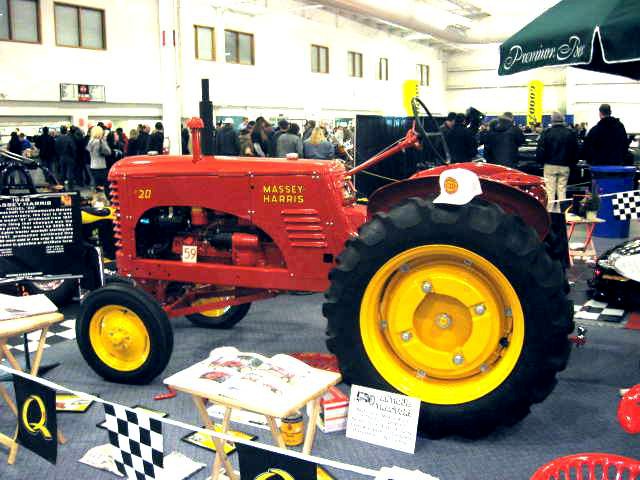
1948 Massey-Harris
In our early years on our perch above the valley, before the trees got too tall, we could just see his farm. It was three miles away, but by road it was seven miles. Ole owned a threshing machine. We would trade work or oats for him to come to our farm with “the separator,” as we always called it. Ole would putt-putt along at a much slower speed than necessary in his 1940’s era red and yellow Massey-Harris tractor towing the machine to and from our farm. Ole never rushed anything. Never. Ole never got excited. Never. Ole would talk . . . but . . . seldom . . . softly . . . with lots of . . . pauses.
He was slight of frame with massive hands at the end of long dangling arms. He always wore a cap, except when he came awkwardly into our house to eat. I waited for that moment when he stood at the door wiping his feet, cap in hand, calling my mother “Missus.” Powdermilk Biscuits would not have cured his shyness, nor given color to his pale skin, which somehow never tanned or burned, nor given thrust to his receding chin.
It was his head I waited to see. He had classic male-patterned baldness, and, here is what I awaited, five large bumps on his head. I do not know why he had them. They seemed benign, and he lived into his late 70’s. But what child could not be enthralled by those bumps!
The Norwegian
Noble—yes, that was his name—was my father’s best friend. And as opposite of my father in temperament as a man could be. He had been a Lake Superior fisherman until the coming of the lamphrey. He switched to farming, with which he needed much help from my father. I liked his name, and he did have a serene Nordic unpolished nobility. But I liked his brother’s name better, Sextus, which always made me giggle. Noble was short, stout of frame, and walked with small slow careful steps. He always bent his upper body forward and furrowed his brow as if deeply worried, which he was not.
Oh, how many stories there are about his kind, gentle, and implacable nature. For instance he once brought back 50 wild yearling steers off the Montana Range, and trustingly left a gate open, letting them escape. We got back 49, one of which died.
One was found as far away as Beaver Bay.
One day when he was about 50 years old sitting drinking coffee at our house, calling my mother “missus,” he casually mentioned that he had married the week before. My parents snorted coffee. It was a women we knew—brusque, demanding, fast-moving, and intolerant of incompetence. It proved to be a lasting, loving, and happy match.
After I moved back to Two Harbors, I often saw Noble. Once I mentioned to him that my backyard had a large pile of firewood which was too punky to burn in our fireplace. He agreed with my suggestion that it would burn in the large barrel stove in his garage, fashioned for him by my father.
Fordson Model F
One Saturday he showed up with a hay wagon pulled by his 1930’s era Fordson tractor, famous for its durability and utter lack of power. Noble had three tractors, one a powerful International Harvester, but he loved to use that old putt-putt Fordson. As he backed it down into the low spot in my yard where the wood was piled, I told him that I did not think it had the power to pull out the load. He thought a moment and said, “Yup, yup, probably not,” and started to load wood. Halfway through the job we went in for coffee. He took off his hat, wiped his feet carefully, and charmed my wife, calling her “Missus.”
As you can guess, the Fordson would not pull out the load. He did not get mad; he just laughed and said, “Yup, yup, you were sure right about that.” He drove the 11 miles home and 11 miles back the next day with the IH, which pulled it out easily.
That was, sad to say, my last meaningful contact with that exemplary man. But I picture him every time I hear the term “Norwegian Bachelor Farmer.”



 Trail Baboon