
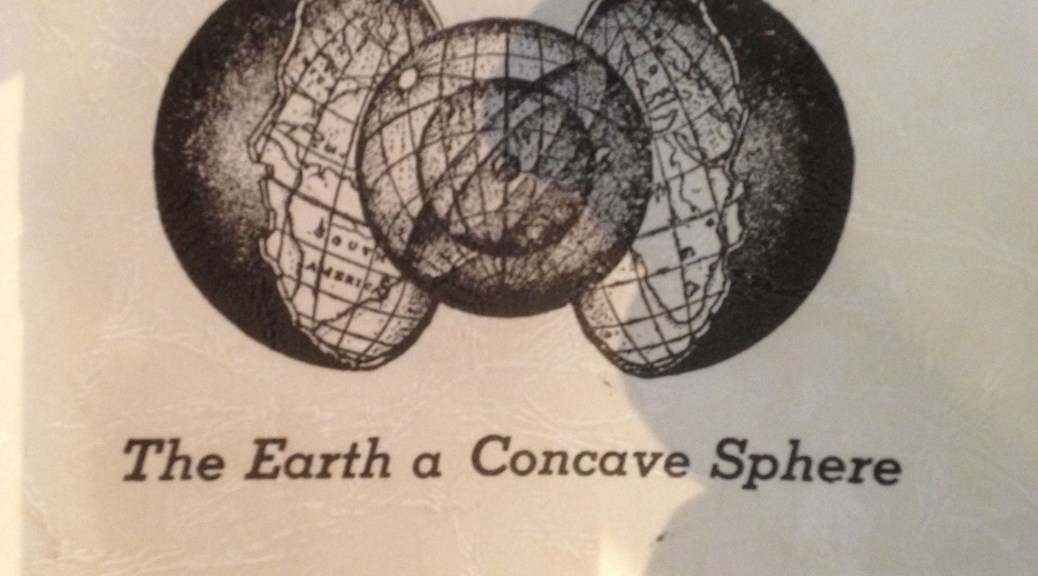
One of the surprises that came out of my recent trip to Fort Myers was discovering the remnants of the Koreshan Unity Settlement – a Utopian community established there in 1894 by a charismatic leader named Cyrus Teed, who believed in some fairly progressive things including the educational value of artistic expression and full equality between the sexes.

But there was at least one thing major thing he got wrong. Teed preached that the Earth was a hollow sphere, and we lived inside it. He thought the globe that we know so well was actually inverted – with the continents pasted around the underside of the curve. Looking up (or inward), you would see a revolving ball of gas that was layers thick, only allowing us to view the refracted rays of the sun, located at the center. The sun, rotating once each 24 hours, was light on one side and dark on the other – thus giving us day and night.
The land beneath our feet was also layered, but digging through it would eventually bring you to the outside of the sphere, beyond which there was … nothing.
Teed and his followers considered the commonly accepted idea of a limitless universe with humans living on the outside of the globe under a distant sun and with planets and stars all whizzing around in their own orbits as inherently chaotic and unknowable, putting God beyond the reach of human understanding. Teed said the Koreshan system “… reduces the universe to proportionate limits, and its cause within the comprehension of the human mind.”
Easily said, though it didn’t take very long for his book, The Cellular Cosmogony, to lead this particular human mind to a state of exhaustion. Still, I would love to have a t-shirt featuring their motto – “We Live Inside!” After all, it’s not that different from the philosophy of Minnesotans in January.
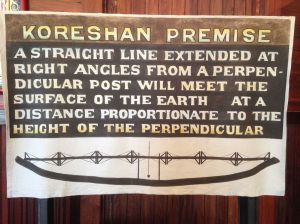
The Koreshans went to great lengths through observations and experiments and words, words, words to support their notion that the wide horizon visible off the Florida coast actually curved up with a smile, rather than down with a frown.
Cyrus Teed died in 1908 and while his utopian settlement lingered for a few decades it eventually faded away. A prime directive of complete celibacy for the most ardent followers of Koreshanity might have had something to do with that. The last Koreshans gave their vast tract of land to the State of Florida in 1961 which allowed for the establishing of a state park.
What impressed me most in this brief encounter with Cyrus Teed and his philosophy was the power a charismatic person with absolute conviction can have over others who are less certain in their beliefs; and once convinced, the amazing ability we humans have to cling to ideas that are completely and obviously wrong.
How do you know you’re right?
 Trail Baboon
i don’t
not any more
it’s an aging thing
LikeLike
I tend to agree with you, Clyde. There are very few things I’m sure of anymore.
LikeLike
but you can’t be sure, right?
LikeLike
Right.
LikeLike
Personally, I find I’m more and more right about less and less (or at least less that anybody gives a fig about).
LikeLike
Funny
LikeLike
LikeLike
Oh the hair!
LikeLike
Good morning. In agriculture I have seen situations similar to that of Teed and his followers. Farmers will some how decide they should trust an agricultural consultant who is a good salesman. When they decide to trust a consultant of this kind they will not believe you when you tell them the consultant is off the mark on some things. Of course, how do I know that the consultant is off the mark. Usually the consultant who I think is wrong doesn’t have any scientific evidence to support what he says and i do have that evidence.
Additional study by scientists can lead to new conclusions, so I can never be sure I am absolutely right when I rely on science. Also, while you can gather good evidence to support a position, it is harder to get the evidence to prove something is wrong. It can always be claimed that there was some fault in the research conducted to disprove a position. However, I am very skeptical of positions taken by consultants that seem to be only a matter opinion or are based on a some untested observations.
LikeLike
I am extremely successful at persuading other people on this topic. It is my firm position that I know very little about anything, and so far I’ve been able to convince others–strangers as well as loved ones–that my low opinion of me is wise.
LikeLike
You have not yet convinced me of that, Steve.
LikeLike
He hasn’t convinced me, either.
LikeLike
Given my nom de guerre is Dr. Bossypants, I find I am pretty good at being right. If I am wrong, it is the other person’s fault for not giving me accurate information with which to make a decision.
LikeLike
Okay, Doctor B. If I can’t come up with an answer to something, I will call on you.
LikeLike
I was delightfully wrong earlier this week. One of the best thing about my job is the consultation I do at Head Start. This week I was observing in the classrooms. The teachers really like me to do this just to check out if there are behavioral or emotional issues with any of the children that they are missing. The children in these classrooms are 3-5 years of age. Some have developmental issues, most are from low income families. In one classroom during free play time I saw a little boy in green shirt and blue jeans who was all over the room. He was a very, very busy boy, loud, rambunctious and never appearing to stop moving or settling down to one activity for very long. Everywhere I looked I caught glimpses of this little guy. After a bit I saw, on my left, a teacher taking him into the bathroom. I looked immediately to my right, and there he was, too! Then I realized I had been observing identical twins, dressed alike! I blurted out “There’s two of them!” The teachers were greatly amused and told me the boys often dressed the same and frequently answered for each other.
LikeLike
Haha I can just imagine my twin grandsons doing that in a few years.
LikeLike
Have you been outside this morning? I know it’s an absolutely gloriously beautiful day, and Daisy and I are going out to the state fair grounds to look at the snow sculptures.
LikeLike
Right? You think I’ve been right in recent memory?
LikeLike
I find this question totally baffling. It seems to imply that there are times I am not right, and that can’t be right.
LikeLike
What she said!
LikeLike
I might know I am right and not know enough to keep it to myself. Half truths often seem to be more acceptable than the truth. They say the truth will set you free. That’s what they say. Is it true?
LikeLike
Actually, I’m right a lot, but I can’t prove it. I remember the high points of things I read, but have a hard time articulating them to others. I can even see where it was on the page, but can’t remember necessarily which book it was from. The people with whom I usually “discuss” want details… I know in my mind and my heart of hearts that I’m correct, I bet I am not alone…
LikeLike
I have a suspicion that I am right at least some of the time, but would say that there is a difference between being “right” and being “correct.” I may have the “correct” answer some days, but not always the “right” one, and vice versa. Today the answer was shopping for socks and a bit of time on the ice rink. The former was “correct,” the latter, “right.”
LikeLike
Like!
LikeLike
i know which way is west . . . . . l hope
LikeLike
AndI know which way is up…… maybe
LikeLike
Loved the story, Dale – you’ve gotta wonder how this Cyrus Teed’s brain worked… talk about a different “world view”.
LikeLike
How do I know when I’m right? I’m not sure I am ever right. Maybe it’s an age thing, but maybe it’s just my lack of self-confidence.
LikeLike
I think you are in good company here on the trail, Edith. Are any of us sure that we are right, other than Dr. Bossypants, and I think she might be exaggerating.
LikeLike
Of course i am exaggerating! I am so wrong so often. I just cover it up well.
LikeLike
Just saw this on FB, posted by Krista:
“If you have to choose between being kind and being right,
choose being kind and you will always be right.”
LikeLike
How wonderful!
LikeLike
I’m a big fan of eccentrics. I have a book called “Eccentric Lives, Peculiar Notions” that includes a chapter on Teed. Before Teed, in the early nineteenth century, was John Cleves Symmes, who also espoused a hollow earth theory. I have a book called ” Banvard’s Folly” by Paul Collins that is especially worthwhile if your taste runs to the eccentric. It includes a chapter on Symmes. If any of the Baboons are interested, I would be willing to share my copies…
LikeLike
I’d love to borrow the Banvard’s Folly… Hennepin County doesn’t have a copy of this one!
LikeLike
Sherilee,
I have an extra copy. You’re welcome to it.
LikeLike
Interested
LikeLike
I thought I was wrong once but I was mistaken.
LikeLike
Snort!
LikeLike
The other axis of the present topic relates to the subject of utopian societies. I personally find them fascinating, not only for the extreme eccentricity of the instigator/founder of these ventures, but also for the inexplicable fact that, no matter how wacko, they always seemed to be able to gather a flock of followers. The nineteenth century was especially fertile ground for “intentional communities”. I have a book called “Escape to Utopia” by Everett Webber that gives chapter-length summaries of a dozen or so of the most notable utopian experiments of the nineteenth century. It’s wide-ranging, droll and engaging, an excellent survey of utopian societies. I don’t know if any of the libraries would have it, but since it’s out of print, that may be unlikely. Copies are available online.
LikeLike
This sounds fascinating, Bill!
LikeLike