
The weekend Farm Report comes to us from Ben.
No rain to speak of around here yet. We had some mist a couple different days, and at least it’s cooler now and I like that.
I see some farmers chopping corn silage. I miss doing that; it was a fun job. It smelled good, it unloaded easy, and it was a very satisfying job. The loads were heavy and if it was muddy that made it harder with the small tractor I used to pull the wagons. For a lot of years, Dad ran the chopper and I pulled the wagons home to unload. There were a few years I did it myself because he was working or retired. Maybe that’s why I just feel like doing things myself so much these days. Yes, fall is coming; I have seen some corn crops really drying out and turning brown both because of reaching physical maturity or because they’re on lighter soils and it’s so dry, the crop is just done. (Especially noticeable in rocky ground; that dried out sooner).
Soybeans are starting to turn yellow and will soon be losing leaves. Not mine, but most or the better-looking crops. My weeds are flourishing in the bean fields. My sister made the comment that she was glad to see some weeds because that meant I wasn’t “drowning the fields with herbicides”. Hmm, Well. All those weeds will be going to seed and making that many more weeds next year. And if the beans dry out but the weeds haven’t frozen yet, that makes harvesting more difficult. Plus the nutrients they’re using that the crop should be using. We can be pro or con to herbicides and chemicals, but we have to be sure we’re looking at both sides of the situation. Crop rotation helps with weed control too, so these fields being corn next year will stop next year’s weed, but those seeds…you know they just hide out and wait.
A few weeks ago, I talked about planting winter rye as a cover crop. I haven’t planted yet because it won’t grow until it gets some moisture in the soil. It’s just hot, dry dirt right now. Chance of rain again Sunday, but that’s the only rain in the forecast. And if it gets too late in the season, is it worth planting? I don’t know yet.
The barn swallows have moved on. It sure is quiet with them gone. We miss them a lot.
Lots of acorns falling. And walnuts. We have one horse chestnut tree I planted from a seed that I picked up outside of our church when I was a kid. Mom says it’s a wonder it ever grew as I was always digging it up to see if it was growing yet. Well, boy, it has a lot of nuts on it now and it seems like 60% of them sprout in the spring. I’ve used the chestnuts for barnacles in plays. And I used to fill my Tonka dump truck with acorns. There are oak trees around the college theater and every morning as I walk in, I step on the acorns and have warm memories.
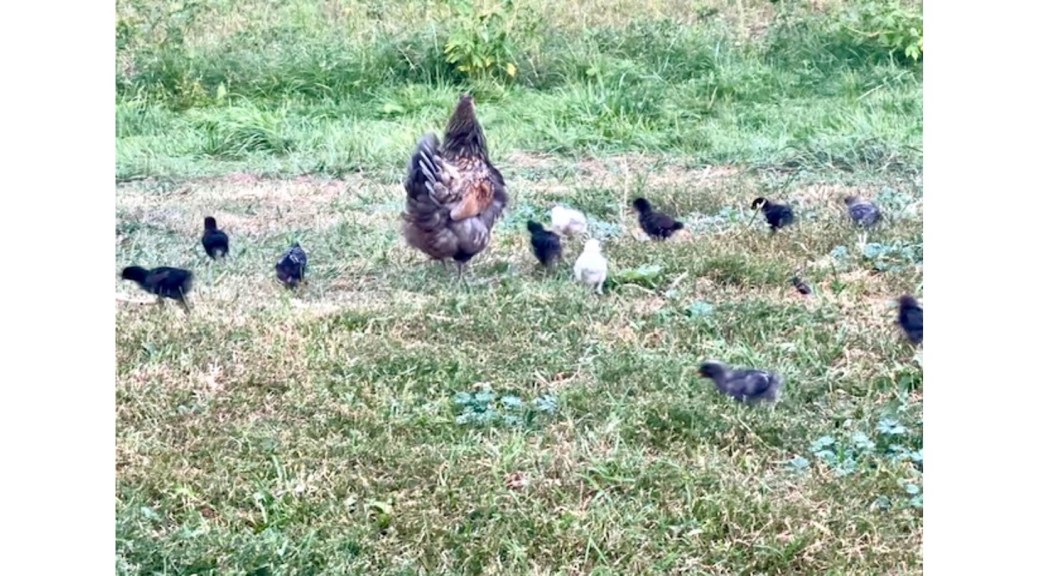
Mother-clucker still has her 13 chicks!
The John Deere Company stopped making moldboard plows this year. A moldboard plow is the traditional looking plow that you’d picture in your mind. The name ‘moldboard’ comes from the biggest metal curved piece that tips over the dirt. That fact it was metal is what made the man, John Deere, famous. From 1837 to 2023, the John Deere company made plows. It’s what started and made the company. It’s a big deal to let that go and there’s been some online debate over it. But that style of farming has changed. The benefit of the moldboard plow was how it could cut the plant roots and turn over that virgin soil. For a lot of years, that was the tool that was needed. These days, as we do more conservation tillage and have equipment that can plant into more plant residue, turning the soil over completely isn’t as critical. At the bottom of the moldboard was the ‘share’. The tip of that was the first piece to wear away from the soil contact. (Isaiah 2:4, “…and they shall beat their swords into plowshares…”)
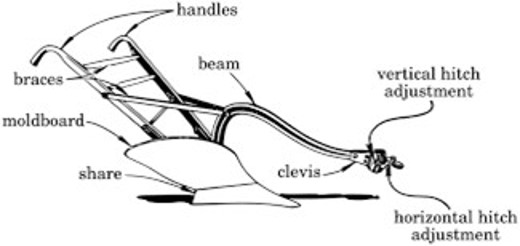
Here’s a website with more about plows and plowing than you knew you needed to know:
I still have a 4 bottom plow at home. I used it when I took some Conservation Reserve ground out of the reserve program and put it back into cropland. Using a chisel plow on sod ground– (“sod” being alfalfa hay, grass, or pasture. Basically, any kind of grassland with the deep, tangled roots) — using a chisel plow, it takes about 2 years for the soil to really break down enough to be workable because it doesn’t turn it over completely or cut the roots so cleanly. I also use the moldboard plow when a neighbor wants part of his hayfield plowed up in order to reseed the next year.
Plowing makes a ‘furrow’ after the last row. That furrow is a trench about 5” deep and 16” wide that you put the tractor tire in for the next round. (If everything is lined up right). At the last round of the field, you try not to make such a deep furrow. That last round is called the ‘dead furrow’. You want to remember how you plowed this year, so the next year you can go the other direction, therefore moving the dead furrow to the other side of the field. Clyde, what would you like to say about plowing? At the end of the field, how did you turn with that? Did you have to lift it or roll it on the side?
Any songs about nuts?


Very first thing that popped into my head is the jingle in the Almond Joy and Mounds
I prefer Almond Joy….
LikeLiked by 4 people
Great minds, VS! Me too!
LikeLiked by 2 people
Simple song
LikeLiked by 4 people
Which brings to mind:
LikeLiked by 3 people
Excellent!!
LikeLike
That was my first thought…
LikeLiked by 1 person
Not technically a nut, but…
LikeLiked by 4 people
I think, as long as tomatoes are considered a vegetable, we can consider the peanut as a nut.
LikeLiked by 1 person
Rise and Shine, Baboons,
I have no nut songs, but all this talk of plows leads to only this old (horse?) chestnut:
LikeLiked by 4 people
Works for me!!!
LikeLike
Well, not necessarily about nuts but it will have to do. https://youtu.be/u90qRE2F7CM?si=_bYl6w6cWB6cxANC
LikeLiked by 3 people
This too!
LikeLike
Well, who can resist Yogi Yorgesson>
LikeLiked by 4 people
I just did.
LikeLiked by 2 people
Had actually never heard of Yogi (well, not this one anyway). I’m not gonna run out and buy any of his records.
LikeLiked by 1 person
Forgive me:
LikeLiked by 3 people
Ben, yes we had a plow just like that. I will explain later. Sandy is taking up my time right now.
Clyde
LikeLiked by 1 person
LikeLiked by 4 people
I am a fan of Patsy Cline. Good one Dr. B!
LikeLike
Well done. : )
LikeLike
Since going crazy is a synonym for nuts.
LikeLiked by 5 people
I wondered if someone would include this. I figured *someone* would. Thanks Wes!
LikeLiked by 1 person
You asked for it:
LikeLiked by 4 people
And to think I might never have heard this!
LikeLiked by 2 people
Nuts, Bolts and Screws
Slade. One of the influential glam rock bands.
If this sounds familiar, you’ve heard their most memorable tune, Cum On Feel The Noize.
LikeLiked by 2 people
We had a single plow for plowing the field for oats. It was heavy clayey soil and we had a 1932 Farmall tractor to pull it. We even had a hitch that would release it from the tractor if it hit a rock which it often did, hence the big rock pile in the middle of our fields. Setting the release point on that hitch was tricky.
But we also had the plow you show above. My father could use it the way pioneers did. Horse reins tied behind his back while he guided the plow. That skill always impressed me.
We used it mostly two ways. My mothers kitchen garden up near the house started right near a drainage ditch. Like everything on our property it sat on a slope. It was hard to use the field plow in its tight corners. The raspberry canes were right beside it. So I rode on the wide back of the draft horse with the harness cutting into my legs so my father did not have to guide the animal. At the end of the row, yes, he had to lift up the back of the plow while I turned in a tight corner. The front end was held up by the chains from the harness,
To move it very far he would lay it on its side and we would drag it across grass.
LikeLiked by 4 people
We had a lot of gardens spread over three properties, by the generosity of our neighbors and we plowed gardens for our neighbors. We often plowed Charlie’s small garden with the horse.
The other way we used that plow was to cut shallow drainage ditches by pulling it on a long chain behind the tractor. The chain gave some slack so my father could manage it better. It usually took a few passes. Driving the tractor for that was one on the tasks I never did right according to my father. My mother eventually gave it to a museum. My father always kept it painted bright red and it well oiled.
LikeLiked by 5 people
Thanks for your memories Clyde.
LikeLike
Oh yeah, that hitch that would release. I think Dad used something like that. There was a special bracket on the drawbar I think?
I saw a video of a narrow board pulled behind the plow and the operator could stand on the board, which sat in the furrow, so basically rode rather than walked.
LikeLiked by 2 people
Another Christmas one, of course:
LikeLiked by 2 people
That’s the only one I had thought of.
LikeLiked by 2 people
Husband and I are both nuts today. It is all because of vegetables. For reasons I won’t go into, we planted 22 tomato plants this year. 14 are Brandywine and Brandyboy beefsteak tomatoes. 8 are San Marzano Roma type tomatoes. The plan was that we would can the San Marzano’s and give the others to the local food pantry. We came home from our trip to Wisconsin to a boatload of ripe tomatoes. The food pantry is only open Tuesday and Thursday. Neither I nor Husband could get there this week due to our schedules, so I just finished canning 12 quarts of tomatoes puree. We also found that a bunny had breached the fence and was munching on the savoy cabbages, so we picked the remaining 4 cabbages. I gave one to a Ukrainian friend for cabbage rolls and borscht, and Husband is making borscht and cabbage wrapped cod bundles in mustard sauce today. That meant I needed to make a pot of the turkey wing/beef shank broth today as well. It made 3 gallons. Husband also got a dozen ears of sweet corn at the farmers market today, and we will cook and freeze that today as well. This is just crazy!
Also crazy is that Sunday is our 40th wedding anniversary.
LikeLiked by 3 people
You make me tired, Renee, just listening! I managed to make a Zucchini and Potato Gratin for lunch…
LikeLiked by 3 people
And Happy 40th! May it be a day of rest!
LikeLiked by 3 people
Wow! You are amazing! Congratulations on your anniversary!
LikeLiked by 3 people
I am ignoring any tomatoes calling out to me from the garden tomorrow. No cooking, baking, stewing, freezing, canning, roasting, grilling, weeding, dusting. All the laundry will be done by this evening. I am laying around tomorrow and doing New Yorker crossword puzzles.
LikeLiked by 4 people
And we are not going to church.
LikeLiked by 3 people
No, I am lying around tomorrow. Fatigue doesn’t excuse poor grammar.
LikeLiked by 4 people
…but as the old joke responds, “ we need the eggs”.
LikeLiked by 2 people
Clearly the English language is…nuts.
Not only does “nuts” apply to seeds, mental health and mechanical devices but also to negative expression.
Of course this telling is fictional but there was a reply from the 101st Airborne that is truthful and “NUTS” was part of it.
LikeLiked by 5 people
As of today Sandra has been in care for two years.
LikeLiked by 2 people
Wow, hard to believe (from here…)
LikeLiked by 1 person
LikeLiked by 3 people
We got a little rain this afternoon. Kelly and I were working on the shed and it was nice to just stand out in the rain for a few minutes. Only ended up with .15″, and I don’t know if I should be grateful or annoyed. I suppose it’s better than nothing, but still.
LikeLiked by 2 people
Out here, .15 is a gift. Wheat and sunflowers seem to need less rain.
LikeLiked by 1 person
Yeah, here too in the evening.
LikeLike
Rained here for about 30 minutes… not a torrential downpour, but better than nothing.
LikeLiked by 1 person
Can’t leave this topic without Monty Python…
LikeLiked by 2 people
AH! Wonderful!!
LikeLiked by 1 person
Good one!
LikeLike
Well, today was a bit more restful, but still busy. The grocery store didn’t have the bread we wanted, so I made two loaves of Farro bread for the week. We unloaded 16 bags of black mulch from Husband’s pickup so he could drive the pickup to Bismarck on Tuesday. Then, we saw bunnies in the strawberries, as they are big enough to jump over droopy sections of the poultry netting fence. We hammered in two new posts and stapled them, while our dear neighbor sprayed bunny repellent around the fencing. Then we had a bottle of champagne.
LikeLiked by 2 people
I knew you couldn’t sit still all day. : )
LikeLiked by 1 person
Sorry to be so late to the party, but happy anniversary, Renee and Chris.
LikeLiked by 4 people