

Photo credit: Greg Messier
A librarian once remarked on the variety of books I was checking out (this was in the era before the automatic check-out stations). I don’t remember what the particular books were, but it was probably a fair assessment; I’m like the moth – easily drawn to whatever light is on in my vicinity.
Last week The Green Bay Tree by Louis Blomfield arrived by my local library. I will admit that it’s been on my Hold list for quite some time; after pushing off the hold date for quite some time, I finally decided it was time to either read it or let it go. I read a biography of Louis Blomfield a couple of years ago – not sure what brought him to my attention – so that’s why I wanted to read Green Bay Tree – it was his first novel, published in 1924.
The day before I picked up the book at the library, the Italian word “semaforo” came up on my daily Italian lesson; it means traffic light. Since I knew semaphore is the use of flags as signals, I looked up the etymology to see how the Italians could get from signal flags to traffic lights. (Turns out to be pretty easy as it comes from the Greek, sema = sign/signal and phoros = bearer. I filed it away in my mental junk drawer.
Imagine my surprise when the next day, on page one of The Green Bay Tree, I came across this:
“Where death had touched the barrier it was possible to see beyond the borders of the garden into regions filled with roaring furnace, steel sheds, and a tangle of glittering railway tracks cluttered by a confusion of semaphore and signal lights which the magic of night transformed into festoons of glowing jewels – emeralds, rubies, cauchons, opals, glowing in the thick darkness.”
This sent me down a rabbit-hole looking for all the various types of signals that have borne the name “semaphore” over the years. I won’t bore you with all of them but I did find this picture: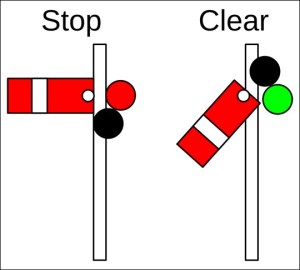
It’s called a railway semaphore, so it’s pretty clear that the Italians aren’t taking a big leap to call their traffic lights “semafori”.
As always I am blown away by the coincidence of coming across semaphore twice in two days.
Any words on the tip of your tongue this week?


Monty Python touches on everything.
LikeLiked by 3 people
Oh I had completely forgotten about this! Thanks.
LikeLike
Thank you! I didn’t know about these…
LikeLike
Dyspepsia, my favorite word for stomach ache which my dad always used to describe it. I don’t have a stomach ache, but when I do I always say I have dyspepsia.
LikeLiked by 5 people
My favorite word of late is tiquismiquis, Español for a fussy person. The spanish speaking crew with whom I’m working have never heard it. Apparently it’s used in Espana not the Americas.
LikeLiked by 3 people
It must be similar to Renee’s fusspot.
LikeLiked by 4 people
Rise and Shine, Baboons,
Vainglorious. I love that word at any time, so not just this week. Merriam Webster provides antonyms, one of which is “biggety.” Biggety is just as good. Both words also perfectly describe a certain criminal ex-president with whom I disagree vigorously. Carly Simon sang “You’re so Vain,” but really it should have been you’re so VAINGLORIOUS, although that does not have the same flow off the tongue.
LikeLiked by 5 people
Whenever we travel anywhere, one of the things I familiarize myself with is where the used bookstores are in the places we will pass through or end up. Back when my youngest daughter was in college in Wooster, Ohio, one of the bookstores in that vicinity or on the way there had a large assortment of Louis Bromfield books. My understanding was that his farm had been nearby. That’s one of the reasons I like to visit used bookstores in other places—their inventory often reflects the place or the interest of the bookseller.
At the time (about 25 years ago) I had not read any Louis Bromfield but I was aware of him. I bought one of his books from that seller, Pleasant Valley. I still haven’t read it but now that you mention it, I will move it into my pile of books in waiting.
A few days ago, BIR used the phrase “while away” in reference to time spent on Facebook. It seemed to me that I had also seen the phrase expressed as “wile away”. Curious as I am about those things, I pursued clarity. It turns out that both are acceptable, but “while away”, which connotes passing time pleasantly, is the older form. “Wile away” earns its acceptability by common usage. Its meaning, though, is somewhat different since “wile” implies trickery, as in a wily plan or feminine wiles. “Wile away” suggests one’s time has been beguiled, which seems appropriate for Facebook.
LikeLiked by 3 people
D’oh. I hate it when I hit the reply button and then realize I hadn’t checked to see if I was still signed in.
LikeLike
Good to know – some days it is wile away, with an occasional while away…
LikeLike
Salubrious, anyone?
LikeLiked by 4 people
Good one!
LikeLike
Eat your veggies.
LikeLiked by 1 person
I just finished George Ade’s Knocking the Neighbors, which is one of the collections of fables in slang. Ade was a newspaper columnist who wrote also novels and plays but is best known for his short fables written with liberal use of slang, both common parlance of the turn of the twentieth century and slang of his own invention. Each fable ends, of course, with a moral. His use of language is very entertaining.
I enjoyed it so much I lent the book to my older daughter and can’t therefore offer an example. I fear that isolated and out of context an example might be lacking anyway.
LikeLiked by 2 people
Cogitating…
LikeLiked by 2 people
Defenestrate
LikeLiked by 2 people
I like it!
LikeLiked by 1 person
It is probably good that the windows of my office don’t open.
LikeLiked by 1 person
I am making two kinds of laminated dough this weekend.
LikeLiked by 2 people
I had never heard the dough for croissants referred to as laminated dough. I am trying a recipe from a new cookbook.
LikeLiked by 2 people
I amalso making Hamburg Franzbrotchen
LikeLiked by 1 person
Oh my! Just looked it up…
LikeLiked by 1 person
I also looked it up. You can just pick up some at Butter crumbs Bakery in Hamburg Germany.
LikeLiked by 2 people
Well, you could come to my house this Sunday for Franzbrotchen and Croissants.
LikeLiked by 2 people
When you are ensconced in Luverne I will!
LikeLiked by 2 people
Not on the tip of my tongue, but makes me laugh –
Cockwomble: British slang term that refers to a foolish or obnoxious person (from definitions.net). And in Yiddish a near synonym would be:
Schlemiel – “inept/incompetent person” or “fool” (from Wiki)
But then you have to go to (because of Laverne & Shirley’s opener):
Schlemozzle – a confused situation or affair: mess, muddle (Merriam-Webster)
LikeLiked by 3 people
Similar to gobsmacked.
LikeLiked by 2 people
LikeLiked by 1 person
“Madam President.”
LikeLiked by 6 people
I was just polled through text messages by a legitimate polling organization (Mercury) about my vote. Watch out. Here they come!
LikeLiked by 3 people
I never respond to polls of any kind.
LikeLike
…except for actual voting.
LikeLiked by 3 people
Just remembered I used the word untoward this week in an email: “hope nothing ‘untoward’ happens between now and then”. According to Oxford, it means unexpected and inappropriate or inconvenient…
It makes me feel like I’m in an Jane Austen novel…
LikeLiked by 3 people
That is one of those words often used in its negative form, but seldom without the negative prefix. “Hope you have a great birthday, filled with toward things!”
LikeLiked by 1 person
Hope. My favorite word.
LikeLiked by 2 people