
The holidays brought me a nice cache of giftcards so yesterday I had a “gift card day”. Dunkin for breakfast on the way to knee therapy. Blicks Art Supply. Barnes & Noble. Taco Bell. A great day.
I spent about an hour wandering around Barnes & Noble. As a dedicated library patron, I have to admit that I haven’t been inside a bookstore since last year when Jacque’s sister was signing her latest book at Once Upon a Crime. Nothing against bookstores but my pocketbook prefers the library system.
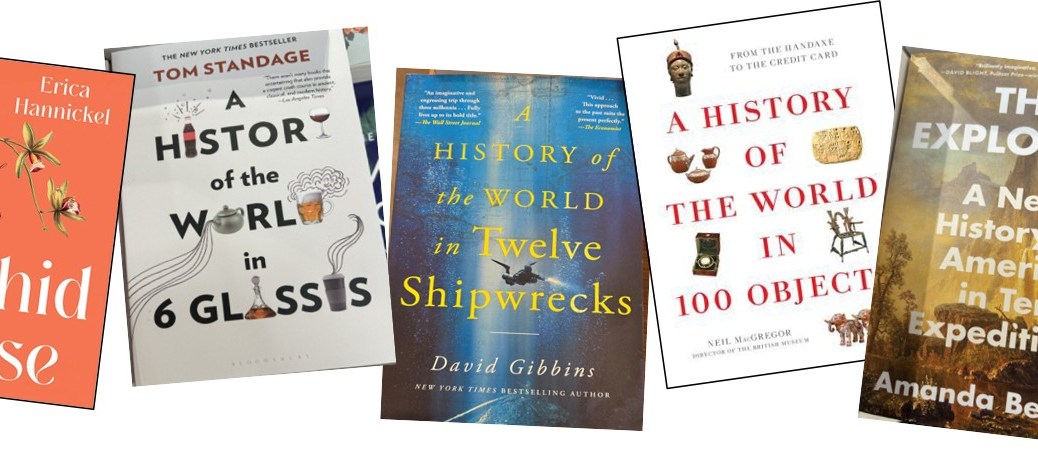
Anyway… as I was checking everything out, I found two tables that had various history books piled up. I’m assuming that B&N stores get table recommendations from headquarters with a few title suggestions but that most of the books are picked for display by store employees. (That’s how it was back in my day in the bookstore.) The history tables had the look of employees having a bunch of fun. History of the World in Twelve Shipwrecks, History of America in Ten Expeditions, History of the World in Six Glasses. Clearly this is a trend and it reminded me of a couple of titles I’ve read – A History of the World in 100 Objects and Orchid Muse: History of Obsession in Fifteen Flowers. 100 Objects started as a BBC radio series – I stumbled upon in once it was published in book form. It looks at objects from all over the world, from as long ago as 2 million years. It was absolutely fascinating. Orchid Muse was a book I read last year as part of my Rivers & Ridges Book Festival experience. The author was at the festival so I got to hear her speak – a lot of extra little details that weren’t in the book.
I didn’t realize that history in a set number of lessons was a thing but if you do a quick internet search, you can find a glut of these books. 47 Borders, 50 Books, 50 Failures, 12 Maps, 500 Walks, 50 Lies. I could go on but this is enough and it makes me wonder if authors are starting out to do a “number of things” or if they have an area of interest and publishers/agents push them in that direction?
Any other suggestions for “History of the World in”…….?
 Trail Baboon
50 Jokes.
LikeLiked by 2 people
100 kind people
100 dictators
100 world changing ideas
100 leaders of the free world
100 typical diets
100 wars for the right cause
100 city layouts
100 plugs of ice from antarctica, dirt from a minnesota farm, from ocean floors in 100 locations
100 guys named al
100 historically obsolete trends that were everyday ways of life
100 playwrites
100 computer data analysts
100 comedians
100 cowboys
100 nomads
100 death beds
it really can go on and on cant it
LikeLiked by 5 people
Good Grief tim, at 6:55 am? I am still waking up!
LikeLiked by 2 people
we all wake up a little differently
LikeLiked by 1 person
tim hasn’t been to bed yet.
LikeLiked by 2 people
… in 100 ways of waking up…
LikeLiked by 1 person
100 songs
LikeLiked by 2 people
100 ways to wake up
LikeLiked by 1 person
Shoot – I wrote that (above) before seeing this…
LikeLike
100 composers
LikeLiked by 2 people
50 Animal Companions
LikeLiked by 2 people
50 means of transportation
LikeLiked by 1 person
LikeLiked by 5 people
Outstanding!
LikeLiked by 1 person
Nice!!
LikeLike
I’m a reader, but, just getting through The New Yorker each week leaves me little time for books. I’m a retired preacher, too, and I remember a suggestion some years ago to try “preaching by the numbers”… lists of “4 things from this parable” or “7 things from this Psalm”, etc.
I recall chagrin about a fellow preacher who had regaled a congregation with “10 Tips for Tired Mothers” one year in May, so didn’t follow the numbers pattern, at least, not so obviously.
LikeLiked by 3 people
100 dances
100 chairs (of course the first one was most likely a rock, so…)
LikeLiked by 1 person
Rise and Shine, Baboons,
I got a cold yesterday and today I am moving slowly! I slept most of the morning away.
Recipes. HIstory of the world in 100 Recipes.
LikeLiked by 4 people
We have about 66 recipes on Kitchen Congress, by my count…we need an editor who can take them and connect them to various eras in history. We might have to pad it a bit to include recipes from long past.
LikeLiked by 2 people
Great suggestions!
I just read the book about how tuberculosis won the western United States. The Stetson hat part was way cool.
LikeLiked by 3 people
You might say that today’s events are an exercise in “alternative history.”
LikeLiked by 2 people
When there are magazine articles, or web links, that promise a certain number of items on a particular topic, they’re called Listicles. The books are taking a page (pun intended) from that strategy. When I asked one of the ten top search engines for an explanation of the popularity of these articles suggested these top five reasons:
Key reasons for their effectiveness include:
Cognitive Ease: Lists break down complex information into a simple, scannable format that the human brain processes quickly and efficiently.
Clear Expectations: A number in the headline (e.g., “7 things…”) sets an explicit promise about the article’s scope and length, reducing uncertainty for the reader and making the content feel more approachable.
Curiosity Gap: Such headlines create a “curiosity gap”—people want to know which seven items were chosen, compelling them to click and read the article to satisfy that curiosity.
Perceived Value: Readers often feel they are getting a high volume of valuable information or “life hacks” in a short amount of time.
Shareability: The concise and punchy nature of listicles makes them highly shareable on social media platforms, acting as effective marketing for the publication.
LikeLiked by 2 people
Well done!
LikeLike
Hmmm.. you should have written this post… love this!
LikeLike