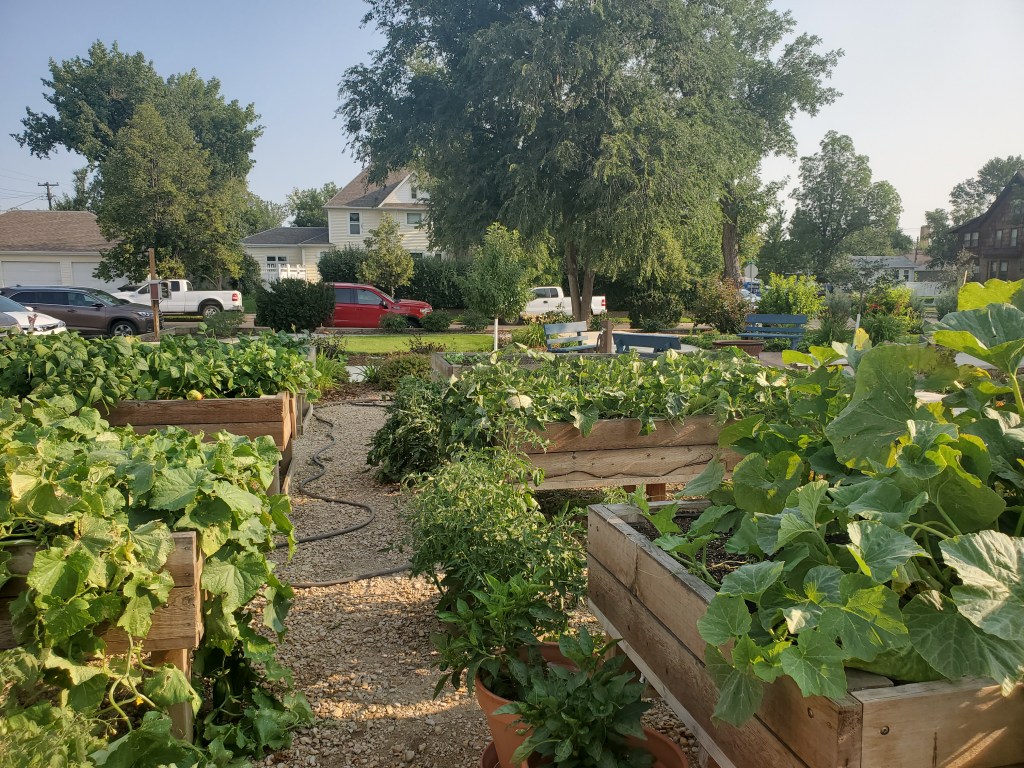
Last Thursday in the late afternoon, Husband and I went to our church to water the vegetables that we and others have been growing there. All the produce is taken to the local food pantry. The veggies are grown in six, 3 ft. high raised beds that you can see below. The rest of the garden is taken up with flowers and shrubs, with walk ways and benches for rest and contemplation.
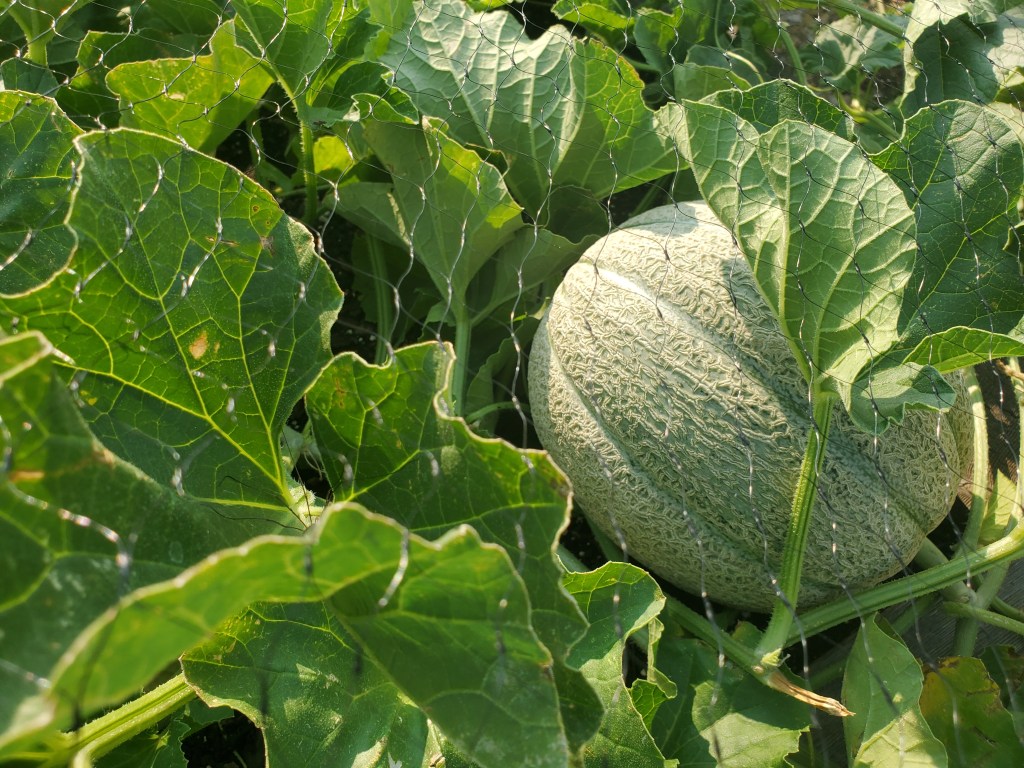
Thursday, everything looked good. There were six nice cantaloupes about the size of soccer balls but still needing to ripen. The squash bed had one hill of bush butternut squash with four nice but still ripening fruits. We had reseeded in the carrot and beet bed as well as the sugar snap pea bed after harvesting the first crops, and all those had germinated and were growing well.
Husband went back to the garden on Friday, and texted me at work to say that half of the cantaloupes were missing. I am sorry to say that when I got to the garden after work, the Lord’s name was taken in vain and a tool was thrown down in anger as we discovered that three of the butternuts were gone as well. You can see the remaining ones.
Nothing else was missing or damaged. I covered the cantaloupe bed with bird netting and stapled it onto the wooden bed so that it would be more difficult to abscond with the remaining melons. Then, we started to hypothesize.
The incident occurred Thursday night. It would be a lot for one person on foot to carry all the melons and squash, so we figured it was either more than one person on foot, or perhaps one or more persons in a vehicle. We drove around the surrounding streets and didn’t find the produce smashed.
Husband wondered if the fact that they didn’t take any cucumbers or green beans, both of which take time to pick, spoke to urgency, which to him suggested possible amphetamine addiction. It was also presumably dark, so that the beans and cucumbers would be harder to see. I wondered if they knew little of gardening, as they took produce that wasn’t ripe. We have two Little Free Pantries on the edge of the garden, I wondered if people availing themselves of the food there thought that the produce was for all to take. We continue to speculate.
We had beets and carrots disappear in the night at times this summer. They were ready to harvest. My reaction to that was “Bless you. You need it more than we do”. I think the reason this recent event made me so angry is that the melons and squash weren’t ripe, and so they were wasted. As James Crockett comments in his Crockett’sVictory Garden, there is no remedy for finger blight.
What have you investigated recently or in the past?What kind of detective work would you like to do? Who is your favorite literary detective?
To wrap up the oat harvest, let me explain test weight and pricing.
There isn’t a big market for oats, so they won’t take the oats if the quality is a little low. By ‘Quality’ I mean if it isn’t at least 32 lbs test weight (That’s the ‘standard’ weight of a bushel of the product. 56lbs for corn, 60 lbs for soybeans, 32lbs for oats). The weight can vary depending on a lot of things; moisture content of the crop, the weather as it grew, the variety, ect. The market price is based on that weight though, so if it’s low, we don’t get paid the full amount because while we deal with the crops in volume (the trucks and wagons it takes to get it hauled in), we’re paid by the bushel. If your corn sample only tests 50 lbs, then it takes more corn to get to 52 lbs and we get docked for the low TW.
My oats samples tested 38 and 39 lbs. The truck is heavier, which means it takes less grain to make 32 lbs so I get more bushels on the truck. But no bonus for being Over TW.
Price this year was $3.58 / bushel at the Elgin elevator (which is closest so most of the oats went there) but they were full so the last of the oats went to another elevator and it was $3.71 there. Heck; if I’d known that I’d have taken it all to that second place!
Remember; hay is something animals will eat; it contains nutrients. Straw is just an empty stalk; there’s not much nutritional value in straw.
Baling straw; it went pretty well this year. No problems.
It might take a while to get the baler working right; get the rust off it, so to speak. I like to bale straw; it’s light and the bales are easy to throw around.
I broke a shear bolt just after starting; a ‘shear bolt’ is protection against something bad happening. It might simply be overloaded or it might be a safety feature against something catastrophic. But sometimes they just wear out. That was the case here.
This shear bolt hooks the baler flywheel to the hydraulic pump for the baler kicker and sometimes it just fails. Then the kicker looses it’s oomph.
In the old days, Clyde and my dad had to have someone on the wagon to catch the bales coming off the baler and stack them on the wagon. I was about 10 years old when Dad bought a kicker baler which ‘kicks’ the bales into the wagon. Less manpower needed. Course, getting them back out is a little more trouble.
In 1993, we hosted 2 men from Russia for a few days. They were here as part of an exchange program with the Farm Bureau. They didn’t speak English, but they had a Russian / English dictionary and we had a good time doing hand gestures. I was baling hay and they rode in the wagon and insisted on stacking the bales as they flew in there from the baler. I tried to stop them; warning them this was dangerous and not to get hit by one. They assured me it was fine and kept stacking. And it’s a wonderful thing; so much easier to unload when they’re stacked, plus I get more bales on the wagon. I’ve been stacking a few ever since. Just the bottom row or two, and a ‘wall’ at the front to help keep the bales in the wagon.
The kicker part of the baler rotates left and right. That allows me to throw a bale in the wagon even when making a corner. And there’s a power adjustment to kick the bale just a little bit or kick it real hard! The average is 3 or 4. It goes to 8, I haven’t had to use it that high unless I’m kicking it all the way over the wagon just for fun. Because the power is based on weight, kicking to the back of the 16’ wagon only needs about 4. If the bales are so heavy it needs 6 or more, then they’re too wet to bale and I can’t even pick them up.
Up or down hills changes that a bit… and making a corner when it kicks can still kick it over the side. All in all, it’s kinda fun.
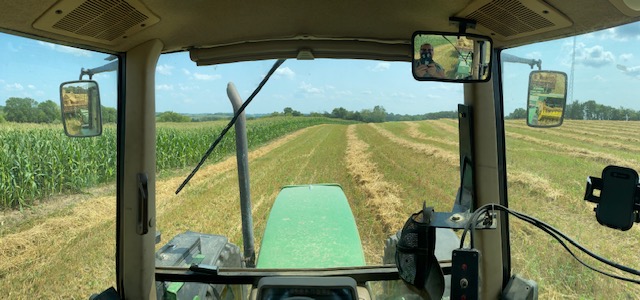
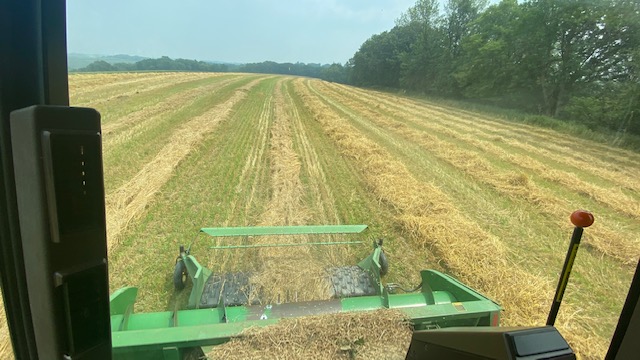
Here’s what it looks like from the tractor cab.
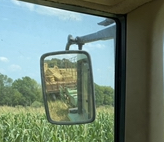
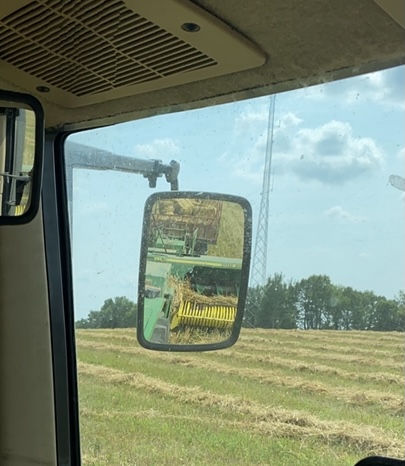
I’m watching my left mirror as that shows the back of the baler and I can tell the bale is good (not missing a string) and I can see most of the wagon. The right mirror shows the row going into the pick up.
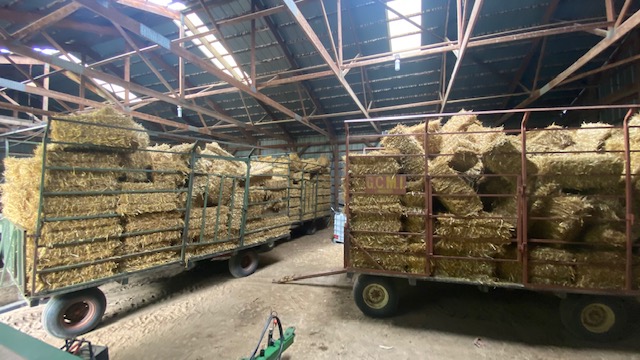
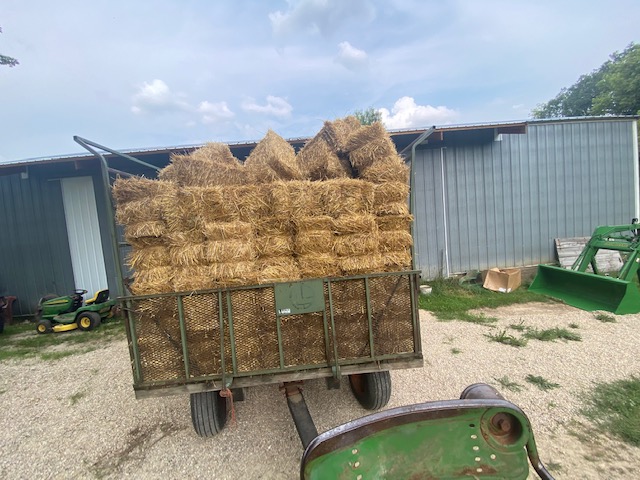
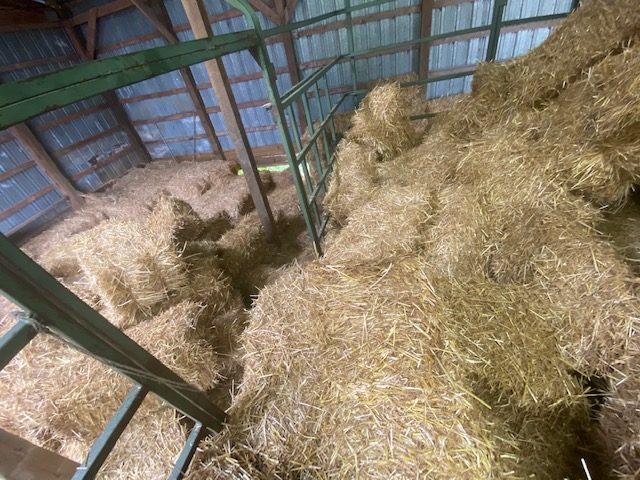
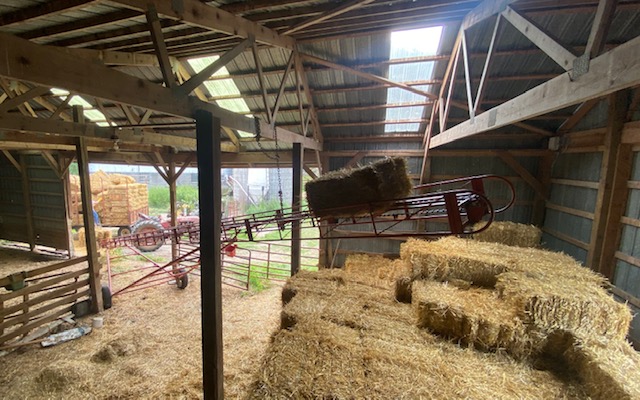
Here’s three loads in the shed.
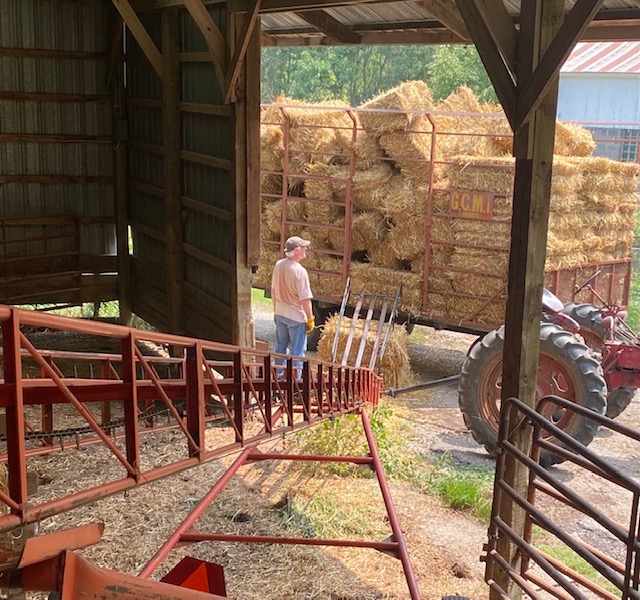
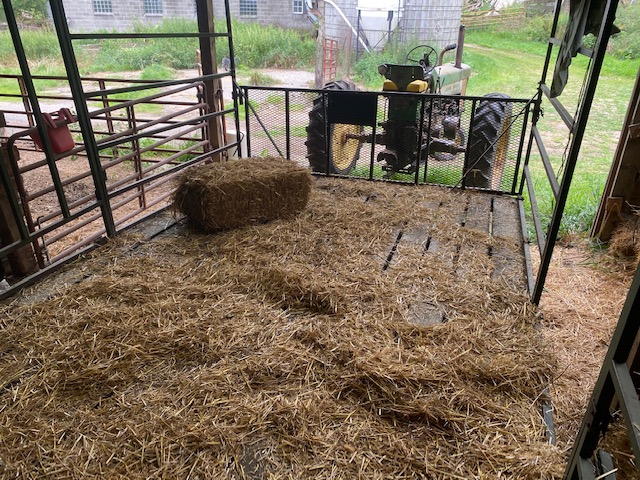
A few weeks ago we talked about backing up wagons. Here’s what it looks like to back up a wagon into the shed:
You need to trust yourself about what’s behind you.
I had about 200 straw bales left in the barn. I baled 612 (there’s a mechanical counter on the baler; each time it ties a knot, it trips the counter). 166 bales (one stacked load) went to the neighbors for their strawberry patch. He’ll use it for cover this fall. The other 446 went in the pole barn. I unloaded one load by myself; back the wagon into the barn, toss a bunch out, get out and stack them, toss a bunch more out. It’s not too hard when the stack is low. It’s too much work once up about two rows.
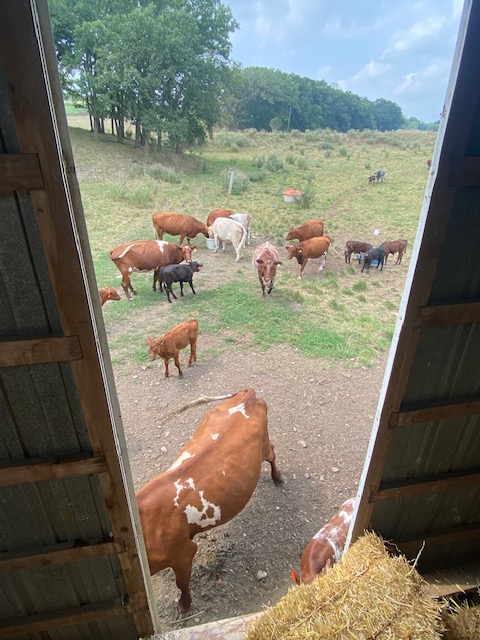
My brother came out; he helped me get the elevator set up and then he and I unloaded the last two loads. The cows came to watch me.
Here my brother is trying to figure out how to start the load
Here comes a bale destined for VS’s garden next spring.
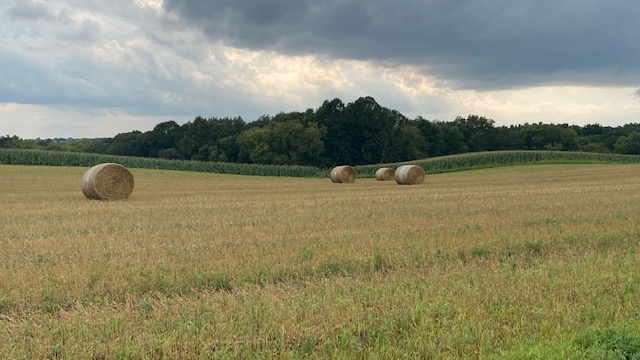
A clean field and the last bale are welcome sights.
I didn’t need anymore small square bales this year so I hired a neighbor to make round bales from the rest of the straw.
I’ll sell them to the neighbor with the cows.
I’ve left off the tractor that inexplicable died. (turned out to be the coil wire). And the dead battery in the other tractor. And the post that has somehow twisted a bit so now the gate doesn’t swing in AND out anymore, so I have to take it off to get the elevator put up.
I did get the hitch welded back on the elevator so that’s one thing.
And I got the second show open.
And time to cut grass again.
Hey! “Straw is cheaper, Grass is free. Buy a farm and you get all three.”
So? “Sew Buttons on a balloon, you’ll get a bang out of it.”
When I was growing up, families in my town who had a lot of money were often looked upon with distain if they demonstrated any public flaws or hoity-toityness.
In the current town in which I live, there are many quite well to do families who face similar scrutiny, none more than the following head of a local family who was recently discussed the media:
I know there is a certain satisfaction to see such folks as the Fishers show themselves for fools. I know that one of my personal struggles is to not rejoice when this happens, but gosh, it is hard not to do so. Pride and greed are sure downfalls for many.
Who were thefolks in your communities when you were growing up who were judged for their wealth? What are your favorite desserts?
Husband is the secretary of our local food pantry Board of Directors. He started out as a simple volunteer on Thursday afternoons, and then they wrangled him to be on the Board.
Due to COVID, all the meetings have been held on Zoom since he started as the taker of meeting minutes. That means he sits at the dining room table and listens intently and writes notes as fast as he can about who said what about which issue. People interrupt one another and don’t identify themselves before they speak or vote. He tries valiantly to type as accurately as he can the proceedings of the meetings. It takes hours of typing to get a rough draft, and then more time correcting the minutes after the other Board officers have perused the document and made their corrections.
The proceedings of the regulatory board of which I am a member are audio recorded so our office secretary can leisurely transcribe them. I have suggested to Husband that they do the same. He isn’t sure they have the technology to accomplish it. I think they do. It may take some wrangling on my part to help him with this. Sometimes, being the secretary is a real pain!
What happened when you had to take meeting minutes? What are your experiences on Boards? Who was the best secretary you ever encountered?
Our friends at the Twin Buttes Powwow last weekend were very excited to serve us fresh fry bread made by a relative named Rhonda. She seems to be well known as one of the best fry bread makers around the MHA Nation on the Fort Berthold Reservation.
Fry bread, for those who don’t know, is a dough made with flour and lard or fat and then fried in oil. It was developed by Native Americans as a substitute for their traditional foods after they were relocated to areas that wouldn’t support the growing of their traditional crops of corn and beans. It is a bread of poverty and hunger, and was first made from US Government commodities doled out to the tribes. Despite its painful history, it is a favorite of many Native Americans, and considered a real treat. I have eaten my fill of fry bread over the years, and Rhonda’s was excellent, light and puffy and chewy, with a hint of sweetness and not too oily.
For years, Rhonda has jealously guarded her recipe and refused to let anyone know her fry bread secret. Last month at a Sundance at Pine Ridge she was there with other family members preparing food for the Sundance participants, got a migraine and, for some reason, started sharing her recipe with all sorts of people, except not with family and tribal members who have always wanted it! My, were they miffed!
What food is essential to your family gatherings? What food do you have trouble understanding why people bother to eat? Have you or someone you knew tried to keep a recipe a secret?
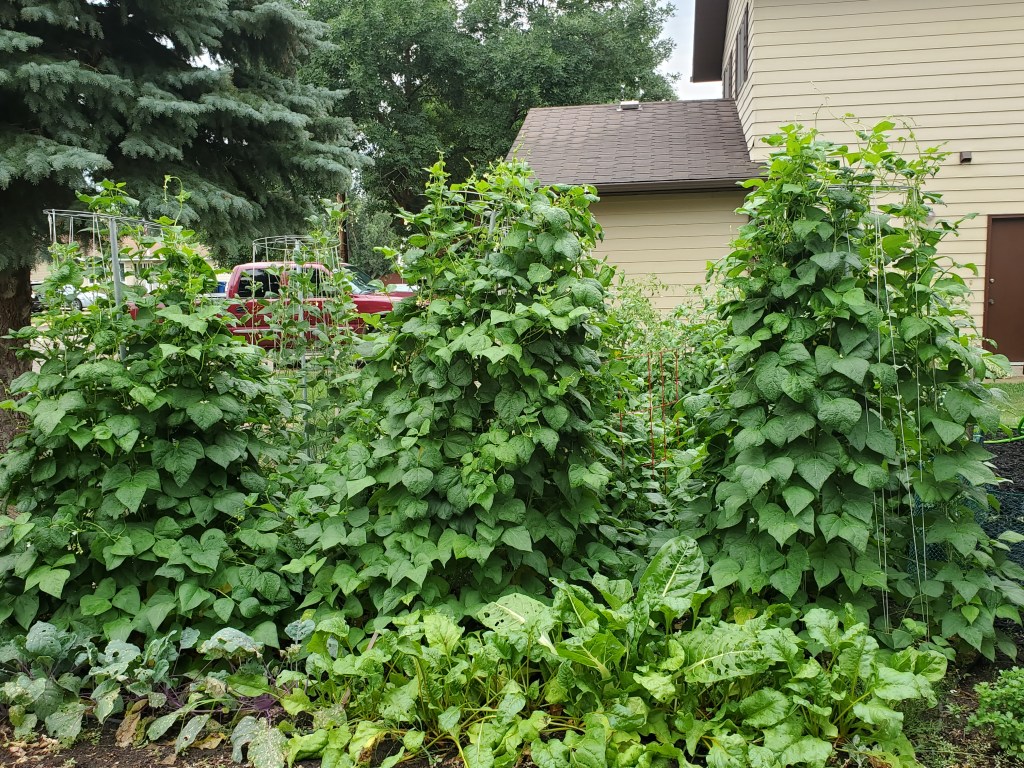
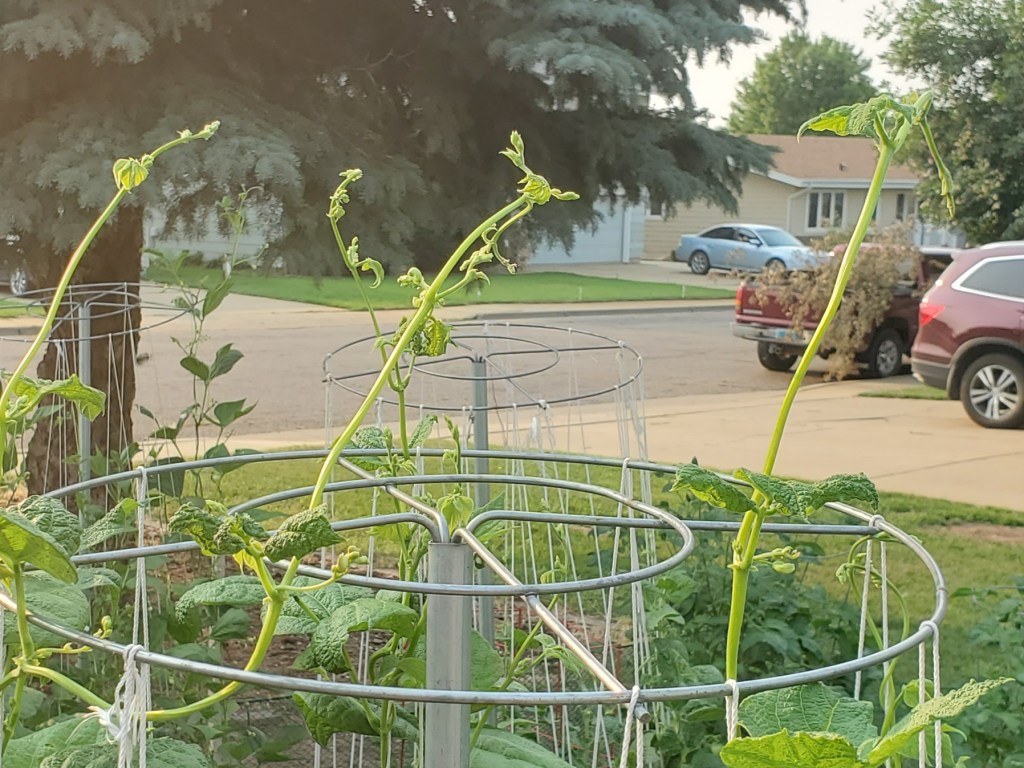
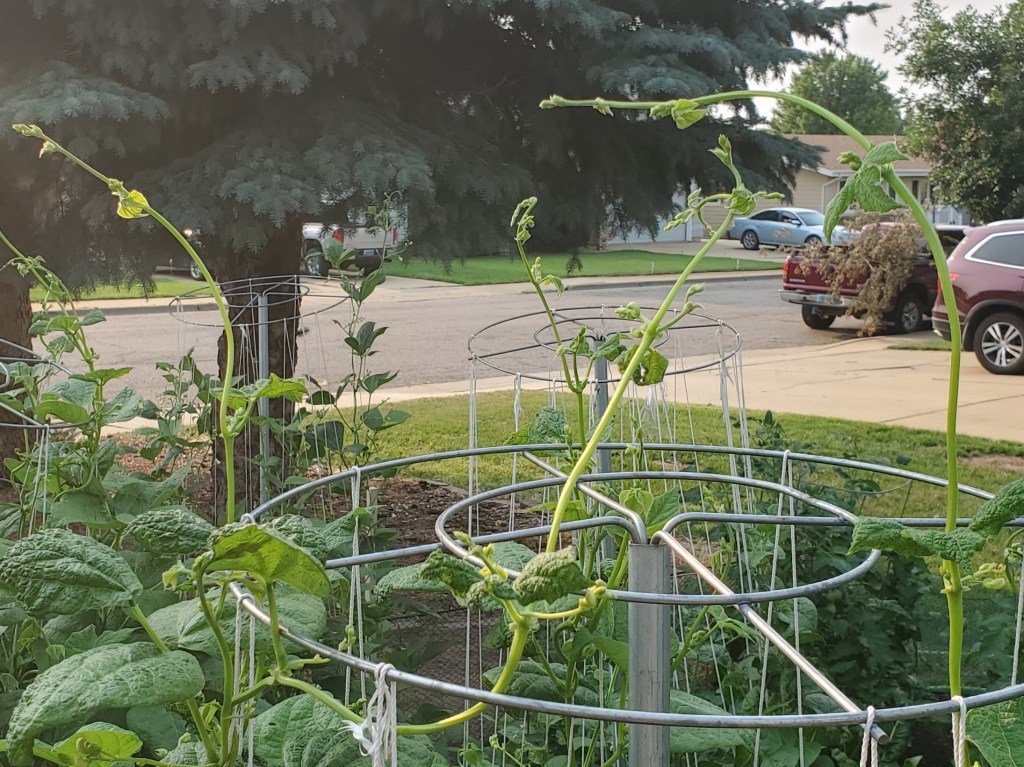
We grow shell out beans and green beans on poles in our garden. It is fun to watch them vine up the strings that we lace from top to bottom for them to cling to. By the time the beans are to the top, it looks like we have a collection of Cousin Its in the front yard. All they need are bowler hats to complete the image. Those are kohlrabi and orange beets in front of them.
The beans always grow beyond the top of the poles. This year I was amazed to track the highest tendrils as they moved from pointing one direction to completely the opposite direction in the space of 30 minutes. They weren’t following the sun, by the way. Husband thinks they were growing and twisting because they are vines, and they grow in a circular fashion. I have no idea. I just liked finding them pointing in a different direction after turning my back for just a few minutes. I hope the following pictures give you a sense of their movement.
The beans pointing southwest at 7:54 AM The same beans pointing northeast 8:26 AM
I know that sunflowers follow the sun until their heads get too heavy and stiff. I have seen our bush cucumbers appear to tilt with the sun. The beans astounded me, as I never saw them rotate so fast or so surreptitiously.
What is your favorite plant to watch as it grows? What natural mysteries have you noticed lately? Any hypotheses about our moving beans?
When last we left the farm the swather was standing on one tire and a jack.
Mechanic Nick came out from John Deere and fixed it up in no time. Now that was a good decision to call them. And $637 later I’m moving through the field again. I was estimating $500. “Labor” was $500… bearing, flanges, locking collar, service call, misc and …. Just put it on my tab. But it’s fixed and I finished cutting oats and the swather is back home in the shed.
I spend a lot of time thinking of ‘what if’s’. What if the machine breaks down? What will I do if I can’t fix it? Who can I call that would know people to come and cut oats? And then, as I near the end it becomes ‘I would just leave this part’, or ‘who has a sickle mower I could use’, or ‘I wonder if the bean head could do this’? This year I learned something. I learned I call John Deere and they can fix some of it. Course it depends what, exactly, has broken.
And what do I think about all day just going round and round? I have music in my head. Last week I had the ‘Mairsey Dotes’ song in there for a while… that annoyed me. Had to work real hard to get something else in there. The first day it was a Pink Floyd song. Got some Led Zepplin going, there was probably a show tune in there somewhere… I can’t remember what finally settled in.
No cab or radio, and I’m wearing hearing protection, long sleeves, and a dust mask.
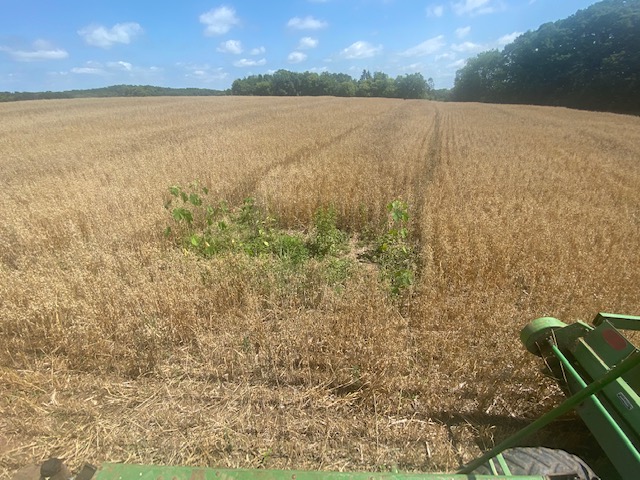
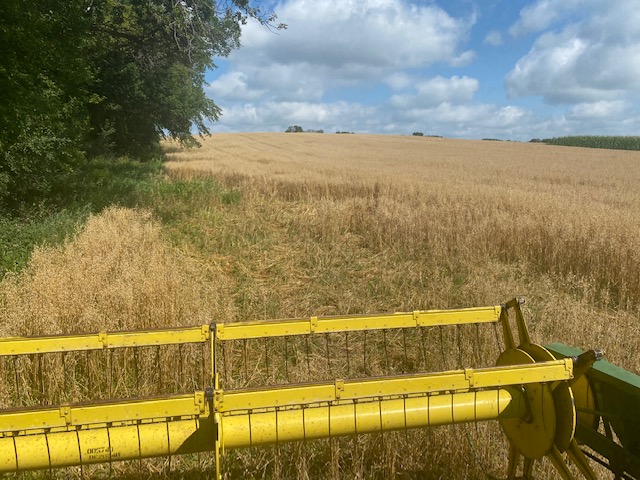
I observe the direction the oats was planted versus the direction I’m cutting it and I wonder if it matters because of how it sits on the stubble; is sitting sideways better than sitting in line? When going the same direction, in line, does it fall down between the stubble more? Hmmm. (It depends how heavy the windrow is). And I leave some stubble so it sits on top of that in case it does get rained on it’s not flat on the ground.
I observe how whenever I stop with the planter, I leaves a gap of a few feet and weeds grow wherever there isn’t grain growing.
Which is kind of amazing when you think about it.
I look at the damage the deer cause and I curse them out a little more.
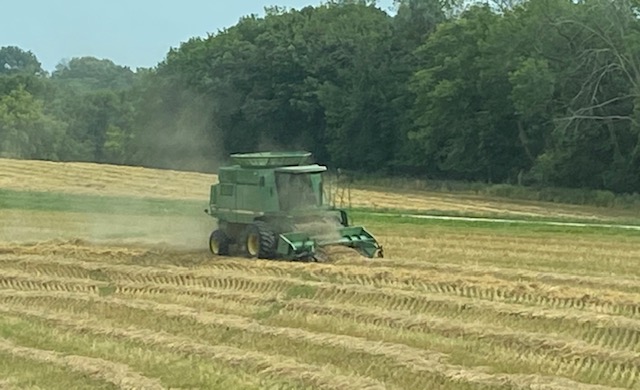
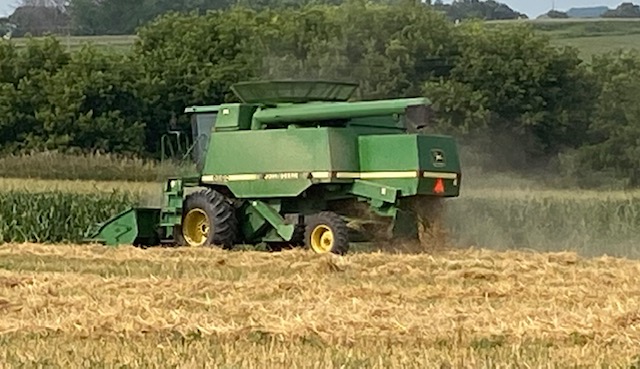
When the combine (we should clarify the pronunciation of this if you’re not familiar. It’s not com-BINE, like adding things, it’s COM-bine. I don’t know where that came from. Subject for another day). The combine has to pick up the oat windrow the same direction it was cut. And that means from the head end. As the swather cuts it, all the heads fall to the back and it’s usually pretty easy to tell. Trying to go the wrong way, it just doesn’t feed into the combine as well.
When cutting, it’s best to make about 4 or 5 rounds all around the field, so there’s room on the ends for the combine to turn around, (and that goes for any crop; corn or beans or anything); we call those the ‘headlands’. And then it can just be cut going back and forth. Corners are tough so we avoid those when we can. Tough in that the machinery doesn’t make 90 degree corners very well, it doesn’t plant well in corners, hard to stay on the row in a corners.
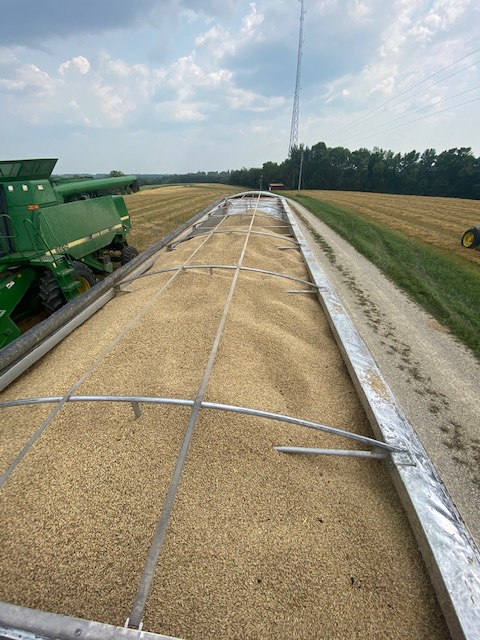
OK, so now it’s Saturday and the combine is here and harvesting and I don’t have any trucks yet. I can’t get the truck guy on the phone. I call another guy from the farm, but he’s over in Wisconsin and he can’t get anyone on the phone either. Finally, we just go to the farm and get a semi and drive it back here ourselves. And, of course, there’s a summer shower and the harvesting is done for the day. Next day he’s back and finishes that field. And a few days later gets the last of it.
I don’t have the final numbers yet, but it looks like a real good crop.
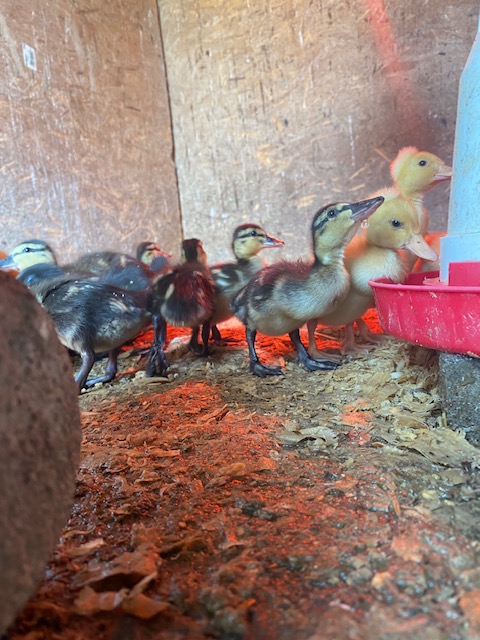
As I write this, I’ve got some straw baled, got another show ready to open, ducklings moved to a bigger pen,
and I’m going to cut the grass!
Talk about when you had to do something yourself. Why is good help so hard to find?
Our daughter was excited to drive us around the Olympic Peninsula when we visited in July. She was equally excited to explore Olympic National Park, not only for the rain forest and the moss, but because of the podcast she chose for us to listen to as we drove.
Daughter thought that a podcast about true stories of people murdered by serial killers in National Parks would be entertaining. It really was, I must admit. There was very little traffic, and we were in pretty remote areas, and it seemed cozy, somehow, like listening to ghost stories in a nice warm room with a fire going and a storm raging outside.
How do you set the mood? What do you like to listen to when you drive or work around the house?
Son and Daughter in Law successfully bid on a new home last month. They close in early September. They matched an existing bid on the home, and the home owners picked Son and Dil. We are all most grateful.
I asked Son why he thought the owner picked them. He said he thought it was because they liked the bank they were working with better than the bank the other bidders were working with. I thought that was reasonable.
A couple of weeks ago Son and his wife took another look through the house, and ran into one of the owners. The owner, a very religious person, told him that they chose Son’s and his wife’s bid after concerted and serious prayer because they both had Old Testament names. How random, but again, we are grateful!
It is said that William Lyon Mackenzie King, an early 1900’s Prime Minister of Canada, used to make important government decisions by flipping open the Bible with his eyes closed and taking as an omen whatever verse his finger landed on. I find that alarming. I tend to use my head and my heart to make decisions, but mostly I decide using my heart. Sometimes, though, following my heart and instinct has led to disaster. It is only through a timely intervention by my head that I can proceed.
How do you make decisions? Tell of important decisions you or others have made that worked out or didn’t work out? Why or why not?
Early in this blog’s history, we had a contributor who wrote exceedingly well and who was excited about life and his role in the world. His name is Aaron. Aaron was a reader and regular commentator in those early years.
This week, Dale Connelly, the founder of this blog, contacted me and Sherrilee about posting some writing by Aaron’s sister, Jessica. Dale commented:
“Aaron has multiple disabilities and gets around primarily in a powered wheelchair. You may have seen him at some of the State Fair shows back in the day. His family is organizing a Zoom event next Saturday, (August 7) to premiere a short (55 minute) documentary about Aaron and the difficult decisions his family faced when he was born. The event is also a fundraiser to gather money to replace Aaron’s accessible van, his primary form of transportation.”
We thought this was a great topic for a post. I have communicated with both Aaron and his sister, and this is how Aaron describes himself:
Aaron Westendorp is a musician, online variety music show host, and a self-advocate in Hopkins, Minnesota, who uses a communication device. Aaron has a brain stem lesion which causes spastic quadriparesis, a partial paralysis from the eyes down. He still has a independent life and a fun personality.
The following is a heartfelt statement from his sister, Jessica Westendorp:
I could have written a different speech every day this year, that’s how many different feelings I have about Aaron and growing up with Aaron. I have humorous, light, jovial speeches, and dark, scary, cynical speeches that underscore Aaron’s evil side. Just kidding. Aaron doesn’t really have an evil side. That Aaron is a bright light, most of you already know. He has always been a calm being, open and waiting for whatever the next step might be. The only time I can remember Aaron loosing his cool was for a brief period in the 5th grade when math and after school studies pushed him to desperation and low lows. He got angry. In that time there was a moment when Aaron looked at me and sighed and it was if he said to me, “so…this is how it is”. And then, he was fine again, calm, collected, open and ready to keep going.
Aaron is disabled. I know this is news to you. It’s hard to see the disability when there is so much AARON to see. But, in case you didn’t get the memo, he is special, differently abled, challenged, a short bus super kid. Other words that were used on him were Duke, Duker, King of Kids, and because there is only so much wonder and excitement I can allow to follow him around, he is also a bratty kid brother.
Aaron’s disability was large. It was another person in the family always taking all of the resources and lightness out of anything. Trips to anywhere were filled with, “but are there curb cutouts? Can he fit through the door? Are there steps inside? Will we need to ask for special help maneuvering or accessing the bathroom?” And then, the weight of carrying all emergency equipment and healthcare needs with him. The backpack needed to be packed and repacked. He needed help with shoes and jacket. He needed to be loaded into the van and tied down. Then Jill and i would translate his finger spelling, “why don’t we go on more family outings?”
I feel heavy and angry re-living that. It was not glamorous. but, the humor helps. One time, when we were all tired and in a long stint of hard times, Mom and Aaron, and Jill went to Burlington Coat Factory. They got out of the van after parking in the handicapped spot. As my mom walked away from the van someone snarked about her use of the handicapped parking spot. Used to public perception often being askew there would usually be a kind reference to my brother or ignoring the problem. On this day my mom said, in her voice we all know as the “mom is not in a great place voice”, “WE ARE HANDICAPPED!”. “we”. “are”. “handicapped”. We are not, and yet, we are and the clashing perceptions combined with the fatigue of it all was the hilarity. And then, there were the helpers. The nurses and PCAs were there ALL THE TIME. Whether they wanted to be or not, they became part of the fabric of our family. They may remember us as a job. I remember them being in my home, sharing a space, and I remember processing my life in front of them. Like any family members some were super duper cool and others, we’ll say, clashed with our brand of special. But, they were there. They helped support the constant needs. Food prep. treatments, mobility, translation. My favorite of these people were those that understood the need to keep the light, the humor, and the irony alive, even and especially when I could not find these.
This all must have been so different for my parents. They had a childhood, a million years before and now they had the weight of this adulthood that they finessed and juggled and braved with faces of intensity and love. But for Jill, Aaron, and I this was our childhood. The pieces of it leave deep impressions. The shiny medical equipment, the smells of medicine, the short quick pace of a nurse who is tasked all become your normal. I will always be a force of quiet, deep love, forever broken by the immensity of daily, weekly, monthly, and yearly struggles that are inexplicable in this speech. I am full of gratitude and am privileged to have learned so much, but due to broken perceptions and realities faced and viewed often, I will also carry a force of anger, always, a deep understanding of disparity and injustice.
Thank you for showing up. Thank you for loving the little brother i worked hard to push and challenge. Thank you for loving this guy who I prayed for, who was surrounded by the light of many prayers. Thank you for knowing that there is no clear narrative here, only people with real needs, hopes, and aspirations all in real time.
Here is the hyperlink to the video regarding Aaron.
Who do you know who has overcome adversity? How did they do it? How have you overcome adversity?











 Trail Baboon