Category Archives: books

Rules of Engagement

When I was in junior high I never did really figure out how to diagram a sentence.  In my mind’s eye I can still see the examples that the teacher had written up on the board but I’m pretty sure if it were ever on a test, I probably missed that question.  I think my grasp of the English language is sufficient without that bit of knowledge.  Although I couldn’t point out a dangling participle to safe my life, I do recognize the subjunctive.  In fact, I remember how excited I was that the first paragraph of Uprooted by Naomi Novik not only mentioned dragons but also used the subjunctive correctly.  Twice!

Correcting someone else’s English use isn’t a habit of mine; since I can’t claim perfect usage, I stop short of deciding if anyone else does.  In fact, I’m re-thinking the idea that anyone has perfect usage.  Bill Bryson’s Mother Tongue (which I just finished) has pretty well convinced me that most of the “rules’ that we think know were just made up (fairly willy-nilly) by folks whose only qualification was their strong opinion!

Imagine my surprise when I found that someone else obviously had a strong opinion about grammar.  I turned the page on a book yesterday to find the above edit.  In red pen in a library book no less.  I can’t imagine that anyone would care enough to do this. It’s clear what the author meant – I’m sure every single person reading this book knew exactly what she was saying.  Makes me think of a t-shirt I’ve seen online recently that made me laugh:

I doubt seriously if this “correction” will give other readers an “ah ha” moment.  No one will look at those red letters and say “Oh, I’ve been using that and because wrong all these years”.  So I’ve decided that I don’t care if the way the sentence is written is wrong by anybody’s standards.  I DO think it’s a heinous crime to write in a library book in red ink.  `Nuff said.

Do you write in your own books?  Margins or editing?

Letters

The rabbit hole that is the internet never ceases to amaze me.  A few days ago I stumbled across a YouTube video called LettersLive.  It was Oliva Colman reading a 17th century letter from a wife to her husband.  It was hysterical.  Since then I’ve found several other clips of letters ready by other celebrities.  I adore letters – some of my favorite books are epistolary (Guernsey Potato Peel Pie Society, Daddy Long Legs, Cold Comfort Farm and Julie Schumacher’s Payne University series).  Turns out that LettersLive is actually a series of live events that began back in 2019.  I’ve found four of them so far. There are usually 20 or so letters read during the evening, many of them funny, many of them insightful, some of them incredibly touching and almost all thought-provoking.

Letter-writing is certainly one of our lost arts.  I remember Steve writing to his friend every week until his friend passed away; it was an amazing feat.  When YA was young, I used to send a letter to Nonny and JB every week – mostly just bullet points of the week along with a page of photos.  I send a lot of cards these days, but don’t consider them letter-writing.   Watching the LettersLive has made me think maybe I should start up the Nonny habit again.

LettersLive is sponsored by Montblanc, which seems perfect but funny.  Celebrating letters is “write” up their alley but what they are sponsoring are live performances and a technology-fueled YouTube site.  I can’t think of anybody better!

The only problem with LettersLive is that there aren’t endless quantities; they are not putting up new YouTubes every week.  Once I’ve listened to all the letters read at the four events, I’ll have to wait until the next one which is in Berlin sometime later this year.  I’ll have to dole them out to myself carefully!

Do you remember the last hand-written letter you received?  Or wrote?

Hausgeist

Husband was at the local college library the other day and saw a book that he thought I would like. He checked out Hausgeister! Household Spirits of German Folklore, and it has been quite a fun read. The book details the various spirits that inhabit German folklore, and outlines the origins and changes in attitudes regarding these characters over the years. Most Germans believed that their homes, particularly farm homes, were inhabited by these creatures, and that the world around them was as well. It was easy to believe in them in the times when houses were poorly lit and were heated with fireplaces. All you needed to be mindful of was making sure you fed them what they liked to eat.

Most of the myths were about kobolds, male household gnomes who helped out with the housework and farm chores. Wichtel were spirits who lived in communities below mountains. They were also helpful. Draks were small fire dragons that could be either good or evil. They entered the house through the chimney. Holzfraulein were female spirits of the forest. Geldmannlein brought people money and looked like weeds.

The Brothers Grimm wrote extensively about these creatures in addition to writing their fairy tales. Tomte and Nisse are their Scandinavian counter parts. I think there is a Finnish character called Sit Behind the Stove. I think we have a kobold in our dining room who rolls the dog’s balls out from underneath the buffet. Something manages to do it. The ball rolls under, and a few seconds later rolls back out. A kobold is more fun to imagine than uneven flooring.

What hausgeist would you want to have? Favorite fairy tales?

Bowled Over

Around Christmas I decided that I wanted to re-read the Inspector Gamache series of books by Louise Penny.  They were favorites of mine when I first re-read them and I enjoyed the tv shows although I wasn’t happy they cancelled after the first season.  Short sighted.

I’m on the third book right now, listening to it on CD in the car.  Last week there was a huge thunderstorm in the book and Louise wrote one of the characters as saying that their mother had explained thunder as “angels bowling”.  This caught my attention because this is exactly what my mother told me about thunder when I was a kid.

As an adult I know in my brain that thunder is caused by the shockwave of air that expands rapidly around a lightning bolt.  But it’s way too easy to remember bowling angels or the Zeus in Fantasia orchestrating a huge storm. 

What kinds of stories were you told as a child to explain natural phenomenon?

Chewing on Words

I’m still working at my Italian every day… some days more than others. Having done some Spanish and French in my youth, I love seeing some of the resemblances. Every now and then though, I get thrown for a loop. Yesterday Duolingo served up “in bocca al lupo” for “good luck”. In bocca al lupo means literally “in the mouth of the wolf”. I have actually heard the phrase “buona fortuna” in the past so finding a reference to a wolf sent me straight to the internet. Apparently In the mouth of the wolf is when something needs to be warded off… like when they say “break a leg” in the theatre. “Buona fortuna” is your basic good luck.

Thinking about this reminded me that a few months ago Duolingo let me know that “bookworm” is “topo di biblioteca” which translates to “mouse of the library”. Fascinating. In looking into that one (yes, I do check up on Duolingo occasionally), here are some others I found:

• English/Serbian/Russian/Thai – bookworm
• Italian/Romanian – library mouse
• Arabic – book moth
• Chinese – book fool
• Greek – book eater
• Danish – reading horse
• French – ink drinker

Of course the reading horse is the most intriguing (PJ, is this correct?) but I think it’s interesting that there are so many varieties. Just a side benefit to learning a new language!

If you were asked to come up with a better phrase for “bookwork”, what would you choose?

My Archivist

I am not a really neat and organized person when it comes to putting away books, recipes, and media such as LP’s and CD’s. I will eventually get around to to when the volume of clutter starts to bother me. Husband, on the other hand has taken it upon himself to be the archivist, reveling in putting things way alphabetically and with similar content. It has got to the point that he doesn’t want me to search for recipes in the binders he has created, insisting that he get them and put them back. He has them organized just so, with the categories just the way he wants them.

It has been quite hard to have all our books in boxes in the furnace room while we wait for the mitigation company to send the guys to put the basement furniture back where it belongs. They said they would be at the house on Monday, but didn’t show up. I plan to send a pitiable text to the foreman pleading with him to speed things up. The bookshelves are behind a bunch of other heavy furniture so we couldn’t get to them and move them if we wanted. We are going to dust off every book before it goes back on she shelf. There are a lot of preliminaries before the archivist can get to work and arrange the books to his liking. I don’ t know what his plan is for organizing them on the shelves, but I am sure that whatever he comes up with will make sense to him, at least, but not necessarily to me.

What job would you want if you worked in a library? Tell about the best library you ever visited.

Hurry Up and Wait

My mother trained me well.  Get to the airport with PLENTY of time.  My travel career cemented this for me.  2 hours for a domestic flight, 3 hours for an international flight, 1½ hours for a connection – this is my general rule.  Too many variables, too many possibilities for things to go wrong (flights late, long lines for security, people behaving badly, etc.)   I will admit that I do make an exception for flying out of the Humphrey Terminal – usually just 1½ hours prior is OK for me. 

Last week as I was heading to Nashville it seemed as if every employee at Humphrey was in a hurry.  I stopped at a check-in kiosk to get a paper boarding pass (just in case) and when the attendant saw that I had my phone with an electronic pass, she tried to shoo me through (unsuccessfully).  At security, where you normally have to wait behind the line until it’s your turn, they were pushing folks up in line – like social distancing had never been a thing.  Then the TSA folks were practically putting your stuff into the plastic bins themselves.  They did still make everyone take their shoes off (except the man in front of me – not sure he could have stooped down to take them off anyway) but they were gung-ho in arranging your stuff and if it was too crowded, THEY were grabbing an extra bin to accommodate things.

Of course it meant we all got through check-in, security and TSA in record time.  In time to sit at the gate for 1½ hours!  Oh well, I had a good book. 

Tell me about your travel habits!

Tomatoes of Wrath

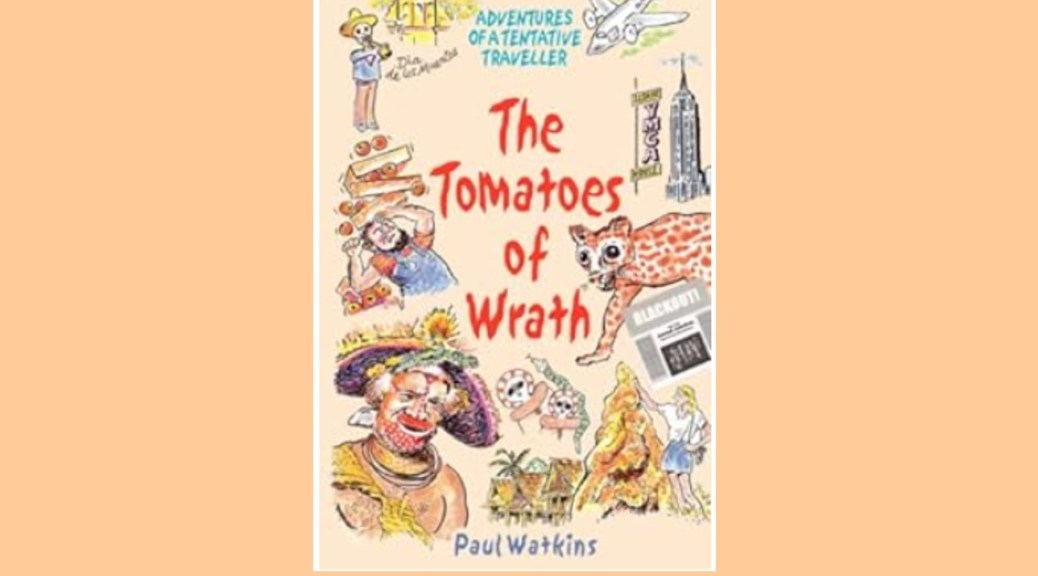
Remember last May when I watched all those killer tomato movies?   I watched some of them online and so found a lot of assorted information, including several sites that said the initial movie was based on “the best-selling novel The Tomatoes of Wrath” by Paul Watkins.  I couldn’t let that pass by, now could I? 

Couldn’t find the title either in my library system or the inter-library loan, but I did find it online.  Please don’t ask me why I thought this was a good use of $12 – I don’t remember what mania overtook me that day.  It showed up promptly and then sat on my nightstand for several months.

I’m here to say that whoever says the movies were inspired by this book is a lunatic.  The book is subtitled “Adventures of a Tentative Traveler” and there isn’t a killer tomato in sight.  The chapter titled Tomatoes of Wrath is ostensibly the account of Watkins when he picked tomatoes for a day in California however most of the story is a reminiscence of the three days he spent sightseeing in San Francisco.  And not a very well-constructed nor interesting reminiscence.  (And I have to admit that after reading this chapter, I didn’t read the rest so I haven’t the vaguest idea WHY was traveling around with no money, hence needing to go out to pick tomatoes.)

When he finally gets back to the tomato picking, it is more of an expose (although a very short expose) on farmers vs. pickers and the injustices meted out by the tomato industry onto workers.  On the next to the last page there was a mention of Grapes of Wrath, comparing the Joads’ struggle to survive picking fruit in California and how unfairly and unjustly they were treated.  Hence the title of the chapter and the book.

All of this is to say, I didn’t like what I read of the book and to think that the Killer Tomato movies were inspired by it is ludicrous.  After this critical review anybody still wants to borrow it, just let me know!

Do you read the book before you see the movie?

Sit Behind The Stove

A favorite book when our children were growing up was “Louhi, Witch of North Farm” by Toni de Gerez with illustrations by Barbara Cooney. It is a story taken from the Kalevala about Louhi stealing the sun and the moon and hiding them. The hero, Vainamoinen, eventually gets them back with the help of Seppo the smith.

A minor character in the book is Sit Behind the Stove, a character from Russian mythology, who lives in Louhi’s cottage. Husband sketched pictures of Sit Behind the Stove, which our children loved. I imagine Louhi’s kitchen looking like this:

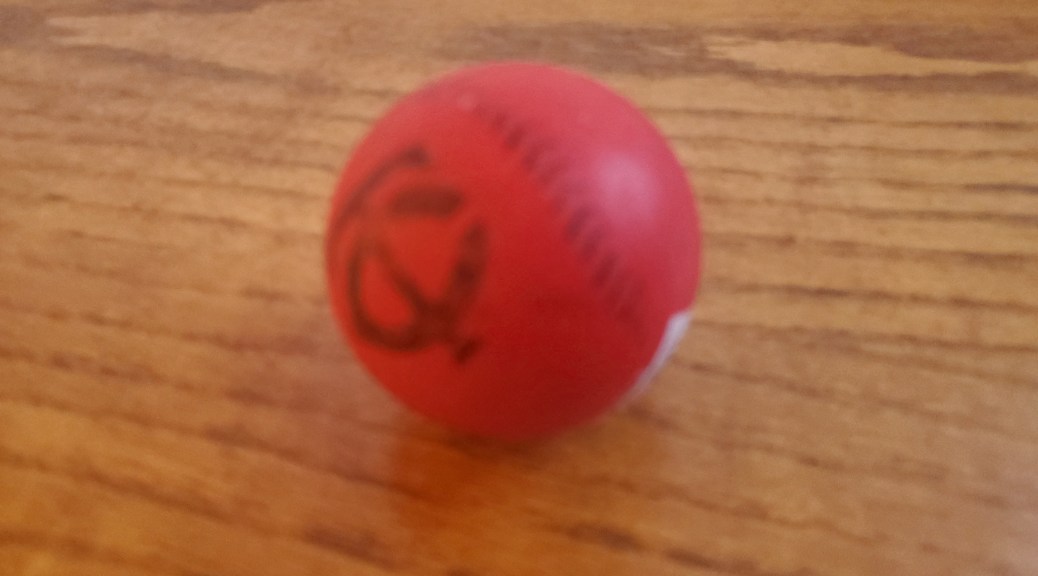
I hadn’t thought about this until recently when Kyrill our Cesky Terrier found a small red ball in the yard and brought it in the house. It is an official Minnesota Twins T-Ball that he loves to chase. At times the ball seems to have a mind of its own, as it is ultrasensitive to even the smallest imperfections and dips in our laminate flooring in the dining room and living room. It gains momentum for movement with every dip in the floor and then rolls. Kyrill has learned that if he tosses it under the furniture it will eventually roll back to him. He watches intently to see where it might emerge, and then pounces on it.

The other day the ball rolled under the buffet in the dining room. When that happens, we usually have to retrieve it for him. After a minute or so, though, it magically rolled back out! It was rather unsettling, I admit, and I imagined that Sit Behind the Stove or perhaps a tomten must have tossed it back out.

Who or what are your favorite mythological characters?

Long and Short of It

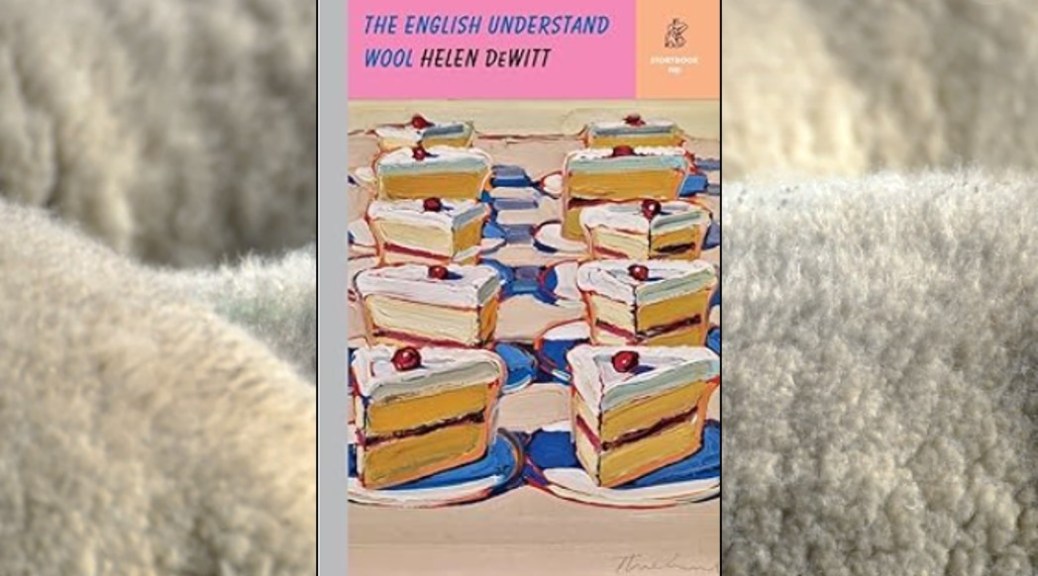
Several weeks back Linda (I believe it was Linda anyway) recommended The English Understand Wool. I don’t even remember what we were talking about but I thought the title sounded quirky so I looked it up on the library website.  It had a good-size waiting list and I noticed that the author was Helen DeWitt.  I almost didn’t request it because I remember how long DeWitt’s first book was… The Last Samurai… almost 600 pages and DENSE. 

The Last Samurai was enjoyable, although a little sad in some places.  I try not to let long tomes scare me off so I went ahead and clicked on the “Place Hold” button for Wool.   Imagine my surprise when I went to pick it up on Saturday… just 69 pages!  I read the whole thing in about an hour – so I read it again. 

I’m reading another fairly short book this week – The Pluto Files by Neil deGrasse Tyson.  I wasn’t sure how long it would be before I requested it (yes, I know I could look up page numbers on the library site if I wanted to….) but I would have guessed that it wouldn’t be too terribly long.  Neil’s books aren’t usually really long; I assume he works hard not to overwhelm his readers with all he knows. 

Not sure how long my upcoming requests will be but I feel like a massive tome would be OK since I’ve had a few short books in a row now.

Do you know the longest book you’ve ever read?