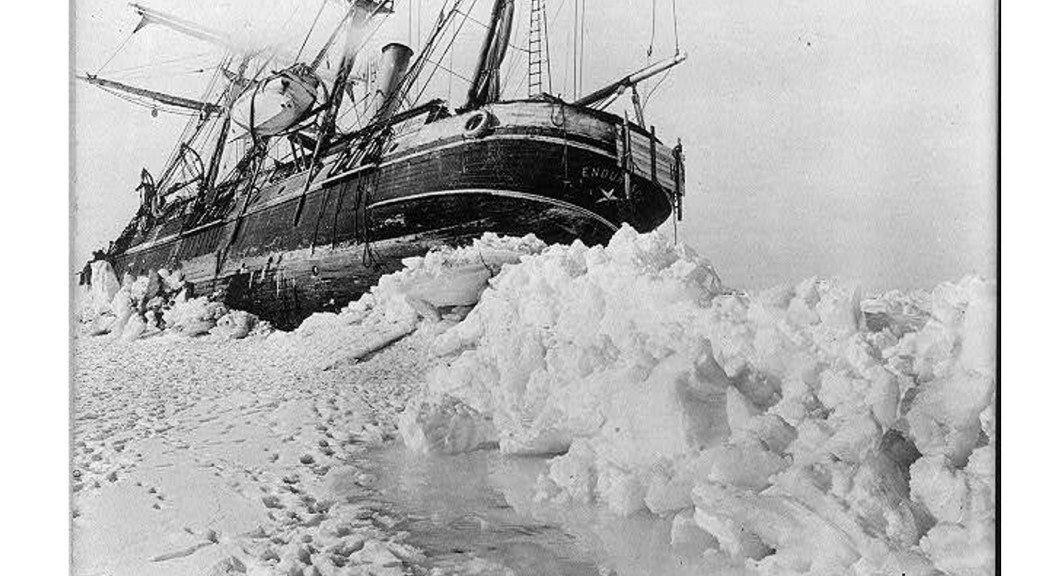
In October of 1915, Ernest Shackleton’s ship, The Endurance (oh, the irony), was crushed by pack ice in the Antarctic and then sank. It had been trapped in the ice for 9 months. In August of the following year, a rescue ship arrived; all of Shackleton’s crew had survived.
The news from Antarctica this week is that after 100 years, the wreck of The Endurance has been found – nearly 10,000 feet under those frigid waters. It didn’t move too far in 100 years, it was found just four miles south of the location recorded by the crew when she sank. According to the search team, it is “in a brilliant state of preservation” and is even sitting upright.
I’ve read a handful of books about various exploration voyages, some about Shackleton, some about others. I also see several stories in National Geographic every year about someone heading off into the unknown to do something that no one has ever done before. None of these stories makes me want to do this kind of thing. Even today, 100+ years later, I can’t imagine how awful it must have been to be trapped on the ice of Antarctica, listening to the timbers of your ship creaking then finally breaking. You’d have to be fairly certain at that point that you would never see home/family/friends again. I don’t even like to set up the tent out of sightline from the car!
I used to think of myself as adventurous, based on all my travels, but after reading these stories about wandering out into the unknown, I’ve decided my level of adventure tolerance is much lower. I can live with that.
Have you ever ventured into the unknown? The partly unknown?
Because we are sustaining members of MPR and the pledge drive gets tedious, and because we always have some sort of music playing, I put a random CD on the other night, The Child Ballads by Anais Mitchell. I learned about it from Dale and TLGMS and Radio Heartland, and I was somewhat surprised to see Husband’s reaction to it. He was entranced by the music and stories. He charged downstairs and brought up a massive document he had printed off after purchasing the right to do so, of English Folksongs of the Southern Appalachians compiled by Cecil Sharp and Olive Campbell. Some of the Child Ballads were in that compilation.
Husband has always been fascinated by any music that has come from the British Isles to the Appalachian region, as that is the region his mother’s people from Scotland and the north and west of England, settled. We have a vast collection of old and obscure hymnals and song books that he has found on our travels and brought home. We both love folk music, but that music from that time and region holds special meaning for him. He took the The Child Ballads CD with him this week to his job in Bismarck so he could revel in it in the drive there and back.
What are you listening to in the vehicle these days?What folk music are you drawn to? Did you know Anais Mitchell wrote the lyrics, music, and book of the Broadway musical Hadestown?Why is folk music important?
Tuesday was my birthday. I had a great day. I got two lovely flower arrangements from my coworkers and from dear friends. I had lovely wishes from friends on Facebook and the Trail. It was a good day. I feel loved and blessed.
As I look on Internet sites concerned with happenings on my birthday, I see that I share a birthday with Clark Gable, G. Stanley Hall ( the first president of the American Psychological Association), Victor Herbert, SJ Perelman, Langston Hughes, John Napier, a Scots mathematician who invented logarithms in 1550, John Ford, the film director, and Boris Yeltsin. Queen Elizabeth I condemned her cousin, Mary Queen of Scots, to death on February 1. Lots of things happened the first day of February.
What important things happened on your birthday? What are your favorite or tragic birthday memories. With whom do you share a a birthday?
It’s been a rich couple of months here on the Trail, esp. with the return of some lapsed or very occasional babooners – Krista, mig (for madeline island girl, if memory serves), Crow Girl (where did that “handle” come from?), Occasional Caroline recently, and Lisa of Mpls. popped in Tuesday… did I miss anyone?
There have been a lot of changes here in the past few years, and there are no doubt major life events that we have missed in each other’s lives. There has also been much sadness following the deaths of two of our tribe – Edith, aka ljb/little jailbird in 2019, and our Minnesota Storyteller Steve this past Thanksgiving.
It occurred to me that perhaps we should have a catch-up day, where we tell the bare bones of what’s happened to/for us in the past few years. We could have a gossip/catch-up day – tell us if you’ve moved, changed jobs, where the kids are now..
For instance, Husband and I moved from Robbinsdale to Winona in 2016. By calling myself Barbara in Rivertown I was able to keep my BiR acronym… I’ll reveal more in comments below.
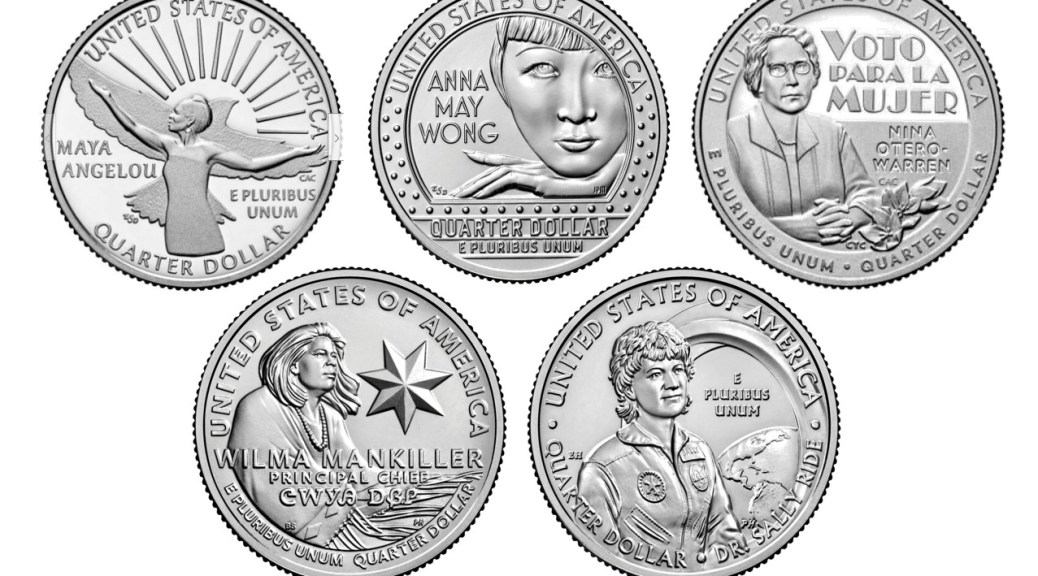
I see in the news that Maya Angelou is going to gracing our nation’s 25-cent piece this year. I was actually a little skeptical about this, seeing as how Harriet Tubman hasn’t made it onto the twenty-dollar bill yet and they’ve been talking about THAT for years.
But apparently there is a whole series of 2022 American women quarters planned: Sally Ride, Maya Angelou, Wilma Mankiller, Nina Otero-Warren and Anna May Wong. While I know Sally Ride (physicist, first American woman in space), Maya Angelou (writer, social activist) and Anna May Wong (first Chinese American film star in Hollywood), I have to admit that I didn’t know the names Wilma Mankiller or Nina Otero-Warren.
Wilma Mankiller was the first woman elected as principle chief of the Cherokee Nation and a lifelong activist for Native American rights. Her surname Mankiller is a Cherokee name (Asgaya-dihi) and refers to a traditional Cherokee military rank, like major or captain. She was elected Principle Chief in 1985 and served very successfully for ten years. She was Ms. Magazine Woman of the Year in 1987, was inducted into the Women’s Hall of Fame in 1993 and received the Presidential Medal of Freedom from Bill Clinton.
María Adelina Isabel Emilia “Nina” Otero-Warren was a woman’s suffragist, educator, politician and the first female superintendent of the Santa Fe public schools. In her role as superintendent she advocated abolishing the practice of sending Native American children to boarding schools and sought to integrate ethnic cultures and languages into the New Mexico school curriculum. She became the Director of Literacy under Franklin Roosevelt and later worked to preserve historic structures in Santa Fe and Taos and continued to promote Native American arts, language and culture.
I wish I had known who they were earlier, but I suppose this is better than never knowing them. I’ll have to make sure to get one of each of these quarters in the coming year.
It’s January in Minnesota and it’s cold and the duck pond is half frozen over. Plus the car is a mess and it’s too cold to get it washed.
When I was growing up, this wasn’t considered a problem. Other than spraying the car off with a hose once in a while, or letting it sit out in the rain, I hardly ever remember getting the car washed. Kicking off the snow warts was about all that was involved in exterior maintenance of the car. Maybe that was just us. The first car I remember was a Chevrolet; a Bel Air or Impala, or maybe Caprice. They all kinda looked the same, didn’t they? Pea Green. And a Chevy C20 truck that was blue. But I don’t remember either ever being washed or cleaned in any manner. And they weren’t rust buckets.
I got to thinking about carwashes. I remember taking my cars to the hand wash places before prom or something important. Not being really familiar with how they worked, I ran out of time before I had washed all the soap off. I drove out and was drying it outside when the guy who ran the wash, who turned out to be a guy I knew, came over and asked me what I was doing and told me to run it back in again and rinse it off. He paid for that. That was my first car wash lesson.
I have a carwash membership these days. I average about 2 washes per month, which is almost cost effective. I do like the convenience of just being able to go whenever I want. And they’re nice people and I like it when the woman who is the owner is on the wash line because I know I get a better wash when she’s there. I tip the guys too, I think that helps. I don’t get too many washes in January or February. (Another time I sure wish I had a heated garage). And those nice warmer late winter days, there’s 15 cars in line at the wash. Even 5 cars back it takes 20 minutes to get into the wash so I need to plan accordingly and decide if it’s worth it. And it’s just going to get dirty again so I need to justify it in my mind that at least I’m taking the first layer off.
I did some research. The first carwash was created in 1914 in Detroit. Workers pushed the cars through an ‘assembly line’ process and each person had a dedicated job. By 1920 some carwashes had large, shallow, pools to drive around to clean off the tires and undercarriage before moving into a stall for cleaning. The first automated wash came in 1951.
There have been a lot of innovations and changes. It was interesting to read how brushes were a big deal and if they made to much noise when scrubbing, people didn’t like that. White wall tires were hard to keep clean and several methods were tried including boys in a 4’ deep pit on the sides to scrub those whitewalls with a steam cleaner or brush. Or the method of attaching a log chain to the front bumper to pull that cars through. That worked as long as the driver followed the rules; Sometimes it would pull the bumper off the car. That was fixed by going to ropes instead of chains so at least the rope would break before it pulled the bumper off.
And the carwash people used to get in the car themselves, which some people didn’t like, or maybe the drivers didn’t like the claustrophobia caused by a tunnel, so the washes got taller and wider and windows got added.
Some washes can handle 250,000 – 300,000 cars annually. Or more. *
Considering how much a car costs now, it’s worth keeping clean. Plus, it just feels better to drive a clean car. In fact, that was a jingle from a local carwash place 30 years ago. “You’ll feel better driving a clean car!” Mermaid Carwash hired a lot of high school kids. He paid a bonus if you kept your grades up. I knew a few kids that worked for him and it sounds like he was a good boss. Eventually he was bought out by a chain.
It will warm up here soon then I’ll get the car washed. The truck too.
Ever been part of a carwash event? Tell us about your carwashes.
Today is the anniversary of the Wall Street Crash in 1929 that started the Great Depression. My great grandmother had invested in some Texas oil company stock and lost a good bit of money. My parents would often talk about the closing of the banks. It was a huge disaster for them and really influenced the trajectory of their lives.
I have never been a great fan of disaster movies. I just don’t like the suspense. I think the worst one I ever saw was a fairly modern one in which the magnetic poles changed position, and the North Pole was somewhere around Minneapolis, and all the oceans flooded dry land, exposing new dry land, and anyone who survived was on this one ship which contained survivors and all that remained of Western Civilization. I have no idea how or why I came to be watching it. I was most tolerant of disaster movies when I was in high school. The Poseidon Adventure comes to mind.
What are your favorite or least favorite disaster movies? Which movies to do think are real disasters? How did your family fare in the Great Depression?Why do you think that disasters are such popular fodder for entertainment?
My van was in the shop last week for new brake pads. My office building is a mile down the same road as the dealership, so it should have been a straight shot for the driver of the courtesy car to get me and take me back to the dealership to retrieve the van when it was finished. There has been extensive construction work on the road, however, so he had to take me the winding, back way through a new housing development behind my work and the dealership.
The driver was younger, a mid-30’s guy who doubles as a mechanic, and he told me that he grew up in an older section of houses also right behind my work. He even pointed out his parents’ home. He remembered when the area of the new development was just tree shelter belts and bare plains. He reminisced with great wistfulness about the trees that were no longer there and all the “forts” he and the kids in the neighborhood would make among the trees and how they would raid the other forts and all the fun they had.
This put in mind all the forts my cousins and I would try to erect in and around the trees in the groves on their farms, trying to nail boards together to make structures and how exciting it was to sit in them. (Here, they are shelter belts. In Minnesota, they are groves).
Children love forts, even if they consist of blankets thrown over the sides of end tables. I remember my mother throwing a blanket over the sides of my crib, and how oddly satisfying that was. I couldn’t have been more than 3. Our children, too, loved blanket forts, and any small enclosure they could erect and escape into. We even had a book about innovative ways to make forts.
What are your memories of forts? Why do you think children like forts? Did you or anyone you know ever have a tree house? Any good tree climbing stories?
Our daughter was lamenting the other day what a raw deal she and her brother got in the DNA department. Both children have their father’s flat feet and bad ankles. Both have my tendency for anxiety. Both have their father’s attention deficits.
I reminded her that we owe our lives to flat feet, and that there are flat foots on my side of the family, too. My maternal grandfather immigrated to the US in about 1908. In the spring of 1914, he went back to his village in Northern Germany to attend his oldest brother’s wedding. He was promptly drafted into the German army. His very flat feet made it hard for him to march as smartly as the officers wanted him to, and he was given a medical discharge after a few weeks. He hightailed it to Bremerhaven and sailed back to the US just before the First World War broke out. Daughter wasn’t impressed. Her bad feet and ankles are quite problematic for her lately, but she is taking measures to resolve the issues with physical therapy.
I, on the other hand, inherited my father’s perfect little Dutch feet, mechanical aptitude, and musical ability. I also inherited his temper and lack of patience. I like to think I inherited a penchant for cooking from a great grandmother who was a professional cook in Hamburg in the early 1900’s.
We can learn new things on our own. We can manage our tempers. Who is to say we haven’t learned a lot of problematic behaviors and attitudes, not inherited them? You can’t argue the heritability of flat feet, though.
What good or not so good things do you think you inherited in your DNA? Who do you look like?
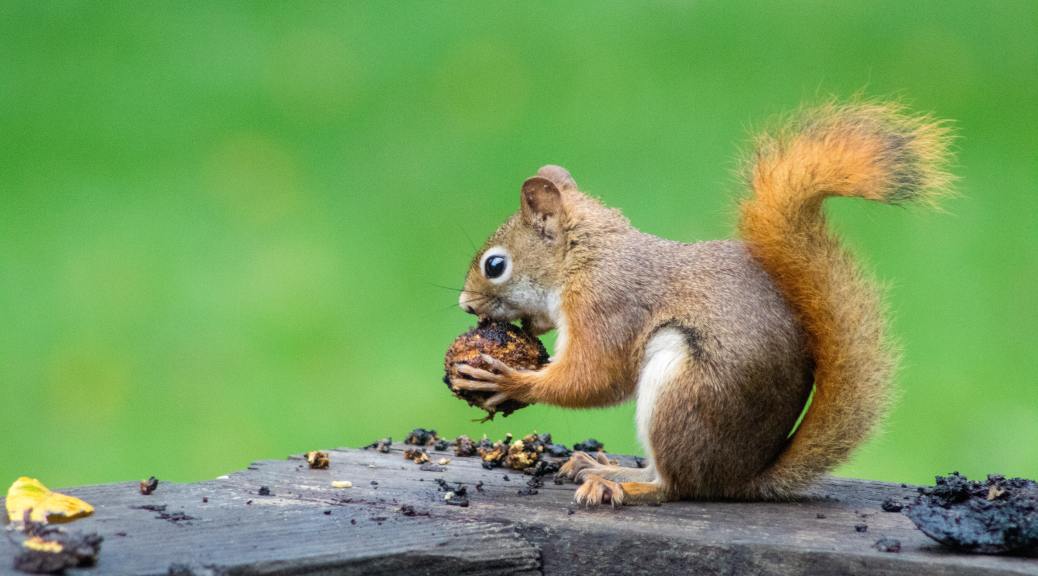
For one thing, I am amazed that a walnut tree could be so prolific. I am also pretty impressed by the tenacity and single mindedness of the squirrel. I truly can understand this from the squirrel’s point of view. I don’t know what it is about having fresh produce, but every time we swear that this is the last tomato or eggplant or green bean we will pick, Husband and I automatically start to think of new ways to use them or preserve the ones that still are coming. We give what we can to the food pantry, but they are only open two days a week.
Husband picked a bunch of Spanish Giant sweet red peppers yesterday, and swore that he was going to pull up the plants. He didn’t, though, as he decided that would be wasteful. So, here I am, watering the garden again as it is going to be in the 80’s this week, because the peppers and tomatoes are loaded with fruits yet to ripen. The lack of a killing frost has made the garden last far longer than usual. I made two spanakopita on Saturday using up three pounds of our garden spinach leaves. There is a feverishness to harvest. Sometimes I think we are nuts with our garden. I lay the blame on our parents and grandparents.
How did growing up with Great Depression-era parents impact you? When have you been industrious? Got any good squirrel stories?







 Trail Baboon