For the first time ever we have an insulated three stall garage with copius built-in cupboards and cabinets. It has yet to get below freezing out there.
There is some trouble in paradise, however, since the cupboards take up so much space that Husband’s pickup is too long to fit in the garage. He is happy to park it outside, but he is concerned how to make sure it can start on the coldest days.
When he worked on the Fort Berthold Reservation he had an electromagnetic thingy that attached to the engine block and kept everything nice and warm. The only problem with one of those now is that he has to crawl under the truck to attach it, and he isn’t that limber anymore. It also needs to be removed before you drive the vehicle. I phoned a local car repair place and asked if the still installed block heaters, something that he could easily just plug in. They hemmed and hawed and told me that block heaters are a thing of the past but they could install one. I declined, as they sounded so hesitant. We went to NAPA and got another electromagnetic thingy and he will deal with it. It is on the oilpan now. If he has trouble crawling out and standing up I will help him.
For some reason, this put in my mind a conversation I had with a directory assistance operator I had in the early 1980’s when we lived in Winnipeg. This was before computer search engines. I needed the phone number for the Curtis Hotel in Minneapolis. We had stayed there on our honeymoon a year or so before and were planning a trip to the Cities. The operator told me there was no such number. I argued with her that there must be, and she finally got exasperated with me and said “Ma’am, they blew it up!” I had missed that news.
What have you discovered to be obsolete? Any memories of the Curtis Hotel? Do you have an engine block heater?
Husband and our 7 year old grandson spent most of Thanksgiving Day in the basement messing around with various string instruments. Grandson brought the three-quarter size guitar we got him in the summer. He and his Opa (Husband’s German name. I am Oma.) practiced tuning the guitar and his cello to eachother, and Opa taught him the difference between bass and treble clef, and that you could play the same tune in both clefs. Grandson also noodled around on the piano upstsirs using the sustain pedal until it got too annoying and we had to have him stop. He actually asked Opa if they could “jam” next time.
During the afternoon, grandson came upstairs and excitedly announced “Opa is teaching me finger picking”. He is to start piano and guitar lessons in the spring. At home he likes to just strum his guitar once a day and practice trying to play chords. He also thought Opa’s cello was pretty cool.
I learned cooking, gardening, and that History was a most interesting subject from my grandparents. Grandson wants me to make tirimisu with him one of these days, and loves to cook with his parents. I am so glad we can help foster these interests, as they really make for a satisfying life.
What skills did your older relatives and grandparents teach you?What names did you use to address your grandparents?
Guess it’s winter on the farm. I even wore a T-shirt under my sleeveless shirt one day.
I don’t think the chickens have come out of the pen all week. They peer out the door, but none of them has much interest in actually going outside. I picked up one chicken that was still living out in the pole barn and carried her back with the rest. And the garage chicken has moved down with the rest. For body heat I presume. Found 4 of the 7 chicks. It’s unfortunate it worked out the way it did for them. I’d have liked them to get a little bigger, or the weather to stay a little warmer, or momma to take a little more care of them a little longer. Any of those options would have served them better.
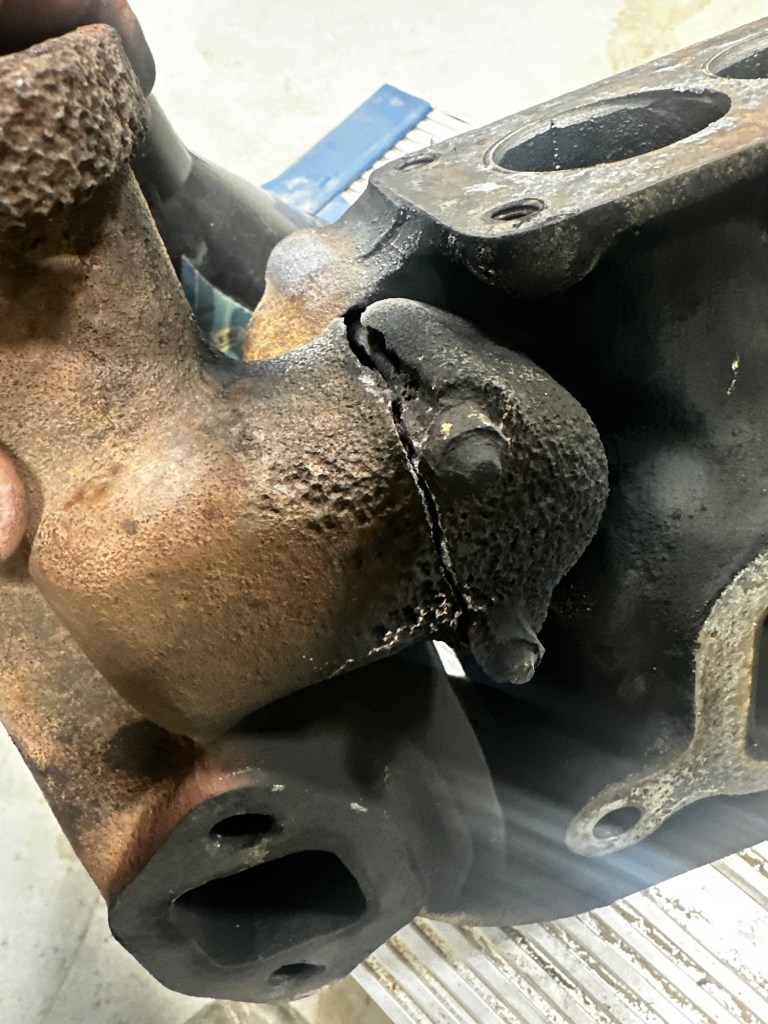
I got the starter put back on my 630 tractor and it started right up. I can’t get over how quiet it is now. Evidently having a hole and crack in the exhaust manifold is like a hole in your muffler. It’s surprisingly loud. And repairing it was very educational and gave me a great feeling of accomplishment. My dad would be so pleased. That thing has been cracked and loud for as long as I can remember. For a tractor from 1959, it’s getting some much needed attention.
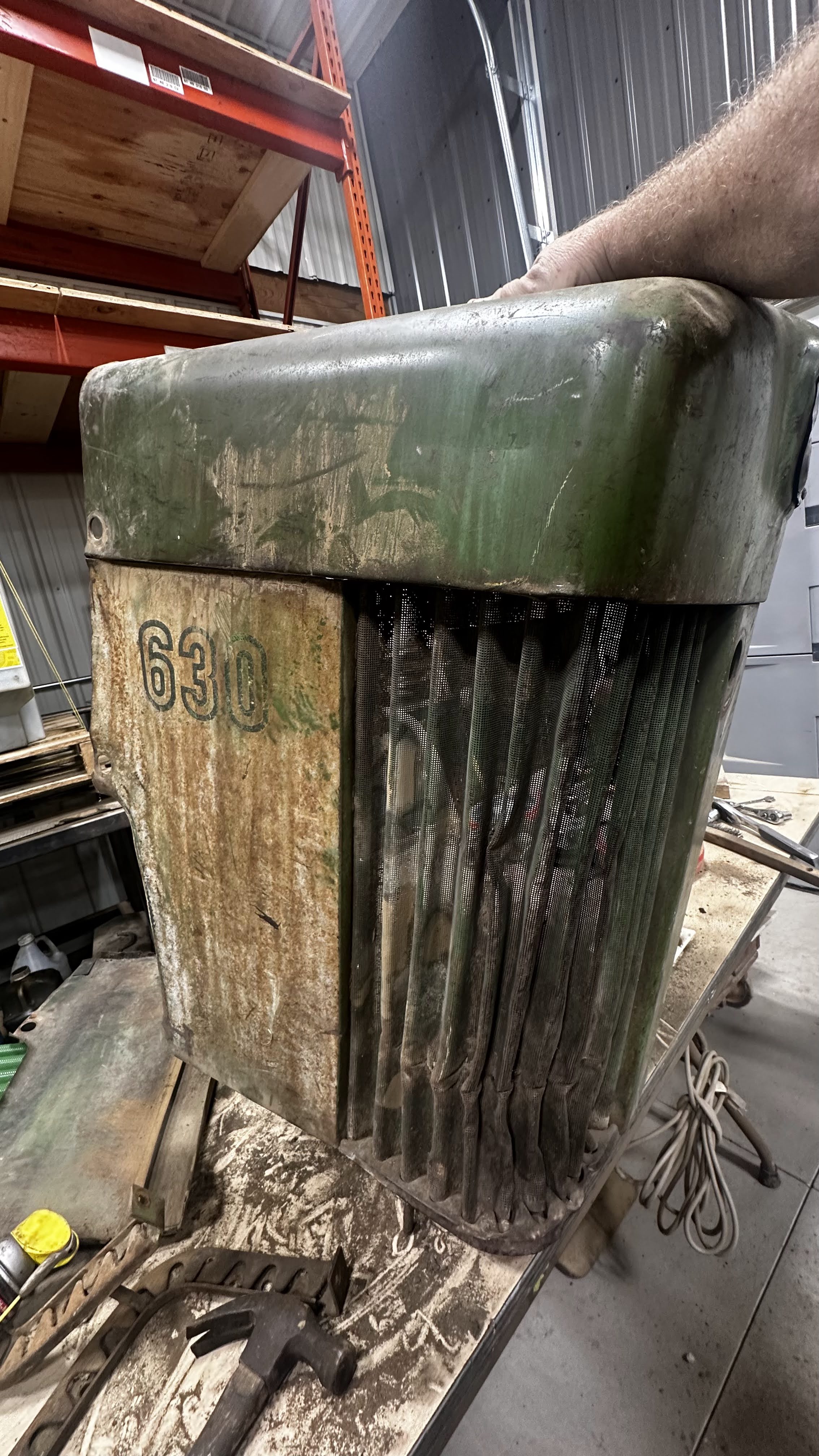
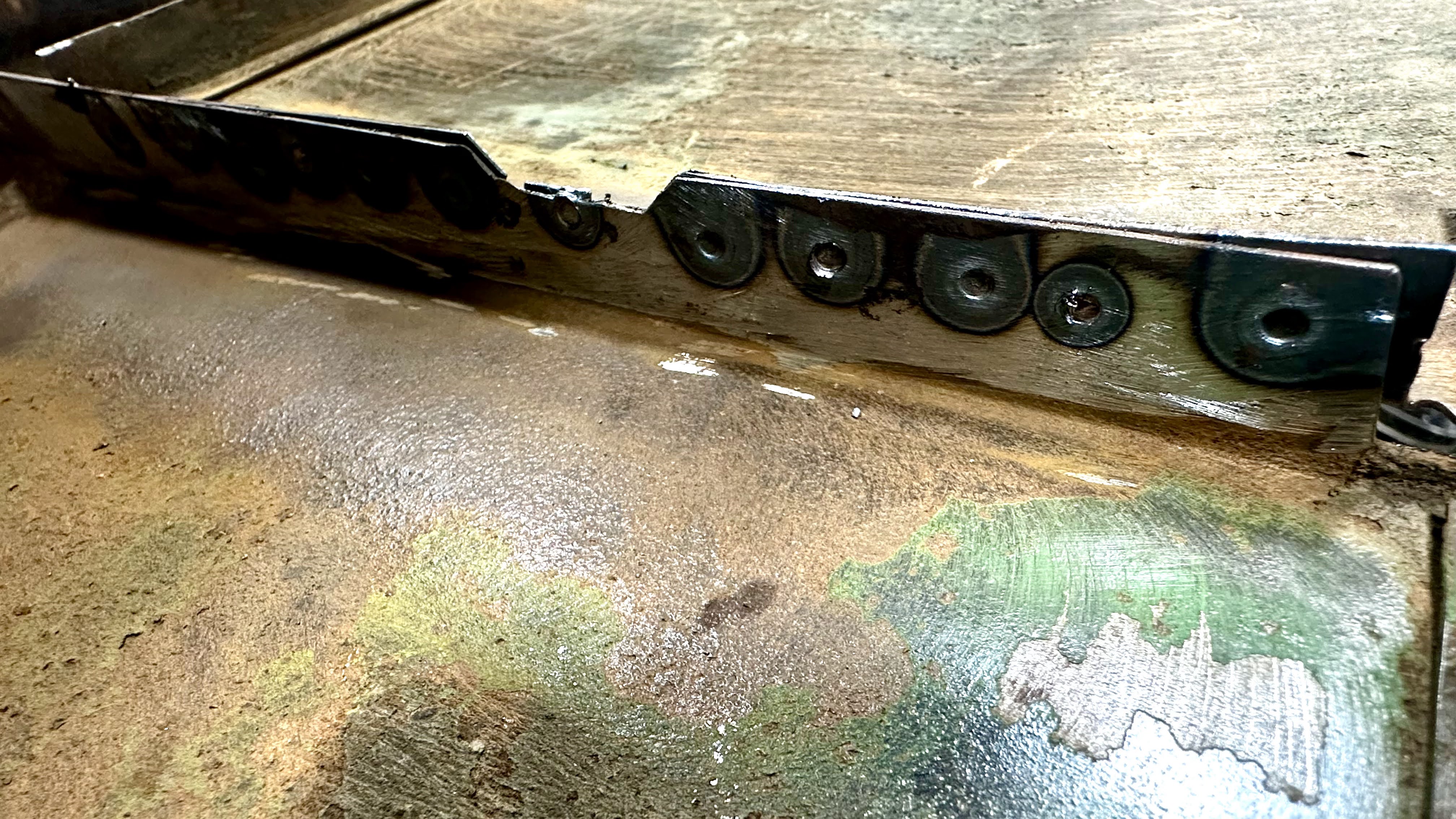
I’m still working on some cosmetic repairs. I have new screens for the front grill and I picked up a cheap spot welder to repair part of the hood. Welding class from 12th grade comes through again!
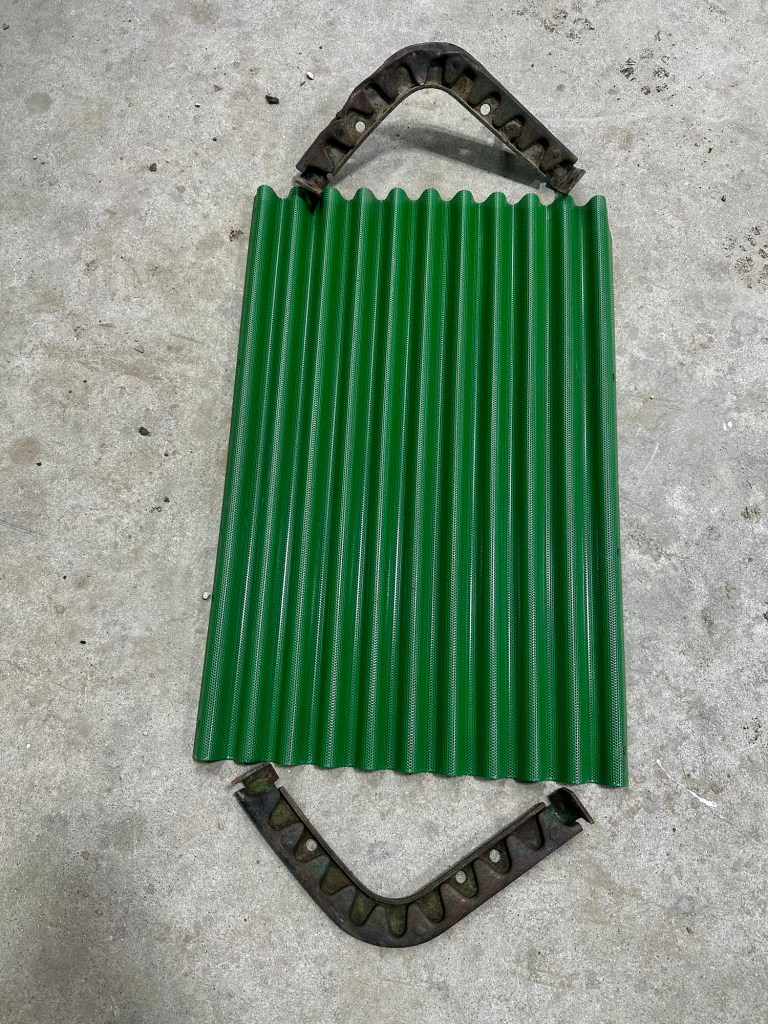
Dad must have run into something to dent it and break off all the welds on one side. And now I need to figure out how to fit this straight piece of corrugated screen into the slots and curves on the corners.
I know it bends, it is just a matter of fitting it all together.
I worked on it for a while one night and decided this was something to ponder and come back too. The dogs all run into the shop and get a drink, and I played ball with Luna while Bailey gets in my face. Humphrey likes having a warm place to lie down and he’s happy. But the others get bored after a bit and Bailey pee’s on the floor and out they go. Kelly lets them back into the house. Out in the shop is my happy place. Have I mentioned that? As I closed the toolbox and turned off the lights, I thought to myself, this has been 35 years in the making. We took over the farm when we got married, 35 and a half years ago. And I’ve been collecting or buying tools and gaining experience since then. If I had it sooner, I wouldn’t appreciate this so much. Or I’d want something bigger.
=====================
At the college I’m getting ready for Holiday Concerts next week. My friend Paul is designing again, so it’s fun to have him back in the shop.
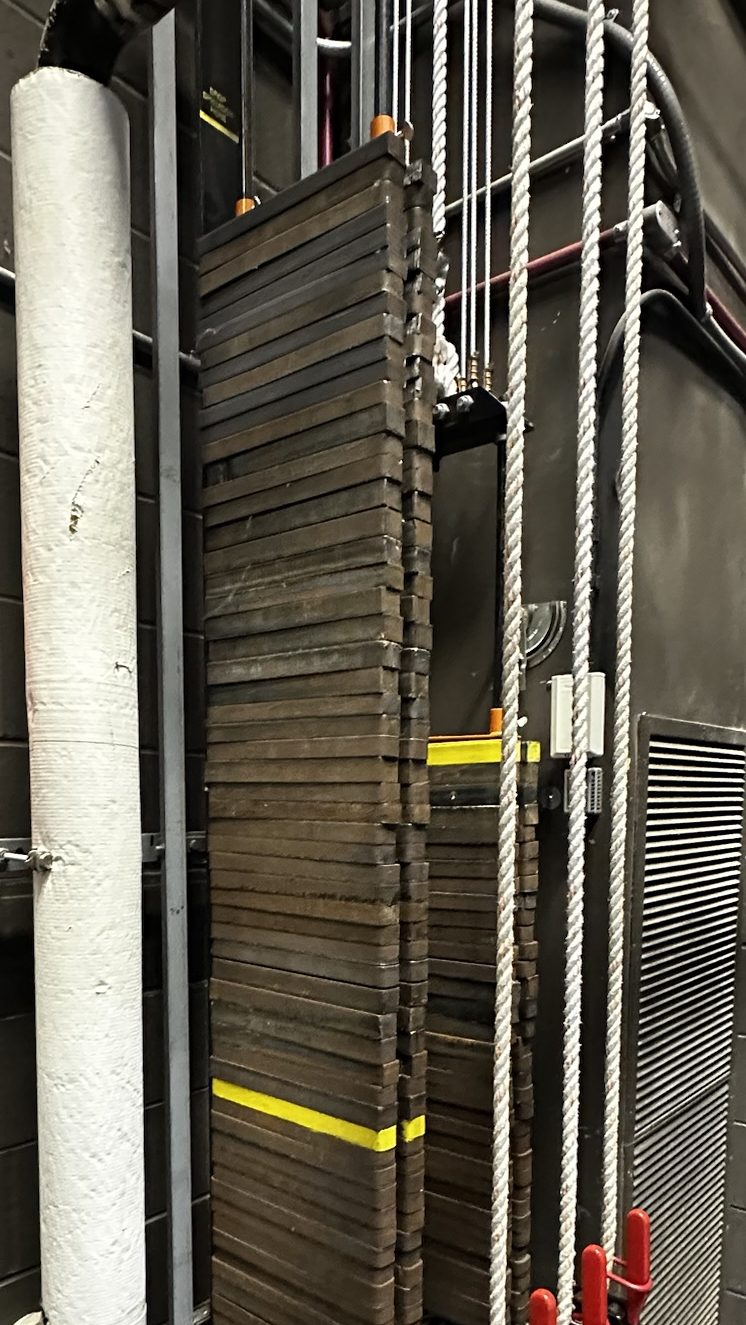
I added a few more LED lights over the stage. Just some plain LED wash lights. They don’t move or wiggle, they just change colors. Over the stage are pipes called ‘battens’ and they’re all counter weighted so they’re balanced as they come up and down. Called “flying in or out”. Our stage has 19 battens. Three are for lighting (called ‘Electrics 1,2 and 3′ front to back). Several are curtains, and some are open to hang scenery. The counterweight is achieved using metal bricks that weigh about 15.5 pounds. We add or subtract them to balance whatever is hanging. When I added the lights to the 1st Electric, I had to add 8 more bricks. This is the main lighting batten. I counted 58 bricks. 899 pounds. This batten is rated for 1000 lbs.
These are the counter weight bricks. The yellow brick is empty base weight.
The First Electric and it’s 23 various lights.
*********************************************
I read an article in a farm magazine recently about the next generation of autonomous farm equipment. The technology is out of testing and is available for sale.
A little background: As with all technology, this has been coming for a few years. First it was the GPS mapping. Then row sensors so machinery could follow the rows by themselves. Then the machinery started to incorporate the equipment and technology to put all this together and the tractor could follow a line through the field. Then it was automated so that the tractor could raise and lower an implement, slow down at the ends, and all the driver had to do was make the corner, find the next line and hit ‘Go’. From there, multiple implements or tractors could talk to each other. The tractor could pull up next to the combine, and the combine would take control of the tractor and unload at a constant speed. So simply removing the driver really wasn’t that big of a leap, it was kind of the next logical step. That said, I’m not sure I’m ready for a driverless car yet.
This information is from an article in Successful Farming Magazine from November of 2025, called ‘How Farmers Are Using Autonomous Equipment to Do More with Less’. It cites labor shortages, changing weather conditions meaning smaller productivity windows, or maybe just not having enough time in the day to get it all done. Some of the jobs open to autonomy are planting, spreading fertilizer, tillage, or pulling grain carts.
Wanna know what it costs?
There are two big companies: John Deere and AGCO. John Deere doesn’t list prices.
AGCO:
Capabilities: grain cart duties and tillage; planned for 2026
Compatibility: AGCO and PTx’s OutRun system is compatible with 2014 or newer John Deere 8R tractors. Compatibility with Fendt tractors is to begin in 2026.
OutRun for tillage has a $54,000 one-time hardware cost and a $9,000 annual recurring payment; OutRun for grain cart has a $55,000 one-time hardware cost and a $15,000 annual recurring payment.
If using the same tractor and base OutRun Intelligence kit for both grain cart and tillage, it has a $65,900 one-time hardware cost and a $15,000 annual recurring payment.
Carbon Robotics:
Capabilities: tillage, mulching, mowing, and LaserWeeder
Compatibility: Carbon ATK is compatible with John Deere 6R, 8R, 8RT, and 8RX model tractors. Installation takes under a day, with no permanent modifications. Carbon ATK is a $60,000 one-time add-on kit that Carbon comes out and installs.
John Deere:
No price listed
Sabanto:
Capabilities: mowing and seeding
Compatibility: The Sabanto autonomous kit is compatible with 2015–2024 Kubota M5 Series tractors; 2015–2024 John Deere 5E, 5M, and 6E Series tractors; and Fendt 700 Vario tractors. The kit costs $70,000, and is available on cab and open-station models.
First off, I don’t even have a tractor new enough to put this on. Second, [Looking at my bank account]… Nope, there is nothing to say here.
It is kinda cool! I can see the advantage for some farmers. Kelly suggested I could have the tractor doing fieldwork while I was at the college. Yep. Suppose Bailey would still get in the tractor without me? From the video’s of the systems I’ve seen, the operator is monitoring it from his phone or tablet. Inside the tractor you set the field and boundaries. Then once you’re out of the tractor, depending on which system you’re using, either you start it remotely and the tractor honks and the lights flash and it uses all the exterior cameras to make sure you’re not around, and off it goes.
If it “sees” something not right, it will stop and alert the operator, who can view the cameras and decide the best course of action.
It was on this day in 1869 that the opera “Das Rheingold” by Richard Wagner premiered on the stage at the National Theatre Munich, Germany. It is 150 minutes long and is the first of an epic four-part drama known as Der Ring des Nibelungen. Rheingold, although it is the beginning of Wagner’s famous cycle, Rheingold was the last of the texts to be written. Wagner didn’t want any of the Ring to be performed until all the parts were complete. King Ludwig II of Bavaria thought otherwise and ordered the staging of Rheingold in 1869. It wasn’t until 1876 that the entirety of Ring was performed at the Bayreuth Festspielhaus in Bavaria. These days, Bayreuth still stages the entire Ring epic each year, a total of four operas that add up to about 18 hours of stage time. Other opera houses tend to stage the Ring over the course of a few years.
Although I recognize some of the music instantly,
I didn’t have a clue what The Ring is all about. The plot is EXTREMELY complex and begins with the theft of gold that is then made into a magic ring Lots and lots of Norse gods and goddesses; truly I didn’t even know there were that many. In the end, Brunhilde (who had been a goddess but was stripped of her immortality) returns the ring but not before Valhalla and the gods are destroyed.
Now that I know more about The Rheingold and The Ring, it doesn’t increase my desire to ever see it. Certainly not 18 hours of it. I’m not a particularly big fan of opera to start with but that much plot to keep track of might make my head explode?
Eighty-five years ago last week, four teenagers accidentally changed not only the trajectories of their lives, but history as well. While hiking near Montignac, France, the four boys stumbled upon caves with a collection of cave paintings unlike anything ever seen. The paintings, known as the Lascaux cave paintings have been dated from 15,000 to 17,000 years back and turned the art world on its ear, proving that Stone Age peoples were artists and biographers.
The four boys ended up on different paths. Two of the boys were Jewish and shortly after the discovery, one boy was sent to Buchenwald with his family and the second boy ended up being hidden by a Jewish Children’s aid organization. The other two boys, who were from Montignac, guarded the cave over the first winter and eventually became tour guides of the famous caves and paintings. In fact, it was the two of them that noticed the condensation in the caves causing algae and mold growth. It was at this point that France closed the caves to the public to protect them from as much outside environment as possible. The cave paintings have been meticulously copied and can be viewed in a replica of the caves – Lascaux IV – part of the Lascaux historical center.
The two Jewish boys survived WWII and Buchenwald; all four lived into old age and were re-united in 1986. The last to pass was Simon Coencas, who died in 2020 at the age of 93.
The paintings were obviously modern art at the time they were created, but at 15,000 years of age, I doubt they qualify any longer. I have a few pieces of modern art but I also lean toward more classical representational art. Impressionism is a favorite and I am fond of a lot of sculpture. I particularly love this one that resides here in the Minneapolis Institute of Arts:
If you could go back in time and discover something, what would it be?
Going to work early one morning and there was the football team, under the stadium lights, all in uniform, having practice. Whew, I think early morning practices would be tough. Like getting up to exercise.
We saw a “V” of geese flying over one day.
Later I listened to about 2 dozen barn swallows gathered on an electric line chittering and chattering and having quite the discussion about when and where to go. Although the ‘where’ is pretty well defined, at least in general. South. Everybody. Just head south.
Kelly got one of those hotel sales calls that would take us someplace south if we just listened to a sales pitch. We don’t like to make hasty decisions, and I didn’t realize the salesperson was on hold while Kelly and I talked a few times. Then the salesperson’s manager came on and tried to shame Kelly for keeping the person on the phone for so long and not immediately just saying ‘Yes’. Snort. Give her attitude, will you? Click.
We will not be going south.
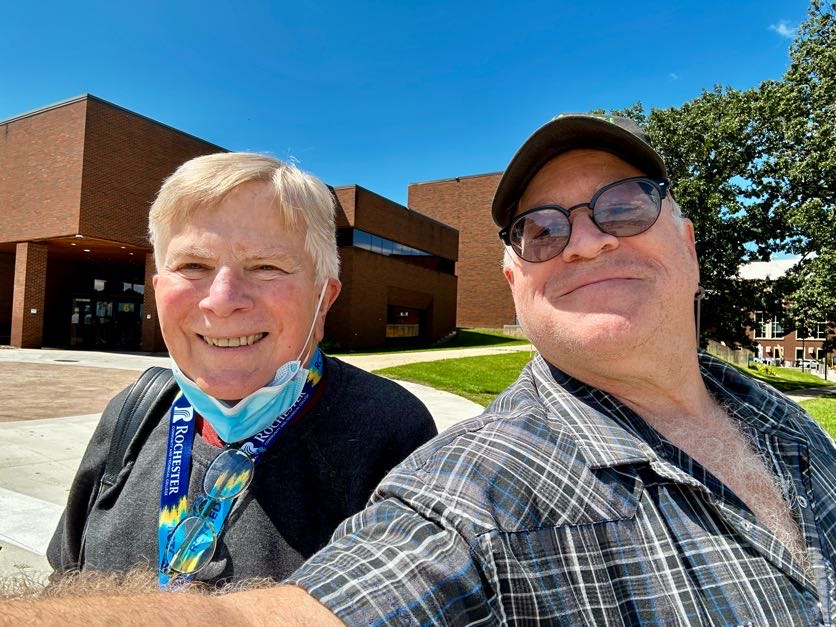
I had my first day of class. Forensic Chemistry. It’s a hybrid class, meaning a lot of it is done online, then we meet Wednesdays for lab. My friend Paul is taking a writing class. Here’s our first day of class photo.
FIRST DAY OF CLASS
I got the front end off the wagon where the wheels went wonky.
It’s not supposed to look like this. I have a nephew, Matt, who is a welder. He’ll be coming to look at it and see if it’s salvageable. A lot of cracks and old welds where the axle attaches to the frame. Old welds must be mine, but I don’t remember fixing this.
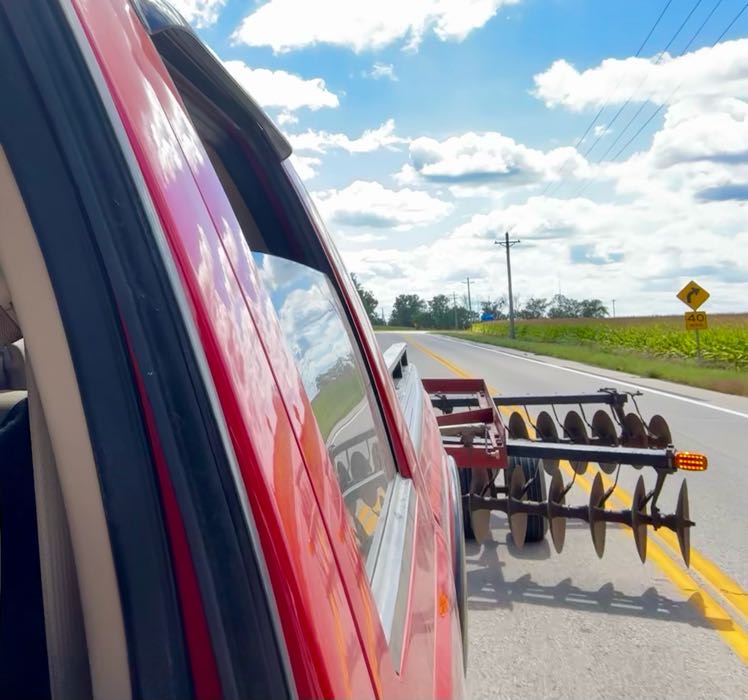
Mid-September there will be another online auction in Plainview. Last week when I dragged all the old machinery out of the trees, I pulled out a pretty nice disc. I had used it for several years until I got something bigger and better. I cleaned the disc up, greased it, and towed it to the auction.
WIDE LOAD COMING THROUGH
It is 20’ wide so I took up most of the road and part of the shoulder. I try to take the back roads when I do this sort of thing, but I have to get to the back roads first. Most traffic was pretty respectful. I had the SMV sign on the back, and I bought two magnetic flashing lights, one for the front corner, and one for the back corner. I travelled about 25 MPH. When able, I’d pull over and let traffic pass me.
Then I got to the road where they were painting new lines on the road. And putting cones down. I knocked over the first two cones before I figured out how far I needed to move over. And I scared a couple garbage cans. But I got it there in one piece.
The next day I took in a 24’ bale elevator, but that was on a trailer and wasn’t any big deal.
Several times, Kelly and I would go outside planning to do “this” and we’d go off and do “that” instead. And we’d laugh, “This isn’t what I came out to do…” Yep, but it needed doing anyway.
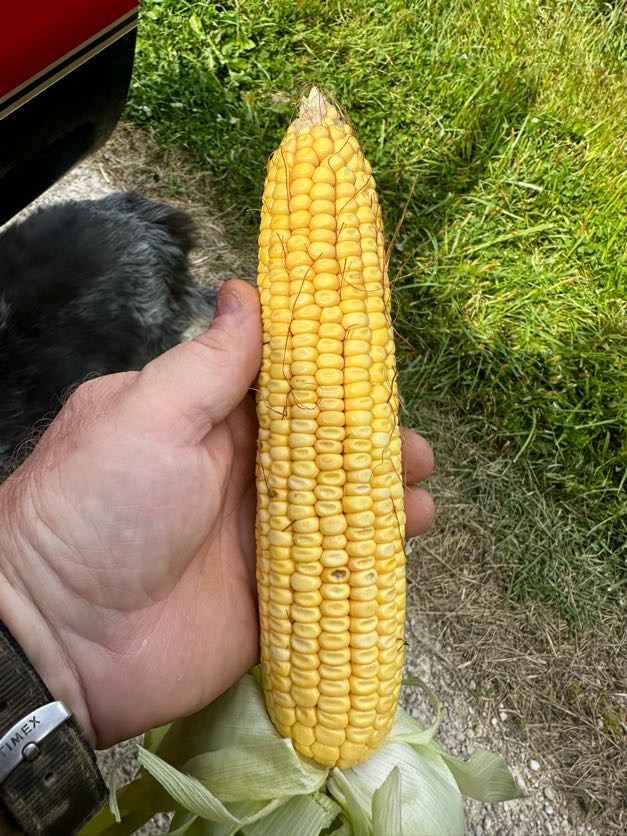
I picked an ear of corn.
THAT is a nice ear of corn
It’s filled to the tip, which means it had ideal growing conditions. Any stress and the plant aborts the kernels at the top. This one was 40 kernels long, and 16 around. (It’s always an even number around). So 40 x16 = 640 kernels x 30,000 (plants / acre) = 19,200,00 kernels in an acre / 90,000 (kernels in a bushel) = 213 bushel / acre. Never in my life have I had a crop that good. This won’t be either. Factor in the deer, the raccoons, the clay or rocky spots, the trees on the edges… and I might actually make 180 bu / acre. We shall remain cautiously optimistic.
The soybeans are looking great.
BELLY BUTTON HIGH!
TOP EXTRA TENDER LEAVES
Notice these extra leaves and pods on the top? Again, terrific growing season. The deer just haven’t found this plant yet… that’s what they’re eating off is all the tender bonus growth on the top.
One evening I burned a brush pile. Later, Kelly and I sat in the gator and enjoyed the fire.
BON FIRE DATE!
I removed the tires from the rims on the old junk wagons. I watched some YouTube videos how to do this quick and easy. They were using car tires that didn’t have innertubes, and they hadn’t been sitting in the trees for 30 years. But I figured it out. Cut it open with a Sawzall, then use a grinder to cut the bead cable. Removed 16 tires.
One didn’t have a tube! Just about every farm tire has an innertube in it. And most of the tubes had patches on them. It made me smile, and feel a little nostalgic. Dad or I had these tires apart before and patched a hole. If you don’t know, getting a tire off the rim is difficult if you don’t have the fancy tire machines. The bead, that inner ring of the tire, has a steel cable in it, and that’s what holds the tire on the rim. And it seals tight and it’s a pain to get off with hand tools. Dad took off a lot of tires, patched the tube, and put the tire back on. You have to get the bead to seal. I have done a lot of tires, too. But now days, with the tire goop stuff you can just pour inside, I don’t take so many apart; I’m not subjecting the wagons and tires to the wear I did when milking cows and making hay. And, like I mentioned last week, I’ll often just go get a new tire before replacing the tube. Working smarter, not harder.
Some of the junk was two old flare boxes. Wagons we used for hauling ear corn or oats. I haven’t used them in a lot of years. The floors are rotted out and frames are too small and lightweight to be reused. It’s just scrap.
Husband is allergic to most things airborne. Pollen in the Spring, grasses all Summer, deciduous and conifer trees, molds, dust, and cats. He has had shots, devours Sudafed multiple times daily, and uses nasal irrigation every day. Nothing really helps. He snots, drips, and gags. It is hard for me to hear. The only thing I am allergic to is oral contraceptives..
It has been particularly bad this last month as the Spring wheat harvest is in full swing and there is harvesting going on all around our community. Lots of dust and pollen are wafting around us.
Despite his cat allergies, Husband adores cats, and at one time we had four cats. He just ups his antihistamine doses and we vacuum the bedspread and brush the cat with the furminator brush. Due to his need for a cpap machine and his REM sleep disorder, I sleep in the guest room with the dog. The cat happily snuggles up with Husband.
I tell him it will be worse in Southern Minnesota, due to the increased humidity, but he is open to try living there. My best friend who will live with us has four cats, so we will have some challenges
What would you do if you found you were allergic to something you adored?I If you have allergies, how do you manage them?
I’ve noticed some soybean fields just starting to turn yellow. Kelly says the barn swallows are grouping up. And acorns are dropping. All that probably means something.
Crop prices keep dropping, too. Due to predictions of good yields across the corn belt. Locally, corn is under $3.50 / bushel, and soybeans are under $10. That’s a tough place to be. My direct costs to grow and harvest corn is roughly $400 / acre, and for soybeans about $300 / acre. Not knowing how the fall will shape up, or what drying costs might be, we’re speculating on final yields and prices. Making conservative estimates of $3.00 / bu final price means I’d need 133 bu / acre to cover costs. And that should be doable. Optimistically I’d have 180 bu / acre. That would leave me $273/ acre to cover repair costs, fuel, interest, crop insurance, pay off the loans, make payments on long term debt, ect. Soybeans work out the same way, just different numbers. Neither is in the bin yet, so we’ll see. This is why I have a few other jobs. To support my farming hobby. (eye roll)
Last weekend Padawan and I did a bunch of stuff. We packed the wheel bearings with grease and took the other wheel hub apart to replace those bearings. Both rear tires were wore out; one was on borrowed time. A few days later I went to Appel Service in Millville MN with the two wagon tires, a tire from the plow I had replace this spring, and another tire I found in the shop that I haven’t remember what it’s for yet. I’ve talked about Appels before; we’ve been taking tires to them for years and years. It’s about 25 minutes away. Great guys and a great drive.
I forgot to buy the dust seals for the axel hubs, which I picked up on Monday, but I had padawan reinstall the hub, even without the dust seal, just so he could see how you tighten it up and put the cotter pin in it. He had no idea what a cotter pin was. If you don’t know, it’s a split pin, length varies: length and the diameter as needed, and once through the hole, you bend the sides to prevent whatever you’re holding from coming off. I have some pins that are 1/4” diameter and 2” long and some tiny ones 1/2” long and 1/32″ diameter.
Then we drained the coolant and he replaced the radiator hose on the old John Deere 630. I had him pull the carburetor off. He is too young to know what a carburetor does. We changed the oil, oil filter, and the air filters on the big tractor, the 8200. It has two air filters; The biggest is about the size of a 5 gallon bucket. He was really impressed with that. Then a smaller inner air cleaner. He went home and cleaned up, and came back out with his girlfriend, who chased down her pet chicken, and they stayed for pizza with us. The kids, not the chicken.
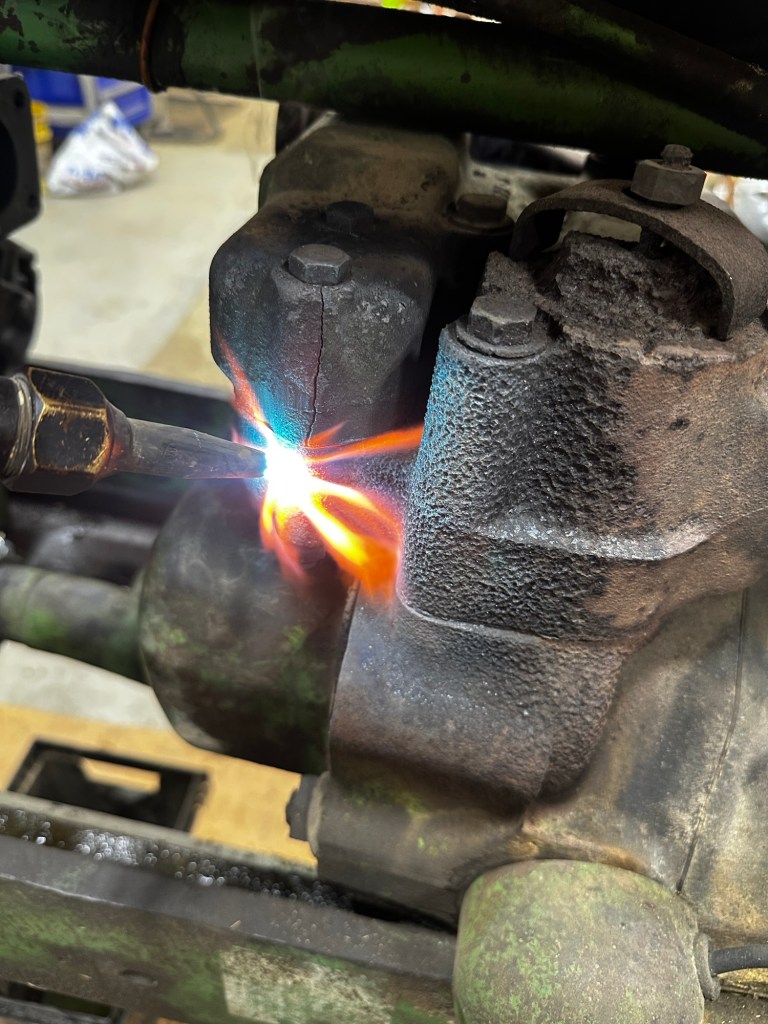
I have been working on the 630 exhaust manifold. Got the bolts out and the manifold off! Heated it with a torch, just like my friend Tim J. said. Would you believe there’s another Tim J?? He’s not too much like this tim j. but that one knows a lot about old tractors. The two bolts that were broken off, I welded nuts on the top (to make a bolt head again) and they came right out! I couldn’t believe it!
Heating the castings to break the rust
Nuts welded on the broken boltsUh, this looks broken…
Took me a while to find my welding stuff as I haven’t needed that in the new shop yet. the old welder on the bottom, newer welder on the top. That old welder, maybe from the 1950’s? has taught several of us how to weld. Dad taught me and some of my nephews. The oxy-acetelyne torch to the right, I’ve had since 1982. I learned how to use a gas welder in high school shop class and mom and dad bought me this one for my 18th birthday.
WELDERS
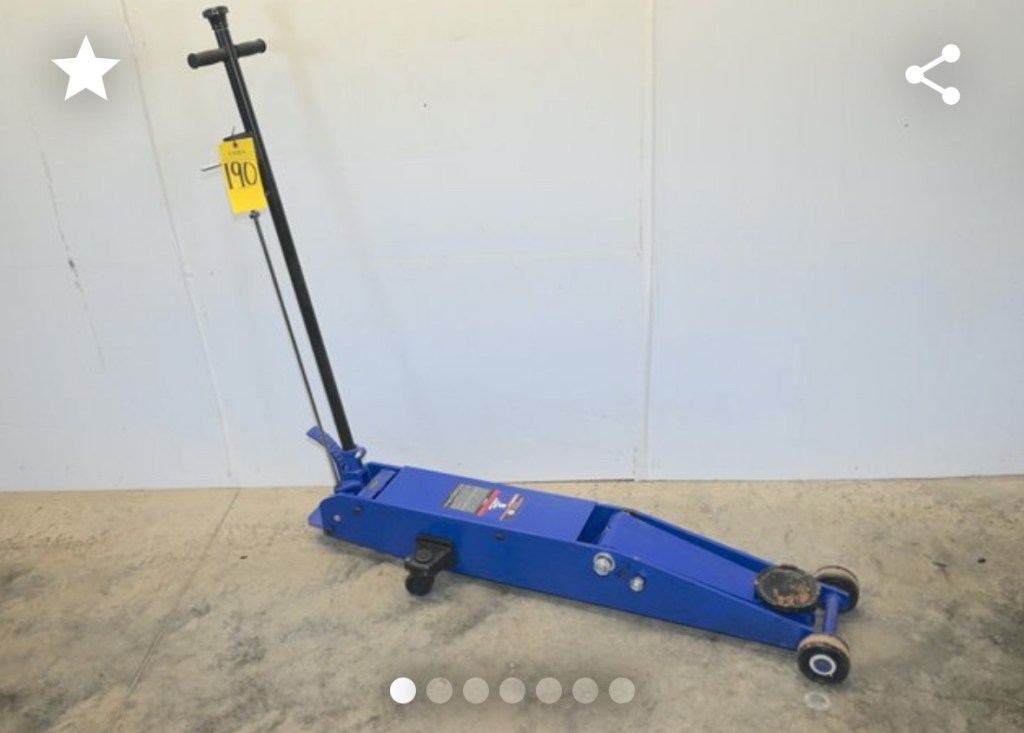
Friday morning I went to pick up a really nice long reach 5 ton hydraulic floor jack that I got at an auction.
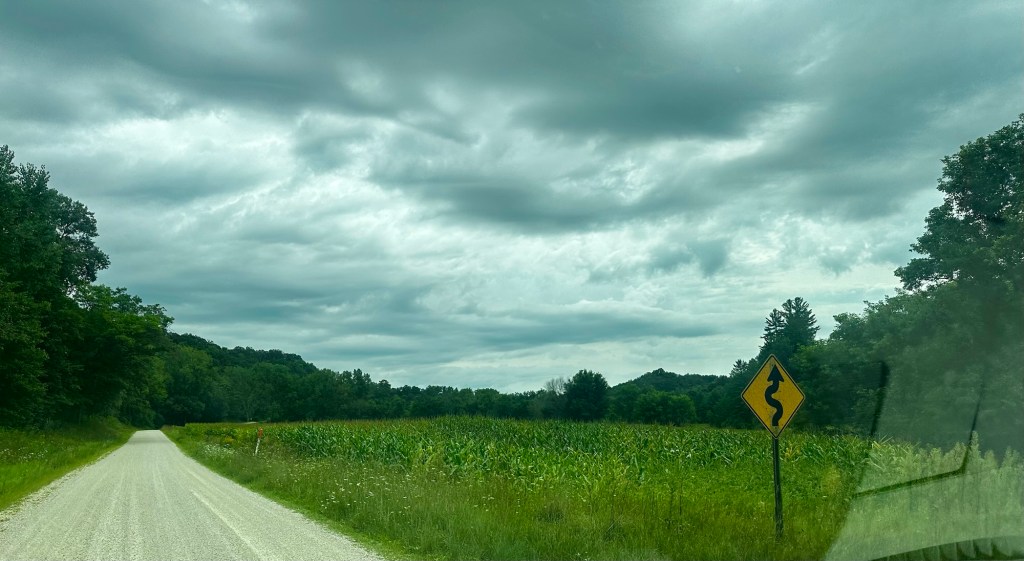
Then to Millville to pick up the 4 tires I had dropped off earlier in the week. I took a random gravel road, 592ndstreet out of Millville, and had a great drive, all by myself, following the Zumbro river to the North. It was a great drive! I wasn’t sure where I was, and there was no cell signal down there along the hills, but eventually the road looped back to the south and I found my way home.
MEANDERING
The truck seemed to be riding rougher than it had earlier and the tread was separating on a front tire. Thankfully it got me home, and I jacked it up (using the new jack) and went back to Millville with the truck tires. Another great drive with no one else on the road, Just the way I like it. It was about 4:15 on Friday when I got there and the shop was pretty quiet. Paul and Dan took the tires off, Jim got me two new ones, and they mounted and balanced them, and I was headed back home in about 20 minutes. I sure do like going to Millville. Good thing I’m employed again since I spent $1200 on tires Friday.
My brother came out and we took 100 bales of straw off the wagon with the broken front end, and put them on another wagon. Then I put 20 bales in the truck for delivery on Saturday, and the last 52 bales on a trailer. Perhaps Saturday I’ll get the front wheels off and see what’s really broken on there. Right after I put the two new tires back on the other wagon.
And I pulled out a disk I’m not using anymore to take to an auction next week. I pulled a bunch of junk out of the trees last week. Two old flare boxes, an old elevator, an old digger, and a 24’ bale elevator that I will also take to the auction. There wasn’t trees growing through them when I parked them there… that’s how long some of it has been there. Time to go.
Music this week is Nina Simone. I recently heard ‘I Wish I Knew How It Would Feel To Be Free”
Our last day of working for the State will be sometime the first week of October. The administrators at both of our agencies are scrambling to figure out who can do all the things we do, and it is turning out to be a challenge.
Husband and I are somewhat unique in that we are actually in-person at our agencies and don’t work remotely. Most of our State psychology colleagues live out of state and only test people via telehealth with the help of psychometrists. Very few of them even test children. We also are unique in that we know how to give IQ tests to children about to turn 3, and that is a rare skill indeed. Children with developmental disabilities need IQ testing before the age of 3 to determine if their issues are severe enough and will be long term. If so, they qualify for a host of services, as well as Medicaid and excellent case management. In other more populous parts of the state, there are enough psychologists in the private sector to do the testing. Not so out here.
We also know how to do IQ testing using the Stanford Binet IQ test, which has norms down to age 2, and which none of the younger State or private sector psychologists know how to use. You can’t test a 2 year old via telehealth. They don’t make them like us anymore.
Husband says he wants to be like a 1964 Chevy Impala. You can see it in the header photo. I identify with my Great Grandmother’s early 1920’s Reo. My father had vivid memories of playing in the car when he was small. Here is a similar model
What out of production car model do you miss? What else have they stopped making that you regret?
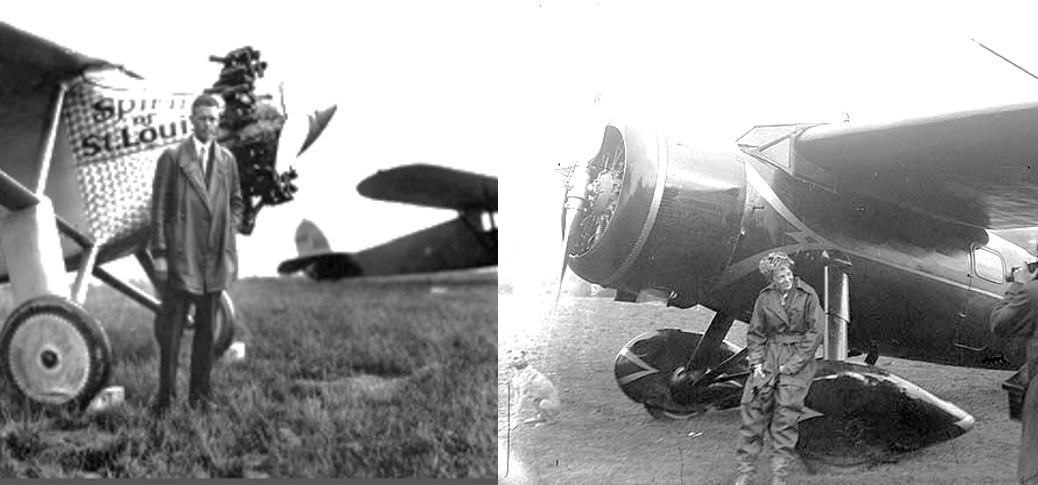
Today is an aviation milestone day. In 1927 Charles Lindbergh landed his Spirit of St. Louis plane in Paris after his 33½ hour solo flight across the Atlantic. Then five years later on this day, Amelia Earhart landed near Londonderry, Northern Ireland after the first trans-Atlantic solo flight by a woman. The combination of a little shorter route and five years of advancing technology, it only took her 17 hours.
My first thought when I saw these two feats on the same day was that it was a concidence, but it was only a fleeting thought. I’d bet money that Amelia planned her flight very carefully to arrive in Europe on May 21.
It does make me think about explorers and adventurers who put their lives on the line because I don’t care how talented Lindbergh and Earhart were, they were absolutely taking their lives in their hands when they took off. Aviation was still a relatively young science, machines broke down at an alarming rate and then there’s the whole “across the ocean” thing.
Personally I’m not a daredevil. The scariest things I’ve ever done were hot-air ballooning in Africa and zip lining in Costa Rica. The balloon experience came available on a Fam trip (which is a trip that hotels/suppliers pay for in the hopes that travel industry folks will then sell their products); I just had a feeling that this would be a once-in-a-lifetime thing and I should get over my fears and do it. It was fabulous. The zipline was another matter. It was done with a client, more or less under duress and I was terrified the whole time. When we got to the part of the course where you didn’t zip, but swung on a rope from one platform to the next, the two guides had to come back for me and basically force me to swing by reminding me that there was no other way to get down than to finish the course. Bungee jumping is not on my list, nor is sky-diving. I simply cannot imagine myself stepping out into nothing. Nope.
So congratulations today to the memories of Charles Lindbergh and Amelia Earhart for heading out across the Atlantic and taking that big step for aeronautics!
What’s the scariest thing you’ve ever done? And did you do it on purpose?
















 Trail Baboon