Category Archives: History

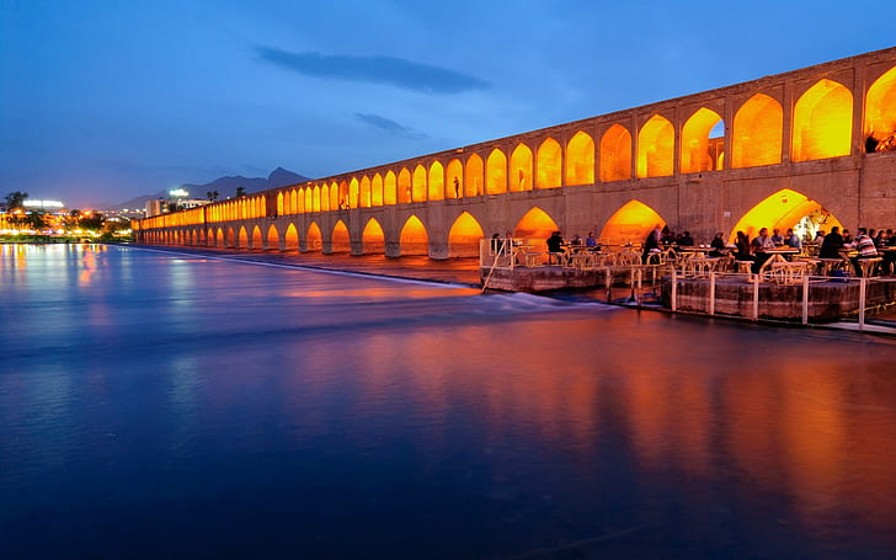
This Week’s Rabbit Hole – Khaju Bridge

As happens often, a book sent me down a rabbit hole last week.  Martyr by Kaven Akbar has been highly lauded recently – New York Times Bestseller & Best Book of the Year as well as finalist for the Waterstone Award.  4.2 rating on GoodReads and the same on Amazon.  Only 3 stars for me.  It was well written but the protagonist was exceedingly annoying and unbelievably full of himself.  It had a plot twist that I saw coming about a million miles away and the ending wasn’t very satisfying at all.  Oh well….

There was a good story embedded in it though about a Persian poet named Ferdowsi who wrote an epic poem in order to get money from the king to rebuild a bridge in his town.  Akbar ended this section saying that the king built a bridge like no other and it is known as the Poet’s Bridge.

You know this was more than I could resist.  Looked up Poet’s Bridge and discovered that there is such a bridge in Isfahan, Iran but it was built considerably later than Ferdowsi lived and is called Poet’s Bridge because “it has been a popular meeting spot and a source of inspiration for poets and artists, with many beautiful poems written about its beauty and the surrounding area.”  However Ferdowsi was a poet and wrote The Shahnameh, one of the world’s longest epic poems (50,000+ couplets) and the longest epic written by a single person.  Here is one of the most famous lines:

“Though you have little wealth, fear not the decree of fate; for the ocean of the sea was once a drop of rain.”

It was written between 977 and 1010 and there are some resources that suggest there may have been a bridge involved, but it’s pretty shadowy.  And clearly any bridge built in Ferdowsi’s time is not the Khaju Bridge which was built in the mid-17th century.   But the Khaju Bridge is gorgeous and is a significant landmark.  If Akbar had not named the bridge in his telling of the Ferdowsi story, I wouldn’t have found the Khaju Bridge.  Not sure if this was Akbar’s intention or not, but I’m glad it happened.

Any favorite bridges?  Do you have any worries about long, tall bridges?

Antique Reads

Lucy Worsley is a favorite historian of mine.  A couple of months ago I watched something about the history of murder mysteries in Britain.  It was interesting and, of course, it sent me down a rabbit hole. 

In addition to referencing quite a few early murder mysteries, she also mentioned the first few books in which women were featured as detectives.  I immediately went online to the library.  The very first woman detective was introduced by Andrew Forrester in 1864 in the very unoriginally titled The Female Detective.  I have that on hold but I was particularly drawn to Susan Hopely: The Adventures of a Maid-Servant by Catherine Crowe.  This was the first female “detective” authored by a woman. The Hennepin County system didn’t have it but I did find it listed on the InterLibrary Loan page.  I immediately requested it.

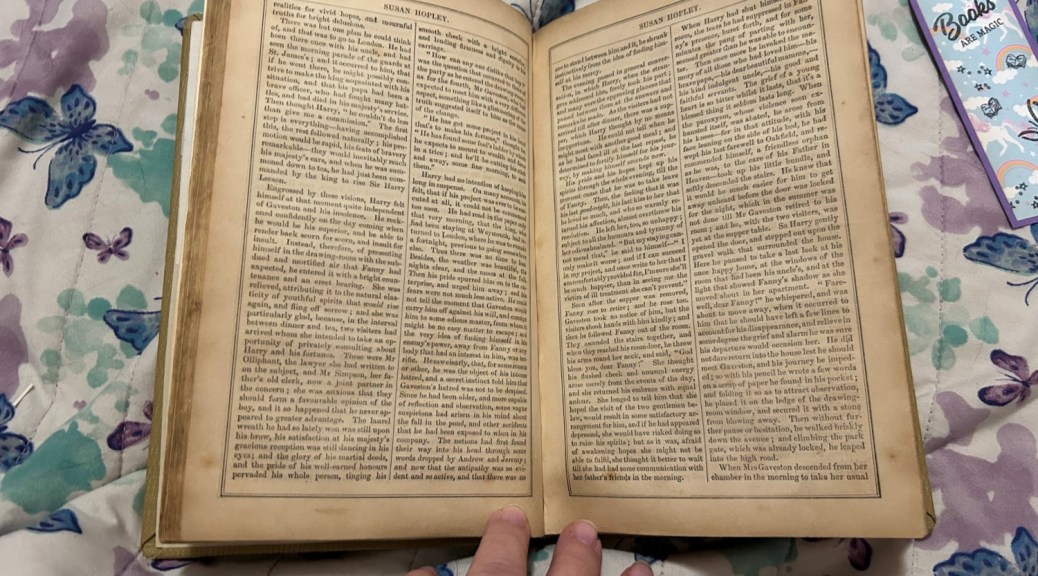
This began a two-month run around, having to do with the ILL system mis-referencing it and involving several emails between me and two different folks in the ILL department.  I had actually forgotten about it when with no notice, it showed up at my local library.  Later that night, when I opened it up (hoping to remember why I had asked for it in the first place), I discovered that the pages were REALLY old, despite a fairly new cover.  I spent some time looking at things on line and was fairly certain that these were pages from one of the original print run from 1842. 

It seemed too incredible that I had a 183-year old book in my hands, so I turned to the one person I know who knows about this kind of thing…. Our Bill!  He graciously allowed me to bring the book over and upon inspection he agreed that those pages were mostly likely from the first print run in 1842.  He then walked me through some of his book collection, showing me quite a few other books which were as old.  This made me feel a little bit better about carrying this book around and I didn’t drag it around with me to the gym or appointments.  When reading it at home, I was very very careful and when I returned it to the library after I’d finished it, instead of sending it down the automatic chute, I carried it inside and handed it delicately to a librarian to scan!

Do you have any fragile/delicate antiques?

Greenbacks

In addition to a daily check of our local regional jail for the inmate list so I can see which of my little darlings are in the hoosgow, (There are several today) and the two funeral homes to see who died, I also check a history site to see what of importance has occurred on this day in the past.

I see that today is the anniversary of the US Congress in 1862 authorizing the printing of paper money. I rarely have any paper money in my purse. Husband usually has some, but it is hit or miss. I remember my dad being so happy to have some “Silver Certificates” in his possession when I was a child. I remember that the engraving was quite elaborate on those bills. I wonder, given the advent of all that is digital, if we will need paper money in the future. It seems the penny is also on the way out.

What is your favorite bank robbery movie, song, or story, or songs or stories about money in general? What is the largest monetary bill you ever carried?

Remnants

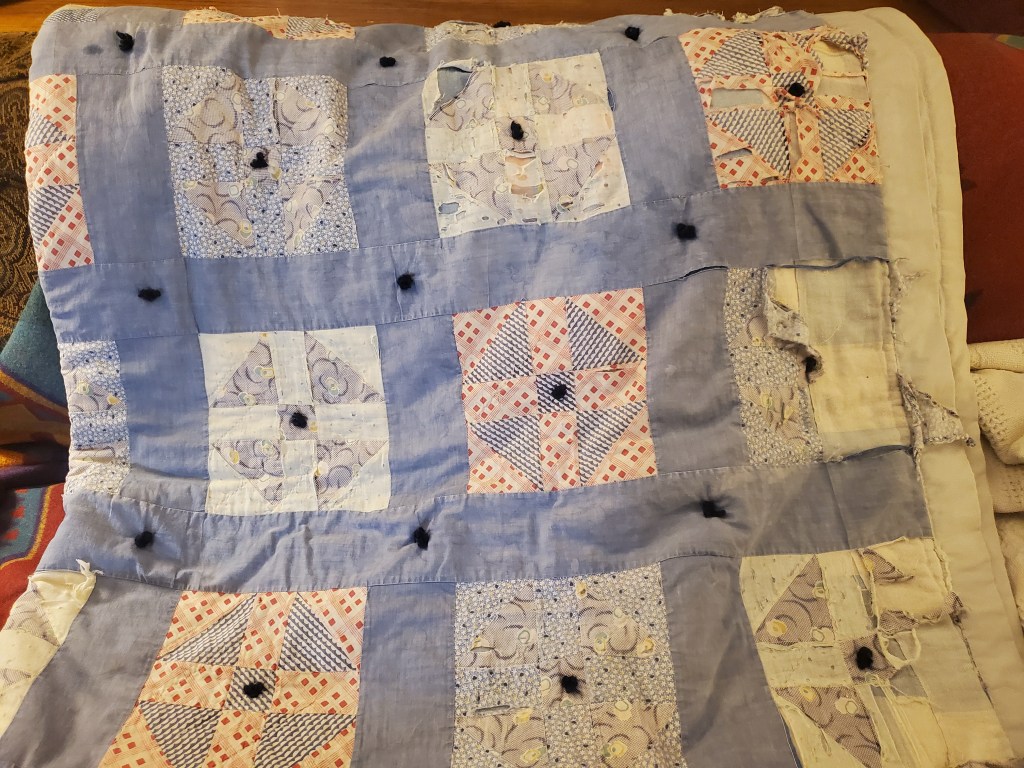
My mother and her four paternal aunts (Lena, Meta, Bertha, and Greta) spent a great deal of time in the mid-1930’s filling my mother’s Hope Chest with patchwork quilts they sewed. They used cloth scraps from their own and others’ unneeded clothing as well as larger pieces for backing. Mom never really used them and just kept them in her cedar chest.

I started using them after Husband and I married. There were four of them. One is still in tremendous shape and we have it on a bed in the basement. The quilts worked best as blankets under the bedspread as they are all sized for double beds. Two of the quilts disintegrated after about 10 years. I decided to preserve the third one and patched it as best I could and put on a new backing. I hung it on the wall in my work office for many years until time and gravity started it to sag and tear at the seams.

It has been in a cabinet in my new office until I started to clean and get rid of stuff preparatory to my retirement. I took the quilt out to our van and left it there to be used as part of winter survival gear

Husband brought it into our son’s house when we were visiting there last week, and our grandson insisted that we put it on his bed, and he slept under it every night we were in Brookings. Mind you, it hadn’t been laundered in 25 years, and was probably full of dust, but grandson loved it and wasn’t happy when we took it home. I told him I wanted to patch it better and we would bring it back to him at our next visit. It dawned on me that the quilt is about 90 years old. My mother and her aunts would be pleased some of their handwork is still being used and loved.

What precious things do you have that have been handed down? What do you want to hand down for future generations? What do you think are essentials for “Hope Chests” these days?

Running In the Family

When our daughter was in college, it never failed that every time she came home at the end of a semester she would spend at least a day lying on the sofa with a low grade fever. I attributed it to her body’s reaction to the stress of finals and assignments.

Last Saturday after my last full time day of work, I was felled both by a flare up of sciatica and a low grade fever that has lasted all this week. Hmm? Could daughter and I have similar reactions to stress? I think so. She probably inherited it from me.

Both our children teasingly blame me for their propensity to Generalized Anxiety Disorder. From their father they inherited flat feet. I have lumbar scoliosis like my maternal grandmother. So does one of my cousins. I did not inherit my father’s athleticism, but I did his musicality. Goodness only knows where I got A- blood type. I did not inherit my maternal grandmother’s ability to do complex math in her head. Our grandson seems to have that ability, and is proud to tell me that in Grade 1 he can do algebra in his head and is in an enrichment Math program. It is hard at times to know what is nurture and what is nature, but however our forebears hand things down to us, it can make our lives interesting.

What did you inherit or wish you had or hadn’t had inherited from your forebears? Ever read Running In The Family by Michael Ondaatje?

Family Time

My parents and I always opened our presents on Christmas Eve after church. That was a German tradition from my mother, and also cleared the way for Christmas with family on Christmas Day.

We usually headed for Magnolia, MN late morning on Christmas Day to either my paternal grandparent’s farm or the farm of my dad’s younger brother a couple of miles east. My dad’s sister and family would come from Sioux Falls, and we would have a huge meal (usually turkey and all the fixings), and then we children would have to wait until after the dishes were done to open presents. That was a long wait! Late in the afternoon we would head to Pipestone, 25 miles north, to whichever of my mother’s family would host Christmas. There usually were no presents, just a big meal and lots of desserts.

Yesterday we spent time in Brookings opening presents, taking turns cooking, napping, reading, doing art projects with our grandson, and listening to grandson read aloud the various books he received (Cat Kid, Wild Robots, or Dog Man). He also received some pretty wonderful art kits which he started to use right away. It was very foggy outside, and we didn’t go anywhere. We watched The Muppets Christmas Carol after eating the French Canadian tortiere that grandson and I assembled and baked. He was a good dough pincher. It was a restful day. The Westie and cat napped on various soft blankets. No one had to wait for the dishes to get done before opening presents. We cleaned as we cooked. We listened to Christmas music on MPR all day. It was a great time.

What were your family gatherings like when you were a child? What were some of your favorite presents? Who did the dishes?

Our Song

I am not too sure why I started thinking about Dr. Zhivago last week, but I did, and that led to memories of our Italian landlords in Winnipeg.

Angela and Emilio lived in a modest home not too far from the University, and when the house next to them came up for sale, they snatched it up. It was a very tiny, two bedroom home with a large enclosed porch and a nice sized garden in the back. There was an alley that ran in the back, and an unattached garage.

Emilio and Angela were from Calabria and immigrated to Canada in the mid 1960’s. Emilio was a ceramic tile layer and flooring guy. He had invented and perfected a way of laying tile that made him the fastest in the city. He wouldn’t let anyone watch him work because he didn’t want anyone else to learn his method. Angela was a homemaker. They bought the house next door out of an Italian desire to be able to control who lived near them. We were their first renters.

Angela told me that Emilio immigrated first, before they married, and she followed several months later. They married in Winnipeg. She told me her first impression of Winnipeg flying over the city was that the rows and rows of houses looked like rows of grave stones in a cemetery. She said that Lara’s Theme from Dr. Zhivago was “their song” since it spoke of lovers finding a place where they could be together. I thought that quite sweet. They managed to make a good life for themselves.

What are your favorite romantic movies? Did you ever have a song that you considered yours?

New Hires

Early last week in the grocery store, Husband and I ran into a couple we have know for years who are famer/ranchers and live in a small town near ours. They are truly salts of the earth, having been foster parents for decades, raising their own large family and adopting a couple of their foster kids, working as school bus drivers, and maintaining their ranch. They are near retirement now, as are we. Frank, the rancher, asked me what I was going to do after I was done working. Frank is a really funny fellow, and said that he heard that Trump was considering me for a cabinet post. I told him that my criminal record would prevent any such appointment, and Frank said that probably made me a shoo-in.

The cabinet picks continued all week, becoming increasingly and astoundingly weird, even that of our own Governor as Secretary of Energy. It seems like anyone, no matter how inappropriate, could be a contender. This got me to thinking who the Baboons would nominate for cabinet posts.

Make some interesting cabinet picks. What posts do you think fellow Baboons would do a good job at? Know any foster parents?

Tudor Anniversary

When I was a freshman in high school, PBS aired The Six Wives of Henry VIII – a one-hour segment for each wife over the course of six weeks.  I do not remember why I watched the first one – it could have been because one of my folks turned it on, although neither of them were big history buffs.  It could also have just been a happy accident – by the end of the first episode, I was completely hooked.  That was the day that my interest in the Tudors was born.  About a year later, Masterpiece Theatre showed Elizabeth I, another six-part series.  Glenda Jackson was fabulous in this. It was also about this time that I saw Anne of a Thousand Days. Any time I think of Anne Boleyn, I also see Genevieve Bujold in my minds’ eye. Even when I hear this:

I would not call myself an expert in Elizabeth or any of her Tudor relatives, but I’m pretty sure I know more than your average Joe.  I remember being amazed when one of my Metro State professors, who I’ve always thought was just the smartest guy ever, didn’t know the order of the six queens.  Didn’t everybody know that.  Guess not.

Six, a musical that is currently playing on Broadway hasn’t piqued my interest yet – I still have to get around the weirdness of having a lot of singing and dancing based on what are almost all pretty tragic stories.  Truly, Anne of Cleves (#4) was the only one of the six who managed to come out ahead of the game.  I know a few people who have seen the musical and they say it definitely is good but I’m not ready yet.  Maybe one of these days. 

Yesterday, in 1558, Queen Mary passed away and Elizabeth came to the throne.  I thought I’d mark the occasion by reading Elizabeth I CEO: Strategic Lessons from the Leader Who Built an Empire.  It isn’t a new book but I’ve avoided it because “CEO” and “strategic lessons” aren’t on my favorite words list.  For some reason this week I’m thinking I might enjoy this – maybe give me some insights that I haven’t considered before.  We’ll see.

When was the last time you pushed yourself to read a book you weren’t sure about? And how did that turn out?

Sistine Chapel

A couple of weeks ago, we hit the 512th anniversary of when the Sistine Chapel was first opened to the public for viewing; Michelangelo Buonarotti spent seven years working on that ceiling between 1508 and 1512.

The story of his work on the Chapel and his relationship with Pope Julius II is pretty well documented by Irving Stone’s The Agony & the Ecstasy, which came out in 1961.  I haven’t read it but reviews have always said that it’s a fairly well done biography, using mostly primary sources including a lot of Michelangelo’s letters and writings.

I’ve seen the movie several times – it got hugely good press when it came out in `65.  I think it portrays a pretty accurate look at the times although modern reviewers wish that the movie had been more “spicy” and suggest that Michelangelo’s life was more passionate than shown– that he wasn’t just a roboton with veins of paint (a great line by Rex Harrison in the movie – “What runs in Michelangelo’s veins is not blood – it’s paint”).

I’ve been lucky enough to visit the Sistine Chapel and it IS incredible.  However I can’t help but wonder at how Michelangelo could have labored for seven years on the project.  In fact, it turns out that a couple of decades later, he returned to work on The Last Judgments of Popes paintings.  So technically MORE than seven years.

A project taking that long would make me crazy.  My “all flowers, no grass” program in the front yard was a 20-year endeavor, but it was short spurts each year, nothing in comparison to hand painting an entire chapel.  The front porch project took four years but except for the two LONG days that tim and I spent sand-blasting the old stucco off, it didn’t seem like an overwhelming to-do.

I’m not sure how I would keep up my motivation for such a big job that would take so long.

What’s the longest project you’ve worked on?