Much has been made of recent security lapses surrounding the President of the United States and his family. The modern presidency is a luxurious cage, and anyone with the funding and the fortitude to get elected must willingly climb inside for their own safety. We expect that the people surrounding the President will anticipate every possible threat and will act with integrity to head off a calamity.
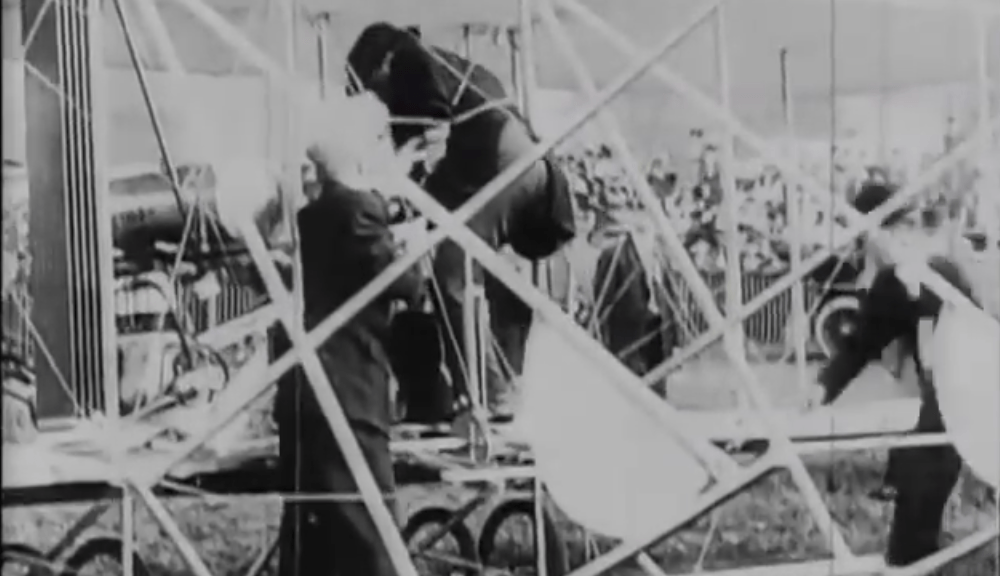
But it used to be different. Example: today is the anniversary of the day in 1910 when another great landmark in the history of Presidential security occurred – in what appears to be a “what the hell” moment of exuberance, sitting president Teddy Roosevelt decides to let some guy take him up in a plane.
Imagine any other President deciding to do this while in office. In an age where we weld down the manhole covers so the chief executive’s motorcade can pass over them unmolested, letting the POTUS go for a joyride in some relatively new piece of technology is unthinkable.
Doing this cemented another milestone for T.R. – he became the first U.S. President to fly. And seeing him in the video as he climbs through the bracing wires between wings so he can settle, uncomfortably, into his seat, makes me wonder if he also became the first exasperated American air traveler to ask “Why is this so uncomfortable?”
Those deep, ground-challenging dips at the end of the flight are breathtaking even today. No aircraft should have its nose pointed ground ward at such a steep angle.
Within three months, Roosevelt’s pilot, Arch Hoxsey, would be dead.
In an air crash, of course.
What do you remember from your first airplane ride?
He’s got Japanese roots, but was actually born in Georgetown, KY. He was named after Miles Davis, one of the greatest jazz musicians of all time.
He’s kind of blue, and he’s reached the age where he’s comfortable with his body and his looks
Miles has visited each coast, been to Canada several times, and almost been to Mexico. He’s traveled nearly the equivalent of a one-way trip to the Moon. He’s gotten a few bumps and bruises along the way, suffered a few minor internal ailments, but otherwise has aged pretty darn gracefully for being 23 years old.
He’s into the Neo-Renaissance thing, and has many and varied interests.
He’s been a good friend for all the right reasons: faithful, reliable, and dependable. He also gets along great with my wife since he spent a lot of time with her the first half of his life, and they’re still on good terms with each other. He can keep a secret better than anyone I’ve known (when we’re out together with the windows closed and I rant about bad drivers or outrageous/stupid/ignorant things I hear on the radio). Based on a few close calls we’ve had, he’s always been willing to put himself in harm’s way to protect me.
He’s health conscious, but also has a sense of humor.
Sometime in the next year or so, Miles will retire, hopefully to a good home that will take care of him in his last years. I don’t want to be the one to pull his spark plugs, so I’d like to either sell him to someone who will use him gently for his remaining time, or donate him to the radio station he learned to love after all those years, Minnesota Public Radio. His favorite show was Leigh Kamman’s The Jazz Image. Yeah, late Saturday night drives home while listening to all those great jazz tunes were some damn good times together.
He’s interested in politics.
His politics were always a little bit different, but he’s a live and let live kind of car, so that’s cool.
He’s a long-time supporter of worthwhile charities
But his heart (engine) has always been good and true, and he believes in helping those less fortunate, (maybe getting a good meal out of the deal after taking the Big Brother (owner) and his Little Brother up to the BWCA for some canoeing and camping.)
When he slowly rolls to his final stop, I hope he’ll be c(a)remated rather than tossed into an open graveyard with hundreds of other rusted old heaps. Better to recycle his useful elements ASAP than have him slowly decay and pollute the ground water.
As his final day approaches, I find myself feeling sad and melancholy. I took him for granted for the first twenty years or so. I always assumed he be there, start on command, get me where I wanted to go fast and efficiently. I would let him go weeks, even months without a shower; throw trash in his backseat; let dust, dirt, mud, and a multitude of food crumbs accumulate in his cracks and crevices; and delay taking him in for regular checkups. At least I made sure he got his annual or biannual oil transfusion. I wasn’t nearly as good a friend to him than he was to me.
He loves to visit wild places, and he’s a firm believer in self-reliance and personal responsibility.
Yet Miles never complained, always had a smile on his grille, always purred like a tiger when I started him up each day. But only rarely would I pat him on the roof and say, “Nice job, Miles. That was a bad storm you just got us through,” or “Thanks for a smooth ride.” Even though I ignored him a lot, I was grateful for every safe trip we ever took, even the shortest trips down to the local convenience store for gas, or bananas and milk, or a late-evening summer ice cream run.
So thanks Miles. For everything: Every new mile. Every new road. Every new town. Every new vista. And all the old ones, too. I’ll miss you when you’re gone. Ashes to ashes, rust to rust.
My question: Why do we anthropomorphize and befriend inanimate objects such as cars? Tell me about your most trusted and rusty friend.
It’s not hard to accept the idea that man’s earliest attempt at humor was a fart joke. It feels right. But the second was probably a prank of some kind.
I have never been a fan of the game some DJ’s play when they make and broadcast prank telephone calls because it seems so unfair to make a show out of mocking strangers. This is odd because I did morning radio for more than 25 years. Fooling any unsuspecting person for your own amusement was a base element in the chemical profile of your standard wake-up show back then. Still is, probably.
And even though I didn’t care for elaborate put-on and almost never committed one, some of my fondest memories from those years are connected to one April Fool’s morning when we said, as straight-faced as possible, that we had been knocked off the air by a technical difficulty and did not know when we could get back on. The size of the problem was unknown, I told listeners, but we were trying to plot the extent of the outage by sticking pins to a map on the wall.
“Call the studio,” I said, “if you can’t hear us.”
The audio is still online, here. We start the prank about 100 minutes into the show. Honest.
We did get quite a few calls from people who got the joke immediately and wanted to participate in the fun. But among the respondents was one clearly confused older woman who couldn’t understand why we were talking about being off the air when she could hear us as clearly as ever a the intersection of Winnetka and Bass Lake Road.
A friend called me at my desk a few hours later and in a make believe voice chastised me severely for “… publicly humiliating my elderly aunt! Have you no decency, sir?”
I was halfway through my apology before he ‘fessed up. The woman was not his Aunt, but he felt a little sorry for her even though he, too, laughed at her bewilderment. Now it was my turn to be mocked. The tables had been turned, and appropriately so.
All this came to mind when I saw that Alan Funt’s son Peter was at it again, shooting new episodes of the classic TV prank show, Candid Camera.
In a commentary for the New York Times, Funt confessed some trepidation at trying to fool savvy moderns. He said “I worried briefly that people are now so tech-savvy that some of our props and fake setups wouldn’t be believed. Instead, we found that the omnipresence of technology has reached a point where people will now accept almost anything”.
And really, isn’t that the lesson of the past 20 years? Virtually any crazy thing is possible. Such as:
Today’s guest post comes from Renee Boomgaarden, aka Renee in North Dakota.
Sometime in 1925, the residents in and around Ellsworth, MN were abuzz with the news that Okke Boomgaarden had bought a $3000 accordion for his daughter, Amanda.
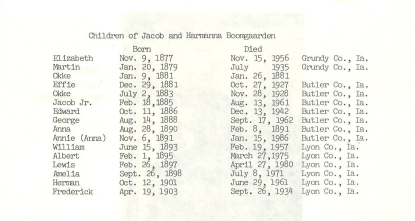
Okke was my great uncle, the fifth oldest of the sixteen children in my grandfather’s family. Okke was, officially, a farmer, sort of like how Don Corleone was, officially, an olive oil importer. Okke made his money bootlegging, and his barn was used for dances, not livestock. Okke had regular dances in the barn. He provided refreshments, at a cost, and members of the family provided the music.
Family historians talk about my grandfather and many of his siblings having a natural aptitude for music. All were self taught.
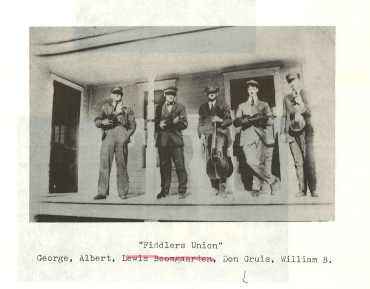
Great Uncle George learned to play the fiddle when he was 16.
Great Uncle Albert also played the fiddle.
Great Uncle Herman was a noted left handed banjo player.
My grandfather played the cello.
Great Aunt Amelia played the piano.
Other family members played the accordion.
In the years before the First World War they were know as The Boomgaarden Orchestra and played for dances, weddings, and harvest festivals in northwest Iowa and southwest Minnesota.
After the war, they changed their name to Mandy’s Jazz Kings, and played in Okke’s barn, joined by Okke’s children Georgie on fiddle, Jake on saxophone, and Amanda and Mabel on the accordion.
My father remembers going to some of those dances when he was a little boy, driving to Ellsworth with his parents in their Graham-Paige automobile. I wish I know more about the music the Jazz Kings and the Boomgaarden Orchestra performed.
I wish I knew what happened to my grandfather’s cello. Until I researched for this post, I never even knew he played a string instrument.
Okke died of a heart attack in 1928, and the dances stopped soon afterwards. The older members of the Jazz Kings had their own farms and families to care for and couldn’t play with the band anymore. Okke’s sons Georgie and Jake kept playing, changing the name to The Georgie Boomgaarden Orchestra. Georgie and his band played in the towns around Ellsworth until the 1970’s.
The Depression hit everybody hard. At one point, Jake’s saxophone needed $12.00 worth of repairs, but he didn’t have the money to fix it. The local doctor intervened and paid for the repairs. He had just built a night club in Ellsworth and needed musicians to play for the dances.
My grandfather felt it was important for my dad and his brother to have some kind of music training despite the tight finances. Grandpa drove Dad and Uncle Alvin to Luverne once a week to practice with a drum and bugle corps. This group was comprised of sons of World War I veterans, and you can see them in the photo at the top of this page. Dad played both drum and the bugle – he is the third boy on the right in the back row. He can still play his bugle, and has two of them in his bedroom.
Renee played bass clarinet for Concordia.
My children and I are the current Boomgaarden music amateurs along with my husband. Husband plays the cello, guitar, harmonica, and piano. He also sings. You can see me playing my bass clarinet in the Concordia College Band in 1978. Daughter plays the violin, French horn, and piano. She sings in college. Son played the trombone and sang in college. He currently sings in the church choir. I drafted husband to join the handbell choir. He drafted me to sometimes play the bass guitar in a very amateur gospel/rock and roll group.
Why do we do these thing? I have no idea. Maybe Okke will explain it to me someday in the Hereafter.
In the past on this page we have discussed where we are from and where we’ve lived. Baboons can be both wanderers and stay-at-homes. It can be a surprisingly tough mental exercise to walk back through your biography to list the places you’ve lived in the proper sequence, and for how long at each stop.
Likewise, each state of the union has a specific history of who happens to live there and from whence they came. Only demographers and other numbers geeks can find much enjoyment in looking over the columns of figures that tell those stories.
For the rest of us the info-graphics experts at the New York Times have developed 50 fascinating charts that display the data as strata – a cross section cut from each state’s census showing the last century’s changes in where residents were born.
Based on your personal history, you can get a sense for how common (or uncommon) you are in your current environment when birthplace is the sole yardstick. Back in the 1970’s I was part of a sliver (3%) of Illinoisans born in the Northeast. Now in Minnesota, my kind are still a rarity at a mere 2%. Rare as hen’s teeth. Precious as gold.
Sometimes we have to go out of our way to feel special.
After looking at this I’m left with the impression that people accumulate in specific places based on a variety of economic forces that drive them there. Because certain individuals may be rooted in place while others are entirely footloose, there is a variable and distinct human geology that defines each state.
I’m thinking the title of today’s post will draw many readers who are scanning the internet for the rare chance to indulge in some choice primate-based vitriol about our elected representatives.
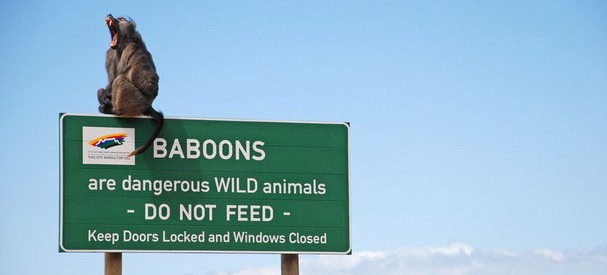
If that’s what brought you here, welcome and apologies, for I’m going to disappoint you a bit – we don’t spend a lot of time venting about Congress at Trail Baboon. But we do tell stories and make lighthearted observations – often in the comments section of each post where a core group of visitors congregates. These are the aforementioned Baboons of the eponymous Trail.
It just turns out that a gathering of baboons anywhere in the world is called a “Congress”. Or not. There is some disagreement about this. It might be better to say “troop” or “tribe” or “flange”. Apparently an e-mail has recently made the rounds to promote a Congressional collection, but English is a living language so ultimately a group of baboons will be named whatever we decide to call them.
The Baboons in this Consortium, Collection or Clump sometimes write guest posts and I (as blog administrator) have resolved to credit those entries more clearly and completely, thus the new item in the top task bar called “The Baboon Congress”.
Take a look – you’ll see the names of some of the writers who have penned guests posts since this blog began almost four years ago. Each name should be accompanied by a click-able link that says “All posts by …” This will give you a sense of the prolific amount guest-blogging done at this site.
I’m grateful to the gentle readers who populate this place and am in the process of adding pages, bios, and the collected writings of every person who has contributed along the way, so check back with us regularly, feel free to join in the discussion, and before long you may discover that you are a baboon too!
What do you call it when you and your friends get together?
On our recent trip to Seattle on a delightful rainy, foggy day we took the ferry out to an island called San Juan Island, stopping along the way at three other islands in the group called the San Juan Islands.
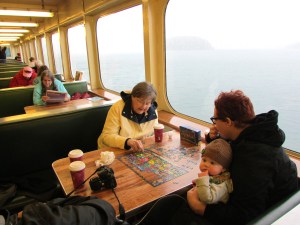
The San Juan Islands mark one of the places on the map I have looked at with longing. I was so enthralled by the two-hour ride I did not even bother with the couple dozen jigsaw puzzles constantly under progress on the ferry.
San Juan Island was delightful, better than I had hoped. Perhaps best of all was discovering a little know moment of history. On both ends of the island are a National Historic Park. The north end is called the British Camp; the south end the American Camp. The park remembers what is called either The Pig War or The Pig and Potato War. (I prefer the lilt of the second name myself.) For a full explanation you can consult Wikipedia.
The essence is that after the 49th parallel was made the border between Canada and the United States, with the exception of Vancouver Island, the exact boundary through the San Juan Islands could not be determined for lack of a clear map. Great Britain and the United States agreed on what the boundary should be like but had to wait to see what line through the San Juan Islands would best meet those conditions. San Juan Island was left in limbo and had settlers on it from both countries, peacefully until the day of the pig.
A British settler had a pig which kept getting into the potato garden of an American settler. One day the American had enough and shot the pig. The American then offered the Brit $10 for the pig; the Brit demanded $100. Both sides bristled. Sabers were rattled. American troops landed. Their leader declared he would make it another Bunker Hill, seeming to forget that the U.S. lost that battle. The leader of the British forces, then titled Rear Admiral Robert Lambert Baynes, who later went on to great prominence and a knighthood, was ordered to attack. He refused, explaining that two great nations do not go to war over a pig. For a few days the two sides tried to goad each other into starting a fight, but soon became friends. For a dozen more years, waiting for a peaceful decision, settlers and pigs from both nations lived together in peace, and the two nations had token forces, more comrades than enemies, on both ends of the islands, the sites of the two parts of the National Park.
Eventually, by international arbitration the U.S. was awarded the island. The island is worth a visit today for several reasons. One, for a beautiful view of Vancouver Island.
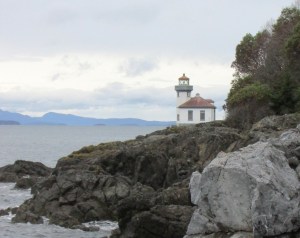
And a very picturesque lighthouse, The Lime Kiln Point Lighthouse.
But one thing is missing from the island, a statue of the noble Admiral Sir Robert Lambert Baynes. We put up statues for great fighters. Why not for a great non-fighter? There is a code about statues of military leaders on horses, the number of feet the horse has off the ground telling us if the man was wounded or died in battle. I think Sir Baynes should be shown sitting on a camp stool drinking a cup of coffee.
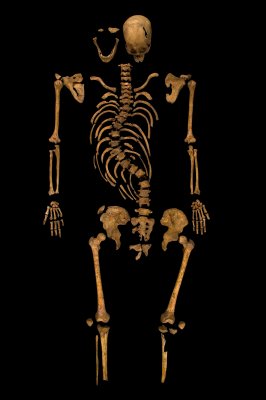
More unfortunate news for England’s Richard III – a year after he suffered the indignity of having his bones excavated from underneath a parking lot, researchers have received the green light to map his genome.
This means Richard III’s genetic secrets will be laid bare, including any serious medical conditions he was predisposed towards. Scoliosis, anyone? That’s the prevailing reason to resist having one’s DNA decoded – to avoid potential discrimination based on the likelihood that you will develop an expensive malady down the road.
Fortunately for Richard III, he doesn’t have to worry about such things because Obamacare is now the law of the land, so he can’t be denied coverage based on a pre-existing condition! He is also protected by the fact that he’s not from around here, and is already disintegrating.
Yet Richard III is still alive as a cultural figure even though his reputation remains dark. It’s bad enough to have great artists (Shakespeare!) interpret your legacy. They don’t really care about you – just their form of expression. And now the great scientists will have a go at telling Richard III’s story their own way. These test-tube shakers and number crunchers have no reason to be kind either – it’s all a collection of data points to them. So you could say Richard has an endless literary shelf life and will soon gain a timeless scientific stature too, but immortality of any sort is wasted on the dead.
Would you rather live forever as a dramatic villain, or a museum exhibit?
One of the surprises that came out of my recent trip to Fort Myers was discovering the remnants of the Koreshan Unity Settlement – a Utopian community established there in 1894 by a charismatic leader named Cyrus Teed, who believed in some fairly progressive things including the educational value of artistic expression and full equality between the sexes.
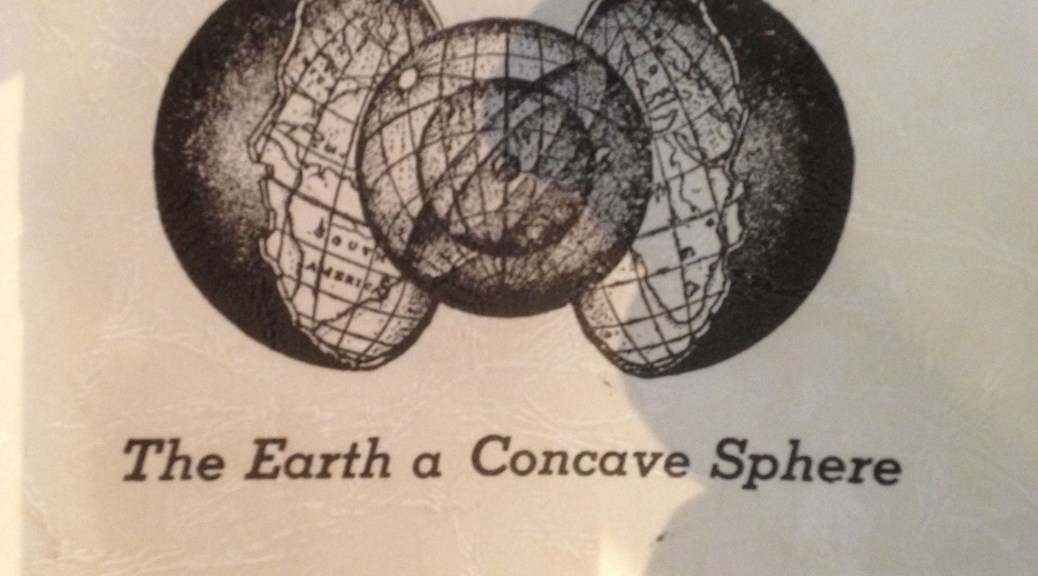
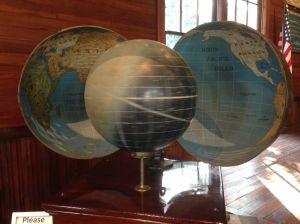
The opened sphere, showing the spinning gasses inside.
But there was at least one thing major thing he got wrong. Teed preached that the Earth was a hollow sphere, and we lived inside it. He thought the globe that we know so well was actually inverted – with the continents pasted around the underside of the curve. Looking up (or inward), you would see a revolving ball of gas that was layers thick, only allowing us to view the refracted rays of the sun, located at the center. The sun, rotating once each 24 hours, was light on one side and dark on the other – thus giving us day and night.
The land beneath our feet was also layered, but digging through it would eventually bring you to the outside of the sphere, beyond which there was … nothing.
Teed and his followers considered the commonly accepted idea of a limitless universe with humans living on the outside of the globe under a distant sun and with planets and stars all whizzing around in their own orbits as inherently chaotic and unknowable, putting God beyond the reach of human understanding. Teed said the Koreshan system “… reduces the universe to proportionate limits, and its cause within the comprehension of the human mind.”
Easily said, though it didn’t take very long for his book, The Cellular Cosmogony, to lead this particular human mind to a state of exhaustion. Still, I would love to have a t-shirt featuring their motto – “We Live Inside!” After all, it’s not that different from the philosophy of Minnesotans in January.
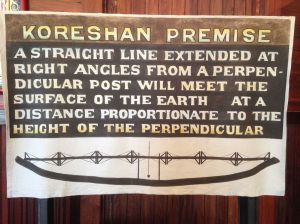
The Koreshans went to great lengths through observations and experiments and words, words, words to support their notion that the wide horizon visible off the Florida coast actually curved up with a smile, rather than down with a frown.
Cyrus Teed died in 1908 and while his utopian settlement lingered for a few decades it eventually faded away. A prime directive of complete celibacy for the most ardent followers of Koreshanity might have had something to do with that. The last Koreshans gave their vast tract of land to the State of Florida in 1961 which allowed for the establishing of a state park.
What impressed me most in this brief encounter with Cyrus Teed and his philosophy was the power a charismatic person with absolute conviction can have over others who are less certain in their beliefs; and once convinced, the amazing ability we humans have to cling to ideas that are completely and obviously wrong.
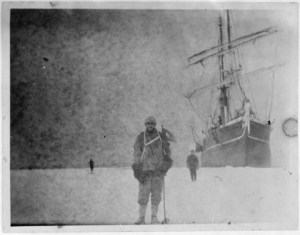
Somebody snooping around in an old hut in Antarctica discovered some century-old negatives that were snapped during the Shackleton Expedition in 1915-17.
(photo: Antarctic Heritage Trust)
First of all, I’m surprised there is a little-used hut in Antarctica. It was built by Robert Falcon Scott and served as the jumping-off place for his unsuccessful 1910 expedition. It also was a life-saver for the Shackleton party when they were stranded. And much of the rest of the time it has just been sitting there.
The photos are interesting, I suppose, if you like looking at black-and-white images of grey water and bright white. Faded landscapes leave me cold, especially when the landscape in question is a glacier. Only a couple of the images feature people, and faces (for me) are the thing that can make an old photograph compelling.
Charming nameless tykesUnidentified couple takes no pleasure in being forgotten.
I just spent the day going through boxes of crinkly old papers that had been pushed to the back of a closet, including several ancient photo albums featuring relatives I’ve never met and, I fear, will never be able to identify. Most of the images have no accompanying notes, not even a name scribbled on the back. For all I know they are members of the Shackleton expedition, stranded on some distant featureless iceberg. I guess it was expected that no one would look at these pictures without the guidance of a knowledgeable companion. I suppose that’s what we imagine when we catalog such shots in family albums – that they will be inter-generational conversation starters. But photographs can easily outlast everyone who has direct knowledge of those pictured, so when the older generation is gone and no one has taken the time to jot down a few notes, only mystery remains.










 Trail Baboon