Category Archives: Nature

The Path Less Traveled

The weekend Farm Report comes to us from Ben.

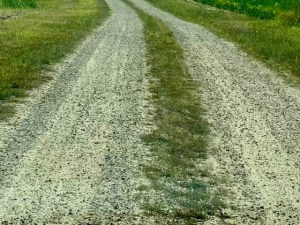
Going home the other day and I was thinking about the grassy strip down the middle of our driveway. I don’t remember that happening when I was a kid. And maybe it’s because back then several tractors had narrow front tires. Meaning the front wheels were right under the hood and ran down the middle of the road, so maybe that kept the grass down.

Dad bought a ‘wide’ front end for the 730 tractor at some point. It had to do with mowing hay and how you didn’t want to run over what you had just cut. It also gives the tractor more stability, but that wasn’t such a big deal back then. There were even some tractors that had single front tires. (Dad used to talk about getting new rear tires on the 630 tractor, then mowing in the calf pen where there is a pretty good hill and the tractor slid sideways down the hill because the lugs on the new tires were too straight.) After he arrived at the bottom, unscathed, after he got off and kissed the ground and thanked the Lord, he ordered different tires to be put on the tractor. Not that wide front tires would have helped that. All tractors have wide front ends now. And we have a grassy strip down the middle of the road.

Along the lines of ‘remember when’, I miss grocery stores loading your groceries. I know there are a few that will still. Was that a convenience or not? Seems like it would have been. The store employees wouldn’t have to go get carts and there wouldn’t be cart corrals taking up parking spaces. Let alone checking ourselves out in the store. Barlows, which was the ‘fancy’ grocery store when I was growing up, had an underground grocery delivery system. They had two lines of cars picking up groceries; the groceries were put in totes, which came up in an island between two lanes. Faster service, I guess. We never went there. It just sounds like a cool idea. Only once in my life do I remember going to a full-service gas station. It was prom night, and I was in a tux. I got full service that night. No inuendo intended.

I talked about all the acorns a couple weeks ago. Mixed in with the acorns is goose poop. Rochester is known for the Giant Canadian Goose. There are mixed opinions about those gooses. They used to be bragged about and families would travel from all over to see and feed the 5000+ geese at Silver Lake. The power plant discharged warm water into the lake, so it never froze over, which is why the geese liked it so well. As you can imagine, that is a lot of goose poop. I remember the city buying a ‘Mean Green Poop Machine’. The local Post Bulletin had a snipped about it.

“The Green Machine’s days were less bright. Ballyhooed on its arrival as the same equipment put to work around Buckingham Palace (a certain park department leader was heard to exclaim that if it was good enough for the queen of England, it was good enough for the city of Rochester), in the end all the machine delivered was a big, filthy smear to rival that of any political mudfight.”

The machine arrived in May of 1999. It sat in storage for a long time and was ultimately traded in on something else in roughly 2015. They tried hard to market them; there was goose poop art, and the goose is on the Rochester city flag.

There was talk of an updated city flag. I don’t know what became of that since the new design finalists in 2018.

Mother Clucker was down to 9 chicks last time we saw them. They’ve pretty much decided they don’t have to listen to Mom anymore and they spread out all over on their own. She seems to have abandoned them; or at least given up shepherding them. The last few days we just haven’t been down there or around enough to see them. Last night when they were all in the pen, I only found 5 MC Chicks. Four were on one side, one was all alone in mama’s old nesting spot, and all the spring chicks were jammed in behind the screen door. It’s possible there’s more chicks in there somewhere.

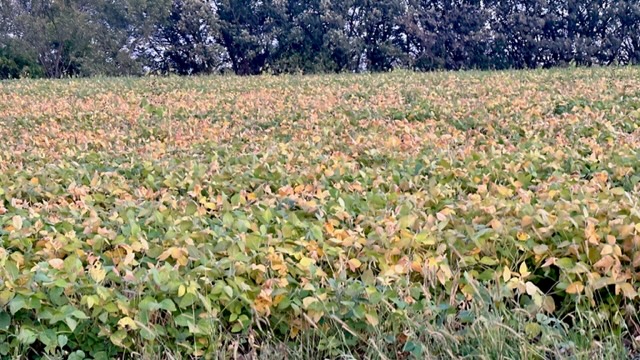
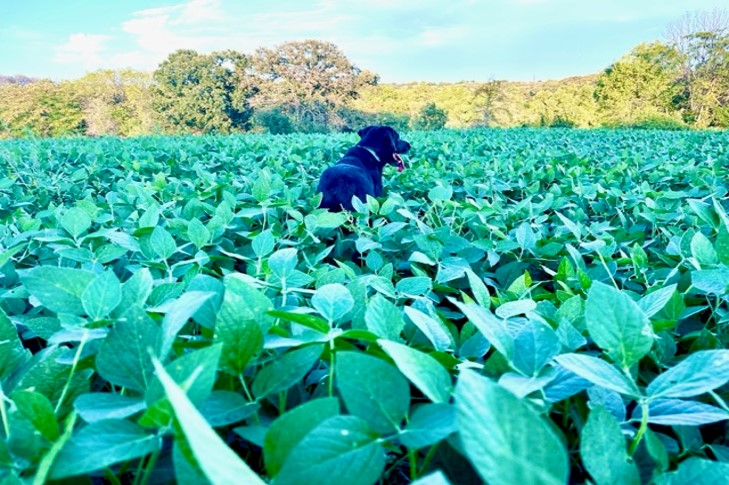
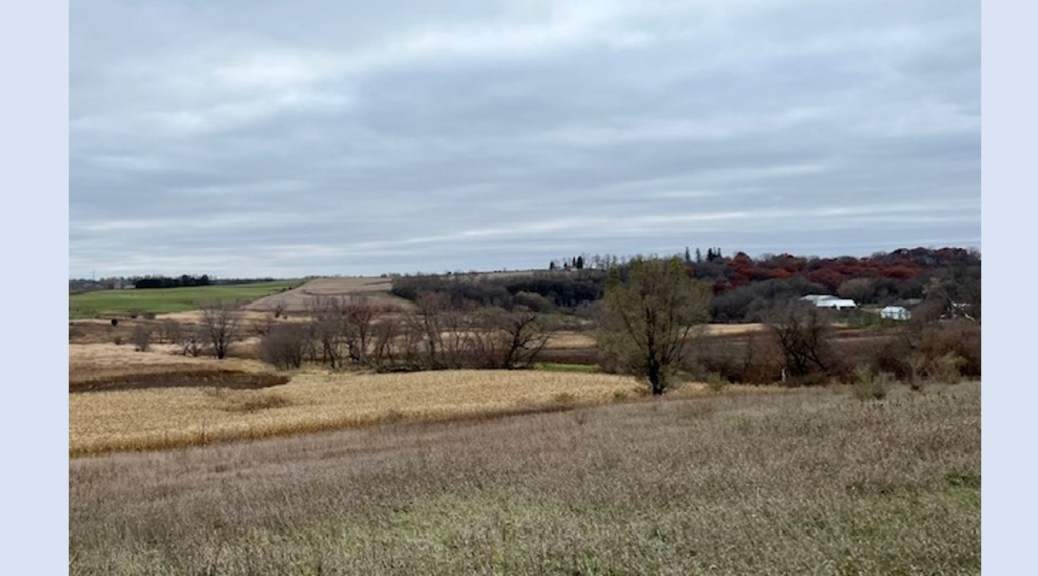
My soybeans have begun to turn yellow. You can see from the header photo, they’re not even Humphrey tall. Once they start turning yellow, within a few days the entire field will be yellow, then the leaves all off. Harvest could be a month out yet for me. Some guys will be going any day now.

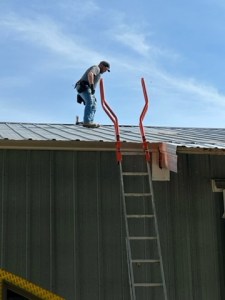
Had my young friend Josh out last week to climb on the roof and do all those things I *shouldn’t* do anymore.

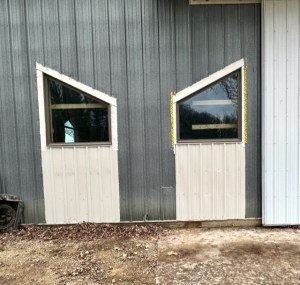
He made it look so easy! He made it look like I should be able to do that. And I’d climb to the top of the ladder…but that last step from ladder to roof, I just don’t feel comfortable, nor trust myself, doing it. And I didn’t. And he got it all taken care of. Over the new shop area, he replaced the old poly skylights with steel, and replaced a missing skylight down in the pole barn. I checked a couple more things off the list.

If you can’t beat them, join them. Discussion?

Fall

Yesterday was the first day of fall, and it was cool and cloudy, I noticed this week that the leaves were just starting to change color. The garden is finally slowing down. I am done canning tomatoes.

Fall has always been my favorite season. Not too hot, not too cold. (We won’t talk about the Ocober 5, 2005 snowstorm that shut the area down for three days and broke off hundreds of tree limbs.) I like the cooler nights.

Things at work always pick up in the fall, especially for those of us who work with children. Bad news at parent-teacher conferences means the phones start ringing at my agency from calls from frantic parents wanting help for their ornery children. Fall is a time of truth and reckoning for some of us.

What are your favorite things about fall? Any favorite fall songs or poems? Did your parents ever get bad news at parent-teacher conferences?

There’s Always Hope?

The weekend Farm Report comes to us from Ben.

Maybe the crops won’t be as bad as I feared. I was looking at the soybeans this past week and there are a fair number of pods higher up the plant. The plants are about knee high, and it looks like the weather will hold for a few weeks yet. We’re at 2845 growing degree units. 368 above normal for Rochester. Mind you, I’m not saying great crops, but not as bad as I thought. Ha, probably just be good enough not to trigger a payment from crop insurance, which is based on 70% of expected (average) yields. I did get a $700 credit on the premium for hail damage. So, I only owe $600 rather than $1300. Which is better than a poke in the eye with a sharp cornstalk.

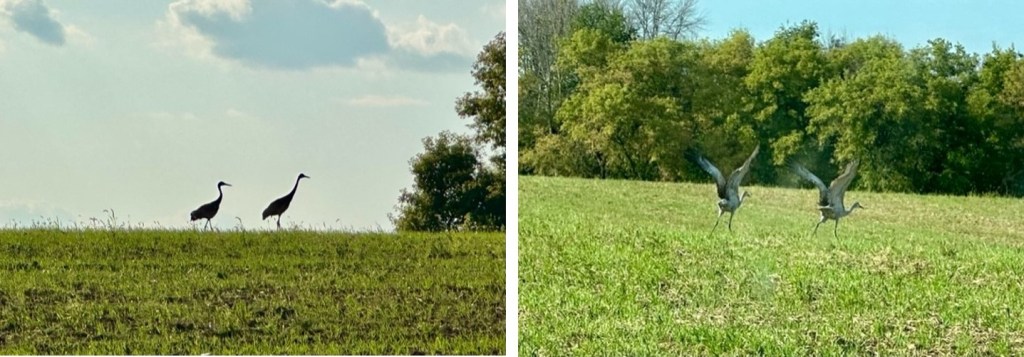
I did plant some rye on Monday and more on Thursday evening. The rain predicted for Friday morning isn’t going to a mounted to much. We wait and see. I spotted a couple sandhill cranes while out planting on both days. They must like this field. It was interesting: On Monday I had gone around the field once, turned around at the end of the field and was coming back when I saw them in the middle of the field. Were they there on the first round? I was maybe 150’ from them and they didn’t pay me too much attention. But then as I came around the corner and got closer, they flew off. Sorry kids, you didn’t get much of a rest here. Thursday was the same thing; didn’t see them on the first pass and then there they were. I adjusted how I planted that field so they could hang out longer. When the time came and I had to go their way, they had flown off.

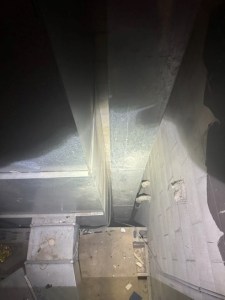
I was working at the college one day and I dropped a cable down a ventilation shaft. Course it wasn’t a plain old power cord, it was a special 4 pin data cable. I can see it down there and maybe with a long stick and a hook on the end, I’m thinking I can retrieve it. Stay tuned.

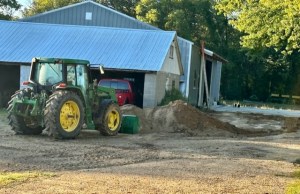
I’ve been scraping gravel from the machine shed approach.

Over the years I’ve added a lot of gravel to the road. Now with the cement pad being the same level as the shed interior, the driveway is 8” too high. I’ve mentioned before the water running in the shed door. So, I’ve been scraping. Man, it’s packed hard. Some rain would help that too. I’m not real good at being an excavator operator. And using the tractor loader isn’t ideal either, but it works. I can’t quite tell yet if there’s just dirt under there or still gravel. Dad must have had rock there when he built this shed in 1981. I may have to go an extra 4” deep and put gravel back on top. I’m using this rock to fill in some holes and the extra will go on the other end of the cement where it is more dirt.

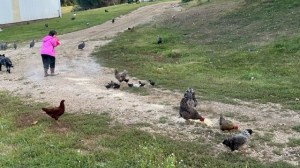
Daughter likes to do her chores: whether it’s hauling out garbage, doing her laundry (I know, right??) collecting eggs, and last night she even threw out corn for the chickens and chicks. Mother-Clucker is down to 12, lost one. The kids are getting pretty independent, and mom is giving them their freedom too. It’s not unusual to see them running 20’ away from mom. They’re between robin and pigeon sized.

Ever had a cement pond at your house? How was that?

(Are you aware Irene Ryan ((Granny)) was a Tony nominated actress and has an acting scholarship in her name?)

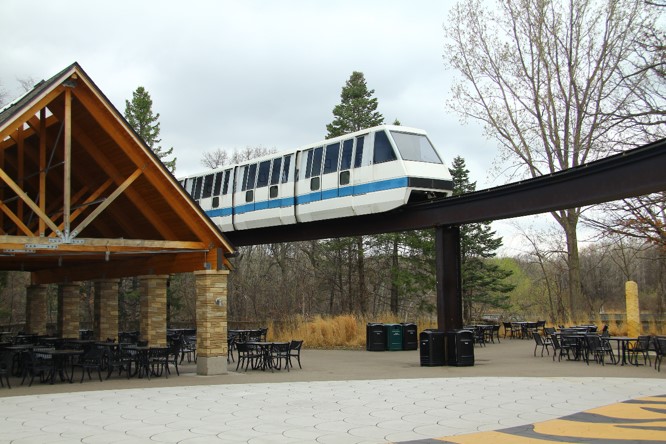
RIP Monorail

I loved the Minnesota Zoo Monorail.  It was part of the zoo experience for me; whenever we visited the zoo, we almost always hopped on a car and took a spin.  We knew when the best time of day was to go (right around lunchtime) and which car was best (the first one right behind the driver/guide – it was the quiet car which most people avoided). 

The monorail was “retired” in 2013 – a nicer sounding word than “abandoned”, but that’s how it felt to me.  For the last 10 years the rail remained a sad reminder every time we went.  When the zoo announced that they were going to put up a walking trail on the old rail, I was skeptical.  And when the scuttlebutt was that they would charge extra unless you were zoo members, I was even more cynical.

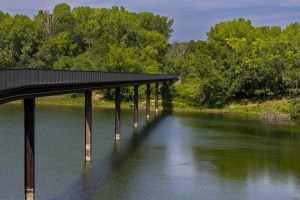
The Treetop Trail turned about to be free for everybody, not just members (we’ll see how long that lasts) and is built over the original rail.  It’s lovely, especially all the places where it overlooks water; there is actually quite a few bodies of water at the zoo.  On a cool day like we had on Sunday, it’s a beautiful hike – about a mile and a half – took us about half an hour (I was very slow as my feet hadn’t quite forgiven me yet for the State Fair).  There isn’t much shade or cover so it might be a little less fun on a really hot day.  Like the monorail, seeing any animals was a little hit and miss, although there was at least constant narration on the monorail.  YA can’t always be counted on for scintillating conversation.  The trail is about 8 feet across so we didn’t encounter to many pedestrian traffic jams.  For those of us with a little acrophobia, the center feels safe and there are lots of spots that aren’t too terrifyingly high.

My final assessment is that the Treetop Trail is nice.  If we can’t have the monorail, I suppose the elevated trail will do.  I doubt that it will become a perennial favorite for me and it will be interesting to see how well maintained it is during the winter months (if it’s even open during the winter months).  But I will recommend it at least once for anybody visiting the zoo.

What’s a duck’s favorite animal at the zoo?

Summer Kitchen

Today’s post comes to us from Barbara.

Some of you have expressed curiosity about my summer kitchen. When the weather gets too warm, I do everything I can here to stave off using the A/C.  This summer, though, it’s been used more than usual.

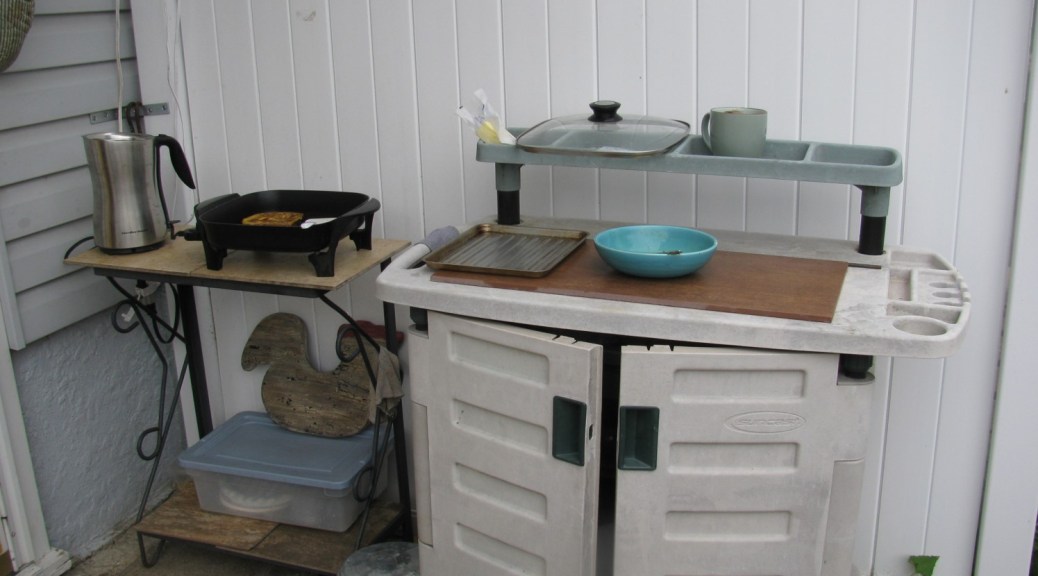
There is a small stand on the patio, just outside the back door, and next to it a former potting table/cart (on wheels) that a neighbor left out on the boulevard when they moved.

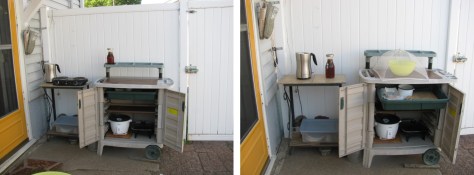
You can see from the photos some of the appliances and their homes. The toaster oven, when I bring it out for baking, stays on the stand to the left. There’s a large ceramic tile on top of the potting cart surface.

I do most of my prep work in the kitchen, and then bring the food out to cook outside. The flaw in this system is that in “high summer”, the back patio is not in shade except in early morning, and late afternoon. In the sun on a hot day it’s just too hot to be out there at all – I need to rig up an awning of some kind. So this works best in early and late summer, like later this week when temps will be low 80s.

We tried several chilled soups this summer, one of them being this one:

Chilled Cantaloupe Mint Soup
1/2 Medium cantaloupe, cut into chunks and pureed in blender with several mint leaves

Add and mix well:

1-1/2 Tbsp honey    (less if you used sweetened yogurt)
1/4 tsp ground ginger
1 – 8 oz container plain yogurt  (or sweetened yogurt and reduce the honey)
1/4 cup buttermilk , or 1/4 cup fruity white wine

Cover and chill 1 -2 hours before serving.
Garnish with fresh mint leaves, and float some blueberries if you have them.
Serves 2

What experiences have you had with outdoor cooking?
Have any good non-heated recipes to share?

Ginkgo Conundrum

I don’t think of myself as clueless but I will admit that most of the time my brain is going 100 miles an hour and I’m not always as observant as I would wish.   

Dog walking has returned to my schedule now that I’m RE-retired. We normally go for 45 minutes to an hour.  I tend to wander around Tangletown or towards Lake Harriet; I like the neighborhoods and I don’t think Guinevere cares where we go as long as we go.  So if you count all the walking we did during pandemic/furlough as well, we’ve probably trekked down Belmont Avenue 50 times in the last couple of years.  But it wasn’t until last week that I noticed the ginkgo leaves on the sidewalks.  The first one I noted, the second one I noted and after the third one, I looked up and down the street.  With few exceptions, all the boulevard trees from 51st all the way to Minnehaha Parkway are ginkgos.  And they are big, sturdy trees – obviously planted decades ago.  Just lovely.

I did a little bit of research and found that the city has always controlled the boulevard trees but I can’t find anything on why this particular stretch was planted with ginkgos.  The current policy, thanks to Dutch Elm disease and the Emerald Ash Borer, is to diversify trees on the boulevards so going forward I doubt any replacement trees on Belmont will be gingkos, although if it were my boulevard, I might petition hard to get a gingko replacement!

How should I focus so I can be more observant?

Still Dry

The weekend Farm Report comes to us from Ben.

No rain to speak of around here yet. We had some mist a couple different days, and at least it’s cooler now and I like that. 

I see some farmers chopping corn silage. I miss doing that; it was a fun job. It smelled good, it unloaded easy, and it was a very satisfying job. The loads were heavy and if it was muddy that made it harder with the small tractor I used to pull the wagons. For a lot of years, Dad ran the chopper and I pulled the wagons home to unload. There were a few years I did it myself because he was working or retired. Maybe that’s why I just feel like doing things myself so much these days. Yes, fall is coming; I have seen some corn crops really drying out and turning brown both because of reaching physical maturity or because they’re on lighter soils and it’s so dry, the crop is just done. (Especially noticeable in rocky ground; that dried out sooner). 

Soybeans are starting to turn yellow and will soon be losing leaves. Not mine, but most or the better-looking crops. My weeds are flourishing in the bean fields. My sister made the comment that she was glad to see some weeds because that meant I wasn’t “drowning the fields with herbicides”. Hmm, Well. All those weeds will be going to seed and making that many more weeds next year. And if the beans dry out but the weeds haven’t frozen yet, that makes harvesting more difficult. Plus the nutrients they’re using that the crop should be using. We can be pro or con to herbicides and chemicals, but we have to be sure we’re looking at both sides of the situation. Crop rotation helps with weed control too, so these fields being corn next year will stop next year’s weed, but those seeds…you know they just hide out and wait. 

A few weeks ago, I talked about planting winter rye as a cover crop. I haven’t planted yet because it won’t grow until it gets some moisture in the soil. It’s just hot, dry dirt right now. Chance of rain again Sunday, but that’s the only rain in the forecast. And if it gets too late in the season, is it worth planting? I don’t know yet. 

The barn swallows have moved on. It sure is quiet with them gone. We miss them a lot. 

Lots of acorns falling. And walnuts. We have one horse chestnut tree I planted from a seed that I picked up outside of our church when I was a kid. Mom says it’s a wonder it ever grew as I was always digging it up to see if it was growing yet. Well, boy, it has a lot of nuts on it now and it seems like 60% of them sprout in the spring. I’ve used the chestnuts for barnacles in plays. And I used to fill my Tonka dump truck with acorns. There are oak trees around the college theater and every morning as I walk in, I step on the acorns and have warm memories. 

Mother-clucker still has her 13 chicks!  

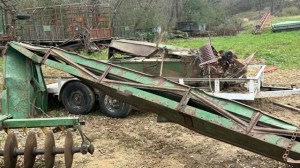
The John Deere Company stopped making moldboard plows this year. A moldboard plow is the traditional looking plow that you’d picture in your mind. The name ‘moldboard’ comes from the biggest metal curved piece that tips over the dirt. That fact it was metal is what made the man, John Deere, famous. From 1837 to 2023, the John Deere company made plows. It’s what started and made the company. It’s a big deal to let that go and there’s been some online debate over it. But that style of farming has changed. The benefit of the moldboard plow was how it could cut the plant roots and turn over that virgin soil. For a lot of years, that was the tool that was needed. These days, as we do more conservation tillage and have equipment that can plant into more plant residue, turning the soil over completely isn’t as critical. At the bottom of the moldboard was the ‘share’. The tip of that was the first piece to wear away from the soil contact. (Isaiah 2:4, “…and they shall beat their swords into plowshares…”)  

Here’s a website with more about plows and plowing than you knew you needed to know: 

I still have a 4 bottom plow at home. I used it when I took some Conservation Reserve ground out of the reserve program and put it back into cropland. Using a chisel plow on sod ground– (“sod” being alfalfa hay, grass, or pasture. Basically, any kind of grassland with the deep, tangled roots) — using a chisel plow, it takes about 2 years for the soil to really break down enough to be workable because it doesn’t turn it over completely or cut the roots so cleanly. I also use the moldboard plow when a neighbor wants part of his hayfield plowed up in order to reseed the next year. 

Plowing makes a ‘furrow’ after the last row. That furrow is a trench about 5” deep and 16” wide that you put the tractor tire in for the next round. (If everything is lined up right). At the last round of the field, you try not to make such a deep furrow. That last round is called the ‘dead furrow’. You want to remember how you plowed this year, so the next year you can go the other direction, therefore moving the dead furrow to the other side of the field. Clyde, what would you like to say about plowing? At the end of the field, how did you turn with that? Did you have to lift it or roll it on the side?

Any songs about nuts?

Overheard in the Raspberry Patch

Man:  This is a good year – lots of good berries.
Woman:  That doesn’t mean we need more than usual.
Man.  I think it means exactly that!

Girl.  Yada, yada, yada, yada…..
Grandpa:  Just stop.
Girl.  Stop what?
Grandpa.  Talking.

Woman #1:  We ended up having to rent a u-haul to get everything to college.
Woman #2:  Makes you wish they would just go to college locally, doesn’t it?
Woman #1:  Absolutely not.  Two u-hauls would be OK with me!

Girl:  He’s throwing berries at me.
Boy:  I am not.
Girl:  Are too.
Boy:  Am not.
Field Worker:  Wouldn’t you rather just be eating them instead of throwing them?
Boy:  I’m only throwing the white ones.

And then awhile later…..

YA:  What are all those scratches on your arm?
Me:  From the raspberry brambles.
YA:  Why don’t you wear long sleeves when you pick?
Me:  Well, it’s hot and the scratches are kinda like badges of honor.
YA:  SIGH (and biggest eye roll this side of the Mississippi)

What shall we do with all the fresh raspberries this year?

BLT – Bean, Layers, Tomato

The weekend Farm Report comes to us from Ben.

Where are we with Growing degree units you might well ask. We are about 450 growing degree units above normal here in Rochester. Extremely hot days don’t add as much as you might think because typically the plants shut down over 86 degrees and below 50 degrees. 

Too bad the weeds never stop growing. I mentioned once before, my soybean fields have really filled in and from the road, although short, they look pretty good. Except for all the weeds. I’m really discouraged about all the weeds. If this was a normal year, I probably would’ve had a second application of herbicide applied. But this year, I can’t justify the cost. 

You can see from the photo, because the plant is so short, there’s not a lot of pods in the first place, and those pods that are in the bottom 3 inches are difficult to get in the combine because it doesn’t typically cut that close to the ground. I have talked before about guys rolling their fields after planting to help level them and to press rocks and such down into the soil. This is exactly why; to get as close to the ground as possible but still, it’s hard to get that low. 

And the beans that are there, are not very big. There just hasn’t been the moisture to develop and fill a bean.

The corn looks kind of rough from the hail as the leaves are shredded up, the ears are OK, except again, small, and not filled to the tip because of drought stress, and I expect the kernels will be small because again, not enough moisture to fill the kernel.

Notice the kernels on this ear and how the tip didn’t fill. Drought stress and the plant pulled resources from them to save the other kernels.

This ear is 13 rows around and 43 kernels long. Everybody remember our math from last year? 13×43 equals 559 kernels on this plant. 80,000 kernels per bushel (bushel meaning 56 pounds), means I need 143 ears to create a bushel, but if the kernels are small and light, it will take more than 80,000 to be a bushel. Be sure to subtract deer, raccoon, and turkey damage. This year will be what it is.

I made a little more progress on the shop. I have some of the two by fours installed on the walls that the interior steel siding will be fastened to. And electricians came back and installed the breaker box and some outlets. The other end isn’t hooked up at the pole yet, but he’s hoping to get that on Tuesday. 

Momma and the chicks are doing well. Kelly calls her ‘Mother Clucker’. How many chicks can you find in this photo? (She’s still got all 13) And the 4 young guineas are hanging out with the older guineas. And we like this batch of ‘mixed breed’ chicks from this spring. They have pretty plumage.

Kelly has one tomato plant, growing wild, and doing better than her plants in a pot.

Daughter waters the plants. She enjoys having chores. And it’s fun to watch her do it. She turns on hose, puts it in plant, thinks for a few seconds, counts “1,2,3…4,5……..6, 7…. 8…. 9,10” thinks for a second, takes hose out. Good thing the pots have drain holes in the bottom.

Last week I mentioned the lack of women behind the parts counters. I feel like I should clarify: There are a lot of women in agriculture. I just don’t often see them behind the counter. There are women who are large animal veterinarians. There are several women agronomist’s I work with and the lady who runs the Crop Insurance agency. There are a few women who are solo farmers and there are several on YouTube I follow. There are many out there working with their families and contributing as much as the men. I am in no way disparaging them. Being a farm wife is a huge task.

We used to have one woman farmer in our neighborhood. Rita. Hair all done up and nails painted and she ran the farm while her husband worked in town.

Kelly and I try to spend a few minutes in the evening sitting on our veranda without a roof watching the world go round.

Do you drink the recommended 15 cups of water in a day? Who do you know in non-traditional roles?

Too Darn Hot!

My best friend from Howard Lake texted me on Tuesday to say that the heat index there was 114 degrees. She had never experienced such heat in Minnesota before. It is hot here, too, but not like that.

I wonder how we would cope if there was no air conditioning. I remember as a child we spent a lot of time in the basement on really hot days before my parents had an air conditioner installed in the living room. It was one of those that sat in a hole especially cut in the side of the house. Most of my relatives on farms never had air conditioning in their homes. They just hung out on their porches and tried to keep cool. There was no air conditioning in the school in Luverne. The nights were the worst, as it never really cooled down because of the humidity.

When we moved here in 1987, our house didn’t have air conditioning, and we really didn’t need it because it always cooled down at night. The humidity here is low. After about five years, things changed, the nights didn’t cool down, and we decided to put in Central air. I think that was my first direct knowledge of climate change. I don’t know what we would do without it now.

When did you first live in a home with air conditioning? How did your family cope without it? Share some weather songs.