Category Archives: Nature

Clash of the Ash

I’m almost to the final chapter of my adventure with the Forestry Department of Minneapolis.  Back in April, we came home to see our two ash trees in the very back of the yard splashed with green lettering.  Someone had painted our trees.  Having lived through the city’s Dutch Elm debacle (plant thousands, wait too long when it’s clear something is amiss, cut down every one regardless of health, give citizens little to no notice), I was pretty sure this was the end of our ash trees.  Despite knowing for the last two years that this was coming it was a little sad nonetheless.

The green paint was followed by a form left on our front door stating that the city required the trees be removed (of course at my expense) and that they would be collecting quotes from various tree services on our behalf.  I called the Forestry department twice when we didn’t hear anything for a few weeks; at the end of the second call, the department representative made it all too clear that I was to await the letter than would eventually show up and not to call again. 

All summer I’ve looked out the back to see my green-trunked trees, impatiently waiting for the Forestry department to get on with it.  Finally the first week of August we got a letter.  The city had to get a special quote because of where our trees were located on the property line.  At the end of the letter they listed two different quotes.  One was for $3,500.  The other was for $18,000 – this is NOT a typo.  This time when I called the city, I got a more helpful person.  She sighed when I squawked about the 18 grand figure and said she wished that the companies would just say they didn’t want the business.  I was a little concerned that some computer somewhere would assign this company to me but she said I could fill out the postcard that accompanied the last letter with that request.  I told her that I would like to get my own quote – and after a bit, she acquiesced and said I could write that on the postcard as well.

Well, my tree guy came in at half the price (of the lower figure) and is including grinding out the stumps.  They were here yesterday and the whole job, including avoiding all the powerlines and doing all the clean up took less than two hours.  I’m still in shock about the $18,000 quote. 

Have you ever been over charged for something?

That Fall Smell

The farm report comes to us from Ben

Had a good rainshower Monday afternoon. One of those downpours where traffic slows, and windshield wipers are on high. I could see it coming, I was several miles from home and the sky was dark and I was hitting Every. Red. Light. At one point there was some pea size hail, just a few stones, and I was considering my odds… can I make it home? Where should I park otherwise? But I thought I could make it. (Risk taker, remember?)

And then I could see the rain coming. Boy, just a few times in my life I’ve been in rain that heavy. Thankfully only lasted a mile or so. We ended up with .87”. Thankfully no hard winds with it in our area. I did hear reports of funnel clouds in other areas.

Rain like that in the fall is tough; the crops don’t really need it anymore, and the weather is cool enough it doesn’t dry as fast as it would mid-summer. The corn is tall enough the sun can’t hit the soil and it stays wet for a week. And it just makes harvest harder because now there’s mud to deal with. So, we’ll see how that goes.

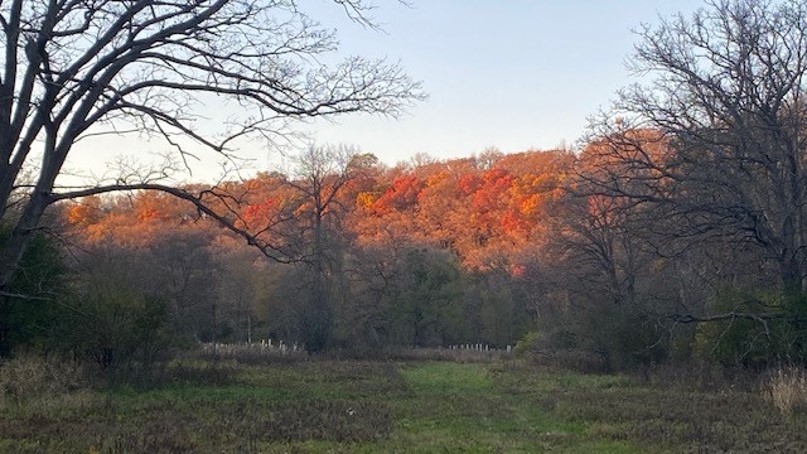
I was out checking crops last evening and I noticed that fall smell in the air. The beans are coming along. I saw several farmers out harvesting soybeans in the area today. Soybean pods are fussy; they dry out in the late morning or afternoon, but they’ll pick up moisture after dark or with the dew. Plants along the edge of the field might still be soft and mushy, but the rest of the field is dry, and the pods crack open easy, which is what you need to harvest. The corn is still looking good, it’s roughly 30% moisture which means the ears haven’t tipped down yet. Too much rain and it gets down inside the husk and can cause mold issues on the kernels. Once the corn dries more and the ears tip down, rain won’t cause mold issues.

After the discussion last week on PTO shafts, I was thinking about how some other things have changed.

Hooking up wagons or implements is different these days. One of the greatest inventions is the extendable wagon hitch. LIFECHANGING! Back when tractors were smaller and didn’t have cabs, it was easy to just look over your shoulder and you were almost looking right down at the hitch (called a drawbar) so backing up to a wagon was easy and we got real good at getting lined up so the hitch pin would drop right in. And the tractor or wagon was small enough we could nudge it a little bit to make the connection.

With a cab, sightlines changed and sometimes it’s harder to see the hole in the drawbar, so it was harder to get lined up right. Some people have added mirrors to the rear window so when the window is open, it allows one to see the hitch. (I need to do that on one of my tractors).

But now, with extendable hitches, as long as we get close, we can extend the wagon hitch to connect it, then we back up and it locks back into place. It’s wonderful! Especially when hooking a wagon to another implement, so I’m guessing where that hitch is way back there; the extendable tongues are life savers!

I remember the first wagon Dad bought with an extendable hitch. It was a remarkable thing.

Hitch pins too – at first, they were just pieces of straight rod with a washer welded on the top. Or even a large bolt if you were desperate. But again, machinery got bigger.

I made a couple hitch pins in high school welding class; that’s where I learned about hardening and how to temper them so they didn’t wear out so fast.

I had no idea I had so many hitch pins until I got them all together for this photo.

Then seed dealers started giving away hitch pins with an ACTUAL HANDLE on the top! That was another wonderful revelation! Course, on a hill it was easy for that hitch back there to drag on the ground and push the hitch pin right out. I ran one wagon through a fence and down into the calf pen when the pin came out… didn’t break anything or lose any bales, just the wagon. (And had to fix the fence). Lost the pin on the grain drill one day and didn’t notice until I got home and didn’t have a drill behind me anymore. One time the anhydrous tank came unhooked from the applicator. Knew that right away and thank goodness I was on flat ground and thanks goodness for the safety disconnect valve that separated. But getting it all hooked back up again was a struggle.

If you wanted to be safe, you put a clip in the hole at the bottom of the pin. If there WAS a hole for a clip. IF it stayed when going through cornstalks.  Again, tractors and implements have gotten bigger Now I use locking pins that might be 5/8” or even 7/8” diameter. And the big tractor has something called a ‘Hammerstrap’ hitch that’s about 1 1/2” diameter. And it will actually drop itself in! (if I back up straight and hit the hitch of the implement just right. It works pretty well and it makes me laugh when It does).

In this photo the PTO shaft is the round thing above the hitch.  Bigger tractors might have a pin as big as your wrist. If you imagine the pull on these machines when they’re in the ground, you can imagine why they might need a pin this big.

Duck Report. The three older ones and the younger ones are just starting to hang out together. And nobody goes in the pen anymore; they just hang out down here by the pond.

I saw a duck get a little air the other day… just a few feet, but I’ll bet it’s coming soon.

What do you remember changing your life? What’s coming soon for you?

September Farm

The farm report comes to us from Ben.

We had some friends and their kids visit and we had a good time giving tractor rides and gator rides and collecting eggs and seeing cows. It’s always fun giving farm tours.

I finally got around to working on the brush mower. I had to order bigger sockets to get the nut off the broken spindle on the big spinny thing. (It’s 45mm by the way) And then trying to get the gear box off the mower deck, I didn’t have the right size sockets for that either. It’s 30mm. I am getting more and more metric tools, but I didn’t have anything that big. I have a 3/8” drive socket set that I use for a lot of things. And a 1/2” drive set for some of the bigger stuff. And then I started buying 3/4” drive stuff for the really big stuff. (I mean the size of the square on the head of the ratchet is 3/8” or 1/2” or 3/4”). Then I put a 3’ long pipe over the handle to get enough leverage to get the nuts loose. Took the gear box up to John Deere for them to fix.

How’s that go: Every job is an opportunity for a new tool. Worked here.

On the way home from John Deere I stopped at a farm stand and bought 4 dozen ears of sweet corn. A couple kids run this stand and it is really good corn. Got that frozen and it will be really good this winter.

My mom has a possible Covid exposure from one of her physical therapy people. I had seen her on Sunday, and she found that out on Monday. But she hasn’t tested positive herself yet and they all wear masks and mom is vaccinated and I’d think the PT person was too. So hopefully she stays good. She needs to isolate in her room, which she isn’t very happy about. And her food comes in a Styrofoam container with plastic cutlery and that’s her biggest complaint. We had a care conference Tuesday and there seems to be exceptions for everything so she’s gotten real plates now. Hope that keeps up.

Monday was Labor Day and I wondered if I should really take the day off or do some work. If I didn’t do anything I’d feel guilty. I took a nap first off. But then decided to clean up the swather and get that put away. I washed it off and oiled the chains, loosened some belts, and filled the gas tank and added some ‘Stabil’ to the fuel, and tucked it into the shed for winter.

Then decided it was a good day to burn a small brush pile behind the shed. Got that burning and cut some grass while keeping an eye on it.

We’re having a little experiment with the ducks. When they go into the pen at night, they can either walk up a ramp or they can hop up onto a block and then into the open door. Most of them seem to hop in. One day I had not put the ramp in the door, it was sitting down on the block. Everyone had gone in except one black duck and two brown ducks. They were very distressed to be outside on their own and I finally went down and put the ramp up and one brown duck went up the ramp and the other two hopped in from the block. Hmm, were the other two moral support for the ramp duck?

This is very curious, so the next night I also left the ramp down and everyone had gotten in except a black duck and a brown duck. I put the ramp back up and both ducks hopped in without using the ramp.
The third night I put the ramp in the door right away. About dusk everyone heads over to the door and the white ducks always go first and hop on the block and up into the door. Might take them two tries, but they make it. Eventually the ones waiting got tired of waiting in line and they all went and got a drink and then came back and some more hopped in, and again, the remaining few got tired of the queue, went and got another drink and then came back and no one used the ramp and everyone hopped in. Evidently the ramp is more emotional support or a guide? It’s very interesting.

FOURTH NIGHT! I had the ramp up and I watched closer; they seem to use the ramp as a guide rail. A few actually use it, some bump against the side while hopping in, and some jump up onto the ramp about 1/2 way up. Very curious. And when they come out in the morning, it’s last in, first out.

When I got home one day, all the ducks were out of their pen. We’d been talking about letting them out; they’re old enough and big enough, but being ‘adolescent’, they don’t always make the best choices and we lose a few to coyotes. That day they found a hole – or maybe ‘made’ a hole and they were all close, just on the wrong side of the fence. It wasn’t too hard to round them up, patch the hole, and get them all back inside. And then I noticed one of the white ones has a wound under one wing. Neither Kelly or I were working from home that day which makes me wonder; maybe a coyote came in the yard and caused a commotion which is what scared them out. Kelly says every day around noon there is some kind of commotion, and the dogs bark and guineas get upset so there’s something going on.

I showed Kelly how to fire the rifle and the next day, when the noon commotion began, she fired a shot. We never see anything, but we’re trying to scare it– whatever “it” is– away. Kelly really wants to shoot a coyote but she’s having trouble making the scope work for her. She is just hoping for plain, dumb luck. And she’s going to work on firing from the hip.

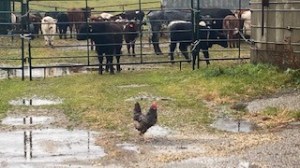
Chickens; they get into the ducks pen, but they can’t ever figure out how to get back out…

BONUS! Two Sandhill Cranes standing in the field when I left for work the other day.

There has been a pair here all summer, we don’t see them, we only hear them. I’m guessing this is another pair passing through.

Can you fire from the hip? And accomplish what you are trying to accomplish?

Fall is in the Air

This weekend’s farm report comes to us from Ben.

Fall is in the air this week. It’s good weather for sleeping; I love it. The soybeans are starting to turn yellow, and they’ll be losing their leaves soon. And with the recent rains the pastures have greened up again. Another inch of nice, slow, steady rain here recently.

Remember a few months ago I left the top lid open on the feed bin and had to spend an afternoon clearing out the rotten corn and gunk. And it was almost empty, thankfully, and there was still a bit of rotten corn stuck to the sides at the bottom. Since I needed to order more feed, now was the time to clean it all out. I wanted to knock loose a little more good corn so I’d have enough to feed the chickens and ducks for a couple days.

First thing I did was drop my long stick into the auger and jam it up. Belt squealing and I’m 15’ feet up the bin so I carefully, hurriedly, scramble down and turn off the breaker. Then I turn the auger backwards, back up the bin to remove the stick, back down to turn on the breaker again, and back up to finish knocking some corn down.

The bin has an 18” opening at the bottom and then a transition angle attached to that which turns it vertical, and then the auger attaches to that. I removed a clamp and the auger attachment, and the auger slid down and out of place. That’s going to be a problem when I get to putting it all back together. The auger is 4” diameter and about 10’ long and goes up through the wall of the feed room with the electric motor attached to the end of the auger in there. I removed the clamp and transition attachment, and then I put a tarp under the opening and climb back up the bin with my stick and start knocking corn off the walls. I’d knock some loose, pull the tarp out and dump it in the loader bucket, then put the tarp back down and knock more corn off. Took 4 cycles.  It wasn’t as bad as I thought it might be. But getting it all put back together took two people, a strap, some C-clamps, a stick, some muscle, and some time.  It might be the first time I’ve cleaned the bin out in 20 or 30 years. Good for another 30 years.

Kelly helped me get the seed cup put back on the grain drill and the 44 bolts reinstalled, so that part is ready to go. I still have some other work to do on the drill, but I can manage that on my own. The 44 bolts took two people with one inside holding the wrench on the head, and me outside tightening the nut. Replacing the seed cup means I don’t have an excuse for leaving gaps in the field anymore. Next year if there’s a gap between the rows it’s my fault for not driving straight.

The next thing to repair is the ‘big spinny thing’ under the brush mower. I got the blades and broken shaft off the spinny part. Now I need Kelly’s help again to get the 8 bolts off the gearbox and take that off the mower itself. Maybe this weekend.

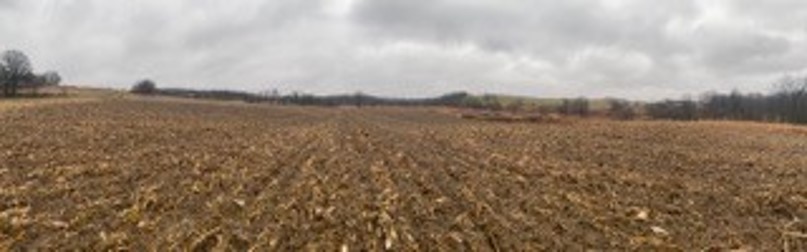
The former oat fields are getting a lot of weeds growing in them now. Bailey and I got them dug up. It needs to be done before they get too big (and before they go to seed) or they will plug up the digger. I try not to go the same way across the field every time I work it up. My fields are not square, and while I’m still trying to follow the contours, it helps to start on the opposite end of the field sometimes and just break up those ridges underneath the soil.

I had the co-op come and take soil samples off the oat fields. Normally you need to do that either in the spring or the fall after the crop is off. Can’t test during the growing season of course but since the oats is done, it was a good time to do those fields. I haven’t seen the results yet.

The remodeling work at one of the local theaters continues and there’s been a good crew in helping with that. If we ever get the flooring done (Thanks to Wes for advice), the bathroom stalls will be the next major job. They came in two dozen pieces and multiple bags of bolts.

In class this week the lab was on topographical maps and reading the contours and an online test on seafloor spreading and continental plates. I learned about Earthquakes, Volcanos, and the Earth’s magnetic field being generated in the core of the earth and that the magnetic field has changed polarity multiple times over the years. The last change was about 1 million years ago.

The only thing we are managing to produce out of our garden is cucumbers.  I make a lot of refrigerator pickles. Neither Kelly or I learned how to can things or preserve things and it’s probably not hard, but it is hard to find the time. At least I can grow cucumbers. Something has gotten in the garden and ate all the potatoes and kohlrabi. All summer something has been in there and I can’t find a hole in the fence, but they leave the cucumbers alone.

And the ducks. They’re getting real nice ‘poofs’ on their heads and some are off to the side like a jaunty little chapeau. I spend a lot of time just watching the ducks play in the water. They are good jumpers being able to hop into one of the water containers. I spend a lot of time watching the ducks.

Got any stories about magnets? Our son stuck one on the TV and messed up the picture and we had to buy a new TV.

Have you been in an Earthquake or seen an active Volcano?

Fill of Berries

I made my annual pilgrimage out to the farm for raspberries last week.  Beautiful day for picking – sunny and not too warm.  A little muggy from the big rain the two days before but after our dry summer, I am NOT complaining about rain.

Since I was the first one out in the field, they stationed me at the far southeast corner of the biggest patch of canes.  Pretty shortly after, they started to put someone opposite me (on the other side of the line of cane I was working on) and she protested that she didn’t want “to be near anybody else”.  I told her I didn’t take it personally and that I had a mask in pocket if needed.  She moved on to another line.

An older couple were then placed opposite of me.  They didn’t even look toward me and so I knew there wasn’t going to be any chatting.  (This turned out to be OK because pretty soon a VERY chatty woman started picking two lines away and even thought she was speaking to the folks near her, I could hear her clearly!) 

I expected that the couple across from me would move ahead of me fairly quickly.  Two people picking together are always faster than just one.  Except this time!   The gentleman stayed pretty even with me and the woman lagged behind.  This was so different from what I usually experience that I started to pay a little more attention to them.  The woman was digging thoroughly through the canes, clearly searching for every single viable berry she could find.  The gentleman was not as thorough.  I soon realized that another reason they were slow was the amount of time spent moving their hands from the canes to their mouths.  The farm does encourage folks to taste while they pick, but this couple was taking it to new heights.  They quit picking before I did with less than a flat of picked berries and I’m sure it’s because they were full! 

So far I’ve made my freezer jam, added raspberries to pancake batter and, of course, enjoyed fresh raspberry shortcake!

How do you like your raspberries?

My Favorite Insects

Having a lot of flowers and vegetable plants to care for has been a relief in some ways lately, since it has kept me outside the house and off my phone looking at news feeds and becoming more and more despondent. Between drought, excessive heat, the pandemic and all the associated idiocy, Afghanistan, and US politics, it has been a heart-heavy summer.

The other morning I was turning the sprinkler on the dahlias when I saw a perfect dragonfly perched on the fence. I like dragonflies. We only see them here when it is sufficiently humid. It is sometimes humid here in the early morning. I love the way they tear around. I also like hummingbird moths and their imitation of hummingbirds. They are a rare sight here, too. I saw a Tiger Swallow tail last weekend, and that always cheers me up. On the rare nights it has been cool enough to have the windows open and the AC off, I even have enjoyed hearing the crickets, unless they are frogs, but I think they are crickets.

What are your favorite insects? How to you cope with bad news? How can you tell a frog call from a cricket chirp?

Crime Scene Investigators

Last Thursday in the late afternoon, Husband and I went to our church to water the vegetables that we and others have been growing there. All the produce is taken to the local food pantry. The veggies are grown in six, 3 ft. high raised beds that you can see below. The rest of the garden is taken up with flowers and shrubs, with walk ways and benches for rest and contemplation.

Thursday, everything looked good. There were six nice cantaloupes about the size of soccer balls but still needing to ripen. The squash bed had one hill of bush butternut squash with four nice but still ripening fruits. We had reseeded in the carrot and beet bed as well as the sugar snap pea bed after harvesting the first crops, and all those had germinated and were growing well.

Husband went back to the garden on Friday, and texted me at work to say that half of the cantaloupes were missing. I am sorry to say that when I got to the garden after work, the Lord’s name was taken in vain and a tool was thrown down in anger as we discovered that three of the butternuts were gone as well. You can see the remaining ones.

Nothing else was missing or damaged. I covered the cantaloupe bed with bird netting and stapled it onto the wooden bed so that it would be more difficult to abscond with the remaining melons. Then, we started to hypothesize.

The incident occurred Thursday night. It would be a lot for one person on foot to carry all the melons and squash, so we figured it was either more than one person on foot, or perhaps one or more persons in a vehicle. We drove around the surrounding streets and didn’t find the produce smashed.

Husband wondered if the fact that they didn’t take any cucumbers or green beans, both of which take time to pick, spoke to urgency, which to him suggested possible amphetamine addiction. It was also presumably dark, so that the beans and cucumbers would be harder to see. I wondered if they knew little of gardening, as they took produce that wasn’t ripe. We have two Little Free Pantries on the edge of the garden, I wondered if people availing themselves of the food there thought that the produce was for all to take. We continue to speculate.

We had beets and carrots disappear in the night at times this summer. They were ready to harvest. My reaction to that was “Bless you. You need it more than we do”. I think the reason this recent event made me so angry is that the melons and squash weren’t ripe, and so they were wasted. As James Crockett comments in his Crockett’s Victory Garden, there is no remedy for finger blight.

What have you investigated recently or in the past? What kind of detective work would you like to do? Who is your favorite literary detective?

Hey, Hey Straw

To wrap up the oat harvest, let me explain test weight and pricing.

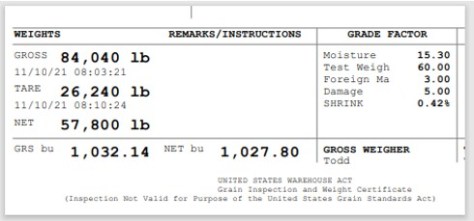
There isn’t a big market for oats, so they won’t take the oats if the quality is a little low. By ‘Quality’ I mean if it isn’t at least 32 lbs test weight (That’s the ‘standard’ weight of a bushel of the product. 56lbs for corn, 60 lbs for soybeans, 32lbs for oats). The weight can vary depending on a lot of things; moisture content of the crop, the weather as it grew, the variety, ect. The market price is based on that weight though, so if it’s low, we don’t get paid the full amount because while we deal with the crops in volume (the trucks and wagons it takes to get it hauled in), we’re paid by the bushel. If your corn sample only tests 50 lbs, then it takes more corn to get to 52 lbs and we get docked for the low TW.

My oats samples tested 38 and 39 lbs. The truck is heavier, which means it takes less grain to make 32 lbs so I get more bushels on the truck. But no bonus for being Over TW.

Price this year was $3.58 / bushel at the Elgin elevator (which is closest so most of the oats went there) but they were full so the last of the oats went to another elevator and it was $3.71 there. Heck; if I’d known that I’d have taken it all to that second place!

Remember; hay is something animals will eat; it contains nutrients. Straw is just an empty stalk; there’s not much nutritional value in straw.

Baling straw; it went pretty well this year. No problems.

It might take a while to get the baler working right; get the rust off it, so to speak. I like to bale straw; it’s light and the bales are easy to throw around.

I broke a shear bolt just after starting; a ‘shear bolt’ is protection against something bad happening. It might simply be overloaded or it might be a safety feature against something catastrophic. But sometimes they just wear out. That was the case here.

This shear bolt hooks the baler flywheel to the hydraulic pump for the baler kicker and sometimes it just fails. Then the kicker looses it’s oomph.

In the old days, Clyde and my dad had to have someone on the wagon to catch the bales coming off the baler and stack them on the wagon. I was about 10 years old when Dad bought a kicker baler which ‘kicks’ the bales into the wagon. Less manpower needed. Course, getting them back out is a little more trouble.

In 1993, we hosted 2 men from Russia for a few days. They were here as part of an exchange program with the Farm Bureau. They didn’t speak English, but they had a Russian / English dictionary and we had a good time doing hand gestures. I was baling hay and they rode in the wagon and insisted on stacking the bales as they flew in there from the baler. I tried to stop them; warning them this was dangerous and not to get hit by one. They assured me it was fine and kept stacking. And it’s a wonderful thing; so much easier to unload when they’re stacked, plus I get more bales on the wagon. I’ve been stacking a few ever since. Just the bottom row or two, and a ‘wall’ at the front to help keep the bales in the wagon.

The kicker part of the baler rotates left and right. That allows me to throw a bale in the wagon even when making a corner. And there’s a power adjustment to kick the bale just a little bit or kick it real hard! The average is 3 or 4. It goes to 8, I haven’t had to use it that high unless I’m kicking it all the way over the wagon just for fun. Because the power is based on weight, kicking to the back of the 16’ wagon only needs about 4. If the bales are so heavy it needs 6 or more, then they’re too wet to bale and I can’t even pick them up.

Up or down hills changes that a bit… and making a corner when it kicks can still kick it over the side. All in all, it’s kinda fun.

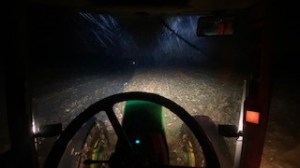
Here’s what it looks like from the tractor cab.

I’m watching my left mirror as that shows the back of the baler and I can tell the bale is good (not missing a string) and I can see most of the wagon. The right mirror shows the row going into the pick up.

Here’s three loads in the shed.

A few weeks ago we talked about backing up wagons. Here’s what it looks like to back up a wagon into the shed:

You need to trust yourself about what’s behind you.

I had about 200 straw bales left in the barn. I baled 612 (there’s a mechanical counter on the baler; each time it ties a knot, it trips the counter). 166 bales (one stacked load) went to the neighbors for their strawberry patch. He’ll use it for cover this fall. The other 446 went in the pole barn. I unloaded one load by myself; back the wagon into the barn, toss a bunch out, get out and stack them, toss a bunch more out. It’s not too hard when the stack is low. It’s too much work once up about two rows.

My brother came out; he helped me get the elevator set up and then he and I unloaded the last two loads. The cows came to watch me.

Here my brother is trying to figure out how to start the load

Here comes a bale destined for VS’s garden next spring.

A clean field and the last bale are welcome sights.

I didn’t need anymore small square bales this year so I hired a neighbor to make round bales from the rest of the straw.

 I’ll sell them to the neighbor with the cows.

I’ve left off the tractor that inexplicable died. (turned out to be the coil wire). And the dead battery in the other tractor. And the post that has somehow twisted a bit so now the gate doesn’t swing in AND out anymore, so I have to take it off to get the elevator put up.

I did get the hitch welded back on the elevator so that’s one thing.

And I got the second show open.

And time to cut grass again.

Hey! “Straw is cheaper, Grass is free. Buy a farm and you get all three.”

So? “Sew Buttons on a balloon, you’ll get a bang out of it.”

What’s your favorite sarcastic reply phrase?

Plants on the Move

We grow shell out beans and green beans on poles in our garden. It is fun to watch them vine up the strings that we lace from top to bottom for them to cling to. By the time the beans are to the top, it looks like we have a collection of Cousin Its in the front yard. All they need are bowler hats to complete the image. Those are kohlrabi and orange beets in front of them.

The beans always grow beyond the top of the poles. This year I was amazed to track the highest tendrils as they moved from pointing one direction to completely the opposite direction in the space of 30 minutes. They weren’t following the sun, by the way. Husband thinks they were growing and twisting because they are vines, and they grow in a circular fashion. I have no idea. I just liked finding them pointing in a different direction after turning my back for just a few minutes. I hope the following pictures give you a sense of their movement.

The beans pointing southwest at 7:54 AM
The same beans pointing northeast 8:26 AM

I know that sunflowers follow the sun until their heads get too heavy and stiff. I have seen our bush cucumbers appear to tilt with the sun. The beans astounded me, as I never saw them rotate so fast or so surreptitiously.

What is your favorite plant to watch as it grows? What natural mysteries have you noticed lately? Any hypotheses about our moving beans?

Doesy Doates

Today’s post comes from Ben.

When last we left the farm the swather was standing on one tire and a jack.

Mechanic Nick came out from John Deere and fixed it up in no time. Now that was a good decision to call them. And $637 later I’m moving through the field again. I was estimating $500. “Labor” was $500… bearing, flanges, locking collar, service call, misc and …. Just put it on my tab. But it’s fixed and I finished cutting oats and the swather is back home in the shed.

I spend a lot of time thinking of ‘what if’s’. What if the machine breaks down? What will I do if I can’t fix it? Who can I call that would know people to come and cut oats? And then, as I near the end it becomes ‘I would just leave this part’, or ‘who has a sickle mower I could use’, or ‘I wonder if the bean head could do this’? This year I learned something. I learned I call John Deere and they can fix some of it. Course it depends what, exactly, has broken. 

And what do I think about all day just going round and round? I have music in my head. Last week I had the ‘Mairsey Dotes’ song in there for a while… that annoyed me. Had to work real hard to get something else in there. The first day it was a Pink Floyd song. Got some Led Zepplin going, there was probably a show tune in there somewhere… I can’t remember what finally settled in.

No cab or radio, and I’m wearing hearing protection, long sleeves, and a dust mask.

I observe the direction the oats was planted versus the direction I’m cutting it and I wonder if it matters because of how it sits on the stubble; is sitting sideways better than sitting in line? When going the same direction, in line, does it fall down between the stubble more? Hmmm. (It depends how heavy the windrow is). And I leave some stubble so it sits on top of that in case it does get rained on it’s not flat on the ground.  

I observe how whenever I stop with the planter, I leaves a gap of a few feet and weeds grow wherever there isn’t grain growing.

Which is kind of amazing when you think about it.

I look at the damage the deer cause and I curse them out a little more.

When the combine (we should clarify the pronunciation of this if you’re not familiar. It’s not com-BINE, like adding things, it’s COM-bine. I don’t know where that came from. Subject for another day). The combine has to pick up the oat windrow the same direction it was cut. And that means from the head end. As the swather cuts it, all the heads fall to the back and it’s usually pretty easy to tell. Trying to go the wrong way, it just doesn’t feed into the combine as well.

When cutting, it’s best to make about 4 or 5 rounds all around the field, so there’s room on the ends for the combine to turn around, (and that goes for any crop; corn or beans or anything); we call those the ‘headlands’.  And then it can just be cut going back and forth. Corners are tough so we avoid those when we can. Tough in that the machinery doesn’t make 90 degree corners very well, it doesn’t plant well in corners, hard to stay on the row in a corners.

OK, so now it’s Saturday and the combine is here and harvesting and I don’t have any trucks yet. I can’t get the truck guy on the phone. I call another guy from the farm, but he’s over in Wisconsin and he can’t get anyone on the phone either. Finally, we just go to the farm and get a semi and drive it back here ourselves. And, of course, there’s a summer shower and the harvesting is done for the day. Next day he’s back and finishes that field. And a few days later gets the last of it.

I don’t have the final numbers yet, but it looks like a real good crop.

As I write this, I’ve got some straw baled, got another show ready to open, ducklings moved to a bigger pen,

and I’m going to cut the grass!

Talk about when you had to do something yourself. Why is good help so hard to find?