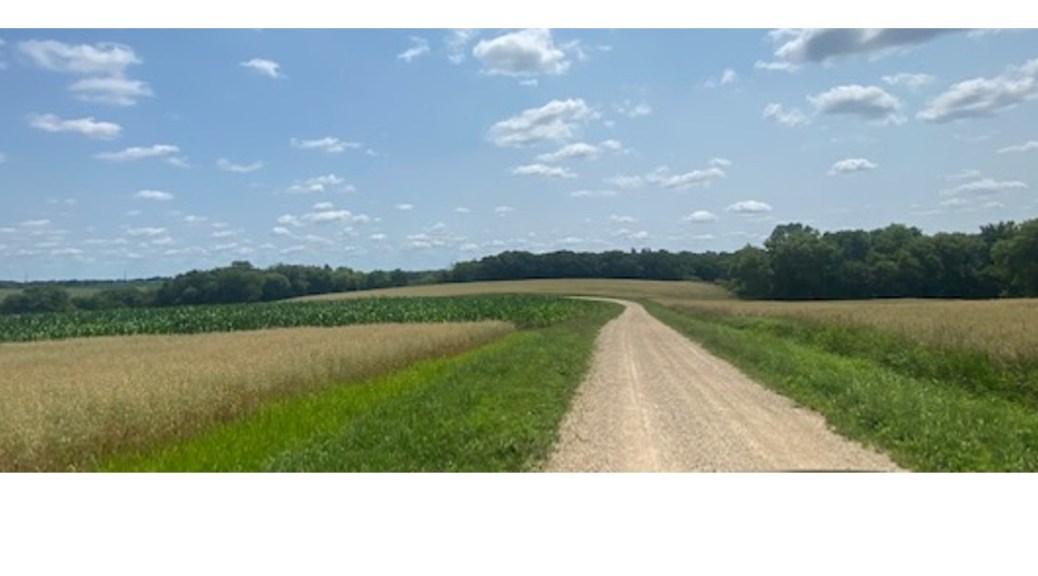
Our hot weather retreated last week, and by Friday it had cooled off substantially. Gentle rains came, and I stood at the front door on Saturday watching the rain fall straight down, with no wind, which is rare here. It was a delight to watch.
Our roses are blooming, and the garden veggies are looking strong and healthy. We weeded all over our flower and veggie beds, laying down newspapers and covering them with dirt to keep the weeds minimized for the season. The absence of weeds is so lovely, and the plants stand out and look really nice. I had forgotten how pretty eggplant plants are. There are visual delights all around. I just have to remind myself to look for them.
We like to grow dahlias in our garden, even though our winters are too cold for them to winter over. We don’t have a cold room in our house to store dug up dahlia tubers over the winter to replant in the spring, so we order new tubers every year from wonderful place in Washington State-Swan Island Dahlias. Their instructions for successful dahlia growing are sort of confusing.
We are to plant the dahlia tubers in rich, moist, soil, but are instructed to not water the tubers until the shoots emerge from the soil. They will rot if we do. It may be ok to water if it is dry or if they are in pots, but that is dicey. It is hard to know what we are to do. What is too dry, and what is too wet? I am happy to report that five out of seven dahlia tubers are emerging from the soil with some watering here and there, given our dry spring, but I still have anxiety about the watering issues. I still don’t know what I am to do!
What are some confusing directions you recall? When were you at a loss about what to do?
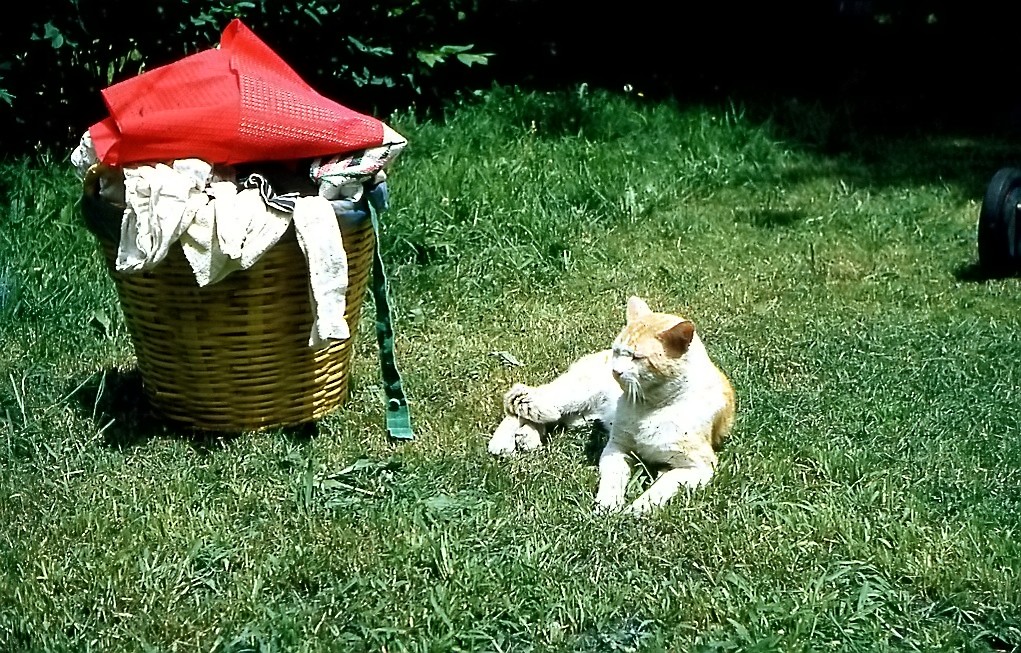
Timothy Gruncheon Grooms, born in a barn in Iowa, was adopted into my family in 1946. He was officially my sister’s cat and always seemed to understand that. Although she did things to him that were beneath the dignity of any cat, he slept each night in the crook of her arm.
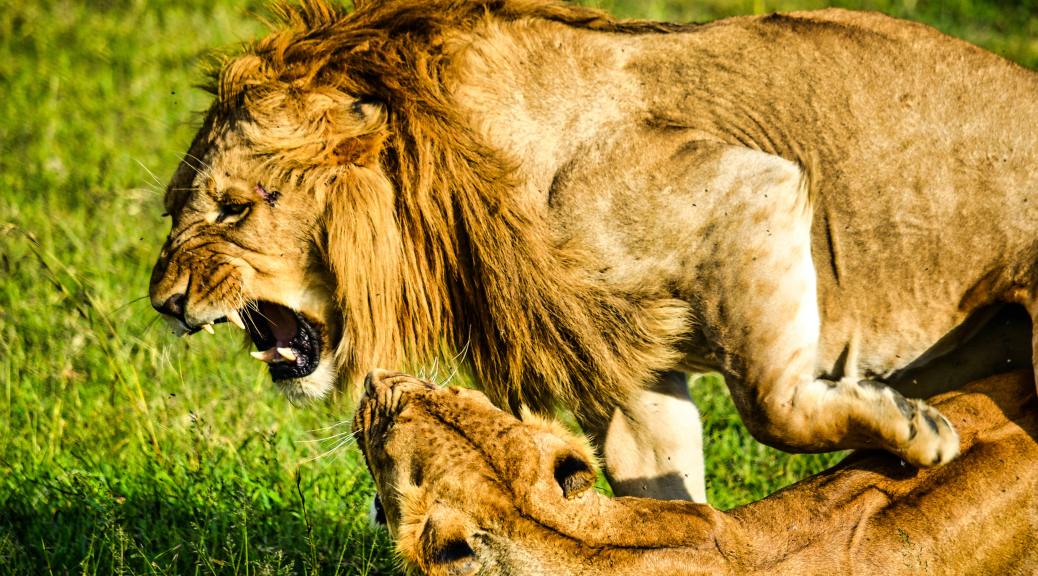
Timmy was a fighter. My parents had never heard of a cat being confined, and they would have been appalled at the suggestion pets should be neutered. So Timmy was a free-range tomcat who roamed the neighborhood fighting with other cats and filling the world with orange and white tabby kittens. All the fighting he did caused Timmy to have a fat face because so much scar tissue built up on his cheeks. His ears were riddled with cuts and holes. I did witness one epic encounter in our backyard, Timmy relentlessly chasing another cat, and I was shocked by the violence of it all.
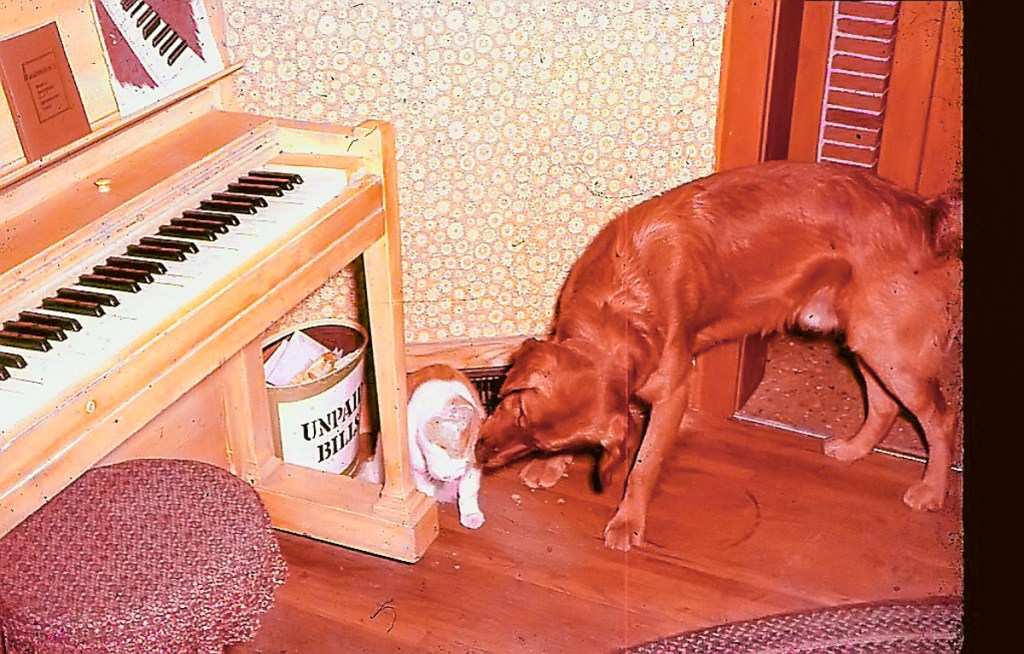
Timmy obviously lost some fights. Once he came home with a chunk of tissue the diameter of a nickel missing from his left cheek. Our vet gave us a spray to keep the wound clean, but our dog had a better idea. Danny, a sweet golden retriever, began following Timmy, licking that wound. Danny and Timmy never had physical contact before or after that incident, but Danny licked Timmy’s wounded cheek until fresh skin formed over the hole.
My sister bonded with Timmy as if he were her child. As I recently wrote, she dressed him in doll clothes, including a bonnet. She plopped him on his back in a baby stroller and went about the neighborhood with him that way. The set of Timmy’s ears were a clue to how he felt about this, but he accepted it all. When Nancy’s fascination with medical issues led her to subject Timmy to some treatments, including an enema administered by eyedropper, he put up with that, too.
Timmy was the most remarkable athlete I’ve ever known. Two stories established his legendary status.
Once our family was in the dining room watching television (eating Swanson’s TV dinners on our TV trays). A bat entered our home and began flying from room to room. Timmy was sitting on a braided rug in the middle of the dining room. As the bat wobbled through the dining room a second time, Timmy shot off the floor like a jack-in-the-box, snatching the bat midair. To my eye, Timmy’s leap took him five feet into the air, and it could have been higher. With the bat in his mouth, Timmy went to the back door and asked to be let out.
In our last home in Ames my mother kept her precious chinaware in a cabinet by the front door. Timmy’s way of letting us know he wanted to be let out was jumping to the top of that cabinet. One afternoon he did that, just as he had countless times before. Timmy, from the floor, could not see that my mother had filled the cabinet’s top with stacks of china. My mother screamed in terror when Timmy walked to the cabinet and launched his leap. Once he was in the air, Timmy saw the china and performed a desperate midair gymnastic maneuver. He managed to land with his four paws in the tiny openings between the stacks of teacups and plates. Standing there, Timmy was unable to move, and he let out a dismayed yowl so we could rush to his rescue.
By 1964 our family, Timmy included, was living in Wayzata, Minnesota. He acquired one annoying habit late in life, crawling around inside the family Christmas tree in the middle of the night, eating tinsel and knocking glass ornaments to the floor. Timmy still lived much of his life out of our sight, and he still got in fights. His health declined. My sister, who was then a student at the University of Minnesota, fell in love with a young man, and they soon got married.
In 1965 Timmy disappeared for four days. We feared we would never see our 19-year-old cat again, but at long last he dragged himself home in terrible shape. He clearly had lost a big fight. Stroking his scarred old head, my mother had a heart-to-heart talk with him. “Timmy, old guy, you have been Nancy’s baby all these years. She is now married and will soon have a baby of her own. You look like you’re at the end of the line, but I’m asking one last thing of you. Can you keep it together a few more months? Can you keep alive until Nancy’s new baby arrives?”
Nancy’s baby arrived in August. A few days later, Timmy died.
Timmy was a vivid character in our family life for nearly two decades. Have you ever had a pet with a distinctive personality?
We started out the garden year hopeful, but restrained, planning to reduce the number of tomato plants to eight, shorten the kohlrabi row, and stick to twelve pepper plants and the same number of peas, beans, cabbages, beets, and herbs from last year. We agreed on two hills of cantaloupes.
We neglected to factor in Husband’s anxiety. He is in charge of our church vegetable garden, and we have had to replant some things there due to extreme wind and unfavorable conditions. Husband is always planning for the worst, and that means that he scouts out bedding plants and seeds “just in case” we have to replant. Of course, he always purchases many times the number of replacement plants that he needed. I have taken excess bedding plants the work three times to pawn them off on my coworkers
At the present time, in our home garden we have fourteen tomato plants, fourteen pepper plants, and a bush cucumber plant (“Renee, those cucumber plants needed good homes”). There are six eggplants stuck in odd places in a flower bed on the south side of the house, five hills of cantaloupes, and three butternut squash plants. It looks very silly, with the odd vegetable stuck here and there quite haphazardly. I was lucky to find eight dozen Ball canning jar lids on Amazon, preparatory to what could be a real avalanche of produce needing to be canned.
When have you had too much of a good thing? How does anxiety make you do silly things? When have your plans not worked out like you wished?
As I write this we’ve had an inch of rain and the temps are cooling. Sometimes we call them “Million Dollar Rains”, this one was a $100,000 rain.
The first few weeks after planting, I spend a lot of time driving around checking on fields. Crop Scouting is really important the first month, and then throughout the summer, but the first few weeks is when we learn the most.
Just like your gardens, we’re watching to see how things are growing and what weeds are coming.
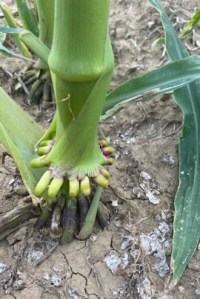
I’m generalizing here; every farm is different and different parts of the country plant different. I mentioned before, the corn was planted at a population of 33-34,000 plants / acre. So, there should be a plant about every 6”. Two together is a ‘double’, and a blank space is a ‘skip’ and that tells me how the planter is working and what I may need to fix for next year. And where there are skips, I might dig it up and see, is there a seed down there that didn’t germinate? Maybe it germinated but didn’t emerge; it’s all very telling. And then the first few inches it grows, it’s so interesting to see how the root develops.
Corn just fascinates me; the seed actually stays in the ground and the root goes down, the stalk comes up and the ‘growing point’ stays underground for a long time. That’s why a freeze or hail won’t necessarily kill a corn plant. Whereas soybeans; it’s the seed that comes up out of the ground. So, if it freezes, it’s done.
This website has taught me a lot about corn development:
This year, with the hard rain, soil crusting, and then cool weather and wet weather, I lost a lot of corn that didn’t emerge. And yet when I compare fields planted after the rain to those planted before, it all looks just as rough. It was kind of a mystery to me and I kept thinking it’s was rather unfortunate this was the year I got so much planted on the first day (because of the hard rain). And then NATE, one of my seed salesman came and looked at the corn. IT’S NOT MY FAULT! YAY! Turns out this particular variety had trouble this year. There are dozens of varieties of seed and most are tested pretty well to judge how it will do with drough tolerance or pest resistance, ect. Guess this one hadn’t been tested for this year’s weather. When I measure out 17’6” (1/1000ths of an acre) and count the plants, that gives us an estimate of the final stand population. I’m counting between 23 and 26 plants. 23,000 plants is a lot less than 34,000. Do the math: missing 11,000 ears, 200 ears = one bushel = 55 bushels less / acre. In a good year I get 160 bushels / acre. I’m thinking the ears will be bigger this year since they’ll have less competition and more sunlight…. ?? J
If I had decided to replant the corn, they would have given me seed to replant free of charge. But I decided there was enough plants there that it didn’t make sense to replant. So, they will refund the cost of my seed. I still paid for fertilizer and spraying so those expenses are already in the ground. And it’s not like there won’t be any crop (Knock on wood; we’re not there yet) but it just won’t be the bushels it should have been.
I’ve been taking lots of photos, but the camera doesn’t capture it very well.
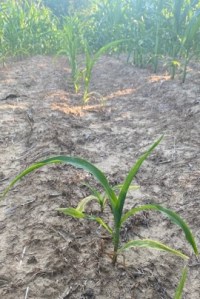
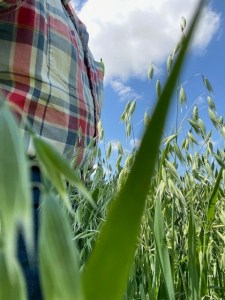
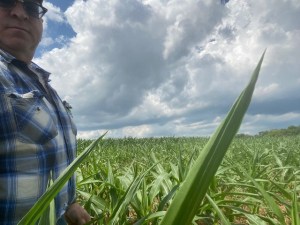
Just notice the leaves curled up from the heat and lack of rain. Notice the uneven stands, the varieties of green color. The deer eating the tops. This corn is thigh high. Now with the rain it will be doubling in height quickly.
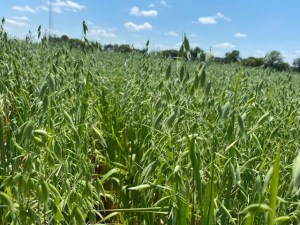
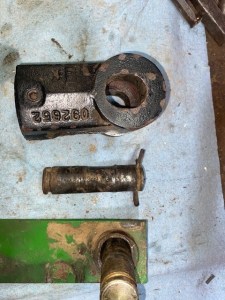
Oats has just headed out; looks like a lot of grain out there. Again, noticethe shades of green… it should all be dark green and I’m not quite sure why it’s so uneven this year. It’s a new variety for me, and maybe that’s what this one looks like. See the strips of dark green that’s taller than the rest? That’s where the PTO shaft on the fertilizer spreader broke and it was making a ‘streak’ of fertilizer.
Things to watch now: as the oats starts to turn color and get ripe, the stalks get brittle. Storms can knock it down, break it in half or even lay it flat. When trying to cut it, broken or flat makes it hard to pick up to cut. There is a fungus called ‘rust’ that can hit oats hard. Makes it brown and dusty and more brittle than usual. I have the corn sprayed to prevent that. Just as the kernels emerge, that’s called the ‘boot stage’.
Soybeans are looking OK. See this one field that looks like a lawn? Just all green? That’s a field I plant for a neighbor; he just uses it as a food plot. I didn’t have that one sprayed with ‘pre-emerge’ grass control like I did on my fields. It was my control field. See the rows on the others? With out the pre-emerge spray, they’d all be solid grass. Definitely a benefit to that. Then later I have it sprayed for ‘broadleaves’ and volunteer corn. I used the drill to plant the beans and I said they were sort of ‘clumpy’; you can see that in these photos. Again, it’s doing OK, seed spacing isn’t as critical for beans.
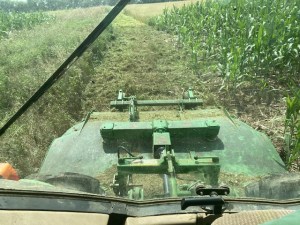
I mowed the roadsides last week. Got 50 bales of grass hay off that. Some neighbors will take that.
Mowed down in the woods for another neighbor. He’s been clearing buckthorn and it looks really nice down there now.
Also mowed an area I call ‘The Swamp’ since it was so dry. Turns out it wasn’t as dry as I thought…
Do you play the lottery? What’s the biggest prize you’ve won?
Mid June. It’s dry, we need some rain. Corn is curling up from the heat. My crops look terrible this year. Corn was planted a little light in the first place, then it didn’t emerge well, and now it’s dry and the deer are eating it… GDU’s: 946 to date, +291 above normal.
Oat’s is just about to head out, in fact it will be by the time you read this, – seems later than some varieties, and this is a new variety for me so… I guess it’s OK; better not to be headed out when it was so hot, the heat just boils the milk out of the heads anyway.
I told Kelly the crops are all in that adolescent stage and they all look terrible. Corn is knee high already, well, some of it.
Soybeans are getting there, look OK when you look down the row, then I look across the field and see all the skips and misses and it looks terrible again.
Back in blogworld, I finished planting soybeans on May 10th. That’s ahead of most years. Some years I’m still working on corn at that point.
When planting any crops, the trick is to have just enough seed to finish, without having too much left over to clean out of the planter. Soybeans are easy because the rows don’t really matter for harvesting, so I can just drive any which way in the field to run out the seed. Remember I had plugged up every two rows? I pulled the tape off and planted at 7” rows just to use up the seed. Once around the outside of one field did it. Oats is the same. I mean I try to figure it so there’s not a lot left in the first place, then just run it empty.
Corn is a little harder as the rows have to line up. I save the left over seed to use next year and the unopened bags can be returned to the dealer.
After planting soybeans, some guys run over them with a large roller, to smooth the field. Soybeans make a pod clear down at the ground, so at harvest, you want to cut as low as possible without picking up rocks or running too much dirt into the combine. Rolling the field pushes down rock and levels out any lumps to make combining easier.
I don’t have a roller. But I have a drag and decided to try that. Haven’t used it in 20 years. And I half expected when I pulled it out of the weeds it would just disintegrate. But no, it held together, and I ran it over all my bean acres. It did help smooth things out.
Time to clean up machinery.
I feel like I’m making dumb mistakes again. Got the pressure washer out and had a tip plugged up. I’m supposed to remember to check them before I start. But I didn’t. So now it’s all pressurized and I can’t get anything apart. I should have let it sit for a few minutes and the pressure would bleed off and I could get it apart. But I got in a hurry. Using pliers and a hammer I got the ‘quick connector’ apart and the tip shot into the air and it never came down. I put on a different tip (I have three different tips that are different spray widths), I didn’t get this one snapped in right and when I pulled the trigger, it shot it off somewhere over by the feed room and I haven’t found it yet. Sigh.
The third tip was plugged up and I WAS smart enough to let the pressure drain before I took it off and got it to the shop and cleaned out. I’m trying foam wash this year. Also tried ‘Simply Green’ cleaner. Not sure how much they help but it all smells better.
Cleaned out fertilizer wagon, washed the grain drill, and the corn planter. There are lots of nooks and crannies to get into. Made notes of things worn out that will need to be replaced before planting next year. I had a minor leak on a hydraulic hose that was spraying a little oil on the back of the tractor. By the time I finished planting, the back of the tractor was covered with oily dirt.
The next day I had some township stuff in the morning. Paul, one of the other township supervisors, and I picked up garbage someone had dumped in a ditch, and we looked at some culverts. Paul works for crop insurance and we talked about how some guys were using a rotary hoe on their corn. A ‘rotary Hoe’ is one of those tools you only need to use about once every 10 years. This would have been the year to have one. I have a really old one; it doesn’t actually help much. And I was afraid the corn was already too tall.
Saw Orioles one day; Put the oriole feeder and hummingbird feeder out. Haven’t seen the Orioles again. But we have two Hummingbirds that are often at the feeder. Maybe there’s more than two, but I have seen two at the same time.
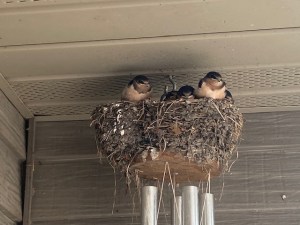
At the front door we have a pair of barn swallows. We really enjoy them and their chirps and their flight patterns. They have a nest to the left of the front door. Now they have a nest to the right of the door, too. And both nests are occupied. I wonder if it’s parents and kids??
They do make a poopy mess, but we put cardboard down and they’re pretty tolerant of us coming and going.
Finally got .22 inches of rain on the 19th. And from then until May 29th we had 2.5”. And since then, hot and dry. No wonder the corn looks so rough. It sure looked bad after that frost. And the uneven emergence didn’t help anything.
Finally cleaned out the tractor cab too. By this time, there’s quite a collection of ‘Nutty Bar’ wrappers, and dirty paper towels. And some tools, and golf balls, and whatever else I’ve picked up in the fields.
I carry a little whisk broom (a trick I learned from a youtube farmer) Millennial Farmer, Zach Johnson,
My cousin who recently died loved butterflies. As her casket was lowered into the ground, those in attendance set free butterflies they had been given, housed in paper packages. Her sister ordered them half frozen, packaged them, thawed them, and then distributed them to be released at the appointed time. They were Painted Lady butterflies. I will never see a butterfly and not think about my cousin.
As we drove home on Friday, we passed these long rows of trees, each about half a mile long and about 100 feet apart, planted many years ago about 15 miles from our town. They were planted to combat erosion in the 1930’s. When my dad lived with us just before he died, he said those trees always reminded him of Franklin Roosevelt. Now, when I see them, I think of my dad and Franklin Roosevelt. How interesting that one thing can remind us of other, non-related things.
What reminds you of people or things? What do you want people to see that reminds them of you?
I believe that, as I write this on Friday June 11, we are in our 7th consecutive day in the 90s. I am not a happy camper. I wilt any time the thermometer rises above 80, especially if humidity accompanies the heat. Husband usually loves heat, to a point, and tolerates it much better than I, so we have what I call the A/C wars, just like my folks had. [Mom would just hole up in the air conditioned rooms, and Dad would hang out in his room (nice large one with its own sitting area and TV) with the window open – he had a nice magnolia tree right outside the window.] I can do climate control with shades in windows in the a.m., but by mid-afternoon I need A/C.I just looked ahead via Weather.com: between now and June 24 in SE Minnesota, there is one (1) day when the high is predicted to be below 85˚ F. And we are in a bit of a drought – greatest chance of rain predicted in that time frame here is 56% chance today, and there’s not yet a cloud in the sky.
So an interesting thing happened after I got up this morning – I’d had a really nice and complicated dream in the wee hours, and wakened with a pretty strong shift in attitude: I am going to Make Friends with the heat. It could be that our entire summer will be like this, and I do not wish to be miserable all summer. Instead of hating and grousing about it, I will embrace it, and do what I can to enjoy it. This will mean shifting my schedule, my way of doing things, where I do things, and perhaps what things I do. And I may have to buy awnings or screens to create more shade for the patio out back (and my out-the-back-door summer kitchen – worth perhaps another blog post).
There is shade on our back patio till about 10:30, and there was a little breeze this morning. I invited a nearby friend over for ice water, if she could come by 8:30. (She’s an early riser.) After that I placed a lawn chair in the driveway under the beloved Hackberry Tree, and till about noon I perused my recipe books for chilled soup recipes. I have fans on right now, and am about to go to the NICE COOL BASEMENT to clean it up and find some sewing projects, perhaps clear a place that we could play Mexican Train. Once the A/C has cooled things off upstairs, I can watch movie clips for a zoom class I’m taking on Musical Theater…
In other words, I’m trying.
How are you coping with this heat wave so far?
Is there anyone or anything you might “make friends” with that could make your life easier?
Man, hot enough for you? I keep talking about ‘GDU’s… Growing Degree Units. But they only count for temperatures between 50 and 86 degrees.
The corn, and even the oats, got a little burned by the frost a week ago. Another week it will look better as it grows out of this, but right now, it all looks kinda rough.
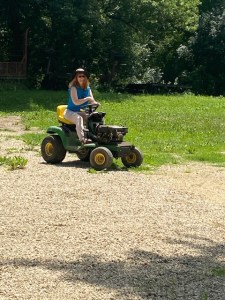
Back in blogworld, it’s the first week of May and I’m getting ready to plant soybeans. After farming pretty heavy for a couple weeks I had to get back into the college for a few days. The last two springs, Covid did give me an opportunity to stay home and farm like I did before the college job. And it was pretty nice. I’m lucky that I have this job where I can sort of set my own hours. So, I’d do college work from home in the mornings, then take the afternoons off to farm.
I had the Township Road inspection one morning. Once per year, all five of us township supervisors gather in one vehicle and drive all our township roads making note of any road issues. Our township, Haverhill Township in Olmsted County, has about 32 miles of gravel roads. We put new gravel on 1/3 of the gravel roads each year and patch any area that might need rock. We check culverts, washed out road sides, ditches that have too steep of a shoulder, and generally make a game plan of things we need to have fixed this year. That takes the full morning and I got home about 1:00. Last year we didn’t ride together. It’s a good group of guys and we have a good time driving around and talking.
The music department had a small concert schedule for Wednesday evening. There is no band program, but there was the choir and the ‘World Drum Ensemble’ so they wanted to have a concert. The choir director is a new guy; I haven’t even met him. There were some last-minute emails, I roughed in some lights, put the choir shells up, pulled the piano out, and added some more lights. Sixteen years ago, when I started at the college, it was really frustrating to have concerts with no rehearsal. Now I’m kinda used to it. Obviously, rehearsals are better and make a better show, but I manage. It went well.
The next farm job is fertilizer for the soybeans. I use a broadcast spreader for that. Just like the one I used for oats. It’s almost the same fertilizer blend as I used for corn, and I have some corn fertilizer left in the wagon. I generally order extra because I know I can use it up on the soybeans. I pulled the corn fertilizer wagon out and get the fertilizer spreader lined up and I auger the corn fertilizer into the spreader. Fertilizer doesn’t slide very well, and it sticks together so eventually I will have to climb into the box with a shovel and move the fertilizer down to the auger. There’s no danger to myself, or of getting into the auger, as the door is only open about 3”.
Well, there is the danger that I can’t get back out of the wagon box or the ladder outside falls over. A few year ago, with a different wagon, I had to call the house and ask my son to come out and lower the wagon so I could get back out… he doesn’t let me forget that. But that doesn’t happen with this wagon because it doesn’t tip up like that one did.
Once it’s all transferred, it looks like rain so I don’t want to go too far from home. I think I’ll start around here and see what happens. I get started but it’s sprinkling a little bit and I go home and put the tractor and spreader in the shed. The rain doesn’t amount to anything and two minutes later I’m back out. I fill the tractor with fuel and decide to go to my rented land a couple miles away. It sprinkles a little bit, but not enough to be a problem.
Driving on the highway with farm machinery can be nerve-racking. People will pass at the most inopportune times. I have signals on the tractor, but you can’t really see them with the fertilizer wagon. If I’m going to make a turn, I kinda move to the middle of the road to prevent people from passing me, but that one person still does…what an idiot. I’m lucky I don’t have to drive on the highway very far or very often. If you’re following farm machinery on the road, please, give us some room, don’t pass in no passing zones, and for goodness sakes, don’t try to squeeze through between us on the shoulder and the oncoming traffic! It’s nuts what some drivers will do.
I saw a pair of geese and a pair of ducks over on the land I rent. Normally I only see golf balls in this field.
I’ve picked up a lot of golf balls over there. I enjoy the stuff rolling around the cab. Bailey doesn’t like it when she rides with me. Finished that and got back home and finish spreading fertilizer on the fields around here. It’s raining pretty good now and, starting to stick to the tires, but other than making a mess on the road, it doesn’t really hurt anything.
FYI, my ‘go-to’ snacks in the tractor are the Little Debbie Nutty Bars and Clif bars. Plus water. The cab is littered with nutty bar wrappers.
The next day I did some fieldwork, Brother Ernie came out and did some more and I got going on soybeans and had 21 acres planted at 9 PM. Twenty-one acres is nothing for most farmers. It’s a good day for me.
Soybeans can be planted in rows 7” apart, or 15” apart, or 30” apart. The total population is the same for all of them, it’s just more or less plants in the row. Generally, around 150,000 plants / acre. Soybean seed size changes year to year and the bag will tell you how many seeds / lb. I prefer 15” rows because the rows will canopy sooner and stop weeds coming up between the rows. However, there are some soybean diseases that thrive in damp, conditions, so 7” rows will stay damp longer than 30” rows. Six of one, half dozen of another.
I can use the corn planter (If I put special bean meters on the seed boxes) and that does the best job of seed depth and seed spacing (just like corn) except it’s only 30” rows unless I go over it twice, off set 15” to make 15” rows. That works, it just takes twice as long. (There are 15” row planters. It’s just $$,$$$) Or I can adjust the settings on the drill, plug up every other row, and do 15” rows with that. Seed spacing is “clumpier”, for lack of a better word, just due to how the drill feeds out the seed. But it works. And this year, just for something different, I plugged two rows, left one open, plugged two, open, ect, and I’m trying 21” rows. Yields are pretty much the same for 15” or 30”. So, what the heck, I just figured I’d try. I have some treated soybean seed and some non-treated. Just like I talked about with the corn, soybean seed is treated for insects and pathogens in the soil in case it sits there a long time before emergence. Typically, because soybeans are planted after corn, the weather is warmer, the soil is warmer, and the beans don’t stay underground too long. But you just never know. And since the seed was ordered in December, it’s another way to hedge my bets. You can see it here: non treated seed on the left, treated seed on the right.
A pretty good day, nothing broke, everything worked well.
Any concert or musical event you are looking forward to this year?What was the last concert you saw?
I have written before about our cat’s fascination with my Julbocken, the Scandinavian straw goats popular at Christmas. She loves to chew on the wheat berries at the end of the straw sprigs that make up the beards. Last Christmas I left them out in the living room instead of putting them back in the closet in January. I had repaired the beard of the largest Julbock and festooned him with a lovely beard and wanted to show him off.
I had three Julbocken and an Austrian straw girl on top of a curio cabinet that I thought was out of the cat’s range for leaping. The figures were at an awkward angle to jump to from the love seat (or so I thought). I thought the angle and the narrowness of the surfaces would dissuade her from leaping. I would sometimes see Luna, the cat, stare intently up at the figures from the floor, as if calculating what she needed to do to get up there. The other evening I heard a strange yowling, and I entered the living room to see her on top of the curio cabinet feasting on the repaired beard of the largest julbock. I got Luna down and put the goats back in the closet. I left the girl, since she had no berries to chew on.
A few days later I took this photo, that I think captures Luna calculating how to make another leap.
She hasn’t, to my knowledge, leapt again to the top of the curio cabinet. The girl has been left undisturbed. Luna isn’t a very active cat, but she is far more calculating than I would have imagined.
When have you taken a calculated risk? Did it work out for you? Who are the most successful risk takers you know?