Category Archives: Science

A Little Bend in the Light

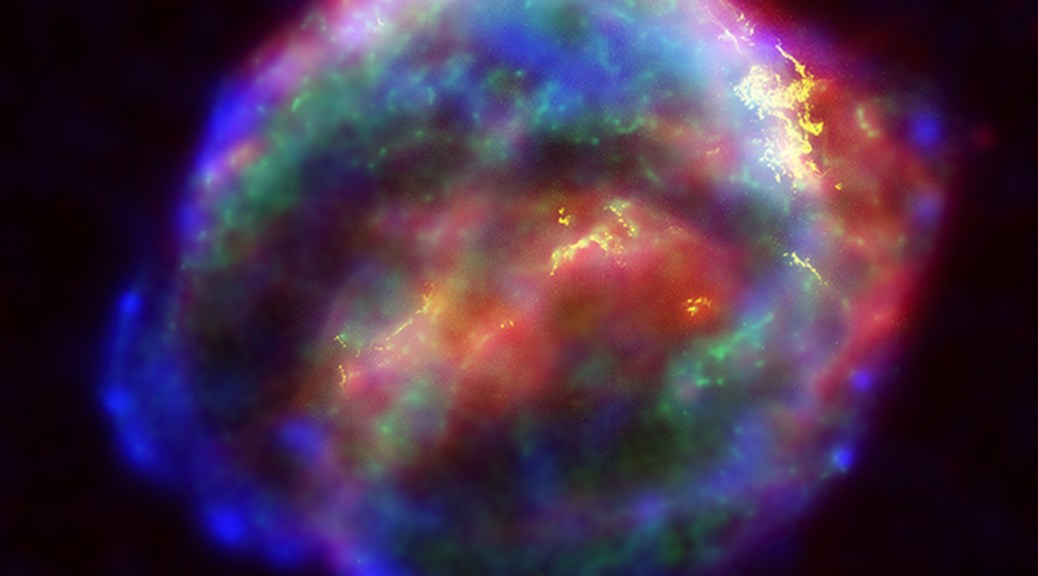
I was trying to get my mind around the news that astronomers have observed multiple images of a supernova exploding by simply looking in the right place and understanding the strange effects of Einstein’s Theory of Relativity, when the phone rang.

It was Trail Baboon poet laureate Schuyler Tyler Wyler calling to beg for a commission.

Things have been a bit tough in the poetry game of late, and what with large companies like General Mills and Target retrenching, the slogan and tagline market has dried up almost completely.

“Give me something complex to boil down into a few lines of verse,” he said. “I have to keep my toolkit sharp in case the discount clothing and packaged food industries bounce back and there’s a sudden need for fresh jingles.”

Of course I gave him the only thing I had – that a star exploding on the other side of the universe nine billion years ago has appeared in our sky at least four times, and it all makes perfect sense. I told him I would buy him a cup of coffee next Wednesday if he could make it rhyme.

Here’s his reply:

To see a Supernova pop
is not so hard to do.
Just float some denser galaxies
between the star and you.

Then get it properly aligned
Nine billion years ago,
to let dark matter intervene
so you can watch it blow.

The light from the explosion
has to go around each side.
So when you view the fireworks
you see it multiplied!

The images arrive distinct
and separate as they please.
A single Supernova that can say
cheese cheese cheese cheese.

What spectacle would you watch over and over and over and over?

Overlapping Shadows

Time now for an occasional (OK, this is the second one, ever) feature of Trail Baboon – Connect Three.

Three current news stories share a common feature – in this case the linkage is anything but obscure – it’s a simple shadow.

The first one has to do with a particular portrait of Bill Clinton in the National Portrait Gallery. Artist Nelson Shanks says the canvas he painted of President Bill Clinton in 2006 includes the shadow of a blue dress, a reference to the famous Monica Lewinski garment which, having been smeared by Clinton himself, left a permanent stain on his presidency.

This, I suppose, is where being an artist trumps having political or financial muscle in that you get to make a lasting commentary. It’s not clear why Shanks would reveal this particular artistic choice right now. Perhaps it’s a bid to set his Clinton image apart from at least 54 others in the Portrait Gallery.

Ah, the Shanks Portrait. That’s the one with The Dress!

Credits: ESA/Rosetta/MPS for OSIRIS Team MPS/UPD/LAM/IAA/SSO/INTA/UPM/DASP/IDA

Meanwhile, far out in space at the constantly moving intersection of comet science and human ingenuity, the Rosetta spacecraft has taken a picture of its own diffuse shadow on the surface of Comet 67P/Churyumov-Gerasimenko. This news is getting enough play to suggest that we retain our ability to be amazed by simple things. Not only could we locate, chase down and go into orbit around a comet – we’re able to throw a little shade on one too. Fascinating. We are enthralled at any bit of evidence that hints at or own existence. Does this light make my butt look big?

And finally, Disney Characters shadowed shoppers in a mall in Massapequa, New York. I’ve been to Disney World and believe me, it’s just like this – you walk along minding your own business while a duck follows your every move just a step behind.

Close enough to reach into your pocket.

How are you as a mimic?

The Galaxy Hillbillies

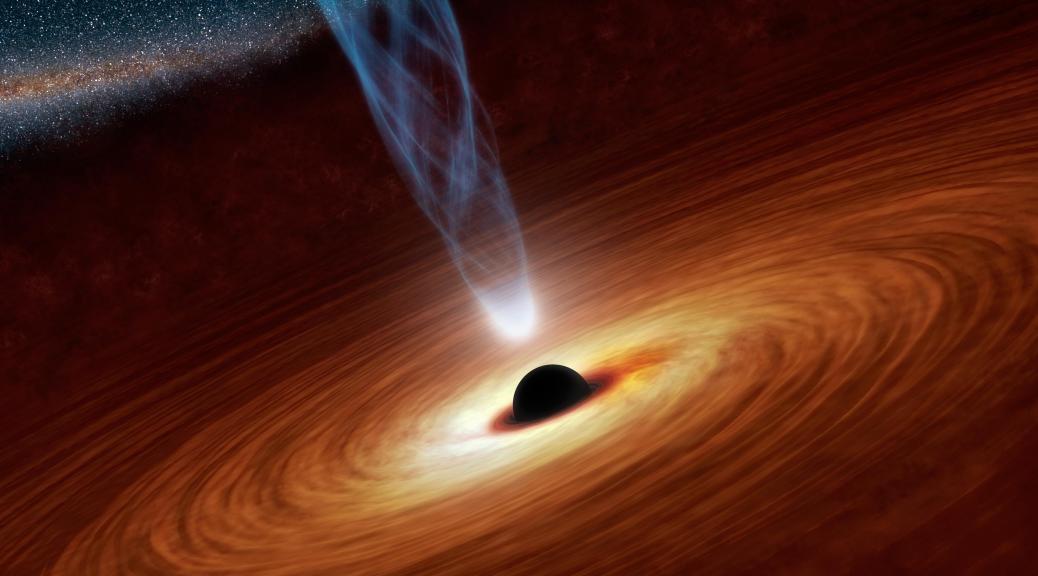
The discovery of a gigantic black hole from the dawn of time has me feeling a bit like that small town boy who thought his world was pretty huge, until he found out about New York City.

We’re such small potatoes, universe-wise, the only way I can get my head around it is through the lens of the literature of my youth – TV show theme songs.

So these scientists was lookin’ at a big black hole,
though goin’ to visit wasn’t anybody’s goal.
The one that they found – was as wide as it was tall …
It made everyone feel impossibly small.

A massive hole. In vast space. Texas trench.

It was further away than a lot they’d seen before
It was large as the sun plus a dozen billion more.
They said “this is bigger than an older hole should be,”
An’ they added it all up to another mystery.

Dawn of time. Ancient gas. Quasars.

What’s the biggest city you visited as a youth, and what effect did it have on you?  

Sleep Scold Slackers

 Photo : Thomas Bresson

The National Sleep Foundation’s Expert Panel on Sleep Duration (let’s just call them the Supreme Court of Sleep) has ruled on the amount of rest you’re supposed to get and their ruling is an eye opener.

No, literally. You can have your eyes open more often now.

What?

The new chart identifies specific age groups and suggests a broader range of  sleep hours are “appropriate” based on your seniority.

I have to admit this is a disappointment.  I expect the National Sleep Foundation to caution, warn and scold me about my sleep habits.  In fact, I don’t even look at a report from any sleep expert unless I want to feel like a smoker – someone trapped in an unhealthy pattern of self-destructive behavior.

But reluctant  snoozers will notice with some relief how the recommended amount of down time has shifted:

  • Newborns (0-3 months): Sleep range narrowed to 14-17 hours each day (previously it was 12-18)
  • Infants (4-11 months): Sleep range widened two hours to 12-15 hours (previously it was 14-15)
  • Toddlers (1-2 years): Sleep range widened by one hour to 11-14 hours (previously it was 12-14)
  • Preschoolers (3-5): Sleep range widened by one hour to 10-13 hours (previously it was 11-13)
  • School age children (6-13): Sleep range widened by one hour to 9-11 hours (previously it was 10-11)
  • Teenagers (14-17): Sleep range widened by one hour to 8-10 hours (previously it was 8.5-9.5)
  • Younger adults (18-25): Sleep range is 7-9 hours (new age category)
  • Adults (26-64): Sleep range did not change and remains 7-9 hours
  • Older adults (65+): Sleep range is 7-8 hours (new age category)

Aside from those always-so-contrary “newborns”,  where the  “acceptable” sleep ranges have widened, they’ve been increased on the low end rather than the high. In fact, only one upper limit was moved – the one for Teenagers, who gained an extra half hour that they can claim “… is perfectly normal. I’m a teenager.  Get off my back.  Geez, mom!”

Of course the usual cautions about not getting enough sleep remain  in the report – you can do serious damage to your health and well-being by skimping on Z’s.   But the takeaway for those who want to stay up late or (horrors!) get up early – you  just got a little more legit.

The big winner – Infants! They gained two hours on the front end – extra awake time to devote to thumb sucking and gently cooing at faces. That’s the best case scenario. In reality, they’ll spend it screaming for dad and smearing poop around the crib.

Toddlers, preschoolers and school age children all got an extra allowable hour of wakefulness. And geezers (65+) got their own category with the lowest upper boundary of all the age groups – eight hours.

Time to get up, grandma.  Quit pretending!

I’m not sure why the sleep boundaries were “widened”, but if you look at the methodology you get an idea of what went in to crafting this new report:

Fifty-eight searches using combinations of search terms related to sleep (eg, time, duration, and sufficiency), age groups (eg, newborn, adolescent), and outcomes (eg, performance, executive function, cognition) yielded 2412 articles. The review team identified 575 articles for full-text review. Of the 575 articles, 312 met our inclusion criteria. Pertinent information (eg, sample size, study design, results) from each article was extracted and included in the literature review materials. Articles were sorted based on the strength of the study and presented in descending order in a summary chart. Expert panel members received print and electronic versions of the literature.

So members of the 18 person panel only had to wade through the particulars of 312 scientific articles to make their judgments about much sleep we need.   And only a third of those panelists were sleep experts – the others came from  such organizations as the American Academy of Pediatrics, the American Association of Anatomists, the American College of Chest Physicians … you can almost hear their inner deliberations …

“Do I really have to read all this?  This isn’t even my real job – how did I wind up on this friggin’ panel?”  

Busy people.  Highly schooled people.  Graduate school and PhD survivors who had other, equally important obligations, mulling over a persistent question – how much sleep do I really need?   And how do I get my work done?

All-nighter, anybody?


Forbidden Prehistoric Love

Header image: "Le Moustier" by Charles R. Knight -Licensed under Public Domain via Wikimedia Commons.

New conclusions reached about a 2008 archaeological find support the notion that we humans  mixed genes with our near-relatives, the Neanderthals, many thousands of years ago.

We weren’t that different.  Contrary to popular belief the so-called “cavemen” had brains that were roughly the same size as ours, and our developmental speed was similar.

My favorite line from the Live Science article is this one:

Probably the most debated aspect of Neanderthal life in recent years is whether or not they interbred with humans. The answer remains ambiguous, with scholarly opinions ranging from belief that they definitely interbred to belief that the two groups didn’t exist on earth at the same time.

I’ve known couples just like that – hard to believe they could exist on earth at the same time.

Thoughts about a human-Neanderthal love affair lead to so many questions, not the least of which is how to pitch your woo to a near-but-not human partner.

“Interbreeding” is such an ugly term, I decided it would be a fitting challenge to try to work it into one of the the prettiest love songs I know.

You have such broad and stocky features,
the ridge across your brow seems so strong.

Our lips (I have to stoop to reach yours)
are whispering, perhaps, that our love is wrong.

The way you wield a club. Your ugly scar.
A hot Neanderthal is what you are!

Ice age! It feels so cold and lonely.
But this age can be more tender and kind.
When interbreeding’s on my mind.

Alas, it is tough to keep the romance alive between such mismatched characters when fire and tools are all they have in common.

What  artifact might fuel speculation about your extinct love affairs?

Lonely Mountain

It’s both intriguing and heartbreaking to read this headline: Mountain-Size Asteroid To Fly by Earth on Monday.

It’s intriguing because this will offer a valuable chance for Earth-bound scientists to examine a large asteroid without having to leave the ground. The asteroid, known as 2004 BL86, will glide by at a distance of 745 thousand miles – roughly three times the distance from here to the moon.

In space terms, that’s close.

Not close enough to be dangerous but sufficiently close for radar observatories in Puerto Rico and California to collect images and data that will help us understand more about 2004 BL86’s surface, composition and orbit.

The resolution possible at this distance with radar telescopes is said to be good enough so that the pictures will reveal details as small as “the length of a typical car.”

If nothing else, we’ll soon know if 2004 BL86 has enough parking.

But it’s heartbreaking because the author of the source article called the asteroid a “mountain“, which fixed an image in my mind that I can’t shake.

While we’re watching it, what if it’s watching us?

I see a solitary wanderer, roaming the universe, looking for a home and scouting the nearby terrain for something that appears familiar and, if not friendly, at least fun.  A space mountain would spot many likely companions on Earth’s surface, including (of course), Space Mountain.

They say we’re safe from a collision with 2004 BL86, but that doesn’t account for the power of loneliness and longing.

Twinkle, Twinkle, lonely peak.
Is our planet what you seek?
As you fly by, so detached,
can you spot an earthly match?
Twinkle, Twinkle, if you please.
Just don’t join the Pyrenees.

Have you ever crashed a party?  

Birds of a Feather

"Photo by DAVID ILIFF. License: CC-BY-SA 3.0"

The latest word from the journal Science about Bar-headed Geese is that they can fly really high.

Like almost-the-summit-of-Everest high.

Actually, legend has it Bar-headed Geese have been seen flying over it at 29 thousand feet, but researchers have only tracked them to 24 thousand using GPS. But that’s still mighty impressive, given the physical cost of getting to that altitude for a bird that constantly flaps its wings.

They do it by staying close to the ground. Sounds easy, but in the Himalayas, the ground is quite vertical. That means these amazing birds gain and lose vast amounts of altitude only to re-gain it over the course of a long journey – something like going on a roller coaster ride if you had to run the length of the tracks rather than ride.

It makes one think Old Mother Goose may not have always been the doddering, bespectacled granny figure in a rocking chair. Perhaps she looked down on Sir Edmund Hillary and Tenzing Norgay while making up rhymes somewhat like  (but not quite) “To Market, To Market.”

To mountain, to mountain, to go very high.
Down again, down again, out of the sky.
To mountain, to mountain, to flap in thin air.
Down again, down again, nary a care.
To mountain, to mountain, on wings and not legs.
Down again, down again, hawks can suck eggs.

The stamina of these amazing birds was described this way in the Science article:

“In the lab, they nudged geese to run on treadmills in reduced oxygen to simulate high altitudes, which revealed that the birds could keep running at top speed for 15 minutes. Humans would not be able to sustain that pace in such conditions.”

Goosey, goosey flyers,
Bird who never tires.
Upskies and downskies
What strength your life requires!

As speedy as the jaguars,
As fearsome as the bears.
An up-and-downy athlete
who doesn’t take the stairs.

Picture it – a goose on a treadmill. Fifteen minutes, full speed, nonstop. Who says science isn’t fun?

What was your most amazing physical feat?

Rotation Indications

Now that we know the age of stars can be told by measuring their speed of rotation, the jig is up for those  celestial impostors who claim to younger than their velocity indicates.

Fess up, Polaris. You’re getting a little long in the tooth!

For some odd reason, it put me in mind of this classic Disney song.

When you time a spinning star
You can know how old it are
Every revolution tells
a tale that’s true.

When it’s whirring like a top
Chances are it’s just a pup.
When the spinning lessens then
it’s more like you.

Stars get old.
Their slowing, up above,
is a precursor of
someday exploding.

Don’t know much, but this I do …
Stars revolve ’til they are through.
When you time a spinning star
you’re spinning too.

How good are you at guessing the age of people and/or things?

Limerick Formation in Space

I had no idea there was an object in the asteroid belt big enough to be considered a “proto-planet.”   Ceres is about to get its close-up as a NASA probe closes in for a rendezvous in three months.

Ceres (pronounced SEER-eez) has enough gravity to hold itself in a spherical shape, and scientists think there may be some water there, but apparently that is still not enough to get past the “proto” stage, planet-wise. I confess I am not aware of the technical requirements for a space rock to advance beyond big-asteroid status, but there is some doubt that Ceres will ever qualify.

Why?  For me, a place is not a place unless it can generate a decent limerick.

Based on my remote amateur observations, Ceres will fall short, as witnessed by these promising starts that were never able to form fully functioning rhymes:

I.
There was a young fellow from Ceres
Who delighted in posing odd queries.
Such as, “Why do birds fly?”
And “What constitutes pie?” …

II.
There once was a woman from Ceres
an admirer of Timmy Leary’s.
She said “Let’s all drop out”
For she was no Girl Scout …

III.
An ill-defined creature from Ceres
Had appendages he called his “dearies”.
They were all rather cute,
but fell out of his suit …

Sorry, Ceres. Planetude seems very far away indeed.

To prove that you originate from a genuine place, write a limerick about where you’re from.

Aww, Man, Don’t Say That!

Today’s guest post comes from Steve Grooms.

When I was a grad student I developed a hernia low on my tummy. A hernia is like when a body part meant to be an “innie” decides to poke its head outside and live as an “outie,” creating a tender bulge. Hernias need to be repaired, so for the first time in my life I would need surgery.

When I asked for help at the University of Minnesota Hospital, nurses ushered me into the office of the most famous man at the University, heart transplant surgeon John Najarian. Dr. Najarian promised to fix my hernia. That turned out to be the first in a series of lies told me by my doctors. The University Hospital was a “teaching hospital,” I later learned, meaning Dr. Najarian was probably a dozen feet from me during the actual operation, supervising the cutting and stitching done by a team of wannabe surgeons.

My response to the anxiety of surgery was typical for me. I decided to become the perfect patient. I would respect every directive from my doctors, winning the affection of my doctors with my cheerful compliance.

Exactly the opposite response was chosen by my hospital roommate, a man I’ll call Frank Higby. Frank was a stocky, pug-nosed character from northern Minnesota who had a potentially fatal stomach ailment. Frank talked nonstop, stabbing the air with the cigars he chain-smoked. Cigars were perfectly legal in hospitals of the time.

Frank despised doctors. When told he had to fast before taking an enema, Frank sneaked out of the room in the night, roaming dark hallways until he found the kitchen. He returned with several slices of banana pie and a bag sandwiches. When I asked Frank why he had so much contempt for doctors, he replied that he had been a caddy in Rochester, Minnesota, when he was a kid. “I got to know those sonsabitches when they didn’t know someone was watching them. What a scummy bunch of phonies!”

Nurses told Frank and me that we each had to take three exams: a lung x-ray, a heart exam and a proctoscopic exam. Hospitals in those days were compensated based on how many procedures they performed, so they routinely called for as many tests as they could. When the nurses left the room, Frank rolled his eyes in terror. He said he’d suffered a proctoscopy once before. He called it “the worst experience of my life” and vowed he would rather die than have another. This did nothing to ease my own concerns about the next day.

On the day of our exams, nurses led barefoot Frank away in a skimpy blue hospital gown
that didn’t cover his butt. Although he didn’t look quick, Frank shocked them by breaking free and scooting out of sight in that large building. I learned this from a breathless nurse who came to our room looking for him. After she left, Frank dashed in looking like a cartoon mouse running from a cat. Wheezing heavily, Frank grabbed a phone and called the Pinkerton Detective Agency. He begged them to protect his anus by “sending your eight biggest goons down here.”

Minute by minute, it was growing harder for me to act the perfect patient. About then I had a conference with the man who said he’d be my anesthesiologist. My life would literally be in this man’s hands, so I hoped he would like me.

My anesthesiologist turned out to be a cross-eyed Korean with a thick accent. I tried to bond with him by making good eye contact, but that was difficult because his eyes were cattywampus like the headlights of a car after a front end collision. One eye pointed left and one pointed right. I couldn’t tell which eye I should make contact with.

My anesthesiologist wanted to know what kind of drug trip I wanted to take during the operation. That was unsettling. I thought he was the one who should be telling me how I’d travel through lala land. Instead, he described three different drug trips, giving me more detail about each than I knew how to handle.

Desperate now, I said, “Gee, it is amazing that you know so much about all of these forms of anesthesia! I suppose you have experienced them yourself?”

The cross-eyed Korean drew himself up with offended dignity. “I should say not!” he barked. “I am a Man of Science. I would never expose myself to unnecessary risk!”

When has someone said the wrong thing to you?