Category Archives: The Baboon Congress

Perfect Pitch

Today’s post comes from Verily Sherrilee

I’m on vacation this week. I’m not doing anything special – just hanging around the house.  A little gardening, a little cooking, a little studio time, a little reading.  OK – a lot of reading.

I’ve gotten a couple of earworms this week, which is way more than usual.  First I got a Beach Boys song stuck for most of a day (Help Me Rhonda) and then yesterday it was The Girl From Ipanema. I don’t remember what started this and I don’t even know the lyrics to this song, but it stuck around all day.   Finally after several hours I started to hum and then eventually, as I was working in my studio, I began to sing the tune out loud.

https://youtu.be/UJkxFhFRFDA

I can carry a tune. I’m in a choir.  I’ve even sung at the Guthrie (as part of the choir, not on my own).  But when I started to sing, both dogs, who had been snoozing away on the floor near my feet, got up and left the room.

Both of them.

Do you sing the car or the shower?

Pals, Buddies, Chums, Confidants, Allies

Today’s post comes from Clyde of Mankato

Steve posted this yesterday:

I continue to be fascinated by Liam [his grandson]. His buddy is Terrian, 7 years old, the next-door neighbor kid. Terrian and Liam, 6, can play for hours. Liam was next door doing that recently until a dispute broke out between Terrian and his parents. Things escalated until the parents sent Liam home.

My daughter wondered how her son viewed the fight. I enjoy the way she talks to him, always with genuine interest in what he’ll say . . . because he is not predictable. “I stayed off to the side,” reported Liam. “When kids do something like that, you just let it happen. And then you hope they learn from their mistakes.”

Liam and Terrian–not the names of my youth. Friendship does mean not trying to change the other person, does it not?

Childhood friendships are a constant source of literature and thought. Among the many movies, my favorite is The World of Henry Orient, about two adolescent girls in New York City. You can no doubt name many others.

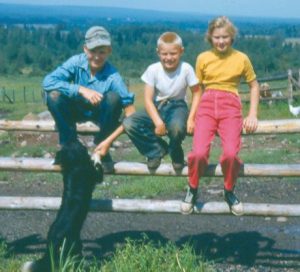
Childhood friendships are very important, yet they seldom last into adulthood. I have nothing in common with my long childhood friend. He went into the Navy; I went to the University of Chicago. We entered two different universes. We stumbled over each other for awhile on Facebook. We were over two years apart in age. I was the younger. In our yKis Pixouth we roamed the woods on my hill together and shared many adventures, often staying overnight in a shack built by our two older brothers, who were long friends and grew very far apart by the time they were 25.

In truth my best childhood friends were Boots and Cleo. Cleo and Clyde–we had to be welded at the hip for life.


What did you learn from your childhood friendships?


We are not Lunatics

Today’s post comes from Renee in North Dakota

My German relatives are coming to visit the US in August. Wilhelm and Petra will arrive at the end of the month to spend some time in Luverne with my mother’s cousin Elmer and his wife, Eunice. The Germans have been here before. Petra speaks English fluently, and Wilhelm not at all. Wilhelm is very interested in US farming techniques, and farms the small farm he inherited from his father. He is a retired auto worker and farms as a hobby.

These relatives were very gracious to us on our trip, meeting us in the Bremen train station and taking us to dinner. Their 25 year old daughter drove us all over Verden and Nedden, showing us sights important in the history of my family. We have a standing invitation to stay with them if we are ever in Bremen again, and we intend to take them up on their offer. We sent them a Pendleton Wool blanket  with Badlands motifs as a thank you gift.

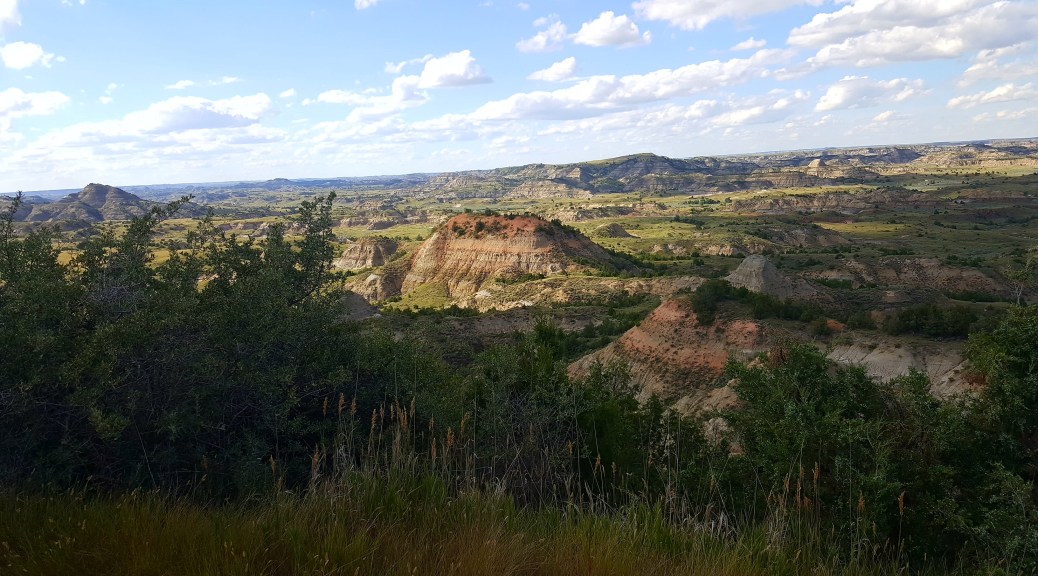
Recent events in the US make me wonder what on earth they are thinking as they prepare for their trip. They plan to fly into New York, where they will be met by Elmer’s daughter, and she will fly back to Minneapolis with them. They will go to Luverne, and plan a trip to the Black Hills. I wish they had time to visit us, just three hours to the north of Rapid City. I  would take them to the ND Badlands and the reservation husband works on to meet our native friends. I think Yellowstone would be a nice destination, as well as Glacier. I want them to see the vastness, the enormity of the sky here, the ocean of grass, maybe even a rodeo. I know some ranchers Wilhelm would find fascinating.  They may even like Lawrence Welk’s home in Strasburg.

Our pastor spoke on Sunday about turning down the volume and finding some quiet sanity within ourselves, loving one another, and caring for the stranger. I hope that Petra and Wilhelm can see the good in us, and not think we are lunatics.

 Where would you take foreign visitors to show them that we are not lunatics?”  

The First Tomato

Today’s post comes from Verily Sherrilee

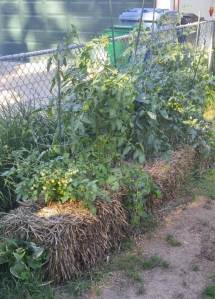
My first tomato of the season! It’s small – a variety of grape tomato known as the Santa.  I noticed it starting to turn a couple of days ago and was hoping some critter didn’t get to it before it was perfectly red and ready.  There it was last night when I got home; it didn’t even make it into the house before I had popped it in my mouth. I try not to say “OMG” too much but OMG!

I’ve always loved tomatoes. I love big fat tomato slices on open-faced cheese sandwiches. I love little tiny tomatoes in pasta salad.  Chunks of tomato with orzo and basil.  Salsa with tomatillos.  Spaghetti w/ tomatoes, olive oil and spinach. Bruschetta with diced tomatoes and garlic.  Hardly a way you can make something with tomatoes that I don’t like.

FirstTomato2

For many years I tried, unsuccessfully, to grow my own. The garden plot was decimated by dogs; the “hanging” contraption was too heavy and kept falling over.  Plants just never grew in big pots.  It was so demoralizing that for many years, I didn’t even try.  Then, thanks to someone mentioning it on the Trail, I read Tomatoland by Barry Estabrook, an exposé on the tomato industry.  It was horrifying and I came away from the book with a new determination to grow my own tomatoes.  It was this determination that led me to straw bale gardening – finally a way to have my own home-grown tomatoes.

I know I’m probably not saving any money by growing my own (cost of bales, cost of water, cost of seedlings, etc.) but I do love picking a tomato, taking in the house and eating it for dinner. There is nothing like it in my book!

What summer produce can you hardly wait for?

Give it Time

Today’s post comes from Barbara in River Town.

I woke up feeling out of sorts, basically missing The Familiar.

We’ve been here in our new home (Winona, MN) for a total of three weeks, and I still haven’t found places to plug in all the lamps (I dislike overhead lights) or put the contents of all the boxes. I sometimes stand in the kitchen and rotate 360˚ while I try to remember where an item is located.

To top it off, this morning the freezer door was standing open when I got up. I’d forgotten that we have to check on the refrig doors, since they don’t “close by themselves” as they did in the old place.

We are still getting used to the idiosyncrasies of this new house.  I am, in a word, unmoored.

Except for visiting my mom, I am currently without direction (now that most of the unpacking is done). In my old life, I had several commitments a week that had me busy and involved – with people I like and projects I felt were worthy of my time. I remember this period from the last time we changed city, so I know it gives way to something better, and I will find my people and projects here. But I’m in that awkward stage of BEFORE, and need to give it some time.

Don’t get me wrong – the house is delightful in many ways, and this town has ‘way more going for it than I even remember. I just need to start connecting.

When was the last time you felt “unmoored”?

My Village

Today’s post is from Renee in North Dakota

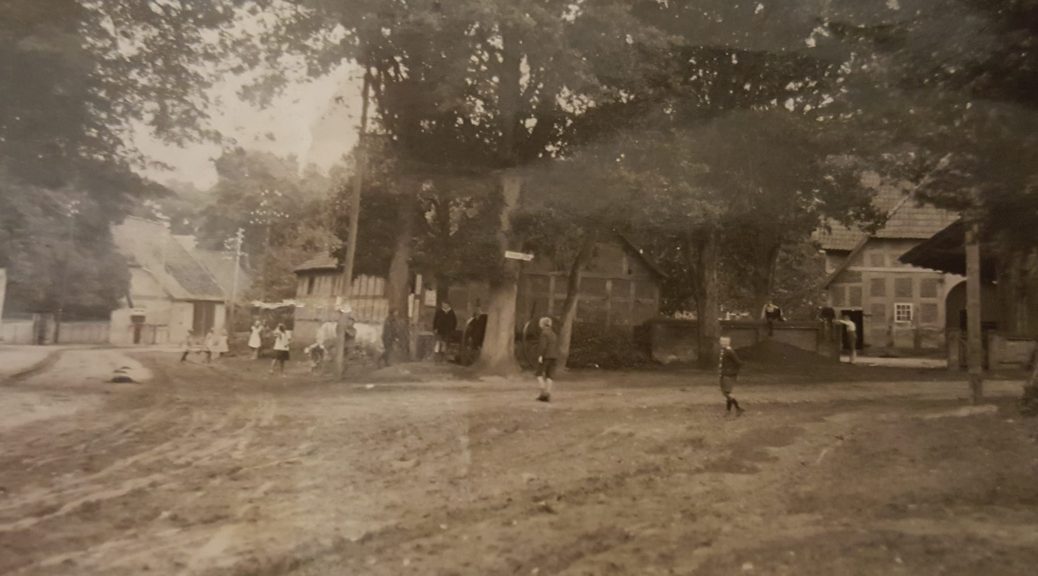
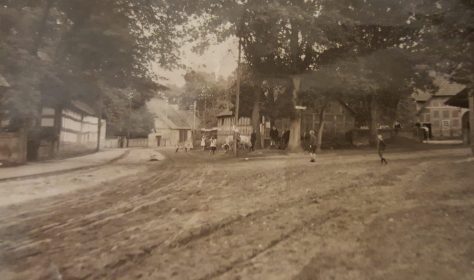
I have an old photograph of a German village street from the early 1900’s.  I was given the photograph by my maternal grandmother, who wrote on the back “The only street in Grandpa’s birthplace which is on Dead End under trees”.  The Grandpa she refers to is her husband, my Grandfather Ernst Bartels.  I wonder where she got her information, as she never stepped foot in the place.  I can hear her saying the words about the village with some derision in her voice. She was a city girl from Hamburg who met my grandfather after she immigrated to the US. She found him impossibly rustic and dull. She always felt somewhat superior to him and his family. She spoke formal German; the Bartels all spoke Plattdeutsch.

The photo always puzzled me because it seemed to be a photo of nothing. It shows a wide, muddy street with trees in the background, and behind the trees, barely discernible,  a large, half-timbered house. The photo is of poor quality and is a little blurry. I never really noticed the house behind the trees before our trip to Germany. Now that I have stood on the street in the photo and was lucky enough to go inside the house, the photo is completely understandable.

20160513_184116

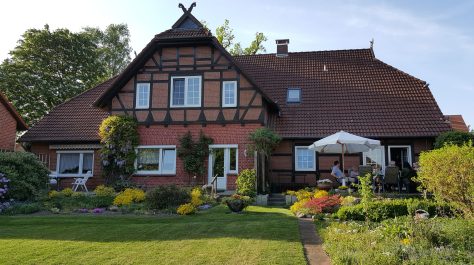
My grandfather and all his siblings were born in that house. I never heard anyone in the family speak the name of the village.  I had always heard that my grandfather was born in Bremen. My mother said she thought he was born in Bremerhaven. I know now that the name of the village is Neddenaverbergen. It is about 50 miles south of Bremen, and with the help of my mother’s cousin Elmer, I contacted family who still live there, and they invited us to visit them.

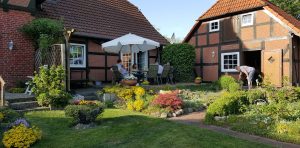
20160513_182343Neddenaverbergen is a small farming community of around 700 people. It is quiet and very tidy. There are lots of flower and vegetable gardens. Oma was wrong. There are several streets in the village. All the farmers live in the village. The farmland surrounds the village on all sides.  Almost all the farm buildings are in the village as well, except for the modern buildings that house large machinery or livestock. The houses are old, and are built in the style in which the barn was attached to the house. All the houses and outbuildings are very close together, so that one neighbor’s house/barn is right next to another neighbor’s house/barn. The houses are half-timbered and made of brick. There are far fewer farmers now, and many of the residents commute to jobs in Bremen or Verden.

20160513_184143My grandfather was one of eight children. He was the second oldest. My great-grandfather died when Grandpa was about 17.  In the old German tradition, Grandpa’s oldest brother, Johan, inherited the farm. The rest of the family, including my great-grandmother, got nothing. Several of my grandpa’s siblings were still quite young, so, in 1910, he and his brother, Otto, immigrated to southwest Minnesota where their mother had family. The boys got farms and earned enough money to bring their mother and siblings to the US before the First World War.

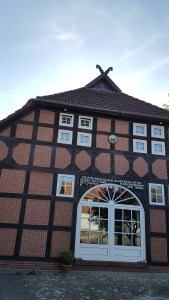
Johan and his family survived both World Wars. His grandson, Peter, still owns the family home. He had no interest in farming and rents the land. The house was built in 1673 by an ancestor, also named Johan . Peter converted the part that was the barn into a family room. We got a tour of the house. I loved seeing the place that my grandfather was born and where he undoubtedly milked cows. The beams that were visible in the barn/family room were thick and very solid. The inscription over the door in the blog photo says something to the effect “I Johan, have built this house for my family and I have done my best and I hope that it serves them well”.

Renee_Germany_2

I  look at the old photograph now and it all comes into focus. I see the house. I know how the street goes right past the house, and I recognize one of the trees, now much larger. In my mind I can imagine it in color. I think of Neddenaverbergen as my village.  I want to go back.

How has visiting a place changed the way you see it?


It Is a Village, Though

Today’s post comes from Clyde of Mankato

I have been thinking much about community–what it is, what makes it, how we lose it, why it matters that we lose it. Community has invaded my fiction without my permission. This is a vignette from my stories about Northeastern Minnesota.

A place. Only a place. Indistinguishable from much of the boreal forest covering Northeastern Minnesota and adjoining Canada. A place, only a place, unless you looked at this place with the masterly eye of the original people who first roamed in small bands through the forest thousands of years ago. A Place: a low hill rich in game, with a level area above a clean-flowing stream, ample supplies of firewood, and many young cedars for poles, baskets, and other village needs.

It was many times a Lakota village for a season or two.

It was a village only once or twice for the Ojibwe, who, forced west by the European settlement of the eastern Great Lakes, displaced the Lakota out onto the prairie. The native peoples had astounding geography skills, which allowed them to remember favorite locations for their nomadic villages, but they were weak at geology. They were unaware of what lay beneath the hill and how to use it.

It was never a village for the fur trappers, first French and then English. The stream had clogged up, making it of no interest to the beaver.

It was not a village for the five men who came prospecting for iron ore. With their geology skills, they found the hidden wealth. Five men focused only on rocks for one week do not make a village.

It became a village once again when the first two dozen men arrived to open up the mine and by necessity begin a town. Soon followed more dozens of men, some to work the mine and some to attend the men who did. The third wave of men, accompanied by women and children, helped establish the mining office, a store with post office, boarding houses, and a dining hall.

Ten years later it was a large village, complete with several hundred residents, seven stores, two banks, two law offices, one doctor’s office, three churches, and a committee of village leaders to incorporate it as a municipality under the statutes of the young State of Minnesota, allowing them to plat and try to maintain muddy streets, provide a constabulary with jail, build a pine-framed city hall, organize a volunteer fire department, and grant the mining company and railroad all the exemptions and privileges they desired. The committee named the town for an eastern wealthy industrialist of dubious integrity but who had a proper British surname, unlike eighty percent of the residents.

After another ten years it had grown to a village of more than fifteen hundred residents who, despite some strident objections, added a brick city hall with jail, a larger fire hall with better equipment, a hospital, a small pine-framed elementary school, and parks, which at first were no more than rocky, weedy empty lots. It was a village because people gathered for their commonweal by assigning or gathering in the various roles that a village needs. United they were despite being divided into different heritages with different cultural norms, into different brands of Christianity, into opposing political points of view, and into social strata based primarily on occupation and nationality.

As a village it struggled, like all villages do, to serve the greatest good of the greatest number of people despite the interests of a powerful few. The library was a telling point for the village, opposed by those who saw it as a waste of tax dollars or waste of people’s time and by those who feared books as sources of dangerous ideas. A few years after the first small pine-framed library was built in the alley behind the city hall, it was replaced in the town center by a large-windowed brick and stone building, funded, along with its oak shelves and books, by Andrew Carnegie, who had made himself wealthy beyond the village’s imagination by processing their high-grade ore into iron and steel. His wealth was built with his skill, his ill-use of his employees from his mines to his blast furnaces, his intimidation of those who dared oppose him, and his manipulation of Wall Street, which has never cared what makes a village.

It was a village because most residents knew most of the others, because they gossiped about each other, by which is meant, among other things, knowing and tending to each other’s needs. Through gossip they knew what to help celebrate or who to help grieve. As a village they wove the strands of the web that bound them together, the strongest bonds woven in the hard times, of which there were many. Through boom and bust it was a village parenting each other’s children and finding pride in landmark events, such as their first high school graduating class of only two young women and one young man, others of suitable age having gone to work instead of going to high school.

It continued to be a village as it grew to over 4000 residents who survived the disaffections and deeper divisions that come with larger size. It was a village proud of its new brick and granite grade school and imposing high school on the top of the highest point in town, donated by the mining company. More and more students were graduating, more and more were heading south for a better jobs or to add to their education for a fuller life.

It was a village united behind their sports teams which played other mining villages, united in elation when their teams were victorious over the teams from their rival town ten miles to the east or untied in dejection when the teams lost.

It was a village when it proudly and naively marched boys off to wars, stunned but united in grief when the sad telegrams began to arrive, and bound in relief when men came home.

It was a worried village when the ore of their mine began to dwindle. The population started to fall, more young people headed south, and businesses began to close. As a village it stood through it all, taking the loss as too-personal when their high school closed, sending their young to the rival school ten miles to the east. To the village’s relief, the grade school remained, but only for a few years until the population dropped back to a few hundred residents, most of whom were beyond the parenting stage.

It remained a village after the downtown closed and house after house was abandoned, a village whose residents drove elsewhere to bank, to shop, to visit the medical clinic, to treat themselves to a restaurant meal, and to hire lawyers to write their wills.

It is a village still, a village of mostly retired people, more women than men, who gather to mourn the impending death of the village and to pass around photographs of children and grandchildren who live in distant large cities where people have no sense of what makes a village and why villages matter.

© Clyde Birkholz 2016

What has not endured that you thought would endure?

Elite Hotel

Today’s post comes from Renee in North Dakota

I think one of the most fun things about traveling is finding interesting hotels and lodging to stay in. We had really good luck with our lodging for our recent Europe trip. All the places were unique and had interesting and unexpected features. I mentioned the Merrion Hotel in Dublin in a previous post about Bruce Springsteen. Here is some information about some other hotels we stayed at.

20160512_075552

In Bremen we stayed at the Design Hotel Uberfluss. I love the name. (It was hard to find a place in Bremen the week we were there due to an international conference on the medical management of open wounds. Just what I would want to learn about!) The Uberfluss is situated along the Weser River in central Bremen near the old city. It is ultramodern and decorated in white and black with funky looking light fixtures. The rooms have enormous windows that open like French Doors if you turn the handle one way, and tilt open from the top if you turn the handle the other way. During construction they discovered a section of the original town wall of Bremen, circa 1300, and preserved it in the basement. Artifacts like medieval shoes and jewelry, also excavated by the wall, are on display in the lobby. I found that fascinating.

We were in another, similar hotel called the Varsity, in Cambridge, England. It was located on the River Cam, and we could see people in punts with poles on the river. It was very peaceful.

Glasgow brought us to a lovely restored Georgian town house called the Glasgow 15 Bed and Breakfast.  It was beautiful and more like a hotel than a B and B. The breakfasts were huge. Two doors down was a plaque on a house where Sir Joseph Lister, the father of antiseptic surgery and the namesake of Listerine, lived and did research. Glasgow was full of memorials to scientists. Kelvin, he of the Kelvin Scale of temperature, has many statues and things named for him.

20160525_165933

In Scotland’s western highlands we stayed in a very old hotel 6 miles out in the country near Oban. It was called the Knipoch Argyle. In 1592 a Campbell, then the Thane of Cawdor, was brutally murdered in the dining room. We had a great meal there.

20160516_074623

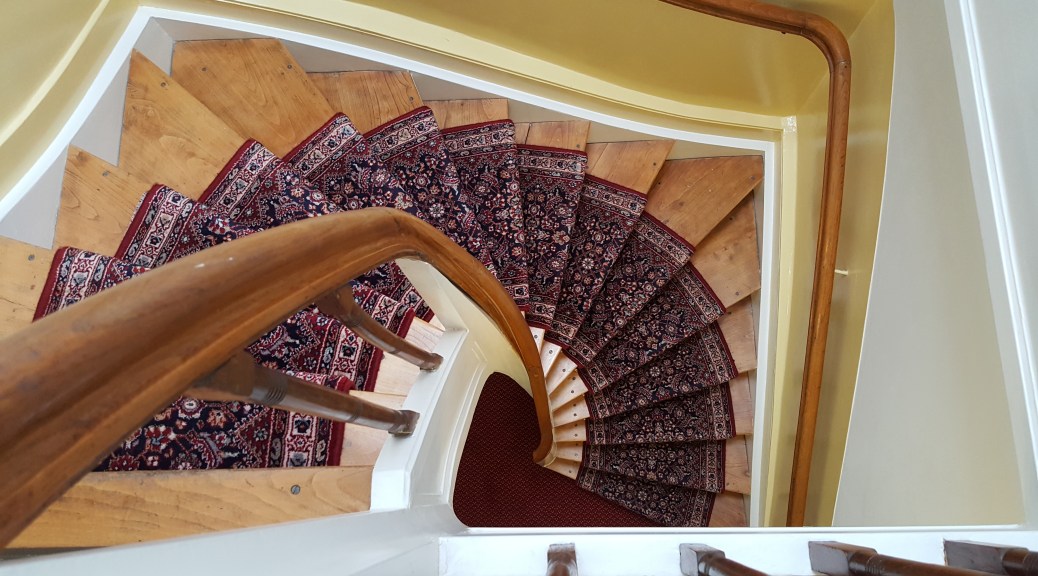
The Wiechmann Hotel in Amsterdam was probably the quirkiest place we stayed. It is in a narrow, three-story,  19th century building on the Prinsengracht Canal a couple of blocks from the Anne Frank house. Our room was on the top floor. There were 46 narrow and winding steps to our room, and no elevator. Those stairs were killers, and once I got downstairs I didn’t want to go back upstairs. There was a large German Shepherd who slept near the front desk. On the wall behind the front desk was a gold record, a gift to the owner from Emmylou Harris. It is the gold record she received for her second album, Elite Hotel. I guess she stayed at the Wiechmann and really liked it. Johnny Rotten and the Sex Pistols also stayed there too,  but I can’t think what they would have brought the owner except mayhem.

What is the most memorable hotel you’ve stayed in?  


Hope’s Ride to Winona

Today’s post comes from Barbara in River Town

On a pleasant Wednesday evening in late June, with a “little” help from some nephews, Husband and I filled the front half of a 15-foot U-Haul truck with the remainder of our stuff at the old house in Robbinsdale, and slept one last time on the screen porch of that house (since most of the rest of the house was empty). On Thursday morning, we drove over to my mom’s senior residence and spent the morning loading the remaining U-Haul space with HER stuff. Then we all headed off – Husband in the truck, Mom and me in a full sedan – on an adventure to the Southeast, and we landed in Winona, Minnesota.

My mom, whose name is Hope, is 90 years old. She has put up with my moving her four different times since Dad died in 2006, and is nothing if not intrepid. This is the second time she’s come to a new residence “sight unseen” (either she really trusts me, or she just has no choice). At this point she doesn’t remember all of the places unless she is prompted with a photo. She is, in a word, amazing – and always ready for something new, some fresh adventure.

We were stymied on Highway 100 by construction for a frustrating while, then finally eased out of the city. Once we got past the stoplights along Hwy 55/52, and found the roller coaster hills of Hwy 50 between Hampton and Red Wing, we were sailing. She was enthralled by ALL the scenery – even planes overhead and the refinery at Rosemount. She especially loved seeing the patchwork fields; she noticed every pretty church steeple, the pink and yellow vetches along the sloping ditches, the farm houses, the Round Barn just south of Red Wing.

But once we had reached the Mississippi River, it was the bluffs that captivated her. They are totally blanketed right now with trees of the richest greens – it looks like you could reach out and squeeze them like a sponge. They reminded Mom of her native Sioux City, IA, also long a great river – the Missouri. She couldn’t take her eyes off them, and kept commenting on their beauty.

So imagine Hope’s delight when, a few hours after setting out, we got to her new apartment at St. Anne of Winona, and the view from her windows is… the bluffs of Winona.

What’s the best view you’ve had from a window in a place you’ve lived?

My New Roommate: A Grandson

Today’s post comes from Crystalbay

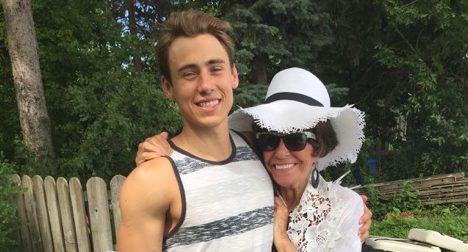
A few days ago, my 21-year old grandson, Conner, approached me about living here for a while.  My first reaction was, “Oh no!!  What if it doesn’t work and I’ll be in the position to tell him to leave??!!”.  It was a beautiful summer afternoon and, as we sat together on the lake swing, I decided to take the risk.

Conner, a formerly heavy pot smoker and a somewhat aimless kid, had gone to the U of M for two years, then dropped out, saying he hated it there and wanted to be a personal trainer.  The whole family worried that this young man was lost.  He took a pricey personal training course.  Still, we wondered how this slender kid could possibly make a career out of a profession in which so few can succeed.
That was then; this is now.  Conner just won a national natural body building competition one month ago out of 70 men older than himself.  He’d worked out for a year and sculpted his body into near perfection.  When I saw him on that stage, I couldn’t believe the transformation.  His career “stock” shot through the roof, and he now has enough clients to make a solid living.
When he moved in a few days ago, he made the upstairs his own, putting my furniture in the closet, rearranging everything, vacuuming, washing floors, putting his own posters on the walls, etc.  Since then, he’s mowed the lawn, gone on errands, put every single dish in the washer, taken the garbage out, and introduced me to new Netflix series.
IMG_1819
Every morning, he makes his bed even though no one goes upstairs but him.  We respect each other’s space and, thank God, he has no interest in watching TV.  Each day, we find time to sit on the lake swing and share everything from our day to childhoods to politics.  I must admit that I’m doing my best to shape him into an ardent progressive. I did worry about feeling invaded after so many years of quiet solitude, but now find myself looking forward to him returning from his day.
I sense that this is a very important summer; more than previous summers.  The new but growing bond is forever.  Without this opportunity, I may never have known my grandson.  I’m even thinking about how much I’ll miss his daily company when he moves on, but I’ll enjoy the moments we have for now.
Yesterday, he asked if I’d teach him how to play the piano.  Today, I asked him to come to a nearby fitness club and create a free weight lifting routine for me. He and my daughter are competing in the same contest in August. He’s now proposing that he, his mom, and I could compete together one day.  Imagine that; three generations! I’d win because I’d be the only one in the over-70 class. Our daily routines blend together seamlessly and our gratitudes for the smallest exchanges, a hug, a peanut butter sandwich, music he’s introducing me to, and, most of all, our appreciation for sharing this most beautiful piece of earth.
Yes, this will be a summer to remember.