I’m one of those folks who can’t quite get over the fact that Pluto has been demoted from planet to dwarf planet. I’m not a complete fanatic; I haven’t cried over it and I haven’t written any poison pen letters to Neil deGrasse Tyson whose Hayden Planetarium was the first to build an exhibit with the Pluto demotion for all the world to see. Although to be completely honest, I DO own a t-shirt that says “Pluto. Revolve in Peace. 1930-2006.”
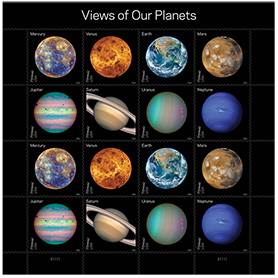
I was not thinking about Pluto this morning until I went to the post office to replenish my postage stamp stock. They know me pretty well there and know that I’m always looking for new and fun stamps. When I said I needed stamps today, the clerk said, “Oh I have some new ones to show you.” and pulled out some national park stamps and also a sheet of stamps with the eight planets. They’ve very pretty but I couldn’t resist a “poor Pluto” comment.
The clerk laughed and said “Wait, you’ll appreciate this” as he disappeared into the back. A minute later he returned with a four-stamp sheet with Pluto and the New Horizons spacecraft (the one that did the close flyby of Pluto recently). At this point I was laughing as well, knowing that I am clearly not the only one out there who is still mourning the loss of Pluto from our team of nine. Of course I had to buy a sheet of those as well. I’m not a stamp collector or saver but I might have to make an exception for the Pluto stamp!
One of the reasons we traveled to Bremen, Germany in May was to visit the towns where my mother’s family came from.
My maternal great grandmother’s family came from a town a few miles south of Bremen. The family last name was Cluver, and they came from Verden, a town with about 25,000 people. It was a very important place in the Middle Ages. Charlemagne slaughtered 4500 Saxons there in 782 for sliding back to pagan worship after they had been baptized. I imagine some of them were my relatives. The town was closely connected to the Old Saxon Law courts nearby. The town was considered a Free Imperial City of the Holy Roman Empire. A medium size cathedral, built between the 12th and 15th centuries, was home to a Prince Bishop from 1180 on, from whom my Cluver ancestors enjoyed great political patronage. That relationship also caused the eventual downfall of the family.
We have extensive records on the Cluvers. They were very wealthy in the centuries before the Reformation. Northern Germany is flat, low, and swampy, and the Cluvers possessed the knowledge and ability to drain wetland so that it could be used for growing crops. The Cluvers often loaned money to the Prince Bishop of Verden as well as the Prince Archbishop of Bremen. The bishops rewarded the Cluvers with land, allowed them to live on grand estates that they owned, and used their influence to further the Cluver’s business and political aspirations. Things went well until the Reformation and the 30 Years War, when Sweden invaded and occupied the area and the whole region became Protestant. The Prince Bishops were ousted from power.The Cluvers clung tenaciously to the Church and refused to convert, I believe as much out of greed as from religious conviction. They didn’t want to abandon the cash cow that gave them so much prestige and power. I gather that they were pretty annoying and rebellious toward the occupying Swedes, who retaliated by killing as many male Cluvers they could find. Eventually, the family lost most of their wealth and lands, and became small Lutheran farmers like the majority of their neighbors.
It is hard to describe the feelings I had as I walked in the cathedrals of Bremen and Verden and saw the monuments and tombs of my ancestors. There is a quite large and elaborate tablet from 1457 on the wall near the north Tower in the cathedral in Bremen in memory of Segebad Cluver. I wonder how he would feel knowing how things turned out. Greed can be pretty destructive. I also saw acres and acres of good farmland, though, so I suppose the family contributed something to the area that lasted.
What is a a gift or opportunity you’ve come to regret?
Husband and I have vastly different ways of processing information. I scan my environment accurately but hastily, taking in only what is pertinent and ignoring the rest. In Rorschach Inkblot terms, it means I have tendencies toward underincorporation, and I may fail to notice something important.
Husband, on the other hand, readily admits he is a super overincorporator. That means he tries to take in all the details he sees without regard to importance. It is as fraught with error as underincorporation, as a person can only process so much information before becoming overwhelmed.
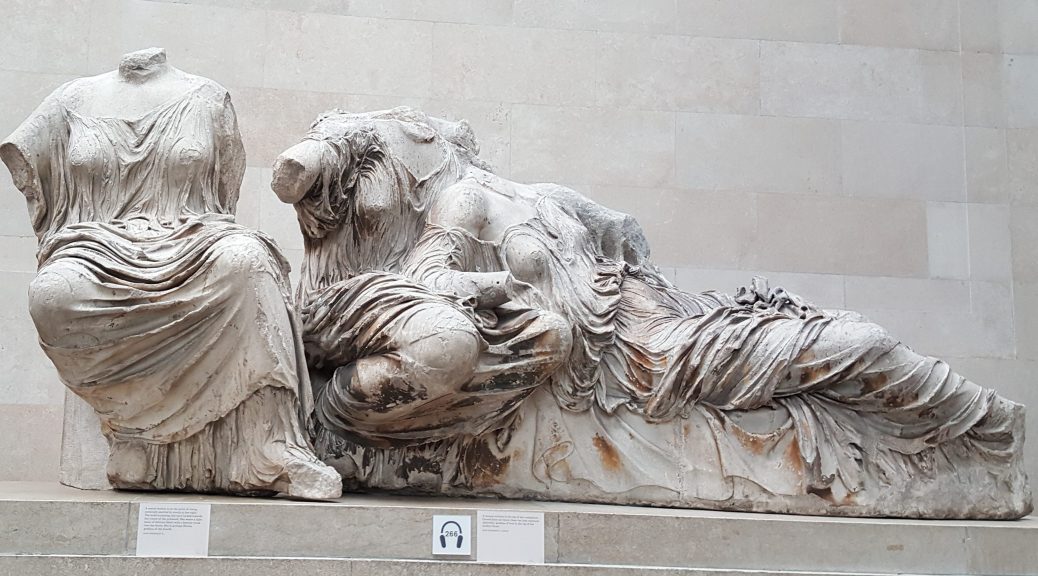
We went to several museums on our recent vacation, including the Rijksmuseum, the British Museum, London’s National Portrait Gallery, Westminster Abbey, the Kelvingrove Museum in Glasgow, and Trinity College Library to see the Book of Kells. Westminster Abbey is a place of worship, but I think of it as a museum as well.
The practical implication of our differing information processing styles meant that by the time we finished with our first museum, I felt great sympathy and kinship with the woman I wrote about earlier who killed her husband with a blow to the head with an ornamental stone frog.
I flit through museum rooms, not concerned about seeing everything but zeroing in on what catches my eye, or what I had planned to see, then moving on. I always plan to come back another time, on another trip, to see what I may have missed, to take in more details of what I saw before, and maybe see something new. I want to relish what I see without cluttering my mind or my emotions. I find museums profoundly moving. Husband tries to see every exhibit, to read every placard, to not miss a thing. He hates being rushed. This was really a problem in Westminster Abbey, as we had to stop and read every blessed memorial and grave stone in wall and floor. He even tried moving some of the folding chairs that had been placed in Poets’ Corner to make sure he didn’t miss anybody. He certainly is thorough.
I am happy to say we made it through trip and museum without any bloodshed. In Husband’s defense, he had never been to any of the museums we visited, and maybe that overincorporation tendency thrives with the unknown. We started to plan our next trip that may take place in the next few years, and I will try to work on my impatience and maybe suggest to him a more selective approach to museum viewing.
We shall see.
When it comes to incorporation, do you over or under do it?
Our recent trip to Great Britain and Ireland helped me develop a renewed love of the English language. I learned some new words on our trip to Europe, words for technological advances I had no idea existed prior to the trip. I also developed an appreciation of how funny ostensibly stuffy writing can be.
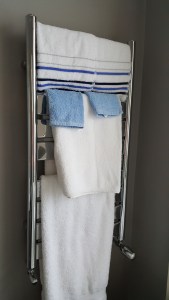
I noticed in our hotels in Dublin and Great Britain these pipe contraptions affixed to the walls in the bathrooms with a placard letting us know they were Hot Rails. They looked like towel racks with knobs and dials on them, and they were, in fact. loaded with towels. When you turned the dials, the pipes filled with hot water, which warmed the towels and made them toasty warm. What a lovely idea, and why don’t we have them readily available in the US?
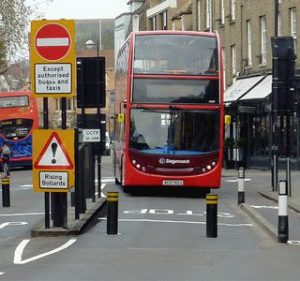
I also noticed official traffic signs warning of Rising Bollards. What wonderful words! What would you imagine Rising Bollards to be? These signs were frequently placed in narrow streets near hotels where it would have been possible to drive or park a vehicle, and where there was often nothing that could have been construed as a Bollard or anything else. A quick search of the internet revealed that a Rising Bollard was a steel post that was lowered into the ground and that would electronically rise so as to prevent someone from parking or driving a vehicle in the area. It could also be lowered at whim. I don’t know who was responsible for raising the bollards, or under what circumstances the bollards would be raised. We read in the London Times about someone who was suing their municipality for raising the bollards underneath their Volkswagen, smashing into the engine and causing untold damage to the undercarriage of the vehicle.
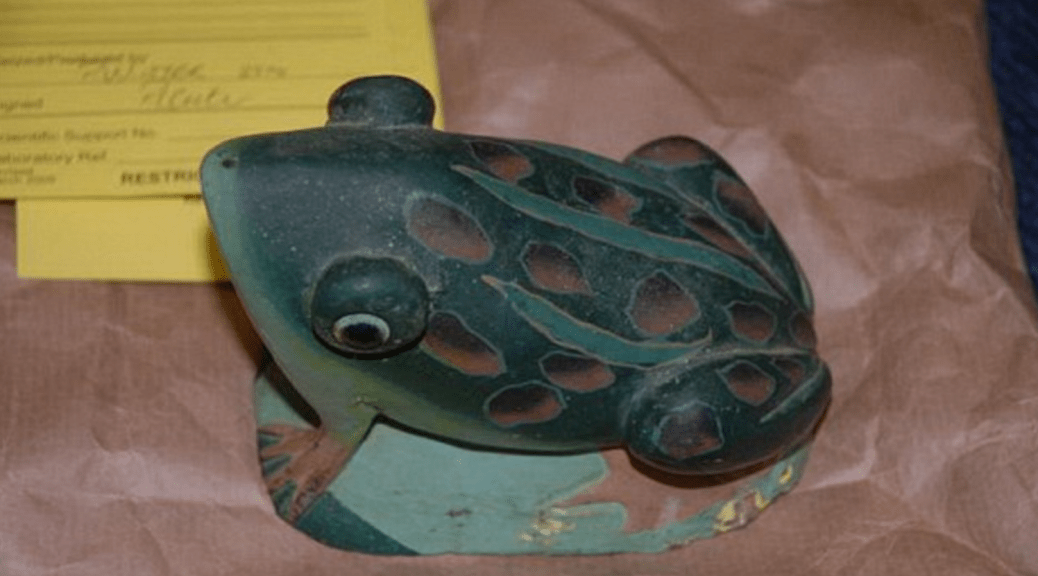
The Times of London was extremely funny. I don’t know if the writers and editors intended it to be that way, but there were the most odd stories that made me wonder if it was all made up. The story that sticks in my mind was a half page article about a woman who confessed on her death bed that she killed her husband 18 years earlier by bashing him on the head with an ornamental stone frog. She wrapped his body in a tarp and hid it in their shed. No one questioned his disappearance, and she spent the next 18 years telling people that she had got away with murder and that people were really going to be surprised at what they would learn once she died. No one bothered to say anything about her odd pronouncements until after she died, and people were strangely surprised when the police found his corpse in the shed. She kept the weapon, too. I found it delightful that a photo of the stone frog was prominently displayed in the article. I don’t know if the journalist did this with tongue in cheek. I can’t help but think so. I love the power of language.
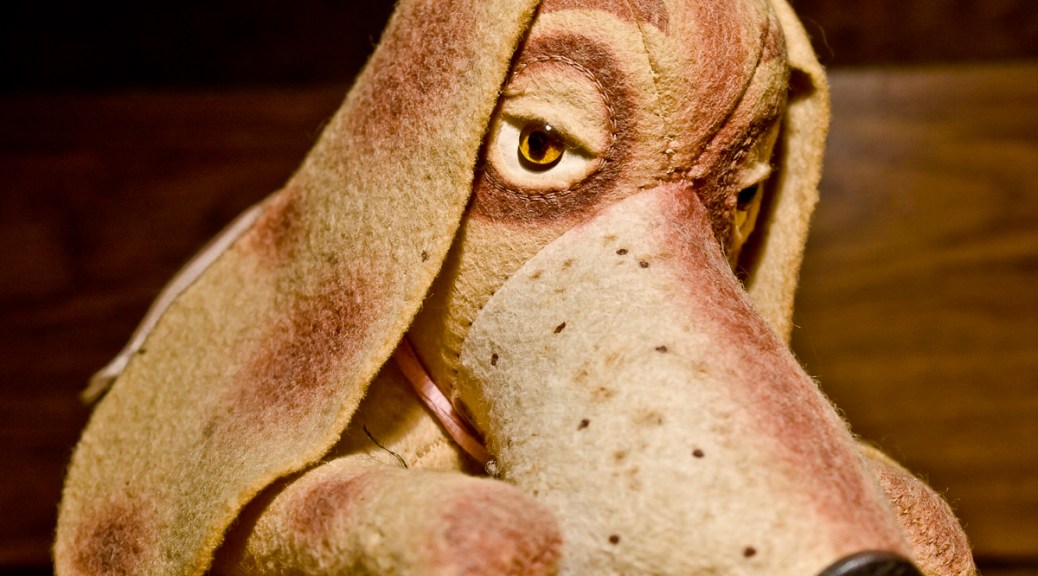
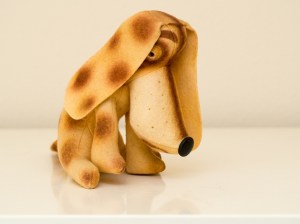
One morning around 1955, George Grooms—my father—woke up with a smile. He had been dreaming. In this dream my dad was walking the sidewalks of our town when he noticed a distinctive dog sitting on the curb. The dog was some kind of hound, a bloodhound or basset. It had a long, pendulous nose and droopy ears. The most memorable thing was the dog’s expression. The dog seemed utterly grief-struck.
In the dream this melancholy dog looked at my father and spoke one short sentence.
“Cheer up,” said the dog.
Cheer up? What a bizarre comment! The saddest dog in the universe had just told my dad to cheer up!
Dad rushed to his office without talking to anyone. He began sketching the melancholy dog before his memory of the dream faded.
My father was a genius at imagining unique toy animals and then figuring out how certain shapes of fabric could be sewn together to form a three-dimensional stuffed toy.
OLYMPUS DIGITAL CAMERA
Designing stuffed toy animals is one of the most obscure jobs in the world. My dad was once considered one of the two or three best designers in the world.
This dog resisted the design process. The body was easy, but all the prototypes Dad created looked jolly or cute. None had the tragic look of the dream dog’s face. Dad knew that the problem lay with the eyes. No matter what eyes he put on this dog, it looked idiotically cheerful.
Then Dad did something totally original. He fashioned eyelids that could be sewn in place to give his stuffed dog a sad expression. This was a radical innovation in the 1950s.
At that time stuffed toys were generic objects meant to be given to undiscerning infants. Stuffed toys were designed to be inexpensive. But my dad was an artist, and the artist in him knew this dog had to have a distinctive face for it to connect with people.
Those eyelids were the first of many innovations he would develop to create stuffed toys with vivid expressions. My dad’s company sold these stuffed toys under the name “personality pets” to highlight the way they differed from cheap, generic stuffed toys.
There was never an issue of what this dog would be called. Cheer Up appealed to children and adults, becoming the first of my dad’s designs to be famous. Cheer Up came in several forms (sitting, lying prone, lounging on his back) and several sizes.
Several years ago I was invited to attend a special meeting of the Ames Historical Society. The society was premiering a film that celebrated my father’s company.
Collegiate Manufacturing had been a significant employer in Ames for over 40 years.
The day before the film was shown I was invited to the home of a man who had a wonderful collection of stuffed toys from Collegiate Manufacturing. It was emotional for me to wander his basement gazing at hundreds of stuffed toys designed by my dad.
Monkeys, dogs, tigers, giraffes, horses, skunks, turtles and other critters stared at me from Don’s display shelves. I grew up knowing these toys but had not seen any of them for nearly 60 years. While I recognized many, I was most moved by Don’s collection of Cheer-up dogs. He had about three dozen Cheer Ups.
Don repeatedly urged me to take some toys as a gift. I was touched by his generosity, but I turned him down. I had no right to anything he had collected.
A day later we had the historical society meeting. When the meeting was over, I rushed to my car to start the long drive to my Saint Paul home. Don ran to catch up with me, shoving a box in my hands. “Don’t refuse me again,” he said. “I could tell by your eyes which ones meant the most to you.” The box held three Cheer Up dogs in the three poses that had been most popular.
My father died in 1999, and I heard that Don died a few years ago. Yet both live on in memory and in the friendly form of the little Cheer Up that sits on my bedroom dresser.
Most mementos honor the memory of a special person. My Cheer Up celebrates the memory of two men with good hearts.
Do you have a memento that helps you remember someone special?
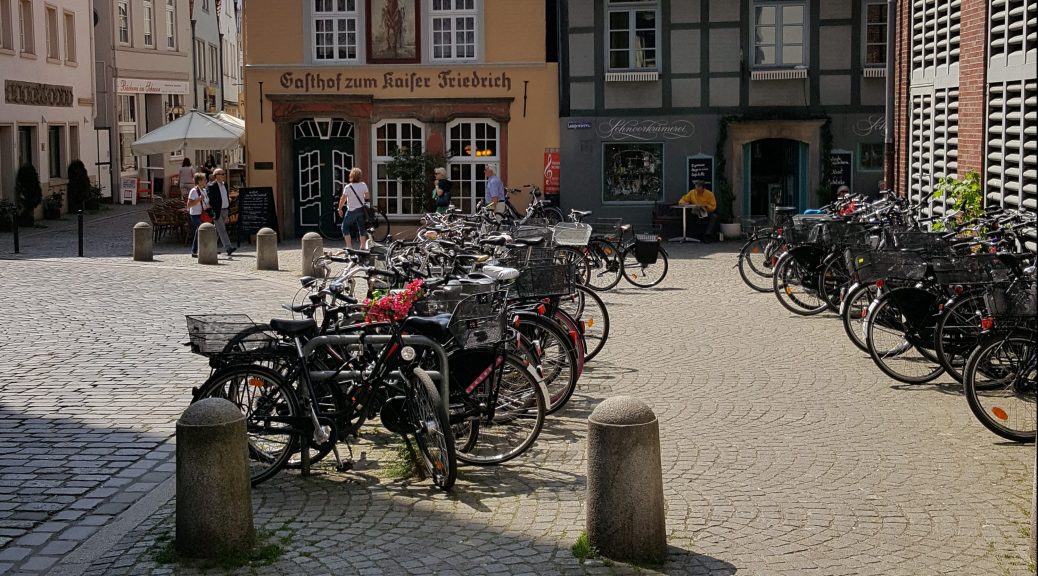
There are about 850,000 people in Amsterdam, and more than 1,000,000 bicycles. Bremen was rife with cyclists, as well. It took skill to discern what part of the sidewalk was for bikes and what part was for pedestrians. We saw families on bikes, babies in infant seats perched precariously between handle bars, and dogs in baskets attached to the front frame. People of all ages, even very old people, rode bikes to get places and go shopping. No one wore helmets.
We marveled at the freedom Bremen and Amsterdam parents gave their children. There were unsupervised children all over the place, riding to and from school and the shops, with no hovering adults to be seen. Daughter-in-law commented that she wished US children could have a similar lifestyle. I read somewhere that German parents encourage and expect a great deal of independence and self-sufficiency from their children, and that “free range” parenting is the norm there. Risk taking is thought to teach safety.
I am sure that there are bad people in Amsterdam and Bremen, and that bad things happen to children there, but no one seemed to let that change their behavior or restrict their children’s mobility. I told this to some of the more hovering parents I know, and they were appalled, yet curious. There is a dignity in risk.
Daughter and Husband planned the last half of our recent trip to Europe. Our trip ended in Dublin, where they booked us into a really swanky hotel called The Merrion. It is the sort of place where the Bell Captains wear top hats and the housekeepers lay out soft mats and bedroom slippers on either side of the bed when they do up the room. It was really grand.
We arrived in Dublin by ferry from Holyhead, Wales. The streets were really crowded and it was hard to find a taxi. We strolled around Trinity College and down Grafton Street and it was wall to wall people. We were told by the travel agent that we were lucky to find hotel rooms in Dublin the weekend we were there, as she was told by someone that there were lots of things going on in town. Those “things” turned out to be:
The Irish Open
Josh Groban in concert
A very important soccer match
Bruce Springsteen in concert Friday and Sunday evenings.
Everyone seemed to be talking about Bruce Springsteen. Nils Lofgren and Stevie Van Zandt were playing with him, and the newspapers had the whole play list for the concerts, which took place in a large outdoor arena that held 65,000 people. One taxi driver told us that there were 100,000 extra people in Dublin just for those concerts.
As we were checking into our hotel, I heard a man asking after a female guest who was “a member of the Springsteen party”, and I realized that Bruce was staying at The Merrion, too. That explained all the people with cameras milling around outside the hotel.
We never saw Bruce, but we heard about him from some delightfully gossipy taxi drivers. They confirmed that he was indeed at The Merrion, and gave us a running itinerary for him, letting us know that on Saturday morning he worked out in the gym around the corner from the hotel, and that on Sunday morning he went bowling.
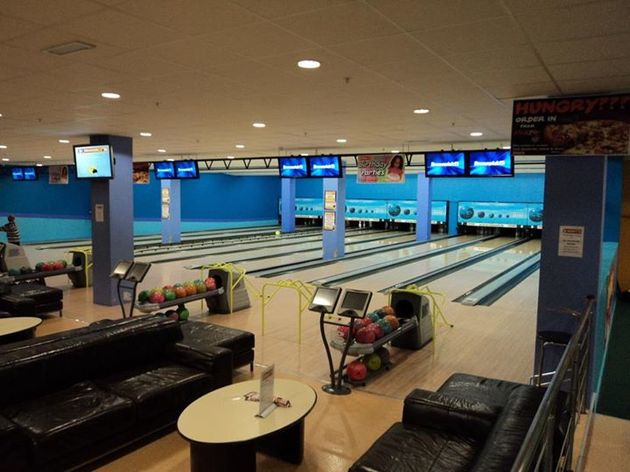
Bowling? Now, in all our time in Europe, I never saw a bowling alley. Did he go lawn bowling? Can you imagine Bruce Springsteen lawn bowling, upsetting the octogenarian bowlers in their white lawn bowling get ups? Why would he go bowling? Why not a short trip to the coast or to some castle, or a private view of the Book of Kells. Maybe he could have gone to church. If I were Bruce Springsteen, would I want to go bowling? I just don’t know.
When Chris from Owatonna announced on the Trail a couple of months ago that he had published his novel, I was thrilled – as a member of our blog community and as a reader. I couldn’t wait to get a copy and when Chris mentioned he was having a kick-off signing I asked for the afternoon off right away. tim and I both went down for the occasion.
It was a perfect day for a drive down to Perfect Day Cakes where Chris’ signing was held. The bakery was all set up, including a delicious-looking array of cupcakes and fancy doughnuts. Chris signed several books and then spoke a bit about how he got to today.
During fundraising for Big Brothers/Big Sisters, an organization he has volunteered with for many years, Chris used to write long letters describing his own experience and the progress of his Little Brother.
Many of the recipients of those letters commented on his writing ability and eventually several folks encouraged him to write a book. While he was writing he was also researching the independent publishing industry which has evolved greatly over the past decade. Now that he is published, he hasn’t forgotten how he got his inspiration. For every book that he sells, $1 goes to Big Brothers/Big Sisters; after he re-coups his hard costs, then he’ll raise that to $2 per book.
Castle Danger is a thriller with mystery, suspense and romance set in northern Minnesota during the height of blizzard season. Chris is thinking about re-visiting an earlier unpublished book that will be a pre-quel and then maybe a sequel to Castle Danger as well. Eventually he’d like to spread his wings a bit more and try some tween fiction as well.
I can’t wait to finish this blog piece so I can start reading my personal signed copy!
What author would you like to meet and get an autograph from?
I took three photography classes from August to December last year. In Digital Photography I, we spent several months learning such basics as exposure, depth of field, focal length, ISO, shutter speed and motion, and lens focal length. For our portfolio (final project), we had a lot more freedom than we did for our previous assignments. Our teacher gave us a list of 11 categories and we were to turn in 10 photos, one for each category minus one. Within these categories, it was totally up to us what we would shoot and how.
One cold day in November, I went out to shoot some pictures for an assignment in another class. I saw a pond, across the street from Cedar Lake, and stopped there. While setting up the tripod for the shots for that assignment, the pattern of the ice that was beginning to form at the edge of the pond caught my eye. So, I took a few shots of that, then went back to shooting for my assignment.
When I looked at my shots that evening, I saw that the shots I took at the pond for my assignment did not turn out well, but the pictures of the ice were pretty nice. But they didn’t work for any assignments in any of my classes, so I set them aside.
As time went on, I was having trouble getting all the shots I needed for my portfolio. I had 9 of the 10 shots, but everything I tried for the tenth one was not up to the standard I wanted for a final portfolio. So I asked the teacher if I could use Nature as one of my categories instead of his assigned categories… and he said yes. So, I picked one of the shots of the ice on the pond for my tenth shot.
Interestingly, when I got feedback from my teacher, the ice picture was one of his top three favorite pictures in my portfolio. And when we viewed the final portfolio pictures in class, that same picture received more favorable comments from the other students than any of my other pictures.
I find it intriguing that some of my best shots are taken when I’m looking for something else.
When have you had a happy accident?
These photos are 8 of the 10 portfolio shots I turned in for my class. I left out the two shots of people in order to protect the privacy of the subjects.
We are nine days out from our move to Winona, and they are coming fast and furious now – the Lasts. I have been to my last Board and Committee Meetings; Husband has been to his last Story Theater rehearsal. We have been to last practices for two choruses. Yesterday eve we hosted our last Annual Circle Dance Potluck in the back yard. Sniff.
It is a bittersweet time. It feels good to be relieved of some of these responsibilities, but saying good-bye to so many wonderful characters, who have been a regular part of our lives, is… hard. Been in this city for 31 years, and in this house for 27. We’ll be only 2½ hours away, and can come back to visit. But a visit is not involvement in the same way. We leave behind a rich set of experiences and people.
We’re into serious packing now, it’s really starting to look weird around here… that tripping over boxes stage. Still to come are things like packing up the Last Box, or removing the Last Piece of Furniture. Then in a couple of weeks we’ll come back to clean the Last Closet, wash the Last Window, and remove the Last Bits of Stuff.
What is a Last Time event or occurrence that you would welcome?


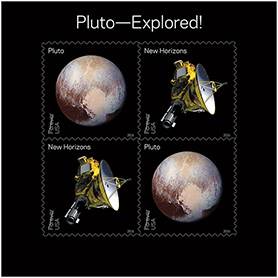 The clerk laughed and said “Wait, you’ll appreciate this” as he disappeared into the back. A minute later he returned with a four-stamp sheet with Pluto and the New Horizons spacecraft (the one that did the close flyby of Pluto recently). At this point I was laughing as well, knowing that I am clearly not the only one out there who is still mourning the loss of Pluto from our team of nine. Of course I had to buy a sheet of those as well. I’m not a stamp collector or saver but I might have to make an exception for the Pluto stamp!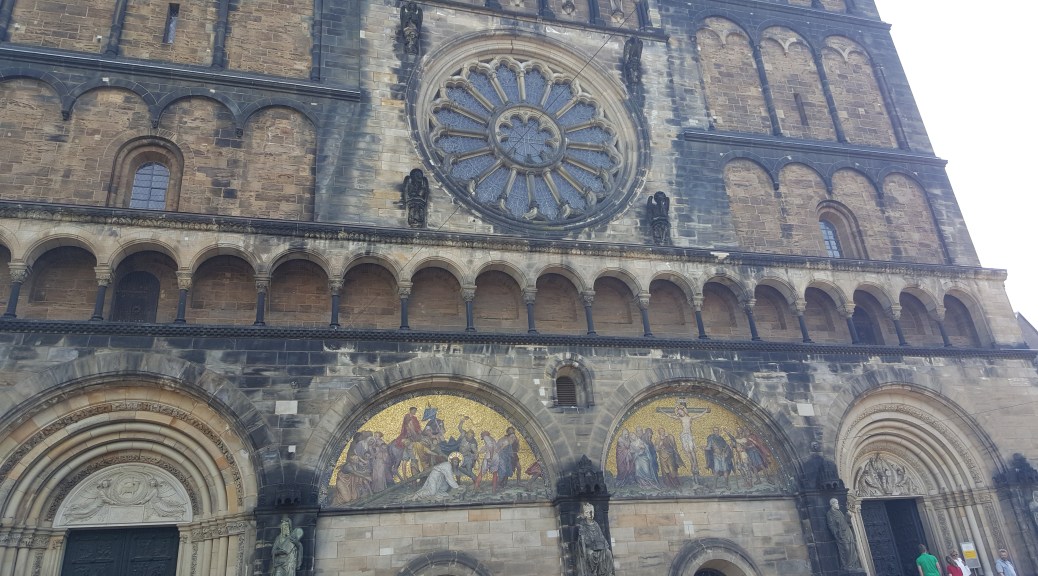







 Trail Baboon