Today’s guest post comes from Steve Grooms
n 1950 my family bought a console radio. Our Magnavox was a big cherrywood box. The vacuum tube radio had a backlit tuning dial. Also included was a record player and an empty box. The salesman pointed to the hole and said, “This is for television. One day you will buy a television to put here, and then you will never turn the radio on again.” Our family sometimes gathered in a circle around the radio to listen to the classics: Fibber McGee, Gunsmoke, the Great Gildersleeve, Burns and Allen and many others.
I was especially fond of radio dramas. Wearing my cowboy hat, I would sit cross-legged in front of the speakers, my cap gun at the ready. When my heroes–Hopalong Cassidy, the Lone Ranger, and Sergeant Preston of the Yukon—got in a tight spot, I was ready to add my gunfire to help them.
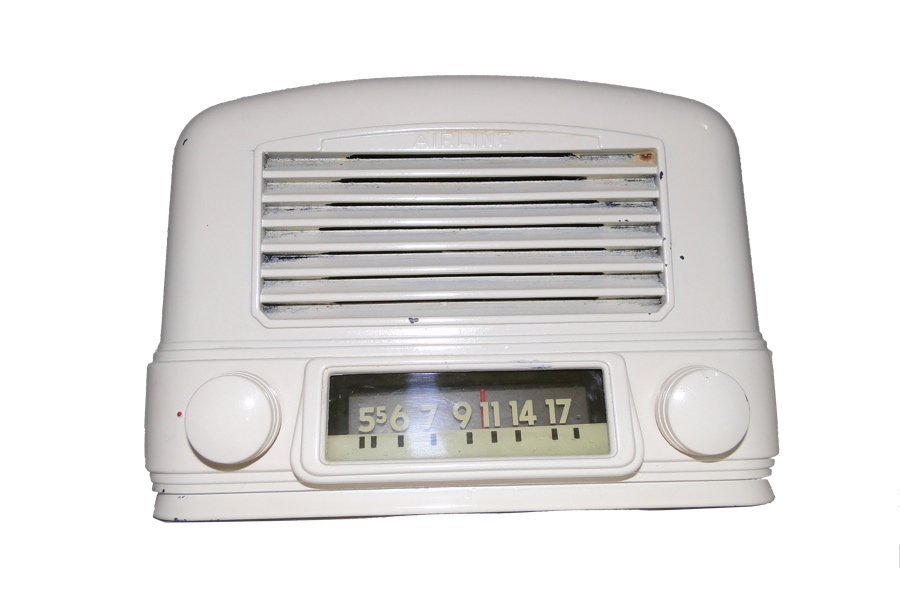
Later my parents bought a cream bakelite AM radio from the downtown “Monkey Wards” store. The Airline became my personal radio. I listened to it in bed when I was supposed to be asleep. One dark winter night when I was about fourteen I was shocked to hear Elvis Presley sing “Heartbreak Hotel.” That was a lonely, confused period of my life. The anguish in Elvis’s voice, amplified with all that reverb, proved that at least one other person on earth understood my turmoil.
The Airline became my magic carpet, taking me to strange and distant places. At night the world accessible by AM radio was thrilling, for then the “clear channel” radio stations could send signals to lands far away. I liked a jive-talking DJ in Louisiana who called himself Gatemouth. He was a Cajun version of Wolfman Jack, and he played an earthy type of r & b, artists like Howlin’ Wolf and Muddy Waters. This was my only escape from white bread Ames, Iowa. I later learned that a kid in northern Minnesota, Bobby Zimmerman, also lay in his bed at night listening to the same music.
Radio entered my life again in graduate school, once again at a desperately lonely moment. One station in Minneapolis played classical music in 1965. They published a monthly playlist. I pored over that schedule with a highlighter, marking the pieces I most badly wanted to hear. Sometimes I’d run home after classes to click on my radio and relax with great music.
Years later, early in my marriage, I read that a new station would broadcast classical music. When the first KSJN broadcast aired I was in my living room, fingers on the tuning dial, waiting for it. It could be tricky to find KSJN in the morning because the host, Garrison Keillor, was often silent for long spans of time. I later decided those long pauses were to let the host smoke.
Sometime in the early 1980s Garrison began talking to Tom Keith, the Morning Show’s
engineer. The banter between them was so witty and interesting that I concluded that “Jim Ed Poole” was just a voice Garrison could do (the way Steve Cannon voiced the characters of Ma Linger and Morgan Mundane).
In 1983 Dale Connelly joined Tom Keith to do the Morning Show. We would have several radios tuned to it so we could listen to the show while moving from room to room, showering, brushing teeth, and drinking coffee. The LGMS tunes and Dale’s witty skits were the soundtrack of our mornings. Birthdays and anniversaries were marked by requests that Dale and Tom never failed to honor.
By that time, the only set moment in our week was the broadcast of The Prairie Home Companion. Our lives were chaotic and unpredictable with the single exception of Saturday evening. I realized that our fidelity to the show brought us full circle back to the time when radio broadcasts were enjoyed by a family sitting around a living room radio. Molly used to fall asleep listening to Lake Wobegon monologues. In a real sense, Garrison, Dale and Tom were honorary members of our family, often present and always welcome.
Radio was central to life in our weird cabin on the shores of Lake Superior. We could hear five public radio stations there. My favorite was the student station at the U of M at Duluth. They played a superb mix of folk music Saturdays after PHC. I listened for hours while swinging in a hammock in the dark. Folk music would blend with the rhythmic sloshing of waves and the occasional bark of a fox calling from the bush.
Radio played a crucial role when my wife left. I processed the emotions of divorce by walking my dog with a Sony headset radio clamped on my ears. Spook and I walked two to five miles a day. We were an odd figure in the neighborhood. Spook pulled 30 pounds of logging chain, a way of giving him a good workout at low speeds. I followed him holding the leash and listening to KNOW while trying to make sense of my life.
When Katie, my sweet setter, entered my life, she and I walked once or twice a day. We almost always walked a long loop in the Minnehaha Off-Leash Park. Our path took us past the great spring that is the origin of Coldwater Creek, a spot the Sioux regarded the center of the universe. At the far end of our loop Katie was usually hot enough to want to wade into the Mississippi. I was usually alone for these walks, but I had Catherine Lanpher, Robert Siegel or the Car Guys for company.
Looking back over a lifetime with radio, I am impressed with how intimate and reassuring it has been. My life would surely have been far less rich if not for radio. Nobody ever made a sillier prediction than the salesman who told us, “One day you will put a television here, and then you’ll never turn on the radio again.”
What has radio meant in your life?









 Trail Baboon