
Today’s post is by Steve Grooms
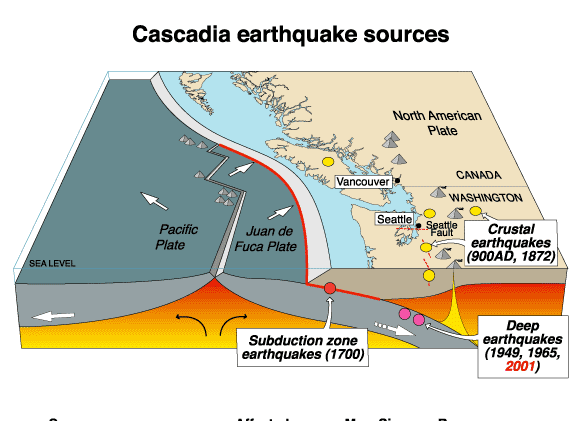
Something terrible is going to happen in the Great Northwest. The approaching danger has a pretty name: “Cascadia.” Cascadia refers to an earthquake that will devastate 700 miles of Pacific coastline from California to British Columbia. That quake will be followed by a massively lethal tsunami.
Here is a little Cascadia Q and A:
How sure can we be that a bad quake will hit here?
Scientists are absolutely sure of this prediction. Quakes registering 9.0 happen in this region about every 250 years. That pattern has persisted as far back in time as geology lets us see. The last big quake struck in the early 1700s, shortly before Europeans arrived. That means no quake has occurred while European settlers have been here, so people in this region have no memory of what a bad quake is like. After the next quake and tsunami, scientists say, the northwest coast will be “unrecognizable.”
When might this happen?
Scientists still cannot predict the timing of quakes with any specificity. They agree that the next quake is seriously overdue. One authority calculates there is a 40 percent chance that Cascadia will hit in the next 50 years. As I consider those odds I hear the gritty voice of Clint Eastwood asking, “Do ya feel lucky, punk?” “Nooooo, Clint! Nooooo, I don’t feel lucky at all!”
How bad will it be?
Seismologists expect a big quake, with Richter ratings close to 9.0. Cascadia will probably be a twin to the quake and tsunami that obliterated coastal areas of eastern Japan in 2011. That disaster tsunami killed about 16,000 people. FEMA planners anticipate at least 13,000 deaths as a result of Cascadia. When it happens, Cascadia will immediately become the worst natural disaster in the history of this country.
How prepared is Oregon?
Experts give Oregon a grade of F-plus. For example, of Portland’s eleven bridges, only two were built with quake-proof engineering. Because of publicity about the coming disaster, there is some hope that local government will begin addressing the region’s vulnerabilities. But the culture of this region is skeptical about government and collective action. Some leaders are campaigning hard for better preparation. So far, they have lost every battle to spend money now to save lives in the future.
The real issue isn’t what will happen to me in a Cascadia disaster. I’m an old guy with serious health issues. I won’t be living long in Oregon or anywhere else on this planet. It would be silly for me to panic about something I can’t prevent and which probably will not occur while I am here. And yet I believe everyone is responsible for planning sensibly for future crises, even those that seem unlikely to happen soon. My greatest concern is for my daughter’s family and for the region as a whole. My daughter’s home in southeast Portland is old. I doubt it can withstand the shaking of a quake, although it lies as bit beyond the reach of the expected tsunami.
My apartment sits near the top of a small mountain south and east of Portland. The soil under these buildings is solid. The elevation puts us safely above any possible tsunami. These apartment buildings were constructed in 2000. They had to conform to building codes reflecting a modern awareness of the threat of quakes.
If I survive the quake, my problems will just be beginning. Our electricity goes out when the wind blows. Quake survivors will have no power or telephone service for weeks after the quake. There will probably be no drinking water or (ugh!) functioning toilets. All banks and financial systems will be shattered. The local transportation system, already fragile and inadequate, will be in chaos. Highways will buckle, bridges will collapse and the tsunami will flood much of the coastal area with debris and corpses. Grocery stores and pharmacies will be looted within hours of the quake, with no chance for re-supply. Emergency vehicles will not be able to move on streets and highways. Any relief will have to come by helicopter. Most disaster relief will be focused on the areas hit most severely. Survivors will have to make do, somehow, for a period of two to six weeks.
Questions abound. For example, should I deplete my retirement fund to purchase six weeks worth of water? Where would I keep it? A sizable swimming pool lies a dozen steps from my apartment. Will it survive the shaking? Could residents drink that water? Who will establish and enforce order so neighbors don’t plunder each other’s goods?
I am more puzzled than panicked. Nothing in my lifetime has prepared me to respond to a threat like Cascadia. The event, when it comes, will be almost unimaginably tragic. And yet, although it is “overdue,” it might not come for several decades. My dilemma is figuring out how a thinking person can plan effectively for such an event, preparing for extreme chaos while keeping things in perspective. Surely there is a sensible middle ground position somewhere between irresponsible oblivion and total panic.
When I was a Minnesotan I knew it was always possible that a tornado could chew my home to pieces, but the odds against it were reassuring. Now, as I try to prepare for what is often called “the big one,” Minnesota winters suddenly don’t look as threatening as they once did!
How should Steve respond to the threat of Cascadia?



 Trail Baboon