Today’s guest post comes from Barbara in Robbinsdale.
The four of us (my sister and her son, Husband and moi) were on our own for five days in Paris.
We learned a lot about food and eating the Parisian way – picked up baguettes from the boulangeries (bread bakeries), croissants and other delicacies for our petit dejuener (breakfast) from patisseries (dessert bakeries), meats from boucheries, crepes and quiches from crèperies.
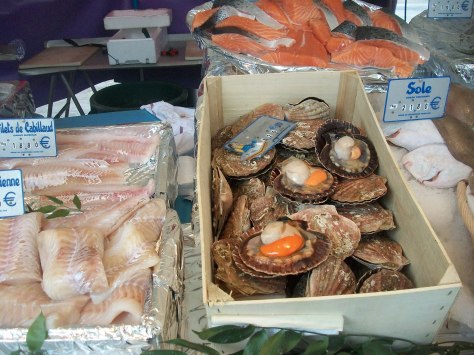
On our first day, however, we were lucky enough to come upon the neighborhood marché (market), which had on display all the spring (and other) vegetables you can imagine, plus sausages, fish, cheese, and our dinner – kabobs. Why I didn’t take more photos at the marché I don’t remember, but here is one.
And here’s how some of the bounty looked back at “our” flat (air.bnb, but that’s another story).
It was delicious, especially because it represented the success I had in asking the price.
Combien, s’il vous plait? (How much, please?)
Of course, the answer was spoken so quickly I couldn’t catch it, so I did what I had seen other tourists do – laid out my palm full of coins (there are 1- and 2- euro coins) and let him take what he needed. Then said “Merci.”
Christmas is not one of my favorite times of the year, Memories are loaded with emotional and physical loss – each of my parents died, I received divorce papers, old reminders of the difficult maneuvering after my parents separated and divorced and remarried. Then there was exhaustion after the long hours working in my father’s retail business wrapping presents, followed by a six hour drive to southern Minnesota to be with grandparents, my parents smoking and arguing what seems like the entire way.
But one Christmas I love to remember: the year I was in Switzerland.
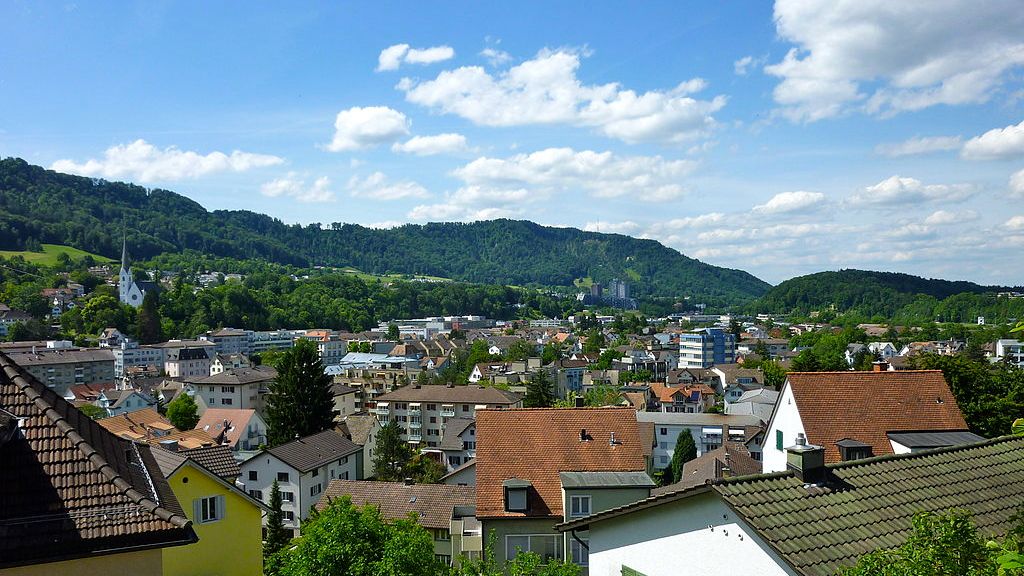
After my first year teaching I quit to travel in Europe. I ended up staying with a family in the small village of Adliswil just outside Zurich. They lived above their tearoom and bakery but also had a home up in the mountains near Einsedeln. The month leading up to Christmas they made candies — delicious Swiss chocolates, many with nummy hazel nut cream. (I thought they were called Moor’s Caps/Moorenkoppen, but I can’t find what I remember them being on the web…so memory being what it is…who knows what they were called.)
Not only did they put up with me, but they graciously allowed me to invite a college friend who was studying in England to join me for the holiday.
On Christmas Eve we drove up to their mountain home. The tree was decorated (did I help decorate it? I don’t remember) with real and lit candles. Interestingly my friend remembers many more details of the holiday than I do, but this we both remember: There was snow. In the evening, we walked somewhere I don’t recall and on our way up along the mountain road a man was riding a bicycle down the road yodeling. A perfect Swiss moment.
In the early 1970s, Robin and I and our friend Steve Carley drove to Calgary, Alberta for the Calgary Stampede. In truth, I was only vaguely interested in the rodeo. As it turned out, the rodeo wasn’t especially exciting; the problem was that the competitors were all excessively competent—every participant performed perfectly and the difference between them amounted to seconds or fractions of seconds.
The real reason I was in Calgary was because Wilf Carter was going to be in the pre-stampede parade. Wilf Carter, also known as Montana Slim, was one of the original singing cowboys. Carter was the first Canadian country music star. An unbelievable yodeler, Carter belonged to the ilk of Hank Snow, Jimmie Rodgers, and Gene Autry. Here’s a sample:
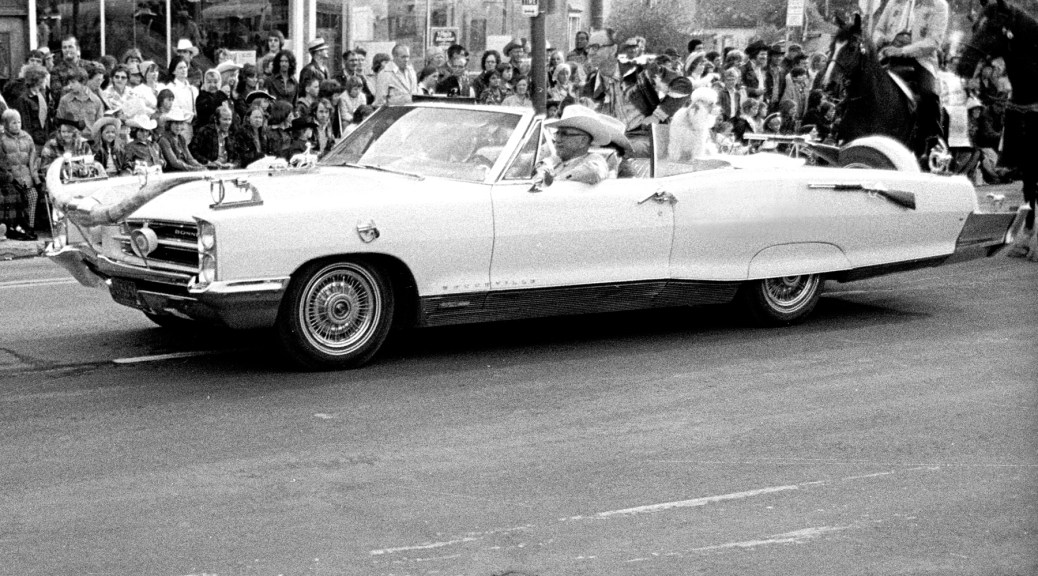
The Stampede was my chance to see him in person. He rode in the parade, in a convertible designed, I think, by the legendary Nudie Cohn. The header photo shows that car.
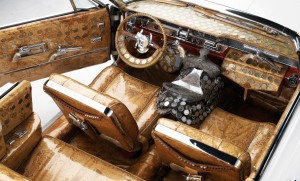
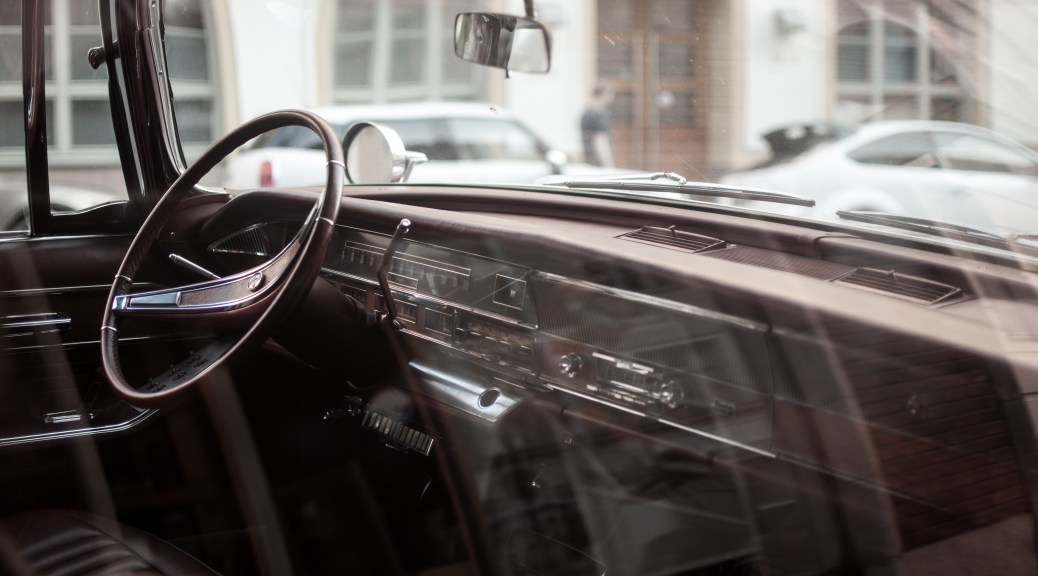
Nudie was a Ukrainian-born tailor who established himself making sequin-bedecked outfits for the likes of Elvis and Roy Rogers and later branched out to designing boots and even cars. Here’s what the interior of the car looked like:
I was going through my cowboy phase then. I was collecting and listening to a lot of early cowboy/country music. You couldn’t get a shirt in those days in the style of the classic movie cowboys, so I was making my own cowboy shirts, with fancy piped yokes and cuffs, curved slash pockets with arrowheads on the corners and pearl snaps. Sometimes the fabric was atypical— hawaiian prints, for instance.
I was never really interested in the actual business of ranching or horses.. What attracted me was the lore and milieu of the singing cowboys. The imagery of the likes of Tom Mix, Ken Maynard and William S. Hart. At the time I was working on a series of drawings I called my Patsy Montana drawings. They had nothing to do with the real Patsy Montana or her songs. She was my muse and the drawings were more along the line of “Even Cowgirls get the Blues”.
In downtown Minneapolis in the 70s and early 80s, on First Avenue, just north of Hennepin, on the second floor, there was a record shop called Pyramid Records. It was a big open space with waist-high benches around the perimeter, on top of which were boxes of records, many of them cutouts, all inexpensive, and chiefly old country recordings and vintage jazz. The proprietor sat in an overstuffed armchair in the center. He seldom made eye contact and never conversation. When you had made your selection, he would reluctantly accept your money. I’ve heard that he just disappeared one night, leaving his entire record stock behind. But he had some incredible, obscure records on offer, if you were in that market. There was a label out of West Germany, CMH, that had reissued classic early country music, including Wilf Carter, Hank Snow, the Carter Family and Goebel Reeves.
I bought them all.
Eventually I moved on from my cowboy phase, though I’ve never lost my interest in either the music or the imagery. I’ve overlaid them with newer fascinations but not many carry the pervasive richness that that long-ago cowboy fixation carried for me.
I can’t judge the extent to which I am deaf to the popular culture and the extent to which I am willfully contrarian. Some of both no doubt. But those are traits I also savor in others. What interests me, what I look for, are the obsessions people nurture that aren’t delivered to them as a readily consumable commodity— obsessions that call for research, diligence, craft and expertise. It could be an art, in the broadest sense, or it could be a collection. It scarcely matters how arcane, how peculiar the obsession might be. After all, the more elusive the interest, the more dedication it requires. And the more dedication it requires, the more it can be uniquely yours.
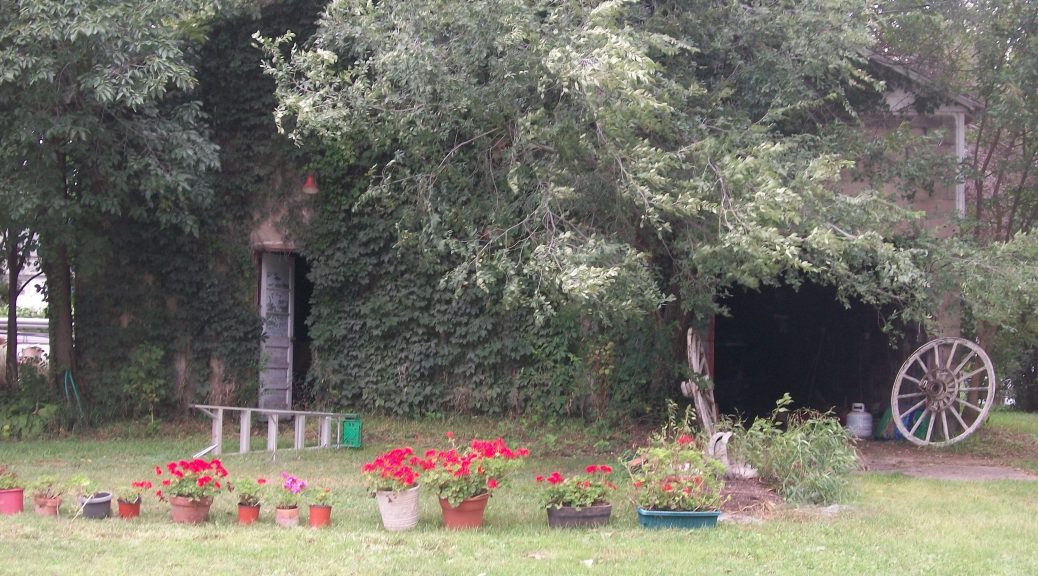
For several years after my dad died, I traveled almost monthly from Minneapolis to Marshalltown, IA, to visit my mom, before she moved up to Minnesota. It didn’t take me long to get tired of the straightforward I-35 à I-30 route; and besides, 35 veered east and took me slightly out of my way. I got out the maps and found a number of “back roads” which, although they didn’t necessarily save me time (since the speed limit is 55 instead or 70), took me more directly south and gave me some different scenery. I got in the habit of giving myself extra road time, because I liked to stop at whatever caught my eye – i.e., the photo at top is in tiny Austinville, IA, north of Marshalltown. There were parks in towns like Hampton that made nice rest stops, and I learned which towns had a decent coffee shop.
Minnesota has great back roads, too – for the numerous trips between Mpls and Winona that we’ve taken this year, we often use the alternate Hwy. 50 north of Red Wing to catch 52, instead of taking Hwy. 61 through Hastings, and this takes us right by a lovely old “garage” in New Trier. Heading south from Winona to catch 90, a short detour into Pickwick yields a view of the old Pickwick Mill.
On our recent trip to Marshalltown from Winona, we could have followed I-90 to I-35 to I-30, but we jumped off 90 at Austin, MN, and head south on 218. This was a little dicey because of the unusual amount of rain that the driftless area (NE Iowa, SE Minn, et al) has seen this month. Indeed, we drove into Charles City and made it over the roiling Cedar River, but were lucky to be leaving 218 and turning west – the road east was under water and barricaded. Here’s a video of this same spot back in 2008, when there was even worse flooding.
On the way back to Winona we decided to try another route, through Nashua IA where resides the Little Brown Church in the Vale – my folks got married there 70 years ago.
We crossed the Cedar River again, still roiling but not flooding our path. The little church was open for visitors, and as I signed the guest book I was astonished to see that the name above mine was a college friend – I looked up and there she was waiting for me to realize we’d crossed paths!
When have you had a memorable experience while traveling the back roads?
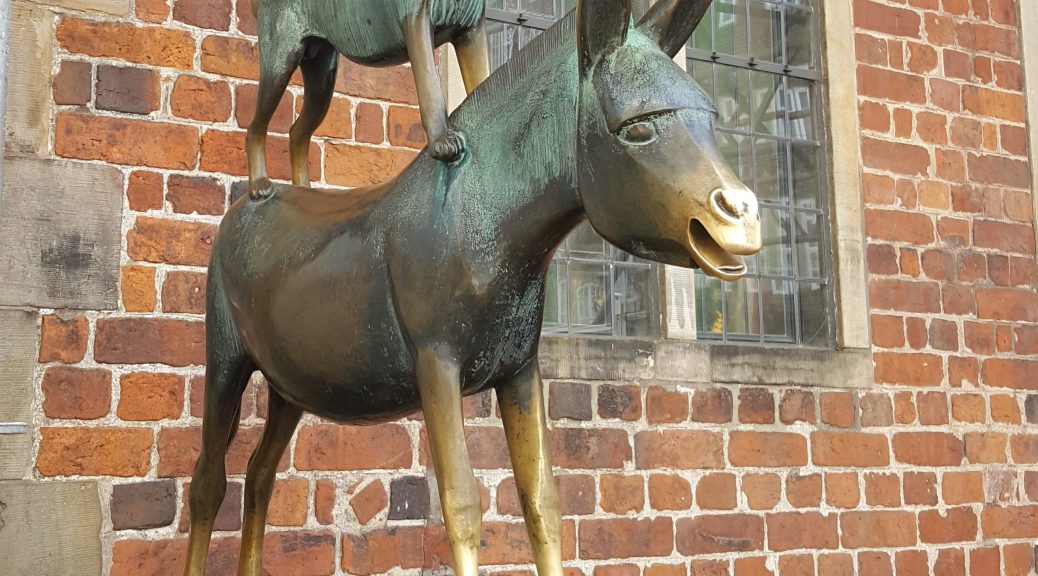
The brothers Grimm wrote many fairy tales set in Niedersachsen, the northern part of Germany where my mother’s family came from. There is a complete travel itinerary from Hannover up to the coast where you can see the settings for many of the stories. It is called The Fairy Tale Road. The stories are not, by and large, comforting, but are, I think, important pieces of literature. I suppose that because my family is so closely associated with Bremen I always was drawn to the story of the Bremen Town Musicians. I remember reading the story in the set of Child Craft books my mother got for me in the mid-1960’s, complete with the picture of the statue in Bremen’s main square. I was really excited to see that statue on our May trip. Both my son and daughter in law were familiar with the story, and they were excited to see the statue, too.
Imagine my dismay when I printed out some travel photos and showed my coworkers the photo of the donkey, dog, cat, and rooster, all making a clamor to scare the thieves away from the farm house, and very few people had ever heard of the story! I could understand why many of our American Indian friends didn’t know the story. They felt so sorry for the animals being neglected and discarded by their owners. Perhaps I am naive, but I thought most Americans my age with any sort of education would know of the Bremen Town Musicians. After all, 46% of North Dakotans claim German heritage. Well, I was wrong.
I rubbed the donkey’s nose after I took the photo in the square, grateful for my parents’ enriching my life with literature. After the dismal recognition rate from my coworkers, I vowed that any grandchildren I may have will know this story.
What stories do you think are essential for children to hear and read?
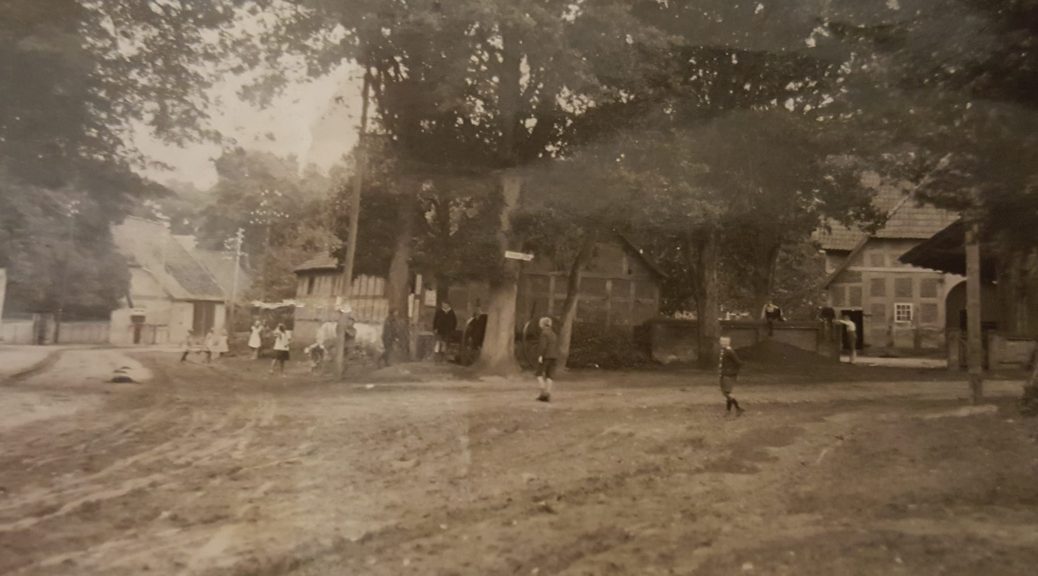
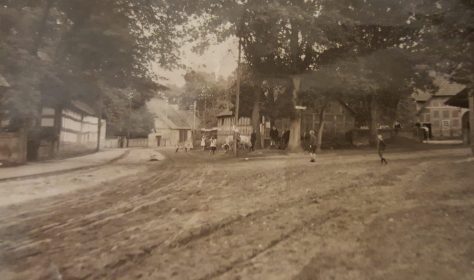
I have an old photograph of a German village street from the early 1900’s. I was given the photograph by my maternal grandmother, who wrote on the back “The only street in Grandpa’s birthplace which is on Dead End under trees”. The Grandpa she refers to is her husband, my Grandfather Ernst Bartels. I wonder where she got her information, as she never stepped foot in the place. I can hear her saying the words about the village with some derision in her voice. She was a city girl from Hamburg who met my grandfather after she immigrated to the US. She found him impossibly rustic and dull. She always felt somewhat superior to him and his family. She spoke formal German; the Bartels all spoke Plattdeutsch.
The photo always puzzled me because it seemed to be a photo of nothing. It shows a wide, muddy street with trees in the background, and behind the trees, barely discernible, a large, half-timbered house. The photo is of poor quality and is a little blurry. I never really noticed the house behind the trees before our trip to Germany. Now that I have stood on the street in the photo and was lucky enough to go inside the house, the photo is completely understandable.
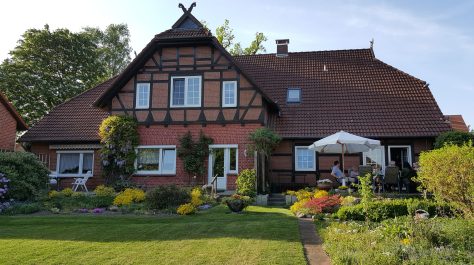
My grandfather and all his siblings were born in that house. I never heard anyone in the family speak the name of the village. I had always heard that my grandfather was born in Bremen. My mother said she thought he was born in Bremerhaven. I know now that the name of the village is Neddenaverbergen. It is about 50 miles south of Bremen, and with the help of my mother’s cousin Elmer, I contacted family who still live there, and they invited us to visit them.
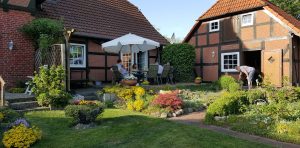
Neddenaverbergen is a small farming community of around 700 people. It is quiet and very tidy. There are lots of flower and vegetable gardens. Oma was wrong. There are several streets in the village. All the farmers live in the village. The farmland surrounds the village on all sides. Almost all the farm buildings are in the village as well, except for the modern buildings that house large machinery or livestock. The houses are old, and are built in the style in which the barn was attached to the house. All the houses and outbuildings are very close together, so that one neighbor’s house/barn is right next to another neighbor’s house/barn. The houses are half-timbered and made of brick. There are far fewer farmers now, and many of the residents commute to jobs in Bremen or Verden.
My grandfather was one of eight children. He was the second oldest. My great-grandfather died when Grandpa was about 17. In the old German tradition, Grandpa’s oldest brother, Johan, inherited the farm. The rest of the family, including my great-grandmother, got nothing. Several of my grandpa’s siblings were still quite young, so, in 1910, he and his brother, Otto, immigrated to southwest Minnesota where their mother had family. The boys got farms and earned enough money to bring their mother and siblings to the US before the First World War.
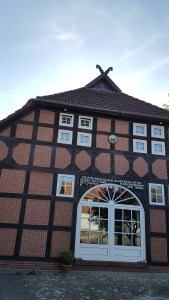
Johan and his family survived both World Wars. His grandson, Peter, still owns the family home. He had no interest in farming and rents the land. The house was built in 1673 by an ancestor, also named Johan . Peter converted the part that was the barn into a family room. We got a tour of the house. I loved seeing the place that my grandfather was born and where he undoubtedly milked cows. The beams that were visible in the barn/family room were thick and very solid. The inscription over the door in the blog photo says something to the effect “I Johan, have built this house for my family and I have done my best and I hope that it serves them well”.
I look at the old photograph now and it all comes into focus. I see the house. I know how the street goes right past the house, and I recognize one of the trees, now much larger. In my mind I can imagine it in color. I think of Neddenaverbergen as my village. I want to go back.
How has visiting a place changed the way you see it?
I think one of the most fun things about traveling is finding interesting hotels and lodging to stay in. We had really good luck with our lodging for our recent Europe trip. All the places were unique and had interesting and unexpected features. I mentioned the Merrion Hotel in Dublin in a previous post about Bruce Springsteen. Here is some information about some other hotels we stayed at.
In Bremen we stayed at the Design Hotel Uberfluss. I love the name. (It was hard to find a place in Bremen the week we were there due to an international conference on the medical management of open wounds. Just what I would want to learn about!) The Uberfluss is situated along the Weser River in central Bremen near the old city. It is ultramodern and decorated in white and black with funky looking light fixtures. The rooms have enormous windows that open like French Doors if you turn the handle one way, and tilt open from the top if you turn the handle the other way. During construction they discovered a section of the original town wall of Bremen, circa 1300, and preserved it in the basement. Artifacts like medieval shoes and jewelry, also excavated by the wall, are on display in the lobby. I found that fascinating.
We were in another, similar hotel called the Varsity, in Cambridge, England. It was located on the River Cam, and we could see people in punts with poles on the river. It was very peaceful.
Glasgow brought us to a lovely restored Georgian town house called the Glasgow 15 Bed and Breakfast. It was beautiful and more like a hotel than a B and B. The breakfasts were huge. Two doors down was a plaque on a house where Sir Joseph Lister, the father of antiseptic surgery and the namesake of Listerine, lived and did research. Glasgow was full of memorials to scientists. Kelvin, he of the Kelvin Scale of temperature, has many statues and things named for him.
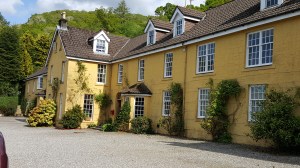
In Scotland’s western highlands we stayed in a very old hotel 6 miles out in the country near Oban. It was called the Knipoch Argyle. In 1592 a Campbell, then the Thane of Cawdor, was brutally murdered in the dining room. We had a great meal there.
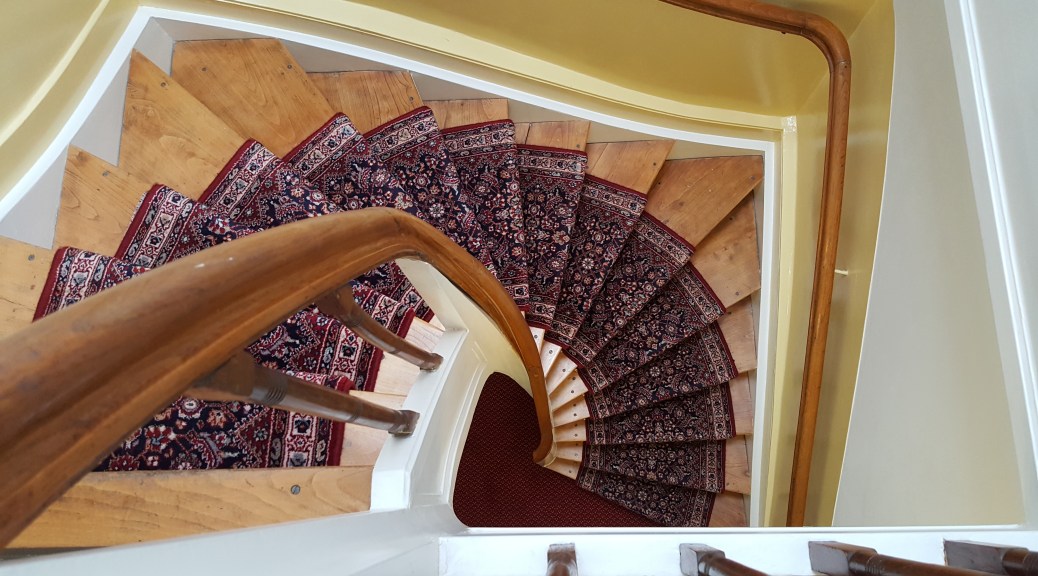
The Wiechmann Hotel in Amsterdam was probably the quirkiest place we stayed. It is in a narrow, three-story, 19th century building on the Prinsengracht Canal a couple of blocks from the Anne Frank house. Our room was on the top floor. There were 46 narrow and winding steps to our room, and no elevator. Those stairs were killers, and once I got downstairs I didn’t want to go back upstairs. There was a large German Shepherd who slept near the front desk. On the wall behind the front desk was a gold record, a gift to the owner from Emmylou Harris. It is the gold record she received for her second album, Elite Hotel. I guess she stayed at the Wiechmann and really liked it. Johnny Rotten and the Sex Pistols also stayed there too, but I can’t think what they would have brought the owner except mayhem.
What is the most memorable hotel you’ve stayed in?
Husband and I have vastly different ways of processing information. I scan my environment accurately but hastily, taking in only what is pertinent and ignoring the rest. In Rorschach Inkblot terms, it means I have tendencies toward underincorporation, and I may fail to notice something important.
Husband, on the other hand, readily admits he is a super overincorporator. That means he tries to take in all the details he sees without regard to importance. It is as fraught with error as underincorporation, as a person can only process so much information before becoming overwhelmed.
We went to several museums on our recent vacation, including the Rijksmuseum, the British Museum, London’s National Portrait Gallery, Westminster Abbey, the Kelvingrove Museum in Glasgow, and Trinity College Library to see the Book of Kells. Westminster Abbey is a place of worship, but I think of it as a museum as well.
The practical implication of our differing information processing styles meant that by the time we finished with our first museum, I felt great sympathy and kinship with the woman I wrote about earlier who killed her husband with a blow to the head with an ornamental stone frog.
I flit through museum rooms, not concerned about seeing everything but zeroing in on what catches my eye, or what I had planned to see, then moving on. I always plan to come back another time, on another trip, to see what I may have missed, to take in more details of what I saw before, and maybe see something new. I want to relish what I see without cluttering my mind or my emotions. I find museums profoundly moving. Husband tries to see every exhibit, to read every placard, to not miss a thing. He hates being rushed. This was really a problem in Westminster Abbey, as we had to stop and read every blessed memorial and grave stone in wall and floor. He even tried moving some of the folding chairs that had been placed in Poets’ Corner to make sure he didn’t miss anybody. He certainly is thorough.
I am happy to say we made it through trip and museum without any bloodshed. In Husband’s defense, he had never been to any of the museums we visited, and maybe that overincorporation tendency thrives with the unknown. We started to plan our next trip that may take place in the next few years, and I will try to work on my impatience and maybe suggest to him a more selective approach to museum viewing.
We shall see.
When it comes to incorporation, do you over or under do it?
Daughter and Husband planned the last half of our recent trip to Europe. Our trip ended in Dublin, where they booked us into a really swanky hotel called The Merrion. It is the sort of place where the Bell Captains wear top hats and the housekeepers lay out soft mats and bedroom slippers on either side of the bed when they do up the room. It was really grand.
We arrived in Dublin by ferry from Holyhead, Wales. The streets were really crowded and it was hard to find a taxi. We strolled around Trinity College and down Grafton Street and it was wall to wall people. We were told by the travel agent that we were lucky to find hotel rooms in Dublin the weekend we were there, as she was told by someone that there were lots of things going on in town. Those “things” turned out to be:
The Irish Open
Josh Groban in concert
A very important soccer match
Bruce Springsteen in concert Friday and Sunday evenings.
Everyone seemed to be talking about Bruce Springsteen. Nils Lofgren and Stevie Van Zandt were playing with him, and the newspapers had the whole play list for the concerts, which took place in a large outdoor arena that held 65,000 people. One taxi driver told us that there were 100,000 extra people in Dublin just for those concerts.
As we were checking into our hotel, I heard a man asking after a female guest who was “a member of the Springsteen party”, and I realized that Bruce was staying at The Merrion, too. That explained all the people with cameras milling around outside the hotel.
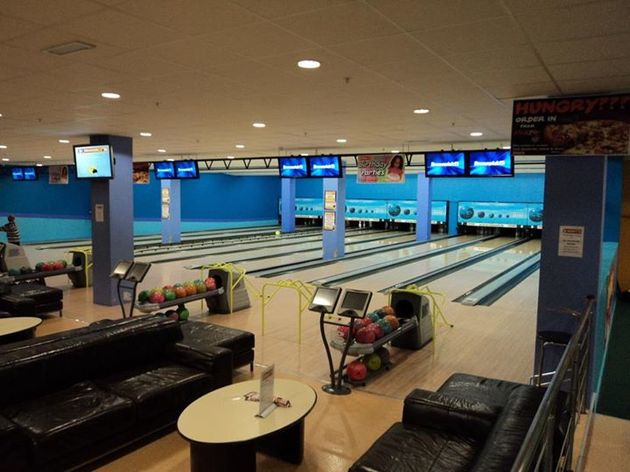
We never saw Bruce, but we heard about him from some delightfully gossipy taxi drivers. They confirmed that he was indeed at The Merrion, and gave us a running itinerary for him, letting us know that on Saturday morning he worked out in the gym around the corner from the hotel, and that on Sunday morning he went bowling.
Bowling? Now, in all our time in Europe, I never saw a bowling alley. Did he go lawn bowling? Can you imagine Bruce Springsteen lawn bowling, upsetting the octogenarian bowlers in their white lawn bowling get ups? Why would he go bowling? Why not a short trip to the coast or to some castle, or a private view of the Book of Kells. Maybe he could have gone to church. If I were Bruce Springsteen, would I want to go bowling? I just don’t know.
I was thrilled to hear this when it was first in the news, although careful attention revealed that it’s just the testing of the cars that became legal. We still have a way to go before self-driving cars will be chauffeuring our kids to their ballet lessons and baseball games without us.
Where roadways are concerned, I am the most directionally-challenged person I know. A friend of mine loves to tell the tale of the time I got lost in a church parking lot. In my defense it was dark when we came out from the concert and the parking lot had quite a bit of one-way directional signage. It’s always been this way for me, but the advent of MapBlast and GoogleMaps seems to have made it worse the last few years, as if having the printed paper in my hand somehow eggs on the traffic/street sign gods.
I keep a 3-ring binder in my breakfast room with printed directions to most of the places in my life. I grab the sheets out of the binder when I need them and put them back at the end of the trip. Some of these directions are not used anymore; I have finally memorized how to get to the Teenager’s pediatrician and it got too dangerous for my pocketbook (& my waistline) to go to St. Agnes Bakery once a month. Some of them were used once and have never been used again, like the gym in Big Lake where there was a gymnastics meet 3 years ago. I’ve added quite a few pages in the last couple of years: BiR, BiB, tim, Jacque & Lew, Steve, Caroline. Many of the sheets have been spindled and mutilated from repeated trips in the car; some of them have coffee stains. I even added alphabet tabs to the binder last year to make it easier to find the directions I want.
I expect that I’ll have this disability the rest of my life. I just hope that self-driving cars will come with GPS!
Where do you want your self-driving car to take you?





 Trail Baboon