Category Archives: Travel

Coming Soon To A Parking Lot Near You

The ideas-unconstrained-by-reality people are busy imagining the future in a world of self-driving cars. After all, the technicians need to know what to build, and the technology is moving forward at an amazing clip.

People at the design firm IDEO came up with three possible expressions of autonomous car technology.

Pretty impressive, and they even gave one of the vehicles a friendly-sounding name.

But why not name them all?

And while you’re at it, leave a few brain cells unoccupied to do the important work of imagining the worst that could happen.

Notion #1 is Marge, a family car that looks at your e-mail and your calendar and already knows where you want to go when you get into it.

How could this fail? A car with access to your e-mail might know where you ought to go and where you’re supposed to be, but one that looks at your Internet browsing history may fully understand where you’d rather be instead. When you get in your autonomous car you might not know who’s driving – is it your Id or your Super-Ego?

I guess we’ll find out when we get there.

Notion #2 is Cody, a delivery truck that is a nimble, see-through tube reminiscent of the Oscar Meyer Weinermobile, except it knows where you are and what you want. Combined with Amazon’s purchase-prediction software, these babies may be orbiting your neighborhood already stocked with what the algorithm says you are going to order.

How could this fail? Salespeople will ruin this for everybody by flooding neighborhoods with delivery vehicles that are cruising advertisements for the stuff inside. Imagine the narrow snowy streets of December clogged with gift-laden vehicles, each one jockeying to catch your eye.

Notion #3 is Dante’, a roving work station that is your portable office. Let it take you and your co-workers anywhere – for inspiration or collaboration.

How could this fail? Fights over the beach vs. the scenic overlook vs. the blank downtown brickscape where I can concentrate on this damn report I have to finish! Could we turn the office around so I can have the sun coming in on MY side for once? Do we really have to co-work with them in OUR parking lot today? Why don’t they ever invite us over to their place? Is there something wrong with it?

So many idea clouds, so many gun-metal gray linings. And there are so many notions the IDEO people didn’t suggest …

Notion #4 – is Sherlock, an autonomous chase vehicle that will follow you on that blind date you dread, and provide you with a quick getaway if it’s as awful as you fear it will be.

How could this fail? Hey, it looks like someone is following us. Hang on! My last girlfriend said I’m almost good enough to be a Hollywood stunt driver!

Notion #5 – is Budge, a Parking Space Holder. If we’re going to the Ordway Saturday night I’ll send Budge over there around 4pm to orbit Rice Park looking for one of those handy metered street parking spots to open up when the matinee crowd leaves. Twenty minutes before the curtain rises we’ll head over there in the second car (“Diva”) to trade places and claim our spot while Budge ambles home.

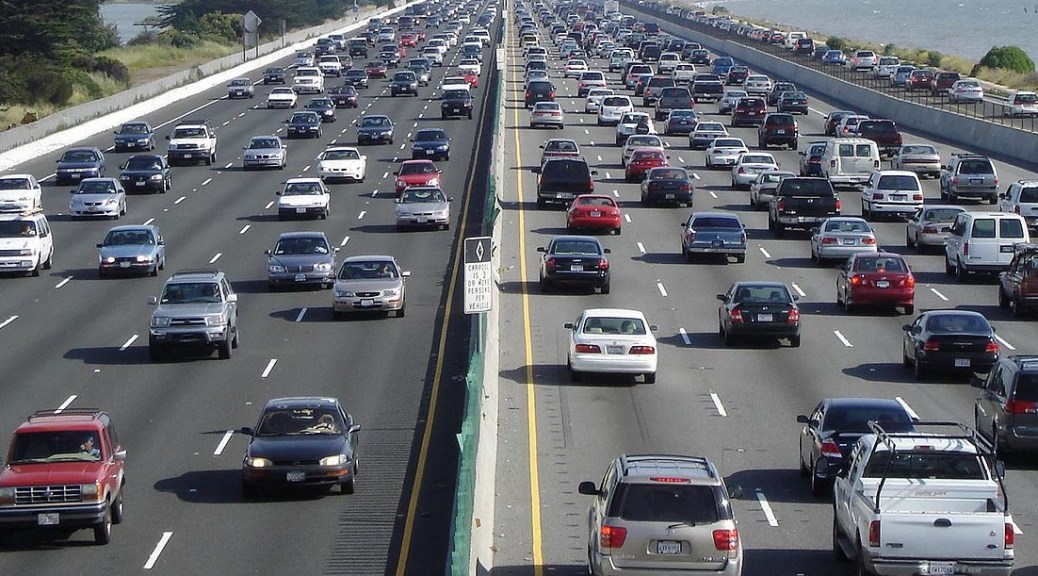
Notion #6 – is Flash Fleet, not a single autonomous car but rather a bit of software developed by highway hackers to commandeer large numbers of autonomous vehicles to “flood the zone”, creating targeted slowdowns and traffic jams at pre-arranged times in carefully selected places. The goal – anarchy.

How could this fail? Actually, this one is a no-brainer. It’s definitely going to happen, and it will be a terrific headache.

What else could happen?

Happy B’Day, Subway

Today is the 110th anniversary of the opening of the first underground segment of the New York City Subway System.

Whenever I go to Manhattan, the subway is how I get around. I think I’ve only been in a New York cab once. Everything about the taxi experience was troubling and question-producing. Will we get where we’re going? What will it cost? Does this driver really have a license? Are we going to die?

Compared to that, the subway is a paragon of predictability. The noise, the crowds, the graffiti and the unsavory smells of the underground train are exactly what I expect to find there, and because I’ve anticipated them, they are nothing more than minor inconveniences. And apparently I’m not alone. The NYC Subway system is setting ridership records. On six separate days in September, more than six million people used the subway.

NY_Subway_1904

You can see in this image from 1904 that the NYC Subway had a fresh look at the beginning. It makes me think of a Disney World ride – clean, attractive and harmless. I expect to see a jolly little choo-choo come puffing around that bend any moment, brimming with charming characters. But of course there is no connection – the Disney rides were built on the popularity of a cartoon mouse, while the NYC Subway system has the Norway Rat as its totem animal.

Those rats were tested recently. Researchers at Columbia University found that the subway rats carry around disease-causing bacteria, viruses, and single-celled organisms in amazing numbers, much in the same way subway cars carry all different types of unsavory humans around. There were 30 viral species, including a 18 viruses that were previously unknown to man.

Among the many rat-borne delights – the Seoul Hantavirus, which causes an Ebola-like hemorrhagic fever.

And yet – next time I go to New York, I will take the subway as my first transportation choice. Yes, there are risks, but a prudent traveler can manage these ordinary hazards with a few simple rules.

  • Don’t put your feet on the seats.
  • One seat per customer.
  • Don’t make eye contact.
  • Don’t lick any surfaces.
  • Don’t make eye contact with,  or lick,  any Norway Rats.
  • Enjoy your ride!

What’s your favorite mode of transport?

View Point Ahead

Today’s guest post comes from Barbara in Robbinsdale.

One of the reasons I like to travel – especially when it’s “over the surface” of the country by car or train, is that I always come home with a slightly different perspective on my life.

Being in touch with all that space just gives one pause, and last month’s road trip to Utah is no exception. The highway (I-70) that we drove through Colorado’s Rocky Mountains was lined with aspens that look like yellow flames in the dark evergreen forests.

In southern Utah, one canyon made you think you’re in a cathedral, and the second must have been dropped there from another planet.

We noticed all kinds of little differences between there and home – names like Grizzly Creek and Hanging Lake; towns called Eagle, Leadville, Rifle, Yellowcat. Road signs warned of “Falling Rocks” or “Avalanche Area”.

And sure enough, several times along Utah’s scenic Highway 12, we slowed for small groups of cattle grazing in the ditch.

My favorite road sign, “View Point Ahead”, echoed my mood.

I am prepared to come home from any journey with a change in point of view – I look forward to it. This time I’ve arrived with shifted priorities, ready to explore what I can and cannot do with my life.

When have you known a change was coming?

Our Home in Paradise

Image: (Nature video)

One of the pipe dreams I occasionally entertain is that I have found a way to live on a Hawaiian island. And since this is a complete fantasy I make certain my island home is situated at the end of a long dirt road and that it sits on a rocky outcropping, surrounded by a merrily sloshing surf and whales that salute me with blowhole water jets as they swim past.

It’s a lovely, impossible scene.

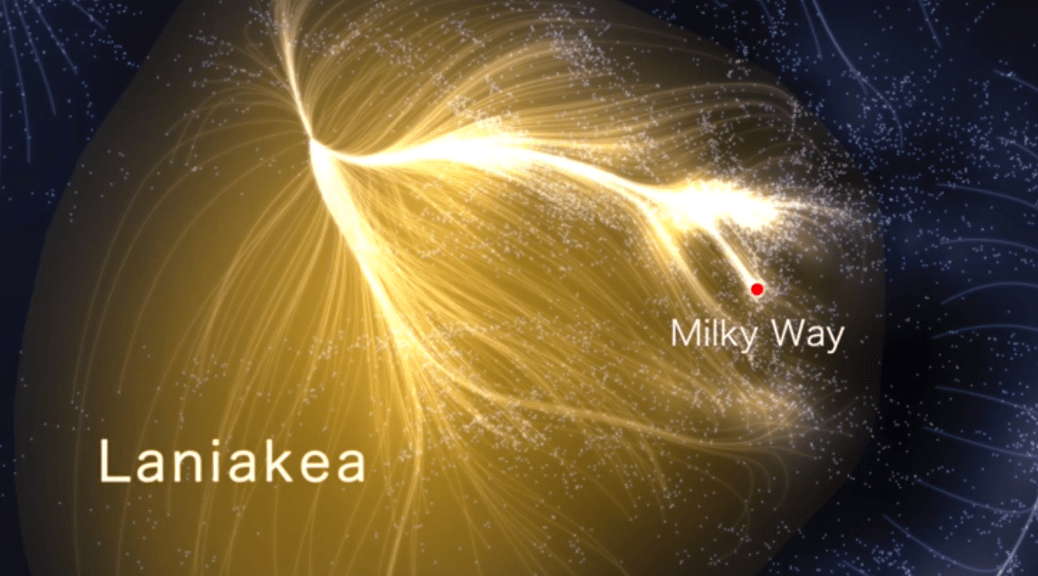
But now with the publication of new research we discover that our actual planetary home in the Milky Way is on the outer edge of a vast collection of galaxies that connect through gravity as a supercluster now called Laniakea, which means “Immeasurable Heaven.”

Finally, a Hawaiian name I can add to my address.

It is coastal property, sort of. But rather than overlooking the water we are one with the current, flowing with neighboring galaxies in a long, thin line towards “a gravitational dense basin of galaxies known as the Great Attractor.”

I’m somehow comforted by the knowledge that everything here is being pulled towards The Great Attractor. It explains so much about our behavior. And I’m glad it’s a GREAT attractor that’s dragging us along and not some dumb little diversion that leads absolutely nowhere.

So three months from now, when icy pellets are flying past your window and the temperature is -20, remember that none of this can change the fact that you live on the edge of Laniakea.

Where is the most beautiful place you’ve lived?

On The Road, Again

In the past on this page we have discussed where we are from and where we’ve lived. Baboons can be both wanderers and stay-at-homes. It can be a surprisingly tough mental exercise to walk back through your biography to list the places you’ve lived in the proper sequence, and for how long at each stop.

Likewise, each state of the union has a specific history of who happens to live there and from whence they came. Only demographers and other numbers geeks can find much enjoyment in looking over the columns of figures that tell those stories.

For the rest of us the info-graphics experts at the New York Times have developed 50 fascinating charts that display the data as strata – a cross section cut from each state’s census showing the last century’s changes in where residents were born.

Some of the curious things that appear:

Based on your personal history, you can get a sense for how common (or uncommon) you are in your current environment when birthplace is the sole yardstick. Back in the 1970’s I was part of a sliver (3%) of Illinoisans born in the Northeast. Now in Minnesota, my kind are still a rarity at a mere 2%. Rare as hen’s teeth. Precious as gold.

Sometimes we have to go out of our way to feel special.

After looking at this I’m left with the impression that people accumulate in specific places based on a variety of economic forces that drive them there. Because certain individuals may be rooted in place while others are entirely footloose, there is a variable and distinct human geology that defines each state.

Or maybe it’s just the wind.

http://youtu.be/UiirdzeXsOM

Where are you headed?  

Barge Traffic

Last fall we were enthralled by the news that Google had floated two mysterious barges on the east and west coasts of the United States, for what purpose the fevered minds of conspiracy theorists everywhere could only guess.

And there were many guesses. The least exciting ones had to do with the barges being mobile showrooms for Google’s “Glass” product – basically a head-mounted computer that projects a screen image on the lens of a pair of glasses. It is a device so extremely powerful, it can make anyone, even some of the world’s most gorgeous models, look like a complete dork.

But Google being Google, it has incredible resources at its disposal and no shortage of imagination, therefore there is no limit to what secret purpose the barges might be hiding.

One of my favorite guesses came from tim during a discussion of this issue on Trail Baboon’s companion blog, The Baboondocks.

Screen Shot 2014-08-03 at 1.51.30 PM

To this I say “Yes”. Clearly tim had already been in the transporter and his head had been turned (possibly all the way around) by the mind-scrambling potential of this secret, barge-borne technology.

And it makes sense that the labs would be floating in San Francisco Bay and off the coast of Maine – this was Google’s way to create safe, mobile and discreet places to work on a device that teleports items (and someday, people) from coast to coast, or planet to planet.

They are safe because barges are islands that can be detached from shore to discourage intruders and curious, snoopy competitors. Mobile so the technology can be moved to a better location if reception is weak. And discreet so the horrible disfiguring, non-survivable teleporter accidents that are bound to occur can be quietly dumped into the sea.

It all makes a weird kind of Google-ish sense.

But now we will have to re-imagine what Google is up to, because the company has started to sell off its mysterious barges.

Or at least the barge in Maine has been sold. But to whom? And how did the buyer know it was for sale since no one understands what the barges are for to begin with? Is there a mystery structure realty firm that cuts secret deals for enigmatic properties?

And why sell now? Is the experiment complete? And if so, was it a complete success, or an utter failure? So many questions!

What does this mean?

Disaster Pros

Today’s post was found scratched into the underside of a piece of tire rubber that was marinating in oily water at the bottom of an immense pothole in South Minneapolis. Knowledgable sources have verified that it was indeed written by the elusive skipper of the pirate ship Muskellunge, Captain Billy.

Ahoy!

Me an’ th’ boys was watchin’ headline news on th’ satellite when our attention got snatched by word that th’ Costa Concordia was makin’ its way t’ dry dock, more than two years after tippin’ over in th’ waters off’n th’ Italian coast.

Th’ details what caught our fancy was basically th’ monetary ones.

Th’ wrecked vessel was a floatin’ palace wi’ 13 bars, 4 pools an’ multiple high-value amenities. An th’ cost – 1.4 billion dollars t’ turn th’ vessel upright, float it an’ move it, only t’ have th’ thing broken down into pieces an’ sold fer scrap.

As perfessionals in th’ fields of freelance maraudin’, swarmin’, pillagin’ an destroyin’, me an th’ boys is lamentin’ that so much was spent havin’ amateurs do work we woulda took on fer free. Ain’t that right boys?

Pirates is, by nature, scavengers in that we is lookin’ t’ pick up valuables what has been left sittin’ out in th’ open, unguarded. An’ if that don’t work, we forcibly liberates said valuables from their secure locations an’ brings ’em out into th’ open where they becomes, in a word, unguarded. We then assumes ownership. Same difference.

One thing I can say fer sure – Had me an’ me boys been given unfettered access to th’ Costa Concordia on th’ day before it foundered, we coulda accomplished th’ very same result without any loss of life, usin’ this here simple checklist we employs whenever pillagin’ a cruise vessel:

  1. Acquire Items of Value Directly From Passengers
  2. Traumatize & Expel Passengers
  3. Raid Ship’s Bars, Consume All Liquids
  4. Liberate Items of Value from Vaults, Supply Rooms
  5. Remove Items of Value From Cabins
  6. Tear Fixtures of Value From Walls, Etc.
  7. Inventory Mechanical Items, Sell on Ebay
  8. Abuse, Misuse & Trash Remaining Items
  9. Indulge in Acts of Selfishness, Carelessness, Gluttony, Etc.
  10. Set Ship Afire and Cast It Adrift

I daresay me and me boys woulda left th’ Costa Cocordia in essentially th’ same shape ’tis in today, at much less expense wi’ only a somewhat massively larger amount of significant environmental degradation t’ th’ surroundin’ area.

Whenever calamity strikes, folks lament th’ haphazard nature of what occurs, completely ignorin’ th’ fact that perfessionals already workin’ in th’ field can do a better job of messin’ things up than an of th’ amateurs who ruins things by showin’ off fer their girlfriends.

But no one ever thinks t’ ask us, an so all these here major mishaps tends t’ unfold in a seemingly random, chaotic way. Which gives disaster a bad name!

Me point bein’ this – ’tis th’ same fer all major construction/destruction operations, whether yer puttin’ on a new roof or burnin’ down th’ livin’ room. Yer gonna get a much better job if’n you asks a perfessional!

Your humble servant,
Capt. Billy

When do you hire a professional, rather than do it yourself?

City in the Clouds

As part of yesterday’s discussion of one’s most favored habitat, I neglected to mention this enchanting idea – colonizing the planet Venus.

The surface of Venus is too hot for comfort (or even existence), but apparently at an upper level of the atmosphere it’s cool enough to be habitable as long as we solve these thorny problems:

  • Nothing solid to stand on.
  • No lakes or beaches.
  • Certain death in a planetary blast furnace if you fall off the edge.

But on the plus side, you’re considerably closer to the Sun, and even if you can’t surf you can tell the suckers back on Earth that you’re having a fine time in Cloud City.

This would not be a friendly environment for those among us who are worst-case scenarists. All you’d have to do is look up to see the giant kevlar balloon keeping cloud city afloat to start imagining myriad ways in which things could go catastrophically wrong.

And then of course there’s island fever – a popular name for the syndrome where one feels hemmed in and limited even though one’s prison is Maui. Being such a townie, I don’t doubt a completely artificial floating city could be constructed that meets all of my work and entertainment needs – a desktop, some nice restaurants and a few stages and cinemas – but after I’ve boasted to my friends that I live in Cloud City, what would I do with the stark realization that I’m stuck forever in Cloud City?

I suspect the final design will have to include a safety net that hangs below, just like the Golden Gate Bridge.

You’re going away for good. Name your preferred prison.

Extraterrestrial Extrovert Exclusion Expected

I’m not against extroverts – quite the contrary.

Yes, of course I’m an introvert and naturally I’m prone to long stretches of uncomfortable silence. That’s why I rely on the extroverts of the world – they keep the conversation going.

It’s the extroverts out of this world that may become the real problem. It seems the ebulliently sociable are on the verge of being excluded from any mission to Mars.

The tiresome effect of introverts and extroverts being in close confines for an extended period of time is a topic we have already explored here. And all indicators suggest the charm of upbeat, chatty people will wear thin during more than a half-year with nothing to comment on but the same black-and-star-speckled scenery.

When desperate to end a conversation, my fall-back is the generic “Well, I gotta go now.” But locked inside a Mars-bound capsule, there’s really nowhere else to “gotta go” to.

Even short trips can seem endless if there’s someone in the car who needs to manufacture conversation. And anyone who has tried to make small talk can recognize the peril here – in the vacuum of space there’s not much to say about the weather after you agree that you shouldn’t open a window because it sucks outside.

Rather than immediately rule out the extroverted for a Mars launch, I wonder if NASA will consider forming an all-extrovert crew. Yes it would be a talkative seven month journey, but perhaps a TV channel could arrange to broadcast the whole thing live. Some outlets don’t have exceptionally high standards – a group of people saying anything energetically is good enough for basic cable.

But here’s the other problem – what happens after arriving on Mars? Introverts will gain back their strength while quietly pondering the alien landscape, but the likelihood is high that extroverts will feel absolutely lost because there’s no one new to meet.

I’m not one to make iron-clad rules and I certainly don’t want to rob people of opportunity based on personal characteristics over which they have no control, but I wonder if space exploration will ever be a good place for extroverts. Yes, they have many positive and endearing qualities and no one can deny that extroverts are wonderful for loosening things up at a party, but as we’ve seen in countless Hollywood movies, aliens may not be open to the kind of congenial welcome we seek.

So dispatching a landing party that’s skilled in glad-handing and back-slapping could backfire in a cataclysmic way. And after all, there’s no guarantee the extraterrestrials will have backs to slap or hands to receive the gladness.

But even if alien forms of life do have these things, why would they accept our overtures? If they are extroverts they would have already come here and introduced themselves.

And if they are introverts, beware! Nothing is more unpredictable than a moody alien, and everybody knows we can come on a little strong.

What sort of road trip companion are you?

Something New Under The Sun

We have had an impressive run of discoveries in recent weeks.

From the soon-to-be simple parlor trick of making matter out of light, to the location of a prehistoric underwater volcano that helped form the island of Oahu, scientists have been uncovering all sorts of wonders.

And even as far too many of Earth’s creatures disappear forever, we are finding new ones to hound into oblivion. A distinctive sea anemone was just identified, and you’ll be delighted to know there is a vicious mantis in Rwanda that’s as scary as anything from Jurassic Park.

Not to be outdone by such a pipsqueak, the already-extinct dinosaurs have just wowed us again by producing a creature that was probably as large as a seven story building!

But my favorite discovery story of the week is this study in persistence:

In 1936 a scientific researcher discovered a particular kind of snake on a remote Mexican island and cataloged it for the American Museum of Natural History in New York.

You’ve gotta love the pluck of these old explorers. Here’s what William Beebe wrote about that initial moment of contact:

“We walked on, flashing the light all around. Not far from the water on the black lava I saw a small dark brown snake. It seemed to be unlike the one I had found in daylight, having lines of black spots on the body, so I picked it up and cached it in my shirt.”

Naturally. Who wouldn’t do it just like that?

Tromping around an exotic place in the dark and stuffing strange snakes into my shirt is definitely on my bucket list, though I’m saving it for the very last thing. And clearly I’m not the only one who feels this way! Almost 20 years after Beebe felt a wriggle in his blouse, a return expedition tried and failed to find the aforementioned snake and wrote off the original discovery as a mistake. Maybe they didn’t turn over enough rocks, or perhaps their pockets were already full.

Fast forward to 2013 and another effort has validated the first discovery. Overcoming obstacles like limited access (you can only get to the island under military escort) and visibility (the creature is nocturnal and lives on an island almost 700 miles from shore), National Museum of Natural History researcher Daniel Mulcahy has learned that the elusive Clarion Nightsnake really exists!

Of course we love our new creatures to be exciting and dangerous, but based on the latest descriptions (brown, with some black spots) and historically nonthreatening demeanor (excessive shirt-friendliness), it’s on-again, off-again status may be the most interesting thing about the Clarion Nightsnake.

What’s your greatest discovery?