Husband is a compulsive baker of rye bread. It seems that every Friday we agree that we aren’t going to bake on the weekend and will just use up what we have.
We really have a hard time keeping to our bake-free agreement. Husband is very adept at finding an excuse to bake something. Last Saturday he was cleaning out the pantry when he came across an almost empty bag of old russet potatoes. They were shriveled and had stems growing out of them. Just the perfect things to boil and mash and use in rye bread! We couldn’t possibly let them go to waste! The rye bread was delicious, but we really didn’t need more.
As you all know, I have an ancient house; it is not the easiest to heat. Ten years ago, when the Airport Commission replaced our upstairs windows, the house became harder to heat evenly7. The windows are not only great sound abatement but they hold the hot air in really effectively. This means that during really cold weather, the temperature difference between the downstairs and the upstairs is significant.
On Sunday morning, I lingered upstairs, reading longer than usual and I noticed that it was chillier than usual. Since it was well below zero outside, I didn’t think too much about it but as I descended the stairs for breakfast, it felt like I was entering a walk-in cooler. A quick look at the thermostat gave me a little shock… 56 degrees. We have one of those set-back thermostats and it is set quite cold during the night (since we’re in the warmer upstairs, asleep under covers) but the program has it set to start warming up at 6 a.m. At this point it was after 8 and it still hadn’t warmed up at all.
I started to panic – I always feel like I’m on the edge where house maintenance is concerned and I envisioned days of frozen fingers and toes. Then I remembered that I’d had someone out to do boiler maintenance at the end of the summer – so it didn’t seem likely that it was a boiler fail. And THEN I remembered that quite a few years back, someone coming out to check the heat had discovered that the batteries in my thermostat had died. Since I can’t remember any time (in years) that I’ve changed those batteries, I thought I would try that.
I spent a couple of hours checking and re-checking the temperature and the radiators, studiously NOT turning on the oven or the space heater so I could be sure any rise in temp was due to the boiler alone. It took about 2 ½ hours to get up to 65, at which point I finally breathed a sigh of relief. I congratulated myself on figuring out the problem on my own.
Monday morning was a splash of cold water in my face. When I went downstairs, it was 56 degrees again. After a few seconds of panic, I realized that it was only 6:15 – there hadn’t been enough time for it to warm up yet. This didn’t keep me from checking several times over the next hour until I was sure everything was fine. Phew!
When was the last time you got it right but didn’t trust that you got it right?
I see in the news that Maya Angelou is going to gracing our nation’s 25-cent piece this year. I was actually a little skeptical about this, seeing as how Harriet Tubman hasn’t made it onto the twenty-dollar bill yet and they’ve been talking about THAT for years.
But apparently there is a whole series of 2022 American women quarters planned: Sally Ride, Maya Angelou, Wilma Mankiller, Nina Otero-Warren and Anna May Wong. While I know Sally Ride (physicist, first American woman in space), Maya Angelou (writer, social activist) and Anna May Wong (first Chinese American film star in Hollywood), I have to admit that I didn’t know the names Wilma Mankiller or Nina Otero-Warren.
Wilma Mankiller was the first woman elected as principle chief of the Cherokee Nation and a lifelong activist for Native American rights. Her surname Mankiller is a Cherokee name (Asgaya-dihi) and refers to a traditional Cherokee military rank, like major or captain. She was elected Principle Chief in 1985 and served very successfully for ten years. She was Ms. Magazine Woman of the Year in 1987, was inducted into the Women’s Hall of Fame in 1993 and received the Presidential Medal of Freedom from Bill Clinton.
María Adelina Isabel Emilia “Nina” Otero-Warren was a woman’s suffragist, educator, politician and the first female superintendent of the Santa Fe public schools. In her role as superintendent she advocated abolishing the practice of sending Native American children to boarding schools and sought to integrate ethnic cultures and languages into the New Mexico school curriculum. She became the Director of Literacy under Franklin Roosevelt and later worked to preserve historic structures in Santa Fe and Taos and continued to promote Native American arts, language and culture.
I wish I had known who they were earlier, but I suppose this is better than never knowing them. I’ll have to make sure to get one of each of these quarters in the coming year.
I don’t remember why I asked for a DVD of The Cave of Forgotten Dreams from the library. I had to get it through InterLibrary Loan so it took awhile. I have a vague memory of seeing something recently about cave art so that is probably it, but I’m not sure I’ll ever remember for sure.
It was captivating to see the cave art (from the Chauvet Cave in southern France) – the public is not allowed in the caves so it felt a little like getting away with something although the scientists and camera crew did have permission.
The film got weird in a few places, a little disconnected and then at the end it got REALLY weird. In a “postscript”, the film introduces a nuclear power near the caves and then continues to show the crocodiles who have been added to the warm waters of the plant. Not only that, but some albino crocodiles became the final focus with the film clearly suggesting that they are mutants from radiated water. This, of course, captured my interest in a big way. First off, they weren’t crocodiles, they were alligators – classic u-shaped alligator snouts. But more importantly, why in heaven’s sake would a nuclear power plant build a crocodile farm?
Of course all my questions were answered when I actually looked up at the screen just in time to see “Written, Directed and Narrated by Werner Herzog”. I don’t know a lot about Herzog but I have seen enough comments over the years to know that he doesn’t use the same definition of “truth” that I do. This made it incredibly easy to fact-check the crocodile farm story. The power plant did NOT build the croc farm; it was built by two crocodile enthusiasts. They are close to the cave and they do use the water from the nuclear power plant but the water is consistently tested and has never shown any radioactivity. And the albinos? Imported from a croc farm in the Southern U.S.; they were albino before they even reached the French waters. Not radioactive mutants. None of this really explains the purpose of the postscript of the film, but it was interesting research.
The most noteworthy fact I found is that the French croc farm is not the only place on the planet where crocodiles are benefitting from nuclear waters. Apparently 25% of the crocodiles in the U.S. thrive among the cooling canals at Turkey Point Nuclear Plant south of Miami. They are protected, having been encouraged there since the discovery of the first nest back in the 70s. Fascinating.
Have you ever held a baby alligator or crocodile in your hands? Snake? Tarantula? Anything?
I’m not sure if it’s a pandemic thing but during the last year, I’ve had a greater yearning for tv shows and movies that I haven’t seen for years/decades.
It started with two movies starring Gene Wilder as Cash Carter: Murder in a Small Town and The Lady in Question. Gene plays a theatre director who helps the local police solve crimes. Even though I’ve read that he was kind of a stinker in real life, I adore him on the screen.
Then there were both of the older Death on the Niles, one from the 70s with Peter Ustinov and the David Suchet version. This is my absolute favorite Agatha Christie and both these versions are pretty true to the book.
Next up came The Girl From Uncle with Stephanie Powers. It’s very dated but I did love it at the time and am always glad when there is a woman in a leading role, especially where spy/detective stories are concerned.
I’ve looked for years for The Scarecrow. I hardly remember it except for the song and the shots of Patrick McGoohan with his Scarecrow mask. It was a short Disney series but for some reason it has stuck in my memory.
And as soon as I started thinking about Patrick McGoohan, I started thinking about The Three Lives of Thomasina. I talked my parents into taking me to see this three times while it was at the local move theatre. In addition to the cat and Patrick McGoohan (I had a thing for him early on), I loved the “witch” who lived outside the town who cured the cat.
The latest of my obsessions is Flambards. It played on PBS in 1980 – I was a young married and I still remember the haunting musical score. I only saw it that once, but I loved the story of a young girl coming of age in turn of the century (20th) England. I didn’t realize for many years that it was based on a trilogy of books by K.M. Peyton; I have just recently read the first one.
I searched for all of these movies/shows and didn’t have much luck (David Suchet’s Nile and the first episode of Flambards were available on the internet for a bit). And I didn’t have much luck with interlibrary loan either – a lot of libraries don’t really want to lend out their DVDs; they show as available but then I get a “sorry” email. I’m still waiting to hear about Flambards, but for all the others, I eventually went online and purchased them one by one. This may not seem too remarkable but purchasing DVDs hasn’t been something I do very often and it’s hard not to feel like I’ve been behaving fiscally irresponsible purchasing so many over the course of a year. But I have truly enjoyed them (over and over again I admit). I have a friend who weighs purchases by how often they are used – she calls this calculation PPU (price per use) – the more often something is used, the cheaper it gets in her eyes. By this calculation, I’m practically saving money!
It’s January in Minnesota and it’s cold and the duck pond is half frozen over. Plus the car is a mess and it’s too cold to get it washed.
When I was growing up, this wasn’t considered a problem. Other than spraying the car off with a hose once in a while, or letting it sit out in the rain, I hardly ever remember getting the car washed. Kicking off the snow warts was about all that was involved in exterior maintenance of the car. Maybe that was just us. The first car I remember was a Chevrolet; a Bel Air or Impala, or maybe Caprice. They all kinda looked the same, didn’t they? Pea Green. And a Chevy C20 truck that was blue. But I don’t remember either ever being washed or cleaned in any manner. And they weren’t rust buckets.
I got to thinking about carwashes. I remember taking my cars to the hand wash places before prom or something important. Not being really familiar with how they worked, I ran out of time before I had washed all the soap off. I drove out and was drying it outside when the guy who ran the wash, who turned out to be a guy I knew, came over and asked me what I was doing and told me to run it back in again and rinse it off. He paid for that. That was my first car wash lesson.
I have a carwash membership these days. I average about 2 washes per month, which is almost cost effective. I do like the convenience of just being able to go whenever I want. And they’re nice people and I like it when the woman who is the owner is on the wash line because I know I get a better wash when she’s there. I tip the guys too, I think that helps. I don’t get too many washes in January or February. (Another time I sure wish I had a heated garage). And those nice warmer late winter days, there’s 15 cars in line at the wash. Even 5 cars back it takes 20 minutes to get into the wash so I need to plan accordingly and decide if it’s worth it. And it’s just going to get dirty again so I need to justify it in my mind that at least I’m taking the first layer off.
I did some research. The first carwash was created in 1914 in Detroit. Workers pushed the cars through an ‘assembly line’ process and each person had a dedicated job. By 1920 some carwashes had large, shallow, pools to drive around to clean off the tires and undercarriage before moving into a stall for cleaning. The first automated wash came in 1951.
There have been a lot of innovations and changes. It was interesting to read how brushes were a big deal and if they made to much noise when scrubbing, people didn’t like that. White wall tires were hard to keep clean and several methods were tried including boys in a 4’ deep pit on the sides to scrub those whitewalls with a steam cleaner or brush. Or the method of attaching a log chain to the front bumper to pull that cars through. That worked as long as the driver followed the rules; Sometimes it would pull the bumper off the car. That was fixed by going to ropes instead of chains so at least the rope would break before it pulled the bumper off.
And the carwash people used to get in the car themselves, which some people didn’t like, or maybe the drivers didn’t like the claustrophobia caused by a tunnel, so the washes got taller and wider and windows got added.
Some washes can handle 250,000 – 300,000 cars annually. Or more. *
Considering how much a car costs now, it’s worth keeping clean. Plus, it just feels better to drive a clean car. In fact, that was a jingle from a local carwash place 30 years ago. “You’ll feel better driving a clean car!” Mermaid Carwash hired a lot of high school kids. He paid a bonus if you kept your grades up. I knew a few kids that worked for him and it sounds like he was a good boss. Eventually he was bought out by a chain.
It will warm up here soon then I’ll get the car washed. The truck too.
Ever been part of a carwash event? Tell us about your carwashes.
Husband grew up with a father who had virtually no mechanical skills. Husband never could watch anyone fix anything when he was a child, and has a hard time, even now, knowing how make repairs without considerable anxiety and error. His father’s lack of mechanical skill was a trait shared by his father’s older brother, who was an engineer at a nuclear power plant in Chillicothe, OH. He needed help installing a blade in an Atra razor, yet he was in charge of a power plant. I marvel at that still.
I consider myself lucky to have had a dad who loved it when I watched him fix things. He did all his own plumbing, electrical, and automotive work, and I watched him as often as I could, fascinated in how tools worked, how he planned and strategized, and how he problem solved when things didn’t work out as planned.
Our recent adventure in plumbing gave Husband a chance to observe a master at work. Husband spent all day as our plumber’s helper, handing him tools, watching him assemble and solder things, and helping him install pipe. He had a lot of fun and learned a lot. When, the next day, our garbage disposal stopped working, he was calm, tried resetting the breaker in the basement, tried using the tool provided with the disposal to unstick the blades in the case of them being stuck, and then decided that our 15 year old disposal needed to be replaced. I agreed with him, but thought about it a minute, and then searched under the disposal for a button I wasn’t sure was there, found it, pushed it, and heard the disposal whirr back in to business. The reset button had tripped. Husband had the grace to laugh and think kindly of my button pushing skills, as that is what a lot of repair is-randomly pushing buttons to see what will happen, It always seems to work for me.
What master craftspeople would you like to watch? Who pushes your buttons?
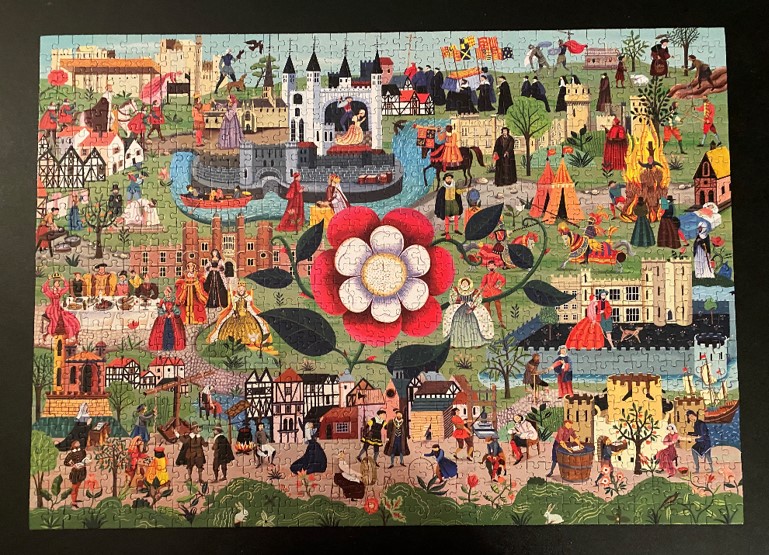
YA and I both received jigsaw puzzles for the hoidays. Since I had several days off, I thought it would be fun to get one of them started. Of course, I should have realized that the apple hasn’t fallen far from the tree where jigsaw puzzles are concerned.
We started the puzzle about about 1:30 p.m., on the card table in the living room. We finished the puzzle at 10:15 p.m. With short timeouts for refreshing a beverage or making a quick sandwich, we both sat at the table until we were finished.
Sitting with her for that length of time I began to see some differences in how we approached the puzzle. I like to go through all the pieces one by one at the beginning to find the edge pieces. YA just like to sift through looking for edge pieces. I tend to look for a piece that fits a particular spot. YA likes to choose a piece and then figure out where it goes. (Her method was seriously aided by a large fold out picture of the puzzle – which she hogged most of the day.)
The next morning my friend in Chicago texted me a photo of the puzzle she and her husband were working on. They have all the pieces sorted by color and instead of assembling all the edges first, they work on sections by color. It’s fascinating to realize that there are probably many other ways to work on a puzzled that I have never encountered or thought of. I’m pretty sure that this realization will not change how I like to do puzzles although this will be tested out soon. YA’s puzzle is made by the same company so I’m assuming it will have a large fold-out picture. Maybe I can hog it when we sit down to do hers!
I am living proof that nothing ever goes as easily as it should.
The toilet in my bathroom is ancient. It’s probably the original toilet from when the bathroom was put in over 100 years ago. This is a good thing; it has a large tank and this means there are very rarely any issues with it doing its job. Understanding that this means a bigger water usage, for many years YA and kept a full bottle of water sitting inside the tank to take up space – this ended when I realized the rust from the bottle’s lid was causing problem. These days we use other water-saving methods. You’ll have to use your imagination for this.
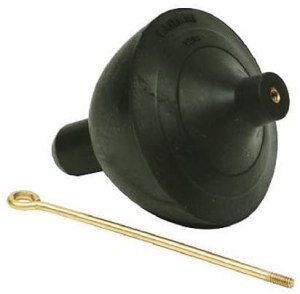
In the 30 years that I’ve owned my house, I have been able to fix any toilet issues since most of them have to do with simply replacing parts of the flush assembly. In fact at any given time I have an extra tank ball in waiting:
But it never fails that any time I mess with the toilet, it takes longer than I think it should. And then there’s the proverbial additional trip to the hardware store. Before the holidays, the telltale signs that the tank ball was nearing the end of its life began to happen. As I was considering when I should deal with it, the small metal hook that holds the tank ball to the toilet arm suddenly failed – first time ever. Since it just straight up broke, I had to purchase a new generic kit and fashion a new hook. Easy peasy, right? But the tank kept having trouble filling, so at that point, I replaced the tank ball, which had been sitting on the counter, as I had been intending. But that didn’t fix it.
So the Sunday morning after Christmas, I decided to tackle it again. After watching the various mechanisms through several cycles, I decided that I had fashioned the hook to be too big and it was pulling against the tank ball. So I made it smaller. This turned out to be exactly the wrong thing to do. A bit more internet research uncovered that I should have made it longer, not shorter. Of course, another trip to the hardware store. Everything seemed fine for a day or two and then trouble again. As I was peppering the toilet with salty language, YA poked her head in. It was then that she mentioned that she had replaced the tank ball the week before. So when I made my replacement, I had used the older version that she had left on the counter. Sigh. It’s been over a week and all seems well. But I’m still wondering why it’s never as easy as it should be?
I took some strategically placed personal days between Christmas and New Years; combined with the paid holidays from my company, I was off for eleven days straight. It was a very low-key holiday with not much going on so it’s not surprising that I watched a lot of tv movies.
Diversity in movies isn’t high on my list of priorities but I did watch a bigger variety than usual, including several films that could be considered “thrillers” – Die Hard, Murder at 1600, Indiana Jones & the Temple of Doom, North by Northwest, several Tarzan movies and pretty much every Japanese monster movie ever made.
You wouldn’t think all of these movies would have much in common but you’d be wrong. The one thing they all had in common was screaming/squealing female characters. In scenes of danger or violence, the women all scream or squeal. The men in these scenes? Silent as the grave (except for the sound of fists smacking flesh). Even in Murder at 1600, which has a very strong female lead (Diane Lane), in the two scenes which qualify, while she doesn’t scream, she makes grunts and exclamations while the male lead (Wesley Snipes) is silent. I will admit that a couple of times Bruce Willis did grunt a bit in Die Hard but when you consider the near-mortal injuries he sustained, you’d think he’d make a bit more noise.
Having never been in any situation even remotely like the ones in these films, I don’t want to speculate as to whether or not I would be a screamer or a squealer. However, based on the fact that language fit for a longshoreman regularly pops out of my mouth almost automatically when I drop something, spill something or even just stub my toe, I’m guessing I might be making noise of some kind!









 Trail Baboon