Packing is Such Sweet Sorrow

Today’s post comes from Barbara in Robbinsdale.

Without realizing it, I have come up with a little system for packing up the goods. (For the novice reader of this blog, Husband and I are moving to Winona, MN in June.)  Part 1:  I have been through each area of the house once, armed with an empty box or bag with which to remove the obviously unwanted items. This first round wasn’t so bad – when you’ve lived in a place for 27 years, you’ve forgotten half of what’s in the back of closets, under the basement stairs, in that bottom drawer. “Oh, I kept these skirts?” or “I don’t even remember ever having this calendar from 1984!”

Basement is ground zero – the holding tank, as it were. There is a “sawhorse table” where the stuff from above is dropped off until it can be boxed and carted away. There have already been several trips to Valu Village and Half Price Books; for each meeting or gathering I go to, I bring along a bag of something for people to paw through (just ask the Babooners who attended Book Club at Occasional Caroline’s in April).

But now I’m starting Part 2 of this system, sorting through a second time as I actually pack it in a box. This takes more time and thought. Hmmm, do I still really need three mixing bowls that size, and does the one from my grandma win out over my favorite color? Will I ever really play all this piano music again in this lifetime?

Luckily, I have help:  I’m almost finished reading a best-selling book by Marie Kondo – The Life-Changing Magic of Tidying Up.

There are many good ideas here, as well as some quirkiness, as she almost gives her possessions human feelings. But the most profoundly useful tactic is her insistence to work by category, rather than room by room. Say my category is “candles”: I travel thought the house and gather ALL the candles into one place, one pile; and then pick up each item to evaluate, based on whether or not it brings me joy.

This is what I want, to have all my possessions be things I use and/or love. So now there is a box of candles leaving, and a box of candles coming with us. And I feel almost euphoric after discarding – there is something about lightening up that… well, actually lightens me.

When have you needed to create a system on order to complete a task? 

Did it work?

Who Are YOU?

Header Image by John Tenniel [Public domain], via Wikimedia Commons

Today’s post comes from Steve Grooms.

When Alice tumbles down the rabbit hole, one of the many peculiar creatures she meets is the caterpillar. After initially ignoring her, the caterpillar asks Alice a rude question: “Who are YOU?” Who indeed! Alice struggles to answer. She has already experienced so many bewildering changes she no longer knows what to say.

Who are you? To some degree, it is a trick question. The question implies that there is a definite answer, and that simply isn’t true. We all have multiple identities. They change and evolve as time passes. Many of us claim identities that don’t quite fit the facts. Some of that is innocent, in a way, since we often deceive ourselves about this issue.

For much of my life I had an identity that seemed credible to others and was comforting to me. Then one day, like Alice, I experienced so many changes that I totally lost my ability to answer the caterpillar’s question. I have spent almost two decades developing a new answer to the question. By now I have constructed a new identity, using pieces left over from the wreckage of former identity but mostly based on fresh insights.

There are conventions to help us answer people who ask us who we are. A century ago it was common to identify by referring to church affiliation or participation in service clubs. One of my grandmothers identified as a Methodist. The other was a proud member of the Loyal Order of Moose.

In earlier times people were identified by where they lived. Biblical scholars claim we know much about Jesus if we remember he was a Nazarene. I have recently learned that I am (and always will be) a Minnesotan.

Most people, when asked who they are, start by referring to their occupation. I am intrigued by the ways this varies. For some people, it is impossible to separate their identity from their work. For others, how they make money has nothing to do with their true character. Increasingly, people define their identity by their recreational interests.

Many people—but I think especially women—define themselves in the context of their immediate family. Ask who they are and they answer with information about their husband and/or children. And yet for some people, the roles of wife and mother are irrelevant to any useful understanding of their unique identity.

I smile to remember how my father characterized himself the night he met the woman who became his wife (and, a bit later, my mother). He said he was an artist who rode in cavalry charges on weekends. Both facts were true. What he did not say was that he became a cavalryman as a way of proving he was not gay. To be fair, he was probably not
sufficiently self-aware to know that about himself at the time.

Modern understanding of personality has been impacted by therapy so profoundly that many people use concepts from counseling when expressing their identity. Who are you? One answer that might be useful is provided by Meyers-Briggs. In that context, I am an ENFP on a good day but an INFP on a more typical day.

It is relatively easy to describe identities if we are allowed to use an unlimited number of words. What is far more challenging is compressing the description until we are left with a handful of essential truths that reflect the essence of a person.

As an example, let me introduce my friend, the 92-year-old woman I write each morning. Who is she? She is a reader, a donor and a traveler. There is far more to know about her, of course: mother, widow, former university administrator, avid student of history, and so forth. But I suggest “reader, donor and traveler” define her unique and essential character. Anything I might add to a definition of her personality would have to come after those first three characteristics.

Reader. She reads voraciously, especially history and social commentary. The word “reader” also reflects a commitment to lifelong learning. Her greatest fear is that she might lose her sight. Books have been her main source of solace in the years since her husband passed away.

Donor. My friend addressed a midlife crisis by simplifying her life radically. She and her husband sold their South Minneapolis home and built a primitive house in a valley in southeast Minnesota. Their new home had no bathroom, running water or furnace. It was such a cheap place to live that my friend and her husband could donate to causes close to their hearts, two people of modest means expressing generosity on a scale normally associated with wealthy people.

Spiritual voyageur. My friend was raised as a judgmental sort of fundamentalist Christian. With the passing of years she became more tolerant and progressive. An abhorrence for sin morphed into a compassion and a deep concern for social justice. My friend often refers to her “voyage” as a person of faith. To her, it is the single most consequential fact of her life.

The caterpillar became a butterfly, although she is too modest to claim that.

Who are YOU?

Mail Truck Muddle

Today’s post comes from Renee in North Dakota

My friend Janelle from work has all the luck. She is keenly observant with a sensitive radar for the absurd, and notices more funny things in the world than anyone else I know.  She recently told me about something she witnessed only a block or two from my house and  oh, I wish I had been there.

Janelle stopped after work to see her brother. They were standing out front of his house talking to one of the neighbors when she noticed that there were two small Postal Service trucks delivering mail. Now, this is odd in itself, as the mail in our neighborhood is delivered around noon, not after 5:00 pm, and there are never two trucks working in tandem. The mail carriers parked on the same side of the street, and each got our of their truck and walked ahead to deliver the mail. When they went back to  get more mail, they traded trucks and each drove the other’s truck down the block, as though they were leap-frogging, trading vehicles as they went. Just then, two large mail vans pulled up, and their drivers got out and started delivering more mail to houses that had just had mail deliveries from the first two carriers. The drivers of the small trucks turned their vehicles around and drove back to the larger vans. The street was blocked  with mail trucks. All the carriers got out of their vehicles and yelled and waived their arms around with angry gestures. Then they all returned to their trucks and drove away. At this point neighbors came out of their homes and looked through their mail and traded mail with one another, as much of it had been delivered to the wrong addresses!

I can’t even begin to guess what was going on in this scenario.

Can you explain what was happening?  


Derby Day!

Today’s post comes from Verily Sherrilee

One of the bylaws at my workplace is that it be a fun place to work. Every summer we have a splendid program called “Summer of Love” with some afternoons off, food trucks out on the lawn, bands and a relaxed dress code.  We even have a party room in Building 2!   The rest of the year is sprinkled with other fun events and this week we celebrated the Kentucky Derby.

DerbyDay1To get ready for the event, my department decided that we wanted to make Derby Day hats for the celebration. Instead of our regular department meeting, we gathered in one of the rooms here with our hats, silk flowers, ribbons, toile and glue guns.  An hour later, we were transformed from everyday worker bees to queens (and kings) of the hive.

The party room was set up with a photo both, bean bag toss, beer pong and ping pong. We had mint juleps (a little strong – I could hardly get through just one), finger sandwiches and little pecan pie tartlets.  There was also a fun set-up for “betting” on the Derby horses.  The top ten forerunners each had a sheet with their picture, their stats, their jockey, etc.  Then they each had a big glass vase; there was one glass vase for all the long shots together as well.

DebryDay3 As we entered the party room, we each received two tickets to bet on our choice.  I bet one of my tickets on the long shots and my second on Destin, a three-year old gray born in Kentucky.  His jockey is Javier Castellano.  I chose him because I follow a science-blog done by a guy named Destin. If there had been a woman jockey I would have chosen her or if there had been a really interesting jockey name, I could have dumped a ticket in that vase.  So even though I was adorned like I was ready for a day at the races, I still placed my bet based on the name of a science jock.

How do you pick `em?

The Essential Albums

Header photo by Will Folsom via Flickr.  License CC 2.0

Today’s post comes from Barbara in Robbindsale

The radio station The Current, KCMP (89.3 FM – MPR’s answer in 2005 to the fact that a hefty chunk of  its listeners were middle aging), has taken on compiling the 893 most essential albums of all time.

Back in mid-April they asked listeners to help by sending in their votes for individual listeners’ “top ten” albums.

What constitutes an Essential Album? According to Jim McGuinn, The Current’s program director, these are the albums that, if your house was on fire (and there was no such thing as an iPhone), you would run in and grab before they burned. They are the albums that may have changed your life, or perhaps that got you through important life changes; the albums you would want with you on a desert island along with that volleyball.

The station received around 8,000 votes from listeners all over the world – with over 14,000 albums receiving at least one vote.  Beginning Thursday morning May 5, the choices will be unveiled and played from 8 a.m. – 7 p.m. each weekday through next Thursday May 12, and over the weekend from 10 a.m. – 6 p.m. The Current expects to unveil album #1 around 7 p.m. on the 12th. I should add that this is during their spring pledge drive.

Even though The Current’s voting is over, let’s do a Baboon poll:

What are your top 5 – 10 essential albums?


The Cat Came Back…Not Quite The Very Next Day

Today’s post comes from Anna.

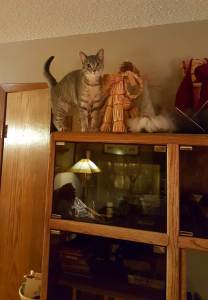
We recently adopted a cat. Or at least we took her into our house and are feeding her and attempting to keep her entertained. She has adopted our daughter, but is not at all sure about the dog and thinks the guinea pig should either be food or a toy (but she can’t get to him, so is frustrated). She will demand affection from the other two humans as well, but Daughter is the clear favorite. Like many kitties, our little tuxedo cat is full of sass. She is as likely to chew on your feet as curl up next to you purring and will chase a laser pointer in circles and up the wall until your finger cramps from holding the pointer.

She is also an escape artist. Young, not-yet-spayed cat + spring time = cat who really wants to be outside. The first time she got out we didn’t even see it happen – we thought we had heard her indoors, but she showed up a couple days later, strolling in from the back yard with the dog as if it were expected that the cat would be outside at 5:30 am. She recently got out again, but this time I saw her mad dash – in fact, I was anticipating the mad dash and still couldn’t prevent it.

addie2Our dog, bless him, is old and blind, so it can take a bit for him to navigate up the back steps and into the house. I knew not to open the door until the last possible moment to let him back in (this sometimes means he runs into the partially open door before figuring out where the opening is) to minimize the cat escape opportunities. Cat had been lying in wait, occasionally going to the door and meowing plaintively, clearly feeling it was unfair that the abhorred canine got to go outside but she did not. As soon as the door opened, even with me attempting to block her route, out she zoomed to freedom. She led me on a fine game of tag around the perimeter of the house and then made off for parts west (across the street) where I lost sight of her. After an overnight in the wilds of South Minneapolis, she is back in the house acting as though it is our fault she is hungry and a bit dirty.

Prior to her walkabouts outside, she had mastered the fine art of hiding in the most out-of-the-way spots in the basement. She also thought that hiding between the dining room curtains and the windows was a fine bit of camouflage, but it was much easier to spot her silhouette there and she always seemed indignant that I had uncovered her coveted lair-on-the-window-ledge.

In fairness, she was a stray before we took her in; a friend-of-a-friend found her hanging around their hobby farm and brought her in from the cold. A move to the big city is not going to immediately tame that touch of wildness, nor dampen her desire to return to the great outdoors (if only temporarily). I can only hope that once we have her spayed that this instinct is at least reduced. (See above comment regarding hawks. And possibly a fox.)

It’s a pity that a Go Pro camera would weigh as much or more than she does – it would be an interesting exercise to strap one on her and see where she goes.

Where do you go when you want to escape daily life?

Campy Summer Camp, Part II

Today’s post comes from Clyde of Mankato

The Fusing of Two Memories

When I worked at Camp House, my room was right on the shore of Lake George. Many mornings when I got up very early for work, a mist hung over the water. I fell in love with the mist and often rowed a boat out into it to lie back and drift in a slow circle in the calm air.

Once when I was very young, our family on occasion went fishing on Lake McDougal near Isabella. The boat ramp was beside a resort. One early wet foggy morning a little girl in a nightgown spun slowly in the wet grass with her arms outstretched.

When I wrote my collection of stories about Northeastern Minnesota, the two memories fused into this sketch.

Called by the Mist 1928, August

Prudence Patience, never called Patty as she wishes, is summoned awake before the dawn. It is not her mother who summons, nor her father, nor her three older brothers. Nor a human voice at all, a summons only she can hear, even in her sleep.

She pulls a long gingham dress over long blond hair and over her night dress. Next are wool mittens, knit by her other grandmother, not the grandmother who owns this lake resort managed by her parents. Next is her hat, her hat, with a big flower on the side but which she wears to the front, given to her by a guest in June. But no shoes—Prudence Patience is not a willing wearer of shoes in the summer.

In her bare feet she steps in silence down the stairs of the main lodge to the side door, the hinges of which creak when opened. Prudence Patience, a small nine-year-old, a “mere lady slipper of a girl” her father calls her, can ease through the door before the hinges reach their point of protest. “Mere lady slipper of a girl” is her father’s tease about her wildness as much as her slim body. Next, before she steps out into the cold northern air which attracts their guests, she has to slink through the screen door, which is below her parents’ bedroom. She knows how to grasp the spring to stop its elastic screech and how to ease the screen door back into its frame. On the lawn, she turns and walks backwards to see the tracks her dragging feet channel in the heavy dew. She knows her route so well she can do it backwards without turning her head. When she reaches the dock, her skirts are soaked, for which she has been often chided this summer and will be again before the mother and children move back into town for school—the school, where the mist will not abide.

It is the mist suspended between lake and clouded night sky which called her awake and invited her into its otherworld of no dimension.

Prudence Patience chooses the smallest rowboat, as she always does, for which she has been often chided and will be again, not for choosing the smallest rowboat but for using a rowboat alone. With short strokes of the oars she rows out far enough to be lost from the shore. She lifts the right oar into the boat and uses both arms to give several hard pulls on the left oar. The boat spins counterclockwise. She lifts the second oar into the boat and moves to the front seat to lie down in the dew with her head below one gunwale and her bare feet hanging over the other. In silence the boat drifts its slow rotation in the sodden air and mirror water.

Creatures of water live in the mist, she imagines, but she does not imagine their shape. The creatures of the mist are indistinguishable from the mist. Creatures of water live in the lake and are indistinguishable from the water. She wants the boat to ever spin, the mist to ever hover, the wind to never breathe, sounds to never speak. She wants to never leave here, to ever be here with dew and mist and lake and fog and rain.

The mist enshrouds her by condensing on on her clothes and hair. The mist condenses in her eyebrows and runs down her temples into her ears. O, let it fill her ears and melt into her mind! She will not move and break the spell! Her hands loll down beside the seat touching nothing. The mist condenses in her long pale eyelashes. O, let it run into her eyes like tears! She will not move and break the spell! She will dissolve into water. She will join the creatures of the mist and be unseen. She commands silence upon the lake, no sound of screen door or human voice or creature which will reveal east from west or south from north.

As she blends into the mist, she forgets to hold her spell to hold the silence. A loon vibrates its plaint from their nesting ground in the reeds near her dock. She exhales. She forgets to breathe in! Another loon calls from a different direction. The spell is saved! She is lost again!

She breathes in and surrenders to the empty moment. A fish jumps by her head, telling her nothing, nothing at all.

She drifts on in her circle. Or does not. It no longer matters. Time tendrils into the mist. Time condenses on her skin. Time drips from her feet. Mist and time condense in her eyes blurring form. From the stern of the boat a blue heron clatters its beak. She is indistinguishable from the mist! Being of the mist, she feels not cold, she feels not wet.

The mist and time condensing in her eyes cannot shield her from the increasing light. The screen door slams! Her father calls, “Little Lady Slipper, come back off the lake.”

It has ended. He can see her. The mist has arisen and will return as rain.

In the lodge her mother tells her to get out of her wet clothes and hurry back to eat. As punishment, she will help with the laundry. She always helps with the laundry. At breakfast Prudence Patience sits in silence, regretting her return to solid form, coddled and teased by her family, who will again laugh at her if she again tells them she became water and chose to live with the creatures of the mist and not the creatures of the lake.

©2016 Clyde Birkholz

Is the summer you a creature of sunshine or of the fog, dew, mist, and rain?


Taco Confundo

Today’s post comes from Ben Hain.

I don’t understand the popularity of late night Taco Bell. I mean I’m right there in line too, Just why is everybody else here??
What is the appeal of Taco Bell late at night??

It can’t be just the food is it?

Dairy Queen is open right next door and I should’ve gone there! But I thought I needed something a little more nutritious than ice cream. So it’s 10 o’clock on a Thursday night and I am the ninth car in line. We’ve been here at 11:30 at night and been the 12th car in line. And the parking lot is full of cars too. I don’t understand –what is the appeal?

And why hasn’t the local franchise owner opened another one of these restaurants?

Rochester, a town of 100,000 people, has two Taco Bell’s; One out north and one downtown. One night Kelly got so fed up with the line at this one she went to the north one.

And there was a line there too!

I drove by Snappy Stop, but as I’ve had that a few times lately, well, I guess I was in the mood for Taco Bell. But there wasn’t a line at Snappy Stop. (Anybody know what Snappy Stop is? It’s just a drive-through burger place in a little building about 10’ x 20’. Hamburgers and hot dogs is all they do. Oh, and ice cream sandwiches. And their hamburgers are really good. Like Five Guys good.)

I dictated this while waiting in line. I’m still the seventh car in line at Taco Bell… Shoulda gone to Snappy Stop. Or Dairy Queen.

Seventeen minutes later I have my food. I could have gone home. But this chicken quesarito was really good.

I don’t understand.

What don’t you understand?

Campy Summer Camp, Part I

Today’s post comes from Clyde of Mankato

I am surprised by how often summer camp appears in movies. As a result I wonder if summer camp is a more common experience than I realize. Of course, here in the Midwest it is tied to church camps. How common is it on the coasts, in the South, on the prairie? I don’t know.

My favorite movie summer camp is very campy indeed, Addams Family Values. What a delight Christina Ricci is as Wednesday. “You sent us to camp. They made us sing.” In one of Ron Howard’s first movies, The Courtship of Eddy’s Father, he plays a boy who is sent to camp, falls in love, and runs away, which covers a few cliches. I suppose we could include Dirty Dancing in that list of movies. I had a few friends at the University of Chicago who had Borscht Belt experiences.

One summer camp is tied into my life, Camp House, near Brimson. In my childhood it was owned by the D.M. & I.R. Railway Employees Association. I was sent there in about fourth or fifth grade. I remember it cost only $12 a week as a result of funding by the railroad. I did not like it. There is a picture of me with my mother on the Sunday visit. I am not going to share that photo. I do not look happy. You see, my mother told me that I was staying for a second week. Somehow half of the $12 was being paid by the railroad or Employees Association. I do not think my mother could turn down a bargain. My sister attended as a camper once or twice.

Oddly, I returned the summer before my senior year to work as an assistant to the maintenance man, my first job. About him and that experience I could tell a few tales. My sister was a counselor during the four weeks of girls camping that summer. It was special to have her there. We were very close back then. We had many late night talks. I was surprised then and am surprised now that my father released me from helping with the haying. I made up for it the next summer when he went to Michigan for work and I did the farm alone.

The winter after I worked there, the Employees Association was disbanded and the camp was sold. It became a Lutheran camp and still is. My children attended it two or three summers and loved it. My daughter has gone family camping there twice with her children. Three generations are thus tied to Camp House. For three years my daughter served on the board that oversees Camp House and other Lutheran camps.

A common sub-genre of movies is about camp counselors, often as gathering a few years later. I have only seen part of one of those movies. It struck no chord with me.

In the header photo, taken about 1955 by my mother, the building farthest the right on the lake is where I slept for ten weeks. Campy Summer Camp, Part II will reference that building.

Did you attend a summer camp, wish you had or wish you had not?

On Being an Expert


Header image from the public domain; source: Andrea Rauch

Today’s post is from Chris in Owatonna

Most of us go through life developing talents, skills, and interests that add to our enjoyment of life or pay our expenses. Some are happy doing relatively simple jobs, happy with their high school diploma or G.E.D., happy to be in the middle of the bell curve of expertise.

But some of us strive to become an expert at one thing: a field of study in college or beyond, a sport, a career, a hobby, a craft, an artistic discipline. Some earn a degree, or a license, or a certificate, or validation from adoring fans if they become rock stars or award-winning actors or world-class athletes.

The other group of strivers usually become experts by default. Often it’s simply for the love of the subject.  Who doesn’t know someone who’s a walking encyclopedia on a certain subject, like a woodworker who can build furniture as good as the masters of centuries past? Or the good cook who tried new recipes, developed new ideas, found a passion for feeding people and then opened their own restaurant without even knowing there is such an institution as the Culinary Institute of America?

Intentional or not, I seem to have earned my expert stripe in an area I hadn’t thought possible until about six years ago–writing fiction.

Yep. Fiction. A novel in fact.

“Big deal,” you say.

And you’re right. There are millions of people in the world who have written a complete book but aren’t entitled to call themselves experts.

“Why?” I hear you ask.

Because they haven’t published the book.

For better or worse, I took that step and published my novel! For people to actually purchase and read. I still shake my head in wonderment as to how and why I came to this point in my life.

I didn’t earn an MFA or Literature degree. I didn’t take master class after master class and earn validation from other experts (most far with far more expertise than I’ll ever have).  I didn’t even answer an ad in the back of a tabloid and get an online degree from “How ta Write Good University.” Nevertheless, I’ve earned the right to  pretend to be an expert in the field of fiction writing because I crossed the line from talking about it and dreaming about it to doing it.

My novel Castle Danger is now available in print for order through your favorite local bookstore ( my preferred  way to purchase books), Booklocker.com, the Amazon and Barnes and Noble websites, or the trunk of my car. And I am available for book clubs, bar mitzvahs, coffee klatches, neighborhood block parties, or hardware store grand openings. 🙂

Now that I’ve written a novel I suppose I’m qualified to teach classes or give interviews  on “how to write a novel.” Strangers may regard me with a modicum of admiration or envy or jealousy or dubiousness (THAT guy wrote a novel?? Sheesh!) But I don’t feel any more an expert on writing than I did before I decided to put the darn thing out into the world for public consumption. I wonder if other experts with real degrees, validation, or money in the bank earned from their expert endeavors feel like a true expert. And can anyone ever know everything there is to know about a subject or field of study? I doubt it.

So my question for Babooners is: In what subject, job skill, artistic or athletic endeavor, or hidden talent have you become a de facto expert? Meaning no official recognition by governing bodies, licensing boards, piles of money in a Swiss bank account, or public acclaim and accolades?