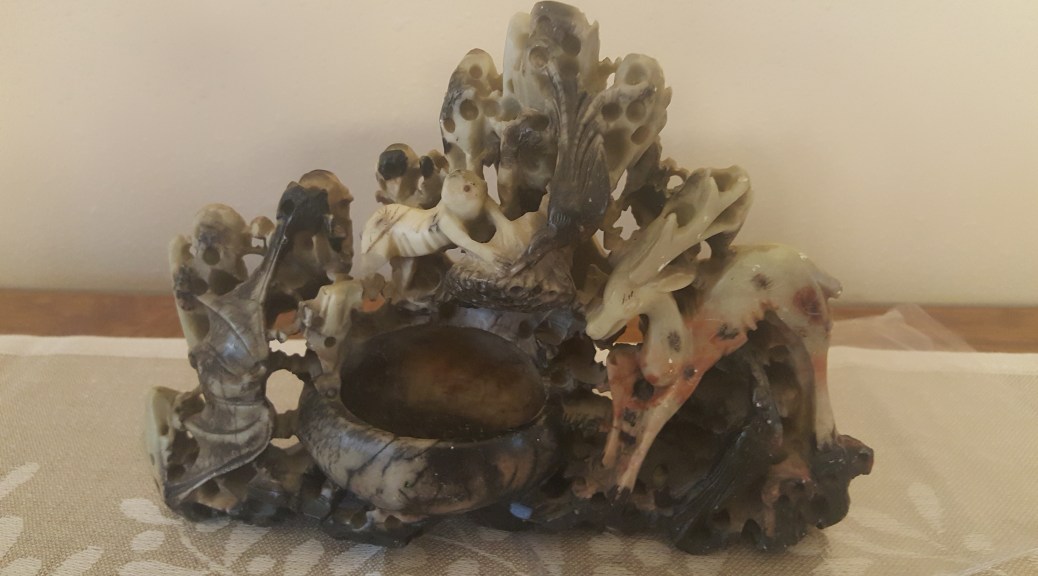
Some time ago I submitted a post about a large piece of carved Chinese jade in my possession that my maternal great grandfather hauled from Hamburg, Germany to New York to Minnesota in 1914. I thought it was an incense burner, and couldn’t figure out why it was so important that the family brought it with them when they immigrated to the United States.
My son did a little research this fall and discovered that it isn’t exclusively an incense burner. It is called a Scholar’s Mountain, Scholar’s Rock, or Spirit Stone (Gongshi), and it was used to encourage wisdom and deep thoughts as it was gazed upon. The holes, some natural and some that were carved in it, are for calligraphy or paint brush handles, and the round basin is either for incense or for water for rinsing the brushes. Who’d have thought?
Most were naturally occurring rocks carved and perforated by water, sometimes embellished with carvings, sometimes placed in gardens as points for contemplation or else brought inside. They were chosen on how well they emulated the natural world of landscape, especally mountains and elevations. Ours is 10 inches by 7 inches. It is carved with a stag, a bat, a bear, two ravens, and a honey comb or coral shape. Now that I know this, the shape and design and purpose make sense. I wonder what scholars or deep thinkers might have used this for inspiration.
I used to worry what would happen to this after I am no longer here, and now that son has taken an interest and we know what it is, I think it will continue on its journey with him. He is a scholar and a deep thinker, after all.
Describe a sight or an object that encourages you to think deep thoughts.
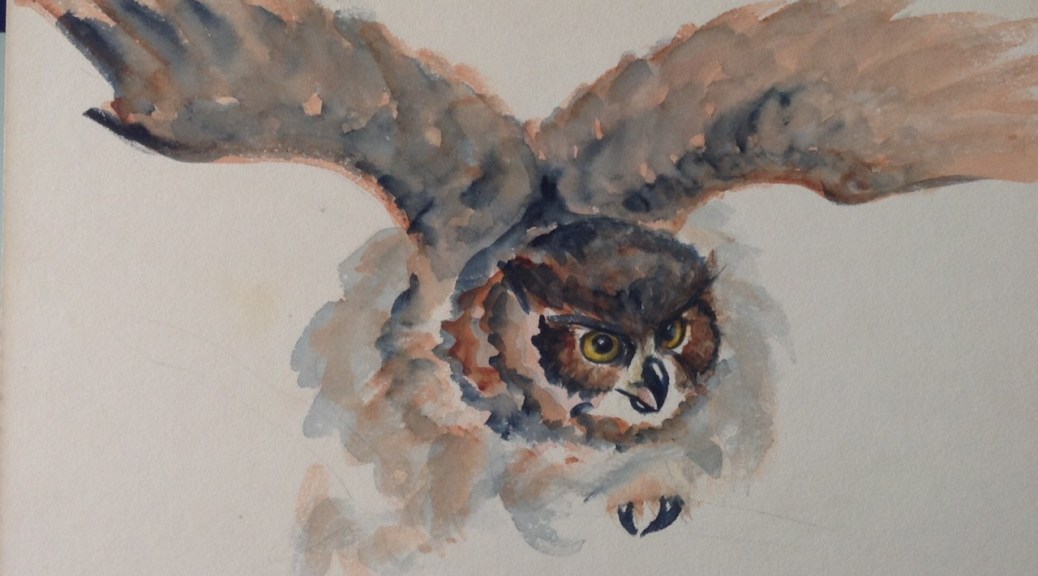
I don’t often talk about my paintings or my painting that stopped years ago. Recently, however, I mentioned on the blog of selling a couple watercolors to Robert and Ruth Bly.
Barbara in Robbinsdale and Plain Jane asked to see photos of them and suggested writing and posting photos here. So, here goes.
I painted often in the late seventies and early eighties, then stopped when my marriage ended and I had to get a day job full time. My time being with and inspired by my animals diminished, while other activities, needs, demands took its place.
I first painted in oils. Then in the early eighties I met a woman whose watercolors I admired, so I began taking lessons with her, then spent time painting with her, building a friendship and learning techniques from her.
Now that I am retired, will I return to drawing and painting? I think about it, but hesitate…fear, perhaps, that the skill is diminished or has atrophied with time? Yet to be answered.
The photo shows my sister Cleo at age 13 and and me at age 10.
Standard clothing and standard work for farm children in the mid 1950’s. I cannot imagine my ten-year-old and thirteen-year-old Minnesota grandchildren working like this, nor do I want to. But I do not regret this labor in my childhood. My father did not assign us this task lightly. He no doubt was off doing even harder work at the same time. My sister, I suspect, came out of her own free will to help me. We were close that way. My sister was not afraid of exercise. She became a physical education teacher. The work she and I did mattered; it contributed to the welfare of the family.
However, one of my many back issues is a disorder in my upper back which is associated with doing heavy lifting at a young age. Perhaps it is related; perhaps it is not. I promise that was heavy snow, having been pushed there by the county plow. We lived at the end of a road.
I am a bit confused about the issue of children working. I did not make my children do much work, but none of the supposed effects of not requiring children to work is evident in my mid-forties offspring. Quite the opposite in fact.
It’s not what you think. I don’t know what you’re thinking, but it’s not that.
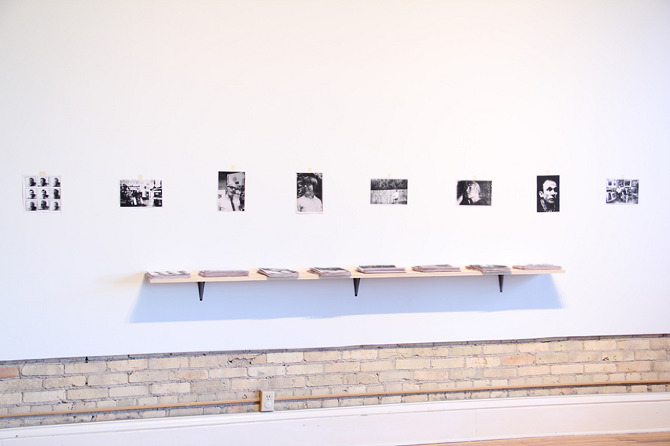
When I was in high school, 15 or 16 years old and living in the suburbs, I would sometimes get on the city bus and go downtown by myself. Once there, I would visit art galleries. There was a gallery on Hennepin, up a narrow staircase to the second floor, called the Bottega Gallery. It was run by a guy named Tom Sewell and it had a reputation as avant-garde. In fact, when Marcel Duchamp was in town for his show at the Walker, curator Martin Friedman brought Duchamp to the Bottega Gallery. I didn’t know anything about the avant-garde or about abstract art of any kind, but I was drawn to the Bottega Gallery and returned whenever I came downtown. At that time, Hennepin Avenue was pretty scruffy. To my suburban sensibilities it had a tang of dangerous bohemianism and adventure.
After visiting the Bottega Gallery, I would walk down to the Walker Art Center to look around. This was the old Walker, with a grand staircase leading up to an open gallery looking out on a center atrium. It was the only Walker I’ve ever really loved. After the Walker, I would make a stop at the Kilbride-Bradley Gallery. As I recall it, K-B Gallery was part gallery, part art supply store. Bob Kilbride published a newsletter/“zine” called The Potboiler, which was always entertaining and free for the taking..
When I say I didn’t know anything about abstract art, I mean I had no basis for knowing anything. Art appreciation and art history were not taught in my high school. Art was not part of my home life. I doubt that either of my parents ever visited a gallery or art museum in their lifetimes. That wasn’t in their world. My impulse to seek out art galleries feels a little like a rogue mutation of the family genetics. Nothing foreshadowed it, but there it was.
Looking down from the altitude of more than half a decade, I have enough distance to see my teen-aged self dispassionately and wonder where the motivation for those ventures came from. It certainly wasn’t peer pressure– none of my friends or schoolmates knew about my excursions. I never talked about it. I always went alone.
My secret life was innocent enough, but private. It makes me wonder how unusual that is. Did everyone have a secret life like mine? Did anyone?
The Saturday after New Year’s Day, our churlish next door neighbor stormed over to our house and told my husband that we had to keep our dog quiet. Did we know how many times she had barked that day? Husband just said “Ok”. and shut the door. We were pretty puzzled about this, since she really hadn’t barked at all that day.
Our dog is 14 years old. She is a terrier. Terriers bark. We have tried our hardest to minimize her vocalizations over the years. We don’t let her out in the yard unsupervised, and she does her business on the deck in the back. Our neighbor has complained about her for years, and it seems that nothing we do is good enough.
There are plenty of other dogs in the neighborhood that we hear barking, but he seems to be obsessed with our little Maggie. He spends a lot of time in his family room, the closest room in his house to our deck, which is the only place she barks. He has even installed white noise machines. There was a dog in the garage of the house on the other side of neighbor’s house that barked continuously for 5 hours the day he came over to complain. We think that he assumed the noise was coming from our dog.
Now, to put Maggie’s barking into perspective, her barking never lasts more than 10 seconds at any one time before we bring her in, and she doesn’t bark in the house. After this last visit from neighbor, we started collecting data on the times she went out, whether she barked, and the duration of her utterances, if any. We stand by the patio door until she is finished with her business so that we can leap out and quell any barking that might occur. Her barking, which wasn’t much to begin with, has been reduced even further. Now we have actual data to use in the event neighbor complains to the police. The longest string of barks she has produced outside since we started data collection is 5 woofs long and lasted less than 5 seconds. She barks less than 3 percent of the times she goes outside. Ooh, I love being a behavioral scientist!
Our dog is getting frail and I think this is her last winter. I have a secret plan for when she passes that would be satisfying to implement, particularly if she dies before next Christmas. I plan to tell the neighbor that she has died. I want to lull him into a false sense of relief, and then I want to start broadcasting from our deck this musical selection that husband found on the internet.
One of my friends tells me that someone has to be the bigger person here. I suppose she is right. There is an entire album of Barking Dogs’ Christmas music, though! It is pretty tempting to do, especially since neighbor hasn’t thanked us for the nearly silent neighborhood in which he now lives. Of course, he never thanks us for anything. Sigh.
life forms habits. when these habits are disrupted for whatever reason it can be traumatic. it can be annoying it can be revealing.
my habit back to the mid 70’s when i first bought my own house and didnt have to be worrying about others i the bathroom in the morning has been to take a long soaking bath with music tv cigarettes and a pot of french roast. reading the news paper and getting my day in order. an hour, 5 cigarettes and 4 cups of coffee was the usual agenda. newspaper could be finished in that time with the tv blasting out david hartman or diane sawyer in the background.
80s brought a new era where smoking had to move outdoors and the day started with one cigarette on the front porch and up to the tub with the paper coffee and switch form tv to radio in the morning. it was still tub based but the activities were becoming the driver.
the 90’s brought mpr and swimming pool i quit smoking and started raising kids and dealing with the rat race but still the bath in the morning was the respite to start the process.
i moved into a house in the 2000’s with a big old whirlpool tub in the bedroom and i found a late night soak at midnight or an early morning bath at 5 were wonderful ways to find a little peace and quiet and a time to work out the trials and tribulations of life. my kids picked up the tradition and there was a steady stream of soakings clocked on the hot tub.
our new house is a nice house with a main bath for the upstairs bedrooms a master bath with a shower off our bedroom and a bath with a shower downstairs for the bedrooms the boys use down there. so there is one tub. it has the typical set up and when you fill it up the drain lever up by your toes it drains o the bottom of that thing the lever sticks out of. did i get bigger or was it always set up so your torso sticks out of the bath water about 1/2 way. the tub was a morning hot spot with people getting ready for school and by the time it cleared out i was looking at a later start to the day than was ok.
my wife suggested that we look at a hot tub and i jumped at the thought. i found one and enlisted my boys to help me move it. no way… it weighs way too much and is way to difficult to move so i hired tub movers and when they dropped it off i took their cards for an electrician to wire it up and found it was a thousand dollars to wire it up. so plan be went into play. got a buddy who has a brain for electrician kind of stuff an away we went. 3 nights of pulling wires through pvc piping and gluing corners and lengths of pipe to the side of the house with circuit breakers and breaker boxes being placed where they needed to go and zip zap there was a tub in the back yard. its my new respite and gets used a time or two a day for a highlight of my day at 5 in the morning at midnight when its 10 below or 20 above i haven gotten to do it in the heat of summer yet but i bet it will be ok with lemonade
i find silence and reflection are the current mode. i need time to think and reflect and found a way to get er done.
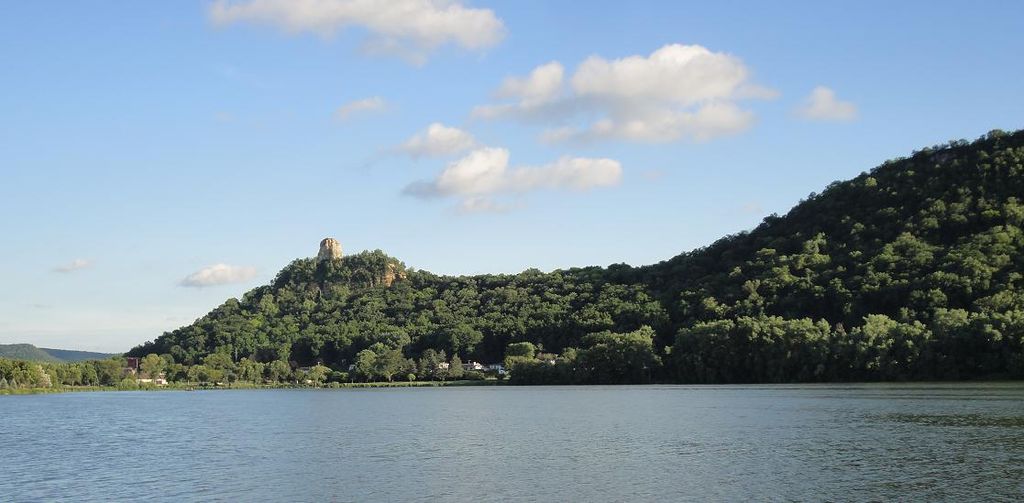
Header photo of Lake Winona and bluffs via Wikimedia Commons
Today’s post comes from Barbara in Robbinsdale
Winona Ho!
When Husband and I moved up to Minneapolis from Winona in 1985, it was with mixed feelings. We thought we had found “Home” in Winona, and we knew how much we were leaving behind in the small town. Minneapolis is where Husband had landed a good programming job, and we had his family and several friends in the Twin Cities. But we were pretty sure it wasn’t going to be permanent – we would return some day to Winona.
There are many reasons why this is finally going to happen, probably in mid-summer:
– For Husband, he’s realized that Winona is where his Tribe resides – people he’d met as he helped to start up the food co-op and the farmers’ market, from his apple-picking days at an orchard on the river, from living on the Hippie Farm above East Burns Valley… there were many colorful characters, several of whom are still around.
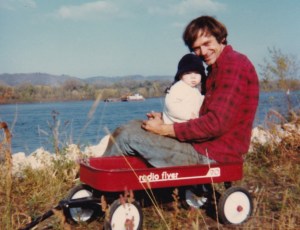
– My roots there are not as deep, but I formed a bond with local folk dancers, and parents in the preschool play group that Joel and I had joined. I fell in love with the beauty and the – movement is almost the right word – of the river. (…“you rolling old river, you changing old river…” Bill Stains) Our house was just a couple of blocks from the Mississippi, so we would often pull the wagon up on the levee to see it. I also love the fact that this town, slightly larger than Marshalltown IA (a little over 25,000 when I was growing up), had such a vibrant Alternative Community. Then there was the Culture available with three (now two) colleges, a boat house community…
– It turns out that my Tribe, I have come to realize, is mostly our Babooner “collective”, plus a few others. I am hoping this is a portable connection, though I imagine it will feel somewhat different not being right “in the center of things”. I figure I’ll be traveling up to the Cities at least monthly – will try to schedule it around Baboon events.
– I am also aware that, for both Michael and me, we are not as moored to this place as we once were, before our son Joel died in 2007. And Husband has lost several family members in recent years, either literally or figuratively – freeing us up even more. I am hoping that my mom will be amenable to moving there when the time is right, and we have done some research to that end.
– We have recently seen the power of the network of Winona people, since our best Winona friend Walken (who is experiencing the early stages of Parkinson’s) lost his wife Bernadette in December to pancreatic cancer. There is a food network that brought daily meals for weeks, and several people who provided rooms for his visiting in-laws. (Reminds me of how we Babooners have gathered to help each other at times.)
I have never said “No” to a move, and I have never been sorry. But as I think about leaving Mpls, it is with mixed feelings. No doubt I will miss a lot of things about this city – this is worthy of its own blog at some point.
But the bluffs are calling.
Have you ever had to leave a place before you felt you were ready to leave?
Of course there are noisy climate change deniers who refuse to accept scientific research because it conflicts with their closely held political beliefs.
That’s almost understandable.
But what I can’t comprehend is the much more commonplace lunacy of daily weather denial.
A good winter storm reveals it, especially in more tightly packed urban locations. Some people downtown believe they don’t have to put on anything special to be outside because they’re only going to be exposed for a short time.
And besides, heavy clothes worn in layers just don’t look that nice. But I think inadequately dressed office workers look silly shivering as they wait to cross the street.
When I mentioned this pet peeve of mine to Trail Baboon’s sing-song poet laureate Tyler Schuyler Wyler, he said he also has a certain peeve that pesters him – presumptuous people who rip off the work of other poets merely to get a laugh.
And right after saying that, he presented me with his latest opus, which included an insincere note of apology to Robert W. Service and The Cremation of Sam McGee.
There are fashions worn in a winter storm
that would otherwise seem gauche.
Everybody knows layering your clothes
is a common sense approach.
Even dilletantes in fine restaurants
will adjust to a degree.
For a little while they’ll abandon style
if their name’s not Sam McGee.
All Sam’s garb was sheer and he wouldn’t hear
of a parka or a fleece.
If a shirt or gown had an ounce of down
his frustration would increase.
“It feels very wrong and takes far too long
to suit up for cold or sleet.”
“And besides,” he’d wink, “there’s no risk, I think.”
“I’m just gonna cross the street.”
Right across the way sat a mad buffet
called “The Sacrificial Goat.”
It was hip and loud and it drew a crowd
that opposed the winter coat.
They disdained its buik and they’d tend to sulk
if harsh weather was foretold.
Putting on their things, they’d assume it’s Spring.
‘Cause it’s cool to not seem cold.
So off Sam would skirt in a polo shirt
with Bermuda shorts below
Into two degrees with his naked knees
and flip-flops, to face the snow.
“Winter air feels fresh on my naked flesh!”
he declared. “It’s strength of will.”
“And what’s more,” he spat, “I don’t need a hat,”
as he stepped into the chill.
Quite against Sam’s plan the snowflakes began
to collect between his toes.
And those flopping flips, ‘midst their many slips
became rigid when they froze.
Trying to be brave, Sam’s blue eyes turned grave.
As streetward, on he pressed.
At the crosswalk light, his mouth thin and tight
He tried not to seem distressed.
In the urban grind one will often find
that delay is the routine.
And slow went the time at that corner sign
with Sam blocked by traffic’s stream.
Then a passing truck’s plume of slushy muck
sealed the frosty fate Sam faced.
For his flops got iced and nothing sufficed
to dislodge a man encased.
With each frigid blast nature built a cast
that enveloped Sam, complete.
It was clear and slick and six inches thick
from his head down to his feet.
Looking through the shell one could clearly tell
that his face showed some regret.
A wardrobe reform could have kept him warm.
but he’s not been thawed out yet.
In December’s pale, teachers tell the tale
of the legend Sam became
Heading off to play on a chilly day
All the children learn his name.
Don’t go out of doors with just summer drawers
against winter’s nasty breeze.
you could be marooned in a white cocoon
like the ice man, Sam Mcgee.
Header image – Washer Women by Barrington Watson 1966 via Wikiart
Today’s post comes from Plain Jane
When I think of the people who have had a lasting impact on my life, most of them are folks who were, or are, a steady presence in my everyday existence.
On several occasions, however, my life was impacted in a major way by a chance meeting, a short interlude. I have written about two of them, briefly, before on this blog: Bob Dean and Barry Watson. Both Bob and Barry had a far greater influence on my life than the short time we spent together would seem to justify, and for very different reasons.
I met Barry at a small cafe in Basel my roommate, Annette, and I often visited. I don’t recall the details of why or how Barry and I started talking, but we did. By the time Annette and I left that evening, I had learned that he was a painter who had been studying a couple of years in London and Amsterdam, and that he was on his way to Madrid for a few months before returning to his native Kingston, Jamaica. As Annette and I were getting ready to leave, Barry asked if I’d be interested in meeting him the following afternoon; he wanted to visit the Basel Art Museum and show me some of his favorite works. I said why not, and agreed to meet him on a bridge close to where I lived and worked, and not far from the museum.
I had never before had a conversation with a black person, so I was both fascinated and a little aloof; I think Barry sensed it. Our first afternoon at the museum was spent looking at the remarkable Klee collection for which that museum is renowned. Barry had a high regard for Klee’s work and enthused about its merits to this complete novice. I’m ashamed to admit it, but I had never before set foot in an art museum, and had not had prior exposure to modern art; I was mesmerized.
Afterward we had a bite to eat and talked for hours. When Barry walked me home that evening he asked me if I would like to see some of his paintings. Promptly on high alert, I responded “not tonight, maybe some other time.” “OK,” he said,” how about tomorrow afternoon?” And so our next rendezvous was set.
When I met Barry the following day, he greeted me with a bear hug and a huge grin. “You thought you were really clever last night when I asked if you wanted to see some of my paintings, didn’t you?” he asked. Without waiting for a response, he continued, “I was really the clever one; I had the slides of my paintings in my pocket the whole time, and could have shown them to you anywhere. But I wanted to see you again, so I didn’t tell you. You thought I was trying to lure you to my room, didn’t you?” He was right, I admitted it, and we both had a good laugh. After that I relaxed. I realized that we were kindred spirits who enjoyed each others company, and that I could learn a great deal from him in the few days he had left in Basel.
Barry and I met two more times, and on both occasions spent hours at the art museum. He introduced me to Picasso, Miro, Chagall, and the museums impressive collection of works of the Holbein family.
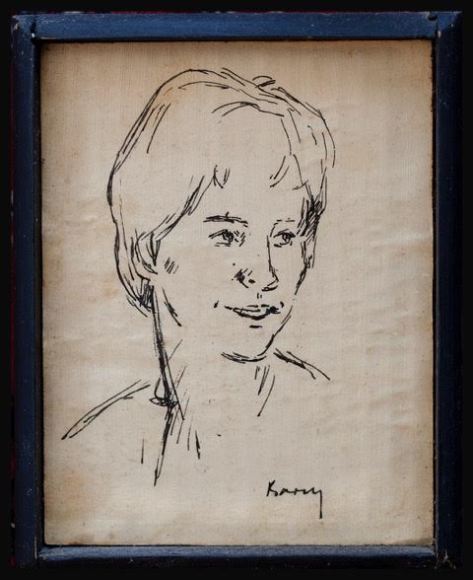
Barry Watson’s portrait of PJ
As a parting gift, Barry sketched a portrait of me in pen and ink. He signed it: Barry. He didn’t sign his last name because he planned on becoming famous, he said. He didn’t want me to sell this keepsake, but to keep it as a reminder of the time we had spent together.
When we parted, we made no attempt to stay in touch.
Seven years later, as a freshman at SIU, I came to know several students from Kingston, Jamaica. I asked them if they had heard of a painter named Barry Watson. To my surprise, they said they had. He had become a quite prominent figure in the Jamaican art world. They told me he had become the director of the Kingston Art Museum. This was in 1968, before the internet made access to all kinds of information possible, so I had no way of verifying whether or not this information was accurate.
Fast forward to sometime last year when a blog on the Trail Baboon jogged my memory, I decided to see if I could find out what had become of Barry. I was astonished to discover that he had, indeed, become quite the celebrity in Jamaican art circles, although he had not been director of the Kingston Art Museum. I sent him a message asking whether he remembered our encounter so many years ago. He did, and must have shared our story with his family. I was saddened when on Wednesday morning I received the message that Barry had passed away the previous evening at 10 PM. He had just turned 85. The volume of his work is impressive, and the quality of his work is remarkable; check it out.
Thanks, Barry, for introducing me to art, and R.I.P. old friend.
Going through some old letters I had sent to my mother from my first teaching job in Port Angeles, Washington in 1964, I found a paragraph describing all the “new” foods I was eating. Foods I had never heard of in my small northeastern Minnesota hometown such as artichokes, zucchini, Swiss chard, eggplant, turnips, parsnips. (I led a very sheltered food life.)
I remember that first taste of an artichoke – a more worldly friend teaching me how to tear off a leaf, dip it in butter and scrape off the soft inner part with my lower teeth. How exotic. Later that friend’s aunt taught me to use mayonnaise with dry vermouth and garlic for dipping — still my preference.
Washington state firsts: Dungeness crab. Fresh salmon. Fresh apricots. Carrot cake.
So this got me to thinking of all the “exotic” foods that I was introduced to since then. Five months in Switzerland, four of them living above and eating in a bakery/tea room — cheese fondue with bread dipped in kirsch (cherry brandy), lamb curry, gibfeli (croissants), café au lait, escargot, tripe soup. I have fond memories of all but the tripe soup.
On the small Italian ship I took to Europe in 1965 I had tongue and my first cappuccino. When we landed In England I had coffee with Demerara (brown) sugar. Did I try steak and kidney pie? I might have. But that really hot Indian curry in a English restaurant made me feel guilty for not eating it all because of the hungry children of India.
In Greece I watched a man slam an octopus repeatedly on the rocks. Was he trying to kill it or tenderize it? But I did not eat octopus until many years later and then in a sushi restaurant. (A friend traveling in the Orient had octopus so fresh the sucker stuck to the top of his mouth. But that may have been the least exotic thing he ate on that trip…was it duck bills or duck feet?) Squid entered my eating repertoire much later, though the first time I had it I was unnerved by the little tentacles.
When I was a child my father paid me to eat asparagus – or, tried to. He had tricked me into eating horseradish when I was five. How could I trust him to steer me right? Asparagus cooked to a gray mush? Then in 1972 I paid $2.50 for three spears of properly cooked white asparagus in a San Francisco restaurant. There I also had a “bird with a long beak” for an entrée. It had four legs and no wings…a rabbit, perhaps? Did the waiter mistranslate or was he leading me astray and making fun because I didn’t know French?
Asparagus was the first thing I planted when I moved to this farm. It still comes back every spring. I eat it sautéed it to a bright and crispy green.
Smørsbrød
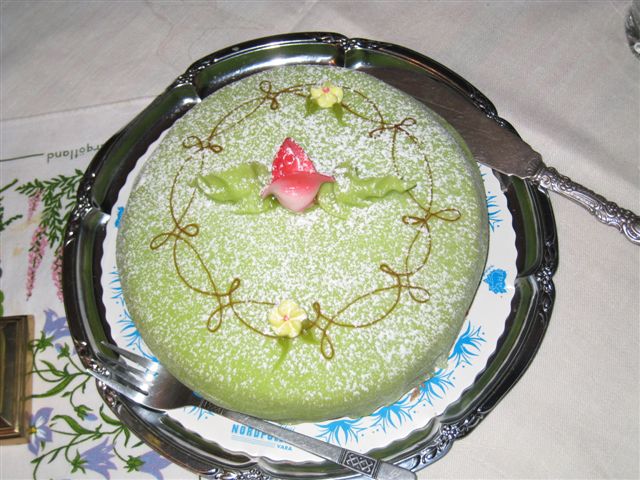
First time food that has not been repeated: Rocky Mountain “oysters” (our kid goats’ testicles). Foods have become favorites: really, really hot Mexican food, goat meat, spanakopita, lobster, clams, mussels, lamb. Swedish Princess cake made with marzipan, whipped cream, raspberries and custard. Every cake I ate in Norway. Scandinavian open face sandwiches (smørsbrød). French goat cheeses and Norwegian brown cheese. I could go on…but won’t.
What “exotic” foods have you tried and fallen in love with….or not?