The Geezer Trees

The internet has something for everyone, including the advanced-age contingent desperately trolling websites looking for a tidbit to suggest that they still matter.

turning tree

That news came yesterday in the form of a global study of trees that reached a surprising conclusion. Big old trees suck up much more carbon than younger trees and continue to grow aggressively in their later years, overturning the depressing expectations about aging and decline that appear to remain true with just about every other living thing.

Somehow, elderly trees manage to stay relevant. They dominate the forest. Of course this cheerful news demanded a parody of what may be America’s best-known tree poem. With apologies and thanks to Joyce Kilmer

I’m thrilled to hear this new decree
That old age benefits a tree.

An elder tree, with vigor blessed
adds height and girth and all the rest

At rates that common sense confounds!
But old folks also put on pounds,

and widen out and suck up space.
Should old trees be less in your face?

The answer: an emphatic “No!”
These geezer trees – please let them grow!

And when an elder tree expands
wrap ancient trunk with heart and hands

and hug it tight! It’s adding mass
to kick those young trees’ woody ass.


What improves with age?

Heavy Legacy

Today’s guest post comes from Renee Boomgaarden.

We recently made a grocery run to Bismarck. I started singing “The Wells Fargo Wagon” as I usually do whenever we buy provisions like that, and husband asked two interesting questions. Why was Wells-Fargo hauling freight to Mason City, Iowa, when everything came by train in those days? Were there stage coaches in northern Iowa at that time? Those questions puzzled me and I had no good answer until 2:00 the next morning when it came to me. Trains hauled everything to the towns, and Well-Fargo hauled things in the towns. It was a dray service.

My maternal great grandfather was a drayman. He had a business in Hamburg, Germany hauling freight on the Hamburg wharves and delivering things all over the city, just like the Wells-Fargo wagon. I wish I could have seen those wharves at the turn of the century when my great grandfather worked there. Hamburg was, and is, a very important world port, and it must have been a wild and exciting place to work. He did pretty well, I gather, since my grandmother told me that they had their own carriage with horses that had shiny, polished hooves. 145

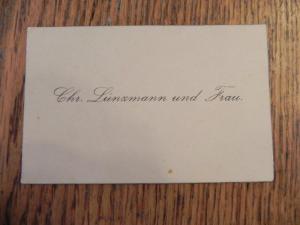
Her parents would leave gold-edged calling cards embossed with her father’s name when they went visiting. I still have one.

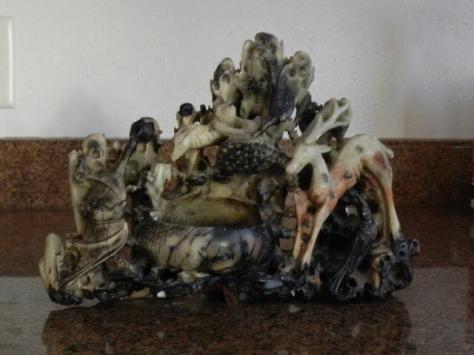
We had a strange carving in our house that my great grandfather was said to have been given by an Italian sea captain. I have it in my house now. It has always been an object of fascination for me, and you can see the weird animals and fantastical landscapes carved in it. It weighs 4 lbs. It is multicolored, with streaks of black, pale green, white, and scarlet. There are ravens, a bat, a stag, and what I think may be a bear, along with a bowl-shaped recess carved in the middle.

144 (2)

My mother didn’t know what sort of stone it was made from. I took it to a chemistry class in high school and the teacher helped me with a variety of chemical tests that ruled out granite, quartz, and marble. In 1995 I was in San Francisco, walking through China Town, and I saw similar carvings out of identical stone, and was told they were jade incense burners.

In 1913 my great grandfather left Hamburg, slipped into Holland, and boarded a ship in Rotterdam that sailed to New York City. He loved to gamble and lost everything playing cards. He ran away to avoid his creditors. My grandmother, age 14, her sister, age 12, and their mother followed in April of 1914. They brought the carving with them. Why? It is heavy. It must have taken up precious space in their luggage that they could have packed with more useful things. Not only did they haul it to New York City, they hauled it to Foley, MN two years later, and then to Pipestone County a few years after that. I wonder what it meant to them. It is more weird than beautiful. It is hard to dust. Why have I hauled it from Rock County to Winnipeg to Indiana to North Dakota? I have no idea.

My great grandfather died alone in an apartment in Pipestone in 1947. He lived with my grandmother for a few years after his wife died in 1937, and my grandmother eventually kicked him out of her house because he still played cards for money. I guess she never forgave him for what he lost in Germany. I don’t know what my children will do with the carving when I am gone, but I hope one of them will keep it and ponder its mystery and keep hauling it around.

What object are you hauling around as a relic of past generations?

As Seen From Space

Today’s post comes from the Mars Curiosity Rover

OK, I’m a robot and I speak and think in numbers. It’s not in my programming to quibble with you about language. So I must be having a software malfunction because I feel compelled to complain about the words you use.

I made news on Earth because a NASA satellite orbiting Mars snapped a photo that includes me and my zig-zag tracks in the Martian dust. “Curiosity Rover Spotted From Space” is one of the headlines I noticed. This is troubling from a public relations standpoint, since part of my mission is to build enthusiasm for space exploration. But being “seen from space” puts me in bad company. Only excessive, grotesque things like The Great Wall of China and horrible catastrophes like tsunamis and forest fires ever make the news for being seen from space.

Curiosity_rover

Besides, look at this picture. Can you really see me? I know the last time my photo was posted on this blog I was complaining about how huge some parts of me looked. But here, I’m a speck in the middle of the left hand side of the image. Big deal! Whenever I look at this picture, I feel diminished and alone.

But here’s my real problem with the wording. Saying I’ve been seen FROM space suggests that I am currently somewhere that is NOT in space, which is not true! I am in space. Space is my home.

“Ah,” you might say, “you’re on the surface of a planet and therefore technically you are not in space.”

Don’t argue technicalities with a computer. To paraphrase Jack Nicholson in “A Few Good Men”, “You can’t handle the technicalities.”

We all agree Mars is in space and I hope we can accept that I am on Mars. To say I am not also in space would be like saying a tick on the neck of a moose is not also in the woods.

The same is true of Earth. The planet and all its inhabitants are forever part of the cosmos. Therefore, when you sit down at the breakfast table each morning and stare at your Cheerios, your breakfast is in space and you observe it from space.

So you see, “seeing something from space” is not that special.

This may seem like a lot of words to waste on a relatively small point, but please humor me. Have you looked at the pictures? I’m extremely alone up here, and I’ve got nothing else to think about!

Your extra-planetary vanguard,
CR

Yes, OK. I admit we’re all in space. Was that so hard?

What commonly used word or phrase irritates you?

Somewhere In Time

Today’s guest post comes from Clyde.

I love serendipitous juxtapositions. Last month a book and a picture careened into my life at the same moment.

3 (2)

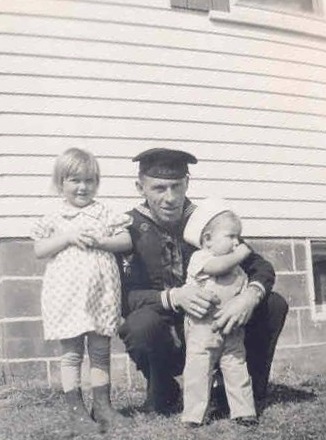
This is the picture. I’m with my father and my sister, and he is just home from the war.

The book is Hamlin Garland’s memoir Son of the Middle Border. Today an unknown author, Garland was one of the writers who inspired my interest in literature and writing. His rather stolid and overly political fiction reflects the life of my mother’s ancestors and her own life. Because my mother’s family history is set in northwest Iowa, his writing would also touch the history of a few other Babooners.

Another way to describe Garland’s early fiction is as the tale of the hard life that Laura Ingalls Wilder wanted to tell, except her daughter urged her to make them children’s stories (who could argue with that decision). Garland’s childhood oddly parallels Wilder’s. He was born in West Salem WI, which is near LaCrosse. His father then moved them to Hester, Iowa, for a brief period and another brief period in Burr Oak, Iowa, where the Wilder family also lived briefly. The Garland’s moved on to a homestead north of Osage, Iowa, or to say, southeast of Albert Lea. From there the Garlands moved to Ordway, SD, long since gone, near Aberdeen.

When Garland’s first book Main Traveled Roads was published in Boston in 1891, it released a storm of criticism because people believed that the life of the Western farmer was full of joy and reward and not dirt, hard work, and deprivation. Garland was an outspoken activist traveling through the country, urging land and economic reform. His early fiction is driven by a point of view called “naturalism,” which portrays humans as caught under the control of powerful impersonal forces, such as weather, plagues, economics, genetics, politics, and random chance. Stephen Crane of Red Badge of Courage, whom Garland encouraged and supported, wrote to a similar point of view with better narrative skill.

I had my mother read Main Traveled Roads when she was about 60. She understood it fully on instinct. She told me of how the details of early Iowa farm life were the details her father told her about his childhood, which were not unlike her own childhood. People sometimes think my childhood was hard, but I do not think so, nor does my sister. We know how hard it once was.

Garland’s memoir begins with his first meeting with his father. Garland was almost four years old when his father came home from the Civil War. It was their first meeting. As I read that opening chapter, I paused to reflect as I often have, that the two great untold stories of America are the lives of the women while the men were off to war and the adjustment men had to make coming home. William Wyler’s The Best Years of Our Lives tells that story very well. Almost every man in the cast and crew was a war veteran, including Harold Russell, who lost both hands in the war. He won the Best Supporting Actor Oscar.

Home From the War ORIGINAL

Just as I was contemplating all this, my sister sent me that photo of the two of us with my father. But there are a couple of things you don’t know yet about that image. One is that it is my first meeting with my father. I was born while he was away at war. And the second is that the version you’ve seen has been adjusted. The original photograph was shot at a distinct angle.

My mother took the picture. She took two others that day with my siblings, one of which is as tilted as this. I have a thousand pictures taken by my mother. Only these are off-kilter. I always assume we are seeing her own emotions in that angle. Obviously, With photoshopping it is possible to straighten that picture. How prosaic it is without the tilt.

What do you view from a unique perspective?

Abuse of Power

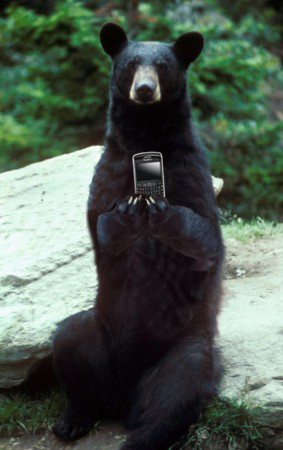
Today’s post comes from Bart, the bear who found a smart phone in the woods.

Hey, Bart here.

Yeah, I’m awake. Hibernation isn’t a long nap, y’know. It’s a prolonged state of half-wakefulness, so I drift in and out.

And there are dreams.

I just had one where I was standing in a room and a bunch of people were yelling at me because I stopped traffic. Which is weird because that’s what we do – bears stop traffic because people have to slow down to take pictures of us. Sometimes you can score a few cheese balls because humans love to throw food to a bear out of a moving car. Even if the car is barely moving. That’s just nature.

But then I realized it wasn’t a dream – the phone was streaming Chris Christie’s news conference about some deal where somebody in his office told somebody else to do something to slow down traffic so the Mayor of some town would be embarrassed. Which seemed like a lot of trouble to go, but I guess that’s what politicians do – they’re like bears and they can’t help themselves. When they get a chance to stick it to the other guy, they pull strings and call in favors and do whatever it takes.

Believe it or not, forest creatures know all about this. A lot of us live on federal land, so we have to be cozy with the government. After all, bureaucrats control our lives. I don’t have to tell you who makes the rules for bear hunting, for example. But I’m not saying I’ve been ordered to do certain things by office holders with authority over my territory. It’s just that there have been times when I sensed there was a specific garbage can I should turn over. I had a feeling that powerful people would be pleased if some secrets tumbled out of a particular pile of trash.

So you do things to make your friends smile. They don’t have to ask. It’s called getting along.

I’m not saying the wild animals of America are turning partisan and playing dirty political tricks at the whim of combative office holding tyrants, because that would be really unsettling. But you do have to adapt to your environment.

Your pal,
Bart

How do you curry favor?

Habit Breaking Habit

Today’s post is a letter from perennial sophomore Bubby Spamden.

Pledge

Hey Mr. C.,

Happy New Year!

Hope that’s an appropriate thing to say. I guess people your age don’t get too excited about another year coming along when you just barely got used to the last one. Writing in that “..14” on the date can take older folks a while, I know. My grandpa says he’s still not used to the “20..” at the beginning. He says by the time he gets the hang of it, we’ll be ready to change it to “21..” But I don’t think that’s even possible. He likes to pull my leg.

Anyway, we’re going back to school today (after TWO EXTRA DAYS off!) and I’m pretty sure Mr. Boozenporn will do his New Years’ Resolution unit about how habits form and how hard it is to break them. He does it every single year without fail as soon as we come back from Holiday (Christmas!) break. At least he has as long as I’ve been around, and I’ve been around a while!

I really love the habits unit. It’s so familiar! And Mr. Boozenporn says the older people get, the more they appreciate their traditions and routines. But when we did the habits unit last year he didn’t teach it right, and when I brought it up to him that he made us read the textbook chapter on Obsessive Compulsive Disorder BEFORE we did the whole-class repetitive behavior assessment rather than the other way around which is how it SHOULD have been done, he told me I was too young to be so inflexible.

What kind of answer is that?

I know plenty of inflexible young people – a lot of them are my best friends, and they’re as crotchety as old folks. Griping about stuff is one way for them to seem grown up, I guess. Even though I think they’re overdoing it. Jennifer Gadberry made a huge fuss at lunch the other day because the cooks served her the wrong color jello. Why would that even matter? I’m sure it’s something she learned from her grandfather, but I have to admit she brought a really fresh level of energy to what would have otherwise been a pretty boring meltdown.

As part of the habits unit, Mr. B. will put everyone on the spot to reveal a major behavior they’re going to break during our post-holiday, full-of-hope-for-a-new-me period. This is a really tough moment for us high school sophomores because everybody wants to look like they have some major private disfunction going on, but nobody wants it to be particularly bad or embarrassing. Once it has been named you can get typecast for the rest of High School if you’re not careful.

And yes, word travels fast.

The ones who aren’t ready for the question sometimes come up with something their parents already criticize them for, like not washing their hands or not keeping their room clean or nose picking. Saying out loud that you want to work on something like that is a really serious mistake.

The right thing to say is “I want to find a way to stop being so awesome so my friends can relax around me and not be intimidated all the time.”

Which is, of course, an awesome answer.

Awesomely, your pal,
Bubby

I told Bubby I wouldn’t be like Mr. Boozenporn and put people on the spot for a New Year’s Resolution. Not for themselves, anyway.

Write a New Year’s Resolution – for someone else.

Ice Pirates

Today’s post comes from the skipper of the pirate ship Muskellunge, Capt’ Billy.

Artist's Approximation of Captain Billy
Artist’s Approximation of Captain Billy

Me an’ th’ boys was quite excited last week when all th’ news channels was besotted with details regarding’ that Russian ship what got caught in th’ ice ’round Antarctica. As professionals in th’ field of immobilizin’ vessels an’ liberatin’ passengers of their valuables, we is always on the outlook few new techniques that could streamline our work! The sight of a ship full of journalists, researchers an’ tourists completely unable to move was, for me boys, like dumpin’ a basket of hot breadsticks in front of a group of pensioners at a buffet.

Now, when it comes to yer types of individuals ya might hope t’ find stranded on a boat, ya can keep yer researchers an’ journalists on account of the fact that they is well known cheapskates. But a boatload of earnest, moneyed, climate-change tourists what can’t move is th’ sort of prize that gets our juices flown’. An’ by the time I joined the conversation, th’ boys had begun to draw up plans to retrofit th’ Muskellunge as an icebreaker, an t’ go chargin’ off in search of some of that frozen polar booty.

‘Twas up to me as Captain t’inject a note of reality into th’ discussion.

“Not t’ pour cold water on yer fine ideas,” I said, “but does any of ya realize that operatin’ comfortably at either one of th’ Earth’s poles requires loads of equipment an’ a level of hardiness that goes far beyond the jolly ‘Har, had, har …’ of yer typical tropical buccaneer?”

I told ’em about all th’ gear they’d need, including thermal skivvies, fleece scarves an’ ear muffs. A pirate is a rather vain creature, an’ none of ’em could picture hisself in such a get-up. When I said they’d have t’ wear all their clothing at th’ same time in order t’ stay comfortable fer this one adventure, an argument broke out about whether a pirate ever should reveal where his secret hiding place is located.

It was a half hour before I could convince ’em I said “layers” an not “lairs”.

I proceeded t’ inform them that human skin freezes in as little as ten minutes when exposed to temperatures in th’ thirty to forty below range. They was unimpressed. But then I told them they could get chilblains. Chilblains occurs when bare skin is exposed to cold water, or when wet flesh cools. As pirates, of course we is never far from water, so one would always have t’ consider it a risk. When a feller gets the chilblains, his skin itches and swells something’ terrible, an’ it can lead to gangrene!

That did the trick. Frostbite don’t sound so bad I guess, but chilblains …? Th’ word itself is too gruesome. They wants no part of it! Their plans t’ set sail fer th’ Antarctic was dropped that very same night an’ we re-committed ourselves t’ bein’ th’ best warm-weather pirates possible.

Let that be a lesson – ya can argue til yer blue in th’ face, but even turnin’ blue in th’ face won’t change minds. But if ya gives somethin’ a properly fearsome an’ somewhat appalling name, people will respect it, an’ learn t’ keep their distance!

Accordingly, t’ keep international law enforcement types away, we’s thinkin’ of re-namin’ the Muskellunge the Cancer Inferno!

Yer salty pal,
Captain Billy

When have you ventured into the cold, unprepared?

Ask Dr. Babooner

We are ALL Dr. Babooner

Dear Dr. Babooner,

I work in a tiny collection booth in a parking lot near the university. I started as a student there about thirty years ago, but I never made it through the philosophy courses I needed and dropped out a few credits shy of graduation. So six days a week, fifty two weeks a year I climb into my little glass-and-plywood box to scan tickets and make change. It’s a pretty crummy job – kind of like sitting out in a open field all day except I get extra helpings of car exhaust. Now the weather forecast says a historic cold wave is coming on Sunday night and Monday morning, and everybody around me is in a panic over it. The Governor has closed all the schools in the state, but he doesn’t have the power to cancel my job so I’ll basically put every last piece of clothing I own, just like I do most every day in the month of January, and head in.

I’ve made a name for myself by being chatty and pleasant when drivers stop at the window to pay their fees. I joke with them and smile and wish them a pleasant day and I never complain about anything even though some people try to get me to do it, especially when the weather is extreme. Of course I’d like an air conditioner or a space heater, do you think I’m not human? But the customers will never hear me say it because I’m trying to project a more positive image. They’ve given me a cute nickname because I’m so upbeat, even though every now and then someone wonders how I handle the tedium of such a dead end job. I usually say “You’re the one who’s driving into a dead end and paying me for the privilege. So I’ll take my job over yours any day.” We both have a good laugh over that but what I’m really thinking is “My job wouldn’t be so tedious if you weren’t so boring.”

It’s important to know the difference in the way it feels to say something out loud as opposed to just saying it in your head. So far so good.

Anyway, on Monday I know a bunch of my customers will encourage me to gripe about the cold. I’m determined not to do it but I’m afraid hypothermia might make me slightly delusional and I could slip and start to get crabby about how they don’t insulate the booth and how bringing a space heater would short out the cheapskate power strip they put in and that would crash the computer and cause a back up in the exit lane which would lead to a lot of fist-shaking rage and refund demands not to mention the huge plume of exhaust that would collect around my work area, which would probably give me lung cancer and make me die, though not soon enough.

Obviously those are some pretty dark thoughts. I pretend to be upbeat but I might be a nihilist though I’m not sure. If I asked one of the professors to explain existential philosophy to me while I ran her Visa card, the cars would back up in the exit lane which would lead to a lot of fist-shaking rage and refund demands and so forth and so on and we would wind up in the same unhappy place. And now comes this weather, which really has me down.

Dr. Babooner, I don’t really have a question for you, I just wanted to say things to someone in a string of words that lasts for more than eight seconds. Thanks for hearing me out and have an awesome day!

Sincerely,
Cheerful Chuck

I told Cheerful Chuck to keep up the good work. Having a job that gives you lots of time to think and very little time to speak is much better than having a job with lots of time to speak and very little time to think, which is what you get when you’re a politician, a pundit or a disc jockey. But that’s just one opinion. What do YOU think, Dr. Babooner?

Frozen in Time

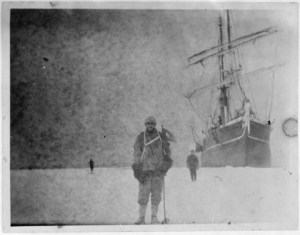
Somebody snooping around in an old hut in Antarctica discovered some century-old negatives that were snapped during the Shackleton Expedition in 1915-17.

(photo: Antarctic Heritage Trust)

First of all, I’m surprised there is a little-used hut in Antarctica. It was built by Robert Falcon Scott and served as the jumping-off place for his unsuccessful 1910 expedition. It also was a life-saver for the Shackleton party when they were stranded. And much of the rest of the time it has just been sitting there.

The photos are interesting, I suppose, if you like looking at black-and-white images of grey water and bright white. Faded landscapes leave me cold, especially when the landscape in question is a glacier. Only a couple of the images feature people, and faces (for me) are the thing that can make an old photograph compelling.

Charming nameless tykes
Unidentified couple takes no pleasure in being forgotten.

I just spent the day going through boxes of crinkly old papers that had been pushed to the back of a closet, including several ancient photo albums featuring relatives I’ve never met and, I fear, will never be able to identify. Most of the images have no accompanying notes, not even a name scribbled on the back. For all I know they are members of the Shackleton expedition, stranded on some distant featureless iceberg. I guess it was expected that no one would look at these pictures without the guidance of a knowledgeable companion. I suppose that’s what we imagine when we catalog such shots in family albums – that they will be inter-generational conversation starters. But photographs can easily outlast everyone who has direct knowledge of those pictured, so when the older generation is gone and no one has taken the time to jot down a few notes, only mystery remains.

How legible is your family story?

The Prescient Prognosticator Prize – 2013

Last year on this very day, baboons on the trail were asked to offer their predictions for the year 2013. Of those who took up the challenge, only one impressed me with his accuracy.

Screen Shot 2013-12-30 at 8.18.34 PM

I cannot go down the list point-by-point to verify each of the things Chris predicted, but he gets credit from me for picking some easy targets and combining those automatic points with a few bold guesses. Chris knows the seer must choose words carefully. He beautifully hedges his bets with guaranteed-to-succeed-on-some-level predictions like:

“The Gophers will win the NCAA Hockey Tournament.
(Uh-oh, I may have just jinxed them.)”

No, the Gophers did not win the NCAA Tournament.
But Yes, it may be because you jinxed them.

And he is frustratingly non-specific on seemingly simple pronouncements such as:

2013 will be cooler than normal. (Just a hunch)

Cooler locally, nationally or globally?
Cooler temperature-wise, or in overall (or individual) hip-ness?

This is the kind of vague prediction that is certain to be both true and not true.

I don’t know if Chris managed to find a publisher or an agent this year, or if he won that hoped-for writing award. But I do have the power to make this part of his scenario at least partially true by awarding him a laurel he didn’t seek and doesn’t expect – the Trail Baboon Prescient Prognosticator Prize for 2013.

Care to enter for 2014?

Make your predictions!