Greatest Show on Earth

Today is the birthday of the American showman and promoter, P.T. Barnum, in 1810.

Barnum had a genius for marketing anything people were willing to gawk at, whether it was a blind old woman, a dwarf, an elephant, a monkey head sewn to the tail of a fish, or a Swedish soprano.

Part of Barnum’s gift was to recognize that people need a story and a powerful name to spark their interest. Thus the blind old woman was amplified to majestic proportions, and in Barnum’s world was presented as not just an old woman, but George Washington’s former nurse. To make the math work, her age was said to be 161 years.

The dwarf was also age enhanced, transformed by Barnum from a 5 year old to an 11 year old, and re-named “General Tom Thumb”. Though he was actually from Connecticut, Barnum advertised him as being brought from overseas “at great expense.”

The elephant was dubbed “Jumbo” and actually was brought from overseas at great expense, and proved to be a huge moneymaker for Barnum, only to die tragically in a head on collision with a locomotive. The monkey/fish concoction was billed as “The Feejee Mermaid”, and soprano Jenny Lind won hearts as “The Swedish Nightingale”.

Barnum is said to have been an advocate of “humbug” as a useful tool for promoting various acts, meaning it’s OK to exaggerate and tell outright lies if the public gets its money’s worth and enjoys the show.
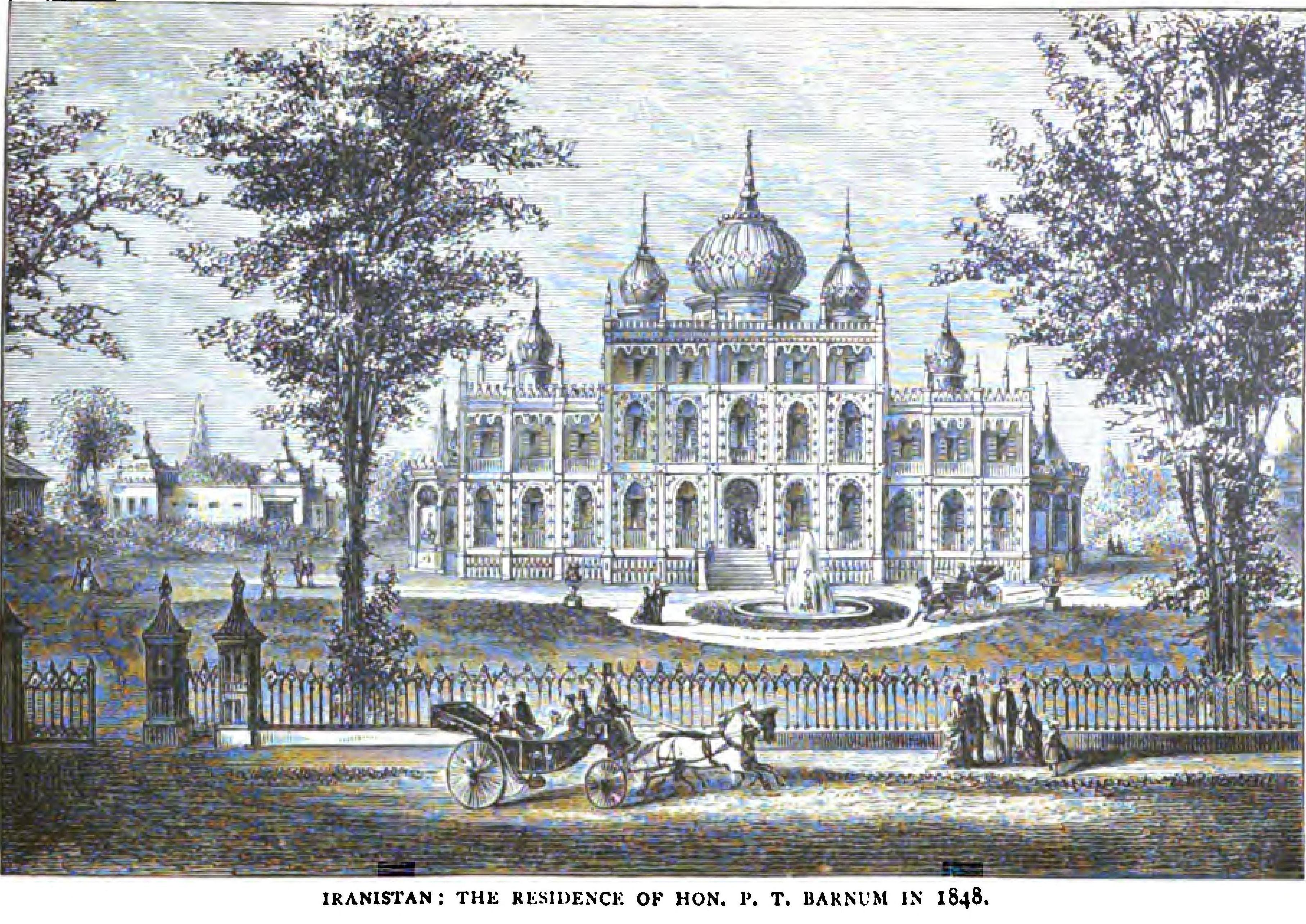
He made a lot of money and did extravagant things with it, including building a palace in Bridgeport, a Xanadu he named “Iranistan” (really!). Jenny Lind claimed that seeing an image of Iranistan is what made her want to come to America to be put on display by Barnum – his success was evident from the majesty of his home.
Never mind that Iranistan burned to the ground 9 years after he built it.

Barnum would feel right at home in the world of 2011, and would thrive online, a vast kingdom made up almost entirely of humbug. In fact, everything I know about P.T. Barnum came directly from Wikipedia. How much is true? Who cares?

Does the world need promoters?
Taking the Long Way

Happy Independence Day!

To celebrate freedom by staying home from work on a Monday must feel especially sweet, unless you happen to be an employee of the State of Minnesota. In that case, the open ended-ness of your long weekend would tend to put a damper on those feelings of jubilation. Trust me on that.

Personally, I’m reporting for work today without complaint, because I have to, and because it’s delightful to have a job.

And so we will observe the day with picnics, parades and fireworks, though some might choose to celebrate with a woodworking project.

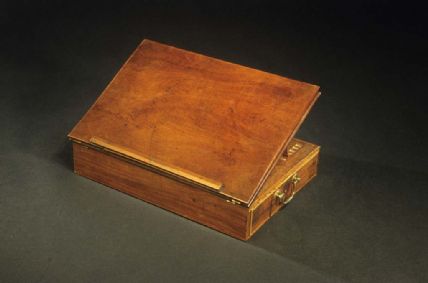
Here’s an artifact that is, without a doubt, an object of great significance. Thomas Jefferson drafted the Declaration of Independence on this lap desk of his own design. A compact and tidy thing, it folds out to present a felt covered workspace that sits at a comfortable angle for writing.

And yes, you have to do your scribbling longhand. There’s no keyboard, kiddies.

But it IS portable. Jefferson was a visionary, and somehow he could see that we would want to be able to plop down and put our thoughts to parchment anyplace, anytime. You can store your writing implements in the handy divided slide-out drawer. And it locks, so people can’t steal your ideas when you drift up to the counter for another caramel macchiato grande latte.

The Thomas Jefferson lap desk appears simple enough to be a basement project for the at-home craftsman, and some have tried. I can only guess that the various moving parts, tight fitting drawer and old-world corner joints defeated a few amateurs along the way. Just like writing the Declaration itself, the creation of an enduring piece of art is a lot harder than it looks.

One of the greatest things about America is that somebody else is ready to sell you that thing you can’t make for yourself – and there’s a price range so you have a chance to find one that suits your budget.

You can pay just over $1,900 (with shipping) for a Jefferson Lap Desk, though you’d think at that lofty price point it might be more effective to deliver the whole package for $1,776. Others are available at $795 and $600, fountain pens not included.

Once the desk arrives, open it up and conceive a nation (in liberty). Feel free to start over as often as you like. As long as you’re creating some founding documents, try to include a few words of advice for future leaders in regard to the whole notion of a debt ceiling.

If you’re like me, you’ll have to figure in the ancillary costs of dribbling ink on your good shirt.

When do you take the time to write it out longhand?

What Government?

Good discussion on Friday about admiring those you don’t agree with. Thanks to Clyde for the thoughtful guest post, and for bringing up Jon Hassler, whose writing provides a comfortable place for so many readers.

And so far, so good on the state government shutdown.

At least as far as my personal comfort is concerned, and what else matters? I’ve already got money, food and good health. Why should I worry about suddenly absent services that only other people need, especially if they’re people I don’t know and can’t see?

A friend forwarded a video for those who adhere to the old Ronald Reagan saying –
“Government is not the solution to our problems, government IS the problem.”

I can’t deny that government is sometimes inefficient and bureaucratic. But unnecessary?
It’s handy to have someone or something to blame for all the problems you see. But you may not want to wish it away entirely.

Where is the most lawless, unregulated place you’ve visited?

Mutual Admiration/Opposition Society

Today’s guest post comes from Clyde.

I am a devoted re-reader of the 1974 book Staggerford by the Minnesota writer Jon Hassler.

I admire the honest but still satirical image of the professional life of a secondary English teacher, which Mr. Hassler once was. It has a delightfully real and satirically-portrayed faculty party and faculty meeting. Also, equally honest is the portrayal of the sad lives some students are forced to endure. As a lucky side-light for me, I have met the teachers who were the models for two of the characters in the book. He got them exactly right.

But when I re-read it every two years or so, I more and more admire the character Agatha McGee, the main character’s land lady. Miss McGee is old-fashioned and conservative, in the true sense of the term of one who does not want things to change, ever. She is a devout Catholic who still uses her ancient Latin Missal. When she passes the peace in church, a modernism she resents, she says “Pax.” She is a sixth-grade Catholic school teacher who dresses and runs her classroom the way teachers did in the 1920’s. She is dark and broods over rain, sin, and the moral laxity of modern poetry. She later becomes the main character in two subsequent books which have never quite worked for me.

As a dedicated change agent in education, and one open to modern adaptations in religion, I should dislike her. But instead I am drawn to her and the clarity and wit of Hassler’s descriptions of her. I suspect he feels a similar contradiction in his attitude towards her. It is the strength of her convictions, her underlying humanity, and her take-charge-in-a-leadership-vacuum ability which so strongly affect me.

I hope I am a better liberal, well, moderate liberal, for having met her.

When have you come to respect, admire, or even love someone, real or fictional, whose opinions or attitudes contradict your own?

Budget Deadlock Haiku

So much has already been said about a possible Minnesota government shutdown tomorrow, I hesitate to add even a single word to the flood of opinion. The Commentary River is well over its banks and some good people may lose their homes while familiar words swirl around them.

Maybe we need to impose strict verbal austerity measures.

Use your talking points.
Three lines, five, seven and five.
No new syllables!

Gold Horses look down
No one can clean their stable.
Mountains of manure!

My closed state park is
Beautiful without me there
Or so I suppose.

Government is the
problem that cannot be solved
with just a hammer.

Here’s a compromise.
You can adopt my viewpoint
Any time you like.

Best Vacation Ever

Thanks to the Sherrilee, Renee, and Beth-Ann, the guest bloggers who kept the conversation rolling while I was enjoying a long weekend in northern Minnesota.

It was a wonderful time to be away – even the mostly rainy day was delightful. And I learned about perspective! There is a proper way to record the events when you are catching impossibly tiny fish.

Pose like this ...

... not like this!

Summer, 2011 is turning out to be wonderfully green and lush. If you were lucky enough to not flattened by a tornado in North Minneapolis or submerged by a river in Minot, the weather has probably been pretty fair for you. Still, it is an upper Midwesterner’s obligation to complain bitterly about whatever prominent feature the climate is projecting. In this case, it’s the outrageous amount of rain and the far-too-cool temperatures, though the truth is that we are blessed to have enough moisture and something less than blistering heat.

For those who would like to experience a truly harsh environment, I suggest you book your passage as soon as it becomes possible to visit an asteroid.

This would be the vacation of a lifetime, if by vacation you mean a bleak and frightening experience that feels endless. NASA has sent a probe named Dawn to spend a year with Vesta, an asteroid that orbits our sun. Like some of those exotic vacation resorts you’ve chosen and then regretted, we don’t know very much about Vesta. Even the brochure is puzzling – this line-up of all the best known features makes Vesta’s amenities look like an assortment of blurry potatoes.

But they have sun there (or we wouldn’t be able to see it), so let’s go! I think I can see a pool in the third image from the top left, and is that the golf course in the fourth picture from the right, bottom row? I think it is, and it looks like there are no trees to get in the way of all the perfect, lo-gravity shots I plan to hit.

Fun!

Describe a vacation destination that was much different than you imagined.

Uncommon Knowledge

Today’s guest blog comes from Sherrilee.

As many of us on the Trail have discussed before, as we get older, it’s an interesting phenomenon that information that used to be part of our cultural lexicon has passed out of usage. As the mother of a teenager I am constantly reminded that the younger generation doesn’t have the same cultural knowledge that my generation has.

Lucretia

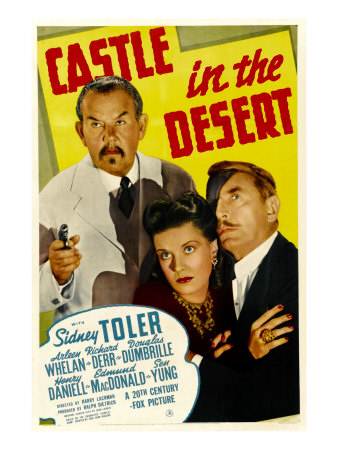
When I was a kid, Lucretia Borgia was well-known as famous poisoner. I didn’t know much more about her except that she had lived in the olden days and wore a big ring that opened up to deliver deadly poisons to her enemies. In fact, I remember a Charlie Chan movie, Castle in the Desert, in which the femme fatale was a descendant of Lucretia and had inherited the venomous ring (which, of course, was the murder weapon). I have since read up and learned that poor Lucretia Borgia was greatly maligned and probably didn’t do any of the dastardly things that used to be “common knowledge” about her, although her father and brother were certainly very poor role models for anything remotely resembling nice guys.

Although she was born out of wedlock, her father, Pope Alexander IV, didn’t hesitate to use her for his political gain. He married her off repeatedly to political allies beginning at a young age. Then when the political winds shifted, he and her older brother Cesare arranged various endings for those marriages (annullment and murder topping the list). Her final marriage survived her father’s ambitions (and life) and she lived the remainder of her life in Ferrara. She died from complications of childbirth in 1513.

She was just thirty-nine

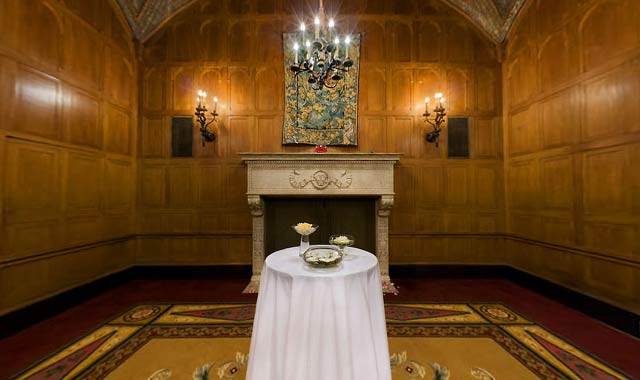
In my job, I arrange a lot of functions in hotels throughout the world – welcome receptions, breakfasts, theme parties, meetings. About 10 years ago, I was working with the Westin St. Francis in San Francisco and arranging the final night dinner for a small group. In discussing the evening, I asked where my event was scheduled and my contact replied “in the Borgia Room”. We finished our conversation but as I hung up the phone, I turned to one of my co-workers and laughed… “I’m not sure if I were one of my participants, I would want to have my final night dinner in the Borgia Room.”

The Borgia Room

My co-worker, who is not that much younger than I am, looked at me blankly. Not only did she not get my joke, but when I explained who Lucretia Borgia, it didn’t even ring a bell. I went on a small surveying trip around my department and with the exception of my boss, no one had heard of Lucretia Borgia. I was dumbfounded to realize that something I assumed was common knowledge was NOT.

My group’s dinner went off without a hitch and no one seemed concerned about eating a meal in the Borgia Room. But I have never forgotten it!

What things used to be common knowledge in your world, but aren’t anymore?

N.A.T.S.

Today’s guest post is from Renee Boomgaarden.

Our town has a wonderful vocal teacher. “Kathy” (not her real name) is a conservatory trained soprano who found true love with a local backhoe operator and successfully blended marriage and motherhood with the work of a vocal performance major. She teaches on occasion at the local college, performs with regional operas and civic choruses, and has a private vocal studio.

Kathy is really gifted at nurturing young voices and picking just the right material to challenge and inspire her students. This April, three of her oldest high school students (my daughter, daughter’s best friend, and another local girl) participated in a juried competition sponsored by the state chapter of NATS, the National Association of Teachers of Singing. The event was held at NDSU in Fargo while the Red River was cresting. Kathy is a member of NATS and participated as one of the nine judges. I drove the three girls to Fargo, along with best friend’s mother who also was the girls’ accompanist.

The singers were divided into competitive categories based on gender and year in school. Our girls were lumped in the one high school category. Most of the singers were college undergraduates, with a few singers in the graduate student and adult categories. There were separate categories for those singing Broadway musical numbers. Most of the participants sang opera arias and oratorio solos, with a few art songs thrown in. All singers started performing at 8:00 am.

It’s quite something to hear and see about 60 anxious singers preparing to compete that early in the morning. Practice rooms were at a premium. Most of the women wore rather daring and flamboyant cocktail dresses and very high heeled shoes. (By the end of the day, most of the women were walking around in bare feet). The men wore somber suits and ties. Once the 8:00 round was completed, the judges decided who would go on to the 10:30 round in which more singers would be eliminated, and so on through the 2:30 round, until the 4:00 final round in which the three best singers in each category would perform and be evaluated by all nine judges.

At 8:00, our girls were judged by two men who wrote furiously while the girls sang. They were finished by about 8:30 and they fell asleep in the van in the parking lot for two hours. Tension runs high at these events and those few minutes of singing wore the girls out. Best friend’s mom and I spent nap time listening to other singers and watching the weeping of those who were eliminated and the excitement of those who were sent on to the other rounds.

Our girls were the only high school students at the competition. Best friend has a phenomenal voice and she was the only one we expected to make it to any of the other rounds. Much to our surprise and delight, the judges decided that since there were only three high school students, all of our girls were automatically forwarded to the final round held in a lovely and intimate recital hall.

The Steinway grand took up most of the stage. The voices in the final round were truly beautiful and I don’t know how the judges decided between them. My daughter was the youngest singer in the competition. She is an alto, aka mezzo soprano at these events. Her voice is just developing strength and range. It was so interesting to hear how the voices matured as the singers got older, even among the college-age singers.

The last singer was a graduate student, a huge, barrel-chested man who closely resembled Pavarotti and looked like he was quite ill. He struggled to the stage, got himself in role, and and filled the room with an enormous, powerful baritone. He then struggled back to his seat and looked like he was going to collapse.

Daughter was awarded $10 for making it to the final round. The judges’ comments were all encouraging and kind. I am informed that she wants to do this again next year and she insists she has to have a new cocktail dress for the event. She feels she is too tall and her ankles too wobbly to wear high heels.

What have been your experiences being judged?

Steerage Song

Today’s guest post is by Beth-Ann.

Early this month, Dan Chouinard and Peter Rothstein premiered a musical docu-drama (Peter’s word) telling the story of immigrants who traveled through Ellis Island. Steerage Song is a powerful homage to what is lost and gained by immigrants.
Beautiful voices sang the words from Emma Lazarus’ poem inscribed at the Statue of Liberty

“Give me your tired, your poor,
Your huddled masses yearning to breathe free,
The wretched refuse of your teeming shore.
Send these, the homeless, tempest-tost to me,
I lift my lamp beside the golden door!”

And like John McCormack in this video the talented cast sang about the Beautiful Isle of Somewhere.

I was moved by this production for many reasons, but one of the big ones is that I am from an immigrant family. All of my great grandparents, my grandmother, and my son are immigrants. They came from Ireland, Russia, Germany, Austria , and Korea to this foreign land where they learned a new language, new jobs, and how to add their potatoes, kreplach, and kimchi to the melting pot that is America.

I am also a migrant. I was born in Japan on American soil and didn’t come “home” until I was 9 months old. Since that time I have lived in Michigan, New York, North Carolina, Virginia, Maryland, Massachusetts, and Minnesota. I think this Land of 10,000 Lakes in My Isle of Somewhere.

We are all immigrants and some of us are migrants too.

What has been your family journey lit by the lamp at the golden door?

The Matchbox Tree

Today’s guest blog is by Sherrilee.

My dad didn’t go to law school until I was born so didn’t settle into his career until a little later in my life. One of the results of this was that we moved around a lot when I was a kid. This meant I was ALWAYS the new kid on the block and I struggled to find friends and fit in.

When I was five, we lived on West Cedar in Webster Groves, Missouri for about a year. It was a great old house on a tree-lined street and as a family, we went through quite a bit in that house. My younger sister had her open-heart surgery when we lived there. My mother survived scarlet fever in this house and I learned to ride a bike on the street in front.

But my favorite memory of living on that block was being befriended by the little boy who lived across the street. His parents had welcomed us to the neighborhood early on; his name was Bobby and he was a year older than I was. There weren’t any other kids on our block that summer (except my sister who was too sick to play outside with us) and this was back in the day when you made do in your neighborhood. You just didn’t get driven around by your parents for play dates back then.

Bobby had a huge collection (or so it seemed to me at the time) of matchbox cars, all different shapes and colors, that he kept in a big shoe box. He knew all the names of the different makes of cars and could tell you when he got each one. He could play with those cars for hours and he invited me to join in his adventures. He did have a little track for the cars in the house but the hands-down best place to play was around the base of the big tree in front of his house. You know the kind of tree I mean – one of those trees with the root systems jutting out of the ground and winding all around. It was the perfect setting for all our matchbox action. We drove the cars all around, up and down the various roots and even placed popsicle sticks across some of the roots to make carports and caves. We had quite a few different scenarios to play out, but it seems that many of our games were spy games, with one spy chasing another all around the tree, in and out of our little caves. It never seemed to bother Bobby that I was a girl and I don’t remember our folks worrying about how much time we spent playing with those cars that summer. My family moved away that fall, but that summer of the matchbox tree still remains as a sweet childhood memory for me.

What childhood game brings back good memories for you?