I was happy to read in the Luverne paper this week that construction has started on a 7.5 million dollar child care center in town.
A couple of years ago, residents expressed concern about dwindling child care options, and the city responded by securing funding for a municipal child care center to serve over 100 children ages birth to 12. The city just had to secure a $1,000,000 city match from community members. Well, that took only six months, and they exceeded the goal.
In Dickinson, child care is getting harder and harder to find, especially for infants. We recenly lost a terrific mental health tech because she had no daycare for her infant daughter. It is so good to hear the progress in Luverne, and I only wish Dickinson would follow suit.
What progressive things are happening in your community? Did you ever have babysitters, either when you were a child or for your own children ?
I read with amusement and disgust the effort by the current president of Chechnya to regulate the speed of music in that country.
The only music that is allowed for singing, instrumental performance, or dance must be between 80-116 beats per minute. The president thinks those tempos correspond to the brains and culture of Chechnyans. Anything else is contrary to Chechnyan values and culture. To give you a sense of what is allowed, Imagine by John Lennon would be too slow, and Here Comes The Sun would be too fast.
Well, good luck enforcing this. I suppose that any orchestra could regulate the speed during performances of classical music. What a loss for the populace, though!
What are your favorite slow and fast music pieces? What laws do you think have been unenforceable?
One highlight of our trip to Tacoma was a side trip we took to the northern part of Puget Sound to Orcas Island to see. . . orcas!
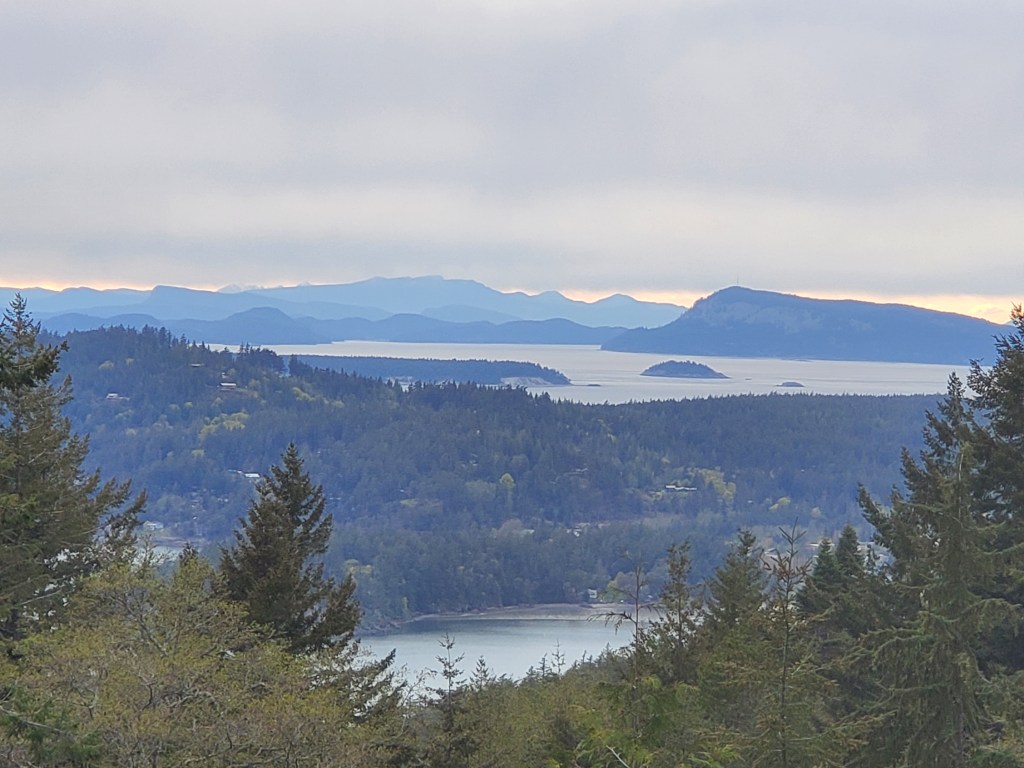
We took a ferry to the island and stayed in an Air B and B that was up a single lane, vertical dirt road to a place that was lovely and that afforded a gorgeous view of islands and the Sound. Vancouver Island was quite close.
The crew of the whale boat were three marine biologists who loved their work and who loved to tell us all about the animals. There were about 30 people on board, including some very lively children. We were very lucky to encounter a pod of seven orcas, including a young orca. We saw them chase a harbor seal, but we didn’t find out if they caught it. At one point the pod divided into two groups and we had orcas on both sides of the boat. The marine biologists somehow knew the lineage of the pod, and showed us the pod family tree going back to the great grandmother. We were also thrilled to see the largest and oldest orca in that part of the Sound, a huge 62 year old with a notch in his dorsal fin, probably from the bite of a Stellar’s Sea Lion.
With regard to the sea lions, they were the only animals stationary long enough for me to get a photo. They were lying on a large rock, grunting and bellowing, and roaring. You can see them in the header photo. They smelled terrible!
The orcas leaped and swam but were too fast to catch on camera. So were the otters. It was nice to just sit and watch with my eyes and put my phone camera down for a while.
What are some memorable “up close” wildlife encounters you have had? Did you ever want to be a marine biologist?
Sliced bread was invented here. That’s right — the Taggart Company was the first place to start selling pre-sliced loaves of bread.
This is home to the world’s largest Children’s Museum, with over 130,000 artifacts, including an indoor carousel and dinosaurs guarding its walls
The original Union Station in this city was the country’s first “union” passenger rail station. Its initial construction was in 1853, but was rebuilt 30 years later. Union Station was frequented by many prominent figures, including Franklin D. Roosevelt, Harry Truman + Woodrow Wilson.
The downtown Athenaeum was designed by Kurt Vonnegut’s architect grandfather. It was originally used as a gymnasium and clubhouse by German-Americans striving to preserve their culture.
This city’s beloved Slippery Noodle Inn was a stop on the Underground Railroad during the Civil War, with enslaved people hiding out in the building before catching the northbound train nearby. Not only that, but it was also a watering hole during the prohibition era + a mobster hangout.
Speaking of Kurt Vonnegut, this is the home of the Kurt Vonnegut Museum & Library!
Where am I? Extra points for knowing WHY I am here!
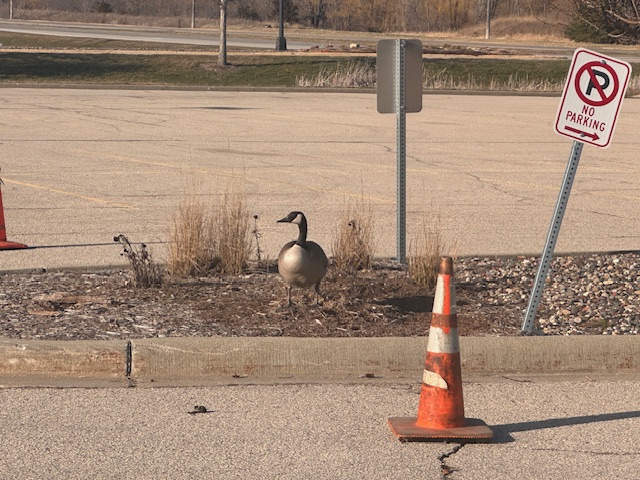
The college says it’s ‘Aggressive Goose Season’. Proof of Spring if I nothing else is.
There are two pairs of geese. One pair in the courtyard on the West side of campus and they will fight you. And another pair on a median in the middle of the East parking lot. The male stands in the middle of traffic keeping watch. It’s down to single lane there and security has put cones around them.
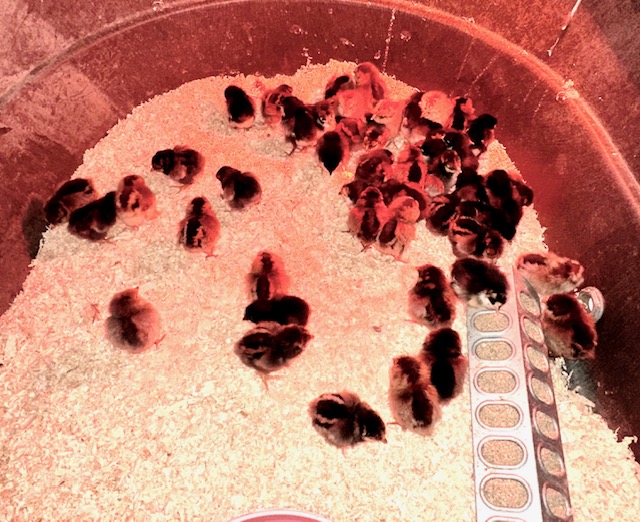
I picked up chicks from the post office on Thursday. Poultry chicks I mean.
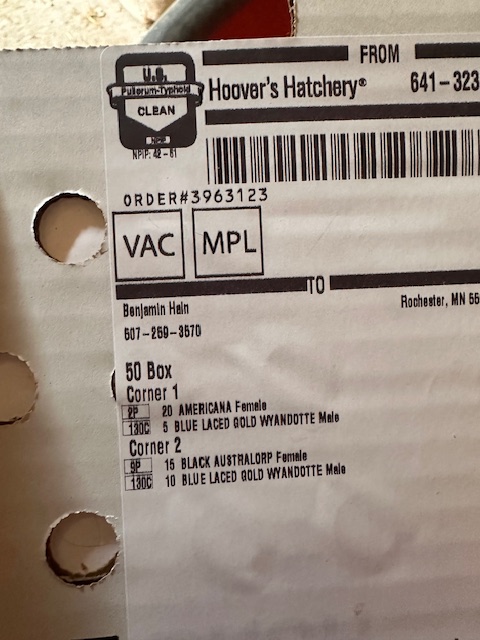
I ordered 50 this year. And because details are a problem for me, somehow I got 15 male ‘Blue Laced Gold Wyandotte’. I didn’t mean to order boys. Still don’t know how I did that. And I looked at this order several times last week to watch the ship date and I never noticed. Details. They’ve been vaccinated for coccidiosis.
So. Guess I’ll have fresh chicken to eat this summer. My mom showed me how to butcher chickens several years ago and that’s when I decided I’d rather collect eggs. I think I’ve heard the neighbors says there’s place I can take them to be butchered. It’s not a good idea to have adult 15 roosters. The poor hens don’t get a chance as they boys never give them a break. And they fight amongst themselves. And believe it or not, we’ve never had a whole chicken to bake, so that will be something to learn and experiment with. Baby chicks are kind of expensive depending on the breed. Somewhere between $4.55 (for the boys) to $5.19 for the green egg layers. I’ll be ordering baby ducks later this summer and they’re $8.36 for a mixed variety, to $9.52 for mallards. Minimum order is 15.
We heard the sandhill cranes this morning. I hope they stick around a while. Saw a turkey vulture too.
Our dogs, Luna-tic, and Bailey are getting along better. Bailey has realized she can fight back, and when she does, she can hold her own and not let Luna push her around, and now they are playing more than just fighting.
Husband and I don’t travel very much. Twice a year I have to go to a conference in various destinations in the US or Canada as part of my work on a regulatory board, and Husband sometimes goes along. If I didn’t have to attend the conferences we wouldn’t travel as much. We are just too busy with work, gardens, and family pets to leave home very often.
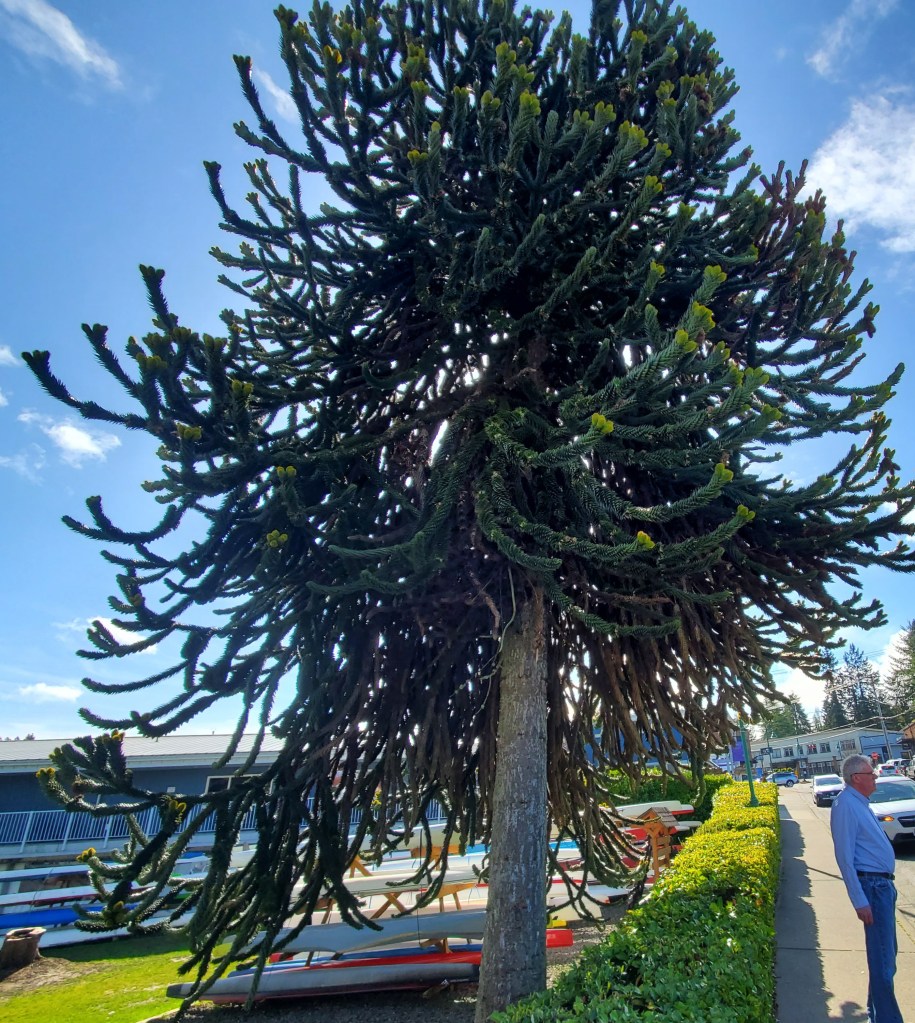
This week we are visiting our daughter in Tacoma, WA. It is so nice to travel without an agenda or meetings to attend.. Wednesday we drove to Gig Harbor to a wonderful bagel shop and cooking store that Daughter loves, and walked around in the marina. We also saw a very strange tree.
We then had a lovely evening with Daughter and two of her dear friends, a married couple, at a wonderful Italian restaurant. Of course, we had to have a sampling of Washington wines masterfully curated by the friend’s husband.
My Husband asked this morning “How do you know you are on vacation?” To him, it means that someone else is letting the dog out, or else he is by a large body of water. To me, it means that I have no access to work emails, and someone else does the driving. Daughter has curated our trip nicely, planning visits to lovely restaurants and time with her friends, along with some great sightseeing. Yesterday we drove north of Seattle, stopping off at the Tulip Festival in Mount Vernon, then driving farther north and west to Anacortes, where where we got the ferry to Orcas Island and a B and B way in the middle of nowhere.
We were advised to travel there in the daylight, as the road there had so many switchbacks. It is a beautiful place. This is the view from the front room.
Today we go whale watching. By Saturday we will be back in Tacoma for more luncheons with Daughter’s friends, and an appointment at a candle making studio. Monday we go home.
How do you know that you are on vacation? What are the best and worst vacations you ever had?
On Duolingo yesterday morning, I started a new section – with words such as lazy and messy. Clean and dirty have come up before so it was nice to have a few more to go with them. Then came “stinks”.
Several animals have made it into the lessons: cat, dog, bird, penguin, snake, duck, elephant (the very first lesson!). But yesterday was the first appearance (after 3 years) of hamster.
Duolingo doesn’t just give you words, they put all the words together in sentences and stories for you. After all these months, I should have seen this coming.
I tuoi criceti puzzano
This translates to “your hamsters stink”. Not a euphemism for anything that I can find although it does remind me of the Holy Grail line “your mother was a hamster and your father smelt of elderberries”.
I can’t imagine that stinking hamsters comes into conversation too often in one’s lifetime. My sister had hamsters and I don’t remember them stinking….
What pets did you have growing up? Did they stink?
We have a couple of new staff at work who are from larger metro areas and never lived in a rural or remote area before. They never realized how much they had to learn when they moved here.
One of our newbies, a social worker, came to the office quite upset last summer after seeing what she thought was a suicidal or intoxicated airplane pilot. She lives about 20 miles outside Dickinson in an even smaller community than ours, and while driving to work saw this little yellow airplane fly under and over power lines and dive close to the ground, then suddenly soar upwards. She wondered if she should phone the sheriff or the FAA. We had a lot of fun telling her about crop dusters. She also encounters coyotes in her backyard, a real shock.
Our new clinical director is surprised by the interconnectedness of us all. She was amazed to hear that one of our mental health skills trainers, a 40 year old mother of two, used to babysit for my kids when she was in high school, that her mother worked as a support staff at our agency for 30 years, and that her aunt is a social worker and one of our crisis staff. Then she learned that the parents of one of our staff were foster parents who adopted some of their foster children who I ultimately saw for therapy.
We tell our urban transplants that these new phenomena are just small town stuff, and we are so glad they are here and we will be happy to help them. It isn’t easy to go to an unfamiliar culture. I remember all the new things I had to learn when I moved to Canada, and I know that any of my rural coworkers would need to learn lots of new things if they moved to Minneapolis, or Seattle, or New York. Big town stuff is also tricky to navigate.
What would you educate newcomers about if they moved to your community? What would be harder for you to adjust to-rural or urban?
Husband and I got a new toaster the other day, trading in our British-made Dualit for an Italian SMEG. The Dualit worked great for about 20 years, but finally gave up.
One feature I really liked in the Dualit was the ability to raise up the finished toast over the top of the slots with the lowering lever after it was done. No need to stick your fingers in the hot slot to retrieve the toast. The SMEG doesn’t have that capability. The other day I was fishing some toast out of the SMEG with a fork when I heard a voice from the past, my mother’s, saying:
“Stop! You’re going to get electrocuted if you stick that fork in there!”
I think my mother said that to me every time she saw me making toast. I don’t know if anyone ever died by sticking a metal implement into a toaster after the toast was done, but she sure was going to make certain I didn’t.
I ignored the warning from the past and fished out the toast with the fork. I didn’t get electrocuted. The toast was good. Sorry, Mom. I am just going to live dangerously.
What safety admonitions did you get as a young person? How do you live dangerously? How do you like your toaster?
I was rather alarmed last Tuesday morning to get an email from my Regional Director insisting I attend a meeting that afternoon with her and four other quality control and administrative staff to discuss some problems with my “compliance” data for timely completion of psychological evaluations.
I have 20 working days from the time I first see a client for an evaluation until the report has to be entered into our electronic record system. I do about ten evaluations a month. My compliance rate is typically 90-95% of the evaluations completed within the 20 day time period. Compliance is a big deal for my agency, as our accreditation and licensure are dependent on everyone getting their paperwork done on time. 90-95% is an acceptable rate of completion.
We have electronic scheduling that helps determine paperwork compliance for most appointments. If your note is completed, a little “F” pops up on the appointment on the schedule. Due to reasons that are too tedious to relate, that doesn’t work for psychological evaluation completion. Someone has to keep a spreadsheet that lists the client’s name, date(s) of evaluation, and date of report completion. A quality control staff has to hand calculate the compliance rate. Most importantly, the appointment in the electronic calendar has to be deleted by the keeper of the spreadsheet.
At the meeting I was informed my compliance rate had dropped to 7%. Well, I knew that wasn’t accurate. I asked who was keeping the spreadsheet. None of the five other people knew what I was talking about. I then reminded them that unless the appointments were deleted from my electronic calendar, it would appear that they weren’t completed if they ran a compliance check with the electronic appointment system. I also told them that none of my evaluation appointments had been deleted from the calendar for more than a year, so it would erroneously seem that I hadn’t finished a report since January, 2023. It was at that point that the they suddenly remembered that my “noncompliance” coincided with the departure of a support staff who had apparently been responsible for the spreadsheet and the deletions, and hadn’t told her replacement or anyone else about it when she left. Everyone was quite apologetic about the mix-up.
Dealing with this nonsense took the better part of a day, what with my fuming and gnashing of teeth and doing my homework to figure out what had gone awry. It reminded me yet again of the danger of poorly run statistics.
Do you access your medical records on-line? What work deadlines have you had to contend with? When have you been wrongfully accused?











 Trail Baboon