Today is the birthday of the writer E.B. White in 1899. The E. stood for Elwyn, which White said he “never liked”.
“My mother just hung it on me because she’d run out of names. I was her sixth child.”
I guess it didn’t take long to get to “Elwyn” during the last summer of the 19th century. Just one of the ways in which things have changed.
White wrote for the New Yorker Magazine and celebrated the city in prose, but he and his wife Katherine were also drawn to the countryside. They bought a farmhouse in rural Maine and lived there in the company of animals from 1938 on.
Observing nature gave him inspiration for plenty of wonderful work, including “Charlotte’s Web”, a classic tale about a philosophical spider and a fabulous pig.
Here’s an E.B. White quote:
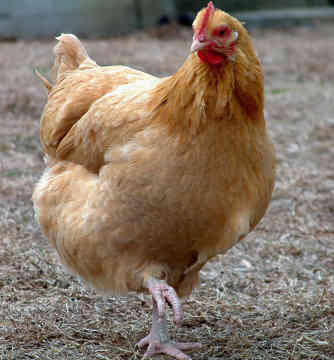
“I don’t know which is more discouraging, literature or chickens.”
There’s a lot of the human/animal struggle in White’s writing, including this letter to a friend.
My poultry operations have expanded considerably since you were here: I have a large laying house with a flock of would-be layers that turned and bit me in mid season. It was the most stinging defeat of my life, for I put a good deal of my energy into the project, raised the birds by hand from infancy, ranged them on green range, groomed them for the battle, designed and built the house, and saw them go into production in early September looking like a million dollars and shelling out in great shape. All of a sudden some little thing went wrong and they began to come apart, the way pullets do when the vitamins don’t add up right, or when a couple of them get going to the bathroom too often. From forty dozen eggs a week I slid off to about fourteen dozen, and cannibalism began taking its ugly toll. Ah welladay! A man learns a lot in a year, if he hangs around animals.
I have to wonder how E.B. White would feel about all the action these days around the issue of keeping chickens in the city.
He wrote about everything, from poultry to polling. Nothing is off-limits to a talented observer.
“The so-called science of poll-taking is not a science at all but mere necromancy. People are unpredictable by nature, and although you can take a nation’s pulse, you can’t be sure that the nation hasn’t just run up a flight of stairs, and although you can take a nation’s blood pressure, you can’t be sure that if you came back in twenty minutes you’d get the same reading. This is a damn fine thing.”
Chickens and people – he seemed to have an affinity for unmanageable things.
Though he died in 1985, E.B. White remains an inspiration to writers everywhere, thanks to his books, poems and a slim but powerful guide, “The Elements of Style.”
If E.B. White gives you a hankering to write, I’d be happy to put you on the list for a guest blog appearance! I’m hoping to take next week off, so drop a line to connelly.dale@gmail.com.
To celebrate freedom by staying home from work on a Monday must feel especially sweet, unless you happen to be an employee of the State of Minnesota. In that case, the open ended-ness of your long weekend would tend to put a damper on those feelings of jubilation. Trust me on that.
Personally, I’m reporting for work today without complaint, because I have to, and because it’s delightful to have a job.
And so we will observe the day with picnics, parades and fireworks, though some might choose to celebrate with a woodworking project.
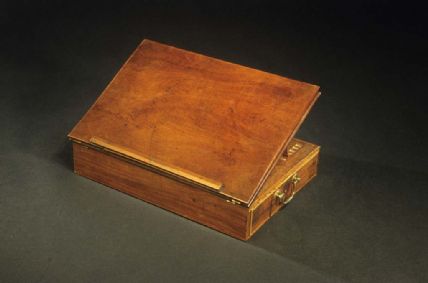
Here’s an artifact that is, without a doubt, an object of great significance. Thomas Jefferson drafted the Declaration of Independence on this lap desk of his own design. A compact and tidy thing, it folds out to present a felt covered workspace that sits at a comfortable angle for writing.
And yes, you have to do your scribbling longhand. There’s no keyboard, kiddies.
But it IS portable. Jefferson was a visionary, and somehow he could see that we would want to be able to plop down and put our thoughts to parchment anyplace, anytime. You can store your writing implements in the handy divided slide-out drawer. And it locks, so people can’t steal your ideas when you drift up to the counter for another caramel macchiato grande latte.
The Thomas Jefferson lap desk appears simple enough to be a basement project for the at-home craftsman, and some have tried. I can only guess that the various moving parts, tight fitting drawer and old-world corner joints defeated a few amateurs along the way. Just like writing the Declaration itself, the creation of an enduring piece of art is a lot harder than it looks.
One of the greatest things about America is that somebody else is ready to sell you that thing you can’t make for yourself – and there’s a price range so you have a chance to find one that suits your budget.
You can pay just over $1,900 (with shipping) for a Jefferson Lap Desk, though you’d think at that lofty price point it might be more effective to deliver the whole package for $1,776. Others are available at $795 and $600, fountain pens not included.
Once the desk arrives, open it up and conceive a nation (in liberty). Feel free to start over as often as you like. As long as you’re creating some founding documents, try to include a few words of advice for future leaders in regard to the whole notion of a debt ceiling.
If you’re like me, you’ll have to figure in the ancillary costs of dribbling ink on your good shirt.
When do you take the time to write it out longhand?
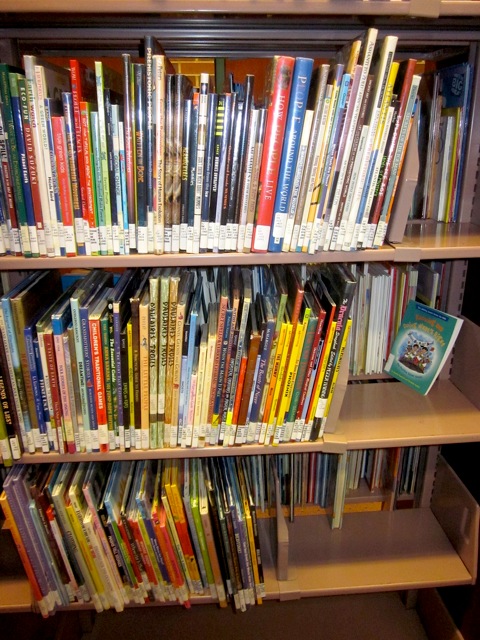
My house is around the corner from a library. The same library I went to when I was a kid; the library where I got my first library card. My first card was heavy, blue-grey paper and had the old “bars” logo for the Minneapolis Library on it. It also had my six-year-old handwriting on it spelling out my full name, hyphenated first name and all. I can remember bringing that precious piece of paper into the library where I would hand it and a stack of books to the librarian where she would press a button on a machine that, with a clunk and a buzz, took a picture of the book and my card, allowing me to take the books home. The red-headed librarian that was there when I was a kid still works there. The kids’ books are still to the left as you come in, and the “grown-up” books to the right. I sometimes wander into the stacks of children’s non-fiction and sniff the loamy aroma of dust-jacketed books and the air of my youth (don’t tell the red headed librarian, she might tell my mom).
I have loved books and reading as long as I can remember, and have no clear memories of not being able read. I remember my father reading chapter books to me at night and I remember reading Dr. Seuss to myself. I remember yelling downstairs when it was time for “lights out” that I was in the middle of a chapter and couldn’t I finish it, then getting five more minutes to read and reading fast enough to go into another chapter so I could repeat the process until my mother’s patience for the game wore out.
Over the past couple of years I have been watching through different eyes the process that leads to independent reading. It is a profound thing to watch, especially when you have forgotten how it was that you learned. First there is learning letter shapes and sounds and putting those together so you recognize the sound for each shape. Next comes putting those shapes and sounds in combinations that make new sounds. Eventually you get to sentences and books. It is amazing all the abstract things we learn that all come together to allow us to recognize a bunch of straight and curvy lines as words we understand.
Earlier this spring Daughter got her own library card, with her own full name spelled out in six-year-old handwriting. She was thrilled. It has its own purple card case and she loves that she can scan it under the bar code reader, scan her books, and tap the screen to get her receipt on her own (technology has advanced a bit since I got my first card). Because we are just around the corner there is a weekly request, easily fulfilled, to go and read at the library. I think Daughter loves the smell of all the books, and the thrill of understanding them, as much as I do. And what better motivation to keep reading than your own shiny library card and the ability to use it to discover new worlds?
What were your favorite books when you were a kid?
I recently read an article in the NY Times about some family elders who are resisting the baggage-heavy names “Grandma” and “Grandpa”, urging the offspring of their offspring to use happy, hip, young sounding names instead – names like Beebo, DooDad and GlamMa.
Until I saw this I had not seriously considered what I might want potential grandchildren to call me. “Grandma” does sound impossibly old and I refuse to see myself that way, but I’m also quite serious about my dignity so answering to cries of “GoomBah” or “TweeBop” is something that makes me cringe.
And yet it would feel sad to have a grandchild call me by my actual name, which I reserve for use by my cadre of friends. And frankly, I don’t like some of my friends very much, so I’d want any freshly minted family members to use something more, well … familiar.
So where does that leave me, Dr. Babooner? I want to be thought of with love and respect and as a person who is fun and not too stuffy, but also as someone to be reckoned with, and obeyed! Is that too much to ask?
Sincerely,
Not Intending To Wear Insulting Titles
I told NITWIT she should be happy if she winds up with Grandchildren, and if she does she will discover that she has very little control over what they actually call her.
That said, any potential grandchildren of hers will likely be raised in the modern commercial environment, where branding is essential in just about every line of work.
I suggested she take a hint from the major corporations that are coining new titles with unusual spellings to make liberal use of previously unfashionable consonants like X, Z and Q. What about Z-Mom? GrandQ? Xmater?
But once you choose to take such a path, you’ll have to allocate time and money to support your brand and make sure it gains a substantial foothold in the marketplace of (grandchild) ideas. In other words, be ready to give them toys and candy for using your new name properly. You might also want to think about creating a logo, and then make certain you get that logo onto a mobile that hangs above the crib.
It’s never too early to start!
But that’s just one opinion. What do YOU think, Dr. Babooner?
Berra is equally famous for his baseball career and his odd quotes. There are six books available on Amazon that feature stories he has told and the strange truth of his serpentine comments.
Among the best known:
“It ain’t over ‘til it’s over”
“Always go to other people’s funerals, otherwise they won’t come to yours.”
“He hits from both sides of the plate. He’s amphibious.”
“If people don’t want to come out to the ball park, nobody’s gonna stop ’em.”
Numerous websites collect his sayings. One article claimed that Yogi is “the most quoted living American.”
Who knows if he actually said all the things he’s supposed to have said? Once you get a reputation for malapropisms, I suppose people begin to assign them to you. And what about the pressure? It creates a certain expectation. How many interviewers have come away from their Q & A slightly disappointed that Yogi didn’t grace them with a memorable word crash?
I would never suggest that Yogi’s sayings aren’t completely genuine – only that there must be a great temptation to give the people what they came for, even if it means hiring a writer. Not than anyone in America today would hire a writer!
Yogi is real, of course, but the character who mangles language is a literary staple. Two of the oldest and best loved come from the field of playwriting, where it’s extraordinarily difficult these days to coin a phrase that will stick as a cultural reference.
To find the earliest examples, you have to go all the way back to 1598 and the character Dogberry in Shakespeare’s “Much Ado About Nothing” …
Don Pedro: Officers, what offence have these men done?
Dogberry: Marry, sir, they have committed false report; moreover they have spoken untruths; secondarily, they are slanders; sixth and lastly, they have belied a lady; thirdly, they have verified unjust things; and, to conclude, they are lying knaves.
And then there’s the mother of the term “Malapropism” – Mrs. Malaprop from Richard Brinsley Sheridan’s play, “The Rivals”.
Mrs. MALAPROP: There, sir, an attack upon my language! what do you think of that?—an aspersion upon my parts of speech! was ever such a brute! Sure, if I reprehend any thing in this world, it is the use of my oracular tongue, and a nice derangement of epitaphs!
Tracking Berra-like sayings is one of the most enjoyable pursuits of English speakers. George W. Bush did great things in the field of presidential misstatement. This is one area where I’m ready to admit that the current office holder is letting us down.
Fifty years ago today, Federal Communications Commission Chairman Newton Minow spoke to the National Association of Broadcasters and told them it was time for television to “grow up”.
The bigwigs of broadcasting were not delighted by this dressing down from a bureaucrat. The most benign (and delightful) reaction to Minow from the TV industry came when the producers of Gilligan’s Island named the cast’s ill-fated boat after him.
You can listen to the whole thing if you want, but here’s the famous quote (the long form):
When television is good, nothing — not the theater, not the magazines or newspapers — nothing is better.
But when television is bad, nothing is worse. I invite each of you to sit down in front of your television set when your station goes on the air and stay there, for a day, without a book, without a magazine, without a newspaper, without a profit and loss sheet or a rating book to distract you. Keep your eyes glued to that set until the station signs off. I can assure you that what you will observe is a vast wasteland.
You will see a procession of game shows, formula comedies about totally unbelievable families, blood and thunder, mayhem, violence, sadism, murder, western bad men, western good men, private eyes, gangsters, more violence, and cartoons. And endlessly commercials — many screaming, cajoling, and offending. And most of all, boredom. True, you’ll see a few things you will enjoy. But they will be very, very few. And if you think I exaggerate, I only ask you to try it.
Newton Minow is still with us today at age 85, and last month wrote a commentary for The Atlantic about the anniversary of his famous speech. He bemoans the fact that so much emphasis was placed on the words “Vast Wasteland” when he thinks the most important word pair in the talk was “Public Interest”.
But there you go. The result proves his argument. Regardless of what you think you mean to say, opportunistic interpreters will find the most provocative and lucrative part of your statement, and that is what we will peddle. And by “we”, I mean the bazillions of us who make up what some call “the media” of 2011. Minow’s original critique focused mainly on the offerings of three measly networks. Big deal.
Here at Trail Baboon, my preferred method of trivializing significant things is to celebrate them with a silly, sing-songy poem. Why should Newton Minow be spared?
Newton Minow watched TV
and said he was appalled it
did not deserve its public, and
a wasteland’s what he called it.
A two-word slam. A snide remark.
A snotty little slight
That for 50 years has stung
And made us wonder – was he right?
A scolding seldom wins the day.
A snob is just a snob.
And to wag his finger at the box
was Newton Minow’s job.
He did his part. He turned his phrase.
He sang his little song.
But seeing how the landscape changed
We know he got it wrong.
Because Minow didn’t know about
“Apprentice”. The poor guy!
He had not beheld a Hasselhoff
Or seen a CSI
In ’61 no one had watched
Mob Wives or Jersey Shore.
But today we gladly take these shows
To have and to abhor.
The ‘wasteland’ part is accurate
today as in the past
but he blew it when he called
his paltry ‘60’s circus “vast”.
The results of last weekend’s word collecting project are in! We are not interested in enforcing “official” language rules here or criticizing people just because we can’t understand them, but there is a certain tone to the comments on Trial Baboon that sometimes begs for an explanation.
So it is in an effort to be gracious and accommodating to everyone that certain members of our online community decided to assemble a Glossary Of Accepted Terms (GOAT), both as a guide for the uninitiated and a reminder for regulars whose brain function sometimes promotes the practice of “self hiding” critical information (see the glossary). Some of these terms were imported from other places because they felt appropriate. Others were created on the spot.
After today, this collection will reside permanently attached to a link off to the right side of the main entry for easy access, should one need clarification or wish to add a new term.
Since all this work was done by readers, it qualifies as a guest blog.
A group guest blog, organized and led by Jacque and Barbara in Robbinsdale.
Babawesome – Awesome in a Baboonish way.
Baboondipity – An interesting coincidence occurring in Baboonville.
Babooner – One who participates by writing and/or lurking on Dale Connelly’s Trail Baboon Blog, formerly known as Radio Heartland’s Trial Balloon Blog.
Babooninomics – This can be summarized as, “Don’t spend what you don’t have.”
Babooniquette – A fairly gracious set of manners adopted by Babooners that is related to, but different from, traditional “netiquette” (e.g., a tendency to avoid all caps when writing…or in tim’s case, any caps at all; an understanding of how to agree to disagree by simply being nonconflictious; etc.). Babooniquette does not require that you know which spoon to use at the dinner table (or that you use any spoon at all), but it may require that you at least hum along to “You Are My Sunshine” when it is played.
Bipartispasm–Against their willful desire, politicians suddenly find themselves experiencing muscle-like brain contractions that influence cooperating and compromising for the common good.
Blogosphere – The world of bloggery, perhaps including other blogs besides TBB.
Brace (of pets) – Two animals. “We have three cats… A brace… refers to a pair of objects, so I have one and half brace of cats.” Larger numbers may be spoken of as the number of “head”, as in “I asked an old Indian in cowboy land one time how many cats he had. He squinted a bit and said, ‘Oh, maybe 30 head!’ ”
Brain Fade – The moment characterized by the question “Why did I come in here?”
Cheapatude – Extreme thrift, as in “We have resorted, in our retired cheapatude, to making our own cards with Steve’s photos and just writing inside.”
Cleaver – Especially creative in a Baboonish way (not to be confused with the ordinary “clever”).
Cliffy – The TB way of saying someone has overdone it on the explanation of the facts. Other examples welcome.
Conflictious – 1. A cross between “litigious” and “conflictual”, possibly making you a candidate for a session with BMB (See acronyms). 2. A delicious conflict.
Credit Card Camping – Camping by staying in motels or B & B’s along the route, as in “I’m no camper! We did credit card camping.”
Delurk — To fully participate by writing on the blog after a period of lurkitude, as in “Nice of you to delurk, Connie.”
E-mail Pack Rattery – Hoarding of emails, as in: “I tend toward e-mail pack rattery … I have countless personal notes from friends that I can’t throw away.”
Fei da, Ish da – The Norwegian equivalent of Oy Vey, as in “I remember my grandfather talking about the progression from uff da to fei da to ish da based on milking cows – ish da being what [barb] experienced … * (though it hovers near a fei da, definitely an ish da if you got splashed).”
* “ …[when Sugar, the visiting goat,] was standing nicely. then i got complacent and BANG! goathoof in bucket. 2 quarts of milk ruined and bucket contaminated.”
Goatswaggled – Physically outwitted by a goat. See also Fei da and Ish da.
Huh? – “I am completely at sea. Please repeat or clarify the last several posts.”
Idiotology — Aberrant political thought, as in, “I am afraid that much of current political discourse has sunken to the point where a lot of it can be described as “idiotology.”
Idiotocracy – The type of politics practiced by MB (See Acronyms).
Interwinkled – associated or connected, as in “Dale [DC] said a while back, humor is what we humans do to get a grip, and we get the grippe to naturally cleanse our innards. It’s all relative. And interwinkled.”
Jimming – a dinosaur baboon word having to do with the practice of double posting (now defunct, as the new blog disallows it).
Joke-A-Sphere — Where all the good jokes that you can’t remember have gone.
Junk Thought – Thought at the most outrageous point, at the greatest amounts of decibels. (See MB in acronyms.)
Lurkitude — Reading the blog from one step back, but not writing and participating; giggling, chortling, guffawing, and belly laughs optional.
Non-Fiction Situation – An event in which it is not prudent to alter facts, i.e. a trip to the tax accountant, where you say, “I swear this information is true.”
O-T – Off Topic.
Pizzle Rot – An exclamation of a Babooner’s frustration, as in “Oh, pizzle rot, my italics didn’t shut off.”
Prumpers, or Pah-Rumpers — Singers of “The Little Drummer Boy.”
Rannygazoo – 1. The run-around, or nonsense, as in, “I had to pass as Canadian so I could avoid all ‘rannygazoo’ with my visa status.” 2. A prank or joke; semi-archaic, from the 1940’s and PG Wodehouse novels.
Scroogitude – Behaving like Ebenezer before he experienced the Three Spirits.
Self-Hiding – The ability to hide something from yourself, as in “I’m getting to the point where I can hide my own Easter Eggs.” See also Brain fade.
Semi-Colonoscopy — The study of the correct placement of semi-colons.
Suspension of Belief and/or Suspension of Disbelief – A fudging of facts used in many situations, particularly by theater people; or re: TV, movies, etc.
Thurgery – Any surgery taking place on a Thursday.
timism – An ambiguity in which you are not sure whether there was a typo, or an intentional misspelling, as in “My favorite timism of the week is ‘Talk snout dysfunctional’…” (See Dec. 23, 2010 TBB for rich, complete discussion.)
Uff da – Norwegian for “Oy”. See also Fei da and Ish da.
Vishnuverheer – A neo-religion practiced by vacationers and post card senders.
“Whobody” Mail – that mail from people you know and like, as contrasted with “anybody” mail, the junk and bulk mail which gets largely ignored.
Whumping – Sound of a Baboon in the process of losing a conflict over finite resources.
Willywacky – as in: “Then you can position your reply, hit paste and Post Comment. If something goes willywacky you still have your comment intact.”
ACRONYMS
BMB – Billy Marty Barry BSOR – Bathtub Safety Officer Rafferty DC – Dale Connelly MB – Michele Bachmann RH – Radio Heartland TB – Trail Baboon TBB – Trail Baboon Blog TLGMS – The Late Great Morning Show
As we head into what is, for many, a busy holiday weekend, Jacque takes the controls for a guest blog that is both a challenge and the beginning of an ongoing project.
To allow time for careful thought and reflection, this post will remain front and center until early Monday morning. The comments you recall and the new contributions you make will eventually become a permanent feature of our baboonish space.
For sometime now I have been threatening our blog-iverse with a Trail Baboon Glossary.
Barbara in Robbinsdale and I have been putting our e-heads together to gather a joint list of terms that seem quite unique to our on-line world.
Most of you know I am trained as a social worker. One of the topics that social workers study in both undergraduate and graduate training is the behavior and development of groups and social systems. It is my expert opinion that TB qualifies as both!
There is a process that groups follow which is fairly predictable.
Stages 1 and 2 are listed below:
1) Gathering as a Group, then defining the group as an Entity – the Trail Baboon on-line community
2) Forming Emotional Connections and Bonding as an Entity — this is typically the equivalent of a couple’s honeymoon. A particular culture is formed, including a language that distinguishes the group.
Well, we certainly have formed a Trail Baboon language that distinguishes the group. And it is long past the time that we define the terms so that we can move along into our next (uncomfortable) stage of development. Should we stall out on this developmental task, all kinds of disappointments may follow. Prepare yourselves, dear Baboons, because the next stage is:
3) Emergence of Conflict within the Entity.
Oh, my. What will we, as timid, conflict-avoidant Midwestern Bloggers do with this? If we were calloused New Yorkers we would just verbally blast each other and say “Gedoverit.” But we are not. So let us get on with naming the terms and defining them so that we can move on up our developmental group ladder. Defining terms might provide a containable venue for conflict over definitions. And it certainly is better than those traditional conflictual topics: sex, politics, religion.
I don’t want to talk about any of them.
So here is the list, but I know there are many, many more. The task this weekend is to pull up the unique terms that have appeared here, then define them for an ongoing feature – A Baboonish Glossary.
Lurkitude, or “In Lurkitude”
Idiotocracy
Cheapatude
Babooner
Cleaver
Baboonimonics
Or is it Babooninomics?
Credit card Camping
E-mail Pack Rattery
Non-Fiction Situation
Suspension of Belief and/or
Suspension of Disbelief
Take a moment to define any or all of these terms, nominate something already said but not listed, or coin something brand new!
Postscript from Dale:
You might have a dim recollection of something said once in the comments and nothing more to go on than that. Fair enough. Unfortunately, the “search” box in the upper right corner of our front page looks at main posts only, not the voluminous and always enlightening comments.
If you would like to search for a term in the comments, this is the easiest way to do it that I know of:
Go to Google and enter “site:daleconnelly.com” in the search box, followed by the term you seek. Here’s a screen shot of what you get for “lurkitude”.
Like hunting for Easter Eggs in our soggy back yard, you will find some treasures and some other stuff. Share the things that delight you, and have a wonderful weekend!
My father was proud of his intellect and his vocabulary. When I was a kid, my sister and I would try to stump him by picking out random words in the dictionary to see if he knew them. He was better at this than most, since he had studied Latin for law school and could weasel out the meaning of almost any Latin-derived word. We quickly learned to look for words with their origin in Greek – he wasn’t as good at those.
When I was in junior high, my dad decided that he didn’t like the words “get” and “got”. He thought they were “lazy” words and that it was a sign of intelligence if you could use other words in their place. If you slipped up and used “get” or “got”, he would said “What?” until you replaced the little offender. This led to some hilarious conversations when my younger sister decided just to use the word “obtain” all the time, even if it didn’t make sense. “Do you think we’ll obtain rain this weekend? or I’m going upstairs to obtain a sweater.” Finally in college I decided that I didn’t have to play anymore either and my dad had to give up trying to enliven my language.
So, it was these memories that I was thinking of when I happened upon Kickstarter.com. In response to the Mark Twain professor who is bringing out an n-word free Huckleberry Finn, the Kickstarter group is raising money to print an edition of Huckleberry Finn with the n-word replaced by the word “robot”. If you pledge a dollar or more, you get a hard-copy version of this book when it is finished. I coughed up the dollar immediately and just the fun of getting the e-mail updates has been worth the price of admission.
If you could get rid of a word, which word would it be?
I know the espionage news is serious, but I can’t help thinking about what a strange word we’ve added to our vocabulary.
“Wikileaks”.
It sounds funny every time I hear it. And when I hear a funny word, I immediately want to use it in a sentence. Or better, a headline. But you know how it is with headlines. For a truly historic one to emerge, conditions must be right.
For instance, if a 1990’s talk show host got an exclusive interview on Twitter with Julian Assange, it might be called:
Rikki Lake’s Wikileaks Tweets
If the interview was altered and delayed for seven days due to illness:
Sickly Week Tweaks Rikki Lake’s Wikileaks Tweets
If Arab royalty became annoyed by the sudden changes:
Sheiks Piqued As Sickly Week Tweaks Rikki Lake’s Wikilealks Tweets
But if Ms. Lake sent her technical staff to calm the disturbance:
Geeks Speak To Piqued Sheiks As Sickly Week Tweaks Rikki Lake’s Wikileaks Tweets.
And if those emissaries had been recklessly eating fudgesicles before the meeting:
Sticky Cheeked Geeks Speak To Piqued Sheiks As Sickly Week Tweaks Rikki Lake’s Wikileaks Tweets.
If tangential observers darkly predicted unsatisfactory results, thus annoying the pocket protector wearing ambassadors:
Oblique Critiques Freak Sticky Cheeked Geeks Who Speak To Piqued Sheiks As Sickly Week Tweaks Rikki Lake’s Wikileaks Tweets.
Although those unkind observations about the work of such resourceful techno-wizards might draw an attack by angry pecking birds of prey, who show no reluctance to cover their antagonists in rivers of their own blood:
Eagle Beaks Wreak Icky Streaks Over Oblique Critiques That Freak Sticky Cheeked Geeks Who Speak To Piqued Sheiks As Sickly Week Tweaks Rikki Lake’s Wikileaks Tweets.




 Trail Baboon