
Today’s post comes from Occasional Caroline.
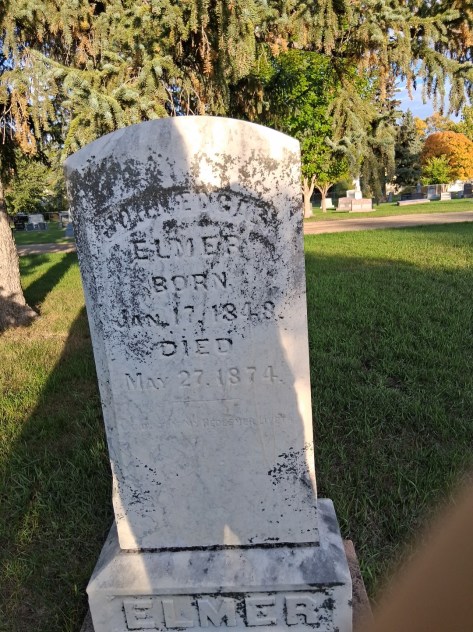
My great grandfather, Oscar Elmer, was sent as a missionary to start a Presbyterian church in Moorhead, MN in 1871. In May of 1874 his brother, John, came to visit from New York. Unfortunately, John Edger Elmer fell into the Red River and drowned. The normal procedure would have been to have his body returned to New York to be buried in the family plot in a cemetery in their home town, but John’s body was not recovered from the river until nearly a week after he disappeared and had deteriorated past the point where it could be shipped East. The town did not have a cemetery and the typical burial in Moorhead at the time would be on the property of the deceased’s family. Since Oscar did not own property he recruited some men from the town to help him bury his brother in a temporary location between two trees, with a rope tied to the trees to mark the grave.
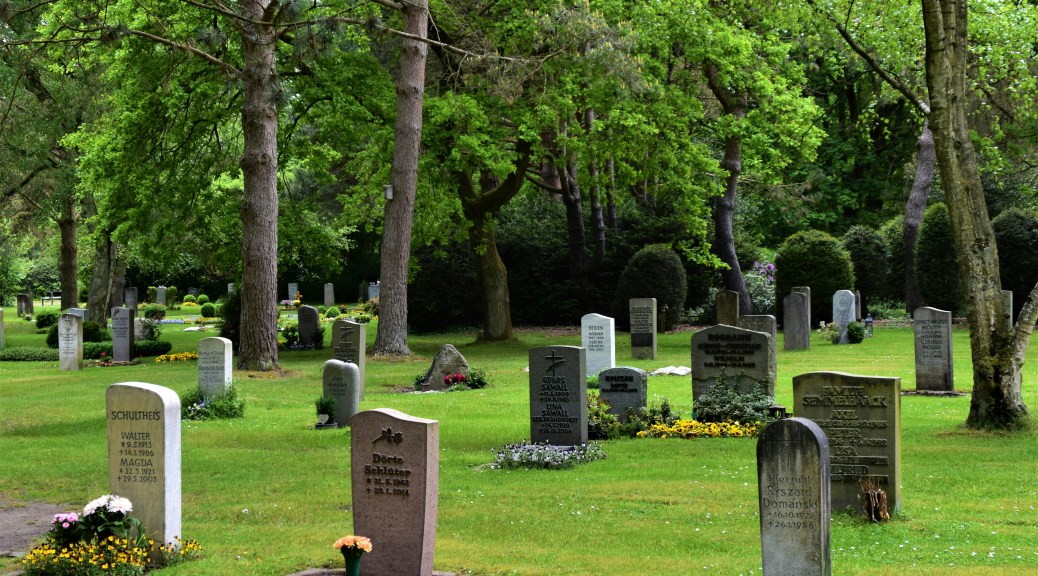
The lack of a proper burial site prompted Reverend Elmer to organize a committee of residents to establish Moorhead ‘s first cemetery. In 1875, a railroad company was persuaded to sell a 5-acre parcel of land to the city for $1 and the cemetery came to be. John Elmer’s body was moved from the tree-marked grave and re-buried in the new cemetery.
Fast forward to 1971 when a 29-year-old man from St. Paul was giving a poetry reading at Moorhead State University. While walking through the town the next morning he happened upon Moorhead ‘s Prairie Home Cemetery. He had been trying to come up with a title for the radio program he was planning, and Prairie Home caught his attention. He changed Cemetery to Companion and the rest is history.
The photo of John Edger Elmer’s gravestone was taken by my cousin’s daughter on recent visit to Moorhead. She is a genealogist and John Elmer’s great great grandniece and Oscar Elmer’s great great granddaughter.
Any family cemetery stories? Where do you want your final resting place to be?


I know where the bodies are buried. I’ve been to the cemeteries in this country where my ancestors, going back to my great great great grandparents repose. Regrettably, no individual of the younger generation has evinced an interest in genealogy, so that knowledge may go no further.
I actually own plots in the cemetery where my parents are buried. Cemetery plots are hard to sell or even give away these days. I’ve tried. I don’t want to be buried there, or anywhere.
As to what becomes of my ashes, surprise me.
LikeLiked by 5 people
Great tidbit to know, OC!
Interestingly, this was, in part, yesterday’s topic for a monthly group we met with yesterday – through our UU Fellowship.
It was interesting to hear everyone’s eventual wishes for their remains. I too am thinking ashes scattered, unless I could manage to find a place for a green burial. The nearest to here is in Viroqua, Wisc., but there are rules about crossing state lines…
LikeLiked by 2 people
Some years ago, when I still bothered to listen to news, the local NPR affiliate in Western Michigan ran a long piece on composting. Is that done in Minnesota?
LikeLiked by 2 people
There are some communities that have a composting site where people can bring food waste, etc. Winona tried but was not successful at getting one set up. We do have a site for leaves and yard waste, with a box to leave expected donations.
LikeLike
Corpses would likely be frowned upon.
LikeLike
here’s the link: https://earthfuneral.com/states/minnesota
LikeLiked by 3 people
It turns out that composting our bodies is legal in Minnesota. Who’da thunkit?
LikeLiked by 3 people
While I love the concept of composting vegetable matter (which I do a lot!), I find the concept of body composting creeps me out. I cannot imagine the odors involved in that process. But more power to them.
LikeLiked by 3 people
In Ohio, composting human remains is close to being approved.
Still quite involved; and expensive.
I rather like the idea of a “green burial” but I wouldn’t want to burden my kids with it.
LikeLiked by 3 people
https://www.etsy.com/listing/4457943736/
LikeLiked by 3 people
perfect
LikeLike
Snort!
LikeLike
viroqua has a historical tie to the garden of eden. i cant recall the details
LikeLiked by 2 people
I don’t know about Viroqua’s association but Galesville, WI does:
LikeLike
Office of the Revisor of Statutes of the State of Minnesota. June 5, 2024. Archived from the original on April 14, 2025. Retrieved May 4, 2025.
LikeLiked by 1 person
?
LikeLike
Sorry about that link. It is from the Wikipedia article on composting of human bodies, and is the footnote to Minnesota.
LikeLiked by 3 people
https://www.fairbankshistory.com/colonial-history/the-burial-of-jonathan-fairbanks-of-dedham-massachusetts-1668
It’s a little long. Interesting take on Puritan theology about death and burials. Bottom line, 10th great grandfather Jonathan’s whereabouts are unknown.
LikeLiked by 3 people
This is cool! I’ll share it with my wife. Who’s uncle’s mother was a Fairbanks as I’ve said before, but once more for the short of memory.
LikeLiked by 3 people
Robin’s family line includes denizens of Dedham in the 1640s. The names were Ellis and Lumber (or Lombard). Likely they knew the Fairbanks.
LikeLiked by 4 people
We replaced two very battered cookbooks by Marcella Hazan with a combined anniversary edition of the two. Her husband, in the Foreward, wrote about the time in Italy during the last year of WWII when she was in high school trying to prepare for university and was taking a human anatomy class. Her teacher lent her a skeleton that was complete except for the skull. Someone told her she could get a skull at the cemetery since there were cadavers coming in every day. She got a skull from one of the grave diggers and boiled it per her teacher’s instructions to remove all the hair. Somehow local officials found out and she was arrested for murder. The grave digger testified on her behalf and she was acquitted. She got to take the skull home with her.
LikeLiked by 6 people
Hopefully her teacher’s instructions were not the beginning of her interest in recipes.
LikeLiked by 3 people
Also, if she had to boil it, what she got from the gravediggers wasn’t a skull. It was a head.
LikeLiked by 3 people
YIKES!
LikeLiked by 1 person
I’d like my ashes to be scattered at the Mississippi headwaters at Itasca Park but that is against the law. So off any riverbank up there would be fine.
During the Spanish flu epidemic, my Mom’s Dad (my grandfather) made a significant income digging graves in Clay County, Minnesota. So many were struck down that he was never out of work. His marker in Glyndon is one of those flat ones easily mown over. Humble as always.
LikeLiked by 3 people
Kelly’s uncles parent, The wife was the aforementioned Francis Fuller Fairbanks, FFF, and her husband was Otto Crawford. He was a twin, and the other brother died of the Spanish flu in boot camp of WWI.
LikeLiked by 3 people
I found FFF!
She is my 5th cousin 3 times removed. I’ll try to do the computaton on what that makes me to Kelly.
LikeLiked by 3 people
The family line comes through my 7th great grandmother, Mary Fobes (1694-1774).
LikeLiked by 2 people
A cemetery was built just a half mile from our place. When Kelly’s aunt Ruth died, I coordinated with the cemetery on plots and costs. Uncle Bill said to buy 6 plots. Uh… six?? Why? Well he was thinking he and Ruth, kelly and I, and our kids. Oh. Well, that’s very nice, but… we took him up on it so we have plots next to them. But we agreed the kids could wait because who knows.
I’ve visited some cemeteries over by Lacrosse where the G-Grandparents are.
Wish I had more fun cemetery stories.
I do know the superintendent of the one close to us, and I stop and talk to him often. I’ve said before how interesting the mechanics of funerals are; all the equipment to lower a vault and casket are interesting.
I rent the farmland that isn’t used for burials. They own 80 acres, actually the cemetery association has owned it for years and years! Maybe back to the 1940’s?
We haven’t decided what to do with our cremains… I’d mix them I think. Then shoot me off into space!
The composting looks interesting. There’s water composting too; still getting approval on that.
LikeLiked by 4 people
Let Kelly know that I have us back to our 46 great grandfather, Titus Flavius IV Titianus Prefect of Egypt, 0150-0220 C.E.
The 40th was Constantine the Great whose great granddaughter married our 37th, Vitalinus Vortigern ap Gwidol, King of the Britians.
“King of the who?”
LikeLiked by 6 people
As a student at Concordia in Moorhead I knew there was a connection between PHC and the cemetery. Now I know!
LikeLiked by 5 people
Better Late than Never, Baboons,
This morning I had to take husband to the ER. Since I returned from my trip, he has had some medical procedures and now we are dealing with some complications. He is OK and we are back home now, but this has been on-going so it is difficult to get into a rhythm again.
In 2015 I was searching for an ancestor grave in the Friend’s Cemetery in Medford, New Jersey. I found it. The stone, a brick with MS scratched into it with the date 1762, was the size of my foot. The cemetery was going to be used as a cornfield, but then someone brought up the stone with the horse drawn plow. It has been maintained as a cemetery, but they had forgotten about in the 1800s. The cemetery is next to the Friends Meeting that MS, Mark Stratton, who emigrated to the Penn Colony in 1701, helped to start. There are still people, descendents of Mark who are members there–Strattons, Hancocks, Matlacks, and afamily who owned a water mill in the town of Medford. They were passionate abolitionists who became “Free Quakers” who fought in the Revolution because they believed slavery was a sin. Mark’s grandson, Daniel, my 8th or 9th grandfather, actually fought in the Revolutionary War, then headed West for Ohio.
When you dive into Pre-Revolutionary War geneology you find that there were a limited number of Puritans and Quakers, and that everyone is related to one another. My guess is that Wes, Kelly, Robyn, and I probably all have mingled DNA from way, way back.
Husband has decided he was his ashes buried in “The Sand Woods” near Decorah, Iowa. HIs cousin Kevin purchased a plot of woods where he has been interring his aunts and uncles ashes (the Sand Family of which husband is considered a part because he spent so much time with them as opposed to his own family). Kevin meant the woods to be a preservation project, but the family fell in love with the place, so there the ashes have been going.
LikeLiked by 6 people
Caroline, I went to college with a girl named Cindy Elmer, whose father was a Methodist minister in Dickinson, North Dakota. Your Elmers were Presbyterians. I wonder if they were related?
LikeLiked by 2 people
I don’t think they would have been related. Oscar had 3 daughters and my grandfather. They all moved to St. Paul where Oscar became the minister of Knox Presbyterian Church. I think my dad was the first of the family to break from the Presbyterian church when he married my mother, a cradle-to-grave Episcopalian.
LikeLiked by 5 people
Can’t resist this OT: I just found a tidbit that would have been apropos a couple of days ago, on the Anyone’s Guess day:
From the Old Farmers’ Almanac on FB: ” we’ve heard that spiders spinning larger-than-usual webs is a sign of a cold winter to come.”
https://www.facebook.com/photo?fbid=1568718795294139&set=a.640691854763509
LikeLiked by 4 people
LikeLiked by 4 people
Wow.
LikeLiked by 1 person
LikeLiked by 4 people
LikeLiked by 4 people
I’ve told YA that she can do whatever she wants/needs to do when I’m gone. I have no expectations/requests/desires.
Guess I’m still shaking my head at the conundrum over my mom’s ashes.
LikeLiked by 2 people