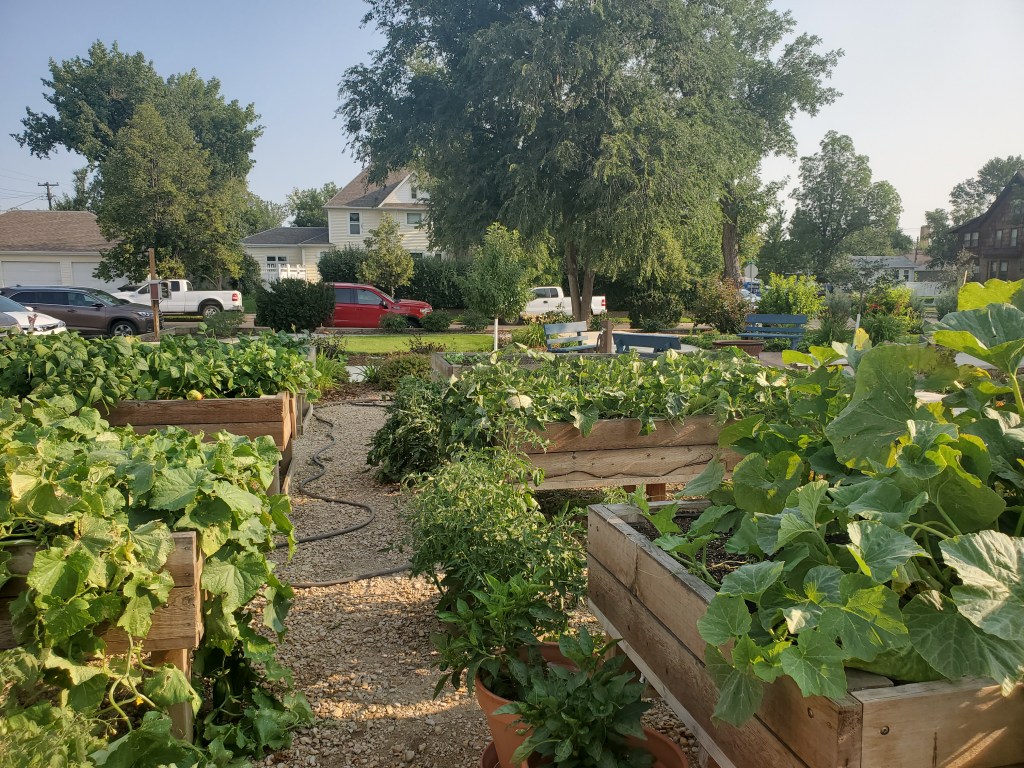
Last Thursday in the late afternoon, Husband and I went to our church to water the vegetables that we and others have been growing there. All the produce is taken to the local food pantry. The veggies are grown in six, 3 ft. high raised beds that you can see below. The rest of the garden is taken up with flowers and shrubs, with walk ways and benches for rest and contemplation.
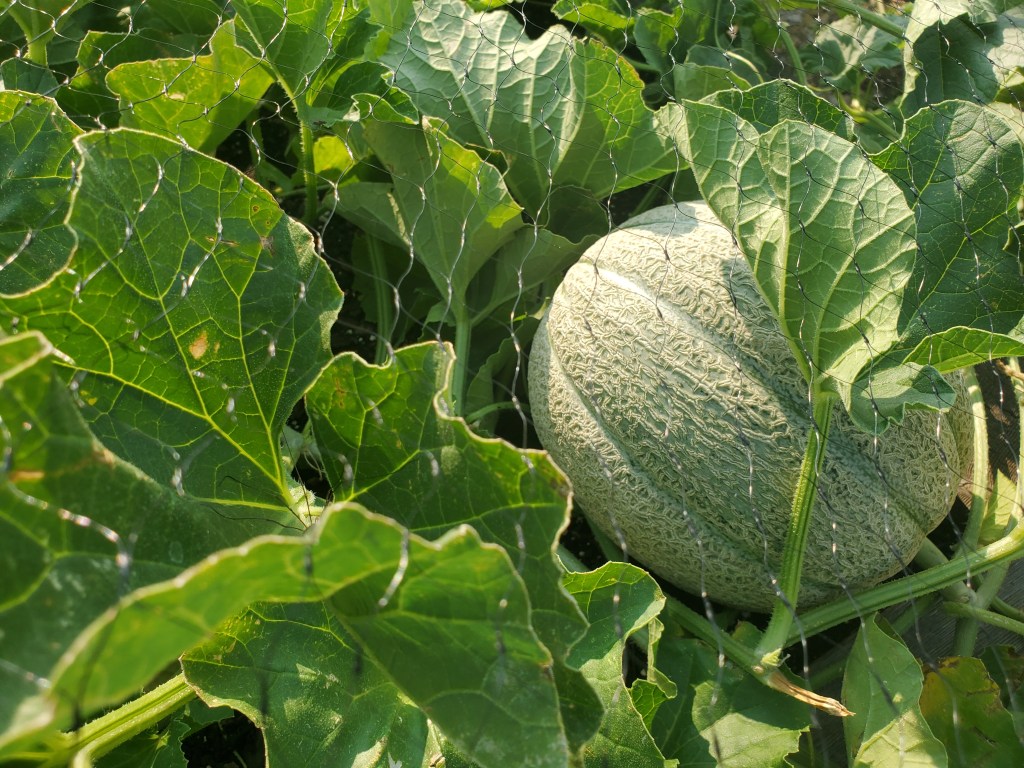
Thursday, everything looked good. There were six nice cantaloupes about the size of soccer balls but still needing to ripen. The squash bed had one hill of bush butternut squash with four nice but still ripening fruits. We had reseeded in the carrot and beet bed as well as the sugar snap pea bed after harvesting the first crops, and all those had germinated and were growing well.
Husband went back to the garden on Friday, and texted me at work to say that half of the cantaloupes were missing. I am sorry to say that when I got to the garden after work, the Lord’s name was taken in vain and a tool was thrown down in anger as we discovered that three of the butternuts were gone as well. You can see the remaining ones.
Nothing else was missing or damaged. I covered the cantaloupe bed with bird netting and stapled it onto the wooden bed so that it would be more difficult to abscond with the remaining melons. Then, we started to hypothesize.
The incident occurred Thursday night. It would be a lot for one person on foot to carry all the melons and squash, so we figured it was either more than one person on foot, or perhaps one or more persons in a vehicle. We drove around the surrounding streets and didn’t find the produce smashed.
Husband wondered if the fact that they didn’t take any cucumbers or green beans, both of which take time to pick, spoke to urgency, which to him suggested possible amphetamine addiction. It was also presumably dark, so that the beans and cucumbers would be harder to see. I wondered if they knew little of gardening, as they took produce that wasn’t ripe. We have two Little Free Pantries on the edge of the garden, I wondered if people availing themselves of the food there thought that the produce was for all to take. We continue to speculate.
We had beets and carrots disappear in the night at times this summer. They were ready to harvest. My reaction to that was “Bless you. You need it more than we do”. I think the reason this recent event made me so angry is that the melons and squash weren’t ripe, and so they were wasted. As James Crockett comments in his Crockett’sVictory Garden, there is no remedy for finger blight.
What have you investigated recently or in the past?What kind of detective work would you like to do? Who is your favorite literary detective?
To wrap up the oat harvest, let me explain test weight and pricing.
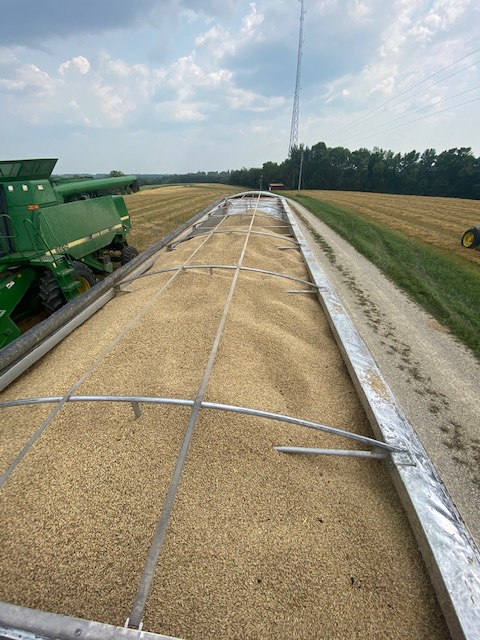
There isn’t a big market for oats, so they won’t take the oats if the quality is a little low. By ‘Quality’ I mean if it isn’t at least 32 lbs test weight (That’s the ‘standard’ weight of a bushel of the product. 56lbs for corn, 60 lbs for soybeans, 32lbs for oats). The weight can vary depending on a lot of things; moisture content of the crop, the weather as it grew, the variety, ect. The market price is based on that weight though, so if it’s low, we don’t get paid the full amount because while we deal with the crops in volume (the trucks and wagons it takes to get it hauled in), we’re paid by the bushel. If your corn sample only tests 50 lbs, then it takes more corn to get to 52 lbs and we get docked for the low TW.
My oats samples tested 38 and 39 lbs. The truck is heavier, which means it takes less grain to make 32 lbs so I get more bushels on the truck. But no bonus for being Over TW.
Price this year was $3.58 / bushel at the Elgin elevator (which is closest so most of the oats went there) but they were full so the last of the oats went to another elevator and it was $3.71 there. Heck; if I’d known that I’d have taken it all to that second place!
Remember; hay is something animals will eat; it contains nutrients. Straw is just an empty stalk; there’s not much nutritional value in straw.
Baling straw; it went pretty well this year. No problems.
It might take a while to get the baler working right; get the rust off it, so to speak. I like to bale straw; it’s light and the bales are easy to throw around.
I broke a shear bolt just after starting; a ‘shear bolt’ is protection against something bad happening. It might simply be overloaded or it might be a safety feature against something catastrophic. But sometimes they just wear out. That was the case here.
This shear bolt hooks the baler flywheel to the hydraulic pump for the baler kicker and sometimes it just fails. Then the kicker looses it’s oomph.
In the old days, Clyde and my dad had to have someone on the wagon to catch the bales coming off the baler and stack them on the wagon. I was about 10 years old when Dad bought a kicker baler which ‘kicks’ the bales into the wagon. Less manpower needed. Course, getting them back out is a little more trouble.
In 1993, we hosted 2 men from Russia for a few days. They were here as part of an exchange program with the Farm Bureau. They didn’t speak English, but they had a Russian / English dictionary and we had a good time doing hand gestures. I was baling hay and they rode in the wagon and insisted on stacking the bales as they flew in there from the baler. I tried to stop them; warning them this was dangerous and not to get hit by one. They assured me it was fine and kept stacking. And it’s a wonderful thing; so much easier to unload when they’re stacked, plus I get more bales on the wagon. I’ve been stacking a few ever since. Just the bottom row or two, and a ‘wall’ at the front to help keep the bales in the wagon.
The kicker part of the baler rotates left and right. That allows me to throw a bale in the wagon even when making a corner. And there’s a power adjustment to kick the bale just a little bit or kick it real hard! The average is 3 or 4. It goes to 8, I haven’t had to use it that high unless I’m kicking it all the way over the wagon just for fun. Because the power is based on weight, kicking to the back of the 16’ wagon only needs about 4. If the bales are so heavy it needs 6 or more, then they’re too wet to bale and I can’t even pick them up.
Up or down hills changes that a bit… and making a corner when it kicks can still kick it over the side. All in all, it’s kinda fun.
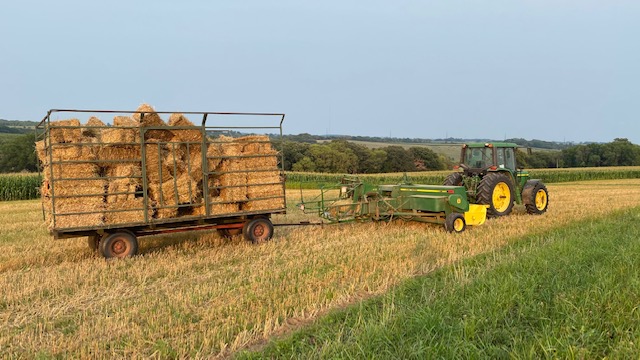
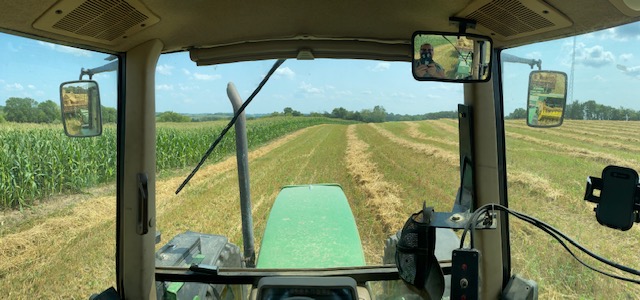
Here’s what it looks like from the tractor cab.
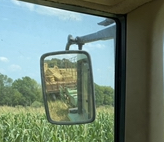
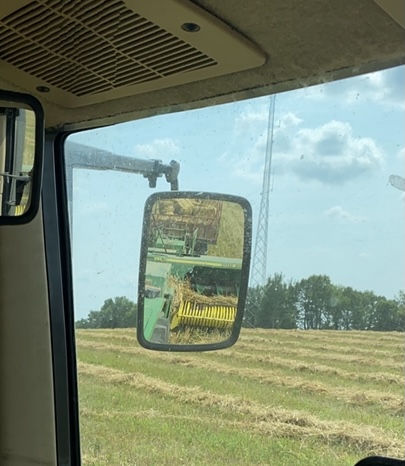
I’m watching my left mirror as that shows the back of the baler and I can tell the bale is good (not missing a string) and I can see most of the wagon. The right mirror shows the row going into the pick up.
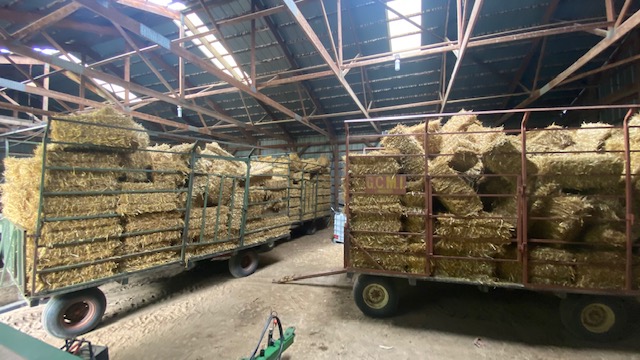
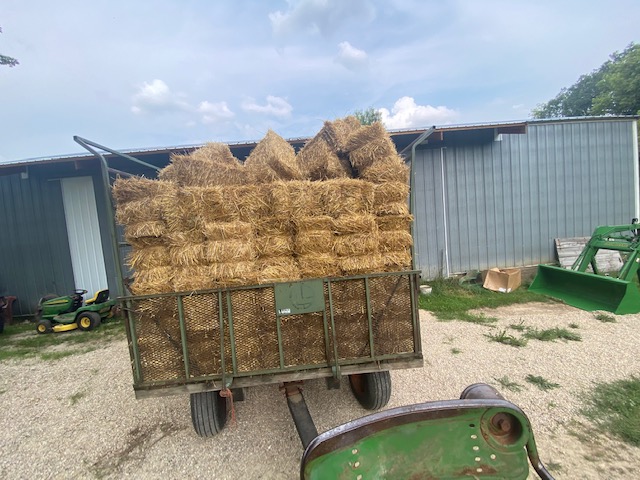
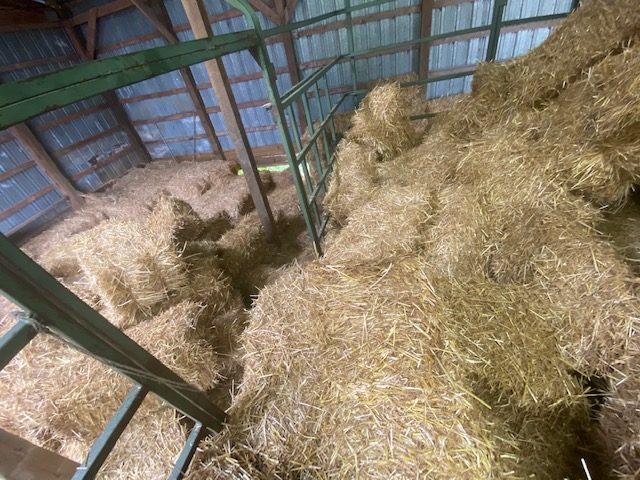
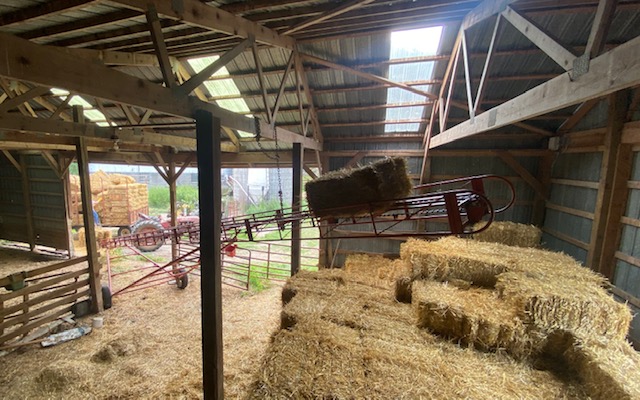
Here’s three loads in the shed.
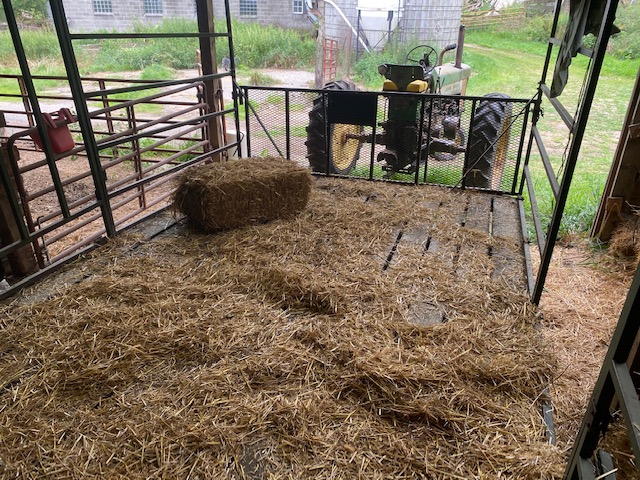
A few weeks ago we talked about backing up wagons. Here’s what it looks like to back up a wagon into the shed:
You need to trust yourself about what’s behind you.
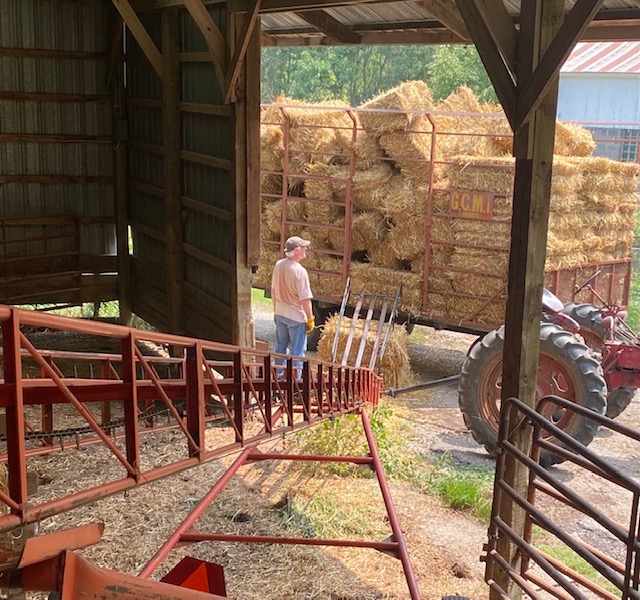
I had about 200 straw bales left in the barn. I baled 612 (there’s a mechanical counter on the baler; each time it ties a knot, it trips the counter). 166 bales (one stacked load) went to the neighbors for their strawberry patch. He’ll use it for cover this fall. The other 446 went in the pole barn. I unloaded one load by myself; back the wagon into the barn, toss a bunch out, get out and stack them, toss a bunch more out. It’s not too hard when the stack is low. It’s too much work once up about two rows.
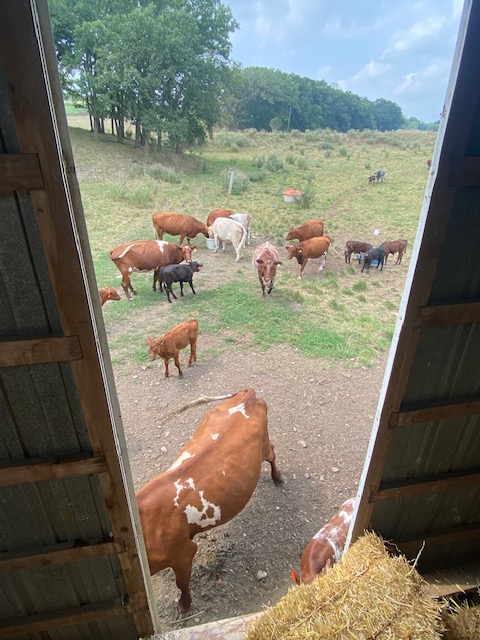
My brother came out; he helped me get the elevator set up and then he and I unloaded the last two loads. The cows came to watch me.
Here my brother is trying to figure out how to start the load
Here comes a bale destined for VS’s garden next spring.
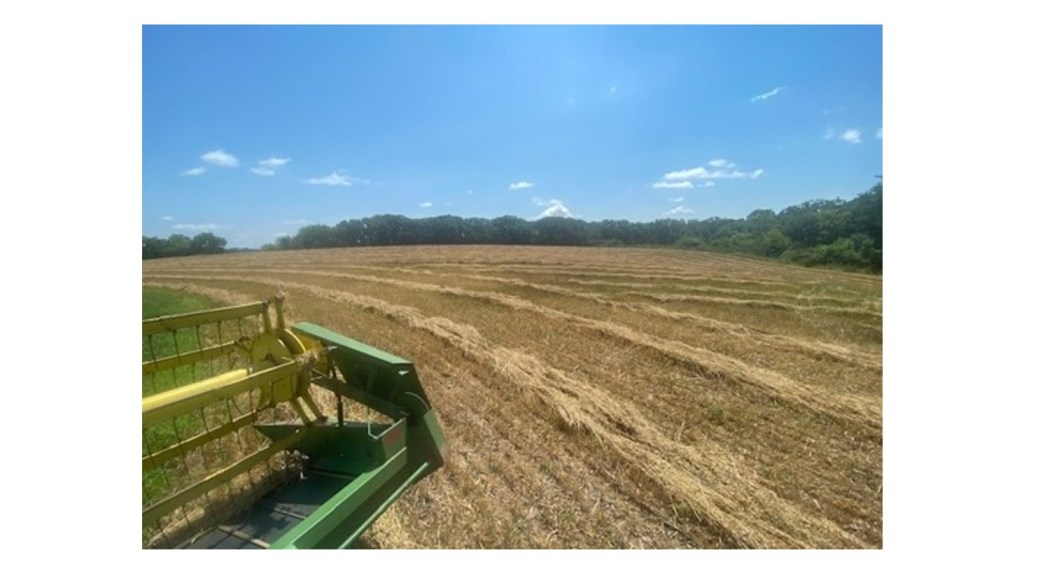
A clean field and the last bale are welcome sights.
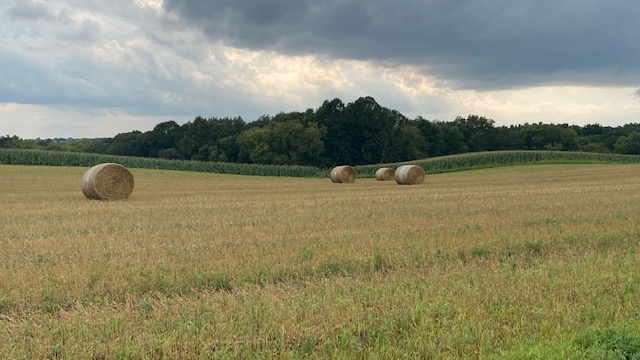
I didn’t need anymore small square bales this year so I hired a neighbor to make round bales from the rest of the straw.
I’ll sell them to the neighbor with the cows.
I’ve left off the tractor that inexplicable died. (turned out to be the coil wire). And the dead battery in the other tractor. And the post that has somehow twisted a bit so now the gate doesn’t swing in AND out anymore, so I have to take it off to get the elevator put up.
I did get the hitch welded back on the elevator so that’s one thing.
And I got the second show open.
And time to cut grass again.
Hey! “Straw is cheaper, Grass is free. Buy a farm and you get all three.”
So? “Sew Buttons on a balloon, you’ll get a bang out of it.”
When I was growing up, families in my town who had a lot of money were often looked upon with distain if they demonstrated any public flaws or hoity-toityness.
In the current town in which I live, there are many quite well to do families who face similar scrutiny, none more than the following head of a local family who was recently discussed the media:
I know there is a certain satisfaction to see such folks as the Fishers show themselves for fools. I know that one of my personal struggles is to not rejoice when this happens, but gosh, it is hard not to do so. Pride and greed are sure downfalls for many.
Who were thefolks in your communities when you were growing up who were judged for their wealth? What are your favorite desserts?
Husband is the secretary of our local food pantry Board of Directors. He started out as a simple volunteer on Thursday afternoons, and then they wrangled him to be on the Board.
Due to COVID, all the meetings have been held on Zoom since he started as the taker of meeting minutes. That means he sits at the dining room table and listens intently and writes notes as fast as he can about who said what about which issue. People interrupt one another and don’t identify themselves before they speak or vote. He tries valiantly to type as accurately as he can the proceedings of the meetings. It takes hours of typing to get a rough draft, and then more time correcting the minutes after the other Board officers have perused the document and made their corrections.
The proceedings of the regulatory board of which I am a member are audio recorded so our office secretary can leisurely transcribe them. I have suggested to Husband that they do the same. He isn’t sure they have the technology to accomplish it. I think they do. It may take some wrangling on my part to help him with this. Sometimes, being the secretary is a real pain!
What happened when you had to take meeting minutes? What are your experiences on Boards? Who was the best secretary you ever encountered?
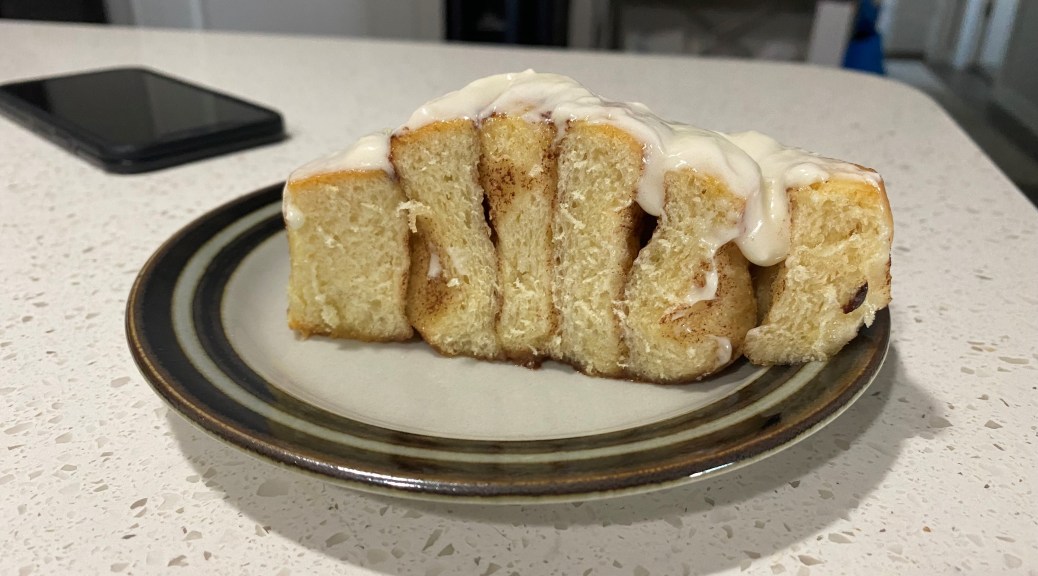
Last weekend when I was in Madison, my girlfriend and I got a huge cinnamon roll to take back to her place to share. She cut it in half and put each half on a plate. Admittedly I don’t think I’ve ever cut a cinnamon roll in half – I’m not much on sharing when it comes to cinnamon rolls. But since we’d already shared a big doughnut at the market, I was acquiescent.
When I looked at my half, I saw Stonehenge. Well, not exactly Stonehenge as it looks now, but the stones that make up the henge. I mentioned it to my friend, who said she could “kind of” see it. She thought it looked more like Legos. Since I’m the traveler and she’s the grandmother, I suppose that makes sense. We see the world through our own filters.
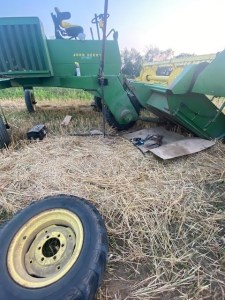
When last we left the farm the swather was standing on one tire and a jack.
Mechanic Nick came out from John Deere and fixed it up in no time. Now that was a good decision to call them. And $637 later I’m moving through the field again. I was estimating $500. “Labor” was $500… bearing, flanges, locking collar, service call, misc and …. Just put it on my tab. But it’s fixed and I finished cutting oats and the swather is back home in the shed.
I spend a lot of time thinking of ‘what if’s’. What if the machine breaks down? What will I do if I can’t fix it? Who can I call that would know people to come and cut oats? And then, as I near the end it becomes ‘I would just leave this part’, or ‘who has a sickle mower I could use’, or ‘I wonder if the bean head could do this’? This year I learned something. I learned I call John Deere and they can fix some of it. Course it depends what, exactly, has broken.
And what do I think about all day just going round and round? I have music in my head. Last week I had the ‘Mairsey Dotes’ song in there for a while… that annoyed me. Had to work real hard to get something else in there. The first day it was a Pink Floyd song. Got some Led Zepplin going, there was probably a show tune in there somewhere… I can’t remember what finally settled in.
No cab or radio, and I’m wearing hearing protection, long sleeves, and a dust mask.
I observe the direction the oats was planted versus the direction I’m cutting it and I wonder if it matters because of how it sits on the stubble; is sitting sideways better than sitting in line? When going the same direction, in line, does it fall down between the stubble more? Hmmm. (It depends how heavy the windrow is). And I leave some stubble so it sits on top of that in case it does get rained on it’s not flat on the ground.
I observe how whenever I stop with the planter, I leaves a gap of a few feet and weeds grow wherever there isn’t grain growing.
Which is kind of amazing when you think about it.
I look at the damage the deer cause and I curse them out a little more.
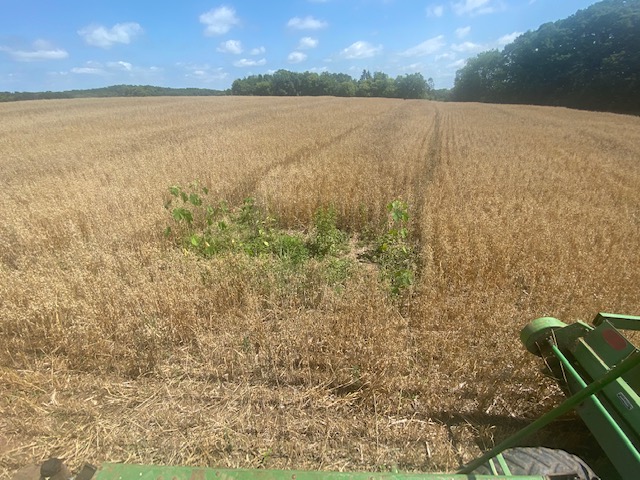
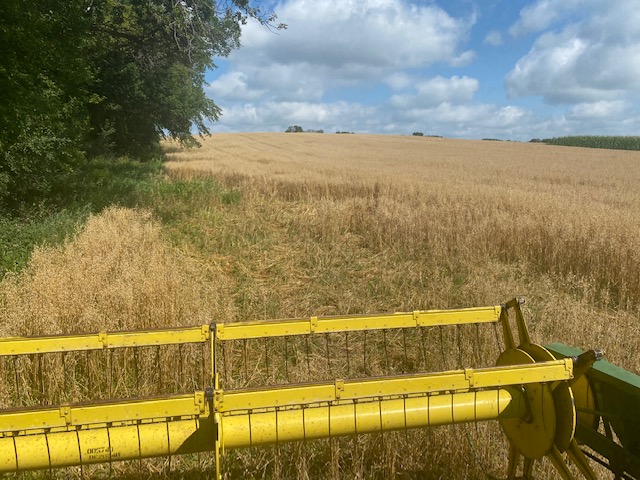
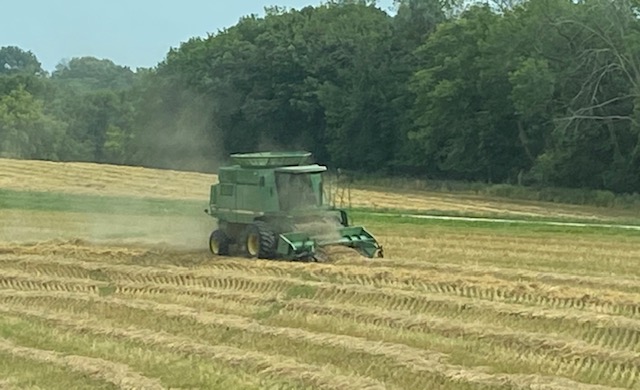
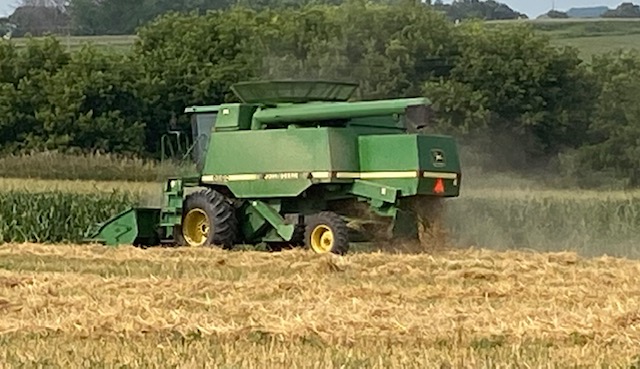
When the combine (we should clarify the pronunciation of this if you’re not familiar. It’s not com-BINE, like adding things, it’s COM-bine. I don’t know where that came from. Subject for another day). The combine has to pick up the oat windrow the same direction it was cut. And that means from the head end. As the swather cuts it, all the heads fall to the back and it’s usually pretty easy to tell. Trying to go the wrong way, it just doesn’t feed into the combine as well.
When cutting, it’s best to make about 4 or 5 rounds all around the field, so there’s room on the ends for the combine to turn around, (and that goes for any crop; corn or beans or anything); we call those the ‘headlands’. And then it can just be cut going back and forth. Corners are tough so we avoid those when we can. Tough in that the machinery doesn’t make 90 degree corners very well, it doesn’t plant well in corners, hard to stay on the row in a corners.
OK, so now it’s Saturday and the combine is here and harvesting and I don’t have any trucks yet. I can’t get the truck guy on the phone. I call another guy from the farm, but he’s over in Wisconsin and he can’t get anyone on the phone either. Finally, we just go to the farm and get a semi and drive it back here ourselves. And, of course, there’s a summer shower and the harvesting is done for the day. Next day he’s back and finishes that field. And a few days later gets the last of it.
I don’t have the final numbers yet, but it looks like a real good crop.
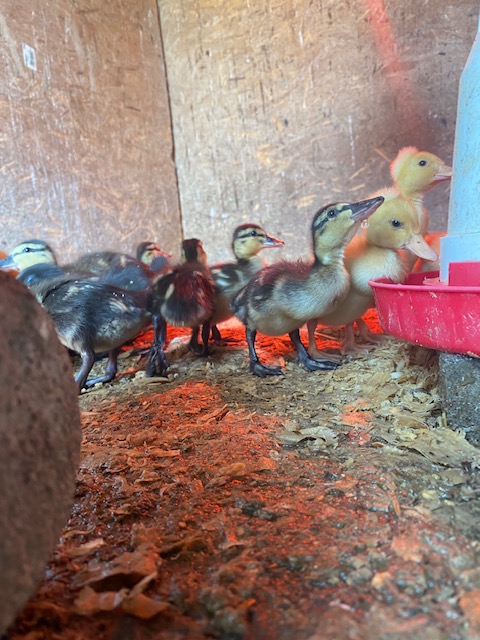
As I write this, I’ve got some straw baled, got another show ready to open, ducklings moved to a bigger pen,
and I’m going to cut the grass!
Talk about when you had to do something yourself. Why is good help so hard to find?
Our daughter was excited to drive us around the Olympic Peninsula when we visited in July. She was equally excited to explore Olympic National Park, not only for the rain forest and the moss, but because of the podcast she chose for us to listen to as we drove.
Daughter thought that a podcast about true stories of people murdered by serial killers in National Parks would be entertaining. It really was, I must admit. There was very little traffic, and we were in pretty remote areas, and it seemed cozy, somehow, like listening to ghost stories in a nice warm room with a fire going and a storm raging outside.
How do you set the mood? What do you like to listen to when you drive or work around the house?
It started out so well– no rain in the forecast and, while the swather always makes me nervous because I know I am on borrowed time, we were making good progress.
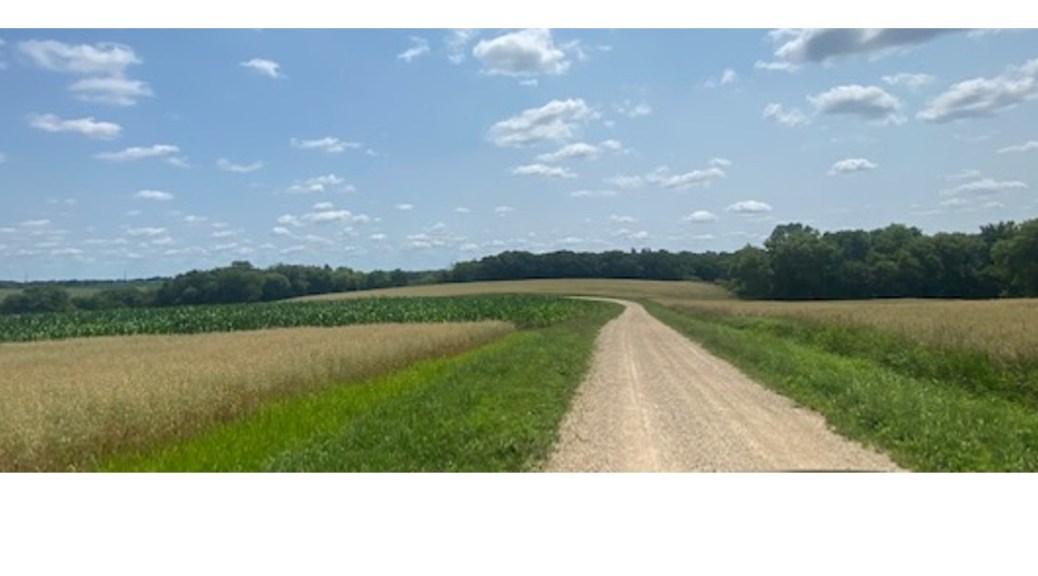
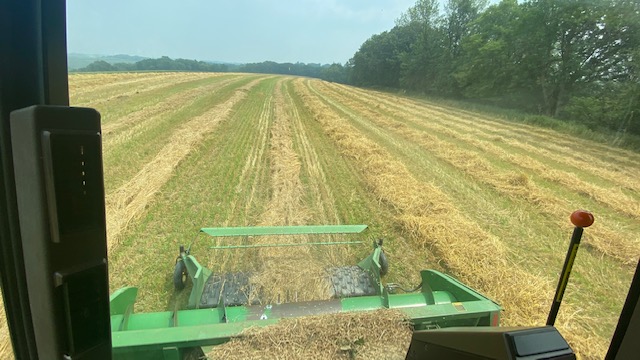
Me, and the dragonflies, and the barn swallows, and the butterflies, just being out in the fields. It wasn’t that hot Saturday morning and I got three fields, or about 9 1/2 acres cut out of my 25 acres of oats. Back out on Sunday afternoon and a good breeze and cut another field of about 5 acres and moved into the last field, about 10 acres. I made one round, and there was a clunk and forward momentum stopped. It stopped on the right wheel anyway, the left wheel kept going. The machine makes a lot of noises and most of them make me nervous. This machine, a John Deere model 800 swather is from the 70s. They’re built like a tank, have a Chrysler ‘Slant 6’ engine (with a reputation of being bullet-proof), and they run forever except when they don’t.
It’s a machine I use only for cutting oats. It cuts the standing oats and lays it in a row; a ‘Windrow’. It gets used a day or two per year. But there’s no one in the area with a swather, so I had to find my own about 6 years ago.
Took a while to diagnose what was going wrong and it turned out to be just a chain off. Well I’ve fixed that before and it’s kind of a process but it’s not bad. Except this one was jammed in there and it was bad. Kelly came to help when I called her for a ride home. I was hoping to be all done cutting by 8:00PM, it was 8 o’clock when we gave up and went home. A few things to do the next day so it was about 4 o’clock when I went back out to work on it again.
I was down to plan “G” or “H” by this point. And that also revealed a wheel bearing going bad. Well, that would explain why the chain had come off. We did finally get the chain out and installed again and we felt pretty good about ourselves.
I had to decide: can I finish cutting on this bad bearing or do I need to attempt another major repair out in the field and replace the bearing. I decided to take my chances, because that’s what farmers do. Except this time, I only went about 10 feet and the chain was off again. And again, it was 8 o’clock at night. We went home and I was back the next day with some more tools. I don’t know how many trips I made back home to get ‘Yet One More Tool’ for this repair. I even took the Oxy-acetylene torch up there to heat up the wheel hub. I’m a little nervous using a torch in the middle of a dry field of oats, but I wasn’t really cutting anything or making sparks, I was just heating up the wheel hub to try to get that off the axle so that the bearing can come off the axle. Nothing has been apart for 50 years I presume. I worked for a few hours and gave up and called the John Deere dealer. It felt as though a huge weight was lifted off my chest because now this isn’t my problem anymore.
The plan was to start combining that oats that was already cut on Tuesday afternoon, however, the guy with the truck needed his trucks to haul corn so he couldn’t make it. He said he would have a truck out here Wednesday morning. With no rain in the forecast for weeks, it didn’t seem like a problem. And then it sprinkled Monday morning, not enough to hurt anything, and it sprinkle Tuesday morning but not really enough to hurt anything and then we had a thunderstorm warning Tuesday night– where the heck did that come from? And I got about 2/10 of an inch of rain. So now we’re not combining on Wednesday either. Could have been worse, it was a pretty bad storm with some pretty gusty winds and heavy rains, but we just got the edge of it and then it built up south of us and I saw some hail damage and some corn flat on the ground from that.
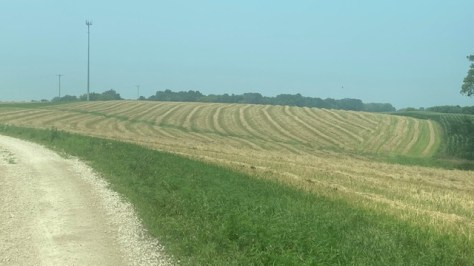
It’s not ideal for oats to get rained on when it’s cut, but it’s not the end of the world, depending. I leave 4 to 6 inches of stubble for the oats to lay on so that it gets some air underneath. And that works pretty well. Light rains like this followed by some sunny days with a breeze and it will dry out again and can be combined with minimal loss. The heavier the rain, the more grain is shelled out on the ground. There have been a few years I had to go out with the hay rake and tip the windrows over. That knocks off a lot of grain. However, the people who take the straw like it because there’s less grain left in the straw if I have to handle it before they get it. Everyone has their own silver lining, don’t they?
So that’s where we are at the moment, hoping the mechanic will get the swather fixed, hoping it holds together for another 10 acres, well really, I want it to hold together for the next number of years.
I’m just about ready to open the one show in town and I’m just starting to work on another show. Remember the song about home improvement from the LGMS and at the end he says, “Now I can go out and mow the lawn!”? That’s kind of what I feel like.
But the beans are looking really good, they’re almost waist high, lots of flowers, lots of pods. 316 GDU’s above normal. The corn ears have already determined their length and girth and now they just need to fill out. If they’re stressed by weather, the tips won’t fill. Be interesting to see how it does this fall.
Often corn will have two ears on them, but only the one really develops completely.
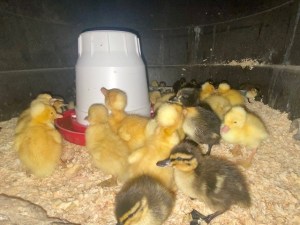
The baby ducks arrived from California after a 2000 trip. These are some well-travelled ducks! I was worried about them making a trip but there were two little Dixie cups taped inside each box that presumably had some kind of food nutrient in it. Lost two of the 40. They were busy little ducks! The first day pretty much all they did was eat and drink.
What’s your most critical tool that you use the least?
I love having “aha” moments and I’ve had three recently, all from reading.
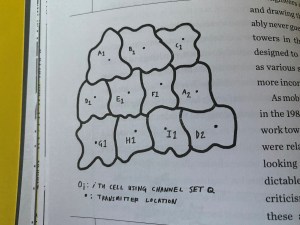
#1. 99% Invisible City by Roman Mars details a lot of the infrastructure that surrounds us in the urban environment, much of which we don’t notice and definitely take for granted. In discussing wireless towers, he writes: “As commercial cellular towers began to sprout up in the 1970s, diagrams depicting their coverage areas looked like blobby plant or animal cells pressed up against one another – hence the name ‘cell phones’.” I had never stopped to think about why we say “cell phones” so this was an amazing discovery for me. I stopped reading for a moment and reveled in the fun of it.
#2. This is Your Mind on Plants by Michael Pollan. This is the second book of Pollan’s that features discussion of hallucinogenics. In writing about mescaline, he alludes to the song Mellow Yellow by Donavan and that the meaning of the song is about smoking banana skins, believed in the 60s to be hallucinogenic. I can sing along to Mellow Yellow but never ever thought about the lyrics and what they might mean. (Turns out Pollan was actually wrong – Donavan was writing about an electric vibrator that he had seen an ad for – the equipment was called the “mellow yellow”.)
#3. A Time of Gifts by Patrick Leigh Fermor. This is an older travel book; the author walked from England to Constantinople in the days before WWII. After completely overdoing it in Munich at the Hofbrauhaus, he woke up with a “katzenjammer”. Now I remember the old comic the Katzenjammer Kids, but had no idea that katzenjammer actually means hangover. I’m not sure how “cat” and “distress” came to mean hangover, but it’s fascinating to know this tidbit!
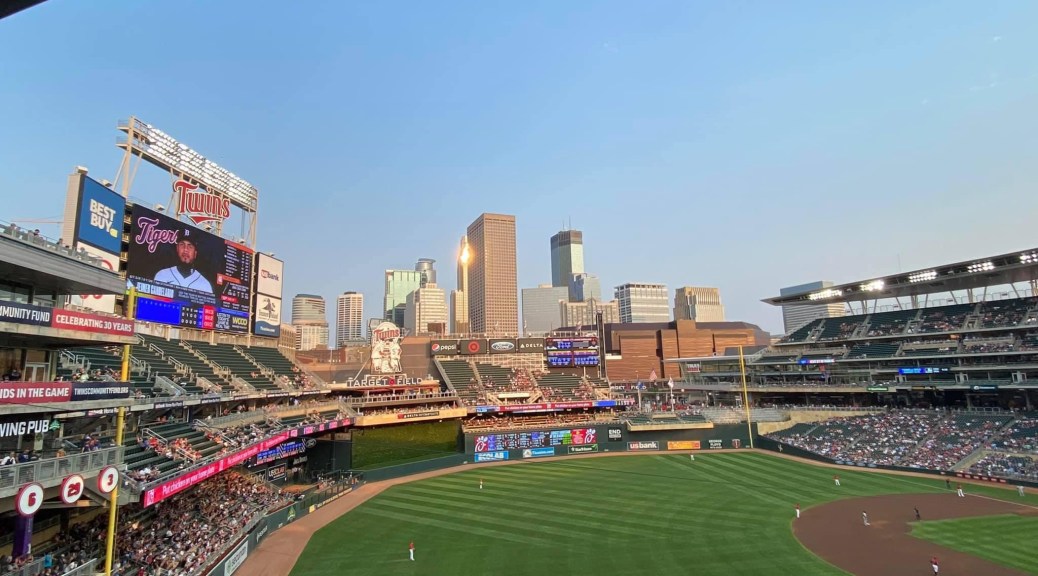
You all know I am not a big sports fan. In fact, I think I’ve probably only been to 10 baseball games in my life. Maybe 15. I do enjoy the games when I’m there, but like Monday night, I come away with more questions than answers.
Why so many huddles? Visiting team did this six times. Six!
Why don’t the outfielders get to huddle? Don’t they feel left out?
Why is Hansel Robles called Caballo Blanco?
How many times can you actually hit a foul before you’re out? Seems like way more for some than others.
What’s with all the fidgeting on the pitcher’s mound and on the plate?
Why don’t relief pitchers get much of a chance? Four relief pitchers for home team, each only pitched 1 inning each. Visiting team sent in one relief – but at least he didn’t mess around on the pitcher’s mound and just threw the ball!
Why do much spitting?
Why do they need to replace the bases halfway through the game?
If the game is tied at the bottom of the 9th and the bases are full when you come to bat, why do you keep swinging? Why not just hunker down and let the pitcher walk you? Especially if you’re not all that tall?
Why do people go wild when they see themselves on the big screen?
Why, after paying so much to get in and then paying a boatload more for food, drink and merchandise galore, do so many people depart before the game is over?
Obviously none of these are burning, social-issue kinds of questions (well, maybe the spitting), but clearly not everything makes sense to me. However, questions aside YA and I had a great time even when it went into overtime.












 Trail Baboon