Last week this time we were preparing for a blizzard, and this week we had record high temperatures and tornadoes and extreme winds. If you’re smart enough to pay attention to the weather extremes going on you would call it global warming. Or you could just shake your head and say, well that’s different. Oh, it was different all right. I’d rather not have to go through that again.
I was glad the snow melted, I really just wanted the banks to melt down on the sides of the road. Guess I should be more specific about what I wish for. White Christmas or brown Christmas won’t bother me.
From the winds, we have a lot of branches down. We have an old maple tree in the front yard. A branch falls off if you look at it funny so it lost several in the winds. I have some trees down around the fields, some minor damage to some of the buildings, and most of the snowfence is gone. None of that is serious. I spent a few hours out with the Townboard guys clearing trees off township roads. I saw a couple trampolines folded in half, I saw metal roofing of a house peeled up over the top. You know if it’s windy down in our valley, it’s really windy out in the open.
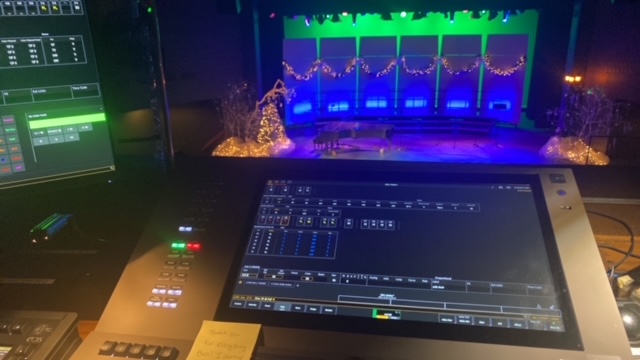
I was supposed to have a choir concert at the college last Friday night. We postponed it to Monday. It was a very nice concert. The photo up top is my view from the booth with the Lighting Console as I programmed. It was nice of Santa to stop in at the concert on Monday.
End of the financial year here so I am settling up with the neighbors. I mentioned a week or two ago about pre-paying some fertilizer and doing tax planning for next year. My neighbors that do the combining and hauling of my crops sent their bill. Combining soybeans is $38 per acre. Corn is $39 per acre. And it’s eight cents per bushel to haul. They also made some round bales of straw at $13 per bale and I sold them 200 bushels of oats at $3.58 per bushel. I’ll be writing them a check for $7310. It’s a lot of money, but it’s cheaper than owning my own equipment and having the time to do it. And the neighbors with the cattle here, they pay rent on the pasture, I pay them to combine the oats, and they will buy the round bales of straw. I did some work for them and we pretty much balance out at the end of the year.
The chickens appreciate the snow melting. You can see them here gathered in a bare spot last week.
They don’t like the snow, they’ll walk over a little, but nothing deep. Except one white chicken. Evidently her feet don’t get cold. There were a few days last week when she was the only one out. Maybe she just doesn’t get along well with the others. She is kind of ornery, biting Kelly twice when she tried to collect eggs. Bad move chicken, bad move.
The MRI on my shoulder last week showed massive tears. Still waiting on the surgery consultation. Some days it hurts more than others. If I’m going to have surgery done, I’d really like it sooner than later. In the meantime, I wait. I remember reading in a John Irving book a phrase something like, “Does anyone in love ever want to ‘wait and see?’ “
How do you feel about waiting? How many other heteronyms do you know?
Well I guess it’s winter this week. We had 4 inches of unexpected snow on Tuesday. maybe I wasn’t paying enough attention to the weather but I don’t think anybody expected that much snow. At least it was light and fluffy.
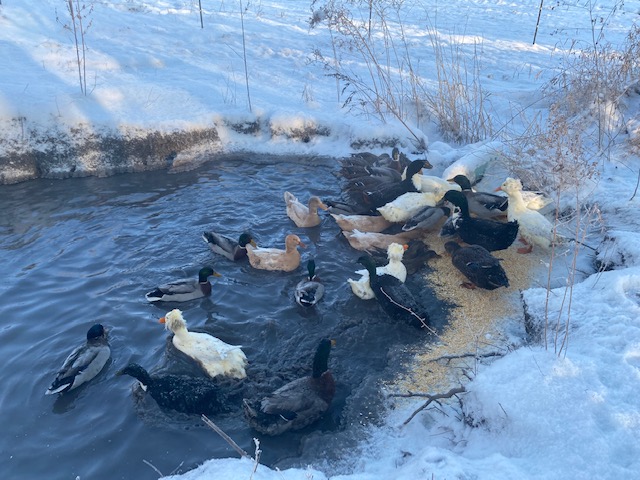
And then it was cold. I had one below zero Wednesday morning! I went down to open up the chickens and they were in no hurry and had no interest in coming out. One chicken, who always ends up in a different side of the pen, ran to the door, stopped and looked, pecked at some snow, and turned around and went back inside. Didn’t blame her a bit. Even the ducks weren’t too interested in leaving the water. I threw corn out to them at the pond.
The deer have started to group up. I took this picture coming home one night. That’s just one group. Usually there’s about three groups this size. This is why I don’t like the deer. Too many of them.
Almost done with class. We had to write a paper about a park or an area and of course talk about the rocks, waters, and land uses etc. I wrote about our farm. Understanding the history of the glaciers coming through and the forces that have shaped the land and the types of rock underneath is really pretty interesting. I will have that submitted before you read this. And then a final in class on Monday and then that’s it. Then maybe I can start working on my basket of farm bookwork.
Or maybe not. My left shoulder has been giving me trouble for years. But not enough to really cause any issues. Until about two weeks ago. One night out of the blue I went to lift my arm and it hurt like all get out. Then it got better then one night again it hurt so bad I went to the ER, but of course by the time I got there didn’t hurt so bad. Had an MRI done on it and as of now, still awaiting results on that. But I foresee rotator cuff surgery coming up shortly. well, that will certainly make me reevaluate some things.
My good friend Paul, the one who occasionally comments on here, had rotator cuff surgery about a year ago. He had a terrific recovery so he can be my guide.
Tuesday night after the snow, Kelly rode in the tractor with me as we bladed the driveway, so she’s ready to tackle that on her own if necessary.
I think I can still design lights with one arm. I need the computer to program and record cues. Obviously someone else should be climbing ladders. Notice I said “should“. No, if it comes to that, I will behave. I can still program the light board with one arm.”
So we’ll see.
Ever received or sent a dear John /Jane letter? How did that go?
Sure been a nice week weather-wise. Temps In the 50’s the last few days. Ten-day forecast has the temps in the mid 30’s and no snow. I’m OK with that. My apologies to anyone waiting for snow.
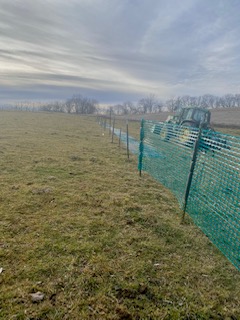
Kelly and I got snowfence up the other day so there’s another thing checked off my list. Glad to have that done.
There was a little wind to contend with and the cowpies were mostly dry.
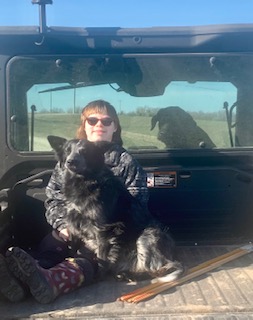
Daughter and I did driveway markers. It was colder than I expected that day and she’s not a fan of the wind. Nice that Bailey could keep her company.
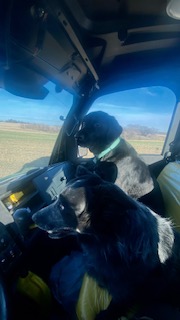
They kept me company inside the gator, too.
I was feeding the ducks one morning and that chicken came running from the pole barn, so she’s still back there laying eggs. .Way in the back, down in a corner. I’m still hoping she gets tired of this as the weather gets colder.
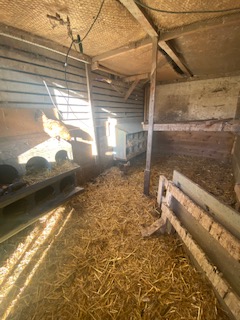
Last weekend I redid a few things in the chicken coop. I put the back wall back in place. (I take it off for more ventilation in the summer) and I changed their perches and got the water buckets and heated pad situated for winter.
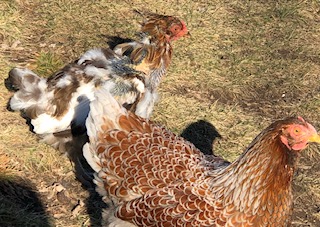
It’s odd, they barely use that rear nest box for eggs, often preferring the front unit. One hen must be molting. She looks really rough right now.
I don’t know if her feathers are going to come in a different color than she was? She used to look like the chicken in the front. Boy, hang in there, girl. Egg production is a little down; the old ones are starting to taper off and the new hens are just getting started.
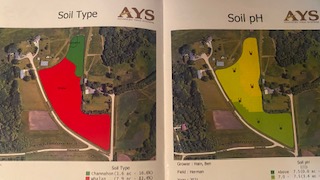
End of the year finances: I’ve paid off our production loans from this years inputs and prepaid some expenses for next year. It’s funny; we have a good year and actually make some money, but it’s tough to save much because taxes will take a big chunk. I know taxes are important and provide a lot of services, but golly. It feels like throwing money in a hole in the ground. I went to the co-op and paid $900 for the grid soil sampling.
Paid $2800 for the lime and applications on half the farm. Prepaid for 4 tons of fertilizer for next year $3400 (again, maybe half of what I’ll need). They don’t have anhydrous nitrogen prices yet and they figure chemicals prices will hold steady so I didn’t pay on them. Easy come, easy go. Sometime before the end of the year I’ll get seed ordered for next year. That also becomes a deduction on this years taxes. Don’t have to pay for it yet, just get it ordered.
Remember getting your first check book? What was the first thing you bought? I bought a Timex Watch and you had to push the button so the time would show up in Red.
The warm weather the last several weeks has given us a glimpse of some fun bird behavior.
We have a bird feeder in our backyard that Husband fills with black oil sunflower seeds. We are the only people on the block who feed birds, so our yard is pretty popular, especially given the tall lilac bushes where multitudes can perch. They also like weaving in and out of the twisty grapevines on our deck. There is a very large flock of about seventy sparrows, with several Red Polls, House Finches, Chickadees, Rose and White Breasted Nuthatches, and Junkos who frequent our yard. There are often seven Eurasian Collared Doves on the ground under the feeder, eating what the other birds knock down. A Downy Woodpecker also makes an appearance now and then. They are all really greedy, and feast and gobble as fast as they can. The Chickadees alert the others after Husband refills the empty feeder to let them know that dinner is served.
I cleared out the rhubarb bed the other day, leaving a large area of smooth dirt that the rhubarb leaves had formerly covered. Last Saturday I noticed about twenty Sparrows rolling around in the exposed dirt, digging into the earth, making little indentations in the soil. I guess they were having dust baths, a luxury in North Dakota in late November.
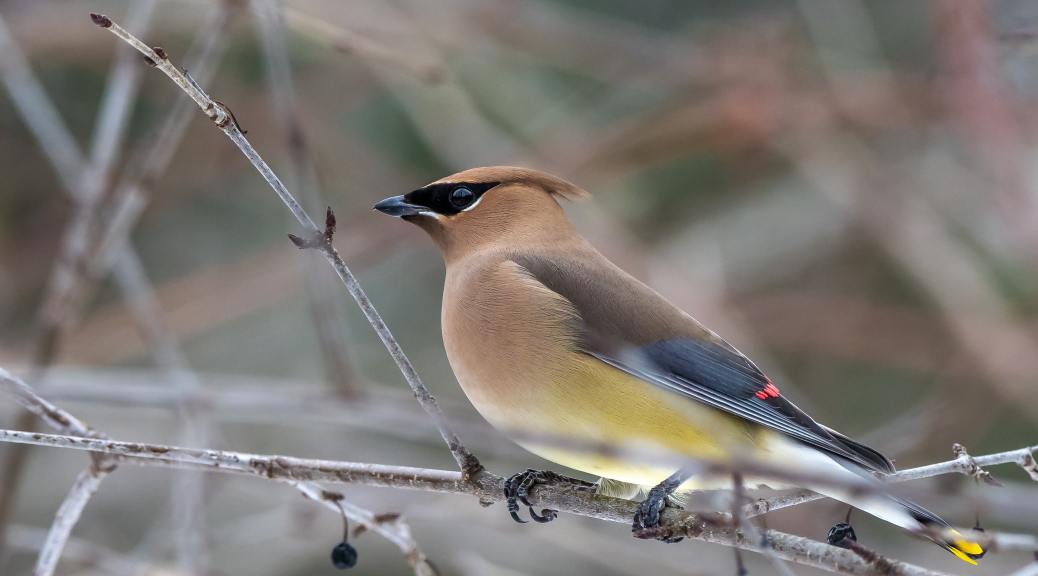
Even more luxurious was the shower they and a migrating flock of Cedar Waxwings had a month ago on the last really warm day of autumn. I set up a sprinkler to water our rhododendrons, bleeding hearts, fern bed, and hydrangeas before freeze up, and we saw the birds flying repeatedly through the spray and huddling on the ground, letting the water cascade over them. The Waxwings made a point of drinking copious amounts of the water that collected on the walkway. The next day, they were gone.
What are your favorite birds to watch? Tell your bird stories. What is your favorite bird-inspired music and visual art?
In searching for something on my laptop last week, I came across a list of books about dragons. Looks like I made this list six or seven years ago (last time it was saved was six years back) and I’ve read a few of the books on the list since then. I’d completely forgotten that I had this list.
Dragons, of course, are widely varied in literature. My least favorite kind are the mindless, evil dragons (think Smaug in The Hobbit). I prefer intelligent dragons who can communicate if they choose (like Ramoth in Dragonflight or Temeraire in the Novik series). My current car is named after a dragonrider of Pern (Brekke – one of the rare dragonriders who can communicate with all dragons, not just their own).
I also like dragons who adore treasure – not sure why, maybe because it’s such a longstanding bit of dragonlore that it feels right when it is included. It’s interesting that the Greek dragons who were set to guarding treasure have morphed into beings who lust after gold, diamonds and jewels. Of course I also read somewhere once that gold is a good conductor of magical energy and that dragons NEED it to exist.
The biggest problem with this list is that I have already reached the limit of books that I can have on hold at the library – with probably be at least a week before that changes. Hopefully in a week, I’ll remember I have this list of books I want to read! Maybe I’ll start yet another tab on my reading spreadsheet.
Tell me about a mythical animal that you think might improve our world if it existed! Or just if you have a favorite mythical animal.
It sure has been windy the last few days. No matter what the temperature is, a wind like this makes it colder. I’m lucky we haven’t had trees down over our road or any of the township roads… knocking on wood.
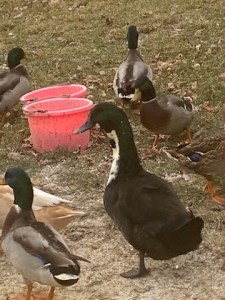
Ducks and chicken numbers are status quo. But I’ve noticed the black and white ducks are getting a green tint on their heads.
A little research shows they’re “Black Swedish” breed. Back this summer I ordered ‘Mixed Ducklings’ so really didn’t have any idea what I was getting. The cream colored ones are “Saxony” and the ones with the pouf are “White Crested” of course. And the ones that look like mallards but are a little heavier and don’t fly are “Rouen”. It seems odd to me they don’t lay nearly as many eggs as the chickens. Just seems like they should be laying more than they do… usually come spring I might get one or two ducks that lay eggs for a while. Usually out in the middle of the yard. Then it depends if me or Bailey finds them first.
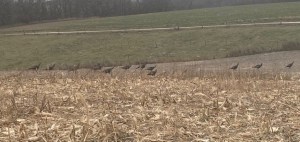
And now that the weather is cooling the turkeys have started grouping up. It won’t be unusual to see a group of 30 or 40. Saw this bunch in the fields yesterday
Dumb turkeys… Once there is snow cover, they’ll be down in the yard eating under the bird feeders in the backyard and trying to get the corn I put out for the ducks and chickens. The dogs love chasing them away, but those stupid turkeys are smart too. They know Humphrey is in the house and Bailey is sleeping out front, so they sneak in the back. And when we do chase them away, they’re back in a few minutes… rotten turkeys. I haven’t even mentioned the herds of deer.
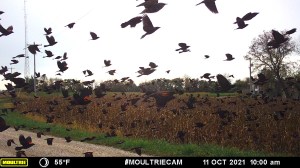
I think most of the redwing black birds have moved on now. Caught a cool picture of them on a trailcam the other day.
I get pretty excited when the birds return in the spring. The Red Wing Blackbirds, the Killdeer, and, of course, our favorite, the barn swallows. Even the turkey vultures returning is another sign of spring.
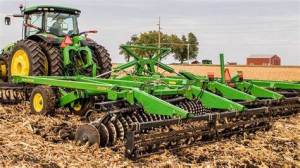
The Co-op called; they finished the grid sampling and said I could go ahead and chisel plow now. My plan is to spend much of Saturday out doing that. Due to crop rotation, every other year will be more soybean acres than corn acres and soybean ground doesn’t need to be plowed up in the fall. This was a soybean heavy year, which means I don’t have all that many acres to work up. In the old days (the “old days”) it was done with the moldboard plow and it made the ground all black because it turned over ALL the residue and buried it. That black surface is great come spring because it allows the soil to warm up sooner and that’s still important. Then we started doing ‘Conservation tillage’ and leaving more residue on the surface, which is important to prevent wind and water erosion plus it conserves moisture underneath. But too much trash on the surface keeps the soil cooler and wetter come spring. Conservation tillage doesn’t use the moldboard plow, it uses a 4” wide twisted ‘Shovel’ to throw up some dirt, but not necessarily bury it completely. The Chisel plow I use is like that. The last few years the hot new term is ‘Vertical Tillage’. I’m still not sure exactly what it is. But there’s a whole new line of shiny equipment to help me do it!
Photo credit: TractorHouse
It’s more about cutting up the residue and burying it a little bit to help decomposition over winter, but again, not turning the surface black. And again, we do want at least a strip of black soil to warm up and dry out for earlier planting in the spring. So there are ‘strip till’ machines that can make a strip a few inches wide while doing the tillage. And then in the spring the idea is to plant into that same strip. You’ll really want GPS and auto guidance to make that work reliably.
I read an article the other day that The Honeyford grain elevator, North Dakota’s oldest cooperative elevator, is the first elevator south of the U.S.-Canadian border to load an 8,500-foot, 1.6 miles-long train. I only cross one set of railroad tracks between the college and my house. About 9:45 PM there’s a train that occasionally keeps me waiting. Some seem long, but not 1.6 miles I guess. It was interesting to read about the elevator and the train. Imagine the parking lot needed to handle that sheer number of cars let alone getting them filled! It just reminds me there are so many things that I don’t know I don’t know. It does say Honeyford Elevator is in the middle of the prairie and the nearest town is 3.5 miles away. Here’s the article: https://tinyurl.com/uys4s7rx
What’s the longest straight road you’ve been on or know of? I know one that’s 13.6 miles.
“Cyril, a good judge of human mood, nudged gently at his side. Canine body language for “I understand”. Dogs understood misery.”
This is a quote from The Peppermint Tea Chronicles by Alexander McCall Smith. It’s a fabulous little book that I’m about half way through. But quote above is in the first chapter. Bertie, who is seven, is disconsolate over having to attend a mostly-girls birthday part. Cyril is the next-door neighbor’s dog. When I read this, I was immediately reminded of a time when I was about seven and was completely heartbroken over something. I don’t remember what the issue was but I do have a snapshot in my memory of sitting on the wide stairs of my home and crying as if there were no tomorrow.
While I cried, our family dog, Princess (aka Princess the Wonder Dog) crept over quietly and sat down beside me. She laid her head in my lap and I clutched her to me as I bawled. I remember this as if it happened yesterday – the feel of her clearly sympathizing with my misery. It’s true – dogs understand misery.
I can’t wait to finish this book; I’m assuming there may be some other nuggets that will speak to me.
Do you remember when you found out the truth about Santa Claus?
Accidents are part of life, and kids are especially likely to take risks or do dumb things that result in injuries. One of my sister’s sons was a wild child who lit fires, jumped off garages, climbed trees, explored dangerous caves, ascended water towers and did other unsafe things. As an experiment, he once bit a wire attached to a lamp, a lamp that was plugged in. Electricity burned a hole in his tongue, sending him to a doctor’s office.
Apart from my one wild nephew, kids in my family have been remarkably prudent and accident-free. My daughter had only two accidents of note. Well, she had three if you count the time a dog bit her, but I blame the dog for that one. That accident had an unanticipated benefit. My daughter had struggled to remember which was her right and which was her left hand. After the bite she knew that her right was her “dog-bite hand,” and never again was confused about left and right.
My grandson is a good example of a kid who is naturally cautious. One afternoon he was walking with scissors in my apartment. My daughter reflexively said, “Be careful Liam!” He wasn’t running, and didn’t appreciate being cautioned. In a quiet voice, Liam responded, “When have you ever seen me not being careful?” I thought that was a nice sentence from someone who was six.
I must have had that same natural caution, for I had very few accidents in spite of living what would now be regarded a risky childhood filled with BB guns, bicycles, bows and arrows, hunting knives and many firearms. While swinging on a very tall swing set at school I used to pump for speed and then “bail out” to sail through the air. In fact, all of the play equipment I used so recklessly as a child would be banned as too dangerous by today’s child safety experts. But I never broke a bone, suffered a concussion or had a cut serious enough to require stitches.
The one exception was when my buddy Mike shot an arrow into me. When I was fourteen I discovered a dump that was heavily infested with rats. The dump, as was true of all such places at that time, was just an open hillside where garbage was strewn willy nilly on the surface. Of course, the place stank from rotting garbage. Plumes of rancid smoke wafted over the dump, making our clothing fragrant.
For reasons that escape me now, my friends and I spent many hours hunting the dump rats with bows and arrows. Although it was a pointless activity, it was challenging. The rats were smart and quick, and they rarely ventured anywhere in sight because they had a fantastic system of tunnels in the rubbish that let them travel unseen.
One day a young rat made the mistake of leaving the security of the tunnels, and it ended up running in little circles around my feet because it apparently didn’t remember where there was an opening to the tunnel complex. I always wore four-buckle black rubber boots for trips to the dump. With the rat running right around my feet I was hopping about in panic. My panic deepened when Mike came up with his bow at full draw—a bow powerful enough to hunt deer—and let loose an arrow. Mike was a superb athlete but somewhat excitable.
I’ll never forget the astonishment of looking at my foot. Mike’s arrow had gone through the boot, through the leather street shoe underneath and was now sticking up proudly like a little flag pole. I limped out of the dump and pulled off my footwear. The arrow had hit my big toe, but apart from that had done little damage.
Back home, I handled the wound the way any teenage boy would have: I kept quiet about the accident because I didn’t want my mother to explode with anxiety. But when I left for school the next day, my mother couldn’t fail to see I was limping, so she forced the story out of me. She was not mollified by my insistence that I was okay because “it was a new, clean arrow that had only been through one rat.”
Did you have childhood accidents? Have you had some close calls? Did you ever do things as a kid that you now know were stupidly risky? Do you remember any painful or unpleasant remedies for childhood mishaps?
Weather has taken a definite turn toward fall. We got 1.72” Wednesday night into Thursday morning. Been seeing geese formation flying South. Rochester used to be famous for the thousands of Canada Geese. Then a few years ago goose poop got a bad rap, and the power plant closed so Silver Lake froze over, and they planted the shorelines to weeds, I mean “Native Vegetation” (some call it weeds) and the gathering of geese is discouraged. So there’s a handful that hang around, but not the thousands there used to be.
I had other stuff to do all week (work), but I took time off Monday afternoon and Tuesday morning so I could work on putting the new gearbox on the brush mower.
I got it installed, pounded out a dent and welded a crack in the ‘big round thing’ (the stump jumper) that goes underneath, added oil to the gearbox, pulled it outside, and had it idle for 20 seconds and then there was a CLUNK and the whole thing started to wobble. I was out of time; I parked it back in the shed and walked away.
The next day neighbor Dave needed to use the tractor so before I unhooked the mower, I crawled underneath it once more and I think I just got the washers on the wrong side of the bolts holding the blades, so they aren’t loose enough to swing. Therefore, one blade is stuck ‘in’ and one ‘out’ and it’s out of balance and it’s all wobbling. At least I hope that’s the issue. It looks like that’s really the only obvious issue.
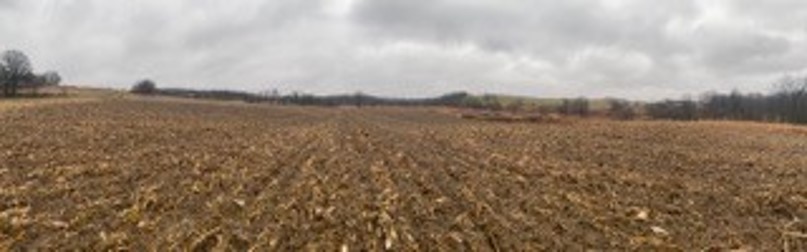
As luck would have it, neighbors Craig and Darryl got our corn harvested Wednesday afternoon. I was busy all day and never got home to see them doing it. But that doesn’t matter; it’s done! The local co-op, where I have it taken, recently merged with another co-op and their website, which was pretty good, is even better! I can get information on the loads, minutes after they’re delivered! Other years I had to wait until it was all delivered, then call up there and have them look it up and give me all the details. Now I can see each load as it’s delivered and get all the details.
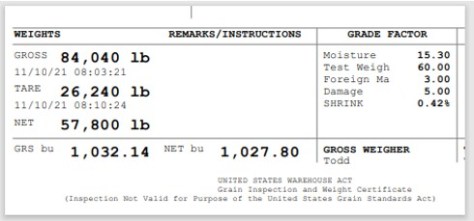
This photo shows the details of one load; Gross weight is the truck and corn, Tare is the weight of the truck, Net weight then is the actual corn. Converted to bushels (based on Test Weight) gives us gross units, then after taking into account moisture, damage, and foreign material gives us Net Units and that’s what we get paid for. Test weight is 60, which is really good because the standard for corn is 56. They need the moisture to be 15% to store long term and I pay drying costs for anything over that. The fact it’s 15.5% is really amazing! Most years it’s anywhere from 18% – 25% coming out of the field. The wetter, the more it costs to dry. This cost me $0.025 / bushel. And one load was even 14% so no drying costs. Plus price is really pretty good this year! Somewhere around $5 / bushel. It’s been $3 / the last several years. And the corn was wet so I was lucky to get $2.50 / bushel to take home.
Considering the low stand population this spring, the hot weather, the dry weather, and I really didn’t expect much of a yield. Turns out it was about average. Which is really surprising all things considered. And raises some interesting questions: was it the lack of competition of plants that allowed me to get an average yield? If that’s the case, shouldn’t I plant at a lower population every year? What if this year had better weather? I should try it next year I suppose, but given the changes in the weather year to year it’s still hard to compare. But it sure is interesting! I even put some corn in storage at the elevator to sell next spring. Maybe price will be better? Course I’ll be paying about $0.30 / bushel / month for the co-op to store it so will the price go up enough to cover that? Either way it’s just some extra money in March.
It was starting to sprinkle Wednesday afternoon about 2:30. I got home about 4:30 and it was raining pretty steady. But that didn’t stop me getting the tractor out and hooking up the chisel plow and I got a couple fields worked up.
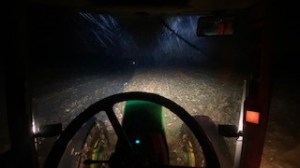
Bailey and I had some quality tractor time. You can see the rain in the headlights. There’s a lot of mud on the steps and frame. It’s not really that muddy on the tires because the cornstalks make so much surface trash it gives me traction. But it was getting pretty soft by the time I quit. Actually, I was surprised it went as well as it did. I hope I have time to get things washed up before it really gets cold. Last week I mentioned waiting for the co-op to do soil samples and apply lime. Still waiting on that and they didn’t want me to plow until that was done. Too bad, so sad. I will just wait to lime this ground until next year. I wanted these fields plowed up this fall because it’s low ground, because it could be wet come spring, and because conditions may not be suitable to plow this in the spring, I always like to get this worked up in the fall. The new LED lights I put on the tractor are awesome! I only switched half of them, I should do the other half next spring. When plowing cornstalks with a minimum till implement, we go diagonal to the rows. My Dad and Clyde could just follow the row with the moldboard plow, but with minimum till, we go about 30° across the rows.
Neighbors Dave and Parm hauled out their beef cows Thursday.
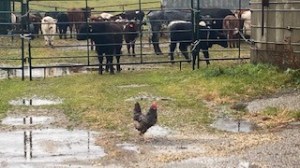
Yesterday Dave hauled in a bunch of fence panels and left a load of silage in the cow yard and got all the cows and calves locked in the yard Wednesday afternoon. Then Thursday it was pretty easy for the guys to get them locked over in one section, back the trailer in, and haul them out. Took four trips to get them all. See the chicken in this photo? She’s been laying eggs out in the pole barn. But this morning she wasn’t sure if she could get there. I went out later and found her spot in the bales in the back corner and collected 2 eggs. As the weather gets colder, one of us will get tired of making the trek out there.
I spent some time looking up custom farm rates. I’ll be settling up with the neighbors at the end of the year so I’m trying to find rates for baling small square bales and the price of round bales of oat straw. And rates for combining corn and soybeans and hauling. Generally those rates come from the Iowa Extension service. Maybe they’ll be helpful for some of you. tim.
Here we are in November and my 1940’s station on SiriusXM radio has been replaced by Holiday Music! Bah! Harumph! For two months!! Grrrrr….
It’s been getting cold at night; mid 20’s. I drained all the hoses. Drained the outside faucet on the wellhouse, and moved the chicken’s water inside. Kelly helped me get the pressure washer into the wellhouse so that pump doesn’t freeze and I took some chemicals in the house. There are a few things in the shop I’ll take in the house before it starts getting serious cold. Things like ‘never sieze’, gasket cement, and the tire-ject’ stuff, stump killer, etc.
Last week I used a trailer and delivered straw to the neighbor’s strawberry farm. That night I noticed all the chickens water buckets were tipped over and their self-watering thing was off the base and tipped over and I thought what the heck happen here?? And then I saw the tracks. I pulled the trailer out, drove right over the top of all that stuff. Broke one bucket. Man o man… pay attention Ben.
Still no time for farming in my life. Open house at the theater on the 6th so finishing touches for that. Then opening a show in that space on 11/26 so a few more finishing touches for that. Called for final inspections by the city, electrical, and plumbing… one of those things I’m at their mercy and waiting for their phone call that says “Sometime in the next 30 minutes”, between 8 and 5. But they’ve all been good people. No serious issues. Will be nice to have it done.
The neighbors have been bringing silage and round bales of hay for their beef cattle for the last month. I suspect they’ll be taking the cattle back home pretty soon here.
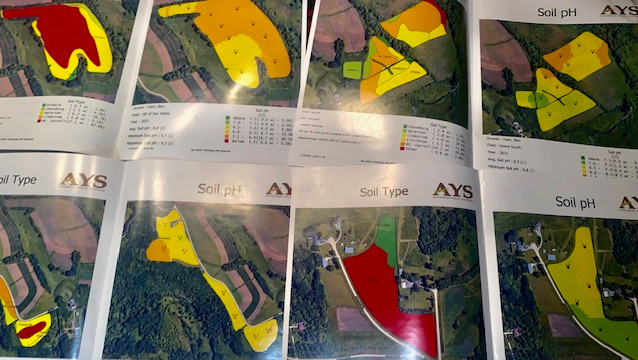
The other neighbors with the late planted soybeans are harvesting them this week. The beans were starting to mature and drop their leaves before it froze. It would appear they got a decent crop off them for late planted beans. They sure got lucky with the weather. And it sounds like they’ll be working on my corn next week. I had the co-op pulling some soil samples and I had asked for them to do “grid sampling” on a rented field. That got lost in translation somewhere and they just pulled a single sample from this 10 acre field. (Grid Sampling, is pulling more samples / field to be able to adjust fertilizer rates more precisely. Not something I can do, but something the co-op could do with their equipment) After a few phone calls, we decided to wait until the corn is off, grid sample the entire farm, then apply lime, if needed, to as much as I can afford to do this fall. (All the fertilizer and chemical prices are way up this fall from the spring. Supply Chain issues) They don’t want me to chisel plow the corn stubble until after lime is applied in order to have a smoother surface for the applicators to drive on. I certainly understand that… it just delays me doing fieldwork until they’re done and hopefully the weather still holds.
Fall fieldwork is always better than spring fieldwork. Even when it’s too muddy, as long as there’s enough traction and it doesn’t plug up, it doesn’t have to work up so well because after the freeze / thaw of winter, it will work up OK in the spring. But I don’t have tractors with tracks, or big enough tractors, that a little mud and a little slippery and I’m done. Then there’s the whole soil compaction issue of working wet soil, but again, maybe the freeze thaw prevents that. We have about 11 acres in a conservation reserve program (CRP – not to be confused with CPR) and planted to wildflowers. Been in the program 11 years now. It’s a 10 year program and Iast year I modified it and re-enrolled for another 10 years. It’s flat, rich, black soil, and makes real good crops. IF it’s dry enough to plant and harvest. Often it gets too wet. That’s why it qualified for CRP. And I have a couple corners that are rocky and surrounded by trees and the deer come out and eat it all. So, I’ve been leaving those bits idle the last few years. I am working to enroll that in CRP. That way I get a payment on the idle ground and it’s not just a net loss for me.
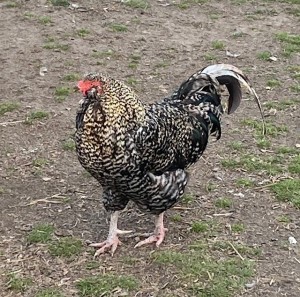
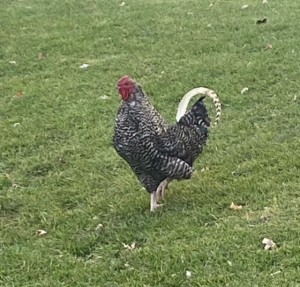
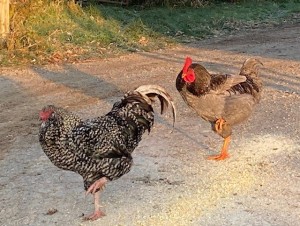
Duck update: All the critters are still around this week. Or at least, the ones I keep track of. Twenty brown ducks, 4 black and white, 4 cream colored, 6 Poofy. And I don’t know how many chickens… 40 or 50. We’ve got these three roosters: The boss,
#2,
and the up and coming #3.
Boss and #2 are almost identical, except the boss doesn’t have any comb on his head. And #2 just has a little one. It’s interesting #3 is never far away from #1 as the photo shows. But if #2 shows up, The Boss chases him away. Evidently #3 is sucking up. Biding his time.
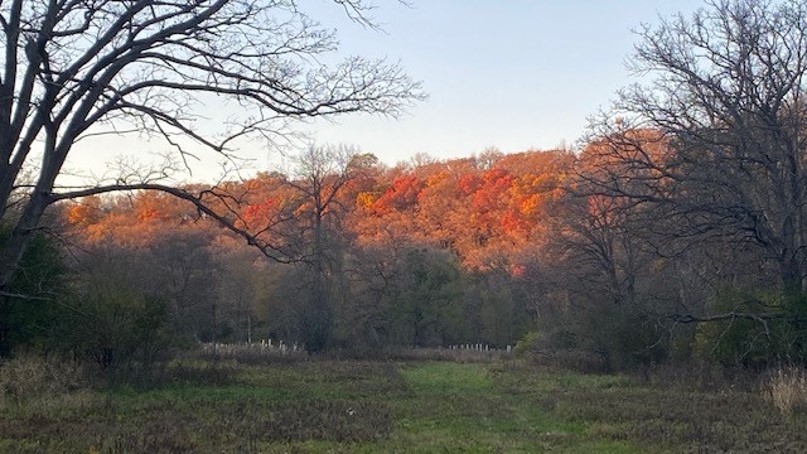
Kelly and I (and the dogs) took a 4 wheeler ride down in the woods one afternoon. It was a nice drive. Header photo is from there.
What kind of medical training do you have? Are you trained in CPR? How do you handle blood?What wakes you up in the morning?









 Trail Baboon