I know we talked about joy the other day, but… I want to talk about it again.
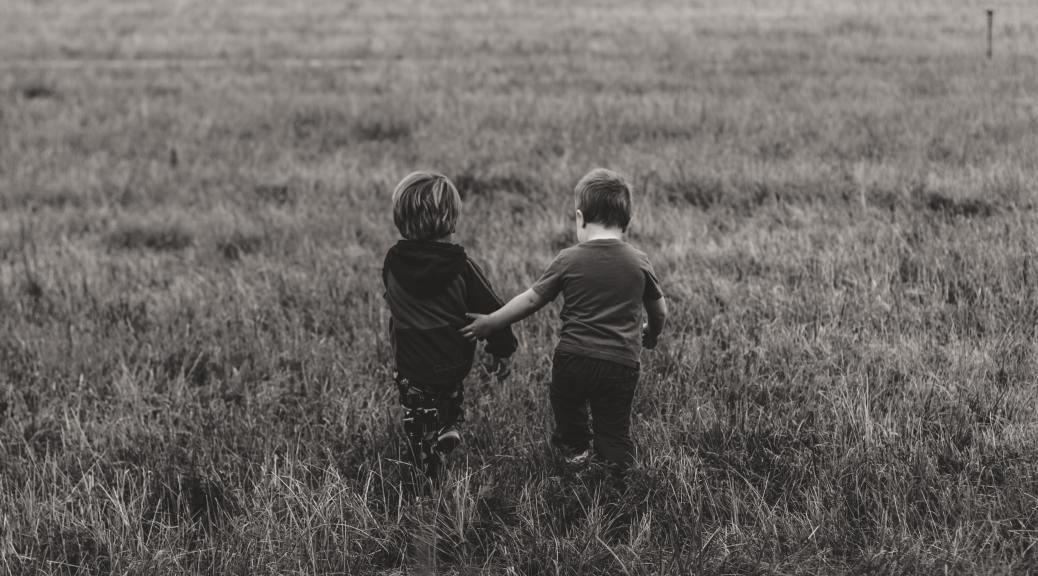
At the State Fair yesterday, a woman with two kids sat down next to me on the curb, waiting for the parade to begin. The son was about 8 or so, the daughter was maybe 3. She was adorable with bright blonde hair that curled around her face and the back of her neck. She also had quite a dirty face – a combination of what looked like chocolate and something berry-ish. The berry stain had found a home on the front of her shirt as well.
The most interesting thing about this little girl was the fact that she was completely suffused with joy. Everything about the parade was fascinating to her. She couldn’t sit down, swaying and dancing as each band went by. She ooh’ed and aaah’ed over the stilt walkers, the art cars, the waving princesses and especially the big bovines. As each attraction reached us, she would turn to her mother, her face alight with pleasure, pointing out this newest discovery.
No matter how you measure it, nobody enjoyed the fair more yesterday than this toddler.
When was the last time you got dirty (and enjoyed the process)?
Actually, hasn’t been much farming the last few weeks…
I’m back at “work” work now, and I lit another show, and we moved my mom to long term care.
Here’s a theater space I was working in and the genie lift that’s my best friend because it means no ladders!
And the view from up there.
With the lights.
And the lighting console in the loft.
And some of the finished product. The colored lights? That’s what I did.
It’s a show called ‘Head Over Heels’, music of the GoGo’s (which apparently I only know two songs.
Mom is 95 and has just kinda lost her self confidence in the last few months. There’s been a few falls (nothing serious) and I think she kinda likes it when the firemen come to help pick her up. And I’m lucky I have siblings here and everyone is chipping in to pack and deal with things. Moving to a long-term care apartment was her idea so that makes it a bit easier; we were over there more and more and balancing the cost of more Visiting Angels or Assisted Living or LTC, she decided this was the thing to do. I can’t say enough good things about VA; they’ve been great.
She was already in a Senior place so we’re lucky that she’s just moving into another section and not across town or anything.
There is a large metal bin down by the barn that holds corn which I use for the chickens and ducks. I opened the top lid one day to climb up and check how much was left inside, and then forgot about it and left the top open for two weeks and that’s when we got 3” of rain. Oh fer….
I spent an hour one morning taking an access cover off the bottom and digging out about 30 gallons of wet, stinky, moldy, rotten corn. I’ll try not to forget to close that again. Thank Goodness it’s almost empty. I’ll be ordering 100 bushels of cracked corn to refill in the next few weeks.
They say August is bean month. Beans have pods, but how big they’re going to get depends on the weather in August.
I was just reading about how corn develops and how the yields are determined by the weather. It takes roughly 90,000 average kernels to make a bushel (56 pounds for corn, remember?). The guys who are winning the yield contests can get that down to 65,000 kernels (bigger, heavier kernels). Final yield started with how many plants emerged back in April. The girth of the ear was determined at the 5-leaf stage; If the plant was happy and it had all the right nutrients and moisture, it can have 20 kernels around. 12-14 is average so any more than that means everything was going right at that point. Now the kernels are there and it depends on the weather as to how much they fill and what the test weight will ultimately be. If it gets stressed now, it won’t develop fully to the tip as the plant sacrifices them to fill the bottom. A lot had to happen already, but the weather this month can still make or break a crop. It’s pretty fascinating.
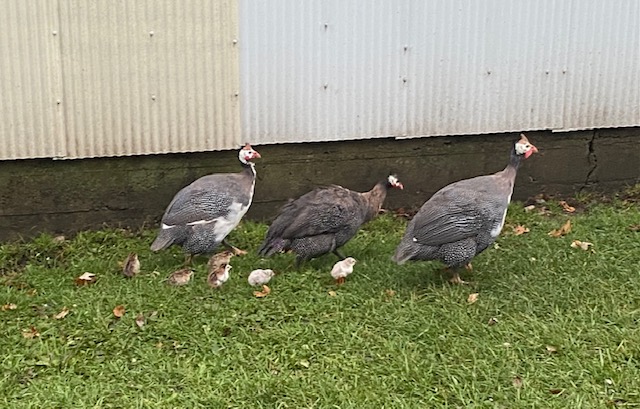
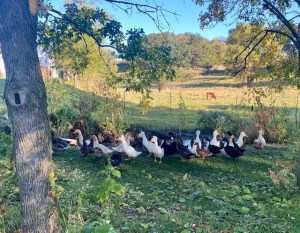
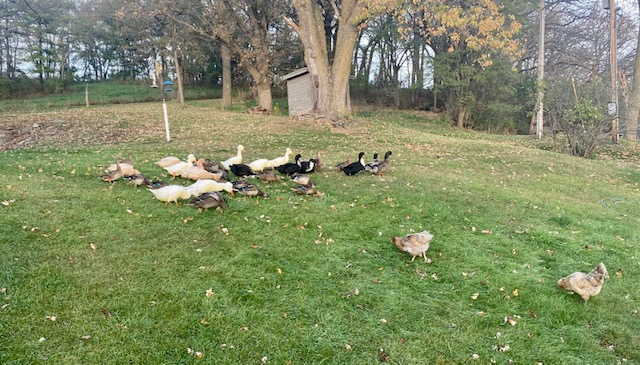
The ducks have moved outside and now it’s all muddy out there (I swear; everything is wet when you have ducks).
Here’s some ducks!
Any Questions?
Boil or microwave your sweetcorn? Who’s done mud wrestling?
Last week, someone at work referred to me as a “glass half-empty” kind of person. I was a little surprised, as I don’t think of myself as a gloomy Gus. I do work hard to keep my expectations low sometimes – especially for events or big occasions. That way, if something tanks, I’m not terribly disappointed. But if it goes well, then I am very happy – probably happier than if I had high expectations. So maybe I am “glass half-empty”.
Next week is the opening of the State Fair. I don’t need to bore you all (again) with my love of the State Fair but I am telling you, it is HARD to keep my expectations in line. YA and I did the mini (pretend) fair experience over Memorial Day and it was a good idea to not go into it with a lot of excitement. But even with that very blah experience under our belts, we’ve spent a lot of time in the last week figuring out which days, how many tickets, what new foods, when will the golden retrievers be there, where parking is this year. We bought our tickets and have even combed through the coupon booklets already. I have taken opening day off of work as well as a few other days. YA has also requested a couple of days off.
Considering the current state of affairs, it seems dangerous to get my hopes up. The Fair could just be a disaster this year.
But with all this activity and still a few days before opening, how do I keep my expectations low? Are you a half-full or half-empty type?
Having a lot of flowers and vegetable plants to care for has been a relief in some ways lately, since it has kept me outside the house and off my phone looking at news feeds and becoming more and more despondent. Between drought, excessive heat, the pandemic and all the associated idiocy, Afghanistan, and US politics, it has been a heart-heavy summer.
The other morning I was turning the sprinkler on the dahlias when I saw a perfect dragonfly perched on the fence. I like dragonflies. We only see them here when it is sufficiently humid. It is sometimes humid here in the early morning. I love the way they tear around. I also like hummingbird moths and their imitation of hummingbirds. They are a rare sight here, too. I saw a Tiger Swallow tail last weekend, and that always cheers me up. On the rare nights it has been cool enough to have the windows open and the AC off, I even have enjoyed hearing the crickets, unless they are frogs, but I think they are crickets.
What are your favorite insects? How to you cope with bad news? How can you tell a frog call from a cricket chirp?
To wrap up the oat harvest, let me explain test weight and pricing.
There isn’t a big market for oats, so they won’t take the oats if the quality is a little low. By ‘Quality’ I mean if it isn’t at least 32 lbs test weight (That’s the ‘standard’ weight of a bushel of the product. 56lbs for corn, 60 lbs for soybeans, 32lbs for oats). The weight can vary depending on a lot of things; moisture content of the crop, the weather as it grew, the variety, ect. The market price is based on that weight though, so if it’s low, we don’t get paid the full amount because while we deal with the crops in volume (the trucks and wagons it takes to get it hauled in), we’re paid by the bushel. If your corn sample only tests 50 lbs, then it takes more corn to get to 52 lbs and we get docked for the low TW.
My oats samples tested 38 and 39 lbs. The truck is heavier, which means it takes less grain to make 32 lbs so I get more bushels on the truck. But no bonus for being Over TW.
Price this year was $3.58 / bushel at the Elgin elevator (which is closest so most of the oats went there) but they were full so the last of the oats went to another elevator and it was $3.71 there. Heck; if I’d known that I’d have taken it all to that second place!
Remember; hay is something animals will eat; it contains nutrients. Straw is just an empty stalk; there’s not much nutritional value in straw.
Baling straw; it went pretty well this year. No problems.
It might take a while to get the baler working right; get the rust off it, so to speak. I like to bale straw; it’s light and the bales are easy to throw around.
I broke a shear bolt just after starting; a ‘shear bolt’ is protection against something bad happening. It might simply be overloaded or it might be a safety feature against something catastrophic. But sometimes they just wear out. That was the case here.
This shear bolt hooks the baler flywheel to the hydraulic pump for the baler kicker and sometimes it just fails. Then the kicker looses it’s oomph.
In the old days, Clyde and my dad had to have someone on the wagon to catch the bales coming off the baler and stack them on the wagon. I was about 10 years old when Dad bought a kicker baler which ‘kicks’ the bales into the wagon. Less manpower needed. Course, getting them back out is a little more trouble.
In 1993, we hosted 2 men from Russia for a few days. They were here as part of an exchange program with the Farm Bureau. They didn’t speak English, but they had a Russian / English dictionary and we had a good time doing hand gestures. I was baling hay and they rode in the wagon and insisted on stacking the bales as they flew in there from the baler. I tried to stop them; warning them this was dangerous and not to get hit by one. They assured me it was fine and kept stacking. And it’s a wonderful thing; so much easier to unload when they’re stacked, plus I get more bales on the wagon. I’ve been stacking a few ever since. Just the bottom row or two, and a ‘wall’ at the front to help keep the bales in the wagon.
The kicker part of the baler rotates left and right. That allows me to throw a bale in the wagon even when making a corner. And there’s a power adjustment to kick the bale just a little bit or kick it real hard! The average is 3 or 4. It goes to 8, I haven’t had to use it that high unless I’m kicking it all the way over the wagon just for fun. Because the power is based on weight, kicking to the back of the 16’ wagon only needs about 4. If the bales are so heavy it needs 6 or more, then they’re too wet to bale and I can’t even pick them up.
Up or down hills changes that a bit… and making a corner when it kicks can still kick it over the side. All in all, it’s kinda fun.
Here’s what it looks like from the tractor cab.
I’m watching my left mirror as that shows the back of the baler and I can tell the bale is good (not missing a string) and I can see most of the wagon. The right mirror shows the row going into the pick up.
Here’s three loads in the shed.
A few weeks ago we talked about backing up wagons. Here’s what it looks like to back up a wagon into the shed:
You need to trust yourself about what’s behind you.
I had about 200 straw bales left in the barn. I baled 612 (there’s a mechanical counter on the baler; each time it ties a knot, it trips the counter). 166 bales (one stacked load) went to the neighbors for their strawberry patch. He’ll use it for cover this fall. The other 446 went in the pole barn. I unloaded one load by myself; back the wagon into the barn, toss a bunch out, get out and stack them, toss a bunch more out. It’s not too hard when the stack is low. It’s too much work once up about two rows.
My brother came out; he helped me get the elevator set up and then he and I unloaded the last two loads. The cows came to watch me.
Here my brother is trying to figure out how to start the load
Here comes a bale destined for VS’s garden next spring.
A clean field and the last bale are welcome sights.
I didn’t need anymore small square bales this year so I hired a neighbor to make round bales from the rest of the straw.
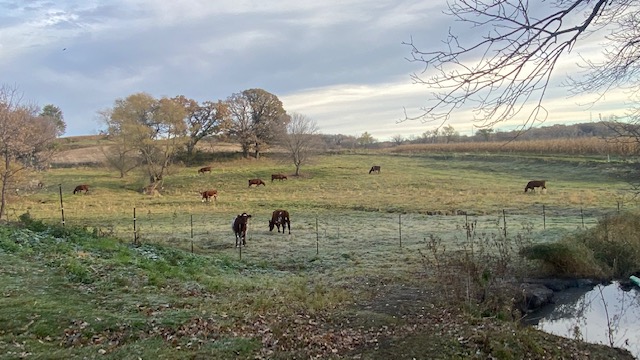
I’ll sell them to the neighbor with the cows.
I’ve left off the tractor that inexplicable died. (turned out to be the coil wire). And the dead battery in the other tractor. And the post that has somehow twisted a bit so now the gate doesn’t swing in AND out anymore, so I have to take it off to get the elevator put up.
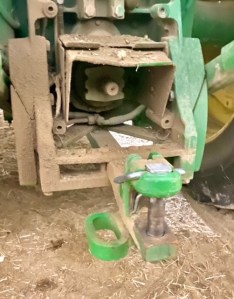
I did get the hitch welded back on the elevator so that’s one thing.
And I got the second show open.
And time to cut grass again.
Hey! “Straw is cheaper, Grass is free. Buy a farm and you get all three.”
So? “Sew Buttons on a balloon, you’ll get a bang out of it.”
When last we left the farm the swather was standing on one tire and a jack.
Mechanic Nick came out from John Deere and fixed it up in no time. Now that was a good decision to call them. And $637 later I’m moving through the field again. I was estimating $500. “Labor” was $500… bearing, flanges, locking collar, service call, misc and …. Just put it on my tab. But it’s fixed and I finished cutting oats and the swather is back home in the shed.
I spend a lot of time thinking of ‘what if’s’. What if the machine breaks down? What will I do if I can’t fix it? Who can I call that would know people to come and cut oats? And then, as I near the end it becomes ‘I would just leave this part’, or ‘who has a sickle mower I could use’, or ‘I wonder if the bean head could do this’? This year I learned something. I learned I call John Deere and they can fix some of it. Course it depends what, exactly, has broken.
And what do I think about all day just going round and round? I have music in my head. Last week I had the ‘Mairsey Dotes’ song in there for a while… that annoyed me. Had to work real hard to get something else in there. The first day it was a Pink Floyd song. Got some Led Zepplin going, there was probably a show tune in there somewhere… I can’t remember what finally settled in.
No cab or radio, and I’m wearing hearing protection, long sleeves, and a dust mask.
I observe the direction the oats was planted versus the direction I’m cutting it and I wonder if it matters because of how it sits on the stubble; is sitting sideways better than sitting in line? When going the same direction, in line, does it fall down between the stubble more? Hmmm. (It depends how heavy the windrow is). And I leave some stubble so it sits on top of that in case it does get rained on it’s not flat on the ground.
I observe how whenever I stop with the planter, I leaves a gap of a few feet and weeds grow wherever there isn’t grain growing.
Which is kind of amazing when you think about it.
I look at the damage the deer cause and I curse them out a little more.
When the combine (we should clarify the pronunciation of this if you’re not familiar. It’s not com-BINE, like adding things, it’s COM-bine. I don’t know where that came from. Subject for another day). The combine has to pick up the oat windrow the same direction it was cut. And that means from the head end. As the swather cuts it, all the heads fall to the back and it’s usually pretty easy to tell. Trying to go the wrong way, it just doesn’t feed into the combine as well.
When cutting, it’s best to make about 4 or 5 rounds all around the field, so there’s room on the ends for the combine to turn around, (and that goes for any crop; corn or beans or anything); we call those the ‘headlands’. And then it can just be cut going back and forth. Corners are tough so we avoid those when we can. Tough in that the machinery doesn’t make 90 degree corners very well, it doesn’t plant well in corners, hard to stay on the row in a corners.
OK, so now it’s Saturday and the combine is here and harvesting and I don’t have any trucks yet. I can’t get the truck guy on the phone. I call another guy from the farm, but he’s over in Wisconsin and he can’t get anyone on the phone either. Finally, we just go to the farm and get a semi and drive it back here ourselves. And, of course, there’s a summer shower and the harvesting is done for the day. Next day he’s back and finishes that field. And a few days later gets the last of it.
I don’t have the final numbers yet, but it looks like a real good crop.
As I write this, I’ve got some straw baled, got another show ready to open, ducklings moved to a bigger pen,
and I’m going to cut the grass!
Talk about when you had to do something yourself. Why is good help so hard to find?
It started out so well– no rain in the forecast and, while the swather always makes me nervous because I know I am on borrowed time, we were making good progress.
Me, and the dragonflies, and the barn swallows, and the butterflies, just being out in the fields. It wasn’t that hot Saturday morning and I got three fields, or about 9 1/2 acres cut out of my 25 acres of oats. Back out on Sunday afternoon and a good breeze and cut another field of about 5 acres and moved into the last field, about 10 acres. I made one round, and there was a clunk and forward momentum stopped. It stopped on the right wheel anyway, the left wheel kept going. The machine makes a lot of noises and most of them make me nervous. This machine, a John Deere model 800 swather is from the 70s. They’re built like a tank, have a Chrysler ‘Slant 6’ engine (with a reputation of being bullet-proof), and they run forever except when they don’t.
It’s a machine I use only for cutting oats. It cuts the standing oats and lays it in a row; a ‘Windrow’. It gets used a day or two per year. But there’s no one in the area with a swather, so I had to find my own about 6 years ago.
Took a while to diagnose what was going wrong and it turned out to be just a chain off. Well I’ve fixed that before and it’s kind of a process but it’s not bad. Except this one was jammed in there and it was bad. Kelly came to help when I called her for a ride home. I was hoping to be all done cutting by 8:00PM, it was 8 o’clock when we gave up and went home. A few things to do the next day so it was about 4 o’clock when I went back out to work on it again.
I was down to plan “G” or “H” by this point. And that also revealed a wheel bearing going bad. Well, that would explain why the chain had come off. We did finally get the chain out and installed again and we felt pretty good about ourselves.
I had to decide: can I finish cutting on this bad bearing or do I need to attempt another major repair out in the field and replace the bearing. I decided to take my chances, because that’s what farmers do. Except this time, I only went about 10 feet and the chain was off again. And again, it was 8 o’clock at night. We went home and I was back the next day with some more tools. I don’t know how many trips I made back home to get ‘Yet One More Tool’ for this repair. I even took the Oxy-acetylene torch up there to heat up the wheel hub. I’m a little nervous using a torch in the middle of a dry field of oats, but I wasn’t really cutting anything or making sparks, I was just heating up the wheel hub to try to get that off the axle so that the bearing can come off the axle. Nothing has been apart for 50 years I presume. I worked for a few hours and gave up and called the John Deere dealer. It felt as though a huge weight was lifted off my chest because now this isn’t my problem anymore.
The plan was to start combining that oats that was already cut on Tuesday afternoon, however, the guy with the truck needed his trucks to haul corn so he couldn’t make it. He said he would have a truck out here Wednesday morning. With no rain in the forecast for weeks, it didn’t seem like a problem. And then it sprinkled Monday morning, not enough to hurt anything, and it sprinkle Tuesday morning but not really enough to hurt anything and then we had a thunderstorm warning Tuesday night– where the heck did that come from? And I got about 2/10 of an inch of rain. So now we’re not combining on Wednesday either. Could have been worse, it was a pretty bad storm with some pretty gusty winds and heavy rains, but we just got the edge of it and then it built up south of us and I saw some hail damage and some corn flat on the ground from that.
It’s not ideal for oats to get rained on when it’s cut, but it’s not the end of the world, depending. I leave 4 to 6 inches of stubble for the oats to lay on so that it gets some air underneath. And that works pretty well. Light rains like this followed by some sunny days with a breeze and it will dry out again and can be combined with minimal loss. The heavier the rain, the more grain is shelled out on the ground. There have been a few years I had to go out with the hay rake and tip the windrows over. That knocks off a lot of grain. However, the people who take the straw like it because there’s less grain left in the straw if I have to handle it before they get it. Everyone has their own silver lining, don’t they?
So that’s where we are at the moment, hoping the mechanic will get the swather fixed, hoping it holds together for another 10 acres, well really, I want it to hold together for the next number of years.
I’m just about ready to open the one show in town and I’m just starting to work on another show. Remember the song about home improvement from the LGMS and at the end he says, “Now I can go out and mow the lawn!”? That’s kind of what I feel like.
But the beans are looking really good, they’re almost waist high, lots of flowers, lots of pods. 316 GDU’s above normal. The corn ears have already determined their length and girth and now they just need to fill out. If they’re stressed by weather, the tips won’t fill. Be interesting to see how it does this fall.
Often corn will have two ears on them, but only the one really develops completely.
The baby ducks arrived from California after a 2000 trip. These are some well-travelled ducks! I was worried about them making a trip but there were two little Dixie cups taped inside each box that presumably had some kind of food nutrient in it. Lost two of the 40. They were busy little ducks! The first day pretty much all they did was eat and drink.
What’s your most critical tool that you use the least?
Today’s post comes to us from Steve, who is at the extreme left above, petting the dog.
The pattern of sending kids off to summer camp is much stronger in the East than in the Midwest, but summer camps seem increasingly popular here. Kids from cities like New York or Boston might be shipped out to spend the whole summer in one or more camps. The Midwestern pattern is more likely to let kids live at home, perhaps attending one or more camps in the summer.
Camps used to be very traditional and outdoorsy, much like Boy Scout camps everywhere. Kids would play outdoors, swim, do crafts and have bonfire picnics. Modern summer camps are increasingly educational, perhaps teaching computer skills or a foreign language. My daughter has fond memories of Artward Bound, a camp that encouraged kids to engage with the visual arts. Alas, it no longer exists.
My first camp was Camp Matigwa, a Boy Scout operation. I was at an awkward age, shy and reclusive. They taught me to make a lanyard, which later made the Billy Collins poem all the funnier. We were supposed to swim once a day, but the water was cold and I was delighted to learn I could spend that hour at the camp’s “canteen” eating Baby Ruth bars instead.
I wore shorts on the day we took our first hike. I contacted some stinging nettle, which hurt like liquid fire until one of the counselors found some jewel weed, a plant whose sap canceled the nettle’s poison. The obvious lesson was that we should learn all about plants. I now suspect that our counselors staged the whole thing. They obviously knew where the nettle and the jewel weed grew, so I was the dupe they maneuvered to blunder into the nettles so they could showcase their expertise.
My favorite camp experience came in the summer of 1956 when I spent two delightful weeks riding horses at the Larry-Jo Dude Ranch near Boone, Iowa. We camped out, sang around a bonfire, groomed horses and took two trail rides each day. On my faithful horse, Margarita, I twice won the water relay event at our end-of-camp rodeo.
But the big event from that summer was when we played hide-and-seek on horseback. Pardon me for telling a story I’ve told before. We rode south of the ranch to a patch of woods. I had been assigned to ride Diablo, a large white mare that was the fastest horse in camp. But Diablo was lame that afternoon. When we divided up to go hide ourselves, I was stuck riding the largest, whitest, slowest horse in camp. I dismounted and led Diablo into a little gully where we could hide under some overhanging shrubs.
It was so exciting my heart still races when I remember it. Horses thundered all over the woods, kids screaming and tagging each other. I knew enough about psychology to know that time passes slowly when you are hiding like that, so I kept squelching the impulse to come out. Then the noises stopped. After what seemed an eternity, I ventured out of the gully. The woods were empty. Everyone had gone back to the ranch house, obviously unaware they were one buckaroo short.
As a courtesy to my lame horse, I held Diablo’s reins and walked her for half an hour back to the ranch. When I got to a hill overlooking camp, I saw three cop cars near the corral, their red and blue gumball lights madly spinning. And I understood: the town’s cops had been called in to find me.
The camp’s managers were delighted to find me perfectly alive and unharmed, but they infuriated me over and over. They kept calling me “the lost camper.” That was outlandish. I knew exactly where I was every minute of that day. They saw me as the lost camper although I saw myself as the hide-and-seek champion of all time.
Dare I say it’s a quiet time around the farm. The Co-op is done spraying, I don’t have hay to put up, oats is coming but not quite there yet, and I’ve got weeds and brush mowed.
We almost had another hot air balloon landing in the fields. I was out doing my chicken chores and heard it and could see it through the trees and it looked pretty low. Kelly and I headed up there and met the chase vehicle coming down. The balloon was pretty high again at that point and still moving East. The driver said he had considered landing here and I guess they were coming to ask permission. I don’t know if they just didn’t get here in time or what, but the balloon moved on. It was a different balloon company so it wouldn’t have counted in my 3 landings = free ride anyway.
One of our favorite nieces, her husband, and 9 month old baby came to visit from South Carolina. Her mom and dad are still here, and the baby got to see Great Grandma Hain and we had a real nice visit with them.
Four generations here. As luck would have it, our son and his wife were able to come down too, so the cousins had a good visit. The Niece always talks about the wild black raspberries that grow out here and she remembers picking them when she was a kid visiting Grandma and Grandpa’s farm. There was a lot of berries this year and they lasted a long time. Just not quite long enough for their visit. I did get a few fresh berries for her. They sure are good.
I did get the waterways and pastures mowed with the rear mounted brush hog. I was down in one of the pastures cutting brush and clearing that darn buckthorn when one of the big spinny things underneath fell off. Oh. That’s a problem. I just unhooked it and walked away for the moment. The main shaft out of the gear box sheared off. I looked up parts online; $600 for the shaft. Plus, whatever bearings, seals or other bits might be needed… I was rather discouraged. I’ll fix it. Later.
I did get the new and improved loader bucket back from my nephew the welder. I don’t have the loader on the tractor right now; I took it off for mowing, and will leave it off for baling straw, then I’ll put it back on. I should give it a new coat of John Deere Green.
There were a few comments on the driveway in the last blog. From the main highway to our house is 1.3 miles. The first .4 miles though is technically a township road, and the snowplow will come in our road about a 100 yards to turn around in a cell phone tower driveway. It’s easier for them than trying to turn around where our driveway starts. The road forks right there and our lovely neighbors are on the right fork, we’re on the left fork. There’s a hill their driveway that’s given a lot of people trouble over the years. You think our driveway is bad, you should see theirs! Our road is longer, theirs is steeper. Both are beautiful drives, just scary in the winter. We both joke, you can always get home, and if you can get out, you can probably get wherever you’re goingI do have a 7’ blower that mounts on the back of the tractor, so I have to go backwards when blowing. The last few years I’ve been using a rear blade if it’s just a few inches of snow. Quicker, faster, and my neck doesn’t hurt when done. But that also makes a pile of snow on the edge of the road that will drift in sooner. So eventually I have to put the blower on and cut those down again.
It’s interesting when I collect eggs, the chickens seem to like the number 3. Often the nest boxes will have 3 eggs in them. There might be more or less, but more often than not, multiple boxes will have three eggs in them. It’s curious.
After 18 months of very little theater, I’m back in full force. I have two shows to open in three weeks. Afternoons this week is working at the Rochester Civic Theatre for a Rochester Repertory Theatre production of ‘Turn of the Screw’.
Then next week is tech for ‘The Addams Family’ down in Chatfield for Wit’s End Theater. Somewhere in here I’ll be cutting oats and baling straw too.
I talked about the helicopter spraying a couple weeks ago? A helicopter crashed about 20 miles East of here while spraying crops. They think he flew under an electric line and snagged one of the wires. The pilot was killed. A newspaper article says “accidents are not uncommon”. Don’t know if it was the same company or anything. It’s terribly sad.
Hot weather or Cold Weather?How many eggs did you eat today?
I like to think that I have a pretty good imagination. After all, the fantasy genre is one of my favorites – give me a good dragon story any day. So it wasn’t out of character that yesterday, when I stumbled upon a show called “Mythical Beasts”, I didn’t automatically change the channel. I won’t go into the ethics of the Science Channel in airing this stuff, but suffice it to say the way they lay out these shows isn’t using exacting science.
It didn’t take long before I was down the rabbit hole. I started looking for the iconic Loch Ness photo (which was debunked decades and decades ago). This led me to the Lagarfljot Worm, an ice serpent in Iceland. It’s supposedly been terrorizing the countryside for centuries, often cited as being responsible for harsh weather and crop failures. This led me to Nahuelito, another lake-based monster in Argentina, similar to Nessie. This led me to the Windigo, which I had heard of but didn’t know about. Apparently it can influence people into greed, murder and cannibalism. This led me to a book called “Abominable Science: Origins of the Yeti, Nessie, and Other Famous Cryptids” (yes, then I had to look up cryptids)! Of course, I have requested the book from the library. If I hadn’t decided to go downstairs for lunch, who knows how long I would have been trolling the internet for made-up beings.
If you had asked me last week if I would be looking up mythical beings this week I would have laughed out loud. You can just never tell where my bring wants to go.