

The farm report comes to us from Ben
Had a good rainshower Monday afternoon. One of those downpours where traffic slows, and windshield wipers are on high. I could see it coming, I was several miles from home and the sky was dark and I was hitting Every. Red. Light. At one point there was some pea size hail, just a few stones, and I was considering my odds… can I make it home? Where should I park otherwise? But I thought I could make it. (Risk taker, remember?)
And then I could see the rain coming. Boy, just a few times in my life I’ve been in rain that heavy. Thankfully only lasted a mile or so. We ended up with .87”. Thankfully no hard winds with it in our area. I did hear reports of funnel clouds in other areas.
Rain like that in the fall is tough; the crops don’t really need it anymore, and the weather is cool enough it doesn’t dry as fast as it would mid-summer. The corn is tall enough the sun can’t hit the soil and it stays wet for a week. And it just makes harvest harder because now there’s mud to deal with. So, we’ll see how that goes.
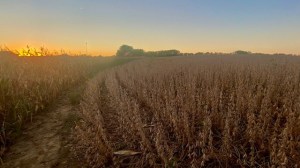
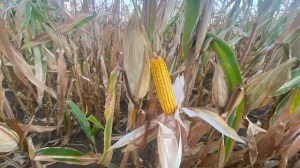
I was out checking crops last evening and I noticed that fall smell in the air. The beans are coming along. I saw several farmers out harvesting soybeans in the area today. Soybean pods are fussy; they dry out in the late morning or afternoon, but they’ll pick up moisture after dark or with the dew. Plants along the edge of the field might still be soft and mushy, but the rest of the field is dry, and the pods crack open easy, which is what you need to harvest. The corn is still looking good, it’s roughly 30% moisture which means the ears haven’t tipped down yet. Too much rain and it gets down inside the husk and can cause mold issues on the kernels. Once the corn dries more and the ears tip down, rain won’t cause mold issues.
After the discussion last week on PTO shafts, I was thinking about how some other things have changed.
Hooking up wagons or implements is different these days. One of the greatest inventions is the extendable wagon hitch. LIFECHANGING! Back when tractors were smaller and didn’t have cabs, it was easy to just look over your shoulder and you were almost looking right down at the hitch (called a drawbar) so backing up to a wagon was easy and we got real good at getting lined up so the hitch pin would drop right in. And the tractor or wagon was small enough we could nudge it a little bit to make the connection.
With a cab, sightlines changed and sometimes it’s harder to see the hole in the drawbar, so it was harder to get lined up right. Some people have added mirrors to the rear window so when the window is open, it allows one to see the hitch. (I need to do that on one of my tractors).
But now, with extendable hitches, as long as we get close, we can extend the wagon hitch to connect it, then we back up and it locks back into place. It’s wonderful! Especially when hooking a wagon to another implement, so I’m guessing where that hitch is way back there; the extendable tongues are life savers!
I remember the first wagon Dad bought with an extendable hitch. It was a remarkable thing.
Hitch pins too – at first, they were just pieces of straight rod with a washer welded on the top. Or even a large bolt if you were desperate. But again, machinery got bigger.
I made a couple hitch pins in high school welding class; that’s where I learned about hardening and how to temper them so they didn’t wear out so fast.
I had no idea I had so many hitch pins until I got them all together for this photo.
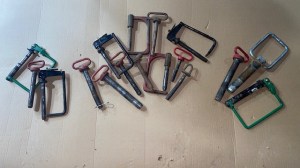
Then seed dealers started giving away hitch pins with an ACTUAL HANDLE on the top! That was another wonderful revelation! Course, on a hill it was easy for that hitch back there to drag on the ground and push the hitch pin right out. I ran one wagon through a fence and down into the calf pen when the pin came out… didn’t break anything or lose any bales, just the wagon. (And had to fix the fence). Lost the pin on the grain drill one day and didn’t notice until I got home and didn’t have a drill behind me anymore. One time the anhydrous tank came unhooked from the applicator. Knew that right away and thank goodness I was on flat ground and thanks goodness for the safety disconnect valve that separated. But getting it all hooked back up again was a struggle.
If you wanted to be safe, you put a clip in the hole at the bottom of the pin. If there WAS a hole for a clip. IF it stayed when going through cornstalks. Again, tractors and implements have gotten bigger Now I use locking pins that might be 5/8” or even 7/8” diameter. And the big tractor has something called a ‘Hammerstrap’ hitch that’s about 1 1/2” diameter. And it will actually drop itself in! (if I back up straight and hit the hitch of the implement just right. It works pretty well and it makes me laugh when It does).
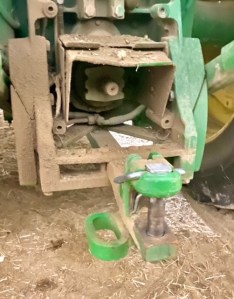
In this photo the PTO shaft is the round thing above the hitch. Bigger tractors might have a pin as big as your wrist. If you imagine the pull on these machines when they’re in the ground, you can imagine why they might need a pin this big.
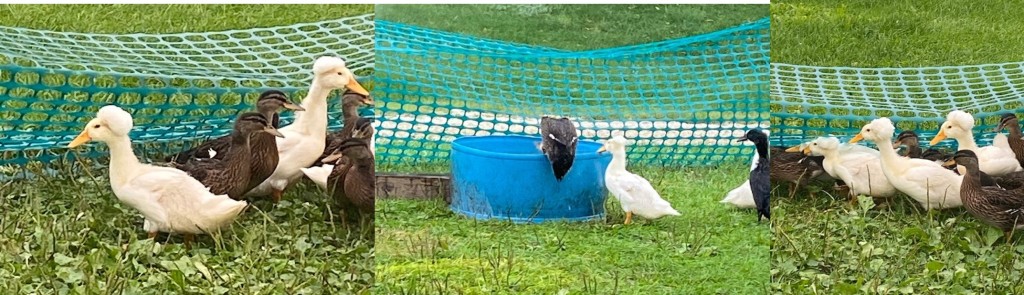
Duck Report. The three older ones and the younger ones are just starting to hang out together. And nobody goes in the pen anymore; they just hang out down here by the pond.
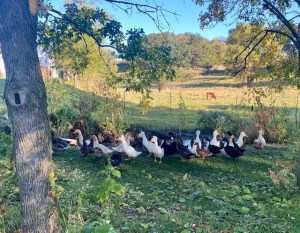
I saw a duck get a little air the other day… just a few feet, but I’ll bet it’s coming soon.
What do you remember changing your life? What’s coming soon for you?







 Trail Baboon