Category Archives: History

Long Range Planning

Today’s post comes from Ben.

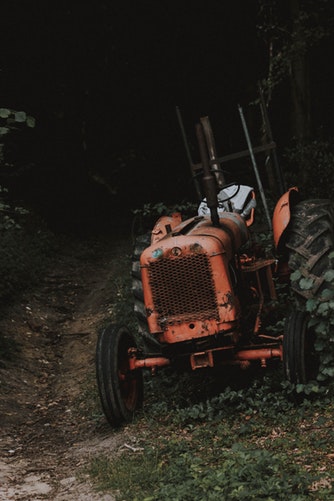
I’ve been doing some long-range planning on building a shop. Or maybe it’s just a ‘garage’. Basically, I want a warm place to work on machinery. And things like grease guns and cans of liquid wrench or chain lube work better if they’re not 20 degrees. Even cordless tools are more fun to use when they’re not cold.

What do I think I want to work on? Does it need to be big enough to get my current biggest tractor in there? (Yes!) Or does it need to be big enough to get a combine in there? If I don’t actually build it for another 10 years, how much will I actually be farming? I don’t own a combine and I don’t expect to own one. My biggest implement (at the moment) opens up to about 26’ wide. Do I need / want enough room to pull that in attached to the tractor, AND unfold it to work on it? I have machine sheds now. But machinery is stored in there. There isn’t room to actually unfold an implement. Heck, sometimes there’s isn’t room to get the tractor and implement all in the shed.

Course during winter I put more stuff in the shed. This fall I spent a couple days moving stuff around so that I could get out either door with the tractor and snow blower. And still get to the rear blade if I needed that.

What started all this, aside from the deep seated, but dormant desire for a nice warm shop, is my grain drill. It’s 15’ wide. I bought it used a couple years ago and It needed a lot of work. Over the summer and early Spring I got it ready to plant. The next summer I fixed a few more things. But it needs one more thing and fixing that won’t be hard, it will just require taking a fair amount of stuff off to get that ‘cup’ out and a new one installed. Every summer I think I’m going to work on that.  But every summer other stuff happens, and I don’t get too it. Sort of like any of my home remodeling projects; ‘We can do it this summer!’ Famous last words. (And I’m still working on hardwood flooring and baseboard trim and closet doors).

Ok, so if I just want a shop big enough to work on the drill, I could get away with a two car garage. But then it doesn’t take too many things along the wall and pretty soon you have a one car garage.

watch some YouTube channels of other farmers; these big guys have the wonderful huge shops and sheds. All heated and well lit. I don’t need that.

Just the other day I got an email a farm magazine called ‘Successful Farming’ and their ‘top shops’ issue. Maybe I need a wash bay? What about a separate welding area? A lube rack?? Painting booth! And what about heating options?? Tool storage?? Water? OFFICE! Sleeping quarters!! ??

I’m still thinking.

And of course, WHERE will it go? Kelly asked me the other day what I was thinking about that. I have some ideas… still thinking.

And also nagging at the back of my mind is the question of ‘When do you really think you’ll have time to use this??’ I mean I can’t get my home remodeling projects done now. So, when do I think I’m going to have time to putter about in my nice warm shop…?

When I retire! But then… do I need to fit the big tractor in there then??

So many questions.

Anything nagging at your thoughts? What are your long range plans?



Playing Carnegie Hall

A couple of weeks ago our church office received an email from an event coordinator who works for Carnegie Hall. She had been searching out bell choirs online, found ours, and asked if we would be interested in playing at The Great Christmas Ring  next year.  We would perform with about 250 other ringers in early December at Carnegie Hall after several days of rehearsals with an eminent bell choir conductor and composer.  They will provide the bells and equipment, and we just pay for everything else.

Six of us have expressed interest, and will submit our applications this week.  Participation is on a first come-first serve basis, so we hope we get in.  I think it will be pretty exciting.  It will not be the first time I played Carnegie Hall, however.

When I was 18 I auditioned for and played in a concert band comprised of high school students from all over the US. We played a concert in Carnegie Hall prior to a European tour.  It was quite an experience.  I didn’t really appreciate my surrounding s when I was 18, so if we get to play bells in New York next December I will pay much closer attention.

If you could perform anything, anywhere, even in the past, where would you perform and with whom would you perform? What famous concerts do you wish you could have attended? 

Storming the Bastille

I have had problems with insomnia since I was a child.  My current sleep pattern is to fall asleep easily, then wake up at about 3:00 am and not get to back to sleep until just before my alarm goes off at 6:30.

I know all the “sleep hygiene” and cognitive tricks for good sleep, but they often don’t work for me. I was gratified to read a recent New Yorker article on insomnia which described insomniacs’ cortisol levels  as so high as to look as though they are getting ready to storm the Bastille.

I know that anxiety and worry trigger the sympathetic nervous system to pump out high levels of chemicals which hinder sleep.  My anxiety and worry are all work related,  and I am hopeful that they will reduce over the next couple of weeks.  Until then, I think I will see if memorizing the lyrics to the Marseilles and repeating them over and over when I wake up at 3:00 will lull me to sleep once more.

How do you deal with insomnia? What puts you to sleep? What keeps you awake?

Cleaning Up

I don’t like cleaning. Organizing yes but cleaning no.  When I was living in Milwaukee I audited a class at the University of Wisconsin called “The Politics of Housework”. This was a LONG time ago but one of the things I remember about the class material was that housework is deeply dissatisfying for almost everybody due to its repetitive nature.  The housework never stays done.  No matter how earnestly you mop the floor, the dogs are going to wipe their muddy paws on it, probably within an hour.  This theory was very validating to me.

When YA was little, a co-worker asked me once how I get everything done and I replied “my house is dirty”. She laughed until she realized I was serious.  Then she laughed some more.  Any time I have a list of things to do, I can guarantee that cleaning is at the very bottom.  One of the upsides of entertaining a lot is that I’m forced to face the cleaning so my house doesn’t become a reality tv series.

With Nonny arriving on Monday, we’re in the last couple of days of getting the house clean (again). YA and I have a pretty good catalog of chores and luckily she likes to clean more than I do.  But mopping is still at the bottom of the list.

How do you get yourself to do the housework?

Lest We Forget

I thought about my paternal grandfather this week leading up to November 11. In December, 1916, at the age of 19, my  grandfather enlisted in the US Army.  He was one of the younger offspring in a family of 12 children. His father had died two years before.  His next older brother, Albert, had enlisted in June, 1916 and was in the 136th Infantry.  (Albert was reportedly chasing Pancho Villa around the Southwest with General Pershing.)

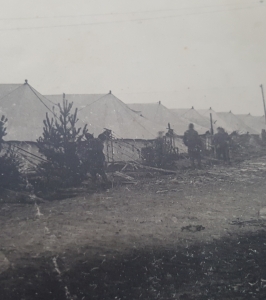
Grandpa was sent to Fort Logan, CO and assigned to Company C, 4th Regiment of Engineers, and on April 30, 1918, he sailed for France on the Martha Washington. He was stationed in France on the Western Front, sometimes at the US camp at Allerey sur Saone.  He sent home postcard photos of the camp.  The header photo is of the Allerey camp, too.

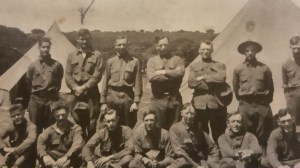
Here is a photo of his unit. He is the second one from the left in the back row.

Grandpa was involved in the Second Battle of Aisne-Marne (Summer, 1918), the Battle of Mihiel (September, 1918), the Second Battle of Meuse-Argonne (Fall, 1918) and Alsace-Lorraine (November, 1918).  According to one source I read, The Engineers were in charge of repairing the devastation of the war to expedite troop movements such as surveying, bridge and road repair, constructing buildings, maintaining communication lines, removal of land mines and “booby” traps, digging trenches and constructing shell, gas and splinter-proof shelters, providing clean water and constructing or removing barbed wire. They also launched gas attacks, built hospitals, barracks, mess halls, stables, target ranges, and repaired miles of train tracks. Their extensive and time consuming duties left them little time for rifle practice and drills and they were not relied upon for frontline combat, but the success of the Allied forces depended upon the support of the Engineer Corps.

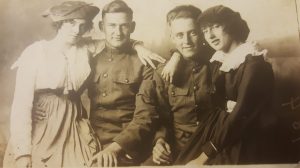
When he wasn’t digging trenches or building bridges, he was chasing women. He is the man on the left. I have no idea how this photo has survived for 100 years, and why my grandmother never threw it out!

Once Germany surrendered, the 4th was marched into the northern Rhine as an army of occupation. He was near the Mosel and sent this postcard home

He sailed back to the US on July 21, 1919, on the von Steuben, a German ship captured by the US.  He stayed in the army until June, 1920. He was a sergeant. He lived until 1980.

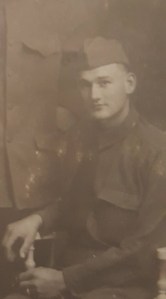
Grandpa had several studio portrait photos taken in France, and it is interesting to see how he changed over the course seven months.  Here are some early ones. He looks so young.

Here is a later one.

Oh, the questions I have after putting this together! I doubt I will ever get them answered.

How did the First World War impact your family?  After reading this, what questions would you have for my grandfather?


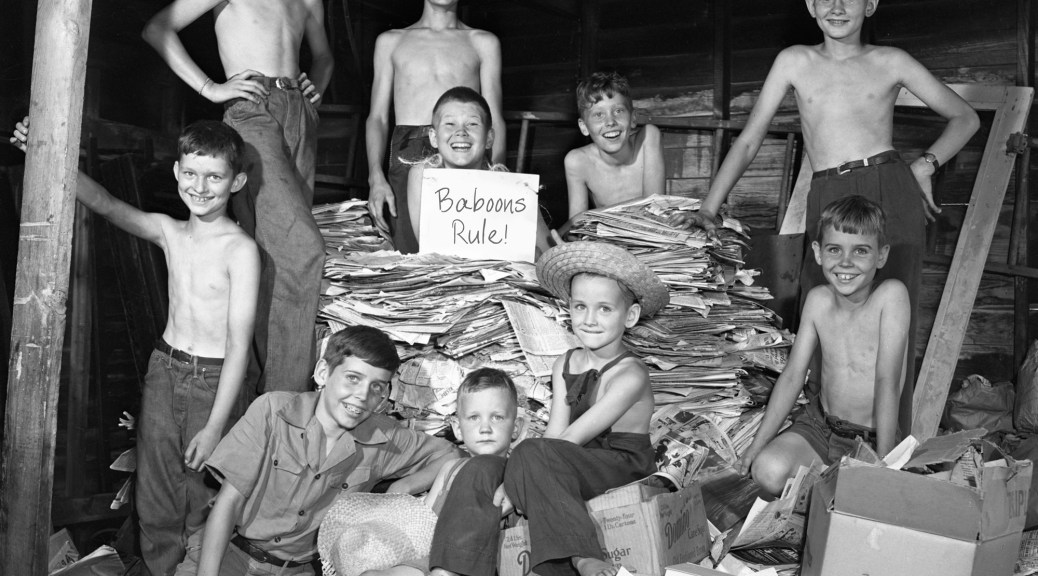
Paper Drive

This weekend’s post comes to us from Bill.
Photo Credit:  Ann Arbor District Library

Here’s a stream of consciousness for you:

Today I bought a roll of sisal twine to have on hand when I bundle tree trimmings or flattened cardboard boxes for recycling and I reflected that sisal twine always makes me think of paper drives. Remember paper drives? When I was in grade school and when I was in Boy Scouts, paper drives were a common way of earning money for extra-budgetary purchases. I especially remember the  school ones. We would each be given some lengths of twine and then, singly or in groups we would pull a wagon around the neighborhood asking neighbors, door to door, if they had any stacks of old newspapers we could have. There must have been a competitive aspect to it but I can’t remember specifically how it was set up. I don’t think it was individual; more likely it was grade against grade to see who could collect the most. I don’t recall a reward for winning either, other than the pride of coming in first. Paper drives have gone away because recycling has reduced the value of scrap paper and nobody has stacks of old newspapers lying around anyway.

It seems like there were a lot of fundraising schemes back then, most of which involved going door to door and trying to sell some commonplace item, like light bulbs, at an inflated price. An easy albeit unimaginative solution for some group of PTA parents to foist upon hapless students as a means to raise funds. Presumably, your native charm and powers of persuasion were supposed to compensate for the poor value of the transaction. Usually what happened is that your parents and grandparents ended up with a stockpile of off-brand light bulbs they had purchased at a non-competitive price. The only party to the scheme that made any real money was the company that supplied the fundraising products.

Door-to-door sales is almost extinct, it seems. Gone are the Fuller Brush men and I can’t remember the last time a kid came around trying to sell something. Although I imagine that would be considered child endangerment these days, most of us had some experience with that kind of commerce. I briefly considered trying to sell waterless cookware when I was in college. I had picked up the sample case and tried out my spiel on some female friends. I was so inept and so unconvincing that they were in helpless tears of hilarity before I finished. I returned the sample case the next day.

How about you? What did you sell?

Data Dump

Last week the Trail hit 7,000 followers.   This made me curious about some of our other current stats.

  • Overall # of views: 834,276
  • The most viewed posts are some of the oldest, written by our beloved leader Dale, however the fifth most-viewed is “Music: The Most Powerful Art Form” by our Chris.
  • The post with the most comments in the last four years is “Chores and the Great Depression” by our Jacque.
  • Top author is, of course, Dale, followed by Verily Sherrilee, Renee, Barbara in Rivertown and Northshorere (Clyde).
  • Recent top commenters are Barbara, Steve and Renee.
  • We have more activity on the Trail on Tuesday and Wednesdays. Our quietest day is Sunday.

But these are just numbers.

What do YOU think is noteworthy about the Trail? And if you have never commented before, this is your day – just a one word comment to add to our stats?


Hot Dish

Dorcas Reilly, the creator of the famous and loved (and also loathed) green bean casserole died this week. She was 92.  Perhaps she attributed her longevity to the casserole.

Thanksgiving is Daughter’s favorite holiday. She isn’t coming home until after Christmas, and she made me promise that I would cook Thanksgiving dinner for her then. The green bean casserole will be on the menu. It is one of her favorites. It has to be the traditional one Dorcas developed using cream of mushroom soup. Daughter also informed me that Brussels sprouts with bacon will be on the list. She has the whole meal planned, and will email the recipes to us. We will, of course, cook it to her specifications. Life is easier that way.

The favorite casserole, however, is the one printed below. We will also make this for Christmas/Thanksgiving dinner:

Butternut Squash Casserole
    • 1/4 cup (1/2 stick) unsalted butter
    • 1 pound thinly sliced onions
    • 2 1/2 pounds butternut squash, peeled, seeded, cut into 1/2-inch cubes
    • 1 teaspoon sugar
    • 1/2 teaspoon salt
    • 1/2 teaspoon ground black pepper
    • 3/4 cup canned low-salt chicken broth
  •  2 cups fresh breadcrumbs made from soft white bread
  • 2 cups (packed) grated sharp white cheddar cheese
  • 1 1/2 tablespoons chopped fresh rosemary
  • 1/2 teaspoon dried thyme

Preheat oven to 350°F. Butter 13x9x2-inch glass baking dish. Melt butter in heavy large skillet over medium-high heat. Add onions; sauté until onions are light golden, about 8 minutes. Add squash; sauté 4 minutes. Sprinkle sugar, salt and pepper over vegetables; sauté until onions and squash begin to caramelize, about 5 minutes.

Spread vegetable mixture in prepared dish. Pour chicken broth over. Cover tightly with foil and bake 45 minutes. (Squash mixture can be made 1 day ahead. Cool, then cover and refrigerate. Reheat in 350°F oven until heated through, about 10 minutes.)

Increase oven temperature to 400°F. Mix breadcrumbs, cheese, rosemary and thyme in medium bowl. Sprinkle over gratin. Bake uncovered until top is golden brown and crisp, about 30 minutes.

What is your favorite hot dish? Which is your least favorite? What would you like to be remembered for?

Traditions?

For a variety of reasons I was contemplating  the tradition of Hobo Days at South Dakota State University.  It has been going on since 1912, apparently, and involves festivities in conjunction with Homecoming.  There are parades and contests, such as the six month competitions for beard growing (for the men) and leg-hair growing (for the women), a parade featuring a 1912 Ford, and people dressed up like Hobos (mainly the men) and “Hippie Chicks” (mainly the women). The women used to dress up like “Indian Maidens”.  That was eventually deemed offensive, so the women were recast as Hippies.  I wonder how former Hippie women feel about it?

I believe that university staff look on the tradition with mixed feelings. It certainly promotes school spirit and cohesiveness. It is also a time of heavy drinking and all the problems that brings, and also glorifies homelessness.

I think I am pretty anti-tradition when it comes to festivities like Hobo Days, but I must admit changes to my comforting and familiar  Lutheran liturgy are upsetting.  Change is hard. Finding new traditions isn’t easy.

What traditions do you cling to? What traditions would you like to see end? What new traditions would you like to see?

Regionality

While on our recent road trip to visit relatives in central Georgia, I was able to take a side trip to Greenville, SC, for a reunion with nine friends from college. We do this every couple of years now, and one of our rituals is a Saturday night book swap. The book I offered this time was Gardenias, by one of my favorite “regional” authors, Faith Sullivan of Minnesota. I’ve loved her books since one of her earlier publications, The Cape Ann; in fact, I included a used copy of that book for background, since it has some of the same characters.

Wiki has this to say about American literary regionalism, or local color: “In this style of writing, which includes both poetry and prose, the setting is particularly important and writers often emphasize specific features such as dialect, customs, history, and landscape, of a particular region.”

I was delighted to find that the book I drew, One Foot in Eden by Ron Rash, was also by a regional author – Carolinian Appalachia – and now that I’ve finished the book, I’ve learned some background history of the area I just visited. I also got to hear some local dialects; got to know some characters whom I would probably not have found in, say, Minnesota; and read descriptions of places I’ve seen only from a distance. And although the ending to this tale was sad, I would probably read another book by Ron Rash.

I have found (and loved) over the years several authors I whom I consider to be regional writers, but will wait to see if other Baboons name them before I do. To that end:

Do you have a favorite regional author? Is there a region of the USA that you would like to learn about through reading?