Category Archives: Nature

Mother Nature – The Great Equalizer

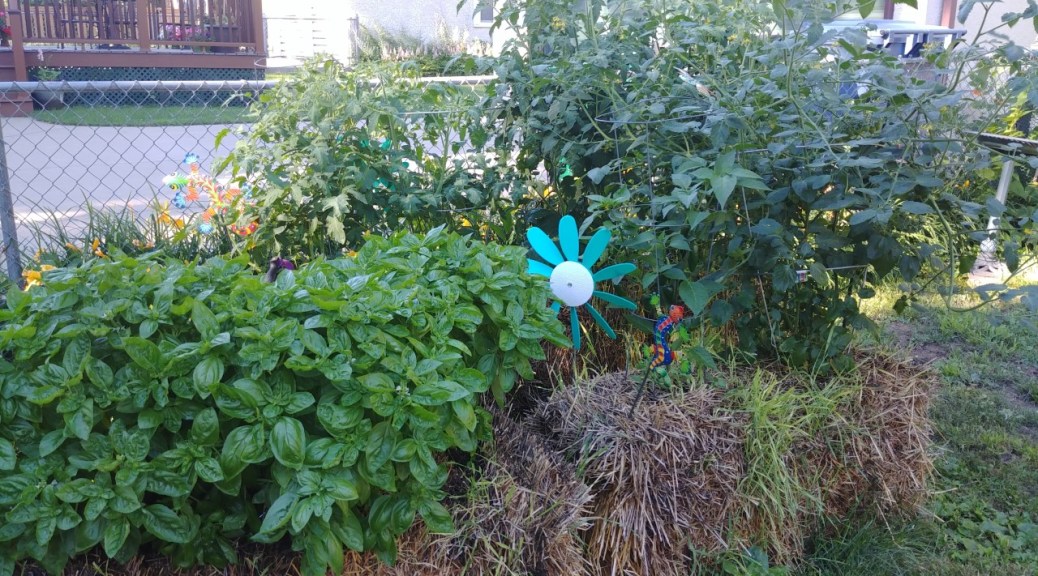
Thanks to Mother Nature’s prolonged temper tantrum this spring and the bad brakes on Ben’s truck, I ended up getting my bales from Bachman’s this year. I should have made two trips, but I only ever say “I should have made two trips” after I’ve made just one trip and it hasn’t been the best idea.  Case in point – four bales of straw in a teeny little Honda Insight.  It took me 40 minutes and the vacuum to get the car clean afterwards.

As I was conditioning the bales, I was drawn to gardening books. I read Joel Karsten’s latest straw bale gardening book as well as The Potting Shed Papers by Charles Elliott and a fascinating book, written in 1870 by Charles Dudley Warner – My Summer in a Garden.

He could have been writing last week and he had a way of looking at gardening and nature that resonated for me. Here’s one bit I really liked:

“I am more and more impressed, as the summer goes on, with the inequality of man’s fight with Nature; especially in a civilized state. In savagery, it does not so much matter; for one does not take a square hold, and put out his strength, but rather accommodates himself to the situation, and takes what he can get, without raising any dust, or putting himself into everlasting opposition. But the minute he begins to clear spot larger than he needs to sleep in for a night, and to try to have his own way in the least, Nature is at once up, and vigilant, and contests him at every step with all her ingenuity and unwearied vigor.”

Who are you doing battle with these days?

Hi, Daddy Bunting

I have been accused of producing fake news and alternative facts.

Last year our maintenance man, Kevin, who is by far the best naturalist I have ever known with a life-time acquaintance with wildlife and conservation, spotted an indigo bunting in the brush 20 yards from our patio. Indigos are very shy – tiny and they blend into leaves and shadows despite the blue. When I looked up indigos, I solved a mystery. A small dull gray bird was in my seed feeder all the time, but I could not identify it. It was the female. I only rarely saw the male last year, and Kevin never did again.

I waited to see if they would come back this year. Sandy saw him first, sitting on our patio table looking in at her, which is not indigo behavior at all. An alternative fact according to Kevin. The indigo has done it once more that she saw. I see him often in our feeder or more often on the ground, even when I am sitting on the patio. Kevin keeps looking. No luck, even though he takes breaks on a deck above and to the right of me. That apartment is between tenants. Fake news he says, when I boast about it.

By dumb luck I have proof. On my first try I got a shot of Daddy Bunting, gone a hunting for food. Not quality photography, taken through a closed window to avoid spooking him, but acceptable in a court of law. Monday morning we go on trial.

I declare this boast day. What do you want to crow about?

They say, the people of science, that an indigo is not really blue, but black.  It is, they say, a trick of how the light reflects off the feathers. I get it a bit, but is not all color just a trick of how light reflects off something? Red looks red because all the colors but red are absorbed, I believe the people of science say.  So how is the blue of the indigo . . . oh, never mind.

What is the mystery in your life today?

Learning the Hard Way

Today’s post comes to us from Steve.

It is always interesting, after the fact, to remember the decisions you made that caused some bad thing to happen. Looking back, you can see the errors. But at the time, you were doing things that made sense.

One of the staple foods I have in my kitchen cabinets is honey. I grew up eating peanut butter and honey sandwiches. In the poverty of my first year of graduate school, I sometimes had peanut butter and honey sandwiches three times a day. I couldn’t afford anything else.

But honey has a nasty habit of crystallizing. The honey gets dull and solid until it will no longer come out of a squeeze dispenser. That just happened to me. But I had an inspiration for melting the crystallized goo back into liquid honey. I popped my honey dispenser in the microwave and nuked it for just 20 seconds. The photo shows what happened. The dispenser will never be the same, and I had to mop up honey from all over the microwave.

That’s one dumb stunt I’ll never do again, for I learned that lesson the hard way.

In the summer of 1970 my erstwife (let’s call her Carol in this story) and I lived along the Saint Croix River. We discovered a wonderful fishing hole north of us, just upstream of Osceola, Wisconsin. Night after night we’d go upriver to our fishing spot at the foot of an island and—quite literally—catch fish until our arms got tired.

Then Carol got busy, and I began fishing alone. The canoe wasn’t stable without a person in the front end, so I found a large boulder that I called “Carol.” I put the rock in the front of the canoe to keep everything steady while I fished. The rock worked so well that I safely walked around the canoe standing up, which is not something the experts recommend.

One afternoon in September I enjoyed what I knew would be my last evening of fishing for that season. Grad school and work were about to start up, so I’d not fish there again until next year. I canoed back downstream to the Osceola bridge where my car was parked. I realized I no longer needed my boulder. With the canoe close to shore, I walked to the front of the canoe, grabbed “Carol” (the rock) and chucked her overboard.

In cartoons when Wile E. Coyote has just made a fatal error there is a terrifying pause. Time stops as he processes what he has done and what is going to happen to him. The cartoon is absolutely true to life. On the river I had my Wile E. Coyote moment. For several seconds I contemplated the fact that I was standing upright in an unstabilized canoe. Then the thing spun like a birling log under a lumberjack. I went sailing, my fishing rod flew even further, and soon we were both in the river. I survived. The fishing rod was never seen again.

And I never walked upright in a canoe again. Well, you don’t forget a lesson you learn the hard way.

What have you learned the hard way?

Not a Good Fit

Many years ago I had a 3-week job in May planting trees in Superior National Forest. This year I am in the midst of a 4 ½ week job scoring standardized tests. Can you guess which job is a better fit for my personality?

The current job is basically sitting and staring at the computer. All the time. Besides breaks and lunch, there is absolutely no need to get up and move or look at something besides a screen unless you want to stretch or go to the restroom. I keep thinking about the tree-planting job and wishing I could do something like that instead of what I’m doing now (although my body would probably have a harder time planting trees all day for three weeks than it did when I was 18). I told a co-worker about the tree-planting job and she said something about not having to think very hard at that job. And I thought to myself: you may think it wasn’t that stimulating mentally, but my thoughts were free because I could think anything I wanted instead of focusing only on 3rd grade English essays – and what can be better than all that fresh air and exercise? This current job is slow torture for someone like me.

What things do you do that are not a good fit for your personality? Or that are a good fit?


All in a Day’s Work

I blew through four cashiers this afternoon!

It’s straw bale time at my house – I’m doing the conditioning of the bales right now, which means I need to add fertilizer to the bales twice a day for six days. This morning I used the last of the bag of fertilizer so needed to stop at Bachman’s on the way home.

Just one bag of fertilizer. The first cashier was clearly just starting out and got hosed up trying to enter my “frequent buyer” number, so enter cashier #2.   When I handed her my Bachman’s charge card (yes, that’s what I said), she looked at it a bit and then swiped it.  The register clearly didn’t like that and I commented (nicely) that for the Bachman’s charge, they don’t swipe it.  This didn’t help so she called over a third cashier who took the card.  I mentioned again that it doesn’t get swiped, but he swiped it several more times but this time pushed some other buttons and got a completely different error message.

All of this was combined with profuse apologies from all three, who appeared to be high school students. Finally they called someone on a walkie talkie.  An older woman came over and immediately said “Oh, with the Bachman’s charge, you enter this here and this here… you don’t swipe the card.”  More profuse apologies.  I was not in a hurry and wasn’t really bothered by the wait and the confusion, although it was really hard not to smirk and say “I told you so” about the swiping of the card.

What was YOUR first job?

More Than Enough

I have a medium-sized yard. Last fall YA and I raked up 22 bags of leaves and yard waste.  Always more bags than the rest of the neighbors.  How can we possibly have this much stuff to be bagged up now?  And we’re not even finished!

What do you have way too much of?

Fecundity Profundity

Nature does go about its business expeditiously. Each flowering plant gets its slot during the year. Even now, before the grass is green and leaves have developed, seeds are being made.

In flowers.

In catkins.

At least I think those are catkins. I am not sure what sort of tree is producing those.

Catkins, or aments, are surprising things, a variation on flowers basically. Most folks are unaware of them. Many are wind-blown, as are these. Birch produce catkins, those long drooping things, looking like a soft dull green/brown pine cone.

Right now I am looking to nature to find hope for this world and for lessons of the cycles of life. But yet, I worry. All of this is so delicate, the process, I mean, and how nature has spent millions of years finding that balance.

Ah, Balance, Balance, Balance.

Do I sound like Chance the Gardner? “As long as the roots are not severed, all is well. And all will be well in the garden.”

How is your balance? What simple but profound insight do you have for today?


A Bone to Pick….

“But see! nearer and nearer the great fish comes, mouthful after mouthful of the fishes falling into its horrid jaws. It must be starving; so eager is it for its prey that is seems unconscious of the fact that the tide has turned and is moving outward.  Now it discovers its danger and turns, but too late.  The water has gone back to the dep, leaving it struggling for breath in a shallow pool.   It thrashes wildly about with its tail, whose sticky secretions help to envelop it more and more thickly with mud and slime, until at last its struggles cease.”

This is from the autobiography The Life of a Fossil Hunter by Charles Sternberg, written in 1909.  I stumbled upon this title in the afterward of Dragon Teeth by Michael Crichton.  His widow Sherri did a nice epilogue and mentioned the Sternberg book as one that Michael had used in his extensive research for Dragon Teeth.

As you can read in the section above, the style of autobiography and memoir was a little bit different back then than it is today. In today’s memoir, we would learn about how abuse in his childhood caused him to seek out a career in the wilderness, how his career caused lifelong challenges in all his relationships and he overcame all kind of obstacles to achieve his desires.  That’s pretty much how every memoir written in the last few years read anyway.  In Sternberg’s autobiography, he mentions a son about 1/3 of the way through the book.  Then he mentions a son about 2/3 of the way through.  We he mentions in the conclusion that he has “raised up a race of fossil hunters”, we learn that there are at least two sons, but that’s it.  No courtship, no marriage, no discussion of any toll his work/travels took on his wife… in fact, the word “wife” doesn’t even come up in this book.

But he did know how to breathe life into his fossil finds!

What’s the oldest book you’ve read recently?


Solving Problems

The weather has been so cold and crappy here for the past couple of  months that I stayed inside and didn’t inspect the yard or the garden beds. Sunday it was very warm and I ventured out and saw this.

Well, I was alarmed. This was a critter hole in the middle of the strawberry bed. Was there still a critter in the hole? What sort of critter was it?  A mole? A skunk or weasel? A bunny?

My initial response was to put a garden hose down the hole and turn it on and see what emerged. Husband said “I don’t want to see what emerges! What if it is angry and aggressive? It might bite!” I looked for a back door hole in another part of the garden but I couldn’t see one.

I am a trial and error problem solver. I like to push buttons and see what happens.  Husband likes to think before he does things.  While husband was putting on his shoes to join me in the garden, I hooked up a hose and drenched the hole. Nothing emerged. It was a fairly shallow hole and I suspect it was abandoned by a bunny after her young grew up. Husband plugged it with brick pavers.  Today we saw a medium sized, somewhat perplexed bunny sitting by the bricked up hole.

The strawberry plants are popping up and I predict a lot of jam this July. What would I have done if an angry skunk or gopher plunged out of the hole? Well, I would just have ran back into the house as fast as I could and purchased a live, humane trap to catch the critter and remove it to the country. What could go wrong?

How do you solve problems?  What kind of critter encounters have you had in your yard or garden?


Arbor Day

The weather is improving, and it is warming up. Today is Arbor Day.  We will be working this Saturday in our church’s new  contemplative garden laying edging pavers and laying out garden beds.  The irrigation system went in on the 26th.

How do you plan to commemorate Arbor Day?  Any yard work or green thumb projects planned?