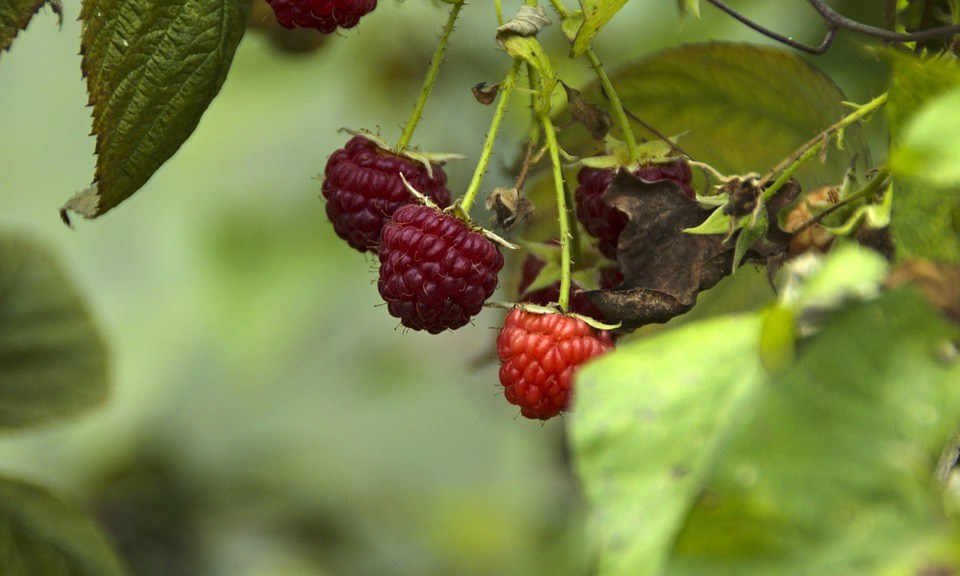
I made my annual pilgrimage out to the farm for raspberries last week. Beautiful day for picking – sunny and not too warm. A little muggy from the big rain the two days before but after our dry summer, I am NOT complaining about rain.
Since I was the first one out in the field, they stationed me at the far southeast corner of the biggest patch of canes. Pretty shortly after, they started to put someone opposite me (on the other side of the line of cane I was working on) and she protested that she didn’t want “to be near anybody else”. I told her I didn’t take it personally and that I had a mask in pocket if needed. She moved on to another line.
An older couple were then placed opposite of me. They didn’t even look toward me and so I knew there wasn’t going to be any chatting. (This turned out to be OK because pretty soon a VERY chatty woman started picking two lines away and even thought she was speaking to the folks near her, I could hear her clearly!)
I expected that the couple across from me would move ahead of me fairly quickly. Two people picking together are always faster than just one. Except this time! The gentleman stayed pretty even with me and the woman lagged behind. This was so different from what I usually experience that I started to pay a little more attention to them. The woman was digging thoroughly through the canes, clearly searching for every single viable berry she could find. The gentleman was not as thorough. I soon realized that another reason they were slow was the amount of time spent moving their hands from the canes to their mouths. The farm does encourage folks to taste while they pick, but this couple was taking it to new heights. They quit picking before I did with less than a flat of picked berries and I’m sure it’s because they were full!
So far I’ve made my freezer jam, added raspberries to pancake batter and, of course, enjoyed fresh raspberry shortcake!
To wrap up the oat harvest, let me explain test weight and pricing.
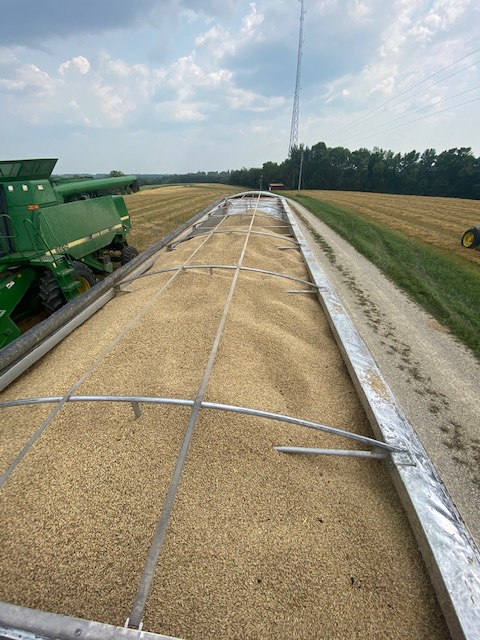
There isn’t a big market for oats, so they won’t take the oats if the quality is a little low. By ‘Quality’ I mean if it isn’t at least 32 lbs test weight (That’s the ‘standard’ weight of a bushel of the product. 56lbs for corn, 60 lbs for soybeans, 32lbs for oats). The weight can vary depending on a lot of things; moisture content of the crop, the weather as it grew, the variety, ect. The market price is based on that weight though, so if it’s low, we don’t get paid the full amount because while we deal with the crops in volume (the trucks and wagons it takes to get it hauled in), we’re paid by the bushel. If your corn sample only tests 50 lbs, then it takes more corn to get to 52 lbs and we get docked for the low TW.
My oats samples tested 38 and 39 lbs. The truck is heavier, which means it takes less grain to make 32 lbs so I get more bushels on the truck. But no bonus for being Over TW.
Price this year was $3.58 / bushel at the Elgin elevator (which is closest so most of the oats went there) but they were full so the last of the oats went to another elevator and it was $3.71 there. Heck; if I’d known that I’d have taken it all to that second place!
Remember; hay is something animals will eat; it contains nutrients. Straw is just an empty stalk; there’s not much nutritional value in straw.
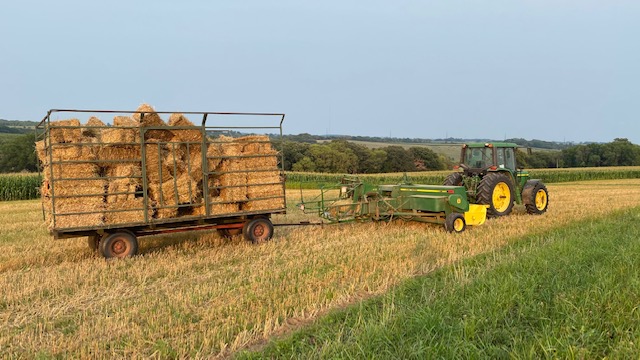
Baling straw; it went pretty well this year. No problems.
It might take a while to get the baler working right; get the rust off it, so to speak. I like to bale straw; it’s light and the bales are easy to throw around.
I broke a shear bolt just after starting; a ‘shear bolt’ is protection against something bad happening. It might simply be overloaded or it might be a safety feature against something catastrophic. But sometimes they just wear out. That was the case here.
This shear bolt hooks the baler flywheel to the hydraulic pump for the baler kicker and sometimes it just fails. Then the kicker looses it’s oomph.
In the old days, Clyde and my dad had to have someone on the wagon to catch the bales coming off the baler and stack them on the wagon. I was about 10 years old when Dad bought a kicker baler which ‘kicks’ the bales into the wagon. Less manpower needed. Course, getting them back out is a little more trouble.
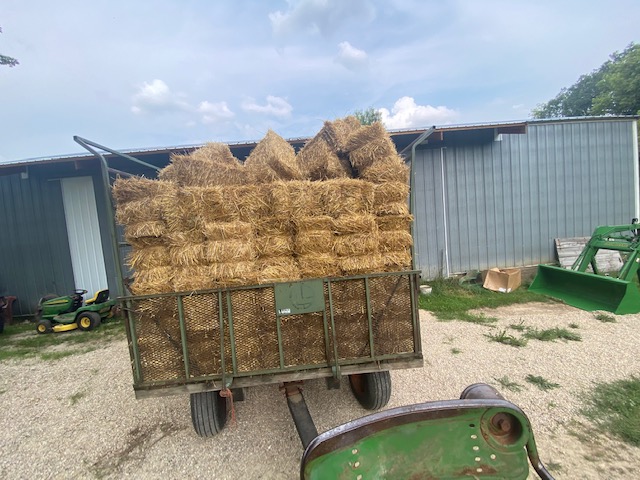
In 1993, we hosted 2 men from Russia for a few days. They were here as part of an exchange program with the Farm Bureau. They didn’t speak English, but they had a Russian / English dictionary and we had a good time doing hand gestures. I was baling hay and they rode in the wagon and insisted on stacking the bales as they flew in there from the baler. I tried to stop them; warning them this was dangerous and not to get hit by one. They assured me it was fine and kept stacking. And it’s a wonderful thing; so much easier to unload when they’re stacked, plus I get more bales on the wagon. I’ve been stacking a few ever since. Just the bottom row or two, and a ‘wall’ at the front to help keep the bales in the wagon.
The kicker part of the baler rotates left and right. That allows me to throw a bale in the wagon even when making a corner. And there’s a power adjustment to kick the bale just a little bit or kick it real hard! The average is 3 or 4. It goes to 8, I haven’t had to use it that high unless I’m kicking it all the way over the wagon just for fun. Because the power is based on weight, kicking to the back of the 16’ wagon only needs about 4. If the bales are so heavy it needs 6 or more, then they’re too wet to bale and I can’t even pick them up.
Up or down hills changes that a bit… and making a corner when it kicks can still kick it over the side. All in all, it’s kinda fun.
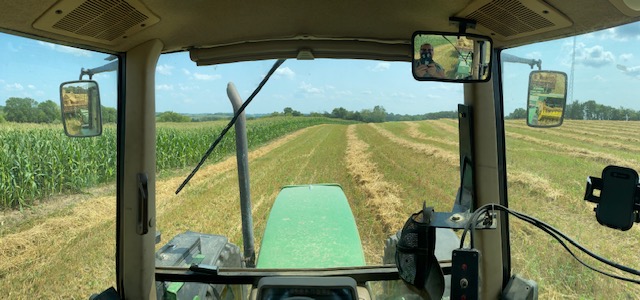
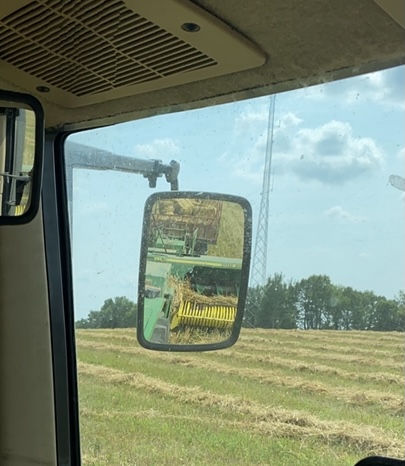
Here’s what it looks like from the tractor cab.
I’m watching my left mirror as that shows the back of the baler and I can tell the bale is good (not missing a string) and I can see most of the wagon. The right mirror shows the row going into the pick up.
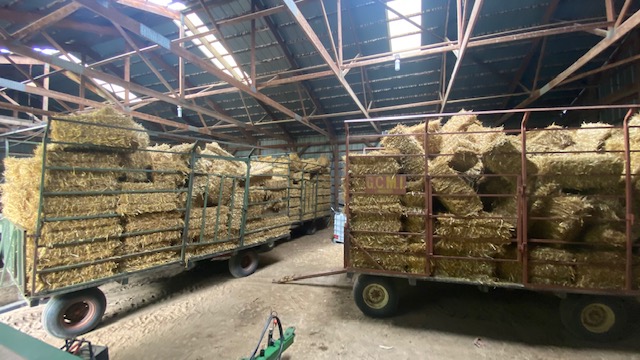
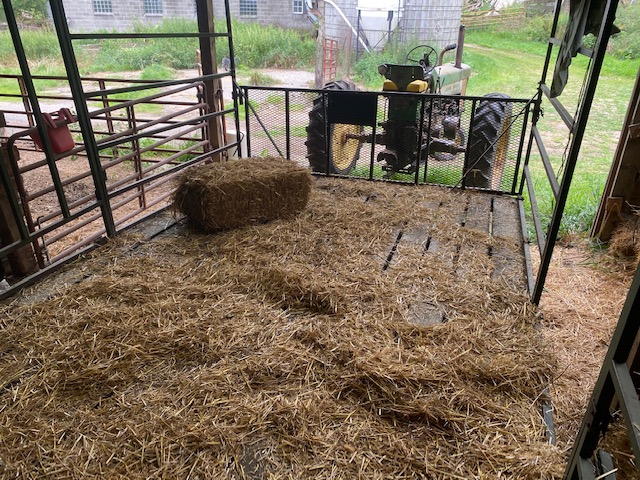
Here’s three loads in the shed.
A few weeks ago we talked about backing up wagons. Here’s what it looks like to back up a wagon into the shed:
You need to trust yourself about what’s behind you.
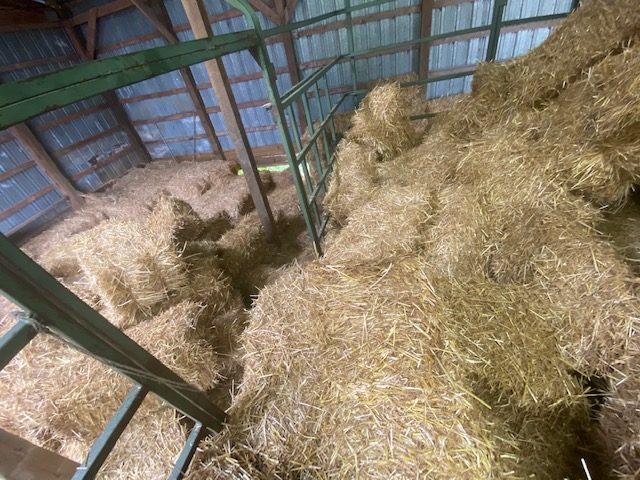
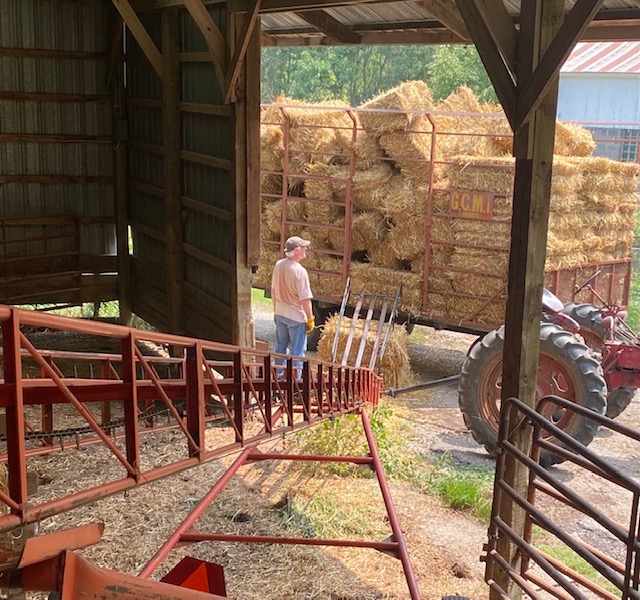
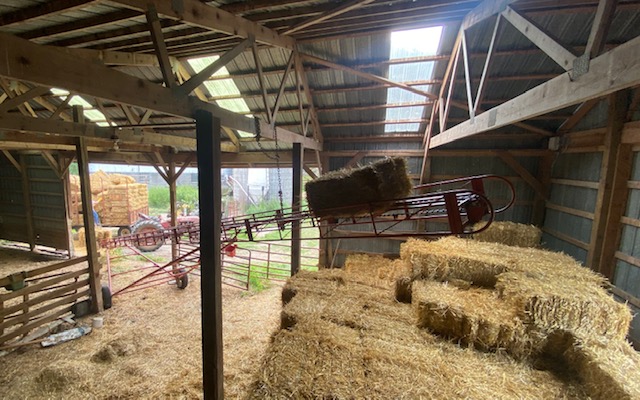
I had about 200 straw bales left in the barn. I baled 612 (there’s a mechanical counter on the baler; each time it ties a knot, it trips the counter). 166 bales (one stacked load) went to the neighbors for their strawberry patch. He’ll use it for cover this fall. The other 446 went in the pole barn. I unloaded one load by myself; back the wagon into the barn, toss a bunch out, get out and stack them, toss a bunch more out. It’s not too hard when the stack is low. It’s too much work once up about two rows.
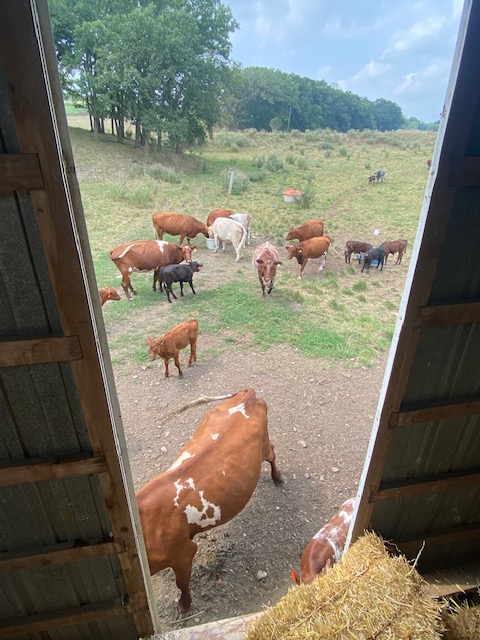
My brother came out; he helped me get the elevator set up and then he and I unloaded the last two loads. The cows came to watch me.
Here my brother is trying to figure out how to start the load
Here comes a bale destined for VS’s garden next spring.
A clean field and the last bale are welcome sights.
I didn’t need anymore small square bales this year so I hired a neighbor to make round bales from the rest of the straw.
I’ll sell them to the neighbor with the cows.
I’ve left off the tractor that inexplicable died. (turned out to be the coil wire). And the dead battery in the other tractor. And the post that has somehow twisted a bit so now the gate doesn’t swing in AND out anymore, so I have to take it off to get the elevator put up.
I did get the hitch welded back on the elevator so that’s one thing.
And I got the second show open.
And time to cut grass again.
Hey! “Straw is cheaper, Grass is free. Buy a farm and you get all three.”
So? “Sew Buttons on a balloon, you’ll get a bang out of it.”
When last we left the farm the swather was standing on one tire and a jack.
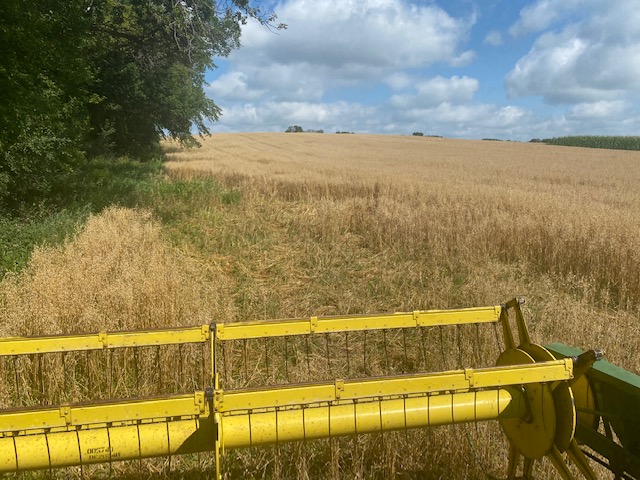
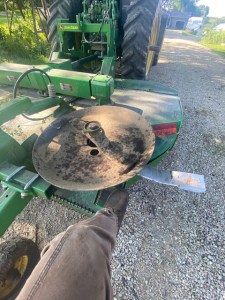
Mechanic Nick came out from John Deere and fixed it up in no time. Now that was a good decision to call them. And $637 later I’m moving through the field again. I was estimating $500. “Labor” was $500… bearing, flanges, locking collar, service call, misc and …. Just put it on my tab. But it’s fixed and I finished cutting oats and the swather is back home in the shed.
I spend a lot of time thinking of ‘what if’s’. What if the machine breaks down? What will I do if I can’t fix it? Who can I call that would know people to come and cut oats? And then, as I near the end it becomes ‘I would just leave this part’, or ‘who has a sickle mower I could use’, or ‘I wonder if the bean head could do this’? This year I learned something. I learned I call John Deere and they can fix some of it. Course it depends what, exactly, has broken.
And what do I think about all day just going round and round? I have music in my head. Last week I had the ‘Mairsey Dotes’ song in there for a while… that annoyed me. Had to work real hard to get something else in there. The first day it was a Pink Floyd song. Got some Led Zepplin going, there was probably a show tune in there somewhere… I can’t remember what finally settled in.
No cab or radio, and I’m wearing hearing protection, long sleeves, and a dust mask.
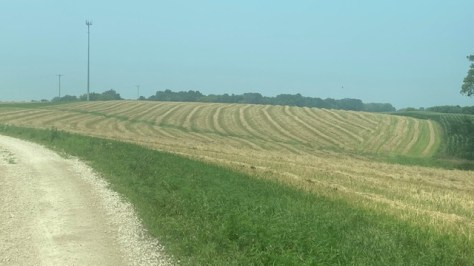
I observe the direction the oats was planted versus the direction I’m cutting it and I wonder if it matters because of how it sits on the stubble; is sitting sideways better than sitting in line? When going the same direction, in line, does it fall down between the stubble more? Hmmm. (It depends how heavy the windrow is). And I leave some stubble so it sits on top of that in case it does get rained on it’s not flat on the ground.
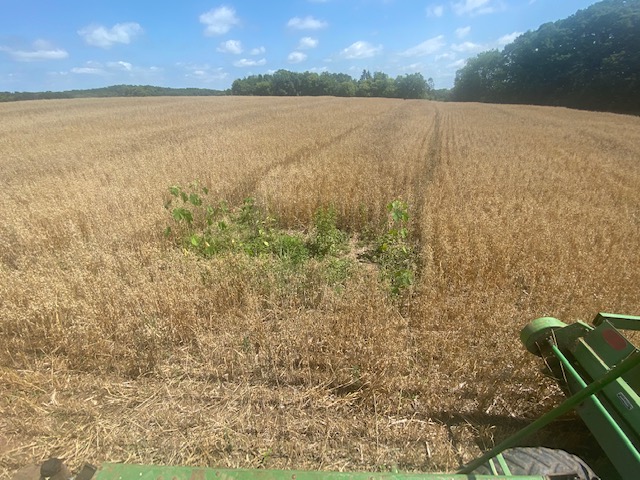
I observe how whenever I stop with the planter, I leaves a gap of a few feet and weeds grow wherever there isn’t grain growing.
Which is kind of amazing when you think about it.
I look at the damage the deer cause and I curse them out a little more.
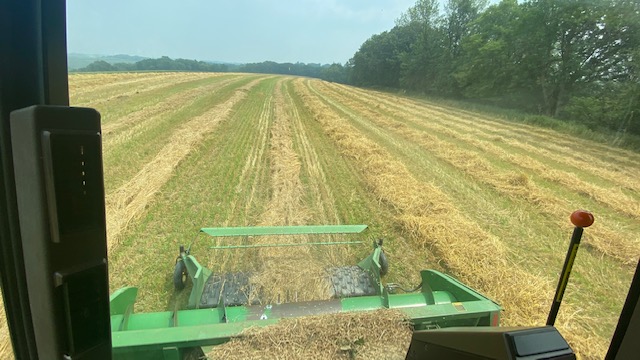
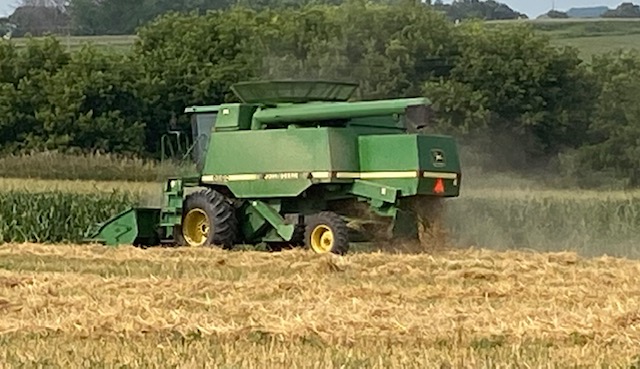
When the combine (we should clarify the pronunciation of this if you’re not familiar. It’s not com-BINE, like adding things, it’s COM-bine. I don’t know where that came from. Subject for another day). The combine has to pick up the oat windrow the same direction it was cut. And that means from the head end. As the swather cuts it, all the heads fall to the back and it’s usually pretty easy to tell. Trying to go the wrong way, it just doesn’t feed into the combine as well.
When cutting, it’s best to make about 4 or 5 rounds all around the field, so there’s room on the ends for the combine to turn around, (and that goes for any crop; corn or beans or anything); we call those the ‘headlands’. And then it can just be cut going back and forth. Corners are tough so we avoid those when we can. Tough in that the machinery doesn’t make 90 degree corners very well, it doesn’t plant well in corners, hard to stay on the row in a corners.
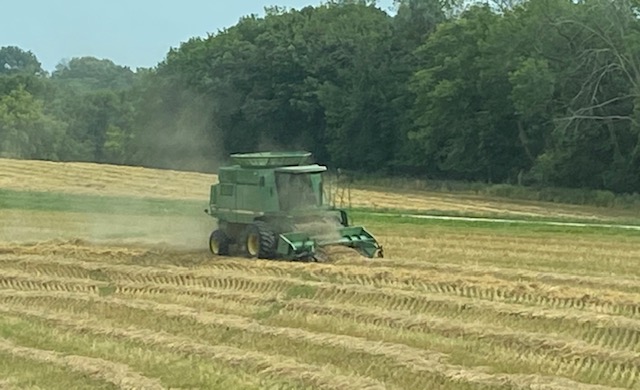
OK, so now it’s Saturday and the combine is here and harvesting and I don’t have any trucks yet. I can’t get the truck guy on the phone. I call another guy from the farm, but he’s over in Wisconsin and he can’t get anyone on the phone either. Finally, we just go to the farm and get a semi and drive it back here ourselves. And, of course, there’s a summer shower and the harvesting is done for the day. Next day he’s back and finishes that field. And a few days later gets the last of it.
I don’t have the final numbers yet, but it looks like a real good crop.
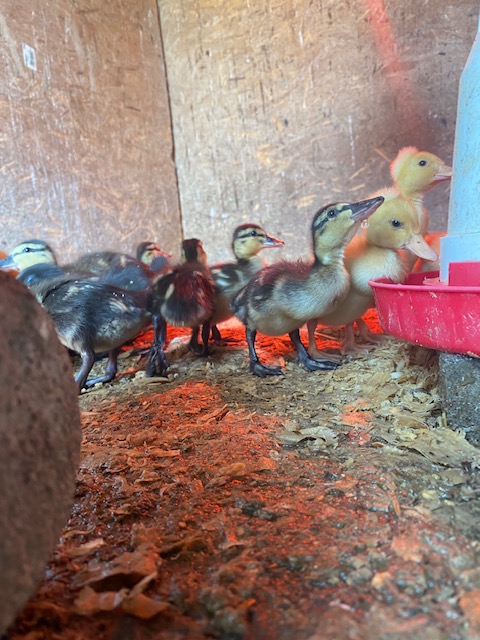
As I write this, I’ve got some straw baled, got another show ready to open, ducklings moved to a bigger pen,
and I’m going to cut the grass!
Talk about when you had to do something yourself. Why is good help so hard to find?
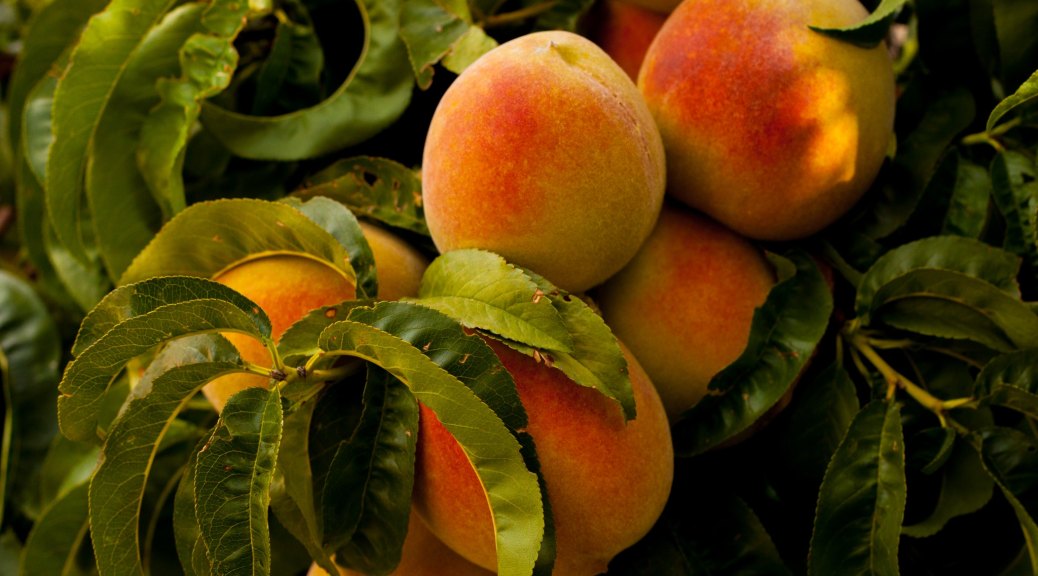
The peach man arrived in town last week. He is also the cherry man, and comes to town a couple of times a week in the summer selling Washington and Montana cherries and Washington peaches in the mall parking lot. His wares are hard to resist, and we bought a crate of lovely organic Washington peaches from him. We can’t find Washington peaches in the stores here.
Our vegetable garden is starting to produce a lot now, and we are scrambling to use up all that we harvest, either by eating now or freezing. Buying a crate of peaches was rather impulsive. The peaches ripened fast, so this weekend we had an additional scramble to use them up. I used 9 pounds in peach pie filling, which I froze. Husband looked up beet and peach salads. He has yet to make one, but the recipe he chose has champagne in it. I found a peach and pasta salad with arugula and goat cheese. I also made a peach quick bread. There is no rest for us in late July.
What do you find hard to resist buying?What is your favorite peach recipe? Made any impulse purchases lately?
Today’s post comes to us from Steve, who is at the extreme left above, petting the dog.
The pattern of sending kids off to summer camp is much stronger in the East than in the Midwest, but summer camps seem increasingly popular here. Kids from cities like New York or Boston might be shipped out to spend the whole summer in one or more camps. The Midwestern pattern is more likely to let kids live at home, perhaps attending one or more camps in the summer.
Camps used to be very traditional and outdoorsy, much like Boy Scout camps everywhere. Kids would play outdoors, swim, do crafts and have bonfire picnics. Modern summer camps are increasingly educational, perhaps teaching computer skills or a foreign language. My daughter has fond memories of Artward Bound, a camp that encouraged kids to engage with the visual arts. Alas, it no longer exists.
My first camp was Camp Matigwa, a Boy Scout operation. I was at an awkward age, shy and reclusive. They taught me to make a lanyard, which later made the Billy Collins poem all the funnier. We were supposed to swim once a day, but the water was cold and I was delighted to learn I could spend that hour at the camp’s “canteen” eating Baby Ruth bars instead.
I wore shorts on the day we took our first hike. I contacted some stinging nettle, which hurt like liquid fire until one of the counselors found some jewel weed, a plant whose sap canceled the nettle’s poison. The obvious lesson was that we should learn all about plants. I now suspect that our counselors staged the whole thing. They obviously knew where the nettle and the jewel weed grew, so I was the dupe they maneuvered to blunder into the nettles so they could showcase their expertise.
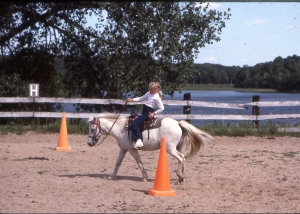
My favorite camp experience came in the summer of 1956 when I spent two delightful weeks riding horses at the Larry-Jo Dude Ranch near Boone, Iowa. We camped out, sang around a bonfire, groomed horses and took two trail rides each day. On my faithful horse, Margarita, I twice won the water relay event at our end-of-camp rodeo.
But the big event from that summer was when we played hide-and-seek on horseback. Pardon me for telling a story I’ve told before. We rode south of the ranch to a patch of woods. I had been assigned to ride Diablo, a large white mare that was the fastest horse in camp. But Diablo was lame that afternoon. When we divided up to go hide ourselves, I was stuck riding the largest, whitest, slowest horse in camp. I dismounted and led Diablo into a little gully where we could hide under some overhanging shrubs.
It was so exciting my heart still races when I remember it. Horses thundered all over the woods, kids screaming and tagging each other. I knew enough about psychology to know that time passes slowly when you are hiding like that, so I kept squelching the impulse to come out. Then the noises stopped. After what seemed an eternity, I ventured out of the gully. The woods were empty. Everyone had gone back to the ranch house, obviously unaware they were one buckaroo short.
As a courtesy to my lame horse, I held Diablo’s reins and walked her for half an hour back to the ranch. When I got to a hill overlooking camp, I saw three cop cars near the corral, their red and blue gumball lights madly spinning. And I understood: the town’s cops had been called in to find me.
The camp’s managers were delighted to find me perfectly alive and unharmed, but they infuriated me over and over. They kept calling me “the lost camper.” That was outlandish. I knew exactly where I was every minute of that day. They saw me as the lost camper although I saw myself as the hide-and-seek champion of all time.
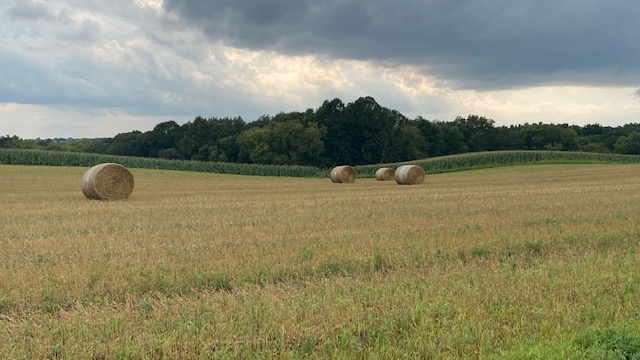
Dare I say it’s a quiet time around the farm. The Co-op is done spraying, I don’t have hay to put up, oats is coming but not quite there yet, and I’ve got weeds and brush mowed.
We almost had another hot air balloon landing in the fields. I was out doing my chicken chores and heard it and could see it through the trees and it looked pretty low. Kelly and I headed up there and met the chase vehicle coming down. The balloon was pretty high again at that point and still moving East. The driver said he had considered landing here and I guess they were coming to ask permission. I don’t know if they just didn’t get here in time or what, but the balloon moved on. It was a different balloon company so it wouldn’t have counted in my 3 landings = free ride anyway.
One of our favorite nieces, her husband, and 9 month old baby came to visit from South Carolina. Her mom and dad are still here, and the baby got to see Great Grandma Hain and we had a real nice visit with them.
Four generations here. As luck would have it, our son and his wife were able to come down too, so the cousins had a good visit. The Niece always talks about the wild black raspberries that grow out here and she remembers picking them when she was a kid visiting Grandma and Grandpa’s farm. There was a lot of berries this year and they lasted a long time. Just not quite long enough for their visit. I did get a few fresh berries for her. They sure are good.
I did get the waterways and pastures mowed with the rear mounted brush hog. I was down in one of the pastures cutting brush and clearing that darn buckthorn when one of the big spinny things underneath fell off. Oh. That’s a problem. I just unhooked it and walked away for the moment. The main shaft out of the gear box sheared off. I looked up parts online; $600 for the shaft. Plus, whatever bearings, seals or other bits might be needed… I was rather discouraged. I’ll fix it. Later.
I did get the new and improved loader bucket back from my nephew the welder. I don’t have the loader on the tractor right now; I took it off for mowing, and will leave it off for baling straw, then I’ll put it back on. I should give it a new coat of John Deere Green.
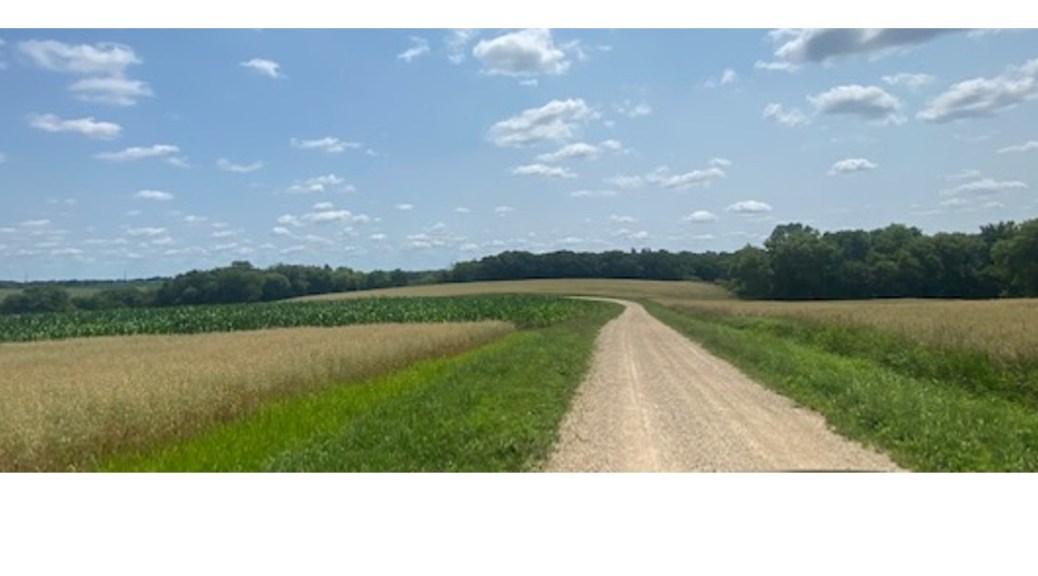
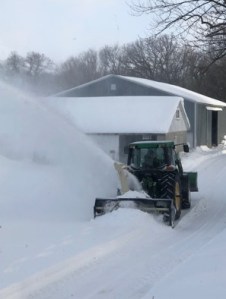
There were a few comments on the driveway in the last blog. From the main highway to our house is 1.3 miles. The first .4 miles though is technically a township road, and the snowplow will come in our road about a 100 yards to turn around in a cell phone tower driveway. It’s easier for them than trying to turn around where our driveway starts. The road forks right there and our lovely neighbors are on the right fork, we’re on the left fork. There’s a hill their driveway that’s given a lot of people trouble over the years. You think our driveway is bad, you should see theirs! Our road is longer, theirs is steeper. Both are beautiful drives, just scary in the winter. We both joke, you can always get home, and if you can get out, you can probably get wherever you’re goingI do have a 7’ blower that mounts on the back of the tractor, so I have to go backwards when blowing. The last few years I’ve been using a rear blade if it’s just a few inches of snow. Quicker, faster, and my neck doesn’t hurt when done. But that also makes a pile of snow on the edge of the road that will drift in sooner. So eventually I have to put the blower on and cut those down again.
It’s interesting when I collect eggs, the chickens seem to like the number 3. Often the nest boxes will have 3 eggs in them. There might be more or less, but more often than not, multiple boxes will have three eggs in them. It’s curious.
After 18 months of very little theater, I’m back in full force. I have two shows to open in three weeks. Afternoons this week is working at the Rochester Civic Theatre for a Rochester Repertory Theatre production of ‘Turn of the Screw’.
Then next week is tech for ‘The Addams Family’ down in Chatfield for Wit’s End Theater. Somewhere in here I’ll be cutting oats and baling straw too.
I talked about the helicopter spraying a couple weeks ago? A helicopter crashed about 20 miles East of here while spraying crops. They think he flew under an electric line and snagged one of the wires. The pilot was killed. A newspaper article says “accidents are not uncommon”. Don’t know if it was the same company or anything. It’s terribly sad.
Hot weather or Cold Weather?How many eggs did you eat today?
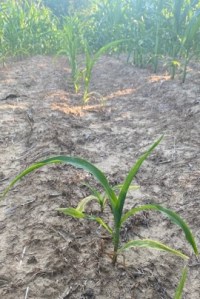
It’s as high as a small elephant’s eye. There have been a few years the corn was only knee high on the fourth and those were extremely wet years and it was planted very late.
Beans are coming along and looking good. Oats is just starting to turn color. The green is fading and it’s turning yellow as it matures and dries out. Now I worry about storms and high winds knocking it down; we want rain, not storms.
We keep scouting the crops, watching stages of development and looking for diseases or insects. Beans can get aphids that affect yield. But we don’t spray for them unless it hits an ‘economic threshold’; the point where the cost of the damage from the pests would be greater than the cost of the spraying. That’s about 250 aphids / plant. It’s been a few years since I sprayed for aphids, it doesn’t happen very often.
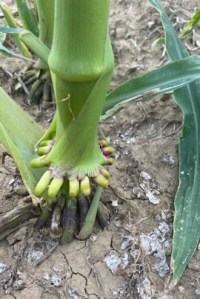
The corn I like to watch as the brace roots emerge – extra roots that come out to help stabilize it as it gets taller.
I found a few places where corn plants are still emerging after all these weeks. They’re too far behind the rest to amount to much; the ear most likely won’t fully develop or be dry enough by fall, but it’s pretty amazing the seed still grew this long after planting and being in the ground all that time!
We are delighting in the warm summer nights and enjoying the fireflies over the crops. They’re always such a treat to watch. Some of us like the “warm” part better than others of us. Growing Degree Units are up – 355 over normal.
I mentioned the helicopter spraying at the neighbors. I’ve always been fascinated with helicopters, so it was fun to watch that operation. I’ve been in a helicopter a couple times; Many years ago I took a helicopter tour over Gettysburg Battle grounds and just a few years ago a helicopter tour over Charleston SC. That was fun.
One night, Kelly was taking a walk and she texted me that a hot air balloon was pretty low. We’ve had a few balloons land in our fields, but usually it’s winter and there’s no crops to worry about. It was a very still night and this guy had lost all his wind and was really just hanging there. I drove up and met his chase crew. I told him if he could at least get to the edge of a field and not land in the middle I’d be happy with that. He said he would do his best. And he did. He managed to get to a water way (just a grassy area) to land and the crew dragged him over to the road. Always fun to see them. If they land 3 times on the farm I get a free ride. It hasn’t happened so far.
Still fixing things, had a flat tire on the lawnmower, which isn’t surprising given the areas I’m mowing. I couldn’t find a hole, so I took the tire apart and couldn’t find anything inside either, so bought a bottle of ‘Slime’ and put that inside and it worked! Plugged up the hole! (‘Slime’ is a green, thick, goop, you squirt inside a tire and it’s supposed to plug up holes and prevent new holes. I’d heard of it before, but never tried it.) I just bought a second bottle. If this works, I might be sold on it!
Working on the grain drill too. It needed some bushings on the arms that support the press wheels and a couple new bearings in the press wheels (they press the seed into the dirt for good ‘seed-to-soil’ contact.) Plus, one of the actual seed cups had been broken since I bought it. Wasn’t really hard to fix, but it was 44 little ¼” bolts and it takes two people. I have a college kid, Khalid, that is helping me with that. Waiting on parts to finish that project.
I also took the bucket off the loader and have it over at my nephew, Matt’s. He’s a welder and got his own shop going as a side business. The loader bottom was bent because I work it too hard. And it’s also 20 years old and it has pushed a lot of trees over. He tried to straighten the bottom, but it couldn’t be repaired so he got a new piece of steel for that and I ordered a new cutting edge from the dealer. Half the price of a new bucket and this will be better than new. [photo]
I bought another funnel at Menards. ¬¬Funnels are a mystery. I have a dozen different funnels and still didn’t have one that will hit the transmission oil filler on the lawnmower. Although this one today might! I even bought a funnel with a right angle on it and that wouldn’t reach either. Some funnels have too big of a funnel end. Some are too long that they’re awkward. Some are too narrow and the thick oil won’t flow through. Some are metal, some are plastic, some are tapered to one side, some are flexible but never the way I need them to be.
It doesn’t seem like it should be this hard, but I guess it is. You think “I’ll just get a funnel for this”, and then it doesn’t work. I got two flexible folding funnel things. Silicone and moldable, made to fit in wherever you can squeeze it. Sometimes that’s the right tool. I tell the kids a lot, “Every new job is an opportunity for a new tool”.
Helicopter ride? Hot air balloon ride? What’s the craziest/most fun thing you’ve ridden in?
Husband and I are traveling to Tacoma, WA on Monday to see our Daughter. We will be gone for a week. This week we are prepping our gardens for our absence, watering like crazy and taking care of any garden pest and disease issues.
Due to the lack of humidity and the isolation on the Northern Great Plains, we have a comforting lack of pests and diseases in our gardens. We rarely need to combat anything, but there are a few persistent garden problems that require action.
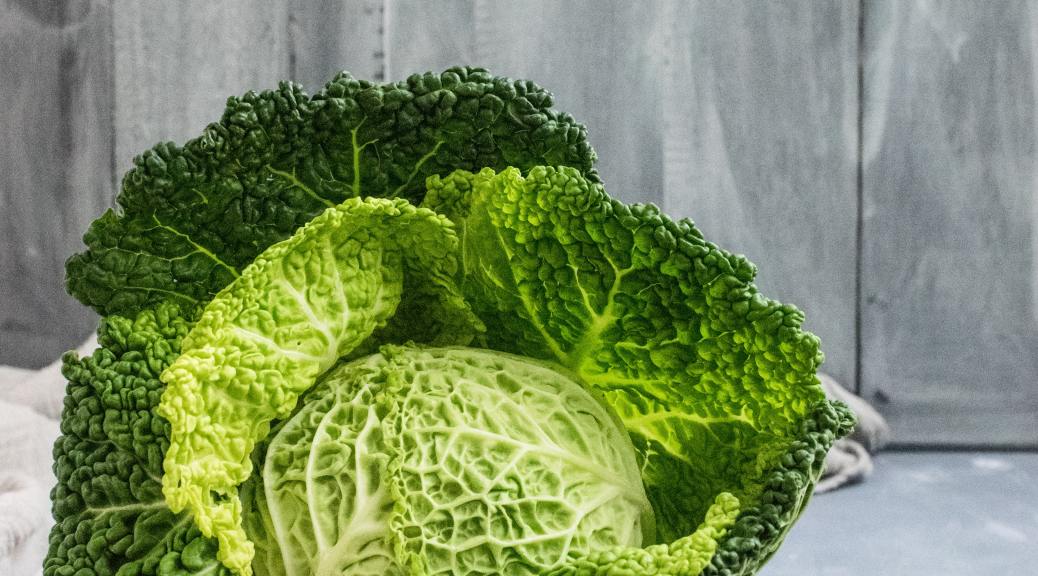
We somehow have blight problems in our tomatoes and roses that require an application of fungicide. I sprayed with Daconil last night. Last year, we had flea beetles in our kohlrabies that required insecticide. I applied some Sevin to some chewed up kohlrabi plants last night. The potted tomatoes and peppers in the church garden need something called Rot Stop to combat Blossom End Rot. (Calcium uptake in a pot is difficult at times.) We also have cabbages that need help with cabbage worms with Thuricide, or Bacillus Thuringiensis, which is an organic worm deterrent. No worms in our Savoy cabbages!
How do you deal with life’s pests, garden or otherwise?
We have two, 50 ft. tall spruce trees in our front yard that are full of birds and their nests. The Collared Doves begin the nesting season, followed by robins, then sparrows, finches, and Warbling Vireos. Chickadees and wrens make their presence known. We feed the birds sunflower seeds in the back yard, but not in summer. Still, our trees are full of birds all year. I wonder how they choose our trees and yard? There are tall trees all around, yet we have lots of birds. I suppose the grapes, hazelnuts, raspberries, strawberries, and currants in the yard are a draw.
I was in a rather fanciful mood the other day and imagined a bird real estate agent trying to sell bird condos in our trees. What would they say?
High rise living with ample food supply in the cold weather. Luxury summer garden worms. Indoor cat brushed outside, leaving fur for nesting. All the comforts of home. Good opportunities for subletting. No squirrels allowed.
The blog title, by the way, is from a Broadway play from the 1970’s. I have no idea why it came to mind.
How would a bird real estate agent list your yard? What are your experiences buying property?
Our hot weather retreated last week, and by Friday it had cooled off substantially. Gentle rains came, and I stood at the front door on Saturday watching the rain fall straight down, with no wind, which is rare here. It was a delight to watch.
Our roses are blooming, and the garden veggies are looking strong and healthy. We weeded all over our flower and veggie beds, laying down newspapers and covering them with dirt to keep the weeds minimized for the season. The absence of weeds is so lovely, and the plants stand out and look really nice. I had forgotten how pretty eggplant plants are. There are visual delights all around. I just have to remind myself to look for them.