Today’s post comes to us from Crystal Bay.
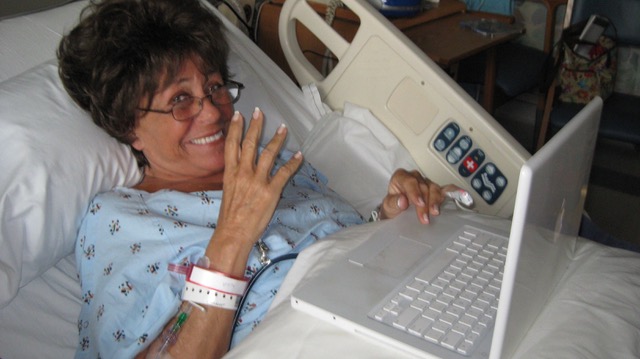
I’m in the process of publishing a book that is a compilation of a year’s worth of journals on Caring Bridge during my battle with cancer. I thought I would share just the introduction with you.
***********
It was a day like any other, getting up to drink coffee, check out the news on digital reading online. Two days earlier, I’d seen my primary care doctor for a complaint about chronic constipation. As he was exiting the exam room, I thought to mention that, once in a while, my daily medications got stuck in my throat. He turned around and said, “I want you to have an endoscopy this week. Don’t worry – 99% of the time it’s nothing”.
On January 20th, two days after the endoscopy, the gastroenterologist who’d done the procedure called me. She said, “I’m sorry, but you have esophageal cancer”. Just like that. No “Come in with a friend or family member because there’s a concern about your test results”. Only, “I’m sorry but you have esophageal cancer”.
Never having heard of this kind of cancer, I immediately googled it. What I read in the first few articles basically informed me that I would be more likely to die than to live with this highly fatal type of cancer. This didn’t scare me; it astonished me. Reading something which basically says you’ll probably die is surreal. From this moment on, I never dwelled on this probability. I still haven’t.
For me, seeing a small white spot on a PET scan was in no way a threat to my life; it was just a white spot. How could a little white spot on a scan kill me???
This whole thing made me intensely curious and I researched endless hours to meet my new, unwelcomed internal guest. Never once did I grasp, much less react to, this as a real threat to my life. It was simply a white spot on a scan.
What I did realize almost immediately was that this diagnosis was a very big deal and that most people hearing it would trip them into fear, panic, anxiety, and generally into feeling powerless. I recognized that this would be a “normal” reaction to hearing a diagnosis of the big “C”, regardless of which type. For some unfathomable reason, my gut rejected falling into a victim space.
I’d learned a long time ago that the story we make up about any situation will determine how we deal with it. I decided right then and there that I’d make up a story which would carry me through as best as possible, and it sure as hell wasn’t the version of crumbling into fear or depression. No. Not me. Not my style.
Crafting a story of my choosing, I decided that this would be the journey of my lifetime no matter how it turned out. I decided that my greatest responsibility was to my children, grandchildren, and friends. I don’t have many friends, but have many dozens of acquaintances from my years of being the local “Dancing Grandma”. With a vision of everyone who knew me in mind, I crafted this story:
I would soldier through with humor and curiosity. I would remain fiercely independent throughout. I would model how to face adversity. I would, if I died, show my loved ones how to do this with gusto and a semblance of dignity. I would not cave into despair no matter what. If I was going to die, I did not want people’s last vision of me to be one of a person victimized by this odd invader. No, I would not allow this to diminish my spirit even as it diminished my physical being.
Making up this story freed me from all of the emotions most cancer victims would feel. This story was so much bigger than me, and I knew it. It was about the people who loved or liked me witnessing a way to make this cancer journey without angst or helplessness. It was bigger than me, and this realization was exactly how I faced cancer with acceptance.
There’s a belief out there that we must view cancer as the “enemy” and envision it as a marauder to be conquered. A very wise friend told me, years after my encounter with esophageal cancer, that I probably survived because I didn’t make cancer an enemy. For me, it was simply a white spot on a scan, nothing more, nothing less. It wasn’t a friend or an enemy; it just was. Its discovery would embark me on a journey that would enlighten me and bring gifts no other journey ever could have. I learned how resilient I was. I learned how to accept – even ask for – help. I’d never before been in such a physically compromised condition that I couldn’t take care of myself. I learned that others instinctively and whole-heartedly respond when they see another human in dire need. I came to understand something I’d taught many clients but never applied to myself: helping someone in need is a gift to the giver. I hope that I can hold onto this part of my enlightenment.
Has adversity brought unexpected gifts to your life?







 Trail Baboon