Category Archives: The Baboon Congress

Chicken Little Was a Silly Optimist

Today’s post is by Steve Grooms

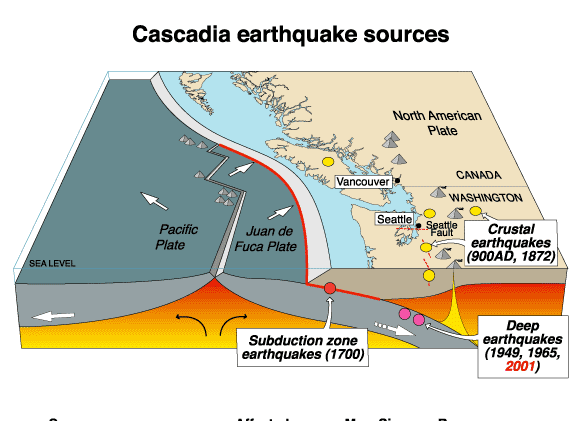
Something terrible is going to happen in the Great Northwest. The approaching danger has a pretty name: “Cascadia.” Cascadia refers to an earthquake that will devastate 700 miles of Pacific coastline from California to British Columbia. That quake will be followed by a massively lethal tsunami.

Here is a little Cascadia Q and A:

How sure can we be that a bad quake will hit here?

Scientists are absolutely sure of this prediction. Quakes registering 9.0 happen in this region about every 250 years. That pattern has persisted as far back in time as geology lets us see. The last big quake struck in the early 1700s, shortly before Europeans arrived. That means no quake has occurred while European settlers have been here, so people in this region have no memory of what a bad quake is like. After the next quake and tsunami, scientists say, the northwest coast will be “unrecognizable.”

When might this happen?

Scientists still cannot predict the timing of quakes with any specificity. They agree that the next quake is seriously overdue. One authority calculates there is a 40 percent chance that Cascadia will hit in the next 50 years. As I consider those odds I hear the gritty voice of Clint Eastwood asking, “Do ya feel lucky, punk?” “Nooooo, Clint! Nooooo, I don’t feel lucky at all!”

How bad will it be?

Seismologists expect a big quake, with Richter ratings close to 9.0. Cascadia will probably be a twin to the quake and tsunami that obliterated coastal areas of eastern Japan in 2011. That disaster tsunami killed about 16,000 people. FEMA planners anticipate at least 13,000 deaths as a result of Cascadia.  When it happens, Cascadia will immediately become the worst natural disaster in the history of this country.

How prepared is Oregon?

Experts give Oregon a grade of F-plus. For example, of Portland’s eleven bridges, only two were built with quake-proof engineering. Because of publicity about the coming disaster, there is some hope that local government will begin addressing the region’s vulnerabilities. But the culture of this region is skeptical about government and collective action. Some leaders are campaigning hard for better preparation. So far, they have lost every battle to spend money now to save lives in the future.

The real issue isn’t what will happen to me in a Cascadia disaster. I’m an old guy with serious health issues. I won’t be living long in Oregon or anywhere else on this planet. It would be silly for me to panic about something I can’t prevent and which probably will not occur while I am here. And yet I believe everyone is responsible for planning sensibly for future crises, even those that seem unlikely to happen soon. My greatest concern is for my daughter’s family and for the region as a whole. My daughter’s home in southeast Portland is old. I doubt it can withstand the shaking of a quake, although it lies as bit beyond the reach of the expected tsunami.
 

Cascadia_earthquake

My apartment sits near the top of a small mountain south and east of Portland. The soil under these buildings is solid. The elevation puts us safely above any possible tsunami. These apartment buildings were constructed in 2000. They had to conform to building codes reflecting a modern awareness of the threat of quakes.

If I survive the quake, my problems will just be beginning. Our electricity goes out when the wind blows. Quake survivors will have no power or telephone service for weeks after the quake. There will probably be no drinking water or (ugh!) functioning toilets. All banks and financial systems will be shattered. The local transportation system, already fragile and inadequate, will be in chaos. Highways will buckle, bridges will collapse and the tsunami will flood much of the coastal area with debris and corpses. Grocery stores and pharmacies will be looted within hours of the quake, with no chance for re-supply. Emergency vehicles will not be able to move on streets and highways. Any relief will have to come by helicopter. Most disaster relief will be focused on the areas hit most severely. Survivors will have to make do, somehow, for a period of two to six weeks.

Questions abound. For example, should I deplete my retirement fund to purchase six weeks worth of water? Where would I keep it? A sizable swimming pool lies a dozen steps from my apartment. Will it survive the shaking? Could residents drink that water? Who will establish and enforce order so neighbors don’t plunder each other’s goods?

I am more puzzled than panicked. Nothing in my lifetime has prepared me to respond to a threat like Cascadia. The event, when it comes, will be almost unimaginably tragic. And yet, although it is “overdue,” it might not come for several decades. My dilemma is figuring out how a thinking person can plan effectively for such an event, preparing for extreme chaos while keeping things in perspective. Surely there is a sensible middle ground position somewhere between irresponsible oblivion and total panic.

When I was a Minnesotan I knew it was always possible that a tornado could chew my home to pieces, but the odds against it were reassuring. Now, as I try to prepare for what is often called “the big one,” Minnesota winters suddenly don’t look as threatening as they once did!

How should Steve respond to the threat of Cascadia?
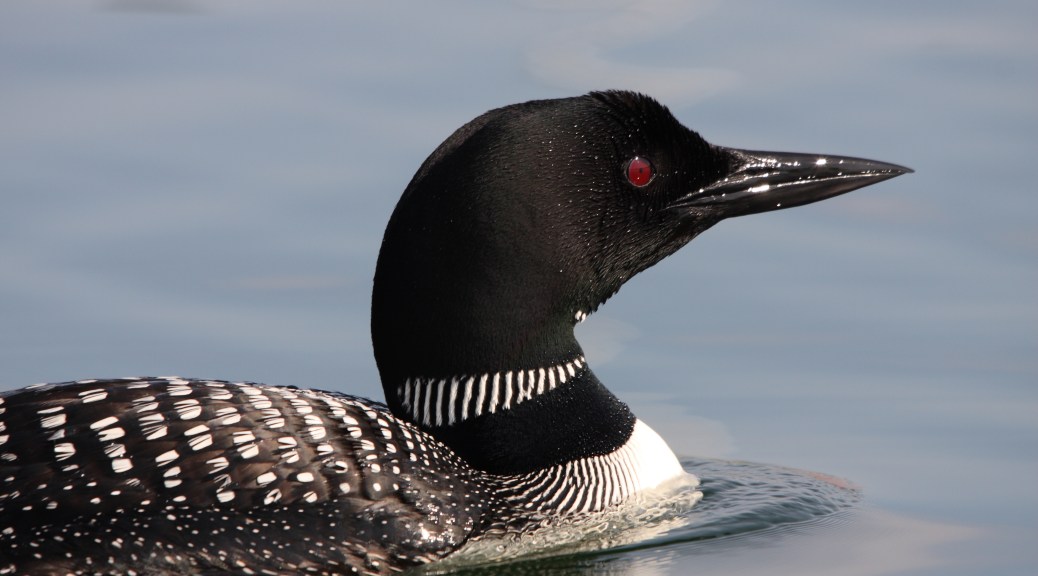
Lone Loon

Header image: from Cephas through Creative Commons 

Today’s post comes from Crystalbay

Every spring, a loon appears on Crystal Bay and stays until late fall. Loons are seen very rarely on this lake because it’s so heavily populated with boaters, especially when compared to the quiet, pristine lakes of the BWCA. Late at night this little loon makes the clarion, haunting sounds that only loons can make. I see him out there swimming and bobbing all by himself. In fact, as I sit here typing while facing the quiet autumn bay, I can see his silhouette far off in the distance.

I’ve never understood how a loon could not have a partner. He’s all alone out there summer after summer. I make up that he had a partner long ago and returns each spring to mourn her or perhaps still wait with anticipation. This loon and I share the quiet aloneness of our lives.

I prefer to use the term “alone” rather than “lonely”. For most of my life, if I didn’t have constant human interaction, I did feel painfully lonely. During my first few years after the divorce, I scrambled to find new people rather than face my new singlehood and desperately avoided time by myself. It seemed as though I only existed when others were around. It was a difficult chapter in my life.

I dated like crazy those early years, trying to compensate for a lifetime of being married to two men I’d grown to thoroughly dislike. For the first time in my 40 years of adulthood, I felt unencumbered and free. Eventually, after dating many ill-suited men, I met and fell madly in love with a man I was certain that I was born to be with. He broke my heart into pieces after a few months, then returned to my life once again three years later, saying he wanted to take care of me after my massive cancer surgery. He abruptly left the night before the surgery. My heart was broken all over again.

I had to come to terms with the obvious: I was in love for both of us. I’ll always see this man as the perfect life partner for me in spite of the betrayal and pain he brought, and in spite of knowing that this love affair was an illusion.

That was five years ago, and I haven’t dated since. Illusion or not, this relationship raised the bar so high that I knew in my heart no one would ever fill the piece he’d carved out. Over the years, I’ve self-repaired by contemplating the gift of this relationship and have long since realized that his presence in my life made it possible to experience the joy of being completely in love for the first time in my whole life. For the rest of what remains of my life, I can honestly know how this feels.

And so, he is long gone, but the precious feelings I finally got to feel are with me everyday. I no longer feel true loneliness, only an occasional bout of nostalgia when I see couples slow dancing. I’ve learned that my own company is enough and that one could ever be as perfectly matched for me than myself. Another way of saying this is that I finally feel safe and content with the best roommate ever: me.

How has a heartbreak been a gift in your life?

Baboon Redux – Farmers and Their Tractors

Today’s post by Clyde was first published in 2011.

In my childhood the few farmers of southern Lake County shared equipment and work. Many of those farmers were characters worthy of being remembered. Two of them were Nordic Bachelor Farmers.

The Swede

Ole, his real name, I promise, lived in the valley below us up a side road of a side road of a side road in a small house. I always wanted to get into that house, to see if it was as neat and precise as were his barn and garages and to see if it had any frills. I never made it in.

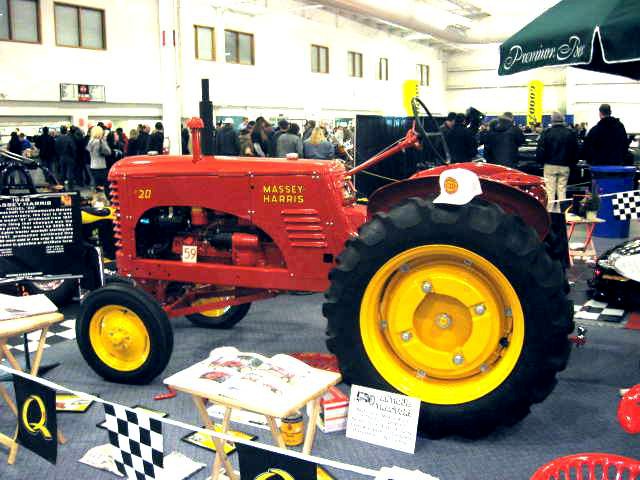
1948 Massey-Harris

In our early years on our perch above the valley, before the trees got too tall, we could just see his farm. It was three miles away, but by road it was seven miles. Ole owned a threshing machine. We would trade work or oats for him to come to our farm with “the separator,” as we always called it. Ole would putt-putt along at a much slower speed than necessary in his 1940’s era red and yellow Massey-Harris tractor towing the machine to and from our farm. Ole never rushed anything. Never. Ole never got excited. Never. Ole would talk . . . but . . . seldom . . . softly . . . with lots of . . . pauses.

He was slight of frame with massive hands at the end of long dangling arms. He always wore a cap, except when he came awkwardly into our house to eat. I waited for that moment when he stood at the door wiping his feet, cap in hand, calling my mother “Missus.” Powdermilk Biscuits would not have cured his shyness, nor given color to his pale skin, which somehow never tanned or burned, nor given thrust to his receding chin.

It was his head I waited to see. He had classic male-patterned baldness, and, here is what I awaited, five large bumps on his head. I do not know why he had them. They seemed benign, and he lived into his late 70’s. But what child could not be enthralled by those bumps!

The Norwegian

Noble—yes, that was his name—was my father’s best friend. And as opposite of my father in temperament as a man could be. He had been a Lake Superior fisherman until the coming of the lamphrey. He switched to farming, with which he needed much help from my father. I liked his name, and he did have a serene Nordic unpolished nobility. But I liked his brother’s name better, Sextus, which always made me giggle. Noble was short, stout of frame, and walked with small slow careful steps. He always bent his upper body forward and furrowed his brow as if deeply worried, which he was not.

Oh, how many stories there are about his kind, gentle, and implacable nature. For instance he once brought back 50 wild yearling steers off the Montana Range, and trustingly left a gate open, letting them escape. We got back 49, one of which died.
One was found as far away as Beaver Bay.

One day when he was about 50 years old sitting drinking coffee at our house, calling my mother “missus,” he casually mentioned that he had married the week before. My parents snorted coffee. It was a woman we knew—brusque, demanding, fast-moving, and intolerant of incompetence. It proved to be a lasting, loving, and happy match.

After I moved back to Two Harbors, I often saw Noble. Once I mentioned to him that my backyard had a large pile of firewood which was too punky to burn in our fireplace. He agreed with my suggestion that it would burn in the large barrel stove in his garage, fashioned for him by my father.

Fordson Model F

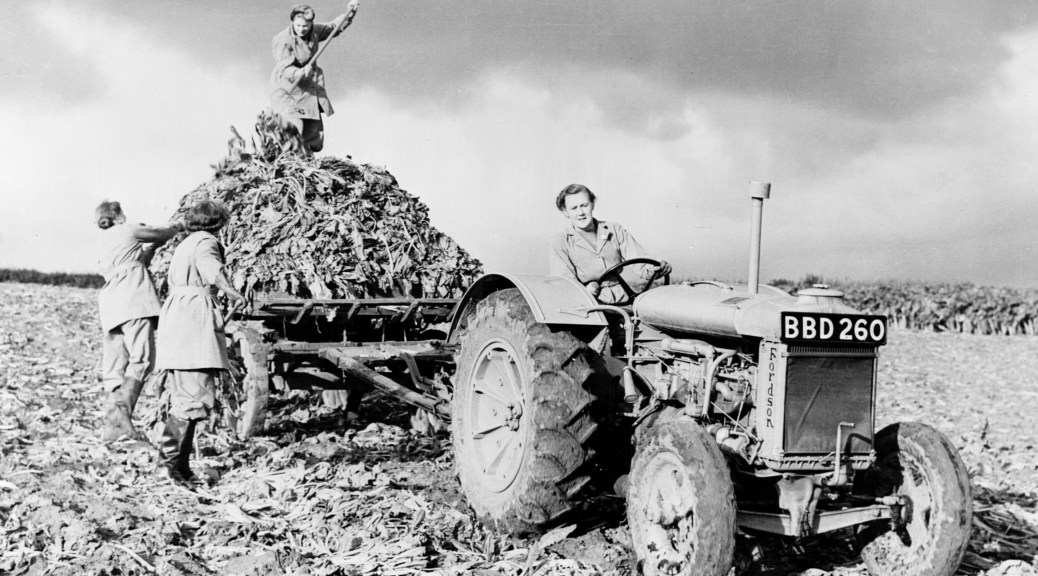
One Saturday he showed up with a hay wagon pulled by his 1930’s era Fordson tractor, famous for its durability and utter lack of power. Noble had three tractors, one a powerful International Harvester, but he loved to use that old putt-putt Fordson. As he backed it down into the low spot in my yard where the wood was piled, I told him that I did not think it had the power to pull out the load. He thought a moment and said, “Yup, yup, probably not,” and started to load wood. Halfway through the job we went in for coffee. He took off his hat, wiped his feet carefully, and charmed my wife, calling her “Missus.”

As you can guess, the Fordson would not pull out the load. He did not get mad; he just laughed and said, “Yup, yup, you were sure right about that.” He drove the 11 miles home and 11 miles back the next day with the IH, which pulled it out easily.

That was, sad to say, my last meaningful contact with that exemplary man. But I picture him every time I hear the term “Norwegian Bachelor Farmer.”

What are the tools of your trade?

Baboon Redux – About The Barn

This guest Blog by Madislandgirl was first posted in 2010

I love digital cameras, because you can just shoot and shoot and not worry about wasting rolls of film that when developed show a nice out-of-focus art shot of the back of someone’s head. My son prefers taking shots of interesting images as opposed to the documentary shots I grew up with (“here we are at Mount Rushmore!”).

A little while back, discussion on the Trail was about wabi sabi. There had also been a bit of talk about old barns and how they are disappearing from the landscape. This got me thinking persistently about what once was my grandfather’s farm.

Grandpa’s Barn

And so it was that one weekend, the son and heir and I headed out to Scott County with the express purpose of taking pictures of my grandpa’s old barn. I figured this might be our last chance, as the family who currently own the place will be selling in a year, and I feel certain the barn will be coming down at that point. An electrical fire destroyed the farmhouse about 5 years ago, so this abandoned barn is what remains of “the farm” as I remember it.

A Tree Grows Through the Fence

The teenage son of the current owners was in the yard when we got to the farm, which solved my quandary about asking for permission to roam around the barn. He acquiesced to our request to take pictures in a way that made it clear that he thought we were nuts, but probably harmless.

I was seldom allowed near the barn as a child, I’m sure it was considered too dirty and dangerous for a “town girl”. My son wanted to go inside. It looked pretty stable, so I let him. We both managed to resist the siren song of the ladder into the hayloft, barely.

The Beckoning Hayloft

We had a great time shooting that barn, trying to figure out how some of the old equipment must have functioned when this was a working farm. My nostalgia for a past I could never recover lifted. This was An Adventure!

We were on a roll, so I decided I would try and find an old family cemetery on the other side of town. It is a corner of a cornfield and completely unmarked. I had been there exactly once before, 10 years ago with a toddler and I was not driving. Still, I was feeling cocky.

We headed out-of-town on what I thought was the right highway. I kept scanning the landscape for something that “felt right”. We came to a little town that I remember hearing of as part of the family lore and took it as a good sign, but had we gone too far? Kept driving. As we were driving, I thought I saw a little gravel track at an odd angle to the road-maybe? I decided to turn back and give it a try. The track was pretty well washed out. I parked near the highway and decided to hike in. If I got stuck out there on a fool’s errand, I would never hear the end of it.

My son elected to stay in the car with the cell phone to call the authorities if the farmer who had posted all those No Trespassing signs decided to mistake me for a pheasant-I had 20 minutes to get there and back or he was calling 911!

I hiked around the bend, thinking this was nuts, when I saw up ahead a small grove with something in it.

I had found what I was searching for.

Sellnow Cemetery

What vanished place do you wish you could go visit?

Baboon Redux – The Bear That Ate Jerry

Header image:  Selsdon Wood Nature Reserve, CR0 (Philip Talmage) / CC BY-SA 2.0

Today’s post by Steve Grooms was first published in 2010.

In early June of 1967, I took a Boundary Waters canoe trip with my roommate, Bill, and his California friend, Jerry Voorhees. Bill was a tall, arrogant fellow who enjoyed barking out commands to Jerry and me. Although I was twenty-five at the time, Bill called me “Steevie,” because he knew it annoyed me. It amused Bill to order Jerry and me about like the drill sergeants he’d suffered under in Army Basic Training.

Jerry is harder to sketch. A plump fellow with thick glasses, Jerry was no athlete and less of an outdoorsman. He was on the canoe trip because Bill ordered him to be. Jerry was a sweet, accommodating soul who lacked self-esteem. Bill didn’t help Jerry’s composure with all the abuse he heaped on Jerry, calling him “fat” a dozen times an hour and mocking Jerry’s stammer. Jerry’s father had been a liberal New Deal congressman in California who became famous because he was the first politician to have his career trashed by mudslinging lies from young Richard Nixon.

The trip was more fun than it might have been. I caught a trophy northern pike whose memory still thrills me. We were out in the bush for six days. When we got back to Grand Marais, we were stunned to read that the Israelis and Arabs had conducted a whole war in our absence, the “Six Days War.”

Other than that, the most memorable moment was provided by the bear.

We slept three across in our little tent. Jerry, as the omega trip member, was stuck between Bill and me. Our heads were at the back of the tent, our feet by the door. It was rather tight in there.

We had gone to bed one night after dinner. It was fairly late, late enough that the loons had finally gone silent. Spring peepers trilled from every puddle in the woods. Jerry snored softly. Bill tossed in his sleeping bag.

I had almost fallen asleep when I heard the bear. Something was shuffling around our campsite, something with heavy feet. We had not been careful enough to run our food packs up into the trees, which should have concerned me. Stupidly, I wasn’t afraid.

Instead of being scared, I was enjoying the moment because I knew Bill heard the bear. Bill’s breathing changed, becoming fast and ragged. I had been with Bill in a violent storm once, and I knew how terrified he could be when he felt himself threatened. I grinned into my pillow, picturing Bill on the far side of the tent, his face a mask of terror. Jerry snored on.

“Jerry! There’s a bear!” hissed Bill.

“Snaaaaark,” said Jerry.

“Jerry, dammit! There’s a BEAR!”

“Snoooooooooooop!” said Jerry.

I pressed my fist into my mouth to keep from laughing out loud.

That’s when Bill snapped. In total panic, he grabbed Jerry with his left hand, clamping down on Jerry’s right thigh like the Jaws of Death.

Jerry, dammit, THERE’S A BEAR!”

“I KNOW! I KNOW!” screamed Jerry, now very awake. “And he’s GOT ME BY THE LEG!”

That’s when we broke into laughter. The three of us hooted and whooped until our pillows were soggy with tears and our tummies ached. Whatever the creature in our camp had been, it obviously fled in panic when we began roaring with laughter.

Jerry later explained that he was awakened by the vice-like grip of Bill’s hand on his leg. “I thought he was going to eat me right up,” said Jerry, “starting with the sweetest meat.”

What terrifying moment are you able to laugh about now?

Baboon Redux – Fawn Doe Rosa

Today’s post by Sherrilee was first published in 2010.

Most of my growing up years were spent in a big city in the Midwest, where the wildlife consisted mostly of squirrels and sparrows. So it was a big deal when we vacationed every summer in the northern part of Wisconsin at the family homestead. We saw deer from the car windows and even the occasional black bear at the town dump. When I was seven, an animal park opened up in St. Croix Falls, which was along the route my family always drove to get to Wisconsin.

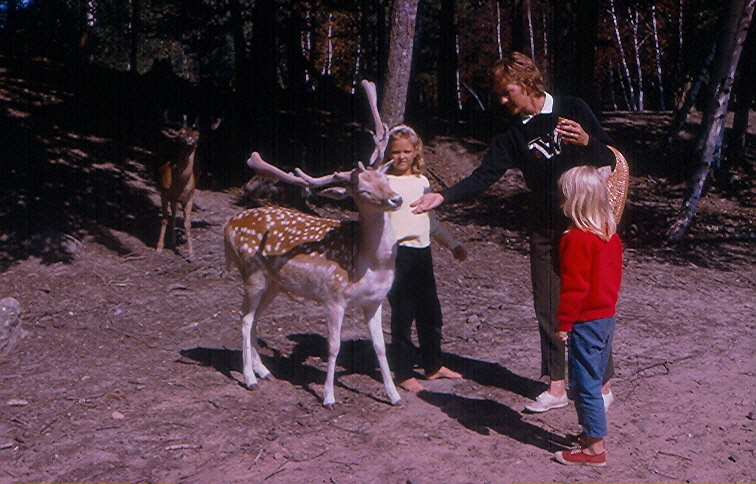
Fawn Doe Rosa was (and still is) a place where you can feed and pet a variety of animals, from deer to ponies to geese and ducks. Always looking for a way to break up the long drive to and from up north, I’m sure my parents were delighted to find anything to get us girls out of the car and out of their hair for awhile.

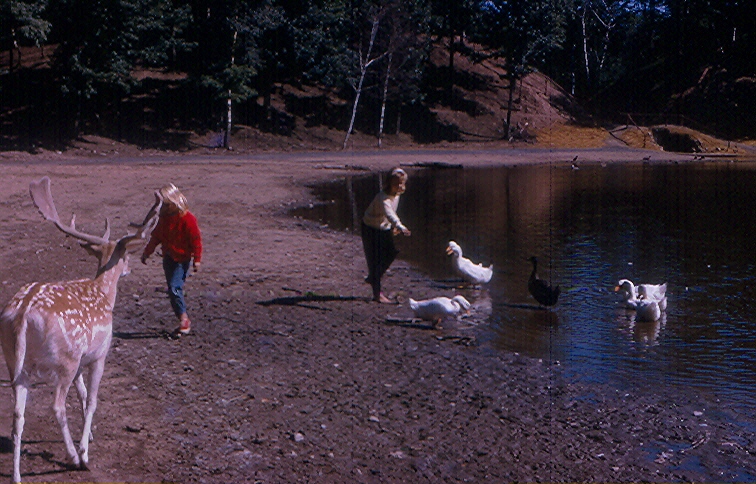
That first year, when I was seven, my sister and I wandered all over the park. Except for dogs and cats, I had never had any interaction with an animal before and was a little leery of the deer, some of whom were bigger than I was. So I opted for the smaller and safer geese and ducks that abounded at the park. At one point, as I was feeding some geese along the little pond, a young elk spotted me.

A Stealthy Approach

Clearly understanding that I was the repository of food, he headed right for me, although I didn’t notice him, so intent was I on my task. My father, who was capturing our day with the camera, snapped a shot as the elk approached me, but didn’t feel the need to warn me. Of course, even though the elk was quite small (as elk go), he did scare me out of my wits and I stepped into the pond and got my feet wet.

It took my mother several minutes to get me to approach the poor elk, who was probably as scared by my antics as I was by his, but was willing to forgive me for my outburst, since I still had food. Within a little bit, I was petting him and feeding him, like he was no more different than the family dog.

Friends for Life

I think about this day often, as the teenager and I still visit Fawn Doe Rosa at least once a summer. What would have been a scarring experience that scared me off animals for a lifetime, turned out to be the beginning of a lifelong love of creatures great and small. We trek out to our two zoos here several times a year, love the Wolf Center in Ely, visit any animal park we find along the way and I believe my love of animals may have rubbed off; the teenager has expressed an interest for a career with animals, although it’s still a little too early to tell.

What memorable childhood experience was captured on film? 

Baboon Redux – Puggi Lives!

Header photo by Christina Nöbauer  

A Repeat Guest Blog from Renee Boomgaarden, originally posted in 2010. 

Recently we discussed our feeling about news stories, and I noted that there was very little in the news that I could tolerate, with the exception, I now must confess, of stories about animal rescue. I don’t mean shows about animal welfare officers rescuing pets from abuse and neglect-those shows just make me angry and upset. I mean stories about helping animals out of predicaments of their own making. You know the kind-goats stranded on bridges or with their heads stuck in fencing, bears who wander into town, get treed and tranquilized, and fall sleepily into the waiting nets of patient rescuers who transport them back to the woods, ducklings retrieved from storm sewers as their mother quacks anxiously nearby.

I think my favorite stories are those told friends and family. The story about the dog who decided it would be a good idea to roll vigorously back and forth over a decomposing porcupine (both smelly and painful) stands out, as does the tale of the poor, bored, Lakeland Terrier who spent hours independently chasing a ball back and forth over a paved parking lot until it had worn the pads off its paws.

My dad and my best friend tell the most memorable rescue stories. My friend grew up on a farm, and one day after checking the cattle she came upon a Great Grey Owl sitting on the ground under a telephone pole. She was able to walk quite close to it and saw that one pupil was quite dilated. It looked kind of stunned and she surmised it had had a head injury. She somehow managed to get it into a tall box in the back of her car and drove three hours to get it to a raptor center at the University of Minnesota. She never heard what happened to it after that.

My father loves dogs and has had his share of trauma with them over the years. He still speaks with sorrow over a favorite dog he had as a boy-a Rat Terrier named Diamond-who went down a badger hole and never came back up. It still bothers him. His all-time favorite dog, however, was Puggi the Pug, a dog he had after he retired. One day in early Spring, Dad and Puggi went to the city park in Luverne, right along the Rock River, to see if the ice had broken up. The river was still frozen over, but barely, and before he could stop her, Puggi ran out on the ice to get to some birds on the other bank.
A portion of the ice gave way and she went through and was pulled under the remaining ice by the strong Spring current.

She was gone.

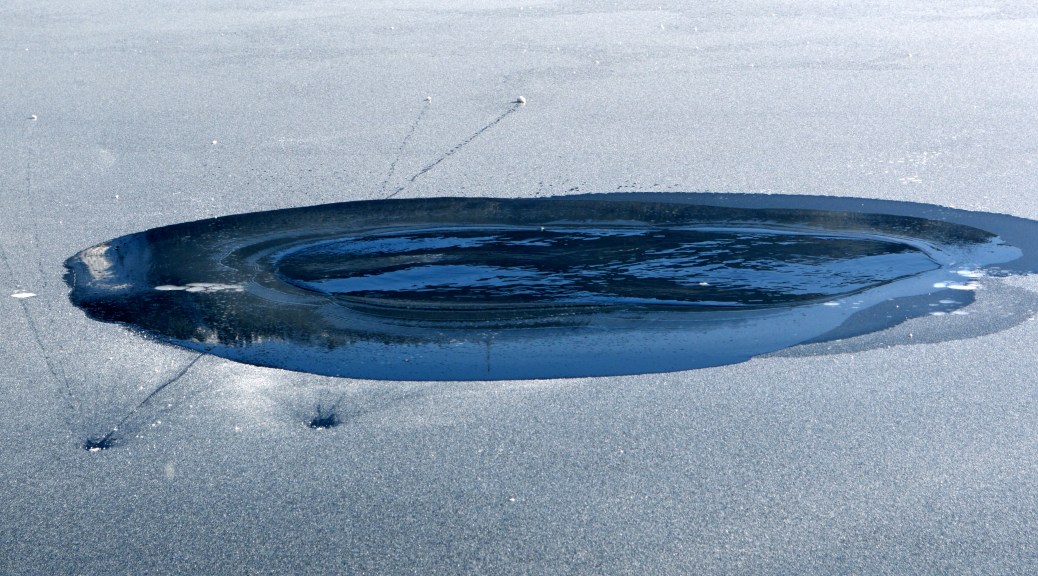
Dad said he walked down stream about 100 feet and just stared, thinking to himself that he had lost his dog for good. His eye was caught by an old ice fishing hole in the middle of the river, and to his joy, up popped Puggi. She couldn’t scramble out of the hole on her own, so Dad laid out flat and advanced across the ice on his stomach. He grabbed Puggi and slithered back to shore. He figured she saw light coming through the hole as the current took her down stream and she swam toward it. He took her home and put her in a hot shower to warm her up. My mother was appalled at the risk he took, I don’t think he thought twice about going out on that ice.

When have you come to the rescue?

Baboon Redux – First Grade With Dr. Franklin

Today’s repeat guest blog was originally submitted by Donna in 2010.

Our school office regularly sends newsletters home to inform families about upcoming events, fundraisers, procedures, and other relevant items. A couple of years ago my colleagues and I were strongly invited to contribute to the newsletter by writing a few notes about the goings on in our classrooms. My turn fell on the week of my birthday, which made it very special … so special, that I submitted two descriptions.

Here’s the piece they rejected:

First graders in room 102 are learning about weather tools that can measure temperature, wind and rain. On Tuesday we taped crepe paper streamers to craft sticks and predicted which condition our tool would measure. Next we took our tools outside and observed what happened when we stood and held them above our heads. Then we tried walking, skipping and running with them. Back in our room we discussed our observations and concluded we had made the perfect tool for measuring how loudly we can scream and shout.

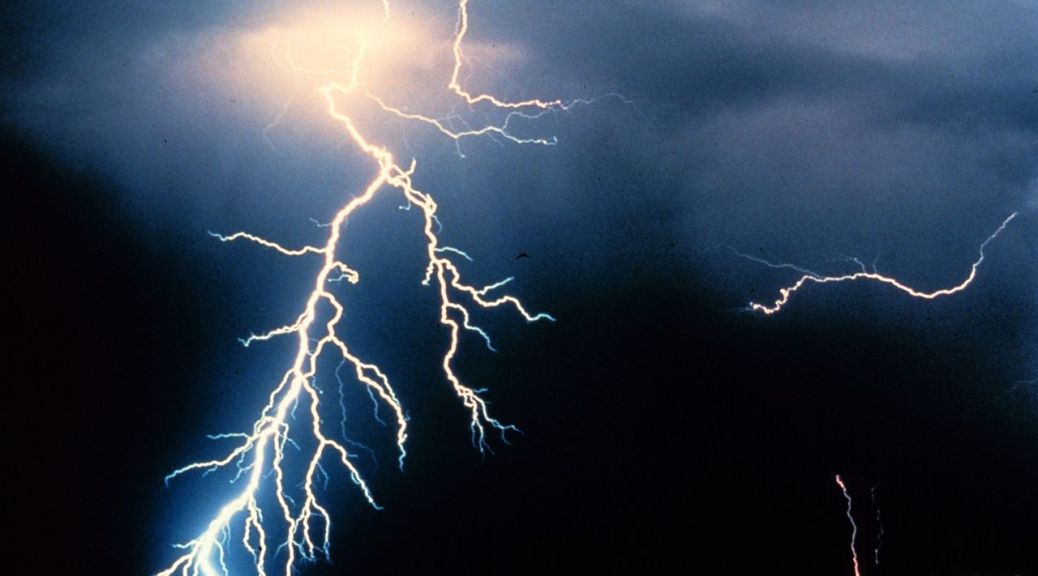
Next week we will take our inquiry a step further and design another weather tool. Scattered thunderstorms are forecasted so we will measure the intensity of lightning. Please send a wire coat hanger and pair of pliers with your child by Monday. Please include a pair of rubber-soled shoes for your child to keep in his locker, since we won’t know until we hear thunder that it is time to take our weather tools outside. Please sign and return the parental release form that you will find today in your child’s folder. And finally, a great big THANK YOU for helping your child explore the exciting world of weather!

“Which of your teachers was the biggest smart aleck?”

Baboon Redux – Second Hand Rose

Baboon Redux – a series of guest blog re-posts.  This was originally shared in October, 2010.

A Guest Blog by Anna

Halloween in Minnesota is a dicey affair costume-wise. As a kid you need to be sure
that whatever you decide to wear will be recognizable either under a parka or over a snowsuit. It should also be something that will work on the odd Indian Summer evening in the 60s. As a result, there are a lot of ghosts and witches as the size and voluminous qualities of either costume lend themselves well to layering.

I think it was an act of desperation bred in part by lack of time on my mother’s part, but one year I went as “Second Hand Rose.” Sewing something for me was not an option, nor was Mom a fan of cheap store-bought costumes (the masks were horrid), and we certainly didn’t have a lot of money to throw at the problem. So Mom whipped open the closets and decided that one of her large, colorful dresses lent itself nicely to “Second Hand Rose” as a concept piece (and would fit neatly over a parka if need be). Two things that she had not thought of: the average kid growing up in the 70s doesn’t know “Second Hand Rose” from Attila the Hun. Also, explaining a costume at every trick-or-treat door gets old (apparently a lot of adults in the 70s didn’t know “Second Hand Rose” either, so it was good I had been schooled in the singing of my theme song).

Shortly after that adventure I quit trick or treating, at least until college. I went out sophomore year with some pals. We set the whole thing up with a short skit involving a safari and searching for the elusive Suburbanis Shopperus (“take pictures, these are rare”). Once again, having to explain at every door what we were up to got old (but it still got us candy, a few photo ops, and one offer of beer).

As an adult, Halloween parties were hosted by theater and Renaissance Festival friends. Not the sort of affairs where you can dress as a pirate or a gypsy. At these events I was variously: Elvis (with a friend as Priscilla), an Lutheran Church Basement Lady in search of a hot dish, and a pregnant alien carrying James T. Kirk’s love child. One year I “took myself to prom” in a fabulous pink tulle dress, teased and bee hived my hair to a fare-the-well to match the dress, and perched a bird on top of the whole works (friends who had arrived as a haz-mat team were kind enough to drape me in caution tape). With each of these I found if you have to explain it, it should be short and sweet, but best to have something that explains itself (see above: lessons learned as “Second Hand Rose”).

Now at Halloween I’m on the other side of the door, handing out candy to the neighbor kids. Daughter usually goes out with Daddy (in an easily recognizable costume). Barney the Basset Hound hopes that it isn’t a year he is required to wear fairy wings. And we all hope for warm evenings with nary a chance of frost.

Describe a costume you could make out of what’s in your closet right now.

Baboon Redux – Fear of Flying

Dear Baboons, for the next few weeks I will be unable to administer Trail Baboon, so I’ve lined up a series of classic guest posts for review.  Starting with this one, which may have been the first guest post to appear on Trail Baboon back in October of 2010.

A Guest Blog by Jacque

In my young adult years I worked in a library twice, once in college “keypunching” the stacks during the first computerization of the collections, then later, at the front desk of the Public Library in Grand Rapids, MN. There in that presumably intellectual, quiet, sedate literary setting, I found a noisy, messy, colorful human parade.

It was not at all what I expected.

One day while I was at my front desk post, a quiet man who frequented the library shot through the entry door carrying a bag, making a beeline for me. He abruptly stopped, spun around to face me, then reported to me that he had just returned from a trip to Martinique where he owned an estate. He handed me the bag saying, “These figs are from my estate. They are for you. Next time I go there, you must accompany me.” He turned and fled out the front door. I was stunned. I looked at the bag of figs. The bag was from the local green grocer who was offering figs on a special. The library book he returned was a book about Martinique. Although he was at the library often, he never spoke to me again, silently presenting his books at the checkout station, then moving on.

Another patron routinely checked out grocery bags full of paperback romances—Harlequins, bodice rippers, tattered and torn books. She always returned them on time, then took another bagful with her out the door. However, the patron was so shy she could hardly look at me. When she did look at me she frequently had a bruise on her cheek or her arm, or a black eye. Not a romantic life at all I feared.

Most afternoons at the library between 2:30 and 3:30 p.m. local businessmen would come in and sit in the lounge area near the front desk where the newspapers were located. They would read and chat with each other. It was a party atmosphere.

One afternoon at that time when the area was full of these patrons, a ditsy blonde approached the front desk. “I’m going on a vacation to England,” she announced to me loudly and proudly. “But I am afraid of flying. I need the book Fear of Flying by Erica Jong!” hitting the J heavily.

“Excuse me?” I said, surprised. “Fear of flying?”

“Yes! I’m going to England on an airplane. But I get so nervous, so I want to read that book to get over it.”

I cleared my throat, uncomfortably viewing the room full of businessmen and lowering my voice. “Well, ma’am, actually, you might not want that book. That is an erotic book. It’s not really about air travel.”

“Oh, yes it is!” she insisted. “ I read about this in a magazine.”

“Um, no, Ma’am, it is an erotic book.”

“Erractic?” she said loudly. “Well, of course I’m erratic!. That’s why I’m scared on an airplane! Now, where can I find that book?”

The businessmen were looking at us. She had certainly garnered their attention. Several were chortling.

“Ma’am,” I said in a whisper. “Not erratic. EROTIC. It’s a SEXY book.”

“Well, I want that book.” She demanded.

I gave up, my face reddening, then directed her to that section of the stacks. She brought the book back and checked it out. I thought it might cure her anxiety – surely the subject matter of the book and the shock of the content would distract her from her fear of air travel. But I’m sure that this book was not what she thought it was. She had a significant misconception about the Fear of Flying. I just wish I could have watched her read the first few chapters.

How do you tell someone they’ve got it completely wrong?