Even though the last thing I really need in my life is another dessert cookbook, I could not resist Frosted by Bernice Beren. It presents some more complicated techniques than the usual sweets cookbook but in a way that made it seem like I could take them on.
But you know my rule. The cookbook shelves are full – if a new cookbook comes in, something has to go. This has been easier in the past but it took me a few days to finally choose. I have a handful of cookbooks that I have never used (not even once) but because they are cookbooks from my travels, they have always been protected by the “something has to go” rule. For many years I would pick up a cookbook while on trips but most of them have just sat on the shelf for all these years as a testament to where I’ve been. The Hawaii cookbook is a case in point. It wasn’t very expensive and had a pretty little cover, but I’ve never made one darn thing out of it. Hawaiian food isn’t one of my favorites and this particular little cookbook is mostly meat and fish recipes.
When selecting a “to-go” cookbook in the past I’ve always felt like I shouldn’t oust a travel cookbook. Having them felt like a statement. But last week when trying to decide I realized that nobody stands back there in the breakfast room reading through all these titles. I’m not making a statement to anybody but myself. And I certainly don’t need an unused cookbook to do that. Even if I don’t remember where I’ve been, I actually have a world map (in the very same room) with push pins of all the places I’ve visited around the globe! (This is not the first time I’ve had a revelation about keeping books around for the statement I think they make, but the first time I’ve applied it to my cookbook collection)
So the Hawaii cookbook is going to a new home in my friend’s Little Library. I expect some of the other travel cookbooks will also make an exit one of these days, although ScandinavianCooking (from my Baltic cruise) and The Africa Café (from my first trip to Capetown) will stay, since I have used them repeatedly!
Anything you’re hanging onto because of a statement it makes?
I knew a young woman who was an indifferent student through high school, the kind of girl who gets lectured endlessly by school counselors who knew she could do better. Her early employment history after college was more of the same. She did what people told her to do, but not much more.
At some point she began working in the office of a company that tried to match temporary workers with jobs offered by companies who didn’t want the trouble of finding, compensating and training temp workers. Like so many companies, it was badly run. Upper management was clumsy, rewarding the wrong workers and failing to produce sound policies. And yet, like many badly run companies, this one did well enough to keep making a modest profit and thus could continue functioning as a business.
Then something strange happened. As that business grew, it assigned two young women, including my friend, to head up a new branch office. While neither of them had distinguished herself in earlier assignments, this was different. Both women had been paying attention to the shortcomings of their business and had thoughts about how they might do better. The two women threw themselves into an effort to run their office in an exemplary way. They did not expect their model to lift up the whole business, and in fact it did not. They didn’t expect their excellence to be identified and rewarded, and in fact it was not. And yet they experienced the rare joy of managing the only effective office in an organization that continued to limp along with shoddy practices.
Good things happen when people take pride in their work. We all have known workers who slacked off whenever possible, but we have also encountered workers who set a high personal standard for excellence. A persistent mystery in business management is exactly how some workers demand a high level of work from themselves. Studies show that the level of compensation is not the critical factor. What seems more important is pride, pride of workmanship.
When I edited a small magazine I worked with writers and photographers who were badly compensated. My magazine paid so little for articles that we couldn’t demand outstanding work from contributors. Some contributors, acknowledging that we paid poorly, sold us articles that were slick and poorly written. And yet some contributors gave us good articles in spite of our amateurish payment programs.
My own work became an example. I realized that I was the untrained editor of a very badly run publication. All of us on the magazine’s staff were ignorant about making magazines. Most of us tried to do our jobs well, but the business was a sort of clown show because had never been trained and now were badly led.
And yet I came to understand that, with all its obvious faults, this was my magazine. Whether it was wretched or entertaining, I was the single person ultimately responsible for the quality of each issue. I began rewriting bad articles, trying to turn sow’s ears into silk purses. Our readers never guessed how hard I had worked to salvage shoddy original copy. It didn’t matter to me whose name was on a story. What mattered was that each article should be as funny, interesting or educational as possible. We continued to print pictures upside down, print captions riddled with misspellings and make all sorts of factual errors. But more and more, almost in spite of ourselves, we began putting out a magazine that people really liked. Our readers were on our side, hoping desperately that a magazine like ours would triumph over the amateurism, disorganization and lack of resources that continued to plague us.
Later, when I became a freelance writer/photographer, I discovered how easy it was to write articles that were marginally better than average for that field of journalism. That is, I could knock off a slick article in two hours that looked pretty good, even if it was pretentious and lacking merit. That could have encouraged me to be lazy, and yet the opposite happened. I came to value the fact it was my name on an article. I took that to be a promise that I would do the very best work I was capable of, in spite of how meager my reward might be. The longer I worked as a freelancer, the higher my standards became. It became increasingly important to put out articles I was proud of.
How did you acquire the standards you hold yourself to in your work? Have they evolved over time? Did anyone serve as a model for you of doing the job well? What gives you pride in your work?
We got 0.4” rain Thursday night. Made a puddle where I throw out corn and the ducks appreciate having their drinking water 5 steps from the food.
It’s gonna get cold next week. I better take the outside faucet out of the wellhouse and move the pressure washer someplace heated. I supply straw to a neighborhood strawberry farm to cover their berries in the winter. They took 150 bales right off a wagon this summer and now they’re ready to cover the berries and will need another “15-50” bales. And another person near them wants 15 bales so I will take 60 over on a trailer tomorrow.
I saw Lowes the other day, selling regular size small bales of straw (not the mini- decoration bales) for $13 / bale. Wowzer! I need to raise my prices.
I haven’t had time to do any farming the last few weeks. The neighbors are all crazy busy combining corn and doing fieldwork and doing all that stuff they need to do. I’ve got a show to open (Will be open when you read this) plus the finishing touches on the theater remodeling project (Open house on the 6th) and a Lab quiz Monday in Geology class (identifying rocks and minerals) so studying for that plus regular class homework. So, I don’t have time to farm anyway for a couple weeks yet… what I have to do when I get time is get the new gear box put on the brush mower and finish working on the grain drill and other things on my home “To do” list.
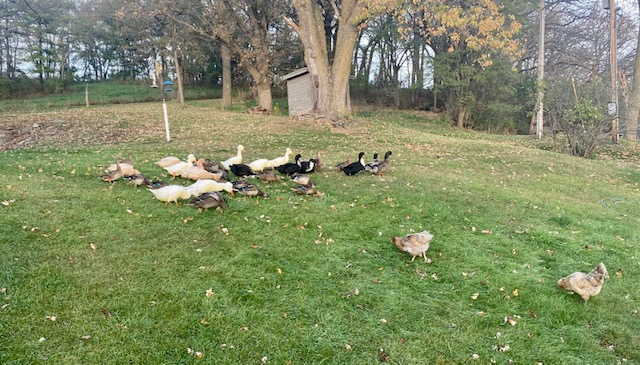
Duck update – Missing the old, balding, poofy one… down to 6 poofs. And it’s hard to say if the old one died or got snatched. The five black and white ones are still there, the 4 cream colored ones are still there, and I have a hard time getting a good count on the brown ones; 20 or 21 but they’re still there.
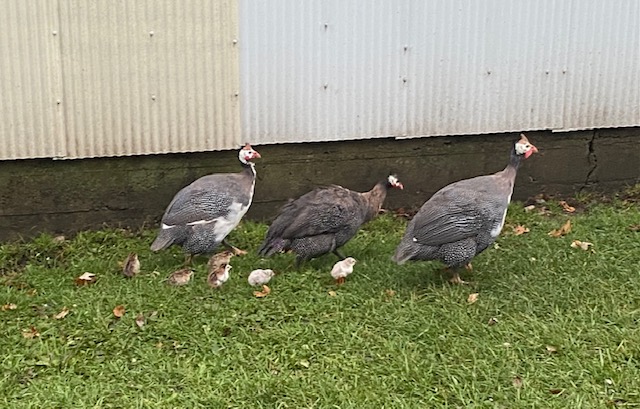
We have 3 guinea fowl on the farm. They’re terrible mothers; lay a nest of 20 eggs and get up and walk away after the first 6 or 8 hatch. Usually a cold rainy day in October. Last week one day, first cold night with freezing temps, there she is with 6 babies.
The three seem to be cooperative parenting. And the 6 babies have made it a week now. But don’t hold your breath. We could catch them and move them inside… but that takes a while and it’s more chores and I just can’t take it on right now. We had been taking about getting more guineas next summer anyway.
I was at the doctor this week; nothing serious, just ‘old man skin’ and had a couple spots frozen off. Lost my only wisdom spot… guess I wasn’t using it enough.
I mentioned the other day I’ve had music of ‘Pink Floyd in my head all week. Still there. I’ve been listening to a lot of that. Loud. It’s better that way.
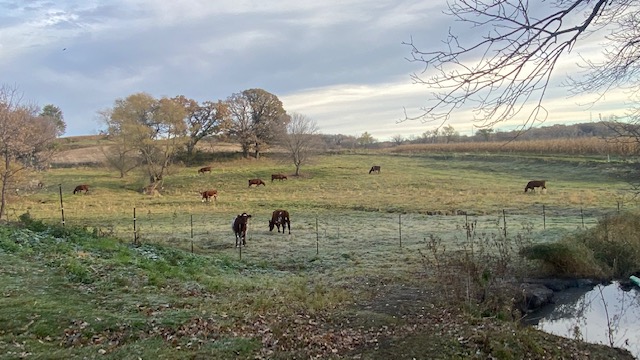
Here’s some of the neighbor’s cows at our place.
Did you ever think you were going to get old? How does it compare to what you imagined as a kid?
Today is the anniversary of the Wall Street Crash in 1929 that started the Great Depression. My great grandmother had invested in some Texas oil company stock and lost a good bit of money. My parents would often talk about the closing of the banks. It was a huge disaster for them and really influenced the trajectory of their lives.
I have never been a great fan of disaster movies. I just don’t like the suspense. I think the worst one I ever saw was a fairly modern one in which the magnetic poles changed position, and the North Pole was somewhere around Minneapolis, and all the oceans flooded dry land, exposing new dry land, and anyone who survived was on this one ship which contained survivors and all that remained of Western Civilization. I have no idea how or why I came to be watching it. I was most tolerant of disaster movies when I was in high school. The Poseidon Adventure comes to mind.
What are your favorite or least favorite disaster movies? Which movies to do think are real disasters? How did your family fare in the Great Depression?Why do you think that disasters are such popular fodder for entertainment?
My van was in the shop last week for new brake pads. My office building is a mile down the same road as the dealership, so it should have been a straight shot for the driver of the courtesy car to get me and take me back to the dealership to retrieve the van when it was finished. There has been extensive construction work on the road, however, so he had to take me the winding, back way through a new housing development behind my work and the dealership.
The driver was younger, a mid-30’s guy who doubles as a mechanic, and he told me that he grew up in an older section of houses also right behind my work. He even pointed out his parents’ home. He remembered when the area of the new development was just tree shelter belts and bare plains. He reminisced with great wistfulness about the trees that were no longer there and all the “forts” he and the kids in the neighborhood would make among the trees and how they would raid the other forts and all the fun they had.
This put in mind all the forts my cousins and I would try to erect in and around the trees in the groves on their farms, trying to nail boards together to make structures and how exciting it was to sit in them. (Here, they are shelter belts. In Minnesota, they are groves).
Children love forts, even if they consist of blankets thrown over the sides of end tables. I remember my mother throwing a blanket over the sides of my crib, and how oddly satisfying that was. I couldn’t have been more than 3. Our children, too, loved blanket forts, and any small enclosure they could erect and escape into. We even had a book about innovative ways to make forts.
What are your memories of forts? Why do you think children like forts? Did you or anyone you know ever have a tree house? Any good tree climbing stories?
Writing therapy progress notes and psychological evaluations is tedious work for me. I need music while I write. In fact, I have music playing in my office unless I have a client in the office with me. I usually listen to classical music, although lately I have streamed Radio Heartland, too. A counselor friend of my son insists that classic honky-tonk music is the best accompaniment for him to write therapy progress notes. Husband needs dead silence or else he gets distracted when he writes.
Many years ago, the office administration staff at my agency were delighted when our Regional Director at the time phoned to let staff know where he was on a drive back from Fargo, and then forget to turn off his cell phone. He proceeded to sing (well, bellow) along to a rather raucous country western song on the radio about true love. The administrative secretary put it on speaker phone so all the staff could hear him. When they teased him about it, he said “Well, I really missed my wife”.
We listen to classical music or the XM Radio 40’s channel or jazz channels when we drive together. Lately I have revisited CD’s by Solas, Salsa Celtica, and Le Vent du Nord on my way to work. Something about the right music makes me really ready to start my day.
I have a long list of CD’s I intend to spoil myself with for Christmas, mostly classical recordings. I am particularly interested in recordings of music by Ludovico Einaudi, a modern Italian composer. Check him out if you aren’t familiar with his work.
What music helps you think and get things done? What are some new recordings you have discovered? What music annoys you?What music makes you sentimental?
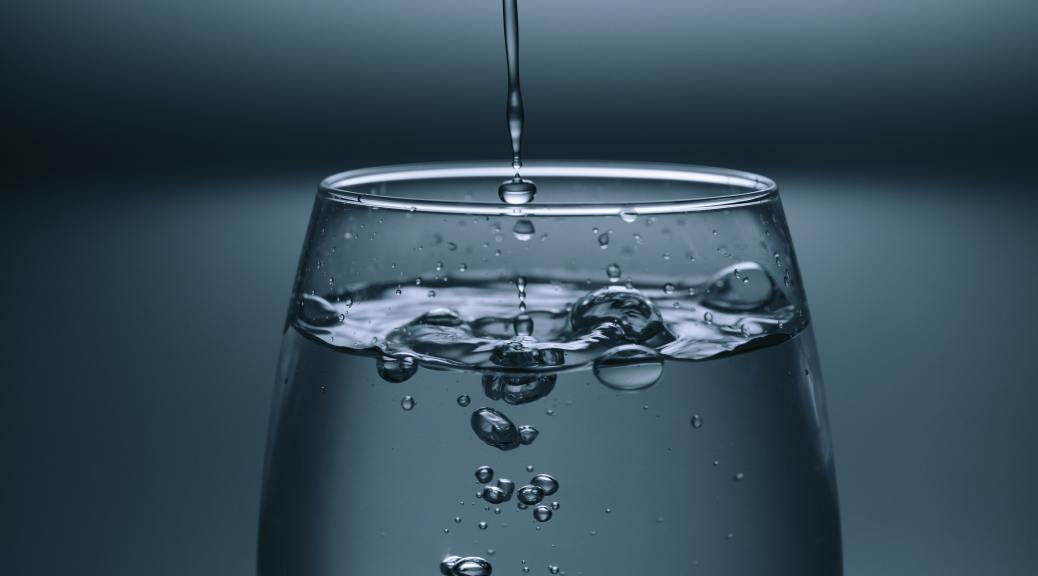
A week ago I was hospitalized in an obscure room of Saint Paul’s United Hospital. My doctors were divided. Some wanted me to avoid all liquids. Some wanted to hydrate me immediately. Hours went by with all sorts of tests, and meanwhile I kept getting more desperately thirsty. I couldn’t talk because my tongue kept getting stuck to the roof of my dehydrated mouth. And then the decision came down: I could drink as much as I wanted. They serve cold water in paper cups in that hospital, with most of the space filled up with soft, easily crunched ice. I went on a crushed ice binge that was so joyful I almost wept as I chewed.
We should never take good drinking water for granted. The Saint Paul city water I get from the tap has won prizes for palatability. I keep a jug of it in the fridge, and it is a treat. Great water is the start of great coffee, which I appreciate. When I moved to Happy Valley, a suburb of Portland, the local water reeked of chlorine. I couldn’t bear drinking it, and coffee made from that water was grotesque. I had to install a filtering system before I could tolerate that water.
I was guilty of bad planning once, shortly after we moved to Oregon. Some family and friends decided on a whim to hike up a trail to a mountain peak overlooking Crater Lake. The trail was not short, and it ascended rapidly. We all began suffering from thirst in the 90-degree air. We finally hit the crest and could enjoy the view, but we all were in distress because we were so thirsty. Bright spring water bubbled out of the hillside. Water never looked so delicious, and yet we knew the prettiest spring water could be filled with giaradiasis, the dreaded “beaver fever” bug. As I recall, half of us were strong enough to resist the most tempting water we had ever seen. And in the end—which with giardiasis usually involves both ends of the body—nobody who drank that water got sick.
I was even thirstier than that once. I made a plan to “through-hike” the Superior Hiking Trail. Through-hiking means you start at one end and walk to the other end of a big trail. A day after hiking south from Grand Marais turned bad when I got confused by the trails. The Superior Hiking Trail itself is not terribly large or obvious, and on that afternoon I got lost when a bunch of smaller trails intersected with the SHT itself. It was August, blazing hot, and all streams along the trail were low. I knew I was in trouble when I began hearing traffic from Highway 61, which should have been well below me but was not. And then I found myself hiking the shoreline of the big lake.
Superior is so big and clean it is safe to drink in most places. Those places do not include shorelines, but I was not in a position to be picky. Out of my mind with thirst, I threw my body along the shore, plunged my head in the lake and began inhaling. I was there a long time. When I got up it seemed to me the lake had lowered a few inches, but I couldn’t be sure.
On the first BWCA trip I took with my father, we camped a week on a Lake called Bichu. It is a pretty place. But our campground did not give us access to water except right near shore, and my dad discovered that the lake water by the shore was absolutely filled with wriggling aquatic life. He solved the problem by dumping in enough grape Kool Aid so we couldn’t see the bugs we were drinking. That trip taught me several lessons about my father’s outdoor camping limits, but none were more memorable than the water that we drank, water surging with life if you allowed yourself to look.
Have you ever had especially good or bad water? How did you cope? What do you do now for drinking water? Ever get really, really, really thirsty? Have you found a way to justify drinking water from single-use plastic bottles?
Husband and I were struck by how quiet it was as we travelled to South Dakota on Saturday. It is a remote area, so there never is much traffic, but it seemed as though there was much less than normal. We saw herds of cattle and sheep, a few mule deer, and some eagles, but people were absent. Wheat had been harvested, and hay was put up. There were a few fields of unharvested sunflowers. There wasn’t much activity at any of the farmsteads that were close enough to the road for us to see. It was as though everyone was inside taking it easy.
Husband commented that the weeks between the middle of October until Thanksgiving in November is his favorite time of year. Everything seems to slow down. There isn’t much snow, the garden is done, and we have time to sit and breathe after a busy summer and fall. Yesterday I was able to take stock of my Christmas baking supplies (I needed glacéed citron, orange peel, lemon peel, and cherries, as well as sliced almonds for Stollen). As a child, I suppose that December was my favorite month because of Christmas, but now I appreciate a time that I can stay home and be a little more still. We have decided to not put up a Christmas tree this year, as we will not have any company and are spending Christmas in South Dakota with our son and his family. That will make for a more peaceful December.
What are your favorite times of year?Got any holiday plans in the works?
Guess the heating degree days are over… This is kinda late for the first real frost or freeze. I had to break some ice out of the chickens water buckets this morning. These first few temporary cold mornings I don’t get too concerned about. I unhooked some hoses and pulled the pressure washer into the garage and wrapped a towel around the pump. But I haven’t turned on the house heat yet. How come it’s frequently a full moon when we get the coldest temperatures? I think there’s an Indian summer coming yet. Or did we already have that?
First things first: Duck update. It makes me smile when I walk outside in the morning and call “Come on Ducks. Chickens! Chickens! Ducks!” and they all quack and waddle over to the barn for their morning corn. The dogs are running around and having fun and that interrupts the duck’s processional and they backtrack once or twice before the dogs get in the feed room to catch sparrows and the ducks can finally get up to the corn. I spread out two buckets of corn: one in the grass and one on the gravel. Ducks need water while they eat you know. They eat a bunch, go get a drink, then back to eat more. Chickens don’t gobble so much up at once…they just peck at it. Ducks gobble. I am down two of the poofy headed ones… used to be 8 new ones and the older, balding poofy headed duck. Now there’s only 7 including the older poof. Coyotes I suspect. The white ones are easier to spot in the dark I guess.
Soybeans are out! Yay! Started last Saturday afternoon about 3:00 on my rented ground. I stopped in about 5:00 and they were done over there and had moved to our home farm. Moving fields is a pretty big deal. There’s the combine, the head on the cart, the semi, and the tractor and grain cart. Plus, whatever pick-up is left at whichever field as they move stuff.
Grain carts have become invaluable these days. As with most things, it was in the interest of production and time that these came in. The cart can run in the field and the combine can unload while it’s still harvesting. Then the cart can run back to the truck and unload. That keeps the truck on the road – or at least out of a muddy field where it would get stuck. The carts keep getting bigger, just like everything. It all keeps getting bigger.
My soybeans did OK for quality. They were dry enough and test weight (the weight of a bushel) was good. Yield wasn’t the best, only averaging about 37 bushels / acre. I was hoping 40’s. Last year I got 51 bu / acre. But this rented field really doesn’t grow good soybeans and it really pulls my average down. I’m having that field ‘Grid Sampled’ for soil testing, meaning the Co-op will pull a handful of samples every 2 acres rather than just 1 or 2 samples on the 10-acre field. I’m guessing it will need lime applied to get the soil pH in line. And since they apply lime with an air spreader, they can adjust the rate as needed which, theoretically, will pay for the cost of grid sampling. Remember I planted these beans in 20” rows just for fun? Hard to say if that made a difference or not. If I take out the lousy production of the rented field my average goes up into the 40’s. And with the dry hot weather this year, I’m grateful we got any crop.
Price for the soybeans was good; $11.71 / bushel was my price. Course two days later it was $11.83 at the local elevator. Hauling it to the river gets a better price, but also costs more for hauling. And this late in the soybean season, the river doesn’t always have room for them. And since this was a Sunday, I’m not sure the river elevator even would have taken it. And since I’m not driving the truck, it’s kinda the neighbors call whether they have time to run them to the river.
So 37 bushels (one acre) x $11.71 = $433 / acre gross. Seed cost $55/acre, fertilizer $45/acre, spraying pre-emergence grass and post emerge broadleaves is $75/acre, combining is $39/acre, grain cart $5/acre, hauling is 0.13/bushel, plus some rent on the one field (I won’t mention the rent cost; that can be pretty competitive in some markets. It might be $200 – $350/acre) I’m lucky I only pay rent on the one field. Diesel fuel, tractor use, my time added in (somewhat variable)… we’re somewhere north of $250/acre for expenses not counting rent. Net, then, is $183/ acre. Losing money on the rented ground. So you can see why we want the best production we can get and I get so grumpy about how much crops the deer and turkeys are eating. Remember, this is just my farm. Your mileage may vary.
I’m guesstimating corn yields and production as I estimate paying off year end bills. Corn is a little more expensive to grow but yields more / acre too. And this year, with the poor stand, it’s anyone’s guess what production will be. Costs for next years crops is way up over this year. Fertilizer and chemicals have practically doubled.
There’s a lot of corn standing yet in the neighborhood. I can hear a neighbor’s corn dryer fans running when I stand outside at night. Sounds of the season. In a few more weeks it will be surprisingly quiet some night. Just another reminder of the cycle of the seasons.
Photos:
Notice the broken kernels. That’s considered ‘Foreign material’ and we get docked for that. Soybeans are kinda delicate. They don’t like rough handling or they crack.
The neighbors like their equipment red. Long as it gets the job done. Here’s the combine, Humphrey, and the bean head on the cart. (The head is 35’ wide; they take it off to travel on the highway).
The grain cart in this picture is holding 805 bushels. At 57 lbs / bushel that’s 45,885 lbs. That’s why they don’t often drive into the field with a loaded truck.
Does this all make sense? Any questions? What’s the biggest thing you’ve ever driven? Or ridden in? Anyone been in a blimp?
I love Halloween. Admittedly I love lots of holidays and special occasions. (I sent cards to a few people on National Eat a Peach Day this year.)
We used to decorate a lot more but the current terrorist tabby and devil dog make indoor décor a little difficult. For many years YA and had ghosts playing ring-a-round the rosy out front and some years we’ve had spider webs adorning the front evergreen. I always do a cornstalk and usually a few days before Halloween, I get pumpkins (if I get them sooner, the squirrels just eat them).
Then on the night of Halloween I put out my luminaries. I made these when YA was little (and I couldn’t afford to buy décor). Mandarin orange tin cans painted orange and then stamped with pumpkins and black cats and eerie clouds – then I punched holes in them with a hammer and nail. (I filled them with water and frozen them first – made it much easier to punch the holes.)
I love seeing trick-or-treaters and when YA was little, we used to have quite a number. As the years went by, it’s gotten less and less. From what I’ve read, this is common everywhere, not just my street. Of course, pandemic threw a monkey wrench into trick-or-treating. Last year I put candies into little bags with orange ribbon 3 weeks before Halloween, wore a mask and held the bowl out as far as I could. I only have to do this three times; only four trick-or-treaters last year. It was very sad.
When I saw the “Candy Map” app on a Nextdoor thread, I asked YA about it. You put your address in indicating you’ll be open for business on Halloween night so all the little zombies and princesses can find you. I don’t know if it will bring more costumes to the door but we decided to give it a try. I went ahead and filled little bags again this year – I did twelve. I’d love it if I have to quickly fill more bags but even if I give out twelve, it will be three times more than last year.







 Trail Baboon