How Do You Get to Carnegie Hall?

Today’s post comes from Steve Grooms.

When I was six my parents arranged for the kids to meet a piano teacher. My sister was deemed to have talent, so she entered a program of piano lessons. The meeting must not have gone well for me. Afterward my father explained that I was musically impaired. His exact words were, “You couldn’t carry a tune in a bucket.” I had no reason to doubt him.

We were obliged to sing in my grade school, especially just before the holidays, when we performed a concert of Christmas carols. I dutifully performed, only I decided there was no reason to spoil the good singing of others, so I lip-synced the carols. Like Milli Vanilli, I got caught. That led to an epic showdown with my teacher, Miss Steele, the low point of my educational career.

While I couldn’t sing or play an instrument, I had ears. I thrilled to the popular music of my youth. I amassed a sizable record collection. In college I discovered classical music. Guys in my dorm introduced me to folk music. Occasionally I fantasized about making music, but mostly I accepted my fate as someone for whom that was impossible. Sometimes, to tell the truth, that seemed a blessing. I often woke up early in the morning to the sound of my sister plonking away on the piano when she would rather have been in bed, but piano practice was mandatory for her for years.

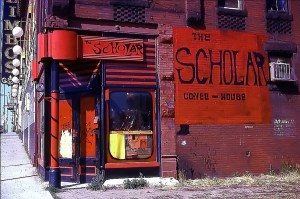
In the first week of graduate school I walked to the Scholar coffeehouse on the West Bank. The first act I caught—Koerner, Ray and Glover—amazed me. A day later I went back. The performer was a kid from Saint Cloud State who played 12-string guitar. The torrent of music coming from Leo Kottke’s guitar almost blew me off my stool. I’d never heard music remotely like that before, and it was one of the most thrilling events of my young life. I began hanging out at the Scholar, walking through blizzards if necessary in order to attend every gig Leo played.
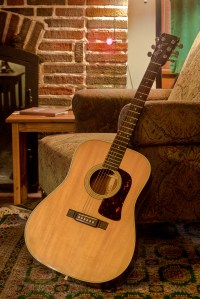
It was inevitable: one day I bought a guitar, a classical model with nylon strings. At first I was delighted to be able to make any kind of music; just strumming a C chord made me giddy. I moved on to finger-picking, emulating my coffeehouse heroes. I grabbed every spare moment to practice. I took guitar lessons, starting with Carter family tunes and moving toward John Fahey compositions. Slowly, very slowly, I got better. I bought a steel-stringed folk guitar. Then—you knew this was coming—I got a 12-string. (I’d love to get back all the time I wasted trying to get that danged thing in tune.) And I practiced, practiced, practiced.

Alas, all those years when I did not sing or play an instrument had set limits on what I could accomplish as a musician. My brain and fingers could never coordinate well enough to enable me to master difficult material. I could do cheesy imitations of some Kotte or Fahey pieces, and that felt like a miracle. But I slurred many notes and muffed others. I had to cheat by simplifying the arrangements because my technique was so sloppy. After getting better month by month, I hit a wall I could not get past it. And I remained stuck there for years.

I finally realized the most graceful thing would be to accept my fate and simply enjoy the limited music I could make. While I was never going to play well, I was delighted to play at all. Then arthritis arrived, and I could no longer even play badly.

My performance career with the guitar now feels like some doomed romances from my past, romances that were fabulous in some ways but which failed. Sometimes things don’t work out, even if you passionately hope otherwise. I’m lucky to have those memories now and I’m sure I am a better listener than I could be before playing the guitar.
OLYMPUS DIGITAL CAMERA

Do you sing or play an instrument? What has that meant to you?

Chance Meetings

We always seem to meet interesting people when we travel, and this trip is no exception. We arrived late in the evening into the Albuquerque airport and had to wait for our prearranged shuttle to take us to Santa Fe.  We waited with a fellow shuttle rider named Abdul. He was an Egyptian man, about 65 years old,  who had just arrived in Albuquerque from Alexandria via  Abu Dhabi and Los Angeles. He was very tall, well over 6 feet, and a professional chef who had worked for years in Santa Fe and was coming back to spend time in a cooperative community of scientists and artists outside of the town.  He gave us some sage advice on good restaurants to try, and which hyped ones to avoid.  He described preparing food as being just like composing and conducting music. We talked about how he manages his diabetes and how he loved teaching classes in Mediterranean cooking. I regret not being able to eat dishes he prepared.

Our second interesting meeting was with a man named Steven, a white man who owned a dusty shop chock full of indigenous art prints and native  ledger art.  He was in his late 60’s and was whittling bear root, an expectorant, to make into tea to help clear his chest from an attack of Spring allergies.  He and I had a serious talk on why the Kachina figure I have in our living room gives me nightmares (he said I had to change my way of living). His art prints were in huge stacks that would take hours to go through.  Husband plans to go back for more conversation and to look at more prints before we leave.

Tell about interesting people you have met on your travels.

Overwhelmed

Today we toured the New Mexico Museum of International Folk Art. The main exhibit is in the room the size of a basketball court. It is filled with part of the Girard Collection, the life time acquisition of Alexander Girard and his wife. Mr. Girard was a designer who worked for Herman Miller.  The room we toured had 10,000 pieces of folk art, toys, miniatures, and textiles. It is only 10% of the entire collection, which the museum has stored somewhere. Mr. Girard arranged the collection display.  There are textiles on the walls, and cases of incredible miniatures and folk art figures from about 100 countries.  It is arranged to demonstrate the universality of folk images and folk life.  We were so overwhelmed with the sheer visual density and the colors and places of origin crammed into interconnected display cases that we could only view a small part of it.  It is not something you can ingest in one visit. Every display was full of meaning. If you get a chance, look up Girard Collection for some photos of this overwhelming collection.

 When have you been overwhelmed by art? What art is accessible and what art is difficult for you to appreciate?

Where in the World are Renee and Chris

I am borrowing shamelessly from VS by posing this riddle for Baboons to consider.

We are not in ND.  We are at an elevation of 6200 ft., but the only mountains are far in the distance. The air wherever we walk  is filled with the smell of roasting meat and vegetables, as well as burning herbs and wood smoke.  It is  center of art and culture. Nearby there are 4000 to 5000 visiting archeologists. It has been a center of government for centuries.

Where do you think we are?

Libraries – A Love Fest

Yesterday was the anniversary of the opening of the first free public library, the Peterborough Town Library in 1833. The decision to purchase books and open a tax-funded library happened at the Town meeting and for the first sixty years, the books were housed in the general store.  In 1893 they were moved to the current location and there have been two expansions since then.

Here are a few fun library quotes:

“Well-run libraries are filled with people because what a good library offers cannot be easily found elsewhere: an indoor public space in which you do not have to buy anything in order to stay.”  Zadie Smith

“The only thing that you absolutely have to know, is the location of the library.” Albert Einstein

“Libraries: The medicine chest of the soul.” Library at Thebes, inscription over the door

“My two favorite things in life are libraries and bicycles. They both move people forward without wasting anything. The perfect day: riding a bike to the library.” Peter Golkin

“I have always imaged that Paradise will be a kind of library.” Jorge Luis Borges

I’m a complete library junkie. One of the biggest selling points when I bought my house was that it was a block and a half from the Washburn Library.  On the average week I am there twice.  I know the hours by heart, am friendly with the librarians.  I even have my library card number memorized.  Twice I’ve had the opportunity to spend an afternoon in the Central downtown library in the upstairs reading rooms – times when I wanted to read resource material that they don’t allow you to check-out.  It was warm and wonderful; so relaxing that I wasn’t sure I wanted to leave at the end of the day.

Tell me about your favorite library memory?


Cruel April

I just read the NOAA weather map for later this week. Oh my! Minnesota Baboons may get a lot of snow! Son and DIL could get 20 inches in Brookings.

It has warmed up sufficiently here that people are jumping into yard work, cleaning flower beds and mowing lawns (which they oughtn’t do yet as it is too early).  Husband and I are waiting to do any yard work until we return from a trip next Sunday.  We first plan to prepare the garden for pea, lettuce, and spinach seeds, which we will plant later in April.  Husband tilled last fall, so we won’t need to do that now. The tomato and pepper seedlings are coming along under the grow lights, Tulips are up and crocuses are blooming.  We have pruning and flower bed cleaning to do, too.

I always find April a chancy month to garden. One April many years ago I was awaiting the first blooming of some tulips I had planted in the fall, when, on April 28, we got 18 inches of heavy wet snow. The tulips had flower buds just ready to open, and there they were, frozen solid just above the snow line. I had to wait another year to see them bloom.   April is the cruelest month. Sometimes March is just as bad, though.

What are your favorite and least favorite months? Any favorite T.S. Elliot poems? 


Quantity Cooking

On Saturday night I finished baking the last of the 10 dozen sweet rolls for our hand bell choir’s Easter breakfast. We plan to serve sweet rolls and egg bakes to our congregation on Easter Sunday as the first fundraiser for our trip to New York in November when we play at Carnegie Hall.  They are quite large, and can be cut in two for an astounding number of rolls.  The other bell choir members are supplying the egg bakes.

The rolls are in our freezers and just need to be thawed and iced on Easter.  I will set them out to thaw in the church kitchen on Saturday when we rehearse with the brass quintet that is accompanying us on one of our pieces. We have two ovens in the church kitchen and we can have four egg bakes cooking and four keeping hot all at the same time.  It will take some coordination as we play at both the 9:00 and 10:30 services and will need to bake and serve and play bells, since people will be eating from 8:30 until 10:30.  I think we will be exiting and entering the sanctuary all throughout the services in between playing.  I just love doing things like this.

In true Lutheran Church Basement Ladies fashion, members of the funeral service committee have volunteered to help out.  It will be an exciting day.

What is the largest meal you ever helped prepare? What would you serve a crowd? 

I’m Melting!

For most of my life I have felt too tall. I reached 5’9″ in Grade 6.  I felt like a giantess, even though I was one of the shorter women in my extended family. My mother was 5’11 and her mother was 6 feet tall.

Husband and I remodeled our kitchen about 15 years ago, and the contractor was concerned when we replaced the soffits with cupboards extending to the ceiling that it might detract from selling the house in the future.  “Not everyone is as tall as you and your husband” he warned. “Some people could have trouble reaching those top shelves”.

Well, “some people” now includes me. I am 1.5 inches shorter than I was 15 years ago and the top shelves are a real stretch.  For the first time I regret losing some of my height.  That inch and a half has made quite a difference in my reach. My doctor isn’t too concerned. I have a good diet rich in calcium.  I get exercise. I often call on husband to get down the things I need. I make good use of tongs and grabbers. I haven’t yet resorted to a kitchen stool.  For some reason, a Joni Mitchell song keeps going through my head whenever I have to get something down from the top shelves in the kitchen:

What didn’t you know you had until it was gone? Ever done a remodel you regretted? What is your favorite Joni Mitchell song?

April Fool

One of my children is very adept at pranking me on April 1, usually with plausible texts about rash decisions or changes in career that I fall for every time. This year I turned the tables and it was satisfying, albeit subtle.

On Monday morning I sent the following text :

In honor of today I thought of sending you a text asking you to please not play an April Fools trick since my newly diagnosed heart condition couldn’t handle it, but I thought that would be a mean thing to do, so I didn’t.

I got the following response:

Hahahahaha“.

Then, after a few seconds I got the following text:

So, no heart condition I’m assuming?”

I assured the recipient (someone who is always concerned about  my health) that no, there was no heart condition, but thought to myself “Yes!! I got them!!!!”

Tell about neat tricks you played on someone or tricks someone played on you.

Big Splash

We live very near to an important geologic area called the Hell Creek Formation.  It covers parts of western North Dakota, Western South Dakota, Montana, and Wyoming. It contains some of the richest fossil beds from the Cretaceous period, the era that ended with the death of the dinosaurs.

Recently, two paleontologists published a paper in the Proceedings of the National Academy of Sciences  titled “A seismically induced onshore surge deposit at the KPg boundary, North Dakota”,  outlining just what happened in what is now North Dakota in the minutes following the crash of an asteroid in Mexico’s Yucatan Peninsula. This was the asteroid that is thought to have killed all the dinosaurs.

Based on what they found in a grey/ black layer near the top of a butte on a ranch near Bowman, ND, about 80 miles from my town, they estimate that in minutes after the asteroid crashed in Yucatan, seismic waves of water and molten rocks smashed into what is now the Hell Creek Formation.  Molten glass particles filled the air, choking any living thing.  Fish (salt water and fresh water), trees, rocks, dinosaurs, and beads of molten glass were swept up into a jumbled mass, preserved in the mud and debris for the modern paleontologists to find.  The fish fossils in the KPg boundary dig  were so well preserved that they could see that their mouths were open, gasping for air.  It triggered fires within 1500 miles of the impact and formed a plume of fire that rose halfway to the Moon.  They estimate 70% of the world’s forests burned.  Almost all life on the planet died.

Well, I find that pretty awe inspiring and amazing.  I like it when scientists can make things real and exciting.  Yucatan is a long way from where I live. That must have made a really big splash when it hit.

What has amazed you recently? Would you want to be a paleontologist? Did you ever do cannon balls?