Sam McGee, Weather Denier

Header Photo “Snowman on frozen lake” by Petritap – Own work. Licensed under CC BY-SA 3.0 via Commons

Of course there are noisy climate change deniers who refuse to accept scientific research because it conflicts with their closely held political beliefs.

That’s almost understandable.

But what I can’t comprehend is the much more commonplace lunacy of daily weather denial.

A good winter storm reveals it, especially in more tightly packed urban locations. Some people downtown believe they don’t have to put on anything special to be outside because they’re only going to be exposed for a short time.

And besides, heavy clothes worn in layers just don’t look that nice. But I think inadequately dressed office workers look silly shivering as they wait to cross the street.

When I mentioned this pet peeve of mine to Trail Baboon’s sing-song poet laureate Tyler Schuyler Wyler, he said he also has a certain peeve that pesters him – presumptuous people who rip off the work of other poets merely to get a laugh.

And right after saying that, he presented me with his latest opus, which included an insincere note of apology to Robert W. Service and The Cremation of Sam McGee.

There are fashions worn in a winter storm
that would otherwise seem gauche.
Everybody knows layering your clothes
is a common sense approach.
Even dilletantes in fine restaurants
will adjust to a degree.
For a little while they’ll abandon style
if their name’s not Sam McGee.

All Sam’s garb was sheer and he wouldn’t hear
of a parka or a fleece.
If a shirt or gown had an ounce of down
his frustration would increase.
“It feels very wrong and takes far too long
to suit up for cold or sleet.”
“And besides,” he’d wink, “there’s no risk, I think.”
“I’m just gonna cross the street.”

Right across the way sat a mad buffet
called “The Sacrificial Goat.”
It was hip and loud and it drew a crowd
that opposed the winter coat.
They disdained its buik and they’d tend to sulk
if harsh weather was foretold.
Putting on their things, they’d assume it’s Spring.
‘Cause it’s cool to not seem cold.

So off Sam would skirt in a polo shirt
with Bermuda shorts below
Into two degrees with his naked knees
and flip-flops, to face the snow.
“Winter air feels fresh on my naked flesh!”
he declared. “It’s strength of will.”
“And what’s more,” he spat, “I don’t need a hat,”
as he stepped into the chill.

Quite against Sam’s plan the snowflakes began
to collect between his toes.
And those flopping flips, ‘midst their many slips
became rigid when they froze.
Trying to be brave, Sam’s blue eyes turned grave.
As streetward, on he pressed.
At the crosswalk light, his mouth thin and tight
He tried not to seem distressed.

In the urban grind one will often find
that delay is the routine.
And slow went the time at that corner sign
with Sam blocked by traffic’s stream.
Then a passing truck’s plume of slushy muck
sealed the frosty fate Sam faced.
For his flops got iced and nothing sufficed
to dislodge a man encased.

With each frigid blast nature built a cast
that enveloped Sam, complete.
It was clear and slick and six inches thick
from his head down to his feet.
Looking through the shell one could clearly tell
that his face showed some regret.
A wardrobe reform could have kept him warm.
but he’s not been thawed out yet.

In December’s pale, teachers tell the tale
of the legend Sam became
Heading off to play on a chilly day
All the children learn his name.
Don’t go out of doors with just summer drawers
against winter’s nasty breeze.
you could be marooned in a white cocoon
like the ice man, Sam Mcgee.


Are you (or have you ever been) a weather denier?

Chance Encounters

Header image – Washer Women by Barrington Watson 1966 via Wikiart

Today’s post comes from Plain Jane

When I think of the people who have had a lasting impact on my life, most of them are folks who were, or are, a steady presence in my everyday existence.

On several occasions, however, my life was impacted in a major way by a chance meeting, a short interlude. I have written about two of them, briefly, before on this blog: Bob Dean and Barry Watson. Both Bob and Barry had a far greater influence on my life than the short time we spent together would seem to justify, and for very different reasons.

I met Barry at a small cafe in Basel my roommate, Annette, and I often visited.   I don’t recall the details of why or how Barry and I started talking, but we did. By the time Annette and I left that evening, I had learned that he was a painter who had been studying a couple of years in London and Amsterdam, and that he was on his way to Madrid for a few months before returning to his native Kingston, Jamaica. As Annette and I were getting ready to leave, Barry asked if I’d be interested in meeting him the following afternoon; he wanted to visit the Basel Art Museum and show me some of his favorite works.  I said why not, and agreed to meet him on a bridge close to where I lived and worked, and not far from the museum.

I had never before had a conversation with a black person, so I was both fascinated and a little aloof; I think Barry sensed it. Our first afternoon at the museum was spent looking at the remarkable Klee collection for which that museum is renowned.  Barry had a high regard for Klee’s work and enthused about its merits to this complete novice.  I’m ashamed to admit it, but I had never before set foot in an art museum, and had not had prior exposure to modern art; I was mesmerized.

Afterward we had a bite to eat and talked for hours.  When Barry walked me home that evening he asked me if I would like to see some of his paintings. Promptly on high alert, I responded “not tonight, maybe some other time.”  “OK,” he said,” how about tomorrow afternoon?”  And so our next rendezvous was set.

When I met Barry the following day, he greeted me with a bear hug and a huge grin.  “You thought you were really clever last night when I asked if you wanted to see some of my paintings, didn’t you?” he asked.  Without waiting for a response, he continued, “I was really the clever one; I had the slides of my paintings in my pocket the whole time, and could have shown them to you anywhere. But I wanted to see you again, so I didn’t tell you. You thought I was trying to lure you to my room, didn’t you?” He was right, I admitted it, and we both had a good laugh.  After that I relaxed. I realized that we were kindred spirits who enjoyed each others company, and that I could learn a great deal from him in the few days he had left in Basel.

Barry and I met two more times, and on both occasions spent hours at the art museum. He introduced me to Picasso, Miro, Chagall, and the museums impressive collection of works of the Holbein family.

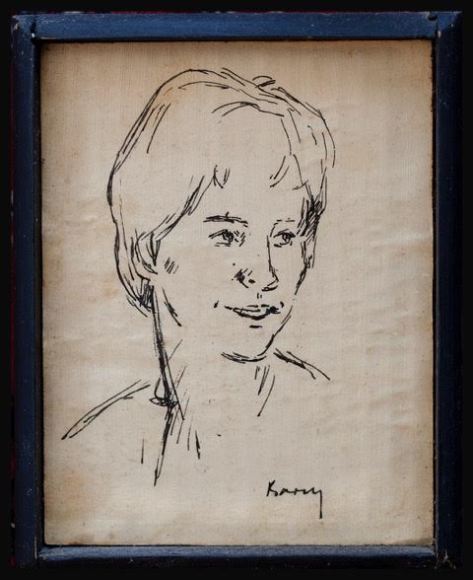
Barry Watson's portrait of PJ
Barry Watson’s portrait of PJ

As a parting gift, Barry sketched a portrait of me in pen and ink.  He signed it: Barry.  He didn’t sign his last name because he planned on becoming famous, he said.  He didn’t want me to sell this keepsake, but to keep it as a reminder of the time we had spent together.

When we parted, we made no attempt to stay in touch.

Seven years later, as a freshman at SIU, I came to know several students from Kingston, Jamaica.  I asked them if they had heard of a painter named Barry Watson. To my surprise, they said they had.  He had become a quite prominent figure in the Jamaican art world.  They told me he had become the director of the Kingston Art Museum.  This was in 1968, before the internet made access to all kinds of information possible, so I had no way of verifying whether or not this information was accurate.

Fast forward to sometime last year when a blog on the Trail Baboon jogged my memory, I decided to see if I could find out what had become of Barry.  I was astonished to discover that he had, indeed, become quite the celebrity in Jamaican art circles, although he had not been director of the Kingston Art Museum. I sent him a message asking whether he remembered our encounter so many years ago.  He did, and must have shared our story with his family.  I was saddened when on Wednesday morning I received the message that Barry had passed away the previous evening at 10 PM. He had just turned 85. The volume of his work is impressive, and the quality of his work is remarkable; check it out.

Thanks, Barry, for introducing me to art, and R.I.P. old friend.

Here’s a link to an obituary for Barrington Watson:

And one that shows some of his work:

When or how has a chance encounter impacted your life?

First Time Foods

Today’s post comes from Cynthia in Mahtowa

Going through some old letters I had sent to my mother from my first teaching job in Port Angeles, Washington in 1964, I found a paragraph describing all the “new” foods I was eating. Foods I had never heard of in my small northeastern Minnesota hometown such as artichokes, zucchini, Swiss chard, eggplant, turnips, parsnips. (I led a very sheltered food life.)

I remember that first taste of an artichoke – a more worldly friend teaching me how to tear off a leaf, dip it in butter and scrape off the soft inner part with my lower teeth. How exotic. Later that friend’s aunt taught me to use mayonnaise with dry vermouth and garlic for dipping — still my preference.

Washington state firsts: Dungeness crab. Fresh salmon. Fresh apricots. Carrot cake.

So this got me to thinking of all the “exotic” foods that I was introduced to since then.   Five months in Switzerland, four of them living above and eating in a bakery/tea room — cheese fondue with bread dipped in kirsch (cherry brandy), lamb curry, gibfeli (croissants), café au lait, escargot, tripe soup. I have fond memories of all but the tripe soup.

On the small Italian ship I took to Europe in 1965 I had tongue and my first cappuccino. When we landed In England I had coffee with Demerara (brown) sugar. Did I try steak and kidney pie? I might have. But that really hot Indian curry in a English restaurant made me feel guilty for not eating it all because of the hungry children of India.

In Greece I watched a man slam an octopus repeatedly on the rocks. Was he trying to kill it or tenderize it? But I did not eat octopus until many years later and then in a sushi restaurant. (A friend traveling in the Orient had octopus so fresh the sucker stuck to the top of his mouth. But that may have been the least exotic thing he ate on that trip…was it duck bills or duck feet?) Squid entered my eating repertoire much later, though the first time I had it I was unnerved by the little tentacles.

When I was a child my father paid me to eat asparagus – or, tried to. He had tricked me into eating horseradish when I was five. How could I trust him to steer me right? Asparagus cooked to a gray mush? Then in 1972 I paid $2.50 for three spears of properly cooked white asparagus in a San Francisco restaurant. There I also had a “bird with a long beak” for an entrée. It had four legs and no wings…a rabbit, perhaps? Did the waiter mistranslate or was he leading me astray and making fun because I didn’t know French?

Asparagus was the first thing I planted when I moved to this farm. It still comes back every spring. I eat it sautéed it to a bright and crispy green.

smorsbrod
Smørsbrød

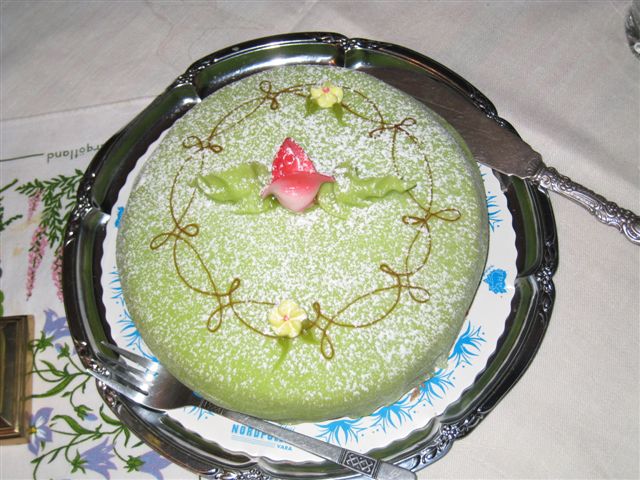
First time food that has not been repeated: Rocky Mountain “oysters” (our kid goats’ testicles). Foods have become favorites: really, really hot Mexican food, goat meat, spanakopita, lobster, clams, mussels, lamb. Swedish Princess cake made with marzipan, whipped cream, raspberries and custard. Every cake I ate in Norway. Scandinavian open face sandwiches (smørsbrød). French goat cheeses and Norwegian brown cheese. I could go on…but won’t.

What “exotic” foods have you tried and fallen in love with….or not?


Looper Hype Picks Up Speed

Today’s post comes from Bathtub Safety Officer Rafferty.

Greetings civilians!

It’s a great day to be alive, and an even better day to stay alive. January, the most frightening month, is nearly over! Which means (to me), that things can only get better from here, unless they get worse.

This, as you know, is my mantra, though I’m reconsidering it at the moment. I’ve heard that chanting the same phrase over and over again can dry out your vocal cords. That’s not good! Maybe all mantras are a health threat. Perhaps I should downgrade this to a simple motto or a mere saying.

I’m checking in with you today to bring your attention to some very alarming news out of California and Texas – two vast places where accepted standards of behavior tend to be the opposite of cautious. These are very troubling states.

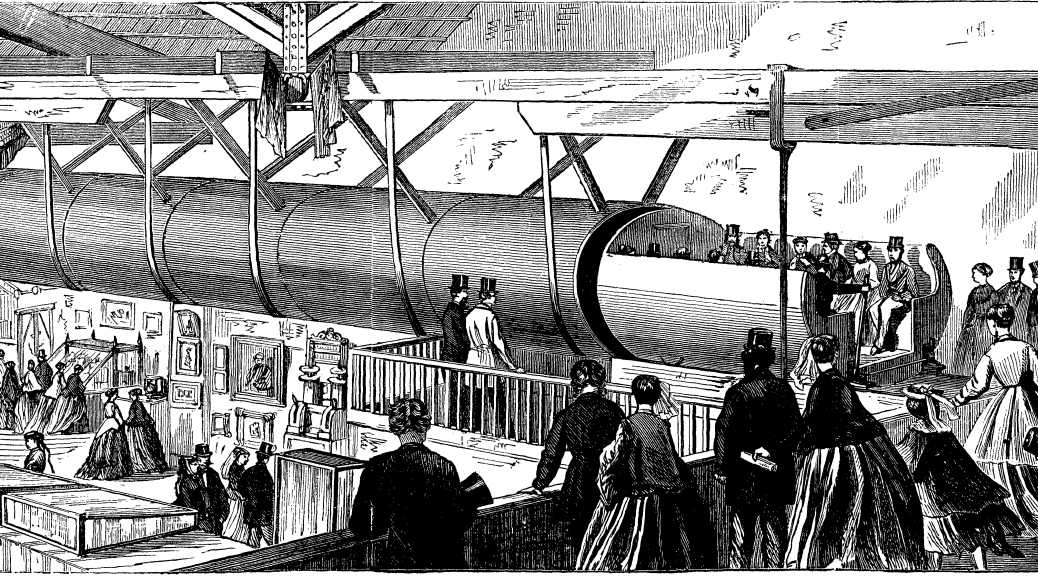
In Hawthorne, California, a big construction firm plans to build a test track for Elon Musk’s Hyperloop. This is the tube-based 800 mph transit system that promises to get people from San Francisco to Los Angeles in 30 minutes.

I’ve warned you about this in the past. I’ve warned you about everything at one time or another.

But this Hyperloop thing has picked up some extra steam of late, I say that knowing full well that if steam were actually involved in propelling the thing it would be even more frightening!

In addition to the test track, there is a competition going on this very day at Texas A&M University where 120 college and high school teams are vying to design a “pod” that would rocket people through this tube.

"Albert Robida - The Twentieth Century - Pneumatic Tube Train" by Albert Robida - Albert Robida's The Twentieth Century (1882). Licensed under Public Domain via Commons
“Albert Robida – The Twentieth Century – Pneumatic Tube Train” by Albert Robida – Albert Robida’s The Twentieth Century (1882). Licensed under Public Domain via Commons

Some folks find this notion admirable and exciting. But I think asking teenagers and twenty-somethings to design a vehicle that I might ride in someday will yield concepts that are absolutely terrifying!

After all, we’re talking about an age group that enjoys roller coasters! They are famous for believing they will live forever and nothing bad can happen to them. And have you ever looked at the back seat of a car that has been driven around by high schoolers for a day? Don’t! They have no concept of cleanliness or order. The possible negative outcomes of tossing a half-eaten slice of pizza over your shoulder is something that simply cannot be considered by a teenage driver when there is a new tweet to read or send.

They are creatures of the modern era, which means they have no historical awareness that dignity and travel can co-exist. These are the people designing your conveyance of tomorrow! Why am I not enthused? It’s all about temperament, priorities and expectations.  Look for USB ports, recliners and cup holders. Don’t hold your breath for designs that include cushions, headroom or bathrooms.
.
tube_room

Where is the Hyperloop Pod design competition bringing together the best plans of senior citizens, nurses, nannies, worrywarts, baby carriage safety inspectors and worst-case scenarists? These are the people who have the kind of safety smarts that could lead to a sensible, comforting design – something close to my ideal Hyperloop Pod – which is one that’s securely bolted to the tube so it cannot move!

The leading concepts produced today may travel on the test track before the year is out. I fear I know exactly what they will be like, in the same way you can be assured that when you climb into a sealed tube, you’ll eventually be spat out at the other end!

Yours in Safety,
B.S.O.R.

What do you need to have in your long-distance traveling compartment?

Hoodwinked!

One easy way to explain the incongruities of a complicated and often disappointing world is that nefarious “others” are furiously working behind the scenes to conceal what is truly going on.

But I’ve always had a problem accepting conspiracy theories that describe a vast fraud perpetrated on millions of people by a secret cadre of powerful deceivers. It’s not that I have more faith in people than your typical climate change denier – rather quite the opposite.

More than the faked Moon landing, the shooter on the grassy knoll, or the recovery of alien remains at Roswell, I completely believe in the inability of humans to keep their mouths shut, especially when they’ve got a really juicy story to tell.

Elaborate conspiracies must eventually come to light whenever people are involved, which is always.

And now a physicist has produced a paper that uses mathematics to show how unlikely it is that conspiracies can remain hidden.

According to David Robert Grimes, it would take about five years for the bitter truth to come seeping out of mixed bag of plotters.

If you’re skeptical, take a look at this small section of the paper that explains the research.

Screenshot 2016-01-28 at 8.18.48 PM

I have no idea what any of that says, but those are some convincing looking equations. How can I NOT believe something so clearly mathematical? Get a load of those numbers and symbols! Because I find them baffling, I know they must be true.

When I mentioned all this to Trail Baboon’s Singsong Poet Laureate Tyler Schuyler Wyler, he quietly informed me that a major pharmaceutical company had already printed his poem about this very subject in secret code embedded in the side effect warning that accompanies a major anti-flatulence drug.

I like to think I’m pretty smart, and my friend Ted is stupider.
I say this ’cause he’s quite convinced the president’s from Jupiter.

He claims it’s all a massive hoax cooked up by some Hawaiian
who encountered aliens one night when they’d just dropped their guy in

to destabilize the country that would make the biggest fuss
over plans they had to subjugate the populace – that’s us!

So this guy from outer space – he needed many, many cronies
to become the president. He built a phalanx full of phonies

to support a story good enough to make him seem for real.
There are many, many people implicated. It’s surreal

how no one has spoken up about it yet, except for Ted.
Who has made me swear to secrecy – or else I’ll wind up …

Can you keep a secret?

Hard Times in Hollandale

Today’s post comes from Jim Tjepkema

Hollandale is a small town in Southern Minnesota that came into being in the early part of the last century when a large wetland area was drained. The organic soil that was exposed when the land was drained was sold off as small vegetable farms. In it’s early days there was a very large number of small farms that produced a wide variety of vegetables. By the time I moved to the area in the early 80s, there were less than 30 vegetable farms and they were primarily devoted to growing potatoes with some of them also devoted to producing onions, carrots, and sweet corn. Most of the families that purchased the original small farms were of Dutch heritage and many of the ones I met when we moved there were descendants of those families.

Within any ethnic group you can often find people who are proud of their heritage. That is certainly true for many of the Hollandale area residents. I asked one of the older members of the community if he agreed with the saying: “if you aren’t Dutch, you aren’t much”. He told me that he might think that, although he never says it out loud. Both of my father’s parents were born in the Netherlands, so I know a little about the pride of the Dutch.

20160124_144338

My first job in Minnesota was at a small agricultural research company located near Hollandale. When that job ended I started a crop consulting business and soon found out that there was a big need for a consultant who could help vegetable growers keep on top of production problems. Two of the best growers were willing to try my services and they made it clear that the other growers should also use my services. As a result, I spent 10 growing seasons checking Hollandale vegetable fields for diseases, pests, and other problems along with providing advice on dealing with what I found. Due to the high production costs for vegetables and large risk of losses due to production problems, I was able to show that my services were needed. Unfortunately, the farmers were not willing to add very much to their costs by paying me a high salary.

During the years I worked with the Hollandale growers the number of farms gradually decreased until there were only 5 of 6 left and now there are only 2 or 3. I’m sure some of them quit because the strain of operating a vegetable farm became too great, as they got older. There is a tremendous amount of work involved in planting, growing, harvesting, storing, packaging, and marketing vegetables. One grower, who also grew corn and soybeans, referred to corn and soybean farming as a hobby because the amount of work needed to produce those crops is very much less than is needed to produce vegetables.

There were a number of other factors that led to farmers calling it quits. A big one was the problems they have with flooding when water from higher ground filled their low lying fields following heavy rainfall. Also they had a big problem with soil loss because organic soil can blow away during dry weather and burn up during hot weather. In addition they had difficulty competing with the very large farms that dominate vegetable production in the United States. The drop off in the number of growers brought my work in Hollandale to an end. However, I have many good memories from the years I spent working with those farmers.

What’s the toughest job you ever quit?

Banished Words

Today’s post comes from Barbara in Robbinsdale

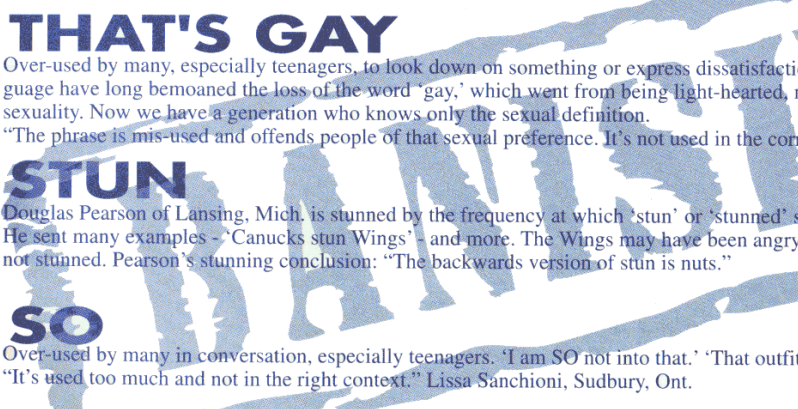
I was listening to “The Splendid Table” one recent Sunday morning and was appalled to hear Lynne Rossetto Kasper mention a kitchen “hack” for a desired outcome. Until then I had thought I could avoid hearing “hack” (used in place of the word “tip”), if I simply stayed off Facebook and Pinterest. It’s just one of those little new words that drives me a little batty, and apparently I’m not the only one. On New Years’ Day, I came upon this New York Times article about a Banished Words List, issued annually for the past 40 years by the Public Relations Department of Lake Superior State University (in Sault Ste. Marie, on Michigan’s Upper Peninsula).

This tongue-in-cheek listing began as a publicity strategy to help LSSU become known as more than a technological institution. “The first list was dreamed up by Bill (William T.) Rabe and… friends at a New Year’s Eve party in 1975. The following day, the “List of Words Banished from the Queen’s English for Mis-Use, Over-Use and General Uselessness” was released – the international reaction from news media and the public was unexpected… Although Rabe retired in 1987, the list has been continued by LSSU’s Public Relations people.    

“People from around the world have nominated hundreds of words and phrases such as ‘you know,’ ‘user friendly,’ ‘at this point in time,’ and ‘have a nice day,’ to be purged from the language.” Some more recent offerings have been: “my bad” (1998), “forced relaxation” (1989), “free gift” (1988), “live audience” (1983, 1987, 1990). 2015’s list included “bae,” “polar vortex” and… “hack.”

It was in some odd way satisfying to find “hack” on the 2015 Banished Words List

“This word is totally over-used and mis-used. What they really mean is ‘tip’ or ‘short cut,’ but clearly it is not a ‘hack,’ as it involves no legal or ethical impropriety or breach of security.” – Peter P. Nieckarz Jr., Sylva, N.C.

What word or phrase would you submit to the 2016 Banished Word List?

Double, Double, Toilet Trouble

Today’s post comes from Renee in North Dakota.

The agency at which I work is housed in a six-story former college dormitory built in 1964.  There are sixteen offices on each floor along with a large secretarial office and central waiting room. The building has one elevator.

The bathrooms are located on the east and west sides of the building. There are 26 bathrooms in the building, four on each floor and two in the basement. The building is owned by our local college, which is responsible for upkeep and maintenance.  The age of the plumbing and water problems made the college completely upgrade the plumbing and the bathrooms. We have been set upon by construction workers and plumbers for the past two months.

20160124_120643Construction began on the west side of the building in November, with the complete gutting of all the bathrooms on that side and the removal of all the old pipes and oddly placed sinks and defunct showers  from Sixth Floor to the basement. We have to use the bathrooms on the east side of the building.  You can imagine the noise, dust, and commotion, and how the elevator has been tied up with carts full of debris and gross-looking iron pipes. It is hard to administer a test for attention and concentration when it sounds like dinosaurs are devouring the building and there are crashes and drilling and pounding above and below. The workers have been really great to work with though, and we have developed a nice camaraderie with them as we pack into the elevator together. It was with the arrival of the plumbers that things have become somewhat more challenging.

20160124_120354The plumbers don’t communicate real well with either the construction workers or Joanna, our administrator responsible for agency-construction company interface. She has had to contend with unexpected water outages, odd and toxic smells, client complaints, and recently, explosions. Last week the plumbers, for their own nefarious purposes, decided to pump air into the new pipes on the west side of the building. Somehow, the air also went into the old pipes on the east side of the building, with some pretty spectacular effects. When flushed, the working toilets responded with crashes as loud as rifle shots and rapidly swirling torrents of water. Joanna was in a bathroom on First Floor. When she flushed, the water exploded high in the air like Mount Vesuvius, drenching her and the walls and the ceiling.  The lead carpenter asked her how she liked the new bidet on First Floor. She was not amused. I don’t know what she said to the plumbers.

Once the west side bathrooms are finished, the east side ones will be completely removed and the space turned into storage closets. There is trouble brewing, though. The architects insist that the new bathrooms will be handicapped accessible. Our nursing staff tried to get a wheelchair into one of the unfinished bathrooms just to make sure. The space is too small to get a wheelchair in and close the door. The fixtures aren’t even in the bathrooms yet. I think we are in for a long construction season.

How have you navigated your way through construction zones? 


Coloring Books

Header: Michael Maggs [CC BY-SA 3.0 ] via Wikimedia Commons

Today’s post comes from Verily Sherrilee

I’m a meeting doodler. I discovered years ago that if I doodle during my twice-monthly department meeting, they go faster and I am less frustrated. I used to sit in the back corner of the room so that my doodling wouldn’t distract anyone but several years back, my boss invited me to sit at the main table, doodles and all. Last fall one of my co-workers brought me a mandala design and a couple of colored pencils (with my boss’ permission). It was fun to do something a little different than my usual doodle designs.

Since that day, I’ve seen quite a few news stories about the new coloring book fad for grown-ups. Every book store and craft store has piles of coloring books and Fortune magazine published a bit about coloring books being a big boost for book sales in 2015. There are also plenty of articles about why coloring books are such a big hit right now. Some say that it lets adults to be more creative than their daily lives allow. Others say that coloring relieves stress. Another theory is that coloring books allow people to ditch technology, a return to their gadget-free childhoods.

So what does it say about me that I received THREE different coloring books for the holidays, complete with colored pencils, a huge set of markers and even some sketch `n sniff pencils?

What takes you back to your childhood?

Letting Go

Today’s post comes from Chris in Owatonna.

I have spent most of the day putting in a comma and the rest of the day taking it out.  –Oscar Wilde

I’ve had it! Enough is enough! I can’t change one more word!

While working on the final draft of my suspense novel, Castle Danger, those thoughts built up over the past few weeks until I reached a breaking point. It’s time to let go and send it to the proofreader, and ultimately the printer.

There comes a time during every creative process that the creator must pronounce his work “finished.” A painter finishes a painting; a sculptor chips off the last piece of marble and sands it down; a composer inks in the final note on the score. Then the artist lets go, releasing his creation to the world for its consumption and subsequent pleasure, displeasure, or indifference.

So I’m now at the letting go stage. I realized I can change a word here, switch sentences there, intensify an expression in a third place, but to keep doing so indefinitely is a sign of fear, doubt, and uncertainty. Is the story good enough? Will anyone buy the book? If so, will they like it? And by extension, will I feel validated for spending several years of my life on creating something from nothing.

I’m glad I waited until this point, though. To have deemed Castle Danger to be finished any earlier would have left me with nagging doubts about whether I gave it my best shot. Now I am confident I gave it my best shot and can face whatever comes in the way of “success,” positive/negative reviews, and feeling good about myself. I feel good about myself right now, and the novel’s success or failure won’t change that.

If it bombs, I’ll be disappointed, but hey folks, I wrote a damn novel! Not the most earth-shattering achievement, but at least, I didn’t sit around for the rest of my life and talk about writing a novel. Seriously, I’m proud of having gotten to the point of completing a  monumental project (for me). It’s something I never imagined myself doing this late in life.

For a Neo-Renaissance practitioner like me, new experiences are always good, but seeing a project through to completion is just as important as trying the new activity.

When have you finally let go of a project or creation and what brought you to that decision?