Eating Eiffel

Today’s guest post comes from Verily Sherrilee.

We talk about food a lot here on the Trail.  We even have a list of our favorite recipes.  And when we get together, food is usually an important part of the experience.  The spread at Blevins Book Club is always amazing and even when we sat on the sidewalk waiting for the Tom Keith memorial, we had a terrific array of goodies (popcorn, chocolates, cookies, fruit).   But one of my most memorable restaurant experiences was not of the informal kind.
JulesVerne2

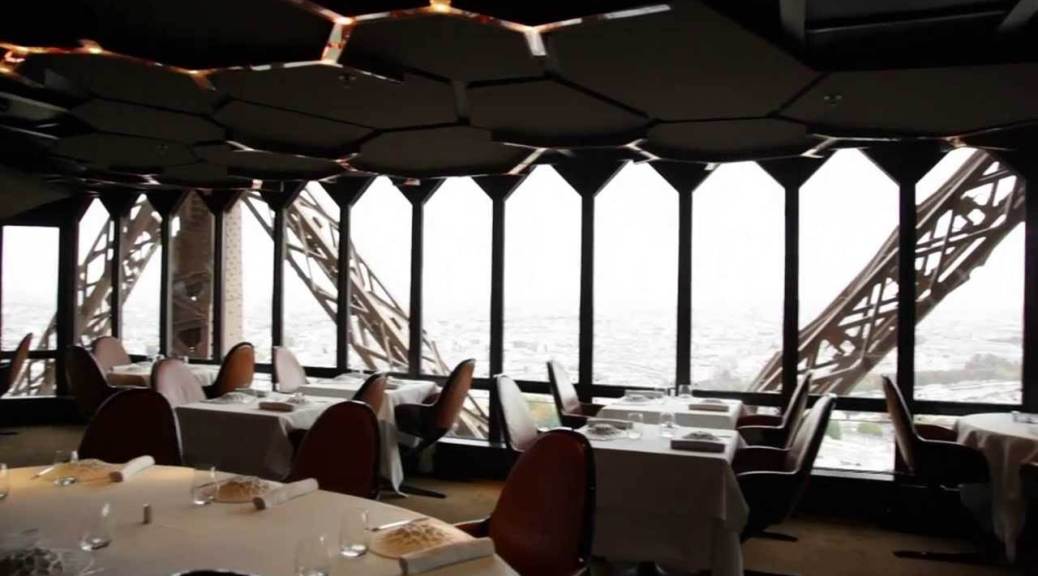
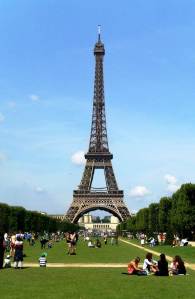
On a trip to Paris with a client, we visited the Eiffel Tower.  As we walked around the first level, our guide mentioned the Jules Verne Restaurant, which is even higher up, on the second level.  Although we already had plans for dinner, the client was entranced by the thought of eating at the Eiffel Tower.  Our guide made a few calls, pulled a few strings and voila! – we had reservations for the evening.

I am not all that good with heights.  I’m usually OK when I’m enclosed so places like the Gateway Arch or the Washington Monument are do-able.  However when I’m NOT enclosed, I don’t like it at all.  So while I wasn’t crazy about eating dinner 125 meters (410 feet) above the earth, I figured I would probably be fine.  Unfortunately what I didn’t know until we arrived is that the Jules Verne is windows from floor to ceiling.  And our guide had managed to not only get us in that night but had swung a table right by those windows.  My stomach took off for parts unknown almost immediately and I chose the chair farthest from the window as possible.

JulesVerne3

As the waiter came around to pour the red wine, I leaned a little bit back to let him reach the glass in front of me.  That was when I learned that the chairs had a little “give”.  As I pushed back, the chair pushed back as well, giving me the sensation that I was falling backwards.  Since I was already so worried about the windows and the height, I screeched and jerked forward, knocking the arm of the waiter.  Red wine went everywhere – the tablecloth, the napkins, the plates – it even extinguished the little candle in front of me.  I managed to stay wine- free but my shriek had gotten everyone’s attention in the entire restaurant.   It was one of those classic moments when you truly understand what it means to want the earth to open up and swallow you.

Luckily the Jules Verne is quite small, so I didn’t embarrass myself in front of too many people.  The dinner was out of this world and I managed to get through the rest of the evening without incident.  But I’ll always remember my dinner at the Jules Verne as the “night of the red wine disaster”.

Have you had a dining disaster?
The Gripper

Today’s guest post comes from Ben.

I was at the Farm Service Agency doing some paperwork and while waiting was talking with another farmer. (He was wearing a ‘Dekalb’ seed cap while I was wearing a ‘Meyer Seeds’ cap. Neighbor Tom was wearing a ‘John Deere’ cap.)

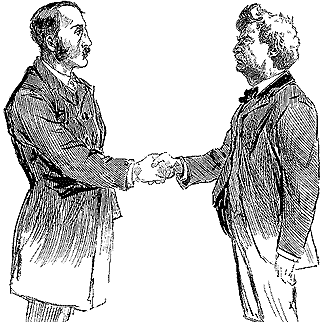
As Dekalb left we shook hands and as the shake finished, I distinctly felt my fingers slipping away from his. And I felt rather chagrined about that; like I let down the farmer brotherhood and he’ll be saying ‘He was a nice guy but he didn’t have a very good handshake...

I’ve noticed before that I release my grip before the other party does.

I need to work on that.

Now I’m not talking about the smoozy, glad-handing kind of shake—I know that guy and I don’t want to be him. I just mean a good firm run of the mill handshake.

Google gives me a nice article from Esquire magazine on how a man with a good handshake can do any thing he wants.

It also gave me ‘Alastair Galpin, the 2nd biggest Guinness World Record breaker of the decade 2000-2009 with 85 records broken. (Ashrita Furman, the top record holder has broken 551 Guinness records.) Alastair and Don Purdon set a new record for longest hand-shake at 33 hours and 3 minutes.

The-correct-handshake

Archaeological ruins show handshaking was practiced as far back as the 5th century BC. It’s possible the handshake originated as a gesture of peace to show that the hands held no weapons.

But there are many different ways of shaking hands or offering a greeting depending on the region or local custom.

Not to mention the possibility of spreading germs which has promoted the organization of Stophandshaking.com and various alternate methods of greeting such as the fist bump, bow, nod or ‘peace symbol’ among others.

There is that one handshake with a finger slipped inside to tickle the others palm while shaking hands. But I save that one for testing the mettle of college students in the shop.

I still believe in a good firm handshake and I’ll save the ‘fist bump’ for more casual greetings.

I just need to learn to hold it a beat longer.

When have you been glad-handed?


Traboules

Today’s guest post comes from Barbara in Robbinsdale.

I have loved secret passageways and other hidden places since I was a very little girl. The first house I remember had a bedroom closet that my mom fixed up as a play house. I remember a hanging light bulb and unfinished attic-y floorboards covered by an old rug; I could touch the rafters of the sloping ceiling… my first hidden place. The other upstairs closet was long and narrow, and I liked how it connected to my folks’ bedroom right next door… my first secret passage.

As I grew older there were more hidden places: the house my grandpa built with its “secret staircase” to the attic, cleverly tucked into a bedroom closet; a friend’s house where the bookcase in the main room <i>was the door to the up-stairway</i>! Heaven. Closets under stairways, pull-down attic staircases, “forts” under pine trees, pedestrian tunnels under busy streets… I’ve always been drawn to these.

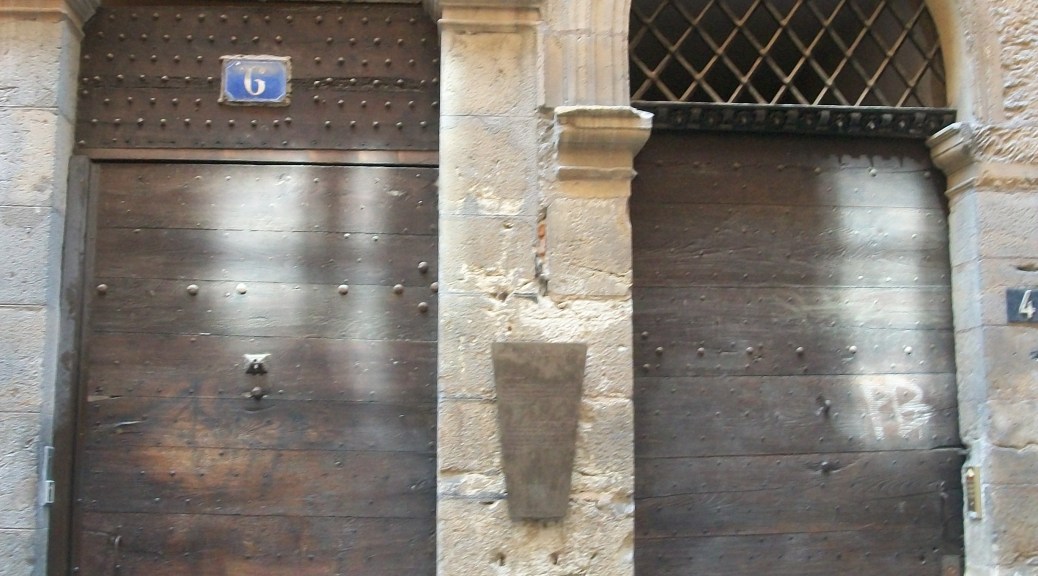
So imagine my delight when, on a walking tour in Lyon, France in early May, we came upon the Traboules (originally from the Latin ‘transambulare’ , meaning to cross, pass through).

In the 15th and 16th centuries during the height of Vieux (Old) Lyon’s silk trading with Italy, city planning was not at its best. Most streets ran parallel to the river, making it pretty difficult to get from one street to the next without taking a long detour. Merchants and Italian architects created, between the courtyards of the buildings, a network of passages – usually hidden by doors that were used as the outer entrance to the apartment buildings. They were then used by both the hard-working and the indolent.

Mailboxes in traboule

Many of these passages still exist, and some of the available entrances are now marked with a plaque (as between the two doors in the photo); others look very ordinary. Often there is a set of mailboxes in the courtyard behind these doors.   These were used by the French Resistance during WWII – perfect locations in which to exchange messages.

What is (or was) your favorite hiding place?

The Art of Winning

Today’s guest post comes from Verily Sherrilee

Art5I don’t get too excited about prize drawings because I never win. Well almost never; I think I’ve won maybe 3 drawings my whole life. This includes a big company anniversary drawing 10 years ago in which they drew 400 names. Zip, zilch, nada.

So last week, when I got an email from a supplier requesting that I fill out a little survey to enter a drawing, I almost deleted it. But it had been forwarded to me by my boss, so I decided to play along. The online survey included a smart-a** option for each question, so you know which answer I chose – for every question – as I figured it wouldn’t matter.

Art2

Imagine my surprise when I found out that my name had been picked for the prize – a trip to the Russian Museum of Art and a painting class. Not only did I win, but I won something that had value for me!

Yesterday afternoon (yes, I got off work for this) a group of 10 of us met at the RMOA. We learned a little history of the current exhibit as well as the background of two specific pieces of art and their artists. Then we took a quick walk over to Simply Jane’s Studio, where they were all set up and waiting for us.

Everyone got a penciled in canvas (we had chosen which of the two pieces we wanted to do ahead of time), smocks, brushes, paints – the works. The staff did a great job of teaching how to use the acrylics, including having us “color block” our canvas and then filling in shading and details. At first I was a little worried that mine would look terrible AND I was sharing the table with someone who was very talented, but after a little bit, I was able to let go of it and just enjoy myself.

Art1

Art4On the left side of the screen you can see the work in its color block stage, and on the right, the finished piece, which I’m calling “She’s Still Life with Apples”.

And I’m feeling like a winner!

If you have paints in front of you, which artist would YOU like to copy?

Orgy on My Patio

Today’s guest post comes from Clyde in Mankato.

A few years ago my son gave me a book which summarized what we know about behavior of the myriad of American bird species. We know the easily observable, such as nests, eggs, migration. We do not know the more difficult to observe, such as territorialism, cooperativeness, life span, causes of death, and how monogamous various species really are. Studies suggest that, contrary to what is told, most species are not monogamous. When a clutch is analyzed, which ornithologists only rarely do, eggs usually have different fathers, which makes sense for the gene pool but destroys our anthropomorphic images of birds.

To study these behaviors for one species would require many hours of close observation of many individuals to describe the common behaviors.

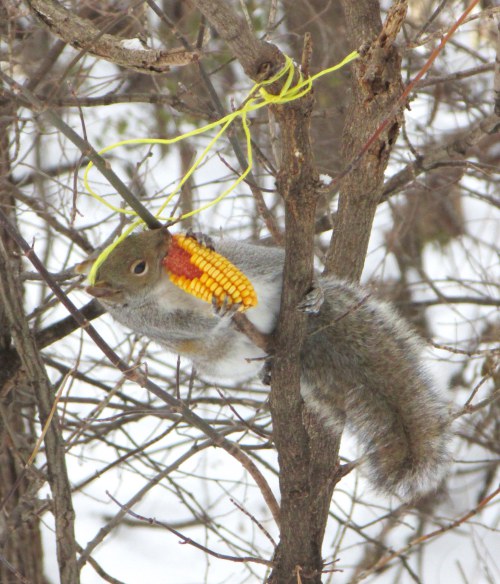
Despite all the time I have spent in the woods around squirrels and chipmunks, I know little about the domestic life of either species. But for three years I have watched a colony of squirrels by my patio. Squirrels are quick learners, very adept with their forelegs, and have good memories. They have memorized the superhighways, off-ramps, and local roads in the trees, which I can observe in the leafless winter. One squirrel learned to cut the twine holding an ear of corn. I then put small ears of corn in a suet feeder. She became very adept at manipulating the corn to extract kernels, food which is hers and hers alone.

Second pix

Because they have accepted my presence on my patio, I have observed much mating behavior in birds and squirrels in the last three days. The second round of parenting has begun. Yesterday several small birds courted and mated in the trees, and a pair of squirrels tumbled and rolled in the grass a dozen feet from me before consummating their fervor, several times.

Above them a second pair of squirrels courted on a large tree limb, the limb shown in the header photo. One squirrel, male I presume, cornered a second squirrel, female I presume, at the farthest end of the many branches on the limb. They faced each other down for a minute or more. She could have easily dropped three feet to the ground. She did not. Instead she jumped to another branch. He found where that branch joined the tree and backed up to sit there. She leaped to another branch. He back up again. This happened several times until she had backed him up by the ropes, where no more branches grew from the limb.

They stared at each other from eighteen inches apart for another minute. The next courting move was—pun intended—anticlimactic. She ran right over the top of him and into the canopy. He followed in—pun intended—hot pursuit. Go ahead: anthropomorphize this behavior.

If I had the resources and time, I would sit in the great art museums of the world to study the art and to observe the passing humans and their reaction to the art. Fifty years ago I did this in the Chicago Art Institute. Most people’s reaction to most art was indifference.

If you had the time and resources, what would you sit and study, or ponder?

The Community Piano

Today’s guest post comes from Jacque

Several summers ago, probably 2011, but really I am not certain, someone with a community project grant placed a piano on the corner across the street from my office.

IMG_0162

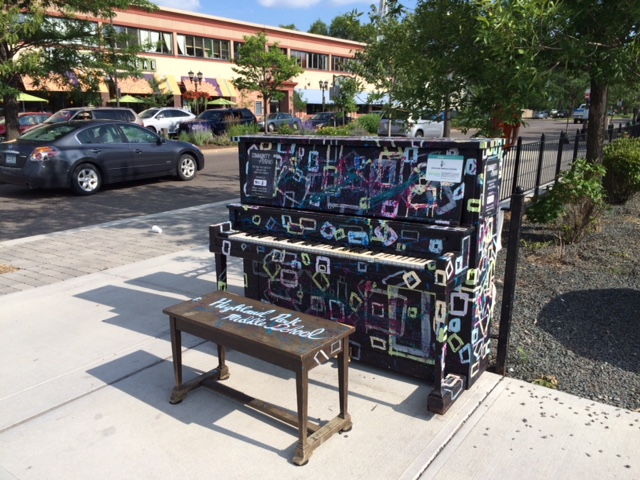
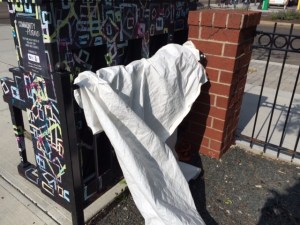
The piano was painted light green with colorful patterns and a small mural. It provided intense community interest and activity, attracting people like a magnet attracts metal. There were players who were accomplished musicians playing a concerto from memory, church organists playing traditional Christian hymns, children playing chopsticks, and cool dudes noodling a bit of ragtime. I could hear music throughout the day. The old piano was tinny and out of tune, suffered relentless sun, and washed by watery downpours if someone did not cover it with the tarp connected to the backside.

IMG_0163

It was a difficult summer for me because I had chosen to continue my business despite a major problem and set back the year before. Re-organizing the business required working many hours as I transitioned to a new bookkeeper, a billing service, recruited some new therapists, and developed the structures the business required. Looking out my office window to the corner where the piano was positioned was a blessed relief to this drudgery.

To my delight, there is a new old piano on the corner again this summer.

This noon as I walked back to the office from eating my lunch, a girl was seated there, just noodling. I don’t know who thought of this idea of community pianos, but to whomever it is, thanks. It brings such a feeling of communal joy. When people are gathered around it like a campfire, listening to someone play or singing along, everyone smiles as they throw themselves into the experience. Though I may not know the name of the folks gathered there, we are part of the community in that musical moment.

We are communing.

We are community.

What gives you a sense of community?

An Overlooked Overlook

We are taking a road trip today to a place many of us baboons have been to and even lived on, but maybe never knew of or noticed. The trip starts in Fargo, elevation 904 feet. Remember that number.

We travel south on I-29 on a really straight road, passing the little towns, crossing the Wild Rice River several times, saluting the fireworks emporiums, and admiring the potato and sugar beet fields. We are at the bottom of ancient Lake Agassiz. The soil is some of the world’s best.

After an hour we pass the Sisseton-Wahpeton tribal casino at the border and cross into South Dakota. The landscape is quite similar to what we have just passed, but there are increasing wetlands now and the terrain starts to roll slightly. We cross the continental divide, so now all the water flows south to the Gulf of Mexico instead of north into Hudson’s Bay.

It is then we notice something looming to our right. In the distant west we see a dark line of hills, a ridge that seems to pop out of nowhere. We drive closer and start to climb, and by the time we get to Summit, SD, we are at an elevation of 2014 feet. We are a thousand feet higher than we were in Fargo. This is a place where the wind howls all year long, it seems. It is no place to be in a snow storm. There are wind farms here. We are on the Coteau des Prairies, a triangular-shaped plateau that starts in northern South Dakota and extends into southwest Minnesota and northwest Iowa. It is 200 miles long and 100 mile wide. You can see the extent of the Coteau on the map.

Anyone who has been in Rock, Nobles, Lincoln, Murray, or Pipestone counties has been on the Minnesota section of the Coteau called the Buffalo Ridge. It is the drainage divide between the Mississippi and Missouri rivers. My father knew all about the Buffalo Ridge. It was significant to him and he loved his first glimpse when ever we drove from Dickinson to Luverne last year.

Lewis and Clark noticed the Coteau des Prairies, and described it in this map from 1814.

Lewis_and_Clark_Middle_Missouri_BigSioux_James

I grew up on the ridge and had never heard about it! I had looked at it over the years on our too infrequent trips home on I-29, but never really thought much about it until this past year when I drove home so many times during my parents’ illnesses.

How many baboons have been in Worthington or Pipestone or Luverne and known they were on a big plateau? The ridge is something you don’t notice until you are off it. You have to be away from it to really see it.

When have you failed to notice something that was all around you?

Things Left Unsaid

Today’s guest post comes from tim

i am so pleased that our blog has proven to be self sustaining.

i miss dale ad his notes on things like the planets being so  close together last week that they looked like one. i dont like relying on the outside world to bring me my trail info. last week on my way home the guy on the radio was telling me and he was a weather guy not a planet guy but i guess he sounded the alarm for me.

our little family has taken form as guest  bloggers with clyde is clicking on all 8 cylinders and sherrilee barbara and jacque cranking out the blogs.

we made it what a month so far. my ideas focus and unfocus as the days go on and if i dont hurry up and take notes they are gone. 

what was that great idea i had?

dale has realized by now what it is like to be a normal human being with 24 hours of your own without having to dedicate 2 or 3 hours per day to tour merry band of blogmates who reside here on the trail. i have come to realize what a remarkable run 6 days a week for 5 ears truly was and am thankful for the ride.

i hope he returns but i think we have proven that we have the ability to start a conversation for the day and carry on in the baboon tradition. the old regulars the occasionals and the newbies. returns he old alpha for bringing us together

i remember the first physical coming together at the russian museum where i got to meet a fistful of baboons and the extension of the camaraderie was formalized. since then the rock bend the bbc the state fair the concerts and other activities (pj i want to meet up with you at the farmers market and learn your favorites and i am an early morning person so it might work and hmong village is not forgotten either)

sometimes the best stuff comes from unexpected sources and if you think about it too hard or too long its gone.

time waits for no one and the trail is a nice place to practice spouting off what you have learned and observed and thought about with those who stop in.

what do you wish you had said to who?

Group Discount

Today’s guest post comes from Renee in North Dakota

It is only to be hoped that the recent Supreme Court decision to legalize gay marriage will have a salutary effect on the price of admission to the McCrory Gardens in Brookings, SD, the largest public garden in the region outside of Omaha and the Twin Cities.

Admission used to be free, according to my son and daughter-in-law, but was increased to $6.00 and the 25 acre Formal Garden site fenced in and closed each day after 8:00pm due to public safety concerns and vandalism in the wee hours of the morning. Locals were quite unhappy with the decision to put up a fence and limit access. The 45 acre arboretum remains unfenced and open 24 hours a day.

069

We traipsed around these most beautiful gardens during a recent visit to Brookings. This August marks the 50th anniversary of the gardens, named after a former Horticulture professor at South Dakota State University. The site is on the campus and is affiliated with the Plant Science department. 40,000 annuals and perennials are planted each year, and I imagine there are scads of Horticulture students and budding landscape architects who have worked like navvies to maintain and improve the gardens.

060

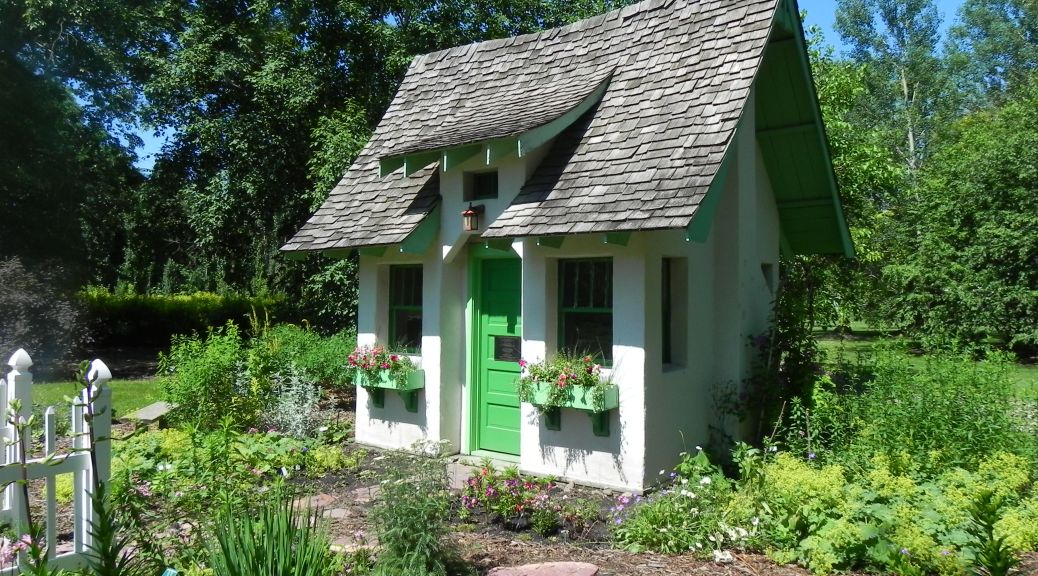
There is a children’s hedge maze, a cottage garden, AAS field plots, a rock garden, and wonderfully designed garden plots dotting the landscape at every turn, loaded with annuals and perennials and shrubs and vines. The cottage by the cottage garden is a former gas station. I found it quite charming and I included a photo of it. The site also boasts of the largest selection of maple trees in South Dakota. The leaves in my other photo are from a Harlequin maple tree.

The linden trees were in bloom, scenting the air with an elusive, sweet perfume that took us quite a while to identify. Staff were setting up for a garden wedding, and we could see the bridal party having photos taken. I wonder when the first gay wedding will take place there? Perhaps the increase in weddings will help lower or even abolish the entrance fee. One can only hope. Gardens are always changing and shifting with the seasons, and so does the social fabric, even in the Dakotas.

You have 70 acres, a large budget, and an army of eager and willing horticulturists. What kind of garden would you have?


The Parade

Today’s post comes from Verily Sherrilee


I love parades; I always have. I love the floats, I love the military guys with all their flags, I love the Corn Queen’s Court waving from the backs of convertibles. Growing up in St. Louis, we went to see the Shriners’ parade every year; the flowers, the clowns, the bands – I adored it all. I even love the parade every afternoon at the State Fair.

So it was fortuitous that twenty-five years ago, I bought a house in Tangletown. This is the one neighborhood in Minneapolis that defies the grid layout that the rest of the city enjoys.  And it is also one of the neighborhoods that has an annual Fourth of July parade.

We gather at Washburn High School – everybody in their red, white and blue attire. Kids decorate their bikes, trikes, scooters and wagons for the parade. Dogs wear their best festive bandanas and there are always balloons galore. The fire engine arrives and the fire fighters pose for photos with the excited kids. Then the engine starts up, someone usually has John Souza on a boom box and we head out, weaving our way through the streets of Tangletown.  Neighbors who aren’t parading sit on their porches or front steps and wave as we go by.  After 6-8 blocks, we end up at Fuller Park where we have a fabulous party. Games and prizes for the kids, a band, kegs of root beer, hot dogs. Everybody brings their blankets and picnic lunches.

It’s a wonderful way to begin celebrating the Fourth – laidback and fun. And close to home!

How would you design your parade float?