Hummel, Hummel-Mors, Mors

Today’s post comes from Renee in North Dakota

Clyde’s recent posts about DNA and birch logs made me think about these little carvings I have that came from my mother’s family from Hamburg, Germany.  

The crabby water carrier and the farm animals and other figures were in my house all throughout my childhood.  Mom would never let me play with them. I think some of them were children’s toys. Mom said she thought that some of them were sent from Hamburg by family in thanks for the food packages my grandma sent them during the war.  She was pretty vague about it.  She couldn’t even tell me  how long she had them, or why she had them instead of my grandmother or other family members.  

She also couldn’t tell me much about the water carrier. She said he had something to do with Hummels. I always thought she meant the porcelain  child figures designed by the nun, Sr. Maria Hummel.  

Well,  That isn’t quite the whole story.

I now know that the water carrier figure was a real person who worked as a water carrier in Hamburg in the mid-19th century and who was noted for his nasty temper. He was given the nickname “Hans Hummel”.  The word Hummel sometimes is used to refer to a bumblebee. Hamburg children would follow him through the streets as he carried water, yelling “Hummel Hummel” and he would respond with “Mors Mors” which is low German slang for “Kiss my a**”.  

People from Hamburg often greeted each other this way long after Herr Hummel went to meet his maker. The water carrier is a popular symbol for Hamburg.  Now, why didn’t my mom tell me this? How did those cute child figures get mixed up with this?  I don’t even know if mom knew the whole story. If that is the case, why didn’t her mother or her grandparents tell her the story?

Since my parents have both died I find I have lots of questions that I will probably never get answered. I wish I could go back in time and ask my great grandparents and other ancestors just what is up with all this stuff.  Husband and I are tentatively planning a May trip  to Bremen and Hamburg, so maybe I will find some answers.

What question would you ask your ancestors?

The Handy Apple

Today’s post comes from Sherrilee

Two weeks ago I received a box from Centerpoint Energy with a couple of new shower heads. It took me a little bit to remember that they had been offered to me several months ago as an energy-saving strategy. Being free, I jumped at the offer but then promptly forgot about it until the box showed up.

I’m fairly handy and all self-taught. I’ve sanded a wood floor, replaced a sash window, changed out electrical outlets and even installed new faucets in the bathroom. I do know my limits – no serious plumbing, no building of anything, no anything that requires I get farther than 5-6 feet off the ground.

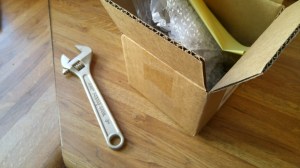
So when I got the new shower heads, I thought “I can do this”.  Then I thought about having to find the right wrench, the plumber’s tape and most importantly, the time!  I shoved the box to the back of the counter, figuring I might get to it over the weekend or the next.

ShowerHead1

Last night when I got home and was feeding all the beasts, out of the corner of my eye I noticed the crescent wrench sitting on the counter.  And one of the shower heads was gone from the box.  I wandered upstairs and saw that the new shower head was installed in the shower, complete with new plumbing tape. Since I was pretty sure that nobody broke into the house to change my shower head, the only solution was that Young Adult had done the installation.  Here is our conversation when she got home:

YA: Did you see that I put on the new shower head?

VS:  Yep.  Why did you do it?

YA:  Because you weren’t getting around to it.

VS: How did you know which wrench to use?

YA: I don’t know – I just chose a wrench.

VS: How did you know to use the plumbing tape?

YA:  I don’t know – I just used it.

VS:  How did you know where the tape was kept?

YA: (Now rolling her eyes).  It’s in the bathroom drawer; I see it every time I open it.

I guess maybe she has been paying attention all these years.  If you had asked me yesterday I would have said she didn’t even know where the wrenches were or that she even knew that plumbing tape existed. Guess the apple didn’t fall that far from the tree after all!

What skill/talent would you like to pass down?

The Fishy Branch of the Family Tree

Header photo by Andreas Trepte,www.photo-natur.de.

Today’s post comes from Clyde in Mankato

Well my stars and garters! Why I never!

I gave it no credence when I first read it. I would not spread such an unfounded rumor, except the more I think about it . . .

I stumbled upon the rumor in my recent trip to Greece. While high in the Taygetus Mountains in the Mani I first heard the tale, but many a lie and many an eerie story have arisen in the remote regions of the land of Homer, where poetic licenses were first issued.

Excuse me, that isn’t quite true. It is only that Patrick Leigh Fermor is such an excellent travel essayist that his book Mani: Travels in the Southern Peloponnesse made me think I was there. Why would Fermor repeat an unfounded and libelous tale from Ireland in remote Greece? Does he sense the strong similarities between the two nations that many Irish believe?


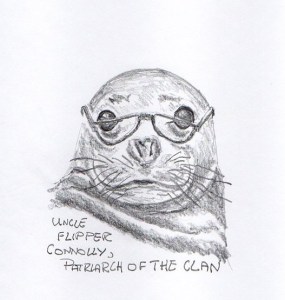
But my arduous research reveals this entry in Wikipedia quoting from Irish Names and Surnames (Woulfe, 1923): “Many traditions, connecting these harmless animals with the marvellous, are related along our western shores. Among these there is one of a curious nature, viz., that at some distant period of time, several of the Clan Coneelys (Mac Conghaile), an old family of lar-Connaught, were, by ” Art magick,” metamorphosed into seals! In some places the story has its believers, who would no more kill a seal, or eat of a slaughtered one, than they would have a human Coneely. It is related as a fact, that this ridiculous story has caused several of the clan to change their name to Conolly.”

Seal

There it is, you see, the possibility that Dale Connelly has seals as relatives. But it carries an aura of bona fides when I think about Dale: the ability to keep many balls in the air at once, his eagerness to clap his hands in applause, his sleek manner of passing through the world with barely a ripple, his migration from dry cultured Illinois to watery backwoods Minnesota, the innate ability to entertain the crowd, the gleam in the eye and the bark in the voice, the faint odor of fish.

Well, not that last one. I have never actually met Dale, you see.

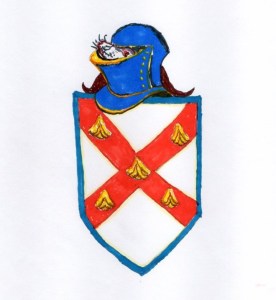
CrestThe Queen of England has a royal seal. Why can’t Dale have one?

Maybe Dale should do a double billing with Sparky at Como Zoo. Oops. Sparky is a sea Lion, not a seal. So maybe the rumor is false and I should not repeat it, Dale being more of a lion than a seal.

Would you do a DNA test? What do you think might be found grafted onto your family tree?

Timber! To an Era

Today’s post comes from Clyde of Mankato

My last guest blog asked you to look closely at grass. This time I want you to examine two slides taken by my mother in 1954. They capture an end of one era in the forest and the beginning of another.

First I apologize that the horse’s head is at the semi-exposed end of the roll. Adeline and I long bemoaned that bad luck. We both recognize the photograph has family and larger significance. Today the ratty right end strikes me as appealingly quaint.

End of one era: the horse for one, which you probably realize. In 1955 it was rare to see horses used for logging, but more than my father were still using them. However, the images also show the tail-end of old growth trees in northeastern Minnesota. Look at the size of the those birch logs! How long had they lived? You perhaps think they were sawed into birch lumber. In 1954 it simply was not done. Birch was then a difficult wood to manage as lumber. Today those logs would be worth as fortune.

I feel an affinity for those logs. First because they are birch wood, as am I, being a German birchwood. Secondly because I spent the next eight years using pieces of the logs as chopping blocks, before which I spent many an hour swinging an axe. I was well acquainted with that birch tree before it was felled. Its grandeur appealed to me. For my father it was a massive temptation to cut down. Because of the girth of the stump, he did not attack it, not having a proper two-man whip saw to do the task. Then along came that yellow chunk of steel in the other image.

Logging 1

Beginning of another era: our nearest neighbor Floyd (man on your left) was a full-time time lumberjack (cutter of trees for lumber) and gyppo (cutter of trees for pulp wood). He was a famously surely tough old bastard, older than he looks in this photo. A couple years later while cutting pulp by himself in the Superior National Forest, he broke his back when a widow-maker fell on him. He had to crawl out to a road to get help, which took two days and nights. Three months later he was back in the woods alone. His personality made working solo a necessity. Being a bachelor, Floyd could not have made a widow.

A few days before these pictures were taken, he stopped at our house to show us his new prized possession, the chain saw. They had been around, but now they were mass-produced at a level that made them affordable for professional cutters. Also, they were dependable. They were still very heavy, nothing like today’s light-weight wonders. Yet even at that weight, a new era swept the woods, for one thing allowing old birds like Floyd to earn real money cutting alone.

The moment my father saw the chain saw before him, he pictured that birch tree. And down it came, my mother coming along, after the fell deed, it seems, to photograph the results.

What you see are only the two bottom lengths of the trunk, minus the two butt pieces on which I am standing, which became the chopping blocks. It took several loads to bring up all of that tree. My father knew how to coax every piece of firewood out of large trees. How long it must have cooked our meals and heated our house! You may wonder by what means the logs made their way onto the sled. My father and I did it alone. How that is done, I will leave a mystery.

If you had those birch logs today and could pay the cost, what use would you make of them?

Advanced Social Media

Many thanks to the gentle baboons who have kept this blog going for several months and especially the past few weeks while I’ve been distracted by work.

Our Fall Membership drive is underway at Fresh Air Community Radio – we’re in the middle of the second week of fundraising, just two days away from the scheduled conclusion. Just recently I’ve been preoccupied helping friends like the Morning Blend hosts (pictured above) as they try to get listeners to call 612 375-9030 to make a contribution.

KFAI_SignIf you’ve never listened, you should give it a try. The most baboon-friendly show on the schedule is Stone Soup, Wednesday mornings from 10am to noon. I often hear host Pam K. playing music that was, or would have been, featured on the old MPR Morning Show.

But that’s no surprise. Our station has many personalities, literally and figuratively. We are the antidote for anyone fed up with tightly formatted radio. While the most popular stations in town strive for stability by trying to sound exactly the same whenever you tune in, we are like the flowing river. Stick your dial at 90.3 / 106.7 FM and you’ll find that you can’t listen to the same station twice. No matter what you think you’re going to hear, it’s always going to become something else.

KFAI_State_FairSome people look at that and say we’re hanging on too long to an outdated model, suggesting that the volunteer-based grab bag approach to programming where individuals use the medium as a form of self-expression is a hippie artifact. They say we’ve got to step into the digital age and create a coherent multi-platform brand that is consistent and predictable and is tied to something more marketable than the quirk factor.

But I look at the digital age and see an environment where any form of media that’s seen as monolithic and prepackaged is at risk of being overwhelmed by thousands of small-time operators who are creatively and subversively employing the same tools as the big players.  And I don’t think subversive is too strong a word.  After all, we have a broadcast frequency in a major American city, and we routinely hand it over to just ordinary folks so they can be heard.

In that sense, community radio is the original social media.

If we were Facebook, we’d give everyone their own show, and I do sometimes encounter people who think they can walk in the door  at KFAI and have an on-air slot within days.  After all, they have excellent musical taste!  Unfortunately, we’re limited by the number of hours in a day, and new program hosts soon find out having your own weekly radio show is a more demanding commitment than simply posting your thoughts and putting up a cat video every now and then.

But it is an enticing thought.

If you had a radio show, what would it sound like and what would you call it?  

Knock Knock Joke

Today’s post comes from Sherrilee

We have dog issues at our house.

The first issue is that my dog isn’t all that well-trained, but she usually doesn’t bug me, so I have let things slide. The second issue that that Young Adult’s dog isn’t even CLOSE to well-trained. And the third issue is that when our big dog Thorin passed away this summer, we realized that he had been the buffer between the other two dogs. We discovered this the hard way last month when they fought over food, I slipped in the melee and got very badly bitten (there were 3 of us there and none of us can even  say which dog bit me).

So we bit the bullet and had a dog trainer/behaviorist out last week and now we have doggie homework. One of the things I wanted to tackle was the fracas made when people come over: the jumping and the barking. But it’s hard to train at the front door by yourself. You really need at least one other person to stand outside and ring the doorbell or knock. During the week, Young Adult and I are like trains passing in the night so yesterday I decided that I would work on the froDogDoorbell2nt door training by myself. I downloaded a doorbell app (yes, there are such things) onto my phone, selected the tone that sounded most like our doorbell, put some painter’s tape down on the floor near the door and called the dogs.

 

I hit the doorbell app; the lovely tones peeled out a la Big Ben. The dogs stood and looked at me. I hit the app again. And again. And again. Nothing.   I went outside and pushed the regular doorbell and they went wild.    DogDoorbell3

Trying not to be outdone, then I downloaded a “knocking on wood” app. It was very realistic sounding. The canines didn’t bat an eye, although they erupted when I went onto the porch and knocked with my knuckles. As I retreated to the sofa, I realized that while they’re not rocket scientists, my dogs are smart enough to tell the real doorbell from the app on my phone.

What’s really sad is that I’m not sure I’M smart enough for that!

When have YOU been fooled?

A Roll in the Hay

Today’s post comes from Clyde in Mankato.

I know, I was an English teacher and all that, but I am really far more visually oriented than word-oriented. I opened at random a book called The Prairie World by David F. Costello. I read this description, and until I came to the key words, which I have left blank below, I had no idea what plant he was describing:

If you examine a stem closely, you will see that the leaves alternate in opposite directions from the stem, and only one leaf grows from the node. The leaf itself consists of two parts: the sheath which forms tube around the stem, and is split its full length; and the blade, which is wide and often flat but nearly always elongated. The portion of the leaf at the junction of the blade and sheath is called the collar. The mebranous or hairy structures where the base of the blade touches the stem is called the ligule. This structure, which varies greatly among different _____s, is useful in their identification. It keeps water from flowing inside the sheath where fungi might grow. Some _____s have appendages, one on either side of the base of the blade, known as auricles . . . As the ______ continues its seasonal growth it produces new stems from buds that develop from old stem bases near the surface of the ground . . .”

Do you recognize that plant? We all know it well. But we seldom look at it at such close range. I had a colleague who taught biology who tried to get students to notice, to look, to see at both the close range and the larger picture; to see patterns, to see differences and similarities and to relish the wonder of nature. I tired to teach essentially the same thing about reading and literature.

Costello is describing grass. Just grass, grown taller than we let it grow in our cultured yards. The technical jargon does not help, it never does, except to the those in the inner circle of the world circumscribed by the given jargon.  But since every June of my childhood was driven by a high concern for grass, or hay as farmers call it in full form, I should recognize it by any description. I used to lie in it, just to relax in the sun, to rest with my dog by my side, to look up at the clouds drifting across the sky on their way to Lake Superior.

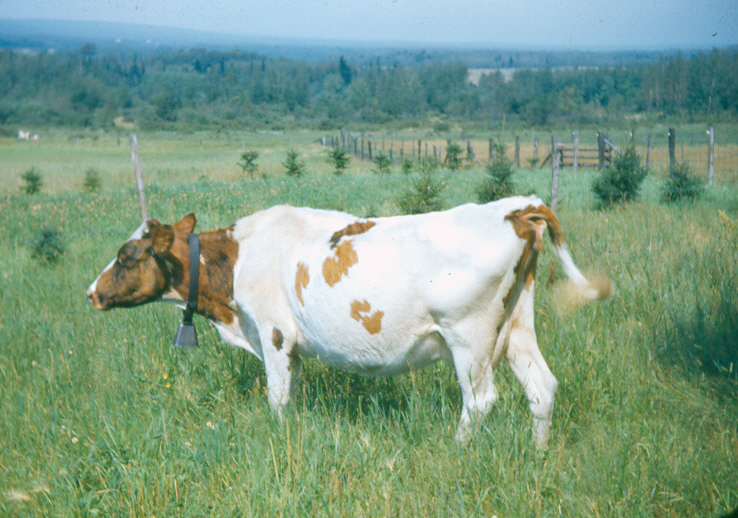
Somehow I did not Mowingroll over and look carefully at the intricacy of a single plant of grass. In the larger picture, driven by the daily details, a biology teacher and an English teacher are teaching many of the same skills.
Praises be for the small and simple yet wonder-filled things which sustain us heart, body, and soul.

Are you a good looker?

Marital Ballistics

Today’s post comes from Renee in North Dakota.

We live on a very “married” block/street.  It was that way when we moved here in 1988 and it remains the same, although “married” status has changed to “widowed” for a couple of the residents. Of the twelve houses that line both sides of the street on our block, ten are owned by couples and two by widows. There has been very little turnover as well.  Gary and Sue, Ken and Rhonda, Elsie and Leonard,  the Maershbeckers, the Knopics, the Lenos, the Kovashes, the Dvoraks, and us have lived quietly and politely close to one another for more than two decades, (but not too close), admiring each other’s lawns, vehicles, gardens , flowers, and children, visiting in a neighborly way, keeping mostly to ourselves but knowing lots of things  about all the others while pretending to mind our own business.

It used to be that the sight of a police car on the block signaled that someone had found a stray dog and had called the city to come and take the animal home. Things got more dramatic a couple of years ago when Ludwig and Martha died. They were a sweet old couple with thick Czech accents who lived directly across the street from us. The Knopics, who lived a few houses south, bought Ludwig and Martha’s home and sold their home to a couple in their late 30’s, oil field people with an aggressive Dachshund and no children.  They are not a quiet couple. They are heavy drinkers who argue and taunt each other loudly and publicly in the front yard, and who have visits from the police.  He has been in the local paper in the District Court proceedings, convicted of simple assault. He always ends up back home and then we see them washing their vehicles, trimming the hedges and mowing the lawn as though nothing has happened.

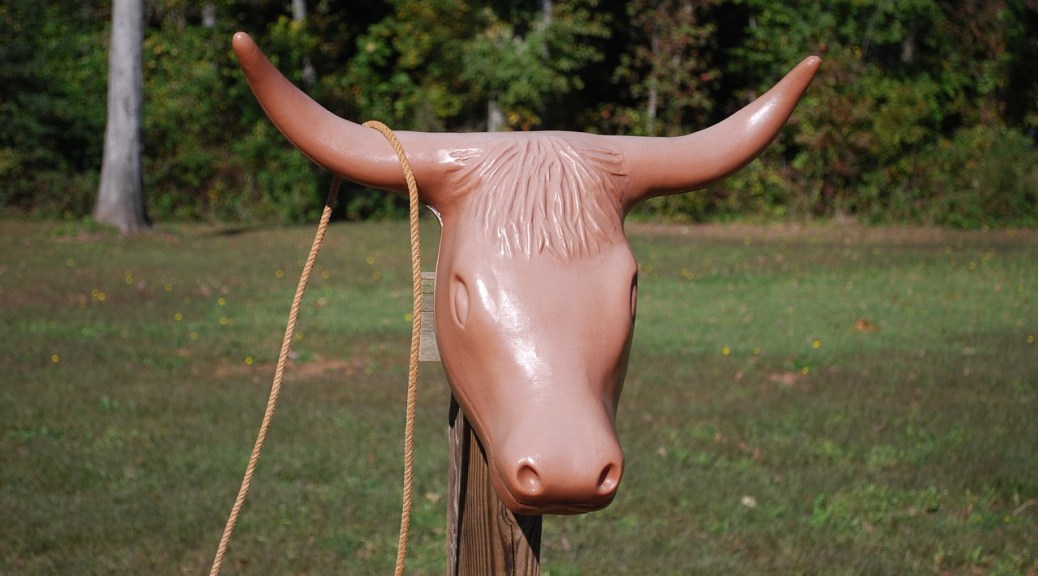
It has been quite a while since the police have been called or he has shown up in the paper. I was tickled the other day to see them in their front yard, each with a lariat,  roping a horned metal steer head.  They looked really happy and were encouraging and giving pointers to each other.  I wondered if they were  participating in team roping, which is a pretty popular sport out here. If so, I can’t think of a more appropriate activity for a heavy drinking couple who ends up in slugfests.  If you are going to win you have to be sober and you have to communicate well with your partner.  Maybe they can refine their technique by trying to rope the Dachshund. I don’t do marital therapy, but if I did, I might recommend lassoes  and metal steer heads as tools to find marital bliss.

What sort of hobby helps keep the peace at home?

My Political Journey

Header Image: Dwight D. Eisenhower Library [Public domain], via Wikimedia Commons

Today’s post comes from Steve Grooms.

My first political act came in 1952. I was ten. I sat on a city curb waiting for the appearance of the famous man who would soon be running for president. In my right hand I clutched a pennant that proclaimed “I Like Ike.”

And I did. Who wouldn’t like the avuncular, smiling war hero who had defeated the mighty German army? My parents were conservative Republicans. And, really, they didn’t have much of a choice. All their friends were Republican. My dad’s boss was Republican, which alone would have settled the issue for us. Everyone knows your political affiliation in a small town, and only a fool would endorse what his boss considered the “wrong” party.

My father, always the storyteller, filled my young ears with spooky images of Democrats. He told me Franklin Roosevelt allowed the sneak attack on Pearl Harbor to happen so the US would have to enter the war. Dad rejected Roosevelt’s “socialistic” economic policies. As poorly as my father regarded FDR, he had a much lower opinion of Eleanor Roosevelt. She was much too outspoken for a woman, and her embrace of political outcasts made him queasy.

While I considered myself a Republican until I went to college, it didn’t take long for the GOP to lose my vote. In my first week on campus, my dormitory fellows and I watched Richard Nixon and John Kennedy debate on television. To my eyes, Richard Nixon looked shifty and mired in the past. JFK seemed young, vigorous and sophisticated.

In that debate, Kennedy suggested the Republicans had allowed the Soviet Union to get ahead of the US in missile design. That charge came up weeks later during the beauty pageant to pick Miss Grinnell, our candidate in the Miss America contest. A pretty blonde in a swimsuit was asked her opinion of “the missile gap.” “This country could not possibly be behind,” she said, adding “And I’m sure we’ll catch up real soon.”

By the time I left college, I knew my core values defined me as a progressive, somewhere to the left of the Democratic party mainstream. And then Vietnam happened. Night after night, I shook with rage as spokesmen for Lyndon Johnson’s government went before television cameras to lie about the war. For me, the Vietnamese war was a radicalizing event that lasted eleven years.

I haven’t changed my basic convictions much in the decades since the US fled Vietnam in panic. I was ambivalent about the first Gulf War but unequivocally hated the second. And yet the passing years have made me relatively humble. I no longer burn with self righteous conviction on any issue. I describe my political affiliation now as “progressive,” whatever that means. The Democratic Party lost my heart long ago by neglecting common folks, choosing instead to cater to the wealthy, as if the other party weren’t already shamelessly sucking up to the most privileged sector of this society. I vote for Democrats because they are the least objectionable of the alternatives I find on ballots. I dream of a leader who would seriously address social and economic injustice. I yearn for a leader who will actually reverse the abuse we continue to heap on our environment. But I’m not holding my breath.

Oddly enough, I have had a dream featuring almost every president to hold office in my lifetime. In my Clinton dream I told him how deeply he had disappointed me. In a recent dream, a president chased me through a spooky Victorian mansion, shooting at me with a pistol. I wasn’t concerned, though. I remember thinking, “I’m good. That’s only George Bush trying to kill me!” My favorite presidential dream featured a conversation I had with Jimmy Carter. As we spoke, Carter’s face sort of melted, and right before my eyes he morphed into Eleanor Roosevelt. I remember thinking, “Gee, Dad was right all along. Jimmy Carter is just Eleanor Roosevelt come back to haunt him again!”

What has your political journey been?