Today’s guest post comes from Clyde in Mankato.
A few years ago my son gave me a book which summarized what we know about behavior of the myriad of American bird species. We know the easily observable, such as nests, eggs, migration. We do not know the more difficult to observe, such as territorialism, cooperativeness, life span, causes of death, and how monogamous various species really are. Studies suggest that, contrary to what is told, most species are not monogamous. When a clutch is analyzed, which ornithologists only rarely do, eggs usually have different fathers, which makes sense for the gene pool but destroys our anthropomorphic images of birds.
To study these behaviors for one species would require many hours of close observation of many individuals to describe the common behaviors.
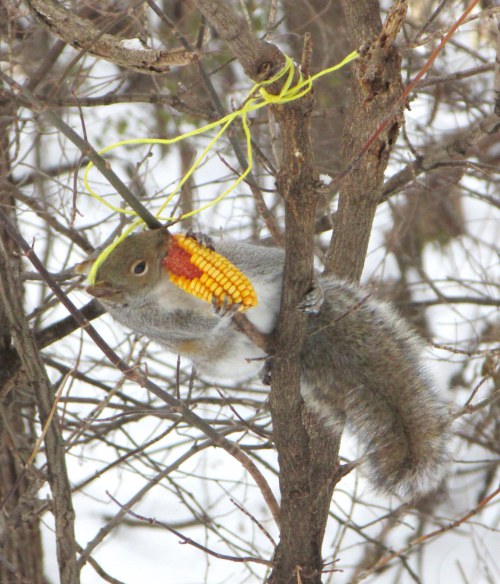
Despite all the time I have spent in the woods around squirrels and chipmunks, I know little about the domestic life of either species. But for three years I have watched a colony of squirrels by my patio. Squirrels are quick learners, very adept with their forelegs, and have good memories. They have memorized the superhighways, off-ramps, and local roads in the trees, which I can observe in the leafless winter. One squirrel learned to cut the twine holding an ear of corn. I then put small ears of corn in a suet feeder. She became very adept at manipulating the corn to extract kernels, food which is hers and hers alone.
Because they have accepted my presence on my patio, I have observed much mating behavior in birds and squirrels in the last three days. The second round of parenting has begun. Yesterday several small birds courted and mated in the trees, and a pair of squirrels tumbled and rolled in the grass a dozen feet from me before consummating their fervor, several times.
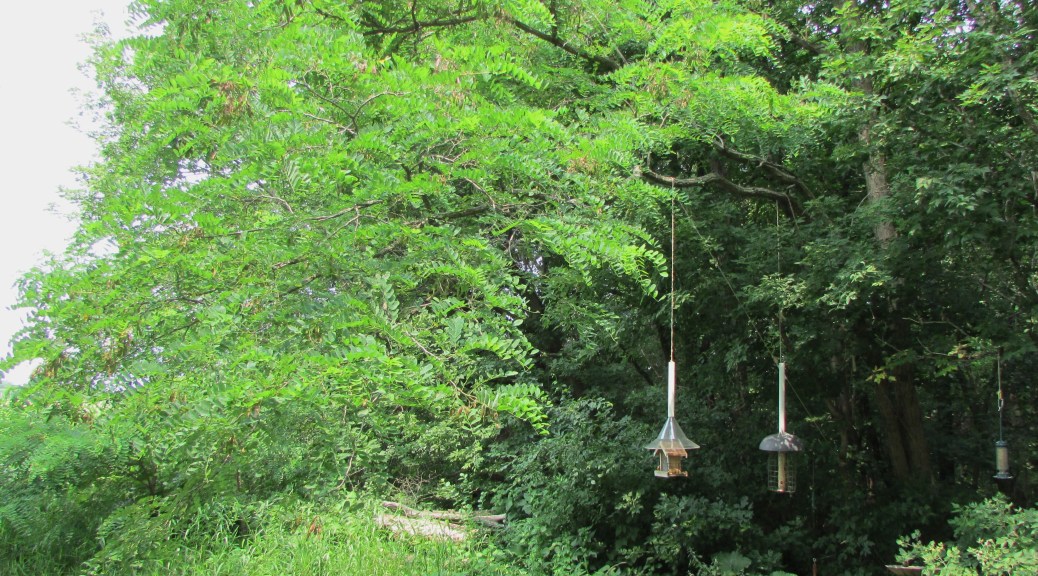
Above them a second pair of squirrels courted on a large tree limb, the limb shown in the header photo. One squirrel, male I presume, cornered a second squirrel, female I presume, at the farthest end of the many branches on the limb. They faced each other down for a minute or more. She could have easily dropped three feet to the ground. She did not. Instead she jumped to another branch. He found where that branch joined the tree and backed up to sit there. She leaped to another branch. He back up again. This happened several times until she had backed him up by the ropes, where no more branches grew from the limb.
They stared at each other from eighteen inches apart for another minute. The next courting move was—pun intended—anticlimactic. She ran right over the top of him and into the canopy. He followed in—pun intended—hot pursuit. Go ahead: anthropomorphize this behavior.
If I had the resources and time, I would sit in the great art museums of the world to study the art and to observe the passing humans and their reaction to the art. Fifty years ago I did this in the Chicago Art Institute. Most people’s reaction to most art was indifference.
If you had the time and resources, what would you sit and study, or ponder?