On The Road, Again

In the past on this page we have discussed where we are from and where we’ve lived. Baboons can be both wanderers and stay-at-homes. It can be a surprisingly tough mental exercise to walk back through your biography to list the places you’ve lived in the proper sequence, and for how long at each stop.

Likewise, each state of the union has a specific history of who happens to live there and from whence they came. Only demographers and other numbers geeks can find much enjoyment in looking over the columns of figures that tell those stories.

For the rest of us the info-graphics experts at the New York Times have developed 50 fascinating charts that display the data as strata – a cross section cut from each state’s census showing the last century’s changes in where residents were born.

Some of the curious things that appear:

Based on your personal history, you can get a sense for how common (or uncommon) you are in your current environment when birthplace is the sole yardstick. Back in the 1970’s I was part of a sliver (3%) of Illinoisans born in the Northeast. Now in Minnesota, my kind are still a rarity at a mere 2%. Rare as hen’s teeth. Precious as gold.

Sometimes we have to go out of our way to feel special.

After looking at this I’m left with the impression that people accumulate in specific places based on a variety of economic forces that drive them there. Because certain individuals may be rooted in place while others are entirely footloose, there is a variable and distinct human geology that defines each state.

Or maybe it’s just the wind.

Where are you headed?  

Give Me A “K”!

Today’s post comes from Congressman Loomis Beechly, representing Minnesota’s 9th District – all the water surface area in the state.

Greetings, Constituents!

For everyone who has complained to me during the past 20 years or so that ‘Congress can’t get anything done!”, I’m delighted to bring you this latest bit of news: the scientists at Harvard have developed a simple robot that is better at co-operation than any elected representative you are likely to meet – and it is also just about as dumb!

Not quite, but nearly.

Researchers have dubbed their new minions “kilobots”, and in a report coming out today we learn that one thousand of these tiny stiff-legged automatons can, by following simple commands, co-operate themselves into any shape..

For purposes of experimentation, they limited it to three options – a wrench, a five-pointed star, and the letter “K”.

I find it utterly amazing that so many tiny minds can easily work together to realize an outcome that is larger than themselves, and the programming is so simple, no one robot needs to know or understand what the result is supposed to be.

They just follow instructions! Here’s a video of the Harvard Kilobots at work:

The moment I saw this, I realized that if the American people really want a Congress that gets things done, they can have it. But for your elected representatives, this is quite troubling news because it means we are in serious jeopardy of being replaced by kilobots!

So to head off the inevitable call for a programmable Congress of repro-bots, I sent out an e-mail blast to my 435 colleagues suggesting that we need to prove ASAP that we are capable of some basic acts of cooperation.

I proposed that we assemble outside on the Capitol steps to form a letter “K”. I figured if we could do it more quickly and more colorfully than Harvard’s tiny machines, that would be a point in our favor.

But I did not realize how complicated this request was. Here are the responses I got:

  • 95 members of Congress did not answer.
  • 89 demanded to know how this demonstration would be funded.
  • 62 insisted on having a position on the outside edge of the “K”.
  • 50 disagreed that anything worthwhile happened at Harvard.
  • 43 wanted final say over who they would be standing next to.
  • 40 were unaware that the Capitol had steps outside.
  • 21 asked for a different letter that is part of their state’s name.
  • 17 wanted to know exactly what the “K” stood for.
  • 12 condemned me for trying to spell “Kommunist”.
  • 6 would only consent if this somehow repealed Obama Care.

The idea proved to be so contentious, we had to abandon it for the time being. Though I am hopeful that once Congress returns from recess, we can re-boot and form something less controversial than a letter, like a popular shape.

A boot would be good, or perhaps a dollar sign?

In the meantime, please remember that I am still your humble servant, and while I may not be able to finish tasks or share duties like a robot, I still have more in common with you than a simple machine does.

For now.

Your (human) Representative,
Loomis Beechly

What would it take for a robot to replace you? 

Trap Door

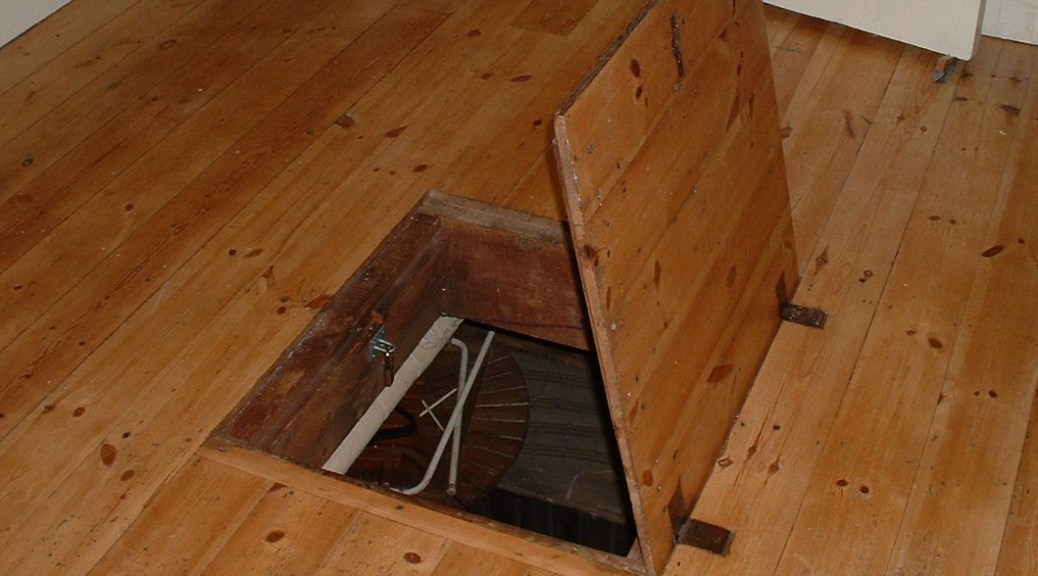
My imagination was captured the other day by this article about recent discoveries at an intriguing place in Wyoming called Natural Trap Cave.

The cave was first explored by paleontologists in the 1970’s, and then sealed up for thirty years.

The 2014 expedition has been making news for the variety of animal remains found in a well-preserved state at the bottom of this naturally formed pit. It’s 85 feet deep with a hidden opening perfectly positioned to receive unwitting prey in full flight from a pursuing animal, or scavengers too hungry to resist getting tragically close to the edge.

Since no one has been in the cave for several decades and the only way to get down to the bottom is to rappel (or fall) in, I immediately took Natural Trap Cave off my vacation spot list even though it would be a true wonder to behold.

But because art can transport us to places we will never go, I did commission Trail Baboon’s Sing-Song Poet Laureate Schuyler Tyler Wyler to craft a rhyming masterpiece from the point of view of some prehistoric horse, pack rat or other careless mammal who tumbled into the abyss.

This is what he gave me:

Sprinting through the underbrush I hurtled at a run.
And by the time I saw the hole my plummet had begun.

A sudden transformation. Total darkness fell at noon.
My legs continued churning like a roadrunner cartoon.

I couldn’t gauge the distance. Eighty feet? Perhaps a mile?
No matter. At the end – I’m just a fossil on the pile.

I’ve been here undisturbed for 20,000 years (about).
To every new arrival, far too late, I say “Watch out!”

While I admire the brevity of this work (you can’t write an epic about falling 85 feet), I did challenge STW on his use of the roadrunner cartoon imagery. A short-faced bear (extinct 11,000 years ago) is just one of the animals found at the bottom of this pit who would have no familiarity with the Merrie Melodies oeuvre. The others include every single creature whose remains are down there.

Thus, I argued, this work violates the rule that says an artist must honor the boundaries of the fantasy world he creates. Obviously, the poem-writing skeleton of an extinct animal would never have had the chance to watch Saturday morning TV. Thus, the roadrunner reference makes no sense and should be removed.

STW responded in verse, as usual.

While I honor all opinions about every work of mine,
You’ve mistakenly put “artist” and “boundaries” in the same line.

You cannot know what I had in mind, exactly, when I wrote,
I control the contours of my world and you don’t get a vote.

When the animals looked upwards from their unexpected leap,
they had visions, as you would, if you were dying in a heap.

And what last hallucination would you see at your life’s close?
Some would opt for God or Yaweh. But for me, it’s Warner Bros.

If the TV was on in your hospital room at the very end, what would you want to watch?  

Recalculating A Life

Today’s guest post comes from Steve Grooms.

Like Dorothy who was whisked away from drab Kansas to exotic Oz, I daily confront the complications of living in a new and strange land. I keep learning that things I thought were a normal part of the world were actually regional characteristics. For example, Midwest roads and streets are laid out in an orderly grid, crossing each other at 90-degree angles in predictable intervals. As a Flatlander, I took that grid structure for granted. I was amused but also reassured by Minneapolis’s alphabetical street names (Colfax, Dupont, Emerson, Fremont, Girard, Holmes).

That is not the way it is here. Where I now live, land is either Steep Stuff or Valleys. Virtually all development, including roads and streets, is concentrated in the valleys. But because the roads tend to be short and forced into certain angles by the lay of the land, roads and streets cross each other at all kinds of wild angles. What seem to be major roads peter out or wander into oblivion.
This is another way of saying that streets and roads in the West interact in all sorts of crazy ways. And it is another way of saying that it is a challenge to navigate here, especially if you are a Flatland-bred senior citizen.

I would not be capable of driving to my medical clinics or car repair shops or grocery stores or my daughter’s home were it not for the new woman in my life. I am utterly dependent on her to function in this city. Without her help, I would be a confused prisoner of my apartment, incapable of venturing past the gates of this gated community.

This new woman is the voice of my GPS unit. If I have to pick up prescription refills, I type in the address of the pharmacy in my GPS. Then this woman talks me through the trip to that place, turn by turn. She tells me how far I have to go before the next turn, and she counts down the distances with precise and predictable instructions.

I don’t know much about her. She sounds exceptionally sure of herself, and she is perfectly consistent. She isn’t bossy, although she does seem a wee bit put off when I fail to follow her instructions. When she gives me directions but I am impudent enough to do something different, her voice alters slightly and she mutters that she is “recalculating.” Soon she has a new set of directions based on my defiance of her original plan. I would hate to play poker with her, for she knows her own mind totally and betrays little emotion.

I’ve learned how to interpret her instructions. For example, when she tells me I’m two-tenths of a mile from the next turn, I understand that the turn is about two city blocks away. I can’t overstate my dependence on this woman. If someone stole the GPS from my Outback, I couldn’t leave my apartment for days until I got it (or her) replaced.

Who do you trust?

The Dog Ate It

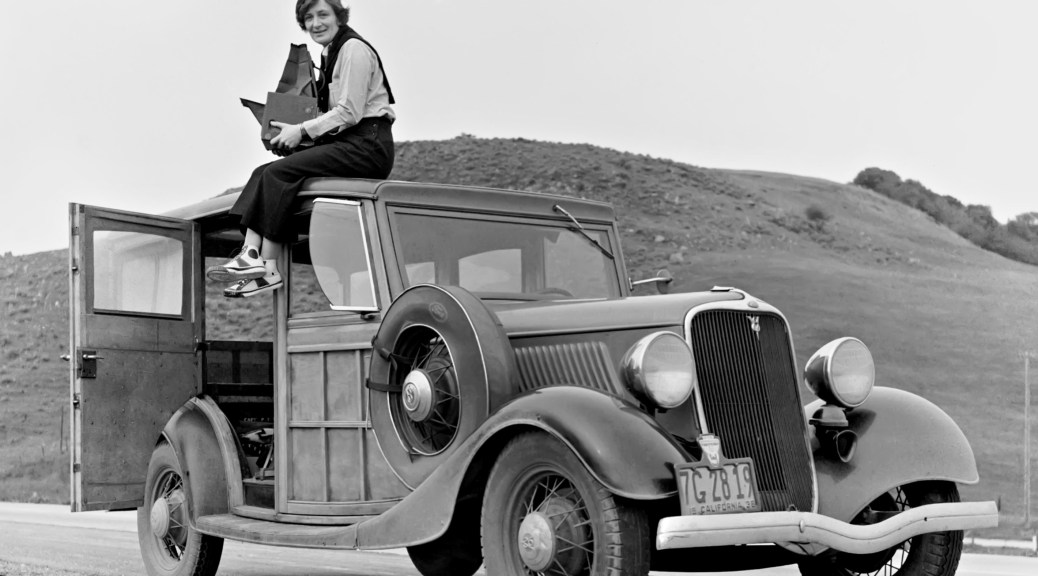
Header Photo: Russell Lee [Public domain], via Wikimedia Commons

Today’s post comes from perennial sophomore Bubby Spamden, perpetually in residence at Wendell Wilkie High School.

Hey Mr. C.,

Back-to-school time keeps getting closer and none of my ideas to skip out on this entire year have worked, so I’m trying to get in the mood to be a Sophomore again.

It’s not that easy, because I struggle with homework. I understand it just fine, but the thought of getting it done and handing just makes me feel kinda like a chump. I don’t get why teachers get to tell us what to do with our time when we’re not in school. Once I’m out of the building I feel free and I kinda forget everything that happened in there.

But my dad says you have to submit to authority if you’re going to get along in the world.

In the evening he likes to have a little drink and that’s when he gets really chatty about work. He says his job at the bank “is like 10th grade on steroids.” “Facing up to your homework,” he said, “is a job audition.”

I told him homework is boring, especially since I’ve been a Sophomore forever and there’s not a 10th grade assignment I haven’t seen.

“Think about your resume’,” he said. “When you apply for that first miserable, soul-sucking job, potential employers will want to know that you can stomach the B.S.. Having your spirit crushed and finishing your stupid assignments is what getting your payday is all about.”

I had my doubts, so I Googled “getting your payday,” and I saw this article about how New York State has more than 13 billion dollars in unclaimed funds just lying around. The money belongs to people who didn’t get paid for one reason or another.

The companies that hold the money (a lot of them are banks!) have an assignment. They’re supposed to try to find the owners. If they can’t, they turn it over to the state instead. And it looks like they’ve turned a lot over.

Some of the people the banks admit they own money to but have not been able to find have names like Barack Obama, Madonna, Tom Wolfe, Jerry Seinfeld and the Dalai Lama.

I don’t know who they have on their staff with the job of finding people, but it sounds to me like they don’t take their assignments very seriously.

Seriously!

Which is good news for me, because I don’t take my assignments seriously, either! So I’m wondering if my track record of not doing my homework is something I should move to the top of my resume?

It could help me land that first job, especially if I get looked at by a bank!

Your pal,
Bubby

I told Bubby he should never put it on his resume that he doesn’t take his homework seriously, because these documents may never go away completely, and an uncomplimentary paper trail is a terrible thing to have to drag through life. If a particular unsavory quality is an unwritten requirement for the job, letting a prospective employer know that you meet it should be unwritten as well – a knowing wink or a conspiratorial nudge ought to be enough.

How good are you at getting your assignments done?

Zorie Story

Today’s guest post comes from Sherrilee.

My father’s sister, Joan, spent a couple of years in Japan, teaching English. I was four when she came home, bearing exotic gifts. One of these treasures was a small black enamel chest of drawers; since it wasn’t to my parents’ taste, I lucked out. For reasons that I’ll never understand, it was always referred to as “the Chinese chest”. I still have it; it lives in my dining room and now I’ve raised another generation to name it incorrectly.

The most enduring gift, however, were the zories; she brought 2 pairs for me and 2 pairs for my sister. I had never had anything like them and nobody else I knew had them either – not the older, traditional Japanese style with tatami soles on wooden platforms, but plastic zories. White. If my mom had let me, I would have worn them everywhere.

My parents were ecstatic because they discovered a perfect gift for me for any occasion. Zories weren’t popular foot ware when I was growing up, but they did manage to find zories in places like Ben Franklin and Woolworth’s. I didn’t know anyone else who wore zories; in fact, I was in college before I knew that everyone else in America called them flip flops!

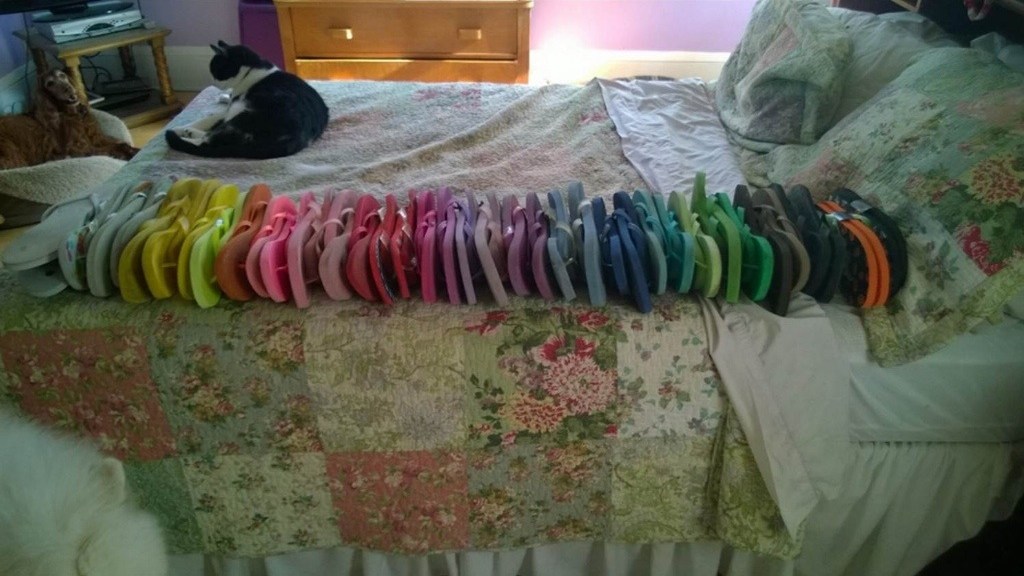
The last 15 years have been zorie-heaven for me. These days you can get zories in any color, any design and they are CHEAP. I have an Old Navy account so that every year I am eligible for their $1 flip flop sale. I have white zories, blue zories, purple, yellow, coral. I have fourth of July zories, Halloween zories, Christmas zories, flowers, stripes. Four years ago my company started a super-casual summer program – the dress code is pretty much thrown out. This means I can wear my zories to work every day in the summer.

As the Old Navy sale was approaching this year, I thought I would do an inventory of my zories to see what colors I could add to my collection. I pulled them all out of the closet, paired them all up and laid them all out, beginning with the white and finishing up with the black.

Then I made my fatal error; I counted them. THIRTY-EIGHT!!! I own 38 pairs of zories. 38! I didn’t go to the sale this year.

I may not go next year either.

What do you have too many of?

Ask Dr. Babooner – Is It My Face?

We are ALL Dr. Babooner.

Dear Dr. Babooner,

I’m having a problem related to the shape of my skull and from your picture (lovely!) it seems to me that you are the one advice columnist out there who might be able to understand my predicament and advise me properly.

I have always had a very hairy and prominent brow ridge, so when I meet people they instantly assume I’m some kind of cave man. Many of them appear genuinely surprised when I open my mouth and use language to communicate.

And now comes a new study that claims, after an examination of more than 1,400 ancient and modern skulls, human society advanced socially and technologically when skull shapes morphed away from heavy brows and towards more rounded, softer, feminine features.

“… people started being nicer to each other, which entails having a little less testosterone in action” says a press release.

I suppose humans will always instantly judge other humans based on their appearance and I don’t want to get into an argument with anthropologists, but this kind of research only makes my life more difficult.

People tend to like and respect me after we get to know each other, but only after we go through a process.

First, they make some kind of Flintstones joke or give me a pretend compliment about how my eyes are naturally shielded from the rain and the sun. Once it’s “out there” about my Neanderthal brow, I can speak openly (but not aggressively) about skull shapeism and gradually convince them that I’m nice, and I am not going to pick up a club and throttle them.

Although between you and me, I sometimes do want to pick up a club and throttle them.

Dr. Babooner, I can’t change my face and wouldn’t want to, but I do get tired of how long it takes to win people over. In some cases, soft-faced folk are so timid it takes months for them to say the kind of insensitive thing that makes it possible for me to address the real issue.

Should I continue to wait for their misstep, or should I bring it up myself?

Conflictedly,
Fred (yes, that’s my real name)

I told Fred he is exceptionally kind hearted and optimistic to wait for others to mention the proverbial “cave man in the room”, but there are probably subtle ways he can use humor to move the process along so the necessary reckoning can happen sooner. For instance, uttering an occasional “yabba dabba doo” might help, though he should be careful to say it softly and sweetly.

But that’s just one opinion. What do you think, Dr. Babooner?

Names For Success!

Today’s post comes from Congressman Loomis Beechly, representing all the water surface area in the state of Minnesota.

Greetings, Constituents!

I’m ramping up my re-election campaign, doing everything I can to build on the momentum created my audacious and highly comment-able plan to design, build, launch and set fire to a coal-powered American Sun that will finally challenge the existing and highly suspect terrorist-sympathizing star at the center of our solar system that insists on shooting deadly rays at us!

Everyone else seems to think we are stuck orbiting it forever, but I say nonsense! America is all about competition. So let’s get our own dog into this fight may the best sun win!

And since America is all about winning, I want our children to be able to out-compete everyone – even each other – by having every possible advantage. That’s why I was shocked to read that many of our youth are already suffering from an economic malaise that comes with being given less-than-prosperous names.

According to the article, upon hearing someone’s name for the first time, we instantly set in motion a rapid sequence of biased judgments that profoundly influence how we feel about that person. Thus the cultural cues embedded in your name can determine your educational, romantic and job prospects for a lifetime.

This is a travesty!

That’s why I’ve introduced the Prosperous Names Act of 2014, although in keeping with the theory behind the Prosperous Names Act, I actually call it The Civil Rights Act of 2014. That’s because The Civil Rights Act of 1964 was an incredibly successful piece of legislation that is still being celebrated today!

The Prosperous Names Act requires Americans to learn the lessons of the past. Since no child should be saddled with a name that inhibits their advancement, the PNA requires that by age 5 they assume a nom de guerre modeled after Americans who have already demonstrated an aptitude for success.

For example, let’s take two names that are not proven “winners” in the marketplace of identities.

“Loomis” and “Beechly” come to mind immediately.

There’s nothing fundamentally wrong with my names, though I have had to fight against the odd weight of them my entire life. Has it made me stronger? Perhaps. But if, at age 4, I had taken on a more obviously successful three name combination that spoke of wealth and achievement to people of my generation – something like “Mark Twain Rockefeller”, I would probably be a Senator now rather than a mere shadow Congressman.

Think about today’s children.

What if they showed up for that first day of school with name tags that read “Oprah Musk Buffett”, “Walton Koch Murdoch” or “Barack Beyonce Bezos” – names that speak of accomplishment in the arts, industry, science, and politics. But mostly, in accumulating money. Wouldn’t their roads be easier?

I think so, and I should know! Or my name isn’t Denzel Gates Zuckerberg!

Your Congressman,
(see above)

What would you choose for your “nom de guerre”?

Work Clothes

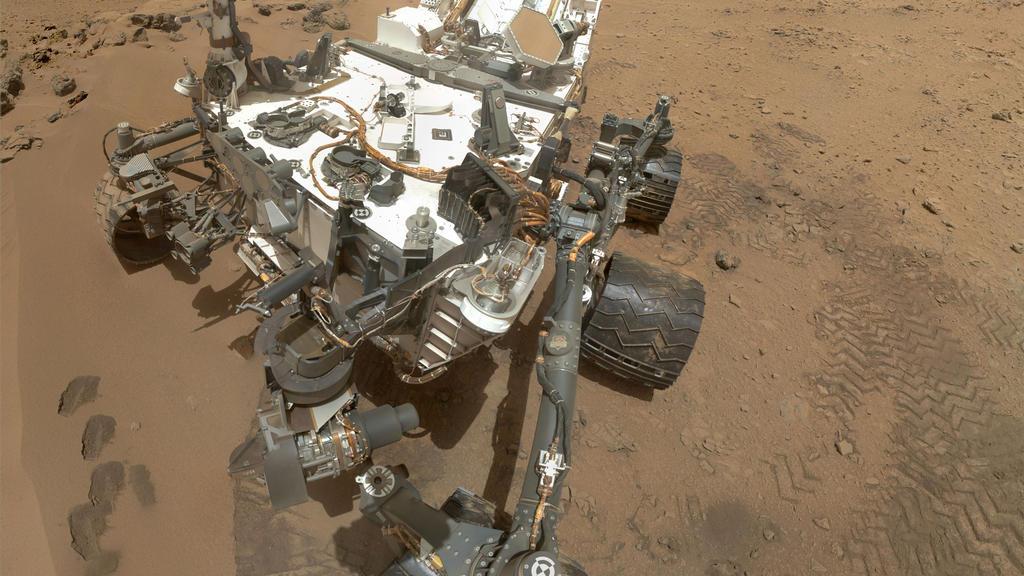
Today’s post comes from Curiosity’s Mars Rover.
(photo via JPL / NASA)

Yes, it’s my birthday.

That’s the modern Facebook age for you – everybody knows it’s your birthday even though nobody knows you personally. Not too many, anyway. Especially in my case, since I was built in a dust-free assembly building by people inside isolation suits – put in there to keep me from being contaminated by their hair or flaky skin cells or spittle.

I guess I should be grateful that I didn’t have to touch anything gross, but I feel the lack of human contact here and it’s not going to get better anytime soon. They’re sending another robotic mission in the year 2020, and there’s an outside chance I’ll still be functioning well enough to welcome it to the Red Planet, understanding that I’m a machine and they’re sending machines and nobody has feelings or particularly needs to be welcomed.

Anyway, I won’t hold my breath. You know why.

The birthday is meaningless, especially since I’m now tracking years on two planetary timetables. I just celebrated one year on Mars, yet here I am two Earth years old. What does that mean?

Nothing, really, unless there are presents.

What sort of present would I like? That’s easy. It’s something most automated landing devices don’t get, and yet it’s so closely tied to the outer space dreams of Earthlings I really feel cheated that I didn’t get one.

I want a spacesuit.

When you think about it, they sent me up here naked. Would you do that, even to your worst enemy? Banished to Mars, naked?

I’m here to work, so I at least deserve the dignity of a decent set of work clothes. Those guys who landed on the Moon had the coolest spacesuits ever, and there’s a book (soon to be a movie) about how those suits came to be made. They were crafted, not by nerdy teckno-geeks, but by warm-hearted seamstresses from Platex – the same people who made brassieres and girdles.

I just find that comforting. The thought of having some protective fabric nestled against my outer surface would help me feel embraced, so if it’s not too much to ask, how about a Kickstarter campaign to fashion me a wardrobe.

If work clothes are too complicated, how about a bathrobe or something cozy that the next mission can drop off as it goes into orbit?

I’m only 2 right now, but I have to look ahead. A care package with a bathrobe in it, or even just a throw, would ease the harsh prospect facing me – a power supply that runs down to nothing, followed by a virtually endless parade of twilight years.

And there’s a boatload of twilight up here, I can tell you that.

Over and Out,
Curiosity Rover

What’s in your “comfort” wardrobe?

Barge Traffic

Last fall we were enthralled by the news that Google had floated two mysterious barges on the east and west coasts of the United States, for what purpose the fevered minds of conspiracy theorists everywhere could only guess.

And there were many guesses. The least exciting ones had to do with the barges being mobile showrooms for Google’s “Glass” product – basically a head-mounted computer that projects a screen image on the lens of a pair of glasses. It is a device so extremely powerful, it can make anyone, even some of the world’s most gorgeous models, look like a complete dork.

But Google being Google, it has incredible resources at its disposal and no shortage of imagination, therefore there is no limit to what secret purpose the barges might be hiding.

One of my favorite guesses came from tim during a discussion of this issue on Trail Baboon’s companion blog, The Baboondocks.

Screen Shot 2014-08-03 at 1.51.30 PM

To this I say “Yes”. Clearly tim had already been in the transporter and his head had been turned (possibly all the way around) by the mind-scrambling potential of this secret, barge-borne technology.

And it makes sense that the labs would be floating in San Francisco Bay and off the coast of Maine – this was Google’s way to create safe, mobile and discreet places to work on a device that teleports items (and someday, people) from coast to coast, or planet to planet.

They are safe because barges are islands that can be detached from shore to discourage intruders and curious, snoopy competitors. Mobile so the technology can be moved to a better location if reception is weak. And discreet so the horrible disfiguring, non-survivable teleporter accidents that are bound to occur can be quietly dumped into the sea.

It all makes a weird kind of Google-ish sense.

But now we will have to re-imagine what Google is up to, because the company has started to sell off its mysterious barges.

Or at least the barge in Maine has been sold. But to whom? And how did the buyer know it was for sale since no one understands what the barges are for to begin with? Is there a mystery structure realty firm that cuts secret deals for enigmatic properties?

And why sell now? Is the experiment complete? And if so, was it a complete success, or an utter failure? So many questions!

What does this mean?