Category Archives: gardening

Late June Farm Report

Last week of June – The crops are looking better. Still need some rain, (all day rain on Saturday only gave us about 1/4 of an inch), so better than nothing, but keep it coming. I say that carefully.

Corn is finally tall enough and filling in enough I can’t see all the bald spots.

Soybeans are looking good and starting to get bushy and fill in.

Oats is all headed out – looks pretty good, looks like there will be a lot of grain out there. Knock on wood.
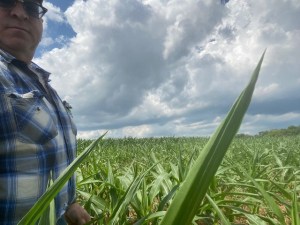
I changed some field boundaries this spring, so I’ve got one corn field that used to be two separate fields. This particular corn field was corn last year on half of it, and the other half was soybeans last year. (Normally crop rotation: soybeans last year means corn this year. Corn becomes oats, oats becomes soybeans. That helps with weeds, soil pests, and erosion.) But what’s really interesting is the corn on corn looks better and is taller than the corn on soybeans. And the only difference is the corn field was plowed up last fall, and the soybean field wasn’t. Is it soil compaction? Root structure? I will dig some up and investigate the roots. It’s very interesting; I need to ask more questions about why this looks so different.

I dug these up when the corn was about a month old. Notice the seed still down in the roots. And the other seed that just never sprouted. That was our spring. 

Been fixing stuff. Picked up parts. A bunch for the corn planter (new fertilizer disks and bearings) and some belts for the lawn mower, a new mower bearing, and other odds and ends. The lift bracket on the corn planter, the thing that actually raises and lowers the planter, was just wore out.
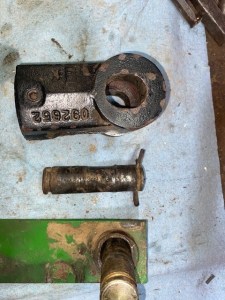
Replaced the pin and bracket, added some weld to the hole in the cylinder end so it’s more ‘round’ again. Then I ran into something and broke a big chunk out of the lawn mower hood so had to buy a new hood. I told Kelly I could just take the hood off and we could go ‘red-neck’. (And I did for a day while working on other parts) A friend put it best when he said, ‘You go redneck and pretty soon you’re judging yourself’. Yep. Good point. No trip for parts is complete without a stop at DQ.

Then the electric clutch that starts the mower wore out so replaced that. I’m also trying to get an older mower running again to use for around trees and to mow in the random areas. I’m mowing more area than I used too; behind barns, up in a grove, all in an effort to keep the weeds down.

I mentioned the barn swallows that have two nests by our front door. Here’s the kids’ double nest.
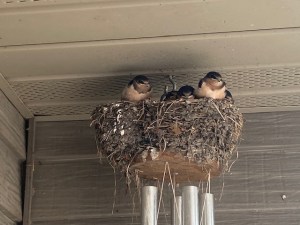
The parents’ condo is on the left side of the door. The kids took flight the day after this was taken.

My chicks are out in the world now. Of the 45 chicks we received on April 14, a few died as chicks and we let 36 out into the open. So far so good out in the world.

I’ve ordered 30 ducklings of mixed breeds. Be here July 27. I really do enjoy having the ducks around, but my goodness are they messy for the first month or so. Water and muck everywhere. I have a bulk bin down by the barn where I store cracked shell corn for the chickens and ducks. I toss some on the ground and I have some in feeders. They prefer it off the ground, I think. Course that also attracts squirrels, rabbits, birds, and, in winter, the deer and turkeys. 

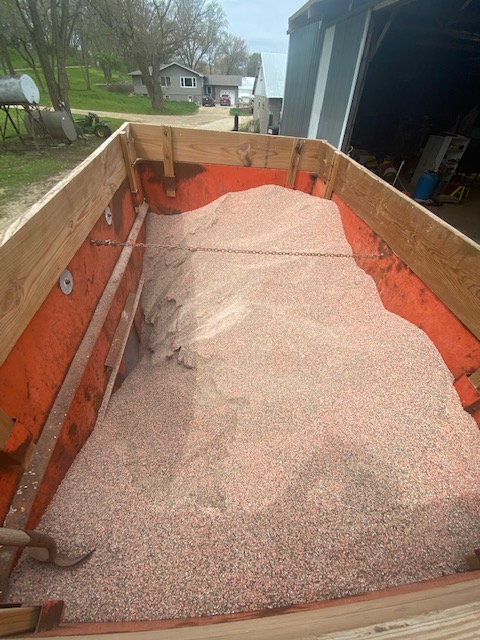
When I was milking cows I had protein supplement stored in this bin. It feeds from an auger into a box inside the feedroom and I fill buckets from that box. It holds maybe a week’s worth of corn in the box. A few weeks ago, when it was so hot, I just got corn from the box and I didn’t run the auger at all. Never really thought about it. And then when I did turn on the auger, no corn came out. Well, sometimes that happens as the bin gets low; cracked corn doesn’t always ‘flow’ very well and sometimes I get a hollow spot. I climb up on top and I have a long stick that I use to knock the corn loose. (I do not get inside).

And what came out was this brown, liquid, sludge! Ewww! I don’t know what that was!! EEEEWWWWW!! It was really gross. There was a fair amount of it, like maybe a couple gallons. Here’s what I think happen: Sometimes when I get corn delivered, the previous load may have had liquid molasses added to the feed. I used to do that when I had calf feed made. And I’m wondering if maybe there was some of that old feed / old molasses down in the bottom, and it go so hot, the molasses all melted and sank to the bottom. Could that be a thing?? Because I’ve never seen it happen before and this stuff didn’t stink like anything rotten… Once that slug was out, it was back to corn and it hasn’t been a problem since. But I run the auger every few days too, now.

Weird.

Wild black raspberries are out; they’re early this year. But just as yummy especially early morning when they’re still cool.

A former college student has been coming out to help on the farm lately. I enjoy the company and It helps me focus and get some jobs done. He’s also applied for a new job and the hours won’t be compatible to here. Such is life.

Got some big summer plans? Making any progress on them?

Committing Thuricide, or, a GARDENer’s Anxiety

Husband and I are traveling to Tacoma, WA on Monday to see our Daughter. We will be gone for a week. This week we are prepping our gardens for our absence, watering like crazy and taking care of any garden pest and disease issues.

Due to the lack of humidity and the isolation on the Northern Great Plains, we have a comforting lack of pests and diseases in our gardens. We rarely need to combat anything, but there are a few persistent garden problems that require action.

We somehow have blight problems in our tomatoes and roses that require an application of fungicide. I sprayed with Daconil last night. Last year, we had flea beetles in our kohlrabies that required insecticide. I applied some Sevin to some chewed up kohlrabi plants last night. The potted tomatoes and peppers in the church garden need something called Rot Stop to combat Blossom End Rot. (Calcium uptake in a pot is difficult at times.) We also have cabbages that need help with cabbage worms with Thuricide, or Bacillus Thuringiensis, which is an organic worm deterrent. No worms in our Savoy cabbages!

How do you deal with life’s pests, garden or otherwise?

A Delight to the Eyes

Our hot weather retreated last week, and by Friday it had cooled off substantially. Gentle rains came, and I stood at the front door on Saturday watching the rain fall straight down, with no wind, which is rare here. It was a delight to watch.

Our roses are blooming, and the garden veggies are looking strong and healthy. We weeded all over our flower and veggie beds, laying down newspapers and covering them with dirt to keep the weeds minimized for the season. The absence of weeds is so lovely, and the plants stand out and look really nice. I had forgotten how pretty eggplant plants are. There are visual delights all around. I just have to remind myself to look for them.

What has delighted your senses lately?

Confusing directions

We like to grow dahlias in our garden, even though our winters are too cold for them to winter over. We don’t have a cold room in our house to store dug up dahlia tubers over the winter to replant in the spring, so we order new tubers every year from wonderful place in Washington State-Swan Island Dahlias. Their instructions for successful dahlia growing are sort of confusing.

We are to plant the dahlia tubers in rich, moist, soil, but are instructed to not water the tubers until the shoots emerge from the soil. They will rot if we do. It may be ok to water if it is dry or if they are in pots, but that is dicey. It is hard to know what we are to do. What is too dry, and what is too wet? I am happy to report that five out of seven dahlia tubers are emerging from the soil with some watering here and there, given our dry spring, but I still have anxiety about the watering issues. I still don’t know what I am to do!

What are some confusing directions you recall? When were you at a loss about what to do?

Silly Garden

We started out the garden year hopeful, but restrained, planning to reduce the number of tomato plants to eight, shorten the kohlrabi row, and stick to twelve pepper plants and the same number of peas, beans, cabbages, beets, and herbs from last year. We agreed on two hills of cantaloupes.

We neglected to factor in Husband’s anxiety. He is in charge of our church vegetable garden, and we have had to replant some things there due to extreme wind and unfavorable conditions. Husband is always planning for the worst, and that means that he scouts out bedding plants and seeds “just in case” we have to replant. Of course, he always purchases many times the number of replacement plants that he needed. I have taken excess bedding plants the work three times to pawn them off on my coworkers

At the present time, in our home garden we have fourteen tomato plants, fourteen pepper plants, and a bush cucumber plant (“Renee, those cucumber plants needed good homes”). There are six eggplants stuck in odd places in a flower bed on the south side of the house, five hills of cantaloupes, and three butternut squash plants. It looks very silly, with the odd vegetable stuck here and there quite haphazardly. I was lucky to find eight dozen Ball canning jar lids on Amazon, preparatory to what could be a real avalanche of produce needing to be canned.

When have you had too much of a good thing? How does anxiety make you do silly things? When have your plans not worked out like you wished?

Crop Report

Today’s post comes from Ben.

As I write this we’ve had an inch of rain and the temps are cooling. Sometimes we call them “Million Dollar Rains”, this one was a $100,000 rain.

The first few weeks after planting, I spend a lot of time driving around checking on fields. Crop Scouting is really important the first month, and then throughout the summer, but the first few weeks is when we learn the most.

Just like your gardens, we’re watching to see how things are growing and what weeds are coming.

I’m generalizing here; every farm is different and different parts of the country plant different. I mentioned before, the corn was planted at a population of 33-34,000 plants / acre. So, there should be a plant about every 6”. Two together is a ‘double’, and a blank space is a ‘skip’ and that tells me how the planter is working and what I may need to fix for next year. And where there are skips, I might dig it up and see, is there a seed down there that didn’t germinate? Maybe it germinated but didn’t emerge; it’s all very telling. And then the first few inches it grows, it’s so interesting to see how the root develops.

Corn just fascinates me; the seed actually stays in the ground and the root goes down, the stalk comes up and the ‘growing point’ stays underground for a long time. That’s why a freeze or hail won’t necessarily kill a corn plant. Whereas soybeans; it’s the seed that comes up out of the ground. So, if it freezes, it’s done.

This website has taught me a lot about corn development:

http://www.soilcropandmore.info/crops/Corn/How-Corn-Grows/

This year, with the hard rain, soil crusting, and then cool weather and wet weather, I lost a lot of corn that didn’t emerge. And yet when I compare fields planted after the rain to those planted before, it all looks just as rough. It was kind of a mystery to me and I kept thinking it’s was  rather unfortunate this was the year I got so much planted on the first day (because of the hard rain). And then NATE,  one of my seed salesman came and looked at the corn. IT’S NOT MY FAULT! YAY! Turns out this particular variety had trouble this year. There are dozens of varieties of seed and most are tested pretty well to judge how it will do with drough tolerance or pest resistance, ect. Guess this one hadn’t been tested for this year’s weather. When I measure out 17’6” (1/1000ths of an acre) and count the plants, that gives us an estimate of the final stand population. I’m counting between 23 and 26 plants. 23,000 plants is a lot less than 34,000. Do the math: missing 11,000 ears, 200 ears = one bushel = 55 bushels less / acre. In a good year I get 160 bushels / acre. I’m thinking the ears will be bigger this year since they’ll have less competition and more sunlight…. ?? J

If I had decided to replant the corn, they would have given me seed to replant free of charge. But I decided there was enough plants there that it didn’t make sense to replant. So, they will refund the cost of my seed. I still paid for fertilizer and spraying so those expenses are already in the ground. And it’s not like there won’t be any crop (Knock on wood; we’re not there yet) but it just won’t be the bushels it should have been.

I’ve been taking lots of photos, but the camera doesn’t capture it very well.

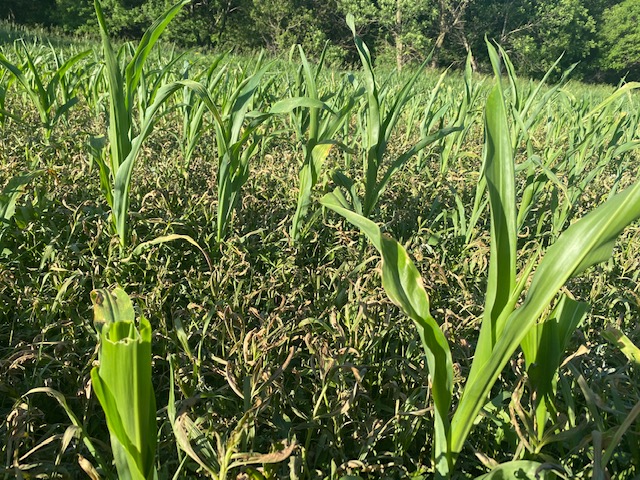
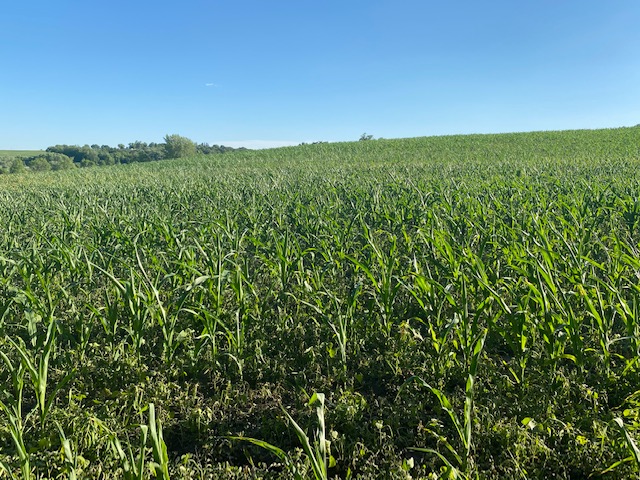
Just notice the leaves curled up from the heat and lack of rain. Notice the uneven stands, the varieties of green color. The deer eating the tops. This corn is thigh high. Now with the rain it will be doubling in height quickly.

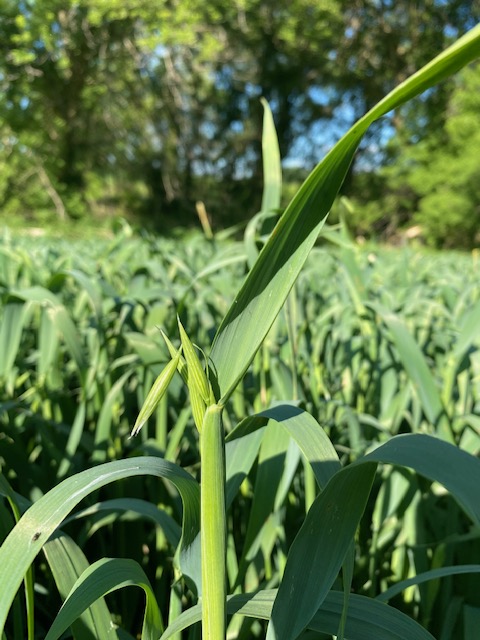
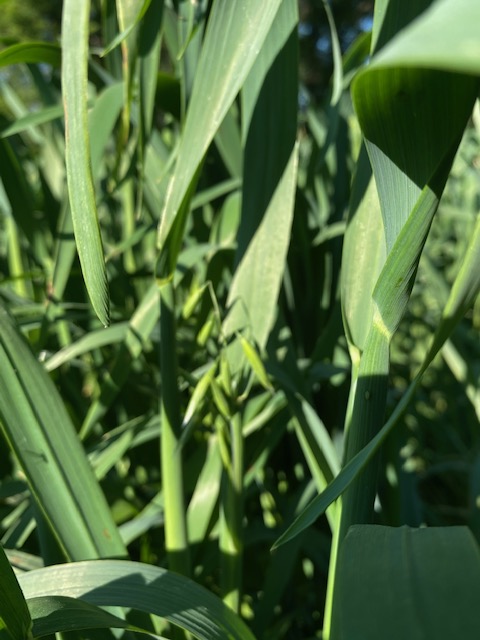
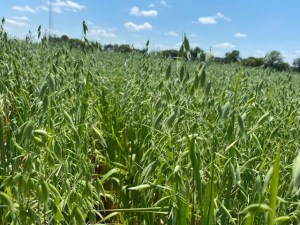
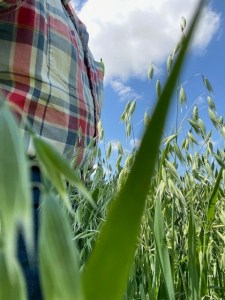
Oats has just headed out; looks like a lot of grain out there. Again, noticethe shades of green… it should all be dark green and I’m not quite sure why it’s so uneven this year. It’s a new variety for me, and maybe that’s what this one looks like. See the strips of dark green that’s taller than the rest? That’s where the PTO shaft on the fertilizer spreader broke and it was making a ‘streak’ of fertilizer.

Things to watch now: as the oats starts to turn color and get ripe, the stalks get brittle. Storms can knock it down, break it in half or even lay it flat. When trying to cut it, broken or flat makes it hard to pick up to cut. There is a fungus called ‘rust’ that can hit oats hard. Makes it brown and dusty and more brittle than usual. I have the corn sprayed to prevent that. Just as the kernels emerge, that’s called the ‘boot stage’.

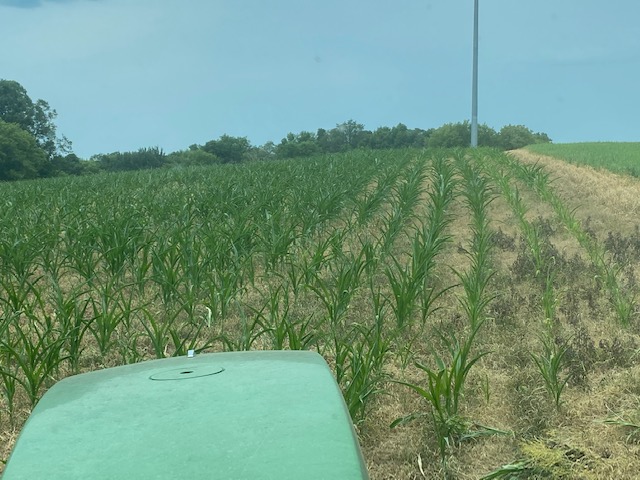
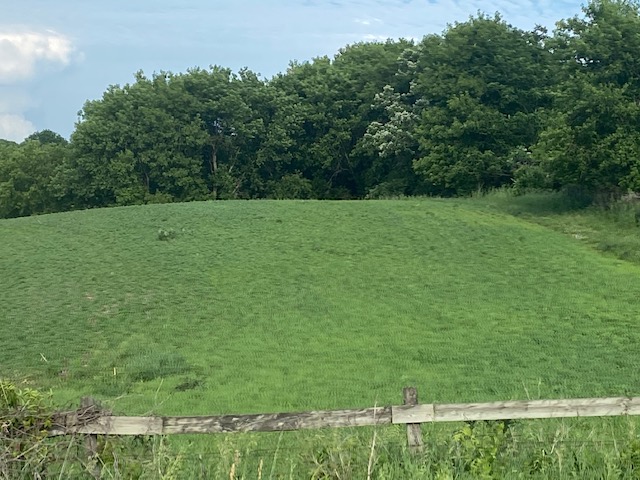
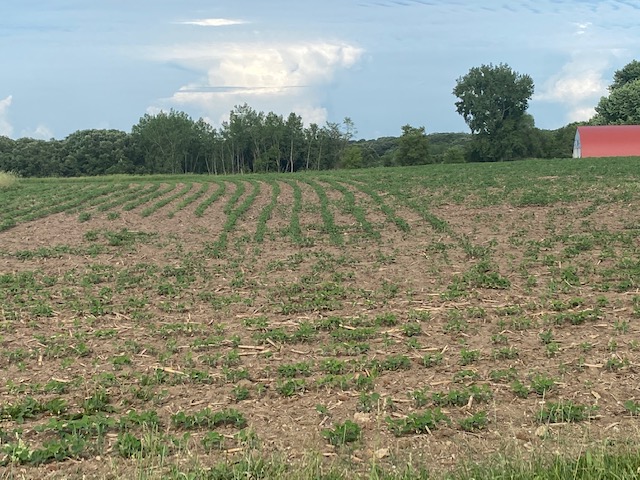
Soybeans are looking OK. See this one field that looks like a lawn? Just all green? That’s a field I plant for a neighbor; he just uses it as a food plot. I didn’t have that one sprayed with ‘pre-emerge’ grass control like I did on my fields. It was my control field. See the rows on the others? With out the pre-emerge spray, they’d all be solid grass. Definitely a benefit to that. Then later I have it sprayed for ‘broadleaves’ and volunteer corn. I used the drill to plant the beans and I said they were sort of ‘clumpy’; you can see that in these photos. Again, it’s doing OK, seed spacing isn’t as critical for beans.

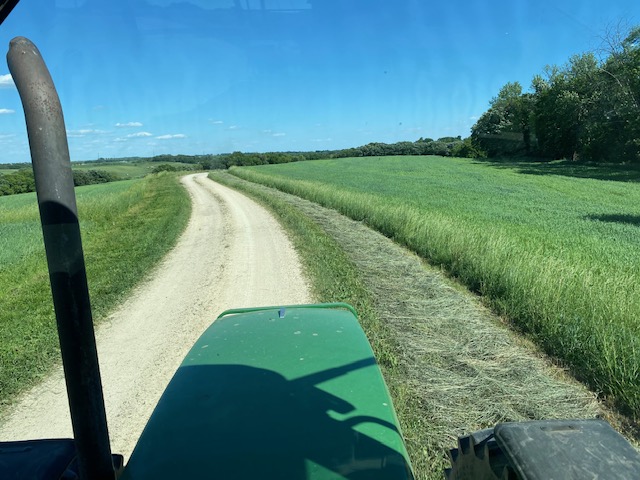
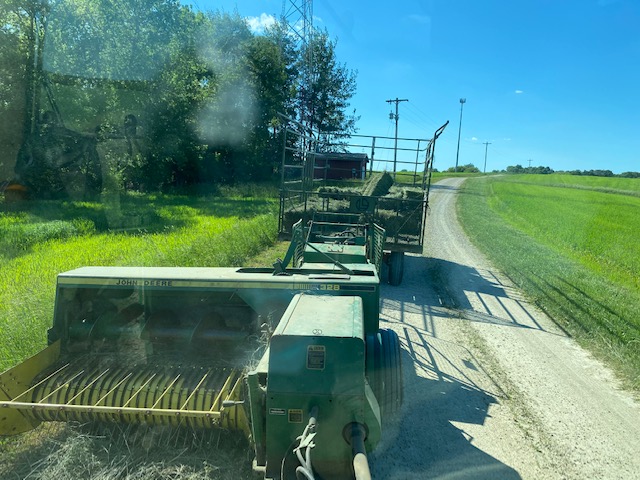
I mowed the roadsides last week. Got 50 bales of grass hay off that. Some neighbors will take that.

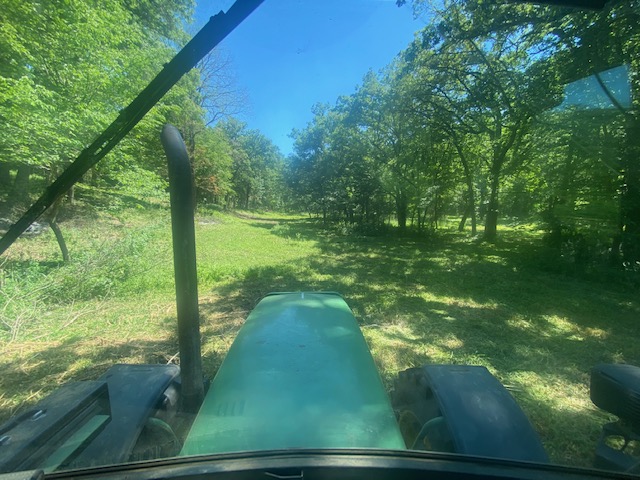
Mowed down in the woods for another neighbor. He’s been clearing buckthorn and it looks really nice down there now.

Also mowed an area I call ‘The Swamp’ since it was so dry. Turns out it wasn’t as dry as I thought…

Do you play the lottery? What’s the biggest prize you’ve won?

Lemonade Stand

Our city council declared June 19th to be Lemonade Day, and encouraged local children to get out there and sell lemonade. Our next door neighbors, ages 5 and 7, rose to the occasion and set up a stand in their front yard with the help of their mom. She baked cookies and brownies. They had pitchers of plain and pink lemonade. A glass of lemonade and a baked good cost 25 cents.

It was a hot and sunny day, and we were out in the front yard working hard in the garden. We were, of course, invited over to sample the lemonade and goodies. Husband paid them $1.00 for each of us, and the children assured us that we could come over for free refills. They came over to help us pull weeds in between customers. When they got really bored they played kickball in the driveway. By 4:00 they were done, and the stand was dismantled.

It was really nice to see all the people stop. The children were so excited when they had customers. There was a near disaster when their two year old brother tried to carry a lemonade pitcher over to our yard, presumably to fill our glasses. He likes watching us in the garden, too.

Did you ever have a lemonade stand? Describe a memorable summer day.

Paved Intentions

I’m not a math whiz but there is one formula that I know really well:

Yardwork + Verily Sherrilee = A Filthy Mess

When I had the new driveway put in, I also asked them to put in a sidewalk from the house to the garage.  For many years, I’ve just had paving stones, which look really good for about an hour after the grass is cut and that’s their only saving grace.  Well, that and they were cheap. Otherwise, they’ve been a pain for years.  Even so, I couldn’t bring myself to just throw them away when the new sidewalk was installed.

YA and I have wanted a little patio under our backyard table for years, so this past Saturday, I decided to re-purpose the paving stones into said patio.  And it was pretty clear early on that I would be invoking the Yardwork/Filthy Mess paradigm.  You wouldn’t think that a 4’ x 4’ square, 2 inches deep would create so much extraneous dirt; I certainly didn’t and I was quite wrong.  It was easier to excavate the space by hand to start with and pretty soon, I had dirt all over myself, including knees, ankles and feet.  I had abandoned my gardening shoes early on – too hot.  Of course sweat and dirt together meant that I was dirty everywhere else as well.

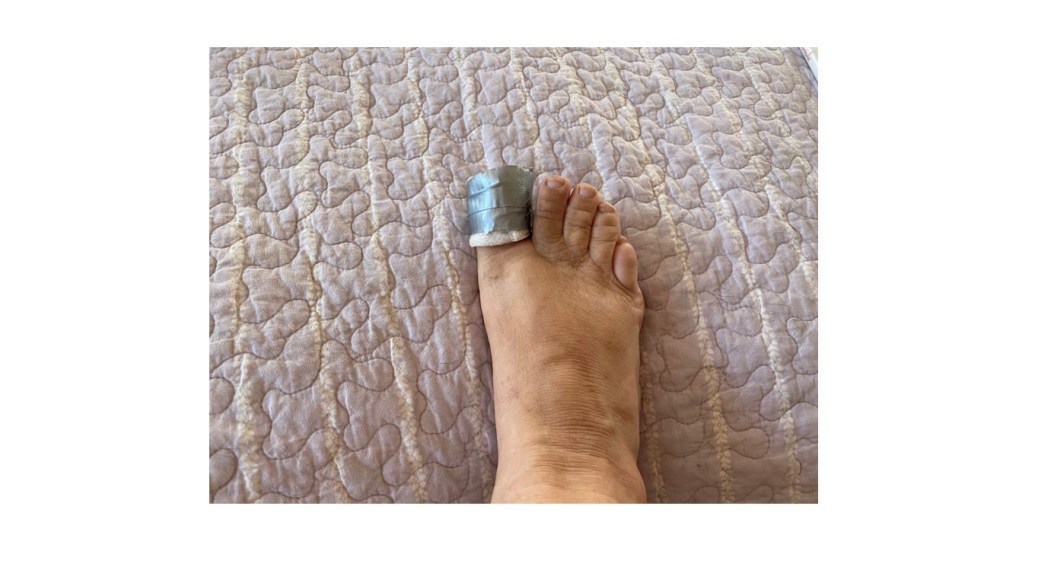
I was very careful with the paving stones as they weigh quite a bit.  As I picked up each one I said to myself “go slow, be careful”.  Every single stone (9 of them).  I even said this to myself as I wiggled the last one into place.  Right before I lost my hold on it and it crashed down on my big toe.  I got a pretty good gash and the blood looked really dark as it bled onto all the dirt on my foot.

I was so close to the end of the project – I didn’t want to lose my momentum but I also didn’t want to bleed all over and get who knows what kinds of germs into the wound.  Looking down at myself I realized that I was too dirty to go in the house and certainly too dirty to go upstairs to the bathroom where there bandaids are kept.

I had YA go inside and get a couple of paper towels while I hosed off my foot and toe.  She came out with a paper towel and DUCT TAPE!  That’s my girl.  I wrapped the paper towel around the toe first and then liberally applied the tape.  Voila – good enough to let me finish up the project!  It’s made me realize that while YA can do yardwork without attracting every dirt particle within a square mile, she HAS inherited my feeling that the wrong tool at hand is always better than the right tool that is not at hand.

What’s your favorite cleaning supply? When have you had a filthy mess? When have you gotten spectacularly dirty?

Early May

Today’s post comes from Ben.

Mid June. It’s dry, we need some rain. Corn is curling up from the heat. My crops look terrible this year. Corn was planted a little light in the first place, then it didn’t emerge well, and now it’s dry and the deer are eating it… GDU’s: 946 to date, +291 above normal.

Oat’s is just about to head out, in fact it will be by the time you read this, – seems later than some varieties, and this is a new variety for me so… I guess it’s OK; better not to be headed out when it was so hot, the heat just boils the milk out of the heads anyway.

I told Kelly the crops are all in that adolescent stage and they all look terrible. Corn is knee high already, well, some of it.

Soybeans are getting there, look OK when you look down the row, then I look across the field and see all the skips and misses and it looks terrible again.

Back in blogworld, I finished planting soybeans on May 10th. That’s ahead of most years. Some years I’m still working on corn at that point.

When planting any crops, the trick is to have just enough seed to finish, without having too much left over to clean out of the planter. Soybeans are easy because the rows don’t really matter for harvesting, so I can just drive any which way in the field to run out the seed. Remember I had plugged up every two rows? I pulled the tape off and planted at 7” rows just to use up the seed. Once around the outside of one field did it. Oats is the same. I mean I try to figure it so there’s not a lot left in the first place, then just run it empty.

Corn is a little harder as the rows have to line up. I save the left over seed to use next year and the unopened bags can be returned to the dealer.

After planting soybeans, some guys run over them with a large roller, to smooth the field. Soybeans make a pod clear down at the ground, so at harvest, you want to cut as low as possible without picking up rocks or running too much dirt into the combine. Rolling the field pushes down rock and levels out any lumps to make combining easier.

I don’t have a roller. But I have a drag and decided to try that. Haven’t used it in 20 years. And I half expected when I pulled it out of the weeds it would just disintegrate. But no, it held together, and I ran it over all my bean acres. It did help smooth things out.  

Time to clean up machinery.

I feel like I’m making dumb mistakes again. Got the pressure washer out and had a tip plugged up. I’m supposed to remember to check them before I start. But I didn’t. So now it’s all pressurized and I can’t get anything apart. I should have let it sit for a few minutes and the pressure would bleed off and I could get it apart. But I got in a hurry. Using pliers and a hammer I got the ‘quick connector’ apart and the tip shot into the air and it never came down. I put on a different tip (I have three different tips that are different spray widths), I didn’t get this one snapped in right and when I pulled the trigger, it shot it off somewhere over by the feed room and I haven’t found it yet. Sigh.

The third tip was plugged up and I WAS smart enough to let the pressure drain before I took it off and got it to the shop and cleaned out. I’m trying foam wash this year. Also tried ‘Simply Green’ cleaner. Not sure how much they help but it all smells better.

Cleaned out fertilizer wagon, washed the grain drill, and the corn planter. There are lots of nooks and crannies to get into. Made notes of things worn out that will need to be replaced before planting next year. I had a minor leak on a hydraulic hose that was spraying a little oil on the back of the tractor. By the time I finished planting, the back of the tractor was covered with oily dirt.

The next day I had some township stuff in the morning. Paul, one of the other township supervisors, and I picked up garbage someone had dumped in a ditch, and we looked at some culverts. Paul works for crop insurance and we talked about how some guys were using a rotary hoe on their corn. A ‘rotary Hoe’ is one of those tools you only need to use about once every 10 years. This would have been the year to have one. I have a really old one; it doesn’t actually help much. And I was afraid the corn was already too tall.  

Saw Orioles one day; Put the oriole feeder and hummingbird feeder out. Haven’t seen the Orioles again. But we have two Hummingbirds that are often at the feeder. Maybe there’s more than two, but I have seen two at the same time.

At the front door we have a pair of barn swallows. We really enjoy them and their chirps and their flight patterns. They have a nest to the left of the front door. Now they have a nest to the right of the door, too. And both nests are occupied. I wonder if it’s parents and kids??

They do make a poopy mess, but we put cardboard down and they’re pretty tolerant of us coming and going.

Finally got .22 inches of rain on the 19th. And from then until May 29th we had 2.5”. And since then, hot and dry. No wonder the corn looks so rough. It sure looked bad after that frost. And the uneven emergence didn’t help anything.

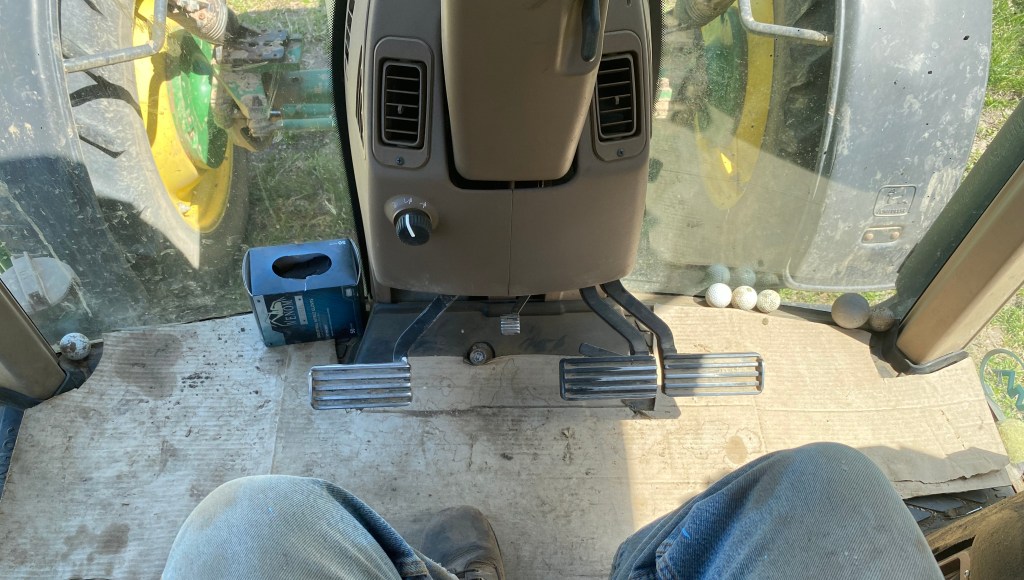
Finally cleaned out the tractor cab too. By this time, there’s quite a collection of ‘Nutty Bar’ wrappers, and dirty paper towels. And some tools, and golf balls, and whatever else I’ve picked up in the fields.

I carry a little whisk broom (a trick I learned from a youtube farmer) Millennial Farmer, Zach Johnson,

https://www.youtube.com/channel/UCp0rRUsMDlJ1meYAQ6_37Dw

Next week I’ll do an up to date crop report.

Do you have any cleaning tricks? How bad do you let things go before you clean?

June Farming

Man, hot enough for you? I keep talking about ‘GDU’s… Growing Degree Units. But they only count for temperatures between 50 and 86 degrees.

The corn, and even the oats, got a little burned by the frost a week ago. Another week it will look better as it grows out of this, but right now, it all looks kinda rough.

Back in blogworld, it’s the first week of May and I’m getting ready to plant soybeans. After farming pretty heavy for a couple weeks I had to get back into the college for a few days. The last two springs, Covid did give me an opportunity to stay home and farm like I did before the college job. And it was pretty nice. I’m lucky that I have this job where I can sort of set my own hours. So, I’d do college work from home in the mornings, then take the afternoons off to farm.

I had the Township Road inspection one morning. Once per year, all five of us township supervisors gather in one vehicle and drive all our township roads making note of any road issues. Our township, Haverhill Township in Olmsted County, has about 32 miles of gravel roads. We put new gravel on 1/3 of the gravel roads each year and patch any area that might need rock. We check culverts, washed out road sides, ditches that have too steep of a shoulder, and generally make a game plan of things we need to have fixed this year. That takes the full morning and I got home about 1:00. Last year we didn’t ride together. It’s a good group of guys and we have a good time driving around and talking. 

The music department had a small concert schedule for Wednesday evening. There is no band program, but there was the choir and the ‘World Drum Ensemble’ so they wanted to have a concert. The choir director is a new guy; I haven’t even met him. There were some last-minute emails, I roughed in some lights, put the choir shells up, pulled the piano out, and added some more lights. Sixteen years ago, when I started at the college, it was really frustrating to have concerts with no rehearsal. Now I’m kinda used to it. Obviously, rehearsals are better and make a better show, but I manage. It went well.

The next farm job is fertilizer for the soybeans. I use a broadcast spreader for that. Just like the one I used for oats. It’s almost the same fertilizer blend as I used for corn, and I have some corn fertilizer left in the wagon. I generally order extra because I know I can use it up on the soybeans. I pulled the corn fertilizer wagon out and get the fertilizer spreader lined up and I auger the corn fertilizer into the spreader. Fertilizer doesn’t slide very well, and it sticks together so eventually I will have to climb into the box with a shovel and move the fertilizer down to the auger. There’s no danger to myself, or of getting into the auger, as the door is only open about 3”.

Well, there is the danger that I can’t get back out of the wagon box or the ladder outside falls over. A few year ago, with a different wagon, I had to call the house and ask my son to come out and lower the wagon so I could get back out… he doesn’t let me forget that. But that doesn’t happen with this wagon because it doesn’t tip up like that one did.

Once it’s all transferred, it looks like rain so I don’t want to go too far from home. I think I’ll start around here and see what happens. I get started but it’s sprinkling a little bit and I go home and put the tractor and spreader in the shed. The rain doesn’t amount to anything and two minutes later I’m back out. I fill the tractor with fuel and decide to go to my rented land a couple miles away. It sprinkles a little bit, but not enough to be a problem.

Driving on the highway with farm machinery can be nerve-racking. People will pass at the most inopportune times. I have signals on the tractor, but you can’t really see them with the fertilizer wagon. If I’m going to make a turn, I kinda move to the middle of the road to prevent people from passing me, but that one person still does…what an idiot. I’m lucky I don’t have to drive on the highway very far or very often. If you’re following farm machinery on the road, please, give us some room, don’t pass in no passing zones, and for goodness sakes, don’t try to squeeze through between us on the shoulder and the oncoming traffic! It’s nuts what some drivers will do.

I saw a pair of geese and a pair of ducks over on the land I rent. Normally I only see golf balls in this field.

I’ve picked up a lot of golf balls over there. I enjoy the stuff rolling around the cab. Bailey doesn’t like it when she rides with me. Finished that and got back home and finish spreading fertilizer on the fields around here. It’s raining pretty good now and, starting to stick to the tires, but other than making a mess on the road, it doesn’t really hurt anything.

FYI, my ‘go-to’ snacks in the tractor are the Little Debbie Nutty Bars and Clif bars. Plus water. The cab is littered with nutty bar wrappers.

The next day I did some fieldwork, Brother Ernie came out and did some more and I got going on soybeans and had 21 acres planted at 9 PM. Twenty-one acres is nothing for most farmers. It’s a good day for me.

Soybeans can be planted in rows 7” apart, or 15” apart, or 30” apart. The total population is the same for all of them, it’s just more or less plants in the row. Generally, around 150,000 plants / acre. Soybean seed size changes year to year and the bag will tell you how many seeds / lb. I prefer 15” rows because the rows will canopy sooner and stop weeds coming up between the rows. However, there are some soybean diseases that thrive in damp, conditions, so 7” rows will stay damp longer than 30” rows. Six of one, half dozen of another.

I can use the corn planter (If I put special bean meters on the seed boxes) and that does the best job of seed depth and seed spacing (just like corn) except it’s only 30” rows unless I go over it twice, off set 15” to make 15” rows. That works, it just takes twice as long. (There are 15” row planters. It’s just $$,$$$)  Or I can adjust the settings on the drill, plug up every other row, and do 15” rows with that. Seed spacing is “clumpier”, for lack of a better word, just due to how the drill feeds out the seed. But it works. And this year, just for something different, I plugged two rows, left one open, plugged two, open, ect, and I’m trying 21” rows. Yields are pretty much the same for 15” or 30”. So, what the heck, I just figured I’d try. I have some treated soybean seed and some non-treated. Just like I talked about with the corn, soybean seed is treated for insects and pathogens in the soil in case it sits there a long time before emergence. Typically, because soybeans are planted after corn, the weather is warmer, the soil is warmer, and the beans don’t stay underground too long. But you just never know. And since the seed was ordered in December, it’s another way to hedge my bets. You can see it here: non treated seed on the left, treated seed on the right.

A pretty good day, nothing broke, everything worked well.

Any concert or musical event you are looking forward to this year?What was the last concert you saw?