Category Archives: History

The Great Pepper Mystery

Husband and I started six varieties of peppers from seed this year.  We started two sweet red peppers (Spanish Giants and Ajvarskis) and two hot chilis (Joe Parker, a New Mexico Hatch type red chili, and Chimayo, a smaller, hotter, New Mexico red Chili). We also started some Habaneros and Thai chilis for our son

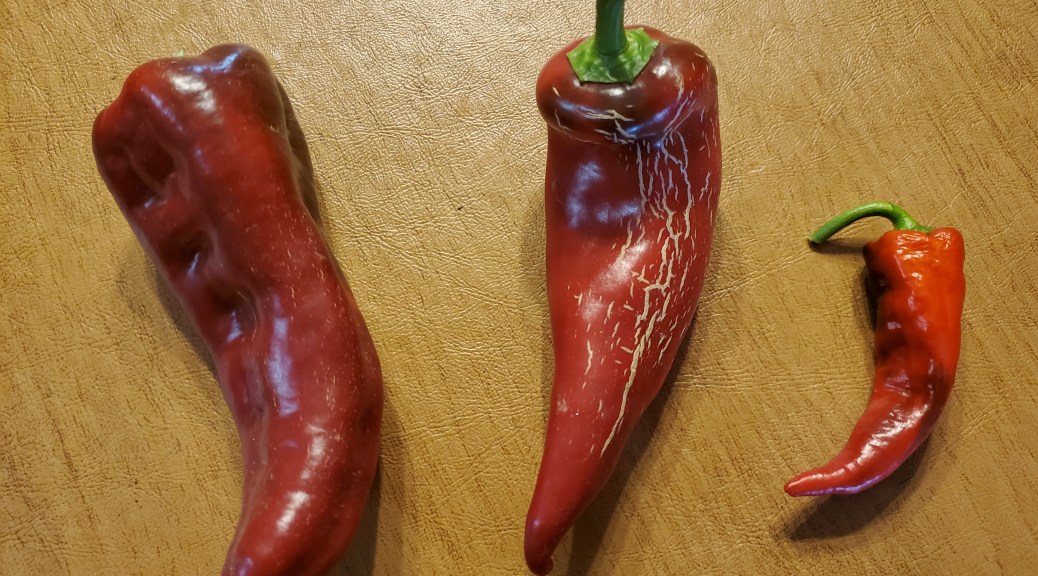
We labeled them and were careful to not mix them up.  When we planted, I was certain that all the Joe Parkers were given to my secretary,  as we decided at the last minute we didn’t want them. The Thai chilis and one Habanero went to our son, and all the rest, (17 in total) went into our garden. Or so we thought. Imagine my surprise  when son sent photos of the alleged Habanero that looked long and slender like a Joe Parker. Two of what I thought were Chimayos also turned out to be Joe Parkers, and now we can’t tell the difference between the Spanish Giants and the Ajvarskis, as their tags got all mixed up when we planted. The header photo shows what I think are, from left to right a Spanish Giant, an Ajvarski, and  Chimayo. (The latter are quite easy to discern.)

Husband tried to do a taste test between two big peppers,  but they tasted similar. I decided the only way to solve this mystery is to not start any Joe Parkers next year. I should add that the peppers I gave my secretary were doing well until we had a wind storm and a big tree crashed on top of her garden.

What mystery, ancient or modern, would you like to solve?

Bad News Bears

Our family often exclaims sympathetically  “Bad News Bears” when we hear about the bad luck of others. For the most part, we and our family and friends have not experienced much bad luck, save for one of my uncles who had years of successive crop failures. He was still able to sell his farm when he retired and buy a nice house in town, though.

Today is the anniversary of the bad luck of a woman baseball fan who was at a Phillies game in 1957 when one of the players fouled and the ball hit her in the face and broke her nose. As she was being carried by stretcher from the ball park, the same player fouled a second time and the ball hit her again. Bad News Bears!

Tell  some tales of woe. 

Favorite People

Husband  told me out of the blue this week that his three favorite people  of the 20th Century were Rosa Luxemburg, Dorothy Day, and Martin Luther King, Jr. (He has more time to sit and think now that he doesn’t travel for work). I had to admit that I didn’t know who Rosa Luxemburg was, but Husband tells me she was a good socialist.

Given our current situation, I think my three favorite people of the 20th Century would be Jonas Salk, Alexander Fleming, and Tommy Douglas.

Who are your favorite people from the 20th Century? How about the 21st? 

The Vasa Syndrome

Header photo credit: Peter Isotalo  A 1:10 scale model of Vasa’s  elaborately decorated stern.  

On August 10, 1628, The Vasa, a brand new war ship commissioned by King Gustavus Adolphus of Sweden, set off on its maiden voyage from Stockholm. It got about a mile  into the harbor when a mild gust of wind tipped it over and sank it, killing about 30 sailors. It wasn’t salvaged until 1961. Quite a bit of the remains of the ship and much of its fittings and cargo are on display in a very popular museum in Stockholm.

The Vasa Syndrome is a term used today to describe modern institutional or business failure due to poor communication, unrealistic  goal setting, and lack of adaptability by management. Gustavus was off fighting a war in Germany and Poland, but kept making changes to the design of the ship, insisting, for example, that there be 84 bronze cannons when the ship could only hold 36. He wanted it built quickly, with elaborate decorations and carvings that showed off his grandeur and greatness on its multiple decks, the height of  which made it unstable in the water.  It was tested for stability in the water and failed the test, but was allowed to sail anyway.  It ended in disaster.  It seems things never change.

What are your experiences with the Vasa Syndrome? Got any good stories about boats?

The House of Orange

Husband informed me this week that the reason carrots are orange is a result of selective plant breeding in the 17th century as a tribute by Dutch gardeners to William of Orange.  Prior to this they were purple, white, and yellow.  This was a real surprise to me, as I assumed such activity  was a phenomenon of the 20th century.  What a wonderful thing to know!

What new things have you learned lately?  What would you change the color of, if you could? Got any good carrot recipes? 

Does It Hurt and Have A Temperature?

Today’s post comes from Wessew.

That is line from a 1963 Bayer Children’s aspirin commercial. The little boy makes an inquiry of his playmate’s health and receives reassurance from her mother that things will be fine. His delightful response? “Mothers are like that. Yeah, they are.”

With the C-19 pandemic, many of us have heard similar screening questions. “Pain? Temperature?”

My construction work at medical facilities requires a negative response to gain entrance into the building. I’m quite sure that over these past months that I’ve had my temperature taken a hundred times and it has consistently been 97.5. This is a surprise, as I recollect normal body temperature being 98.6 or did Keith mis-inform me with the lyric in his 1967 song:

“Hey, 98.6, it’s good to have you back again! Oh, hey, 98.6, her lovin’ is the medicine that saved me! Oh, I love my baby!”

Somehow “Hey 97.5” doesn’t work as a lyric.


Do you have a favorite fever song?

A Different Point of View

I thought about The Wonderful Wizard of Oz on our recent trip to Brookings, SD, as we drove through Edgely, ND and Aberdeen, SD on our way.  Frank Baum lived in Aberdeen around the time he wrote the book, and the girl he used as a model for Dorothy was his niece who lived on a god forsaken farm near Edgely.  (That girl’s daughter became the first woman senator from ND). The area is pretty swampy and remote, in the James River Valley, close to the Red River Valley, but without the good soil. I confess I never read Baum’s  book, but I really liked Wicked, which was the story told from the point of view of the Wicked Witch of the West.

I liked Jane Eyre as a teen, but I really liked Wide Sargasso Sea by Jean Rhys, which is the story told from the point of view of the first Mrs. Rochester.

I suppose one could argue that writing a story from the point of view of another character from an established novel or story is an easy way to make a buck, but I think it is so interesting  to consider. I also don’t know how they figure out copyright and royalty issues, but it must be doable.

What novel or story would you like to see written from another character’s point of view? What novel or story would you like to see written from the point of view of a character from a completely different novel or story?

To Baader-Meinhof or Not to Baader-Meinhof? That is the Question.

Photo Credit:  Hulki Okan Tabak

A few weeks ago a friend came over for some socially distant muffins and tea.  We had a wonderful time chatting in the backyard about all kinds of things.  At one point she recommended a series called “Walking Through History”.  The host walks around Britain and archaeologists and historians pop out of the surrounding country add information as he walks.  Sounded like my cup of tea so I searched it out.

I didn’t actually binge watch it but over the next couple of weeks, I had seen them all.  The host, Tony Robinson, seemed vaguely familiar, so I googled him.  Turns out he is SIR Tony Robinson, an English actor and host and he seemed familiar because he played Baldrick in the “Black Adder” show a gazillion years ago.  I read through his entire Wikipedia page and found that he has had a fascinating career of acting, presenting and writing and has made charity part of his life’s work.

I’m waiting for a DVD of Black Adder from the library (to re-watch) and have checked out Bad Kids: Naughtiest Children in History .  It was very funny – a kids’ book about various ways in which kids are raised (and punished) in various cultures throughout history.  There are quite a few children’s books about history in his bibliography.

Another thing that caught my eye in his biography was a television show that ran for 20 seasons on BBC called “Time Team”.  A group of archaeologists and historians (and Tony Robison as presenter) go someplace in Britain (often invited by a town or home owner) to look into the history of some ruin – they give themselves 3-5 days and then present their findings.  It took me a bit to find it, but eventually I did – on demand cable – all 20 seasons.  It’s fascinating.  I’ve watched 2 seasons so far.

So imagine my surprise when this morning, while reading In the Woods, a murder mystery that takes place in an archaeological site by Tana French (which has been on my shelf for a few years and I’m just getting to), I found this:

“How’s the dig going?” Cassie asked sociably.
One corner of Mark’s mouth twisted sourly.  “How do you think?  We’ve got four weeks to do a year’s work.  We’ve been using bulldozers.”
“And that’s not a good thing?” I said.
He glared at me.  “Do we look like the f***ing Time Team?”

French then adds a couple of sentences explaining Time Team for those readers who don’t happen to be binge watching it this week.

I’m sure a mathematician can probably explain the odds of this occurrence, but I’m thinking there just has to be magic involved.  And maybe dragons.

For what kind of show would you like to be a presenter?

Biscuits And Gravy

Husband, as a rule, has excellent taste in food. There are  exceptions,  like cornmeal mush, that I won’t touch.  That is traditional to his mother’s family who came from southeastern Ohio.  I don’t understand it. I like polenta,  but the mush his family makes isn’t like that at all. He also likes fried clams. My nonexistent gallbladder, which rebels over fried food, can’t tolerate it.  The main  food disagreement we have is over biscuits and gravy.

He never started eating biscuits and gravy until we moved to North Dakota. Don’t ask me why.  I like biscuits. I like sausage. I just don’t like glutinous, gloppy gravy on top of them. Husband has taken to making it in secret. He says the combination of softness (from the biscuits) and the  spiciness (from the sausage), all held together with the comforting gravy, is too appealing to him to give up. I noticed this week that there were bags of biscuits in the freezer I hadn’t noticed before, and he admitted he had made biscuits and gravy for breakfast, and tossed out the leftovers before I got home.

I think part of this has to do with his diabetes, and his feelings of hunger when he wakes up in the morning.  He says there isn’t really isn’t anything I like that he doesn’t like, but that he finds biscuits and gravy so comforting.  He blames it on the diners and truck stop cafes that he ate in while he worked on the Rez for six years.

What do you eat that your housemates won’t eat? Do you eat anything in secret? What are your comfort foods?

Following Directions

On June 24, 1497, John Cabot and his ship bumped into Nova Scotia, thought it was Asia, and claimed it for England.  My, was he wrong!

I love maps and reading maps. I hate being told I am wrong. I don’t know if Cabot learned he was wrong or how he felt if he found out he was wrong.  I reluctantly use Google Maps in cities if I don’t know my way around.  I am a visual person, and I prefer to see where I am going. I wonder about the maps Cabot had to follow. I would have had a word with chief navigator about this entire continent being in the way of Asia, and no one knowing about it.

When have you been wrong? What is your favorite way of getting information?